
Making the most of FFT data December 2020
Making the most of FFT data December 2020 NHS England NHS Improvement
FFT announcement in 2012 “The Friends and Family Test aims to provide a simple, headline metric which, when combined with follow-up questions, can be used to drive cultural change and continuous improvements in the quality of the care received by NHS patients. ” 2 | The Prime Minister said: “In every hospital, patients are going to be able to answer a simple question: whether they’d want a friend or relative to be treated there in their hour of need. By making those answers public we’re going to give everyone a really clear idea of where to get the best care – and drive other hospitals to raise their game. ”
Original DH guidance – for inpatient and A&E • Standard question: How likely are you to recommend the service to friends and family if they needed similar care or treatment? • Strict timing requirements – at discharge or within 48 hours of discharge • Attempt at standardised methodology • Response rate requirements • Using the net promoter score methodology • No free text requirement • Restrictions on • who could give feedback • helping people to leave feedback • materials design 3 |
Early findings • Trying to make the data comparable was turning it into a tick box exercise • There were incentives to avoid asking people to respond if they were unhappy, or to massage the numbers • Response rate requirements (while not making the data comparable) meant some providers were focussing on collecting more responses than they could act upon • It was clear that the FFT cannot be both a robust comparable performance measure and a flexible, quick and easy, anonymous, near real-time feedback tool • 2014 review made lots of recommendations, including that we should clarify whether it was a performance measure or a feedback tool • By this stage it was clear to us that the real strength of the FFT was as a feedback tool, so we made some changes to reinforce that 4 |

2014 NHS England guidance • Extended the FFT to most of the NHS • Shifted the focus towards the feedback • Removed the requirement to proactively ask all patients to respond – make it available • More inclusive – local flexibility on design • Mandated including free text questions • Stopped using the net promoter score • Relaxed restrictions on family, carers and staff helping patients to give feedback 5 |
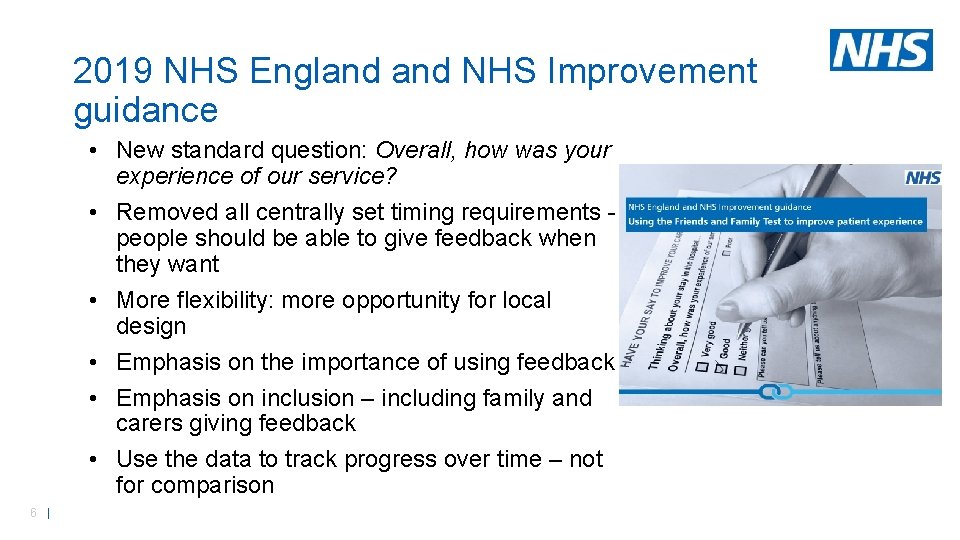
2019 NHS England NHS Improvement guidance • New standard question: Overall, how was your experience of our service? • Removed all centrally set timing requirements people should be able to give feedback when they want • More flexibility: more opportunity for local design • Emphasis on the importance of using feedback • Emphasis on inclusion – including family and carers giving feedback • Use the data to track progress over time – not for comparison 6 |
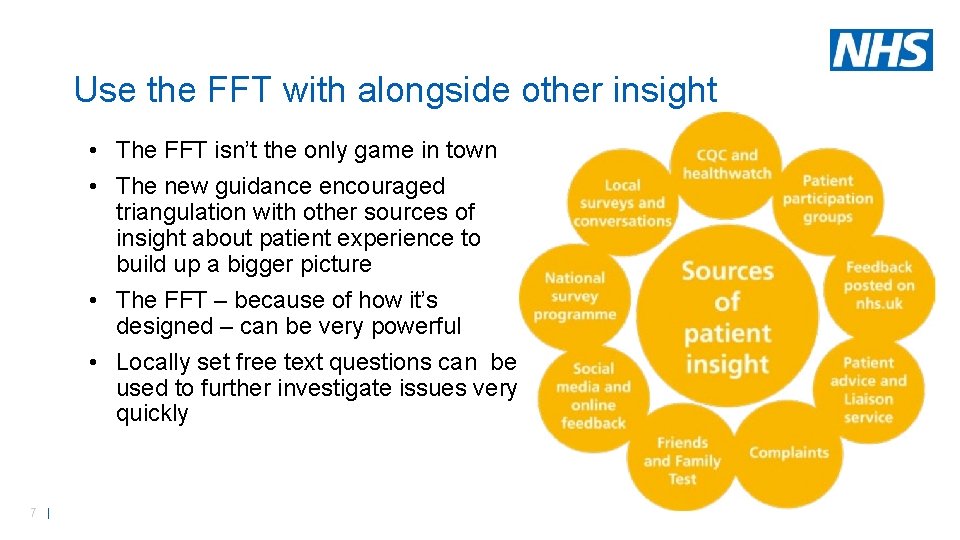
Use the FFT with alongside other insight • The FFT isn’t the only game in town • The new guidance encouraged triangulation with other sources of insight about patient experience to build up a bigger picture • The FFT – because of how it’s designed – can be very powerful • Locally set free text questions can be used to further investigate issues very quickly 7 |

FFT data is not comparable • Unlike our national surveys, FFT is not designed to give us data that is comparable between different organisations • We advise against using the numerical data as a performance measure 8 |
Response rate requirements • The mandatory response rate requirements were removed in 2015 • From 2021 we will no longer calculate and publish response rates (the change to the timing requirements means the response rate calculation doesn’t work) • But: • We will continue to publish the number of responses collected and the number of eligible patients • The published data can demonstrate that providers are collecting a reasonable number of responses, seen in the context of other local initiatives • If the number of responses falls too low you might decide to focus on a specialty area or a trigger point to promote the FFT or ask people proactively 9 |
Our advice to commissioners • FFT data is not a performance measure • FFT data is not comparable between organisations • FFT is one piece of a bigger picture – providers might be putting resources into a wide range of insight approaches that are appropriate to their settings and patients • Commissioners should be assessing their providers’ collection and use of patient experience insight as a whole • Our advice is that discussions between commissioners and providers should be focused on: • What are people saying about the service, and • How are they using feedback to improve services 10 |
Getting the most out of the FFT 11 | • Positive feedback can boost morale and help to identify and spread good practice • Critical feedback can highlight opportunities for improvement • We have produced case studies that illustrate how the FFT has been used to make improvements and track progress • Boards should seek information from patient experience leads about what patients are saying and how that information is being used to make improvements • We know that analysing qualitative data is difficult and resource consuming • We have a project that is focused on what we can do to help with that, ie providing tools and advice for those that need it
Using the numbers 12 | • We will continue to publish the monthly numerical data • We won’t use the word ‘scores’ – when we publish the ‘percentage of positive’ and the ‘percentage of negative’ responses • The numbers can help you track progress over time • The numbers are not hard data, but a significant upturn or downturn might indicate something worth investigating is happening • We have provided an analysis tool that produces time series data down to ward level in Statistical Process Control charts.
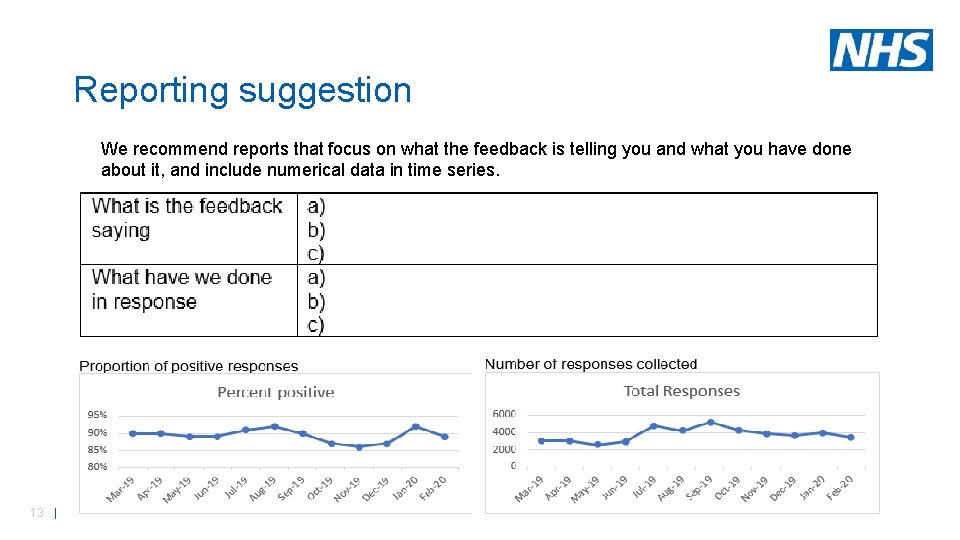
Reporting suggestion We recommend reports that focus on what the feedback is telling you and what you have done about it, and include numerical data in time series. 13 |
Useful links and information • New guidance: www. england. nhs. uk/fft-guidance/ • FAQs: www. england. nhs. uk/fft/friends-and-family-test-developmentproject-2018 -19/faqs/ • Communications resources, including leaflets and posters, examples of easy read feedback cards etc: www. england. nhs. uk/fft-commsres/ • FFT analysis tool https: //fft. england. nhs. uk/ • Contact our helpdesk for advice or support: england. friendsandfamilytest@nhs. net • Register for our monthly FFT Update to keep up with news about resources and any changes we introduce by emailing the helpdesk 14 |
- Slides: 14