
Making the ELPSTELPAS Connection Grades K 12 Overview

- Slides: 46
Making the ELPS-TELPAS Connection Grades K– 12 Overview 2017 -2018 Texas Education Agency Student Assessment Division.
Disclaimer § These slides have been prepared by the Student Assessment Division of the Texas Education Agency. § If any slide is amended or revised for local use, please remove the TEA footer at the bottom of the slide. TEA 2
Introduction
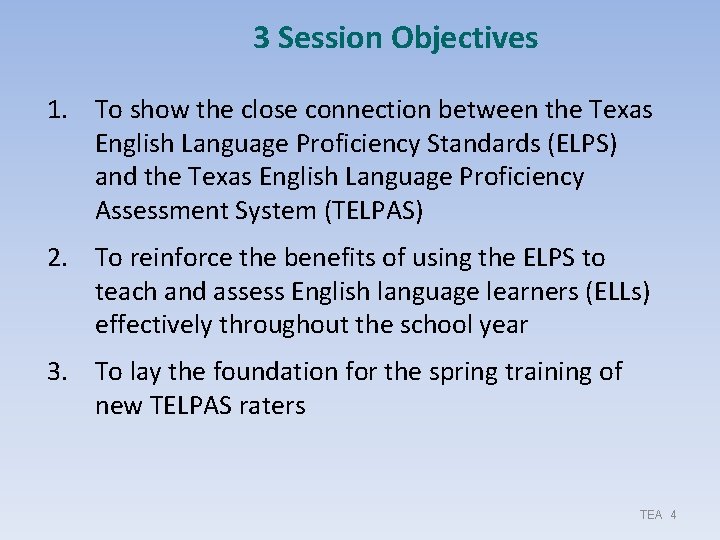
3 Session Objectives 1. To show the close connection between the Texas English Language Proficiency Standards (ELPS) and the Texas English Language Proficiency Assessment System (TELPAS) 2. To reinforce the benefits of using the ELPS to teach and assess English language learners (ELLs) effectively throughout the school year 3. To lay the foundation for the spring training of new TELPAS raters TEA 4
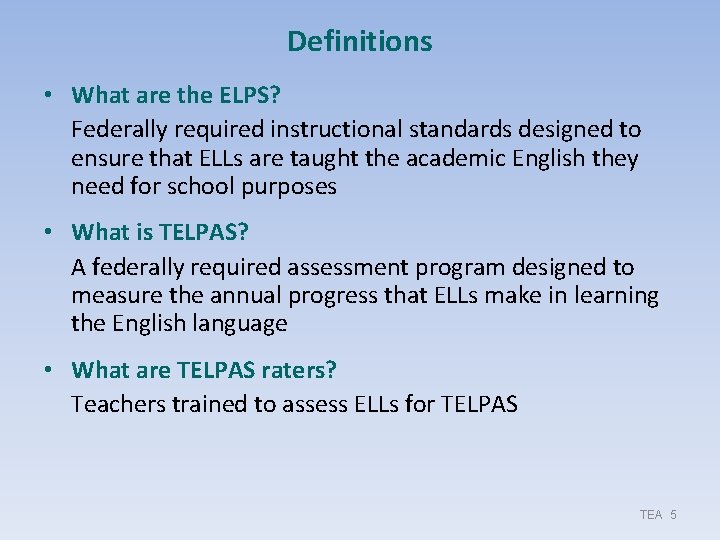
Definitions • What are the ELPS? Federally required instructional standards designed to ensure that ELLs are taught the academic English they need for school purposes • What is TELPAS? A federally required assessment program designed to measure the annual progress that ELLs make in learning the English language • What are TELPAS raters? Teachers trained to assess ELLs for TELPAS TEA 5
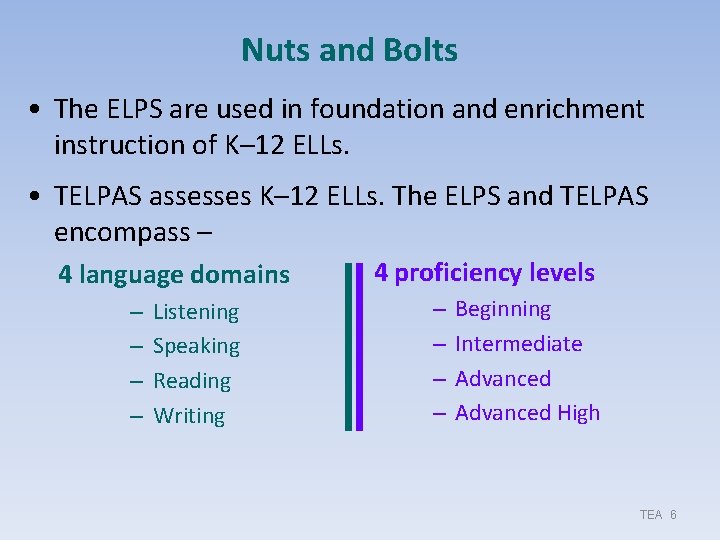
Nuts and Bolts • The ELPS are used in foundation and enrichment instruction of K– 12 ELLs. • TELPAS assesses K– 12 ELLs. The ELPS and TELPAS encompass – 4 language domains – – Listening Speaking Reading Writing 4 proficiency levels – – Beginning Intermediate Advanced High TEA 6
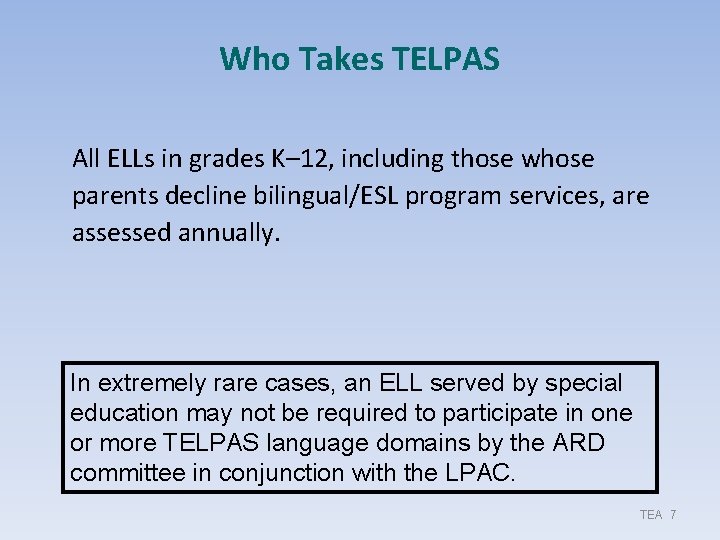
Who Takes TELPAS All ELLs in grades K– 12, including those whose parents decline bilingual/ESL program services, are assessed annually. In extremely rare cases, an ELL served by special education may not be required to participate in one or more TELPAS language domains by the ARD committee in conjunction with the LPAC. TEA 7
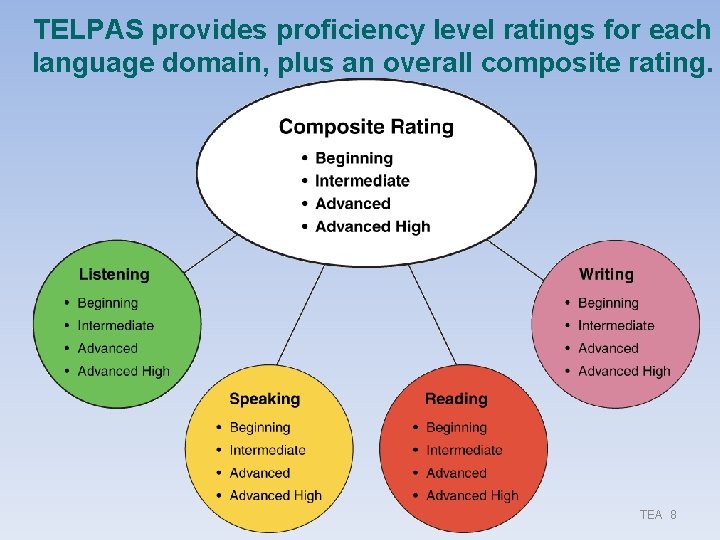
TELPAS provides proficiency level ratings for each language domain, plus an overall composite rating. TEA 8
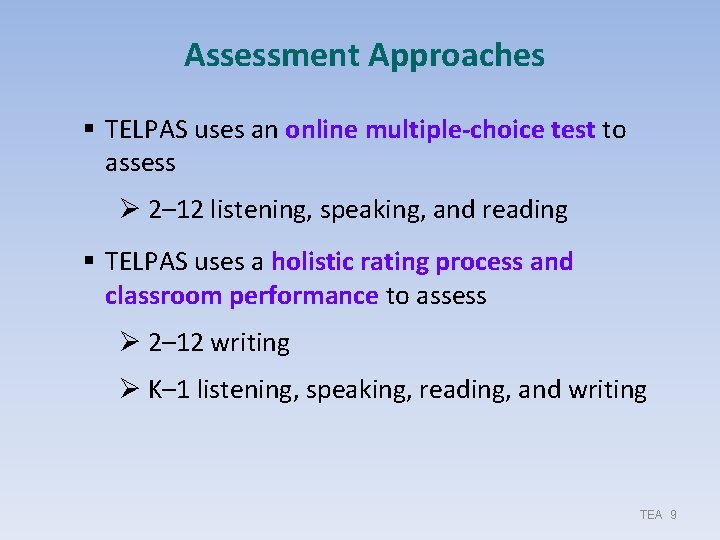
Assessment Approaches § TELPAS uses an online multiple-choice test to assess Ø 2– 12 listening, speaking, and reading § TELPAS uses a holistic rating process and classroom performance to assess Ø 2– 12 writing Ø K– 1 listening, speaking, reading, and writing TEA 9
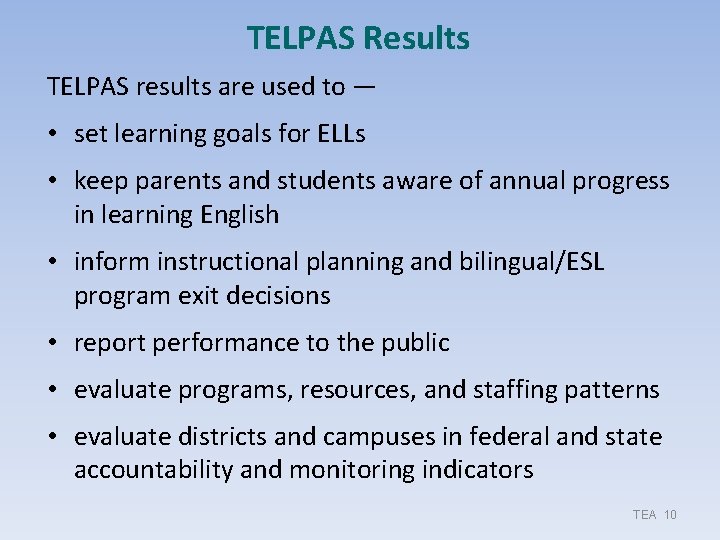
TELPAS Results TELPAS results are used to — • set learning goals for ELLs • keep parents and students aware of annual progress in learning English • inform instructional planning and bilingual/ESL program exit decisions • report performance to the public • evaluate programs, resources, and staffing patterns • evaluate districts and campuses in federal and state accountability and monitoring indicators TEA 10
Brief ELPS Overview
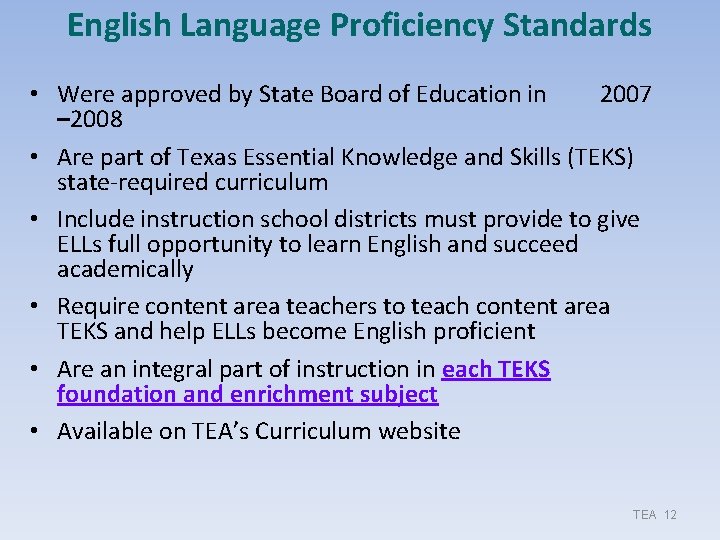
English Language Proficiency Standards • Were approved by State Board of Education in 2007 – 2008 • Are part of Texas Essential Knowledge and Skills (TEKS) state-required curriculum • Include instruction school districts must provide to give ELLs full opportunity to learn English and succeed academically • Require content area teachers to teach content area TEKS and help ELLs become English proficient • Are an integral part of instruction in each TEKS foundation and enrichment subject • Available on TEA’s Curriculum website TEA 12
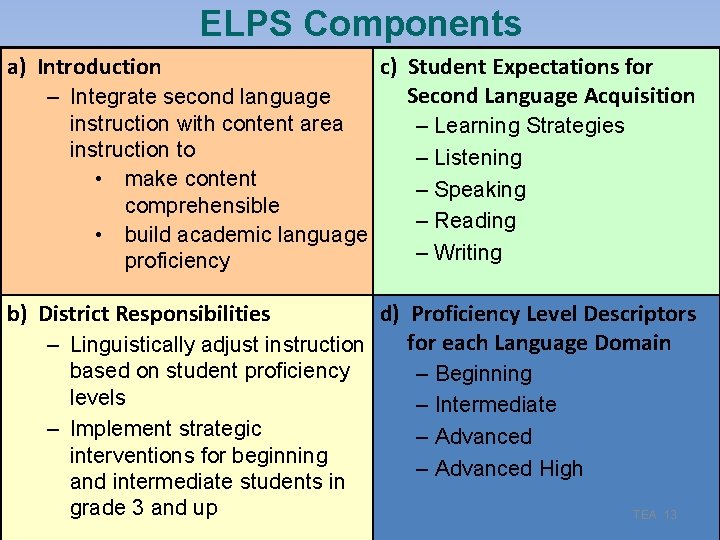
ELPS Components a) Introduction c) Student Expectations for Second Language Acquisition – Integrate second language instruction with content area – Learning Strategies Introduction instruction to – Listening - Integrate second language instruction with content area instruction to • make content – Speaking make content comprehensible build academic language proficiency c) Student for Secondlanguage Language Acquisition– Reading • Expectations build academic -Learning Strategies – Writing proficiency - Listening ELPS Components a) b) - Speaking - Reading District Responsibilities d) Proficiency Level Descriptors - Writing for each Language Domain b) Responsibilities – District Linguistically adjust instruction - Linguistically adjust instruction based on student proficiency levels based on student proficiency – Beginning - Implement strategic interventions for beginning and intermediate students in grade 3 and up levels Level Descriptors d) Proficiency – Intermediate for each Language Domain – Implement strategic – Advanced Beginning interventions for beginning Intermediate – Advanced High Advanced and intermediate students in Advanced High grade 3 and up TEA 13
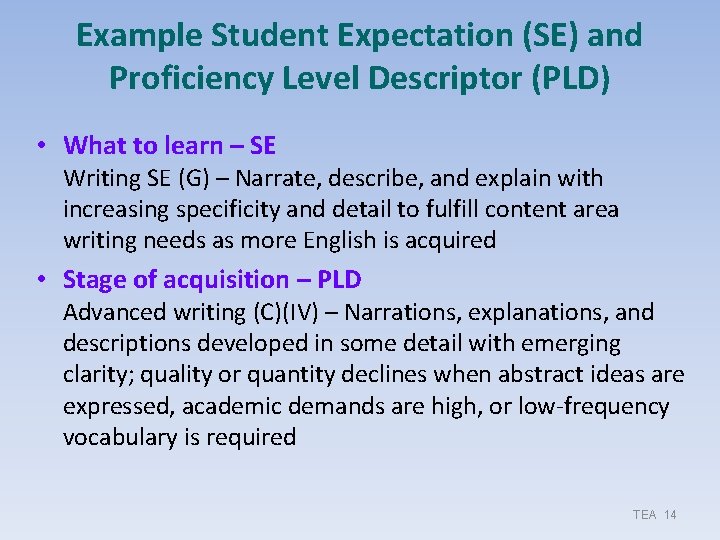
Example Student Expectation (SE) and Proficiency Level Descriptor (PLD) • What to learn – SE Writing SE (G) – Narrate, describe, and explain with increasing specificity and detail to fulfill content area writing needs as more English is acquired • Stage of acquisition – PLD Advanced writing (C)(IV) – Narrations, explanations, and descriptions developed in some detail with emerging clarity; quality or quantity declines when abstract ideas are expressed, academic demands are high, or low-frequency vocabulary is required TEA 14
ELPS-TELPAS Connection
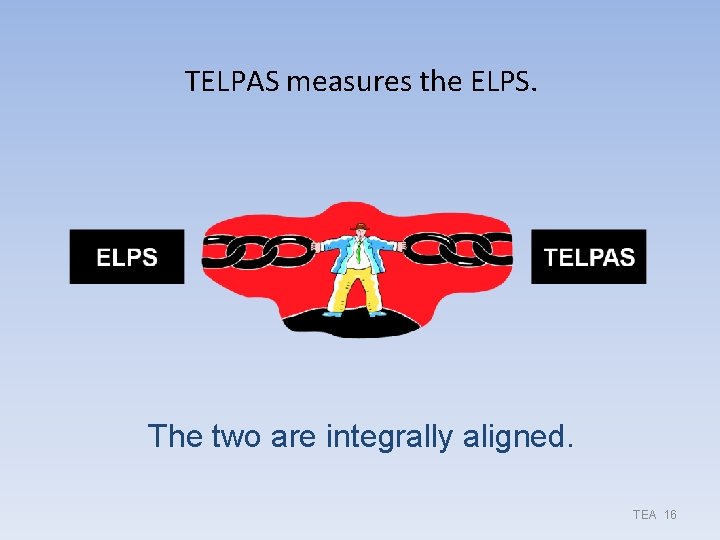
TELPAS measures the ELPS. The two are integrally aligned. TEA 16
Measuring the ELPS TELPAS assesses the abilities outlined in the ELPS student expectations (SEs) and reports performance in alignment with the ELPS proficiency level descriptors (PLDs). TEA 17
PLDs and Instruction Teachers should use the PLDs throughout the school year as formative assessment rubrics to — • stay attuned to the English language proficiency levels of their students • monitor progress • linguistically tailor (accommodate) content area instruction and integrated second language instruction according to the proficiency level needs of their ELLs as the students learn more English Formative Assessment TEA 18
PLDs and Statewide Assessment • For the TELPAS holistically rated domains, trained raters officially determine the English language proficiency levels of ELLs in the spring. • ELLs should be making steady progress all year. • TELPAS is a summative assessment that documents the proficiency levels of ELLs as a statewide spring assessment. Summative Assessment TEA 19
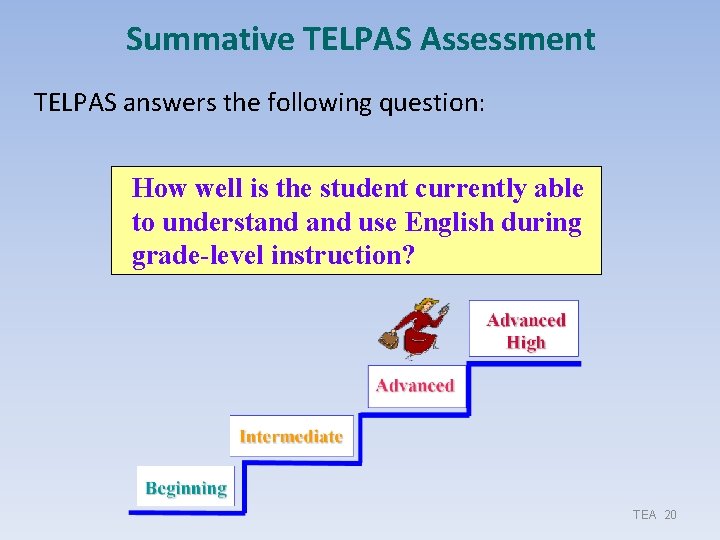
Summative TELPAS Assessment TELPAS answers the following question: How well is the student currently able to understand use English during grade-level instruction? TEA 20
Benefit of TELPAS Rater Training on Formative Classroom Assessment Teachers trained as TELPAS raters internalize the PLDs so that they are able to naturally and automatically assess their students’ English language proficiency levels during ongoing classroom instruction. TEA 21
Benefit of Using PLDs in Instruction • Teachers learn to make effective linguistic accommodations in class, which supports – learning of academic subject matter (TEKS content area student expectations) – learning of English language (ELPS student expectations) TEA 22
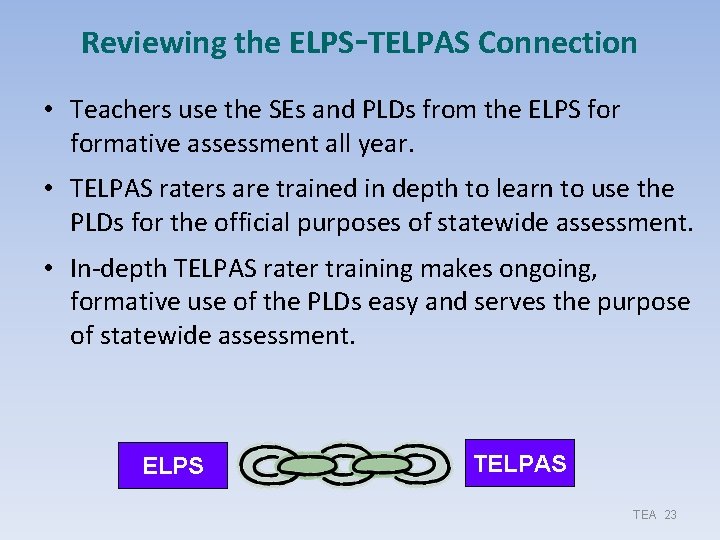
Reviewing the ELPS-TELPAS Connection • Teachers use the SEs and PLDs from the ELPS formative assessment all year. • TELPAS raters are trained in depth to learn to use the PLDs for the official purposes of statewide assessment. • In-depth TELPAS rater training makes ongoing, formative use of the PLDs easy and serves the purpose of statewide assessment. ELPS TELPAS TEA 23
A Word About Grades 2– 12 Listening, Speaking and Reading Even though a multiple-choice test is used to assess listening, speaking, and reading in grades 2– 12, teachers use the ELPS student expectations and PLDs for listening, speaking, and reading in instruction just as they do for the domain. TEA 24
Assessment Information for Administrators and Teachers To prepare for new school year: Use TELPAS results to evaluate whether students have been making steady progress in learning English. – TELPAS confidential campus rosters include • 2 years of test scores • how long student has been in U. S. schools LPAC meetings during school year: Use previous spring’s TELPAS results and current year’s formative assessment results to gauge progress in English proficiency, plan for instructional interventions as needed, and inform spring decisions about student’s participation in state-required assessments. TEA 25
Basics of TELPAS Holistic Rating Process
Grades K– 1 Assessment Approach: Listening, Speaking, Reading, Writing Teachers determine English proficiency levels by observing students in class. They watch how their ELLs § interact informally with them and other students § understand use English Ø when receiving academic instruction and completing class work Ø during cooperative learning activities TEA 27
Grades 2– 12 Assessment Approach: Writing TELPAS raters assemble a collection of each student’s writing from a variety of content areas and use the collection as the basis for evaluating the student’s English language proficiency in writing. • Note that for ongoing formative assessment in grades 2– 12, teachers use classroom observations and interactions in addition to student writing samples to monitor and promote growth in English language writing proficiency. • At the time of TELPAS, student writing collections are the sole basis for the assessment of English language writing proficiency. Information from classroom observations and interactions is not used. TEA 28
Things to Know About TELPAS Rater Training and Administration Procedures
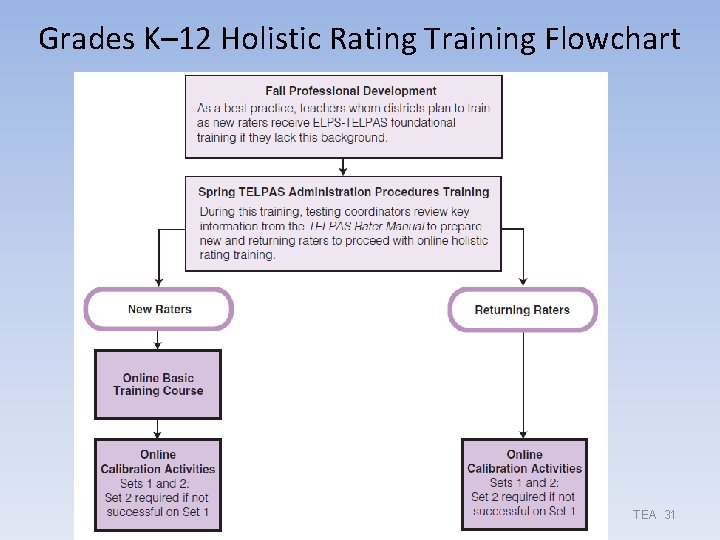
TELPAS Rater Training • It is recommended that districts and campuses determine in the fall who their TELPAS raters will be in the spring. • A training flowchart is provided on the next slide. TEA 30
Grades K– 12 Holistic Rating Training Flowchart TEA 31
Rater Credentials Each teacher selected to rate an ELL must 1) have the student in class 2) be knowledgeable about the student’s ability to use English in instructional and informal settings 3) hold valid education credentials such as a teacher certificate or permit 4) be appropriately trained, as required by TEA 32
TELPAS Rater Responsibilities • A student’s TELPAS rater is the teacher designated by the district as the official rater of the student’s English language proficiency. • The student’s rater must rate the student in all domains for which the student is eligible. It is not permitted for a student to have one rater for some domains and another rater for other domains. TEA 33
Collaboration with Others In determining the proficiency ratings of their assigned students, raters are highly encouraged to collaborate with other teachers and school personnel who have knowledge of the students’ English proficiency. TEA 34
District Validity and Reliability Procedures • Districts are required to implement procedures that ensure validity and reliability of holistic rating process. • Procedures may vary by campus, at district’s discretion. • For one year from the date of testing, campuses maintain documentation of procedures followed. TEA 35
TELPAS Audits The Texas Education Agency conducts periodic audits of the TELPAS holistic assessment process. The goals of the audits are to examine whether § the ratings of teachers reflect appropriate and consistent application of the PLD rubrics § school district personnel follow training and test administration procedures TEA 36
Essentials of Second Language Acquisition
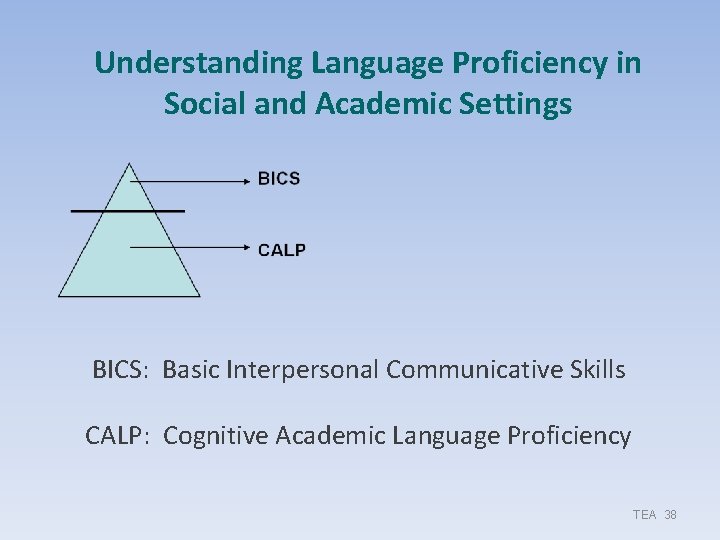
Understanding Language Proficiency in Social and Academic Settings BICS: Basic Interpersonal Communicative Skills CALP: Cognitive Academic Language Proficiency TEA 38
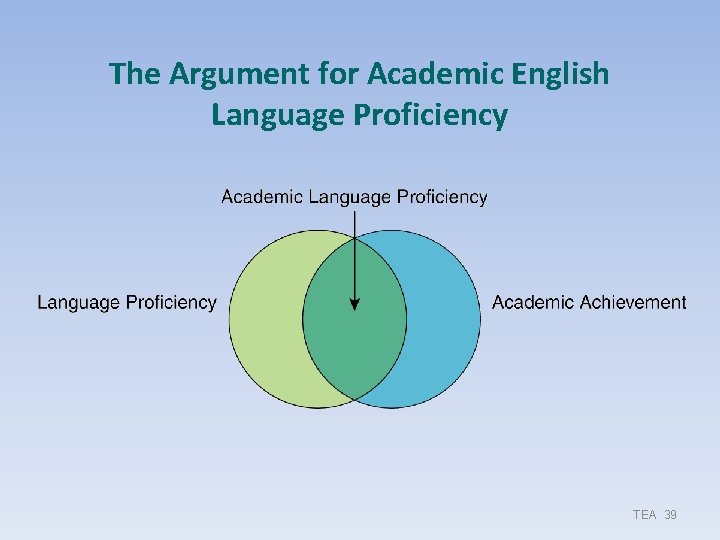
The Argument for Academic English Language Proficiency TEA 39
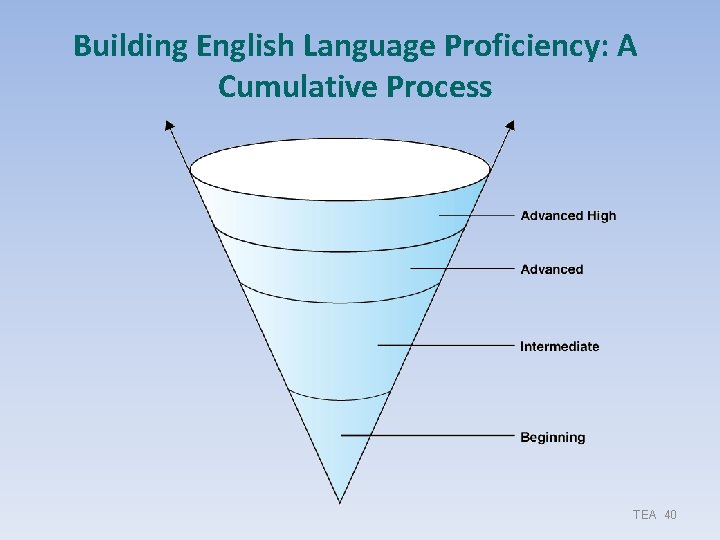
Building English Language Proficiency: A Cumulative Process TEA 40
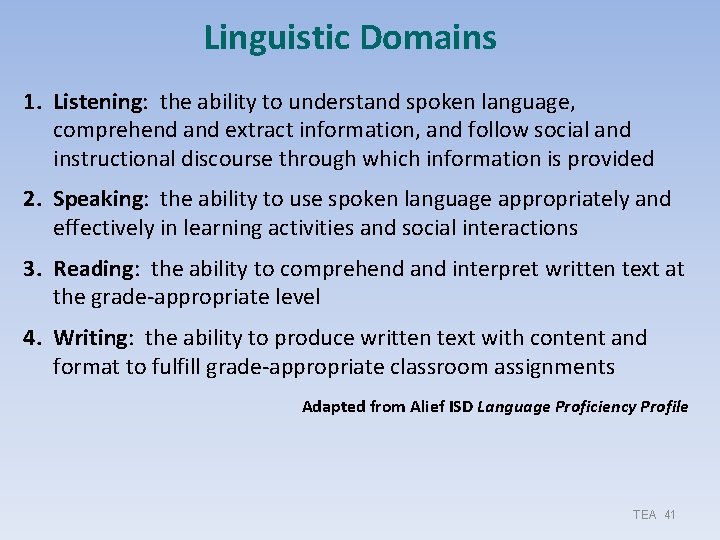
Linguistic Domains 1. Listening: the ability to understand spoken language, comprehend and extract information, and follow social and instructional discourse through which information is provided 2. Speaking: the ability to use spoken language appropriately and effectively in learning activities and social interactions 3. Reading: the ability to comprehend and interpret written text at the grade-appropriate level 4. Writing: the ability to produce written text with content and format to fulfill grade-appropriate classroom assignments Adapted from Alief ISD Language Proficiency Profile TEA 41
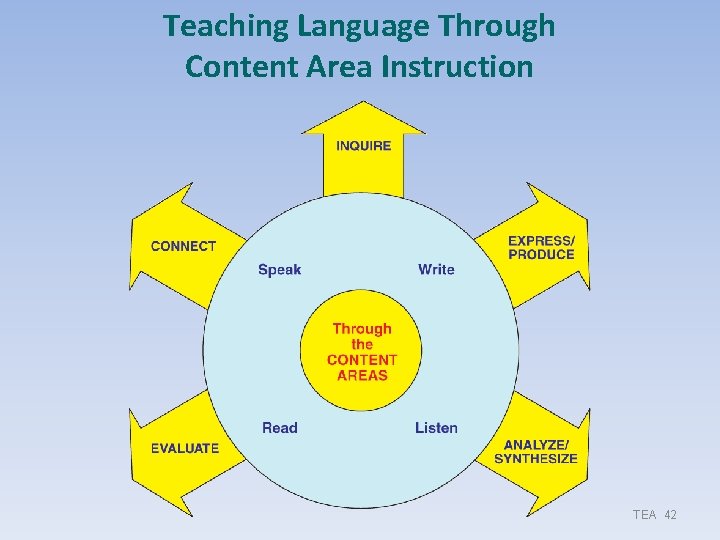
Teaching Language Through Content Area Instruction TEA 42
Summing Up
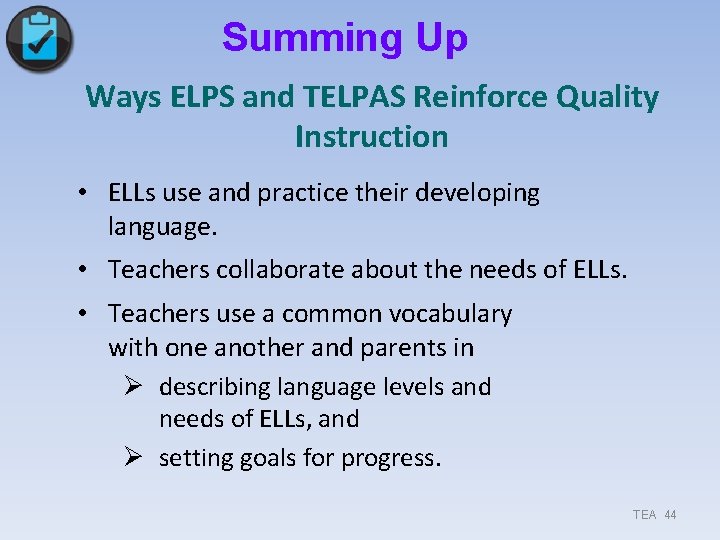
Summing Up Ways ELPS and TELPAS Reinforce Quality Instruction • ELLs use and practice their developing language. • Teachers collaborate about the needs of ELLs. • Teachers use a common vocabulary with one another and parents in Ø describing language levels and needs of ELLs, and Ø setting goals for progress. TEA 44
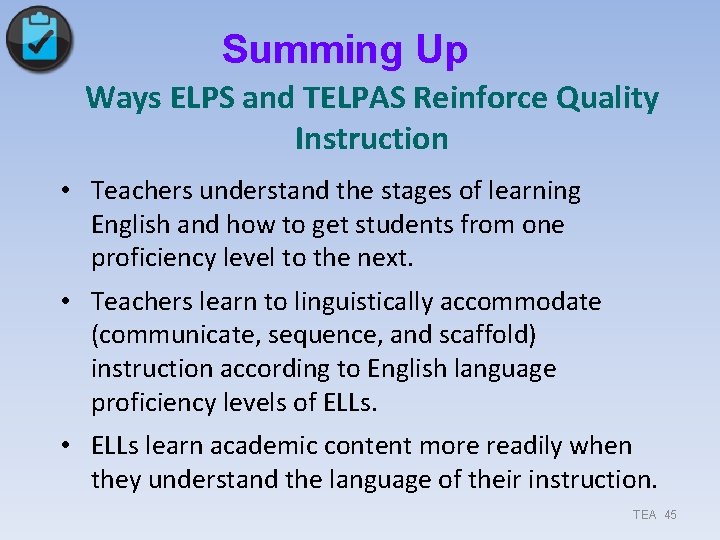
Summing Up Ways ELPS and TELPAS Reinforce Quality Instruction • Teachers understand the stages of learning English and how to get students from one proficiency level to the next. • Teachers learn to linguistically accommodate (communicate, sequence, and scaffold) instruction according to English language proficiency levels of ELLs. • ELLs learn academic content more readily when they understand the language of their instruction. TEA 45
Bottom Line Effective implementation of ELPS and TELPAS assessment approach throughout the school year helps ELLs Ø learn English more quickly Ø grasp academic concepts and skills more readily TEA 46