
Making the Business Case for an IT System
Making the Business Case for an IT System It is all about convincing your superiors! Copyright © 2013 - 2016 Curt Hill
Introduction • The goal of this class is to help students be ready for a position where managing IT would be part of their job • In such a position we need to evaluate whether a system is worth acquiring or worth developing or neither • We first evaluate the value and risk to convince ourselves • Once that is done we convince others Copyright © 2013 - 2016 Curt Hill
Costs and Benefits • Any effort that one can take has costs and benefits – Costs are the investment in time and money – Benefits are the return on this investment • Comparison – There are several measures used to evaluate the efficiency of an investment or to compare the efficiency of a number of different investments • If the return does not equal the investment, we do not do it Copyright © 2013 - 2016 Curt Hill
Problems • There are no silver bullets – All comparisons require prediction of the future • The return of an IT system will generally have some intangibles that are hard to equate with monetary amounts • The investment is not necessarily easy to calculate either – Hardware is easy, but people time may be unpredictable © 2013 - 2016 Curt Hill • Copyright © 20132016
Risk Management • The future is full of uncertainty • We cannot predict the future, but we may consider potential outcomes • In so doing we can employ strategies for mitigating the undesirable outcomes • What are some of the risks that may be encountered with acquiring or developing this system? Copyright © 2013 - 2016 Curt Hill
Evaluation • How are projects evaluated? • Several techniques: – Cost Benefit Analysis – Return On Investment – Net Present Value • All of these have the problem of quantifying intangibles and predicting the future • You should have learned about these elsewhere but here is the executive summary Copyright © 2013 -2015 – Curt Hill Copyright © 2013 - 2016 Curt Hill
Cost Benefit Analysis • Jules Dupuit – 1848 • Corps of Engineers have been obligated to use this to evaluate projects since 1936 • Principles: – Common unit of measurement – often money – Money gains value, future money is less valuable • Copyright © 2013 -2015 – Curt Hill Copyright © 2013 - 2016 Curt Hill
Process • List alternatives – Doing nothing is always an alternative • • List stakeholders Choose measurement unit Predict costs for each year Predict benefits for each year – Over all stakeholders • Apply discount rate for future years • Calculate net present value for each • Copyright Do sensitivity analysis © 2013 -2015 – Curt Hill Copyright © 2013 - 2016 Curt Hill
Commentary • There may be either a positive or negative effect • Predict values for these effects for – Participants – Non-participants • There is inherent uncertainty – A range of values should be employed rather than a single – Sensitivity analysis is the examination of this uncertainty, its sources and effects Copyright © 2013 -2015 – Curt Hill Copyright © 2013 - 2016 Curt Hill
Net Present Value • We would like a return on invested money • Money increases in value over time • One dollar invested today will be worth more next year than a dollar • Invest $1 and receive $1. 05 yields an NPV of 1. 05 • Video Copyright © 2013 -2015 – Curt Hill Copyright © 2013 - 2016 Curt Hill
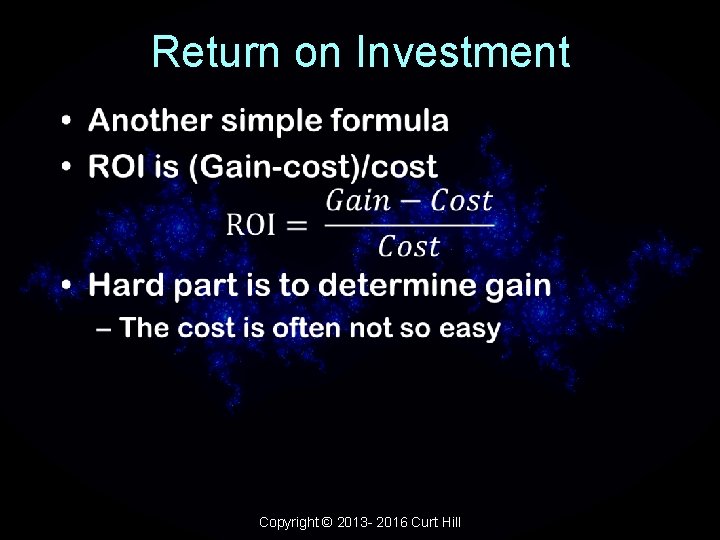
Return on Investment • Copyright © 2013 - 2016 Curt Hill

ROI Questions • Can we afford this? Will it pay for itself? • How much will we get out of the this? • Is this the most we can get out of this investment? • Will the benefits to the enterprise make it worth the investment? Copyright © 2013 -2015 – Curt Hill Copyright © 2013 - 2016 Curt Hill
Numbers • CBA, NPV and ROI are more process than number – Especially costs and results • Each of them requires substantial estimation of intangible impact • No easy way to do this • The process may be biased towards one result or another Copyright © 2013 -2015 – Curt Hill
Persuasion • Once you have been convinced you need to pass that assurance onto your superiors – Or whomever holds the purse strings • This is persuasion – Selling your business case to others Copyright © 2013 - 2016 Curt Hill
Make the Case • The business case sells an investment – Build a strong, integrated set of arguments – Show an IS adds value to the organization – Lays out the costs and benefits, using whichever process the enterprise prefers – Used to make a “go” or “no-go” decision – May be used to justify continued funding Copyright © 2013 - 2016 Curt Hill
Productivity Paradox • Stems from the difficulty in showing that worker productivity was increasing due to investments in information technologies • One problem has been in measurement – Companies typically focus on efficiency over effectiveness – IT systems sometimes increase effectiveness over efficiency – Effectiveness is harder to measure Copyright © 2013 - 2016 Curt Hill
Productivity Paradox • IT systems often take years to hit the bottom line – Any measurement immediately after implementation may show no, or even a negative, productivity impact. • Many industries have a limited size – The first mover may get a bigger slice of the pie – Once everyone has implemented the new technology to catch up, overall it looks like there is no improvement across the industry Copyright © 2013 - 2016 Curt Hill
Three Types of Arguments • Faith – Based on beliefs about organizational strategy, competitive advantage, industry forces, perceptions, market share etc • Fear – If the system is not implemented, the firm will lose out to the competition or go out of business • Fact – Arguments based on data, quantitative analysis, and/or indisputable factors Copyright © 2013 - 2016 Curt Hill
Presentation • Know the Audience – To whom are you are presenting? – What is their background? – What do they care about? • Convert Benefits to Monetary Terms • Measure What Is Important to Management – Know management “hot-button” issues – Describe how the system impacts them • Consider all the stakeholders Copyright © 2013 - 2016 Curt Hill
Finally • The success or failure of the project may hinge on the presentation • It must be compelling • It must show the project as beneficial • It must compare well with competing proposals • The presenter must show confidence and presence Copyright © 2013 - 2016 Curt Hill
- Slides: 20