
Making Structured Reporting Happen in the Cardiac Catheterization


- Slides: 37
Making Structured Reporting Happen in the Cardiac Catheterization Laboratory 16 April 2015 H. Vernon Anderson, MD, FACC, FSCAI James E. Tcheng, MD, FACC, FSCAI DISCLAIMER: The views and opinions expressed in this presentation are those of the author and do not necessarily represent official policy or position of HIMSS.
Conflict of Interest H. Vernon Anderson, MD has no real or apparent conflicts of interest to report. James E. Tcheng, MD, has the following relationships with industry. • Consulting Fees: Philips Medical Systems • Contracted Research: Philips Medical Systems © HIMSS 2015
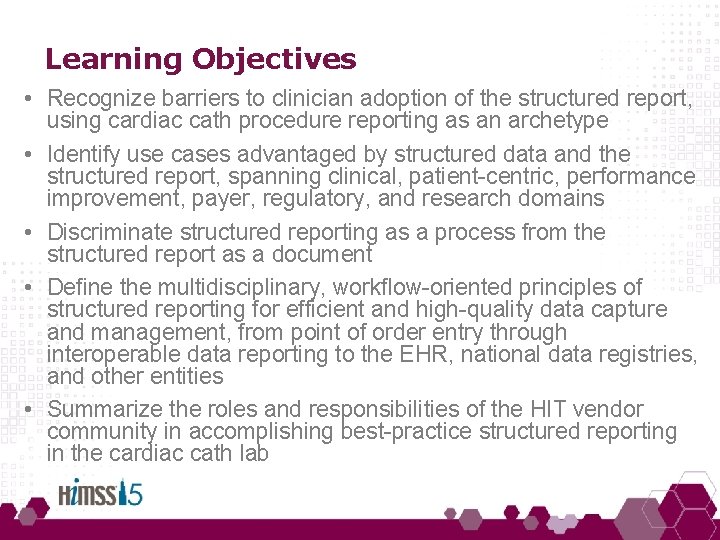
Learning Objectives • Recognize barriers to clinician adoption of the structured report, using cardiac cath procedure reporting as an archetype • Identify use cases advantaged by structured data and the structured report, spanning clinical, patient-centric, performance improvement, payer, regulatory, and research domains • Discriminate structured reporting as a process from the structured report as a document • Define the multidisciplinary, workflow-oriented principles of structured reporting for efficient and high-quality data capture and management, from point of order entry through interoperable data reporting to the EHR, national data registries, and other entities • Summarize the roles and responsibilities of the HIT vendor community in accomplishing best-practice structured reporting in the cardiac cath lab
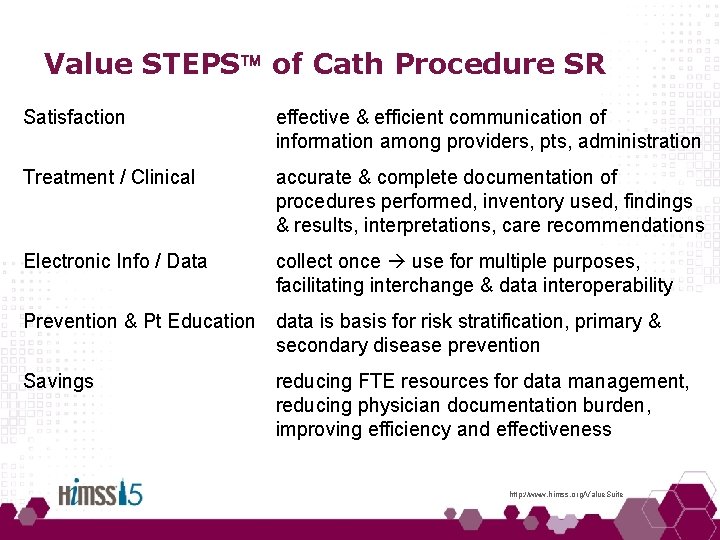
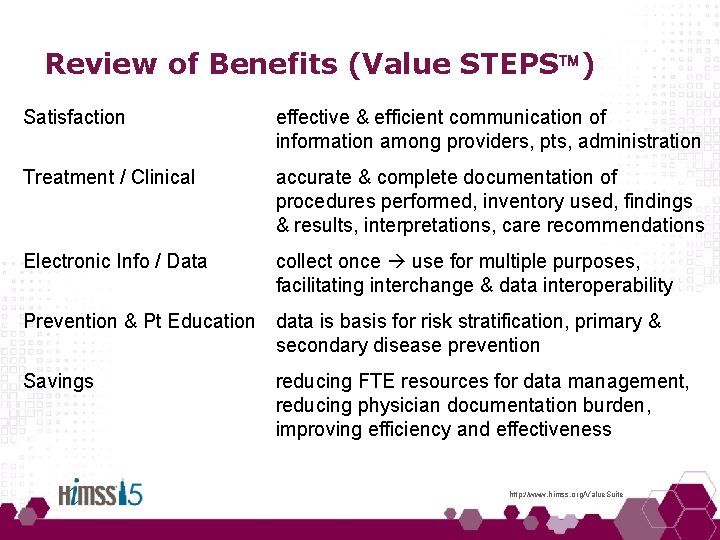
Value STEPS of Cath Procedure SR Satisfaction effective & efficient communication of information among providers, pts, administration Treatment / Clinical accurate & complete documentation of procedures performed, inventory used, findings & results, interpretations, care recommendations Electronic Info / Data collect once use for multiple purposes, facilitating interchange & data interoperability Prevention & Pt Education data is basis for risk stratification, primary & secondary disease prevention Savings reducing FTE resources for data management, reducing physician documentation burden, improving efficiency and effectiveness http: //www. himss. org/Value. Suite
Structured Reporting in the Cath Lab • How did we get here? • The need for data • Healthcare delivery, quality measurement, performance improvement, device surveillance • Structured reporting - what and why? • ACC/AHA/SCAI Health Policy Statement on Structured Reporting • Details, details • Perspectives
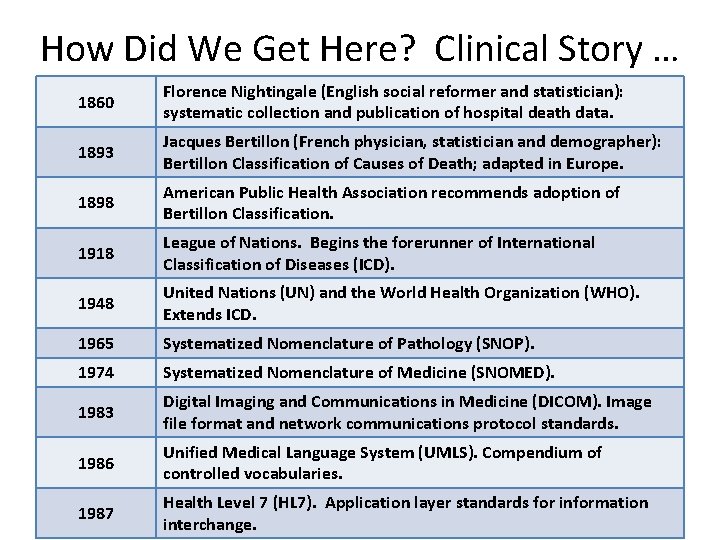
How Did We Get Here? Clinical Story … 1860 Florence Nightingale (English social reformer and statistician): systematic collection and publication of hospital death data. 1893 Jacques Bertillon (French physician, statistician and demographer): Bertillon Classification of Causes of Death; adapted in Europe. 1898 American Public Health Association recommends adoption of Bertillon Classification. 1918 League of Nations. Begins the forerunner of International Classification of Diseases (ICD). 1948 United Nations (UN) and the World Health Organization (WHO). Extends ICD. 1965 Systematized Nomenclature of Pathology (SNOP). 1974 Systematized Nomenclature of Medicine (SNOMED). 1983 Digital Imaging and Communications in Medicine (DICOM). Image file format and network communications protocol standards. 1986 Unified Medical Language System (UMLS). Compendium of controlled vocabularies. 1987 Health Level 7 (HL 7). Application layer standards for information interchange.
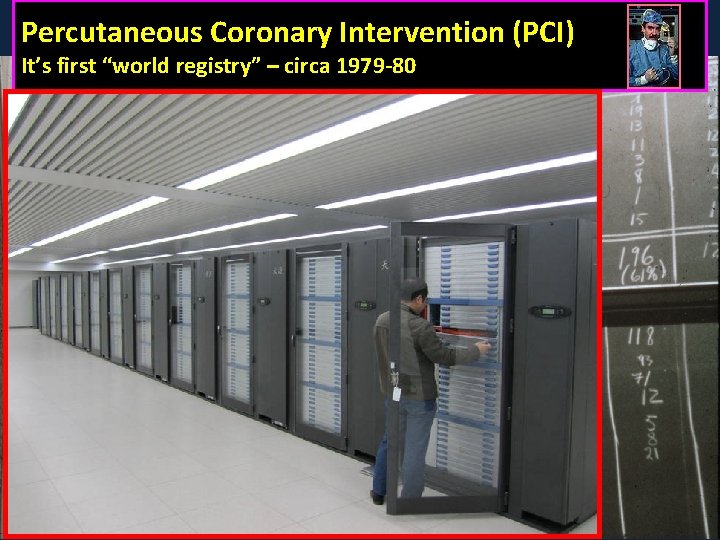
Percutaneous Coronary Intervention (PCI) It’s first “world registry” – circa 1979 -80
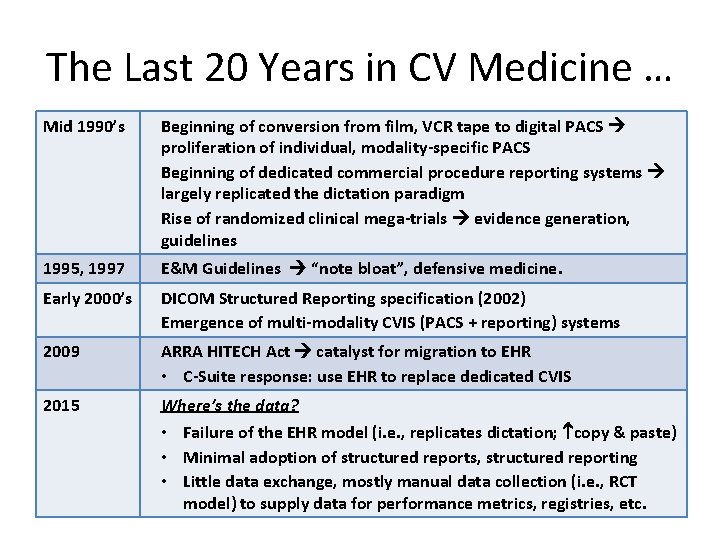
The Last 20 Years in CV Medicine … Mid 1990’s Beginning of conversion from film, VCR tape to digital PACS proliferation of individual, modality-specific PACS Beginning of dedicated commercial procedure reporting systems largely replicated the dictation paradigm Rise of randomized clinical mega-trials evidence generation, guidelines 1995, 1997 E&M Guidelines “note bloat”, defensive medicine. Early 2000’s DICOM Structured Reporting specification (2002) Emergence of multi-modality CVIS (PACS + reporting) systems 2009 ARRA HITECH Act catalyst for migration to EHR • C-Suite response: use EHR to replace dedicated CVIS 2015 Where’s the data? • Failure of the EHR model (i. e. , replicates dictation; copy & paste) • Minimal adoption of structured reports, structured reporting • Little data exchange, mostly manual data collection (i. e. , RCT model) to supply data for performance metrics, registries, etc.
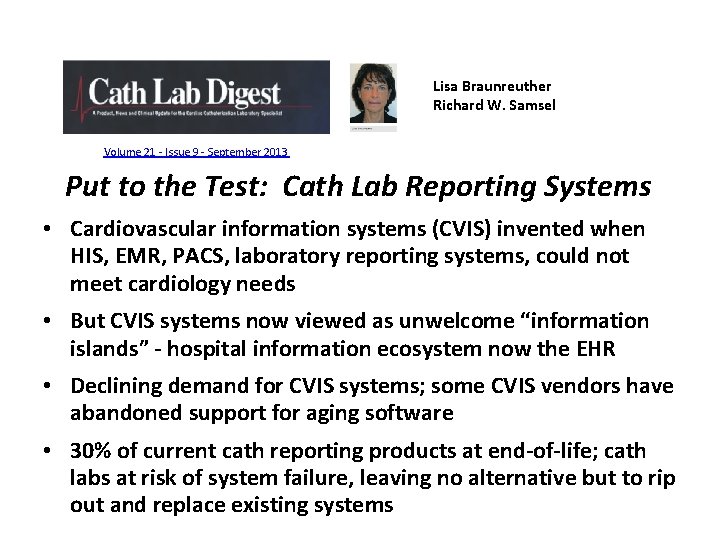
Lisa Braunreuther Richard W. Samsel Volume 21 - Issue 9 - September 2013 Put to the Test: Cath Lab Reporting Systems • Cardiovascular information systems (CVIS) invented when HIS, EMR, PACS, laboratory reporting systems, could not meet cardiology needs • But CVIS systems now viewed as unwelcome “information islands” - hospital information ecosystem now the EHR • Declining demand for CVIS systems; some CVIS vendors have abandoned support for aging software • 30% of current cath reporting products at end-of-life; cath labs at risk of system failure, leaving no alternative but to rip out and replace existing systems
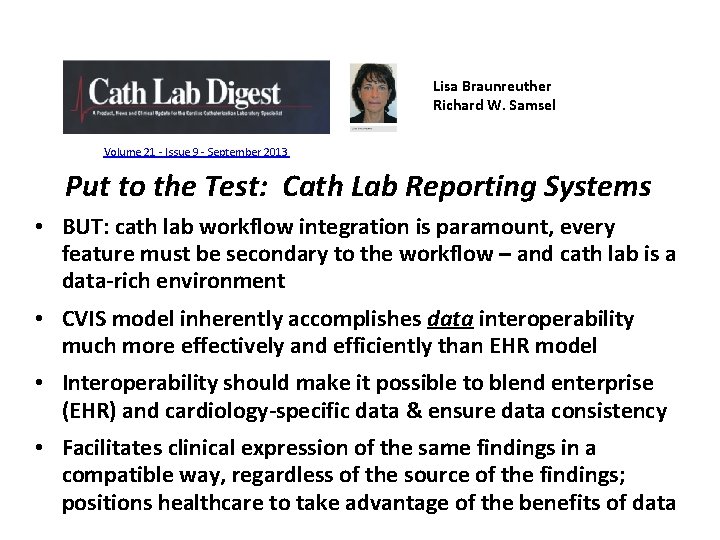
Lisa Braunreuther Richard W. Samsel Volume 21 - Issue 9 - September 2013 Put to the Test: Cath Lab Reporting Systems • BUT: cath lab workflow integration is paramount, every feature must be secondary to the workflow – and cath lab is a data-rich environment • CVIS model inherently accomplishes data interoperability much more effectively and efficiently than EHR model • Interoperability should make it possible to blend enterprise (EHR) and cardiology-specific data & ensure data consistency • Facilitates clinical expression of the same findings in a compatible way, regardless of the source of the findings; positions healthcare to take advantage of the benefits of data
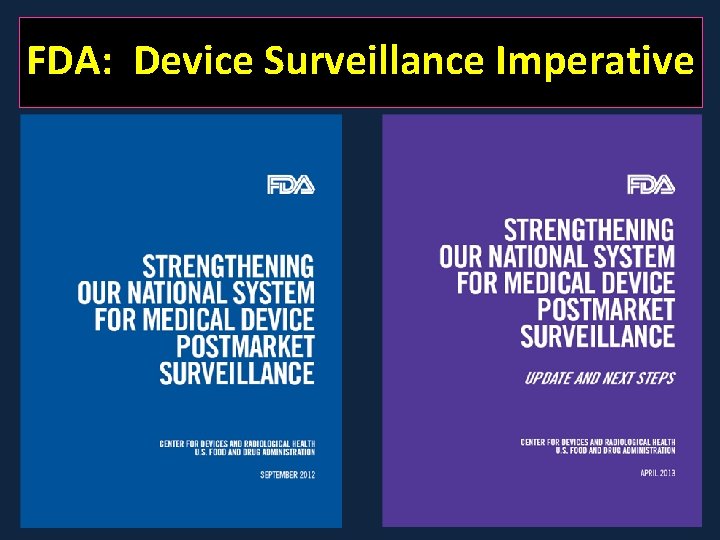
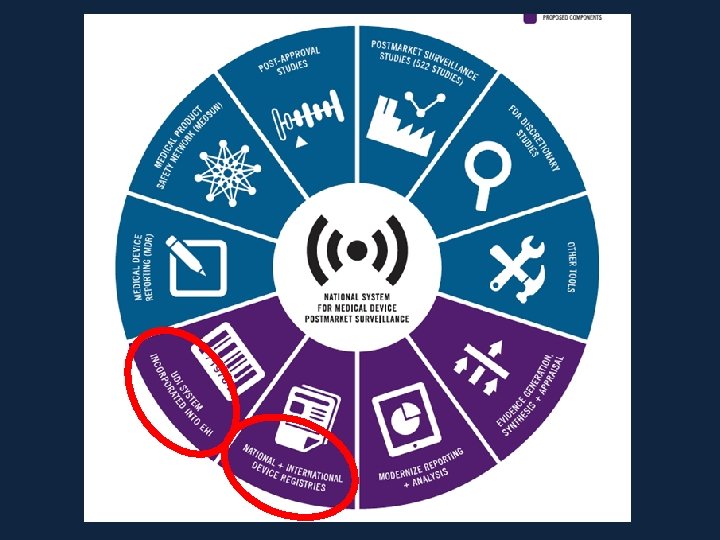
FDA: Device Surveillance Imperative
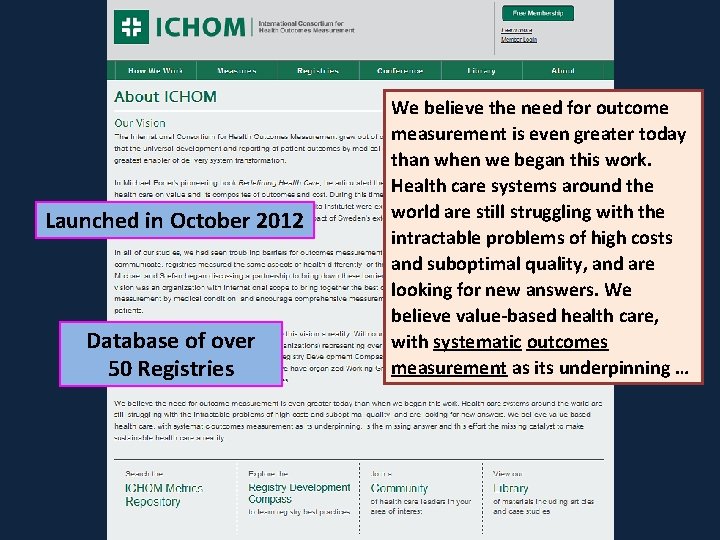
Launched in October 2012 Database of over 50 Registries We believe the need for outcome measurement is even greater today than when we began this work. Health care systems around the world are still struggling with the intractable problems of high costs and suboptimal quality, and are looking for new answers. We believe value-based health care, with systematic outcomes measurement as its underpinning …
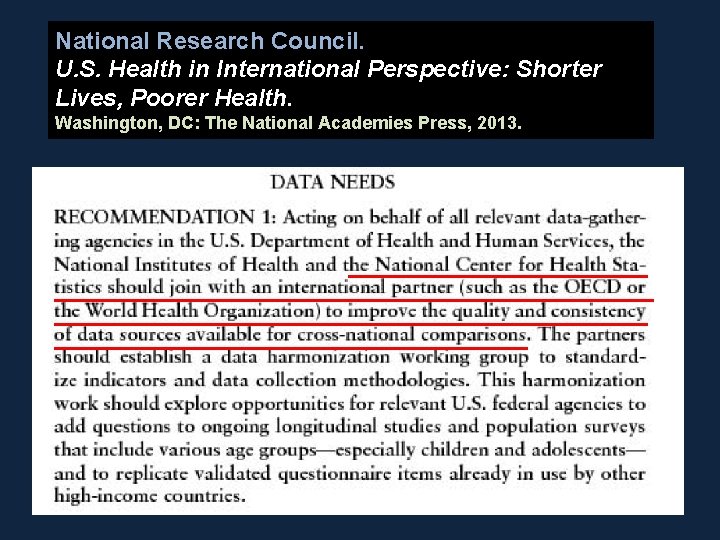
National Research Council. U. S. Health in International Perspective: Shorter Lives, Poorer Health. Washington, DC: The National Academies Press, 2013.
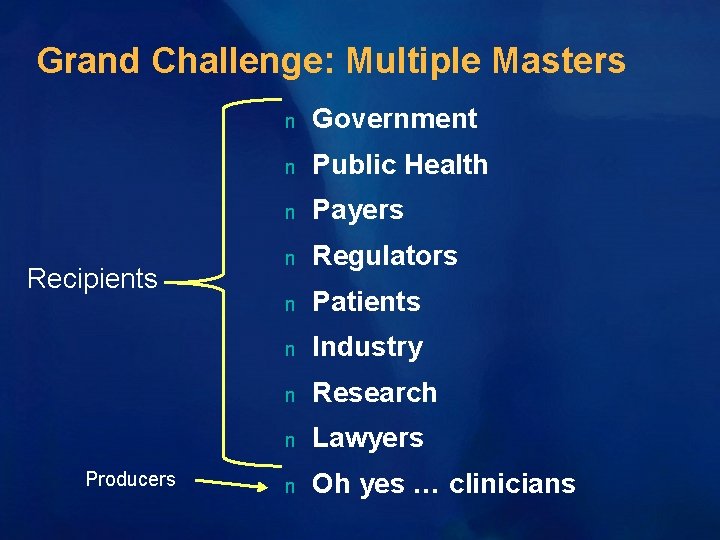
Grand Challenge: Multiple Masters Recipients Producers n Government n Public Health n Payers n Regulators n Patients n Industry n Research n Lawyers n Oh yes … clinicians
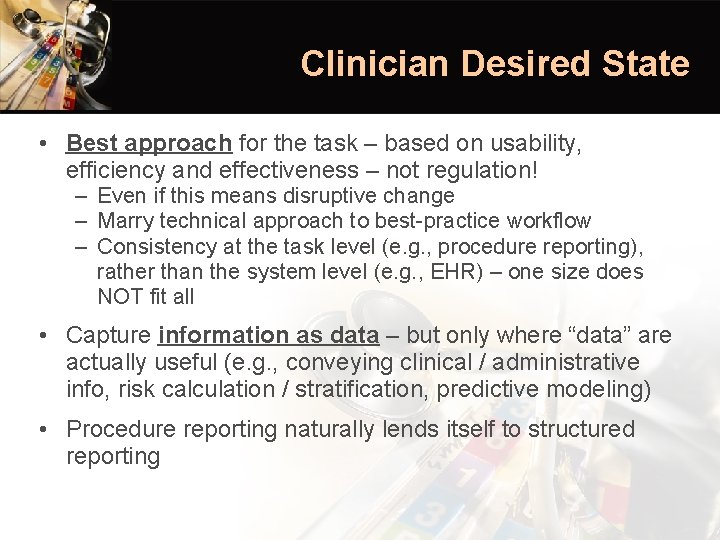
Clinician Desired State • Best approach for the task – based on usability, efficiency and effectiveness – not regulation! – Even if this means disruptive change – Marry technical approach to best-practice workflow – Consistency at the task level (e. g. , procedure reporting), rather than the system level (e. g. , EHR) – one size does NOT fit all • Capture information as data – but only where “data” are actually useful (e. g. , conveying clinical / administrative info, risk calculation / stratification, predictive modeling) • Procedure reporting naturally lends itself to structured reporting
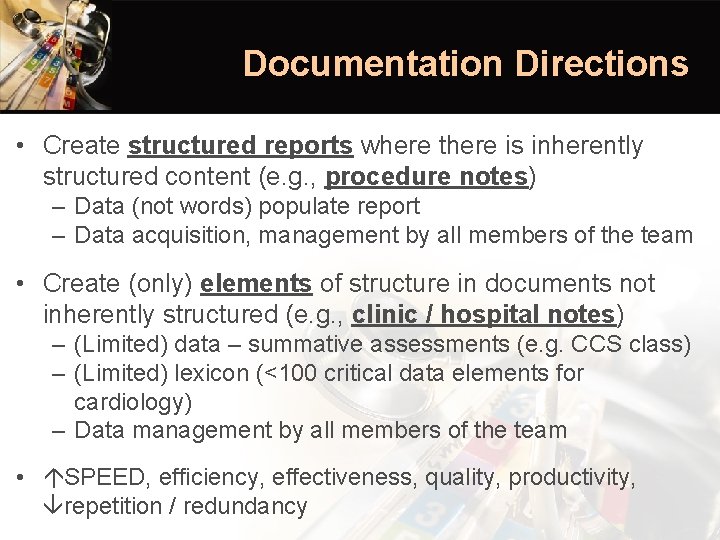
Documentation Directions • Create structured reports where there is inherently structured content (e. g. , procedure notes) – Data (not words) populate report – Data acquisition, management by all members of the team • Create (only) elements of structure in documents not inherently structured (e. g. , clinic / hospital notes) – (Limited) data – summative assessments (e. g. CCS class) – (Limited) lexicon (<100 critical data elements for cardiology) – Data management by all members of the team • SPEED, efficiency, effectiveness, quality, productivity, repetition / redundancy
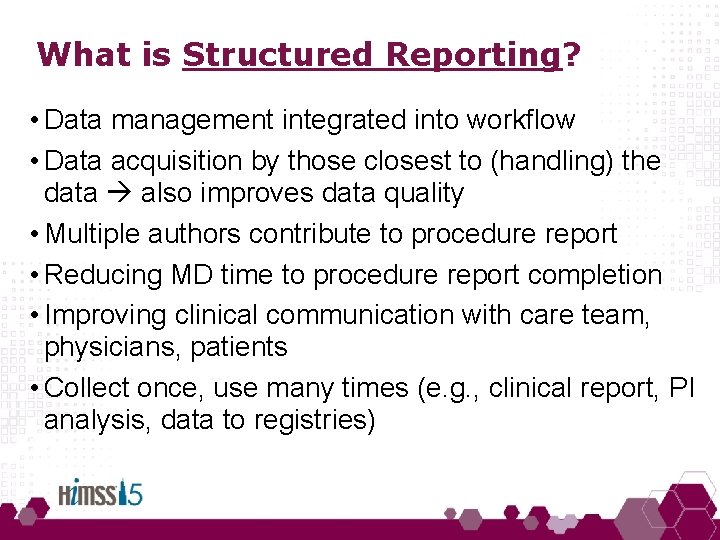
What is Structured Reporting? • Data management integrated into workflow • Data acquisition by those closest to (handling) the data also improves data quality • Multiple authors contribute to procedure report • Reducing MD time to procedure report completion • Improving clinical communication with care team, physicians, patients • Collect once, use many times (e. g. , clinical report, PI analysis, data to registries)
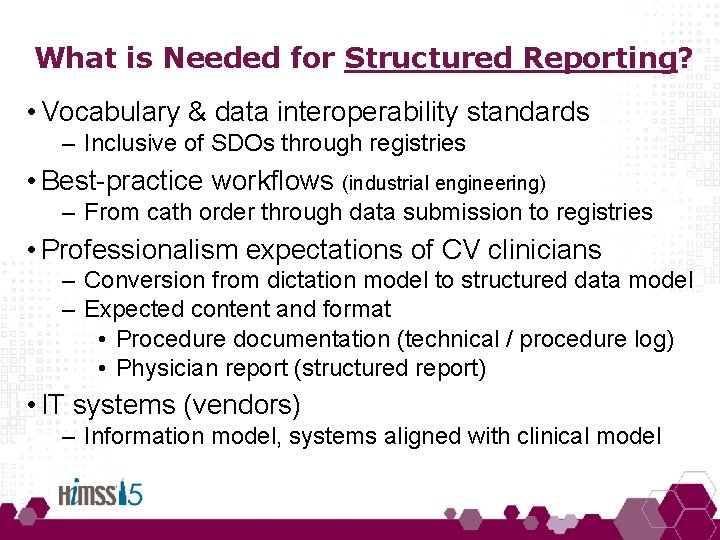
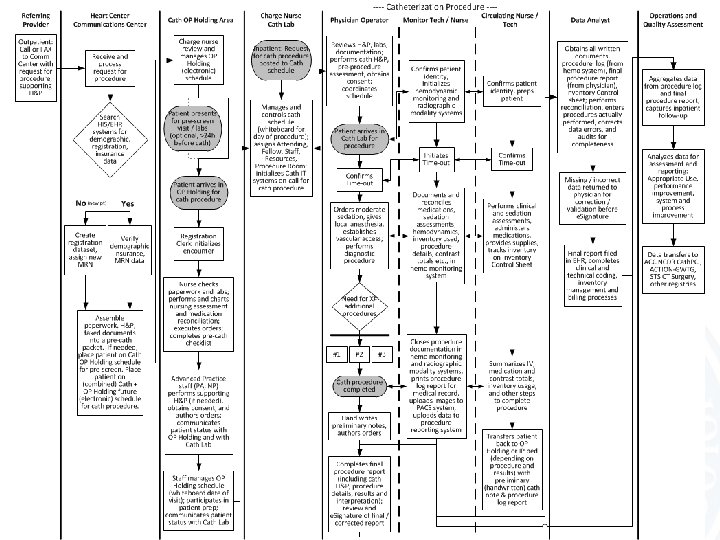
What is Needed for Structured Reporting? • Vocabulary & data interoperability standards – Inclusive of SDOs through registries • Best-practice workflows (industrial engineering) – From cath order through data submission to registries • Professionalism expectations of CV clinicians – Conversion from dictation model to structured data model – Expected content and format • Procedure documentation (technical / procedure log) • Physician report (structured report) • IT systems (vendors) – Information model, systems aligned with clinical model
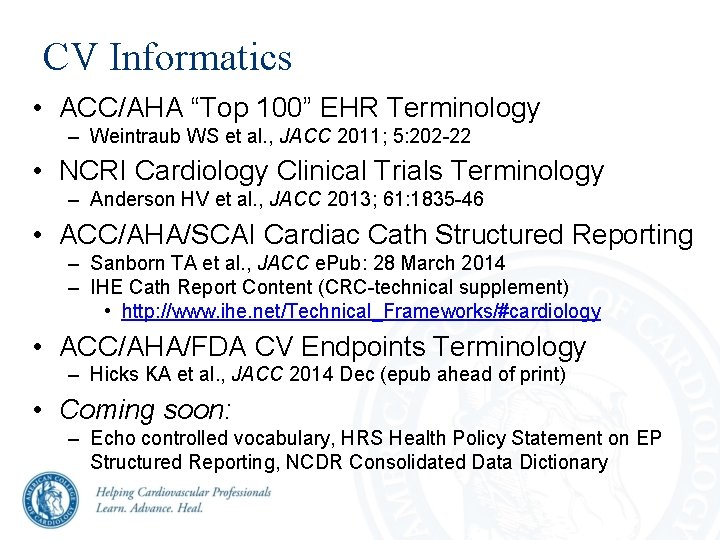
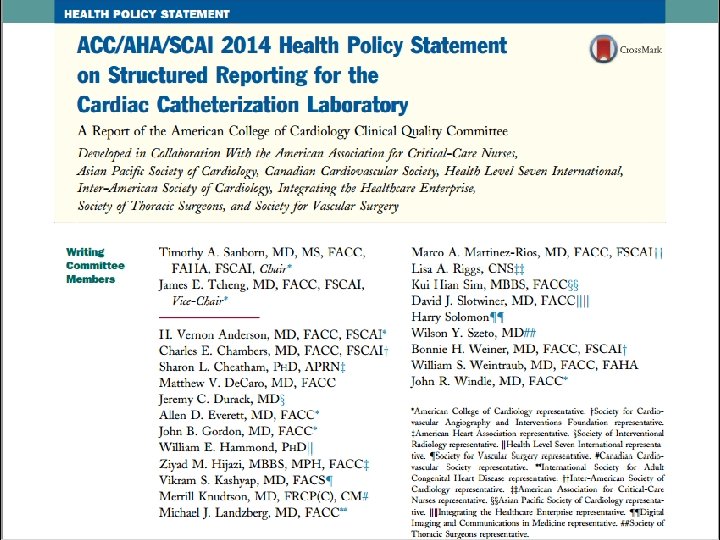
CV Informatics • ACC/AHA “Top 100” EHR Terminology – Weintraub WS et al. , JACC 2011; 5: 202 -22 • NCRI Cardiology Clinical Trials Terminology – Anderson HV et al. , JACC 2013; 61: 1835 -46 • ACC/AHA/SCAI Cardiac Cath Structured Reporting – Sanborn TA et al. , JACC e. Pub: 28 March 2014 – IHE Cath Report Content (CRC-technical supplement) • http: //www. ihe. net/Technical_Frameworks/#cardiology • ACC/AHA/FDA CV Endpoints Terminology – Hicks KA et al. , JACC 2014 Dec (epub ahead of print) • Coming soon: – Echo controlled vocabulary, HRS Health Policy Statement on EP Structured Reporting, NCDR Consolidated Data Dictionary
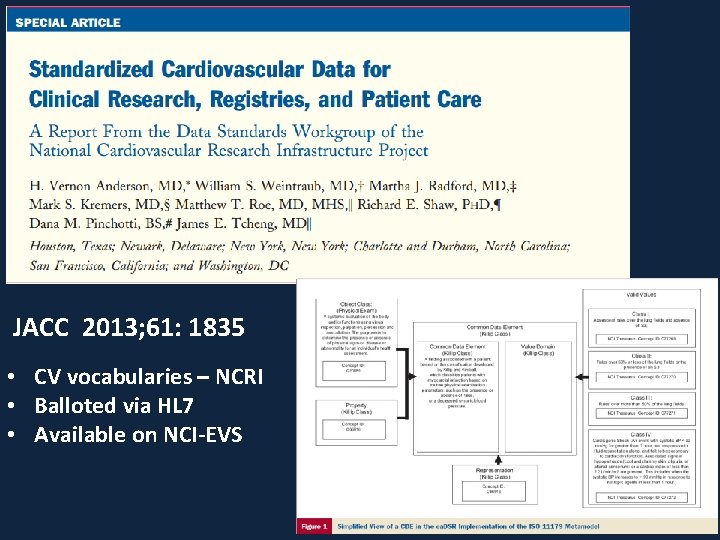
JACC 2013; 61: 1835 • CV vocabularies – NCRI • Balloted via HL 7 • Available on NCI-EVS
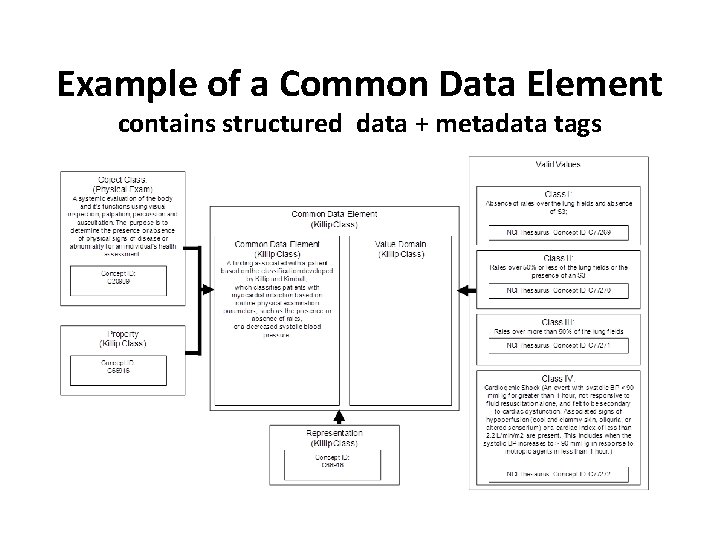
Example of a Common Data Element contains structured data + metadata tags
25
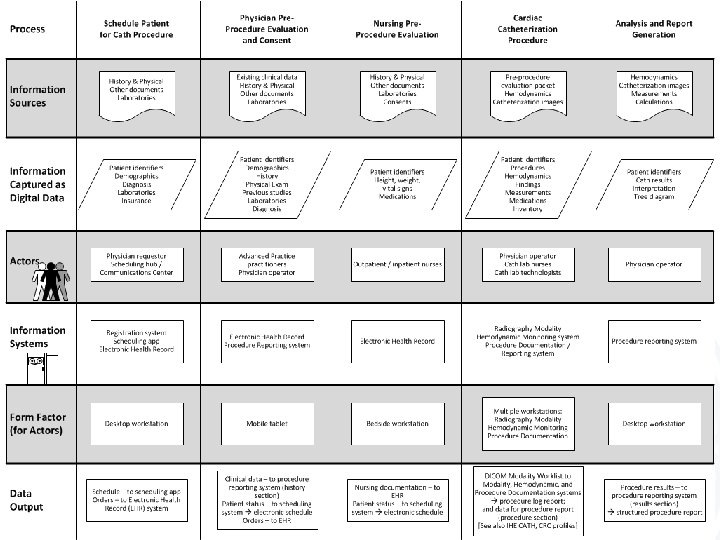
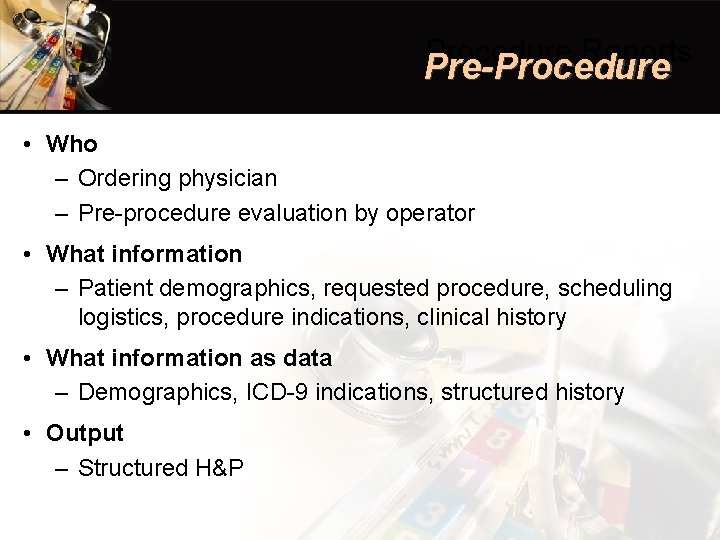
Procedure Reports Pre-Procedure • Who – Ordering physician – Pre-procedure evaluation by operator • What information – Patient demographics, requested procedure, scheduling logistics, procedure indications, clinical history • What information as data – Demographics, ICD-9 indications, structured history • Output – Structured H&P
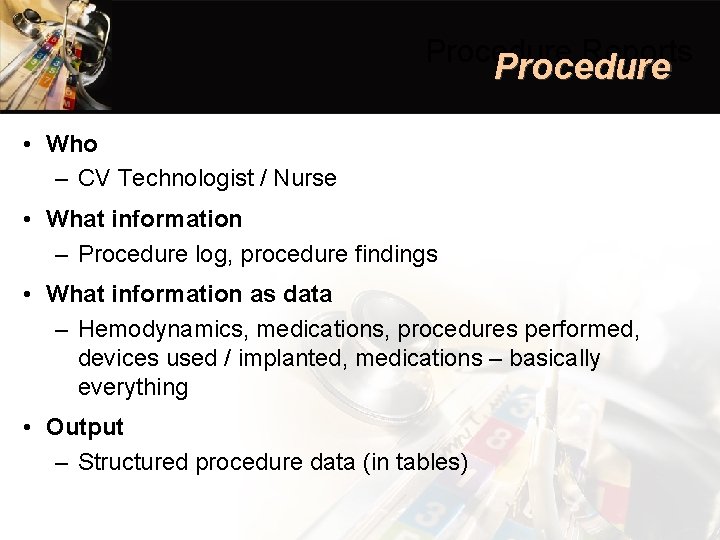
Procedure Reports Procedure • Who – CV Technologist / Nurse • What information – Procedure log, procedure findings • What information as data – Hemodynamics, medications, procedures performed, devices used / implanted, medications – basically everything • Output – Structured procedure data (in tables)
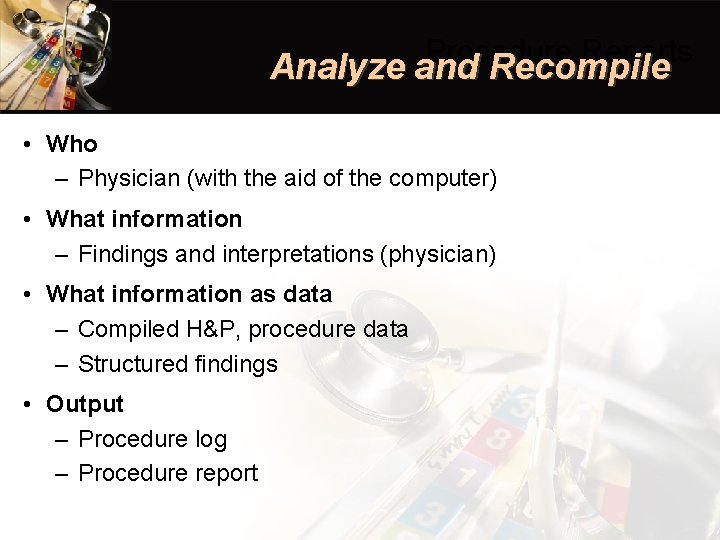
Procedure Reports Analyze and Recompile • Who – Physician (with the aid of the computer) • What information – Findings and interpretations (physician) • What information as data – Compiled H&P, procedure data – Structured findings • Output – Procedure log – Procedure report
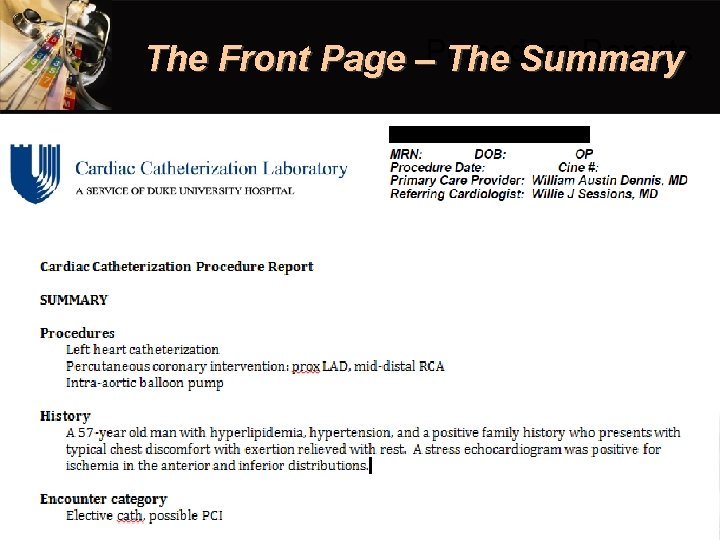
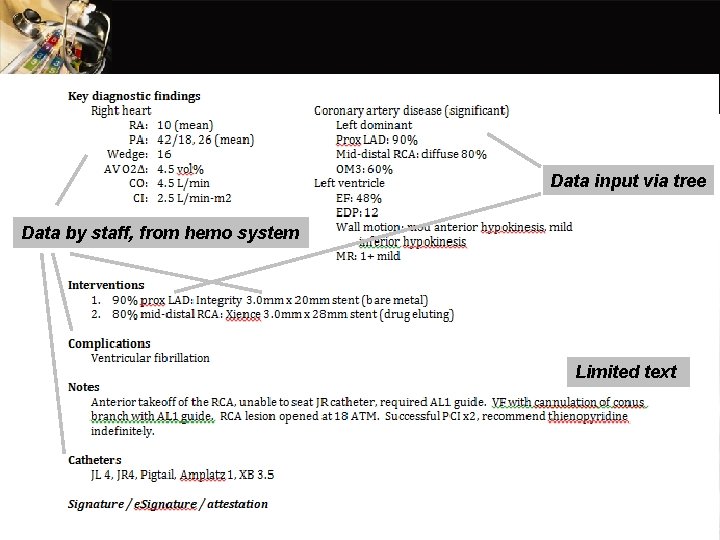
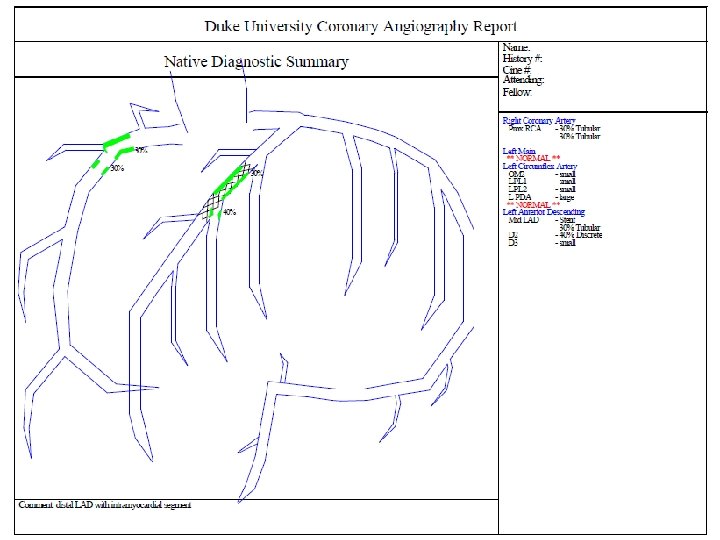
Reports The Front Page –Procedure The Summary
Data input via tree Data by staff, from hemo system Limited text
Procedure Reports Be a poet, not a novelist …
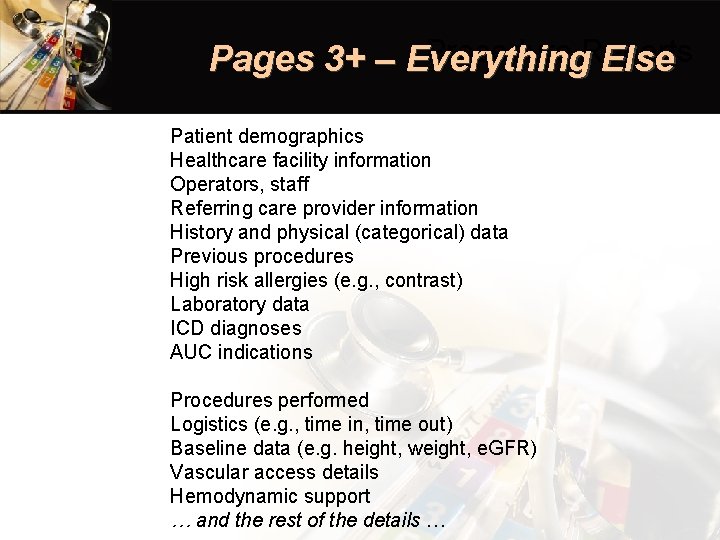
Procedure Reports Pages 3+ – Everything Else Patient demographics Healthcare facility information Operators, staff Referring care provider information History and physical (categorical) data Previous procedures High risk allergies (e. g. , contrast) Laboratory data ICD diagnoses AUC indications Procedures performed Logistics (e. g. , time in, time out) Baseline data (e. g. height, weight, e. GFR) Vascular access details Hemodynamic support … and the rest of the details …
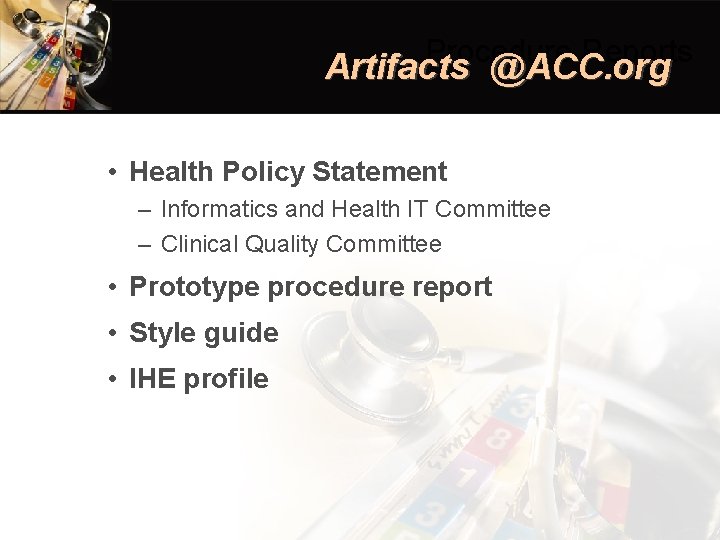
Procedure Reports Artifacts @ACC. org • Health Policy Statement – Informatics and Health IT Committee – Clinical Quality Committee • Prototype procedure report • Style guide • IHE profile
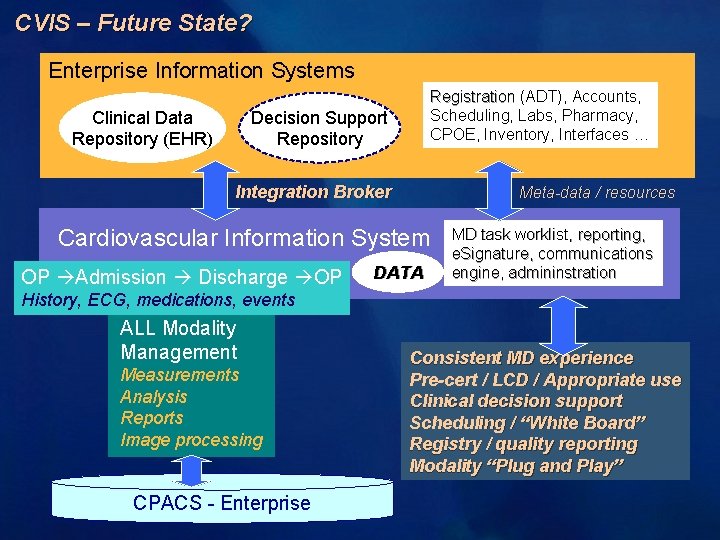
CVIS – Future State? Enterprise Information Systems Clinical Data Repository (EHR) Registration (ADT), Accounts, Scheduling, Labs, Pharmacy, CPOE, Inventory, Interfaces … Decision Support Repository Integration Broker Meta-data / resources Cardiovascular Information System OP Admission Discharge OP DATA MD task worklist, reporting, e. Signature, communications engine, admininstration History, ECG, medications, events ALL Modality Management Measurements Analysis Reports Image processing CPACS - Enterprise Consistent MD experience Pre-cert / LCD / Appropriate use Clinical decision support Scheduling / “White Board” Registry / quality reporting Modality “Plug and Play”
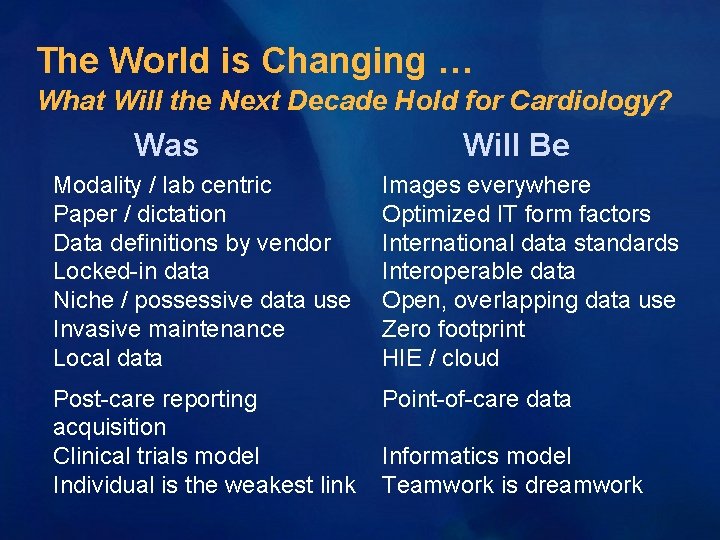
The World is Changing … What Will the Next Decade Hold for Cardiology? Was Will Be Modality / lab centric Paper / dictation Data definitions by vendor Locked-in data Niche / possessive data use Invasive maintenance Local data Images everywhere Optimized IT form factors International data standards Interoperable data Open, overlapping data use Zero footprint HIE / cloud Post-care reporting acquisition Clinical trials model Individual is the weakest link Point-of-care data Informatics model Teamwork is dreamwork
Review of Benefits (Value STEPS ) Satisfaction effective & efficient communication of information among providers, pts, administration Treatment / Clinical accurate & complete documentation of procedures performed, inventory used, findings & results, interpretations, care recommendations Electronic Info / Data collect once use for multiple purposes, facilitating interchange & data interoperability Prevention & Pt Education data is basis for risk stratification, primary & secondary disease prevention Savings reducing FTE resources for data management, reducing physician documentation burden, improving efficiency and effectiveness http: //www. himss. org/Value. Suite
Questions? H. Vernon “Skip” Anderson, MD: H. V. Anderson@uth. tmc. edu James E. Tcheng, MD: james. tcheng@duke. edu