Making Strategy Mapping Out Strategic Success Chapter 12



- Slides: 23
Making Strategy: Mapping Out Strategic Success Chapter 12 CLOSURE: BRINGING IT ALL TOGETHER Fran Ackermann; Colin Eden © Colin Eden and Fran Ackermann: Lecture Notes For Making Strategy: Mapping Out Strategic Success, Sage, 2011
Please note, these slides are designed to be used in addition to the book: Making Strategy: Mapping Out Strategic Success. by Ackermann & Eden, Sage, 2011 They are not designed to be used in a ‘standalone’ manner, or to replicate theory and practice presented in the book. q The assignment design represents one possibility for a 10 credit MBA course. q © Colin Eden and Fran Ackermann: Lecture Notes For Making Strategy: Mapping Out Strategic Success, Sage, 2011
Strategic Management is about agreeing where to practically focus energy, cash, effort, emotion © Colin Eden and Fran Ackermann: Lecture Notes For Making Strategy: Mapping Out Strategic Success, Sage, 2011
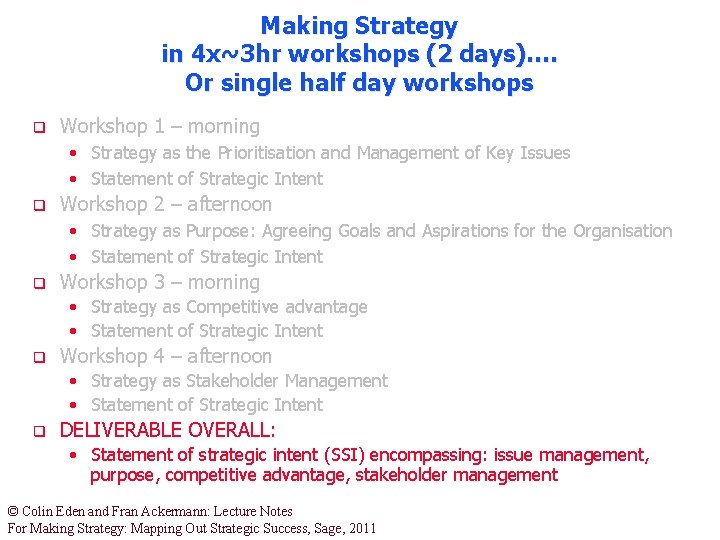
Making Strategy in 4 x~3 hr workshops (2 days)…. Or single half day workshops q Workshop 1 – morning • Strategy as the Prioritisation and Management of Key Issues • Statement of Strategic Intent q Workshop 2 – afternoon • Strategy as Purpose: Agreeing Goals and Aspirations for the Organisation • Statement of Strategic Intent q Workshop 3 – morning • Strategy as Competitive advantage • Statement of Strategic Intent q Workshop 4 – afternoon • Strategy as Stakeholder Management • Statement of Strategic Intent q DELIVERABLE OVERALL: • Statement of strategic intent (SSI) encompassing: issue management, purpose, competitive advantage, stakeholder management © Colin Eden and Fran Ackermann: Lecture Notes For Making Strategy: Mapping Out Strategic Success, Sage, 2011
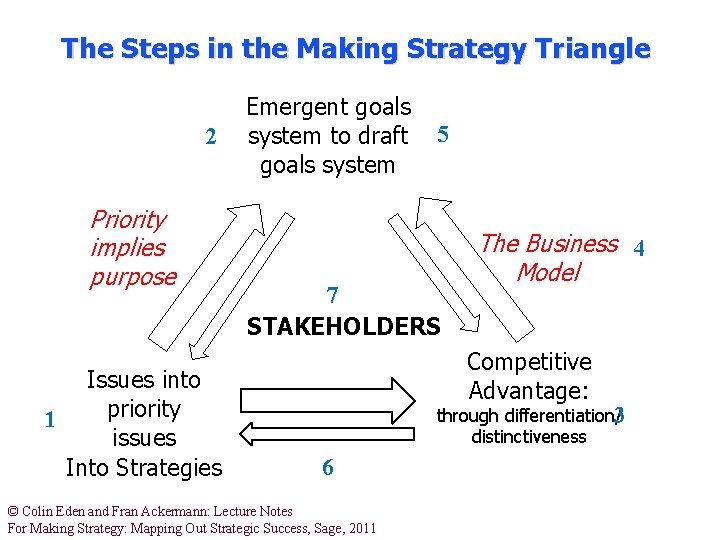
The Logic of the Locking together of the 4 Strategy Forums: IM, PU, CA, SH © Colin Eden and Fran Ackermann: Lecture Notes For Making Strategy: Mapping Out Strategic Success, Sage, 2011
The Steps in the Making Strategy Triangle 2 Priority implies purpose Issues into priority 1 issues Into Strategies Emergent goals system to draft goals system 5 7 STAKEHOLDERS The Business 4 Model Competitive Advantage: through differentiation/3 distinctiveness 6 © Colin Eden and Fran Ackermann: Lecture Notes For Making Strategy: Mapping Out Strategic Success, Sage, 2011
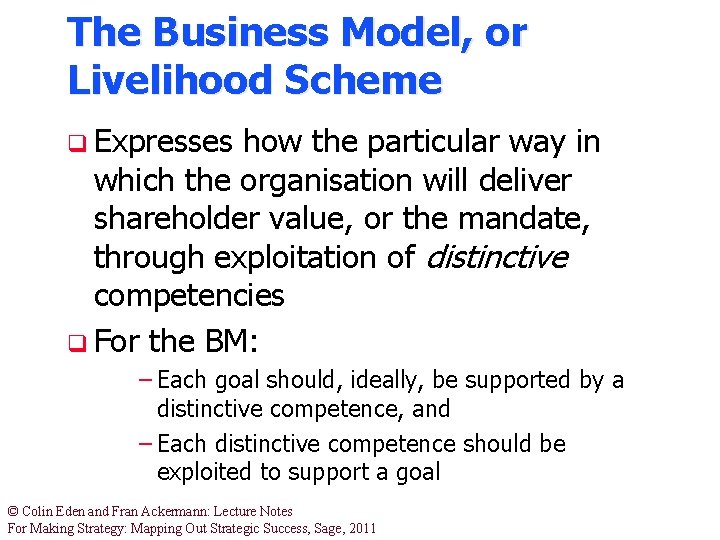
The Business Model, or Livelihood Scheme q Expresses how the particular way in which the organisation will deliver shareholder value, or the mandate, through exploitation of distinctive competencies q For the BM: – Each goal should, ideally, be supported by a distinctive competence, and – Each distinctive competence should be exploited to support a goal © Colin Eden and Fran Ackermann: Lecture Notes For Making Strategy: Mapping Out Strategic Success, Sage, 2011
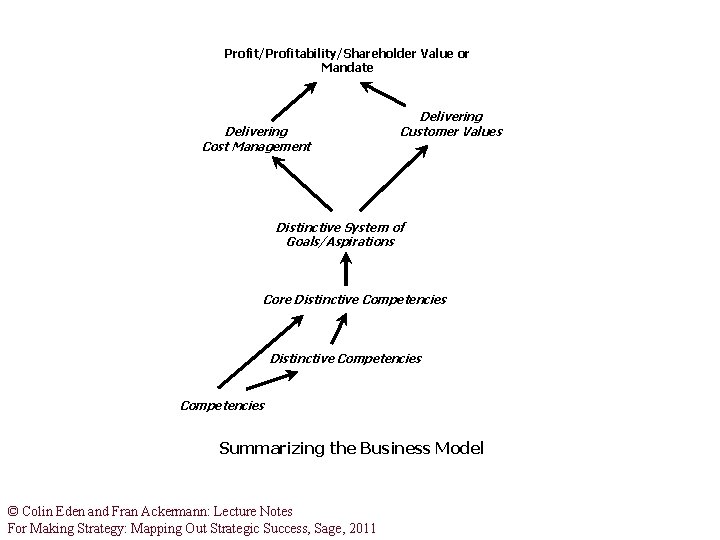
Profit/Profitability/Shareholder Value or Mandate Delivering Cost Management Delivering Customer Values Distinctive System of Goals/Aspirations Core Distinctive Competencies Summarizing the Business Model © Colin Eden and Fran Ackermann: Lecture Notes For Making Strategy: Mapping Out Strategic Success, Sage, 2011
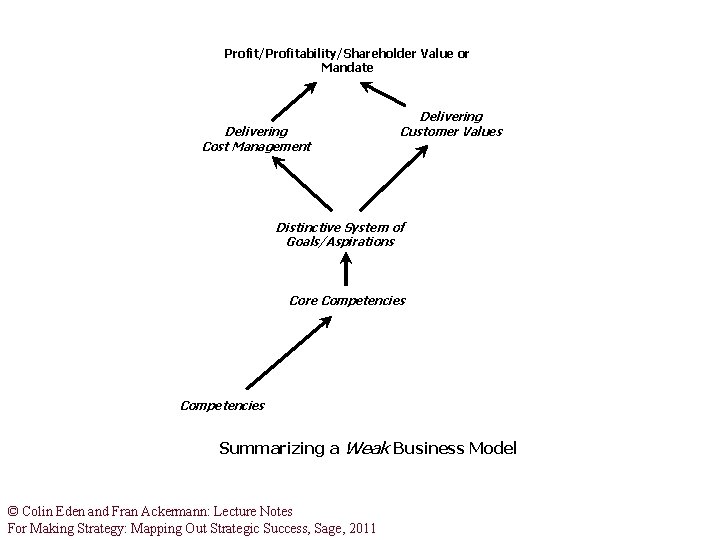
Profit/Profitability/Shareholder Value or Mandate Delivering Cost Management Delivering Customer Values Distinctive System of Goals/Aspirations Core Competencies Summarizing a Weak Business Model © Colin Eden and Fran Ackermann: Lecture Notes For Making Strategy: Mapping Out Strategic Success, Sage, 2011
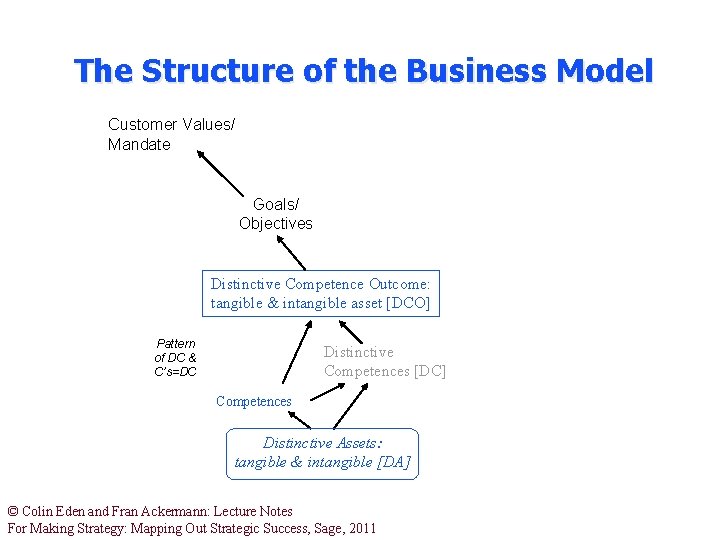
The Structure of the Business Model Customer Values/ Mandate Goals/ Objectives Distinctive Competence Outcome: tangible & intangible asset [DCO] Pattern of DC & C’s=DC Distinctive Competences [DC] Competences Distinctive Assets: tangible & intangible [DA] © Colin Eden and Fran Ackermann: Lecture Notes For Making Strategy: Mapping Out Strategic Success, Sage, 2011
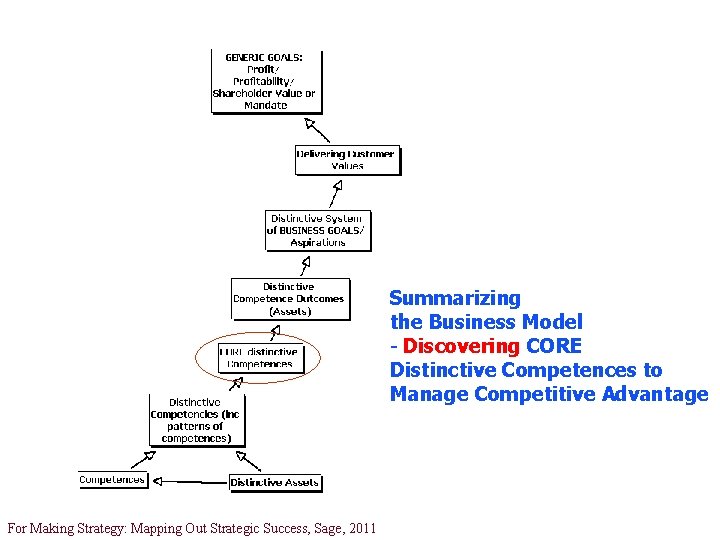
Summarizing the Business Model - Discovering CORE Distinctive Competences to Manage Competitive Advantage © Colin Eden and Fran Ackermann: Lecture Notes For Making Strategy: Mapping Out Strategic Success, Sage, 2011
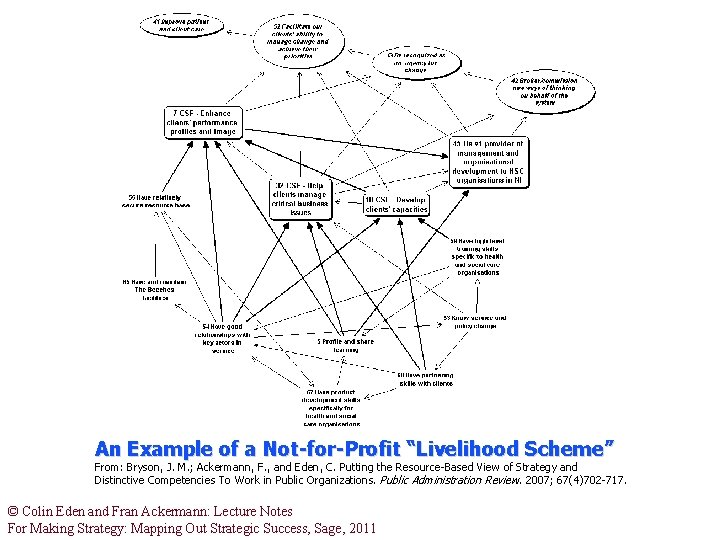
An Example of a Not-for-Profit “Livelihood Scheme” From: Bryson, J. M. ; Ackermann, F. , and Eden, C. Putting the Resource-Based View of Strategy and Distinctive Competencies To Work in Public Organizations. Public Administration Review. 2007; 67(4)702 -717. © Colin Eden and Fran Ackermann: Lecture Notes For Making Strategy: Mapping Out Strategic Success, Sage, 2011
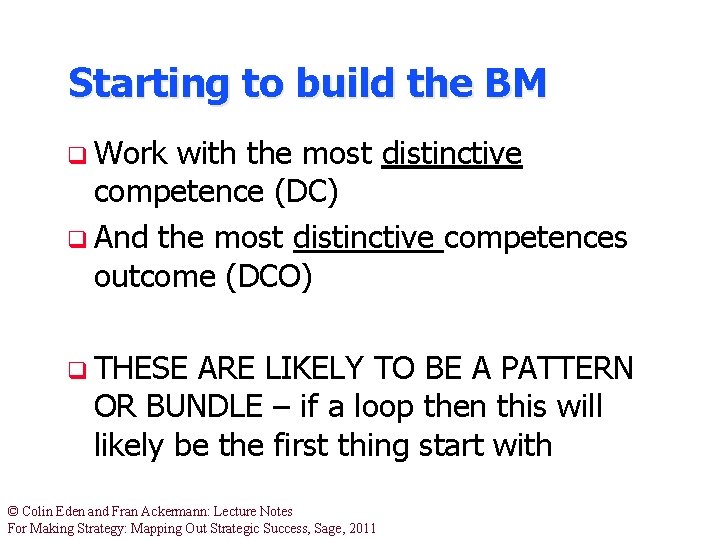
Starting to build the BM q Work with the most distinctive competence (DC) q And the most distinctive competences outcome (DCO) q THESE ARE LIKELY TO BE A PATTERN OR BUNDLE – if a loop then this will likely be the first thing start with © Colin Eden and Fran Ackermann: Lecture Notes For Making Strategy: Mapping Out Strategic Success, Sage, 2011
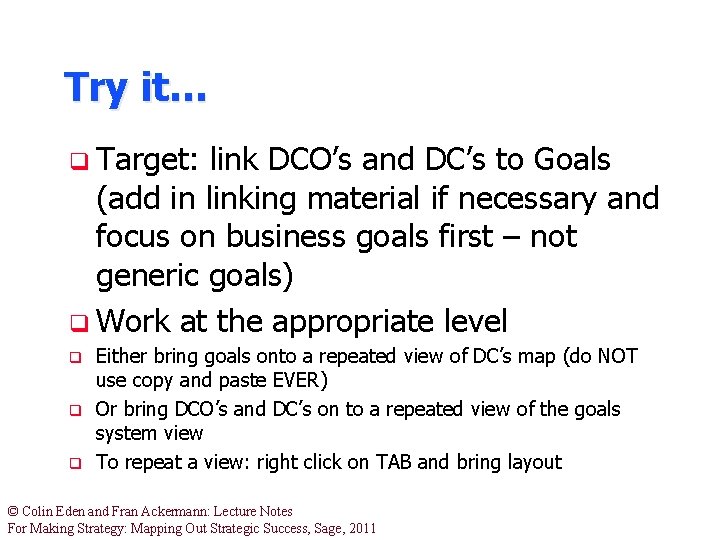
Try it… q Target: link DCO’s and DC’s to Goals (add in linking material if necessary and focus on business goals first – not generic goals) q Work at the appropriate level q q q Either bring goals onto a repeated view of DC’s map (do NOT use copy and paste EVER) Or bring DCO’s and DC’s on to a repeated view of the goals system view To repeat a view: right click on TAB and bring layout © Colin Eden and Fran Ackermann: Lecture Notes For Making Strategy: Mapping Out Strategic Success, Sage, 2011
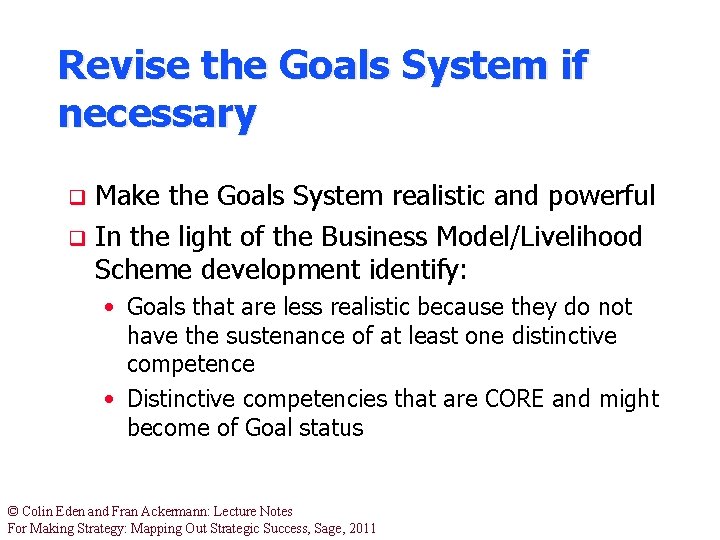
Revise the Goals System if necessary Make the Goals System realistic and powerful q In the light of the Business Model/Livelihood Scheme development identify: q • Goals that are less realistic because they do not have the sustenance of at least one distinctive competence • Distinctive competencies that are CORE and might become of Goal status © Colin Eden and Fran Ackermann: Lecture Notes For Making Strategy: Mapping Out Strategic Success, Sage, 2011
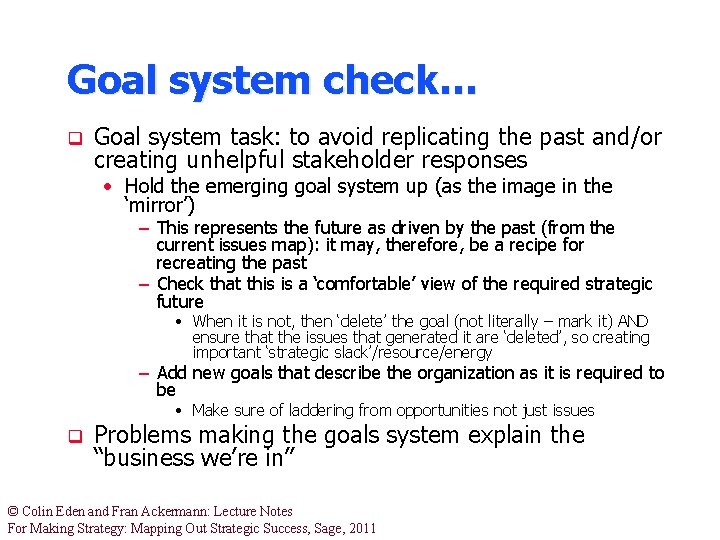
Goal system check… q Goal system task: to avoid replicating the past and/or creating unhelpful stakeholder responses • Hold the emerging goal system up (as the image in the ‘mirror’) – This represents the future as driven by the past (from the current issues map): it may, therefore, be a recipe for recreating the past – Check that this is a ‘comfortable’ view of the required strategic future • When it is not, then ‘delete’ the goal (not literally – mark it) AND ensure that the issues that generated it are ‘deleted’, so creating important ‘strategic slack’/resource/energy – Add new goals that describe the organization as it is required to be • Make sure of laddering from opportunities not just issues q Problems making the goals system explain the “business we’re in” © Colin Eden and Fran Ackermann: Lecture Notes For Making Strategy: Mapping Out Strategic Success, Sage, 2011
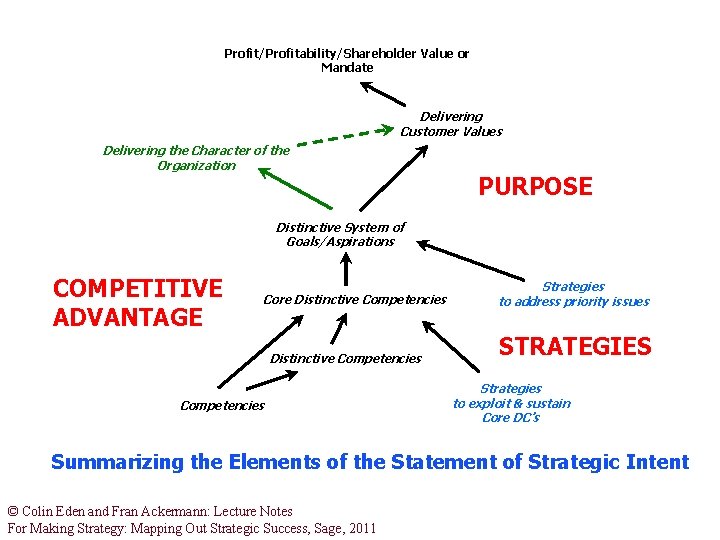
Profit/Profitability/Shareholder Value or Mandate Delivering Customer Values Delivering the Character of the Organization PURPOSE Distinctive System of Goals/Aspirations COMPETITIVE ADVANTAGE Core Distinctive Competencies Strategies to address priority issues STRATEGIES Strategies to exploit & sustain Core DC’s Summarizing the Elements of the Statement of Strategic Intent © Colin Eden and Fran Ackermann: Lecture Notes For Making Strategy: Mapping Out Strategic Success, Sage, 2011
Statement of Strategic Intent (SSI) • Construct a Draft Statement of Strategic Intent in the form of bullet-point statements from the maps - using three sections: • A statement of purpose that gets across the goals system hierarchy • The business model logic: the DC’s that provide for the goals • Draft strategies following from prioritised issues AND strategies to develop the Business Model (sustaining the core DC’s or C’s, implementing new links) • Attend to Stakeholder Management within each part of the SSI © Colin Eden and Fran Ackermann: Lecture Notes For Making Strategy: Mapping Out Strategic Success, Sage, 2011
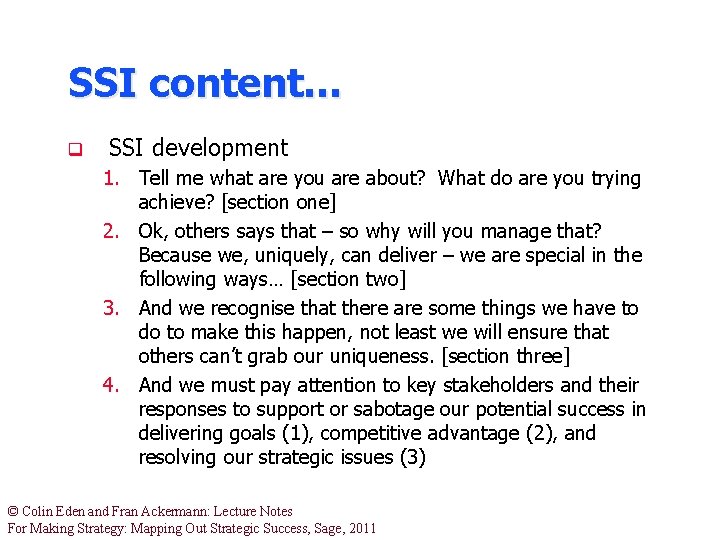
SSI content… q SSI development 1. Tell me what are you are about? What do are you trying achieve? [section one] 2. Ok, others says that – so why will you manage that? Because we, uniquely, can deliver – we are special in the following ways… [section two] 3. And we recognise that there are some things we have to do to make this happen, not least we will ensure that others can’t grab our uniqueness. [section three] 4. And we must pay attention to key stakeholders and their responses to support or sabotage our potential success in delivering goals (1), competitive advantage (2), and resolving our strategic issues (3) © Colin Eden and Fran Ackermann: Lecture Notes For Making Strategy: Mapping Out Strategic Success, Sage, 2011
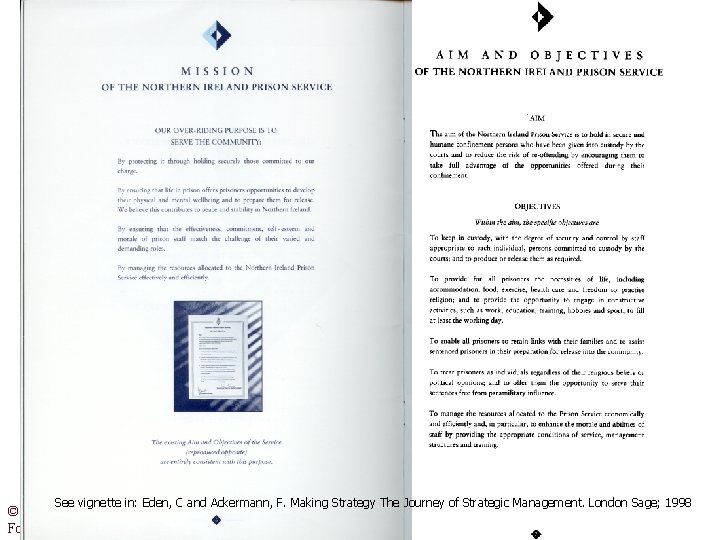
See vignette in: Eden, C and Ackermann, F. Making Strategy The Journey of Strategic Management. London Sage; 1998 © Colin Eden and Fran Ackermann: Lecture Notes For Making Strategy: Mapping Out Strategic Success, Sage, 2011
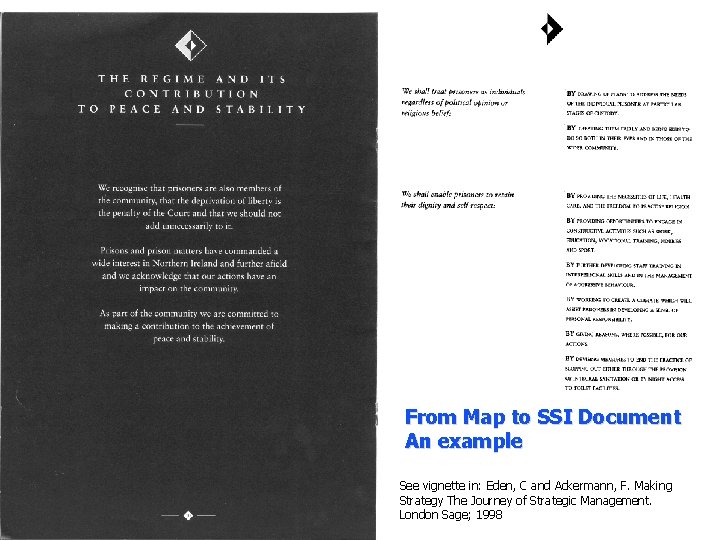
From Map to SSI Document An example © Colin Eden and Fran Ackermann: Lecture Notes For Making Strategy: Mapping Out Strategic Success, Sage, 2011 See vignette in: Eden, C and Ackermann, F. Making Strategy The Journey of Strategic Management. London Sage; 1998
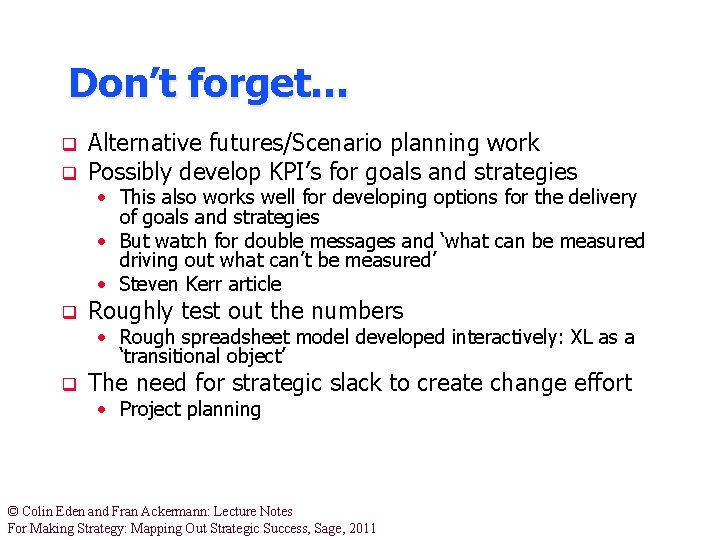
Don’t forget… q q Alternative futures/Scenario planning work Possibly develop KPI’s for goals and strategies • This also works well for developing options for the delivery of goals and strategies • But watch for double messages and ‘what can be measured driving out what can’t be measured’ • Steven Kerr article q Roughly test out the numbers • Rough spreadsheet model developed interactively: XL as a ‘transitional object’ q The need for strategic slack to create change effort • Project planning © Colin Eden and Fran Ackermann: Lecture Notes For Making Strategy: Mapping Out Strategic Success, Sage, 2011
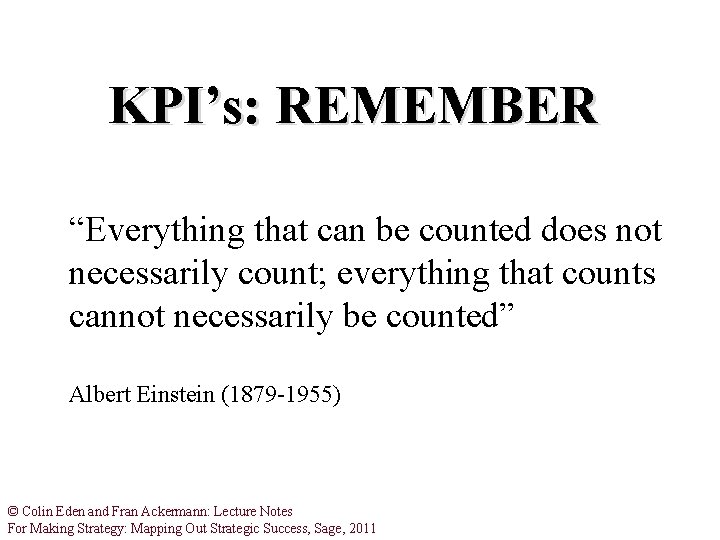
KPI’s: REMEMBER “Everything that can be counted does not necessarily count; everything that counts cannot necessarily be counted” Albert Einstein (1879 -1955) © Colin Eden and Fran Ackermann: Lecture Notes For Making Strategy: Mapping Out Strategic Success, Sage, 2011