
Making sense of HPV and Pap test results
- Slides: 19
Making sense of HPV and Pap test results: What do women need and want to know? Findings from CDC qualitative research with women, ages 30 -65 years Allison Friedman, MS Hilda Shepeard, Ph. D, MBA The findings & conclusions in this presentation are those of the authors and do not necessarily represent the views of CDC/ATSDR
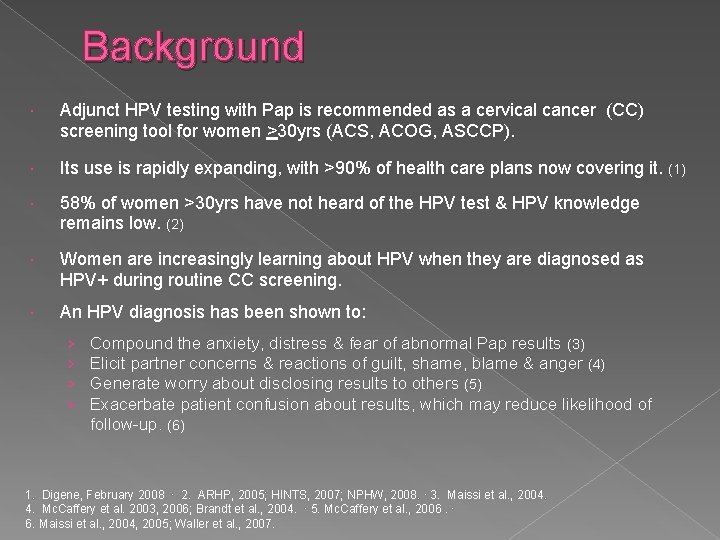
Background Adjunct HPV testing with Pap is recommended as a cervical cancer (CC) screening tool for women >30 yrs (ACS, ACOG, ASCCP). Its use is rapidly expanding, with >90% of health care plans now covering it. 58% of women >30 yrs have not heard of the HPV test & HPV knowledge remains low. (2) Women are increasingly learning about HPV when they are diagnosed as HPV+ during routine CC screening. An HPV diagnosis has been shown to: › › Compound the anxiety, distress & fear of abnormal Pap results (3) Elicit partner concerns & reactions of guilt, shame, blame & anger (4) Generate worry about disclosing results to others (5) Exacerbate patient confusion about results, which may reduce likelihood of follow-up. (6) 1. Digene, February 2008 ∙ 2. ARHP, 2005; HINTS, 2007; NPHW, 2008. ∙ 3. Maissi et al. , 2004. 4. Mc. Caffery et al. 2003, 2006; Brandt et al. , 2004. ∙ 5. Mc. Caffery et al. , 2006. ∙ 6. Maissi et al. , 2004, 2005; Waller et al. , 2007. (1)
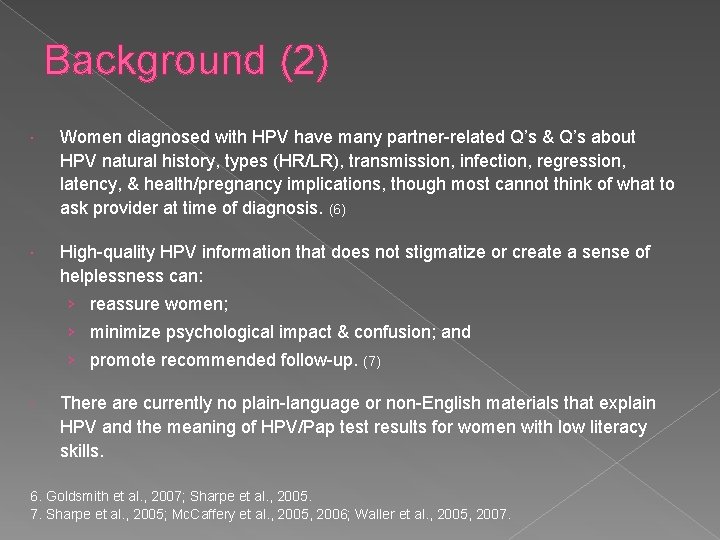
Background (2) Women diagnosed with HPV have many partner-related Q’s & Q’s about HPV natural history, types (HR/LR), transmission, infection, regression, latency, & health/pregnancy implications, though most cannot think of what to ask provider at time of diagnosis. (6) High-quality HPV information that does not stigmatize or create a sense of helplessness can: › reassure women; › minimize psychological impact & confusion; and › promote recommended follow-up. (7) There are currently no plain-language or non-English materials that explain HPV and the meaning of HPV/Pap test results for women with low literacy skills. 6. Goldsmith et al. , 2007; Sharpe et al. , 2005. 7. Sharpe et al. , 2005; Mc. Caffery et al. , 2005, 2006; Waller et al. , 2005, 2007.
Objective This research sought to test English & Spanish educational materials to help women with low literacy skills: Understand HPV and the meaning of their HPV/Pap test results Reduce anxiety, fear & confusion associated with abnormal results Reduce HPV-associated partner blame Facilitate effective partner communication about HPV Promote appropriate follow-up.
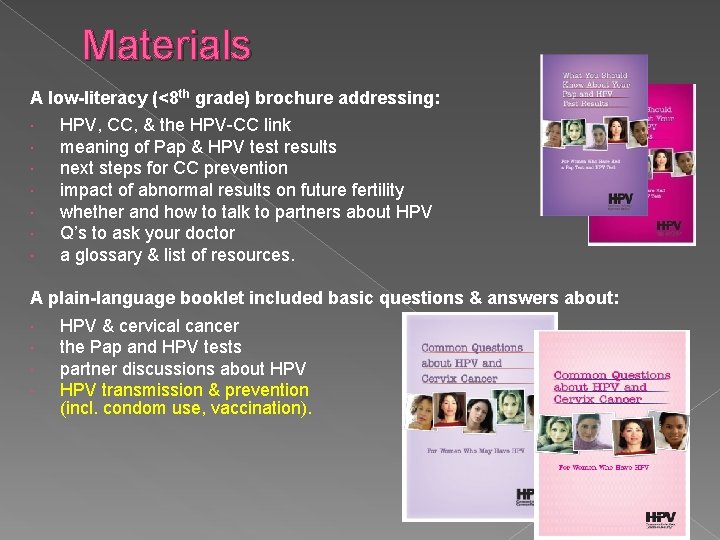
Materials A low-literacy (<8 th grade) brochure addressing: HPV, CC, & the HPV-CC link meaning of Pap & HPV test results next steps for CC prevention impact of abnormal results on future fertility whether and how to talk to partners about HPV Q’s to ask your doctor a glossary & list of resources. A plain-language booklet included basic questions & answers about: HPV & cervical cancer the Pap and HPV tests partner discussions about HPV transmission & prevention (incl. condom use, vaccination).
Methods Ten focus groups were conducted in fall 2006 with African-American, White, & Hispanic women, ages 30 -65 yrs (N=90), in three U. S. cities (selected based on high CC incidence rates). Groups were segmented by: › Age (30 -45 yrs; 46 -65 yrs) › Language/Hispanic origin › Geographic location Women were randomly recruited from general public if they were: › 30 -65 years old › Caucasian, Hispanic, or African American › Sexually active (currently or planned) › Living below average income level for select metro area › Educated at/below high-school-level › Screened for CC (Pap test) in past three years › Were fluent in Spanish (Hispanic only) A mix of married & single participants, with/without children were recruited.
Methods (2) Focus groups assessed participants’: › › awareness & knowledge of CC and HPV reactions to material content, based on hypothetical scenario unanswered questions reported intentions (post exposure) Groups were audio-taped &transcribed, w/ >2 observers/note-takers Results analyzed using a notes-based strategy w/3 independent reviewers
Results Awareness/Knowledge High CC & screening awareness, but knowledge ranged widely High awareness of HPV (except older Latinas)- from TV ads Only superficial knowledge Many questions and misconceptions
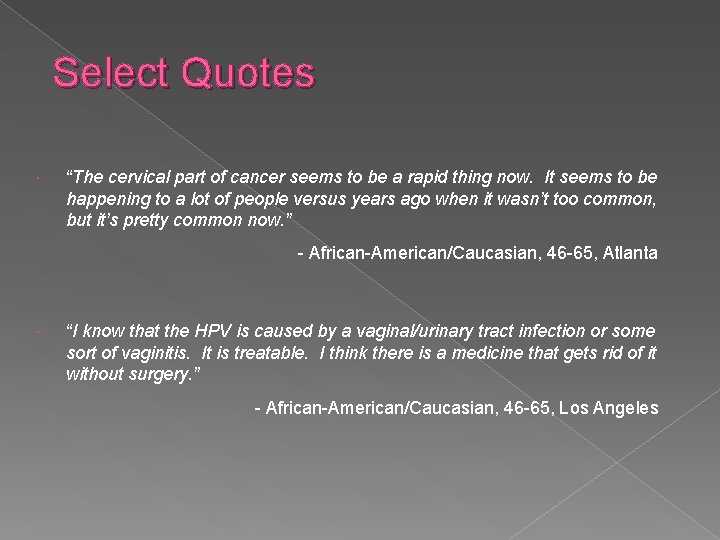
Select Quotes “The cervical part of cancer seems to be a rapid thing now. It seems to be happening to a lot of people versus years ago when it wasn’t too common, but it’s pretty common now. ” - African-American/Caucasian, 46 -65, Atlanta “I know that the HPV is caused by a vaginal/urinary tract infection or some sort of vaginitis. It is treatable. I think there is a medicine that gets rid of it without surgery. ” - African-American/Caucasian, 46 -65, Los Angeles
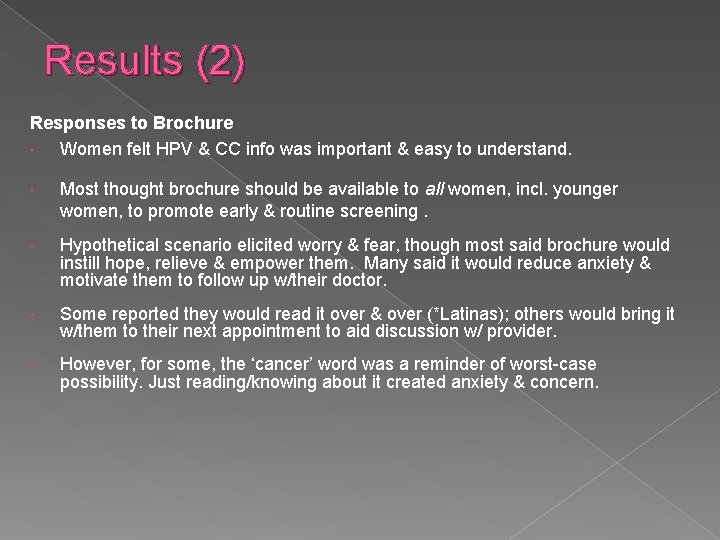
Results (2) Responses to Brochure Women felt HPV & CC info was important & easy to understand. Most thought brochure should be available to all women, incl. younger women, to promote early & routine screening. Hypothetical scenario elicited worry & fear, though most said brochure would instill hope, relieve & empower them. Many said it would reduce anxiety & motivate them to follow up w/their doctor. Some reported they would read it over & over (*Latinas); others would bring it w/them to their next appointment to aid discussion w/ provider. However, for some, the ‘cancer’ word was a reminder of worst-case possibility. Just reading/knowing about it created anxiety & concern.
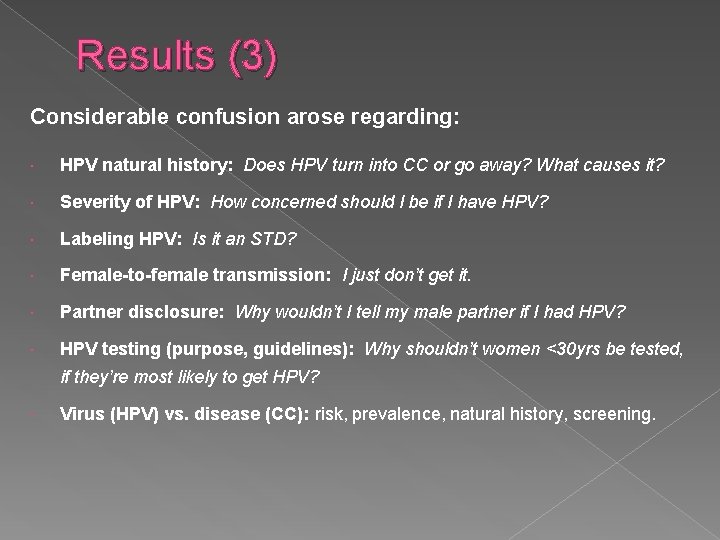
Results (3) Considerable confusion arose regarding: HPV natural history: Does HPV turn into CC or go away? What causes it? Severity of HPV: How concerned should I be if I have HPV? Labeling HPV: Is it an STD? Female-to-female transmission: I just don’t get it. Partner disclosure: Why wouldn’t I tell my male partner if I had HPV? HPV testing (purpose, guidelines): Why shouldn’t women <30 yrs be tested, if they’re most likely to get HPV? Virus (HPV) vs. disease (CC): risk, prevalence, natural history, screening.
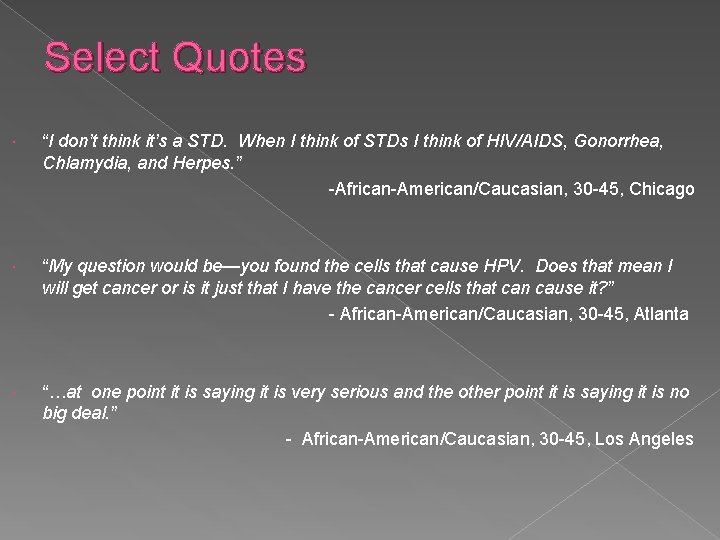
Select Quotes “I don’t think it’s a STD. When I think of STDs I think of HIV/AIDS, Gonorrhea, Chlamydia, and Herpes. ” -African-American/Caucasian, 30 -45, Chicago “My question would be—you found the cells that cause HPV. Does that mean I will get cancer or is it just that I have the cancer cells that can cause it? ” - African-American/Caucasian, 30 -45, Atlanta “…at one point it is saying it is very serious and the other point it is saying it is no big deal. ” - African-American/Caucasian, 30 -45, Los Angeles
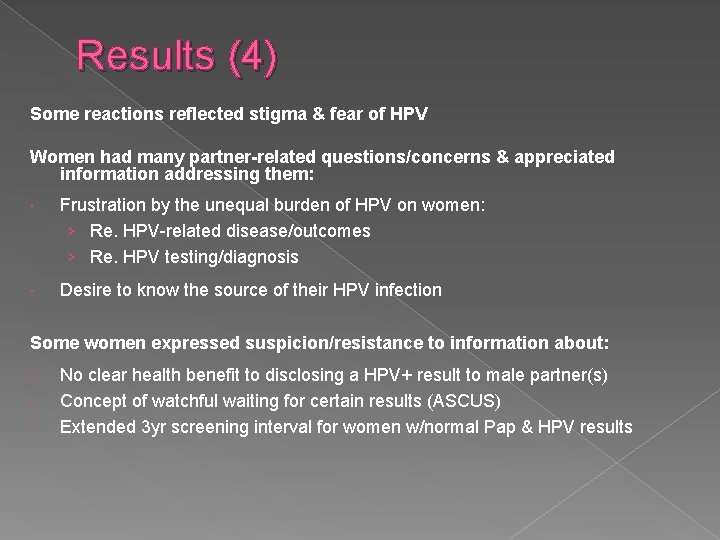
Results (4) Some reactions reflected stigma & fear of HPV Women had many partner-related questions/concerns & appreciated information addressing them: Frustration by the unequal burden of HPV on women: › Re. HPV-related disease/outcomes › Re. HPV testing/diagnosis Desire to know the source of their HPV infection Some women expressed suspicion/resistance to information about: No clear health benefit to disclosing a HPV+ result to male partner(s) Concept of watchful waiting for certain results (ASCUS) Extended 3 yr screening interval for women w/normal Pap & HPV results
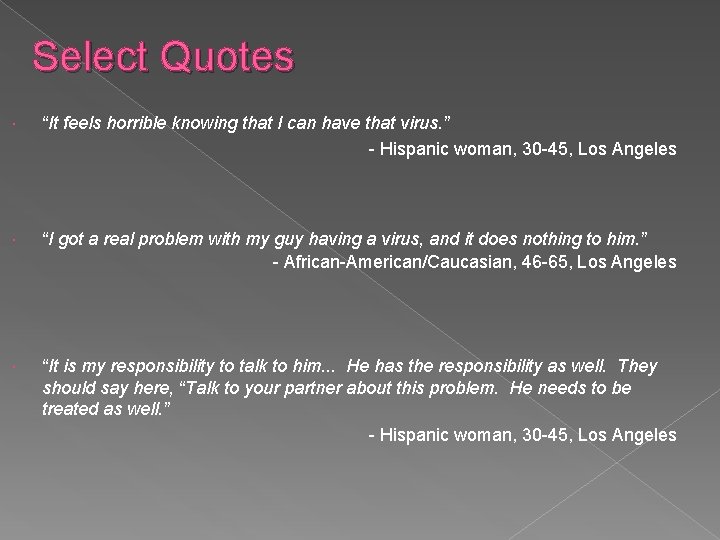
Select Quotes “It feels horrible knowing that I can have that virus. ” - Hispanic woman, 30 -45, Los Angeles “I got a real problem with my guy having a virus, and it does nothing to him. ” - African-American/Caucasian, 46 -65, Los Angeles “It is my responsibility to talk to him. . . He has the responsibility as well. They should say here, “Talk to your partner about this problem. He needs to be treated as well. ” - Hispanic woman, 30 -45, Los Angeles
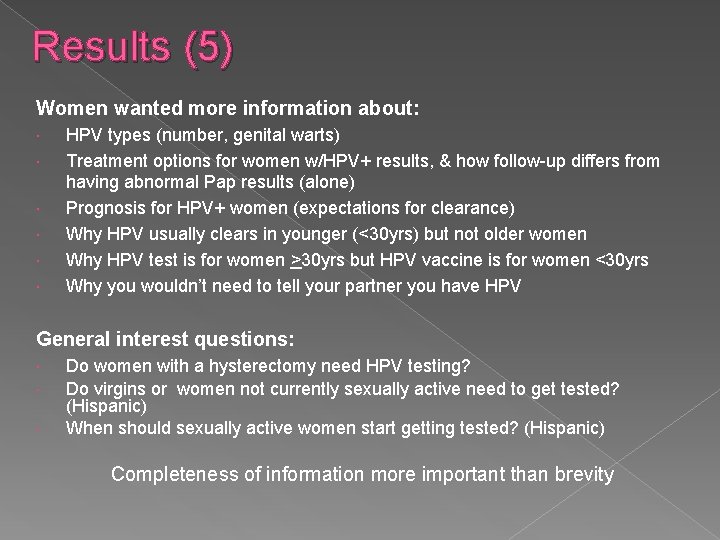
Results (5) Women wanted more information about: HPV types (number, genital warts) Treatment options for women w/HPV+ results, & how follow-up differs from having abnormal Pap results (alone) Prognosis for HPV+ women (expectations for clearance) Why HPV usually clears in younger (<30 yrs) but not older women Why HPV test is for women >30 yrs but HPV vaccine is for women <30 yrs Why you wouldn’t need to tell your partner you have HPV General interest questions: Do women with a hysterectomy need HPV testing? Do virgins or women not currently sexually active need to get tested? (Hispanic) When should sexually active women start getting tested? (Hispanic) Completeness of information more important than brevity
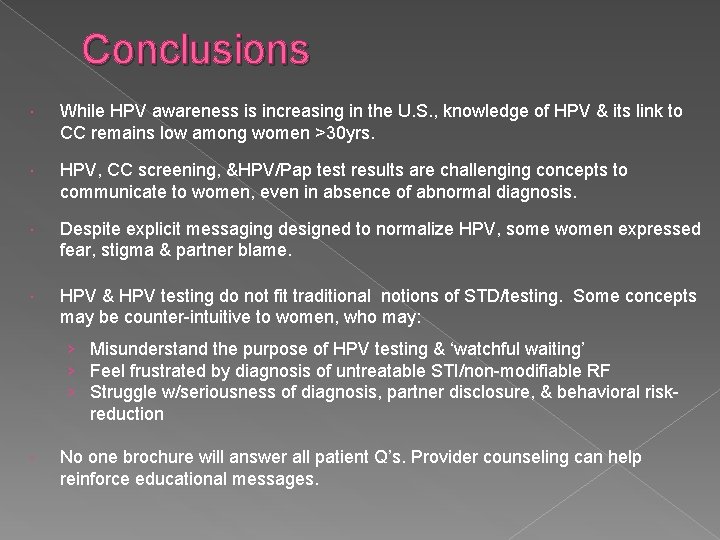
Conclusions While HPV awareness is increasing in the U. S. , knowledge of HPV & its link to CC remains low among women >30 yrs. HPV, CC screening, &HPV/Pap test results are challenging concepts to communicate to women, even in absence of abnormal diagnosis. Despite explicit messaging designed to normalize HPV, some women expressed fear, stigma & partner blame. HPV & HPV testing do not fit traditional notions of STD/testing. Some concepts may be counter-intuitive to women, who may: › Misunderstand the purpose of HPV testing & ‘watchful waiting’ › Feel frustrated by diagnosis of untreatable STI/non-modifiable RF › Struggle w/seriousness of diagnosis, partner disclosure, & behavioral riskreduction No one brochure will answer all patient Q’s. Provider counseling can help reinforce educational messages.
Limitations & Next Steps Participants were recruited from general public; may respond differently to materials than real patients who are trying to make sense of actual results. Patient Q&A is available online (see www. cdc. gov/std/hpv). Major revisions were made to patient brochure to address identified points of confusion & concern. Revised version has been cleared by CDC/HHS and will be available in summer 2008.
Acknowledgments Eileen Dunne Mona Saraiya Herschel Lawson Lauri Markowitz Cynthia Jorgensen Margo Gillman Alyson Burns Emily Yu
Thank You Allison Friedman 404. 639. 8537 alf 8@cdc. gov www. cdc. gov/std/hpv