
Making Salary Surveys Work How to select match








- Slides: 35
Making Salary Surveys Work: How to select, match and use salary surveys to build a strategic compensation plan Pawan Singh CEO and Chief Science Officer www. periscopeiq. com 484 -863 -9119 September 23, 2011
AGENDA • • Introduction to salary surveys Salary surveys and market pricing Strategic role of compensation and market pricing How best to use salary surveys How to identify and avoid pitfalls Advanced uses of salary surveys Your questions answered
Introduction to Salary Surveys
Historical Perspective • Need for salary benchmarking has always existed • Associations or chambers shared data among members • DOJ 1993 Guidelines disallowed such sharing • Ruling boosted the role of third-party survey providers • Wide range of salary survey data providers
Scope of Salary Surveys • Hundreds of salary surveys conducted in the U. S. alone • Survey Scope: National; Industry-specific; Regional; Local; Club. • Large number of salary survey providers including big HR consulting companies. • Government: BLS • New: Self-reported surveys: Payscale; Glassdoor • Benefit policies typically included in salary surveys
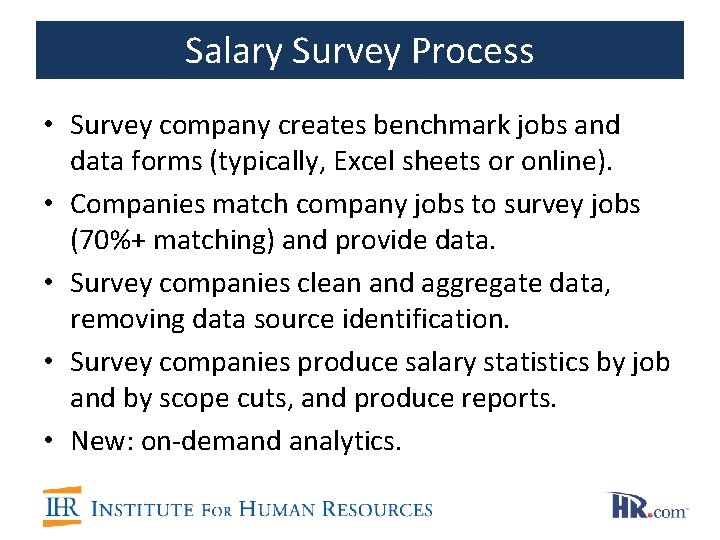
Salary Survey Process • Survey company creates benchmark jobs and data forms (typically, Excel sheets or online). • Companies match company jobs to survey jobs (70%+ matching) and provide data. • Survey companies clean and aggregate data, removing data source identification. • Survey companies produce salary statistics by job and by scope cuts, and produce reports. • New: on-demand analytics.
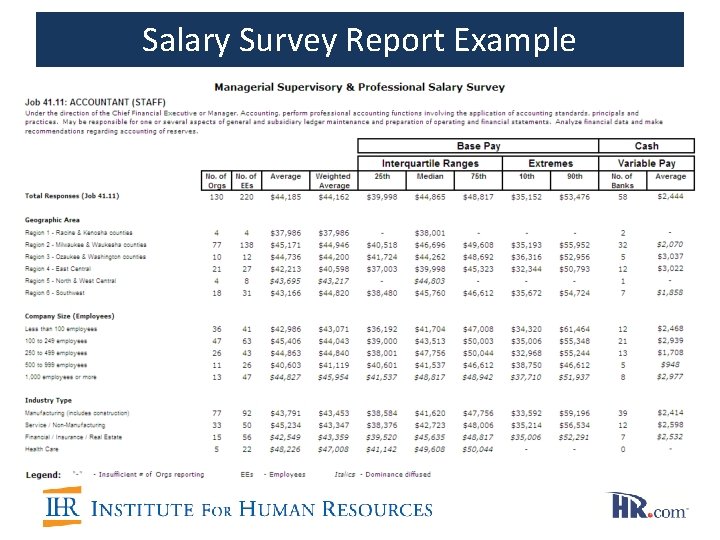
Salary Survey Report Example
Salary Surveys and Market Pricing
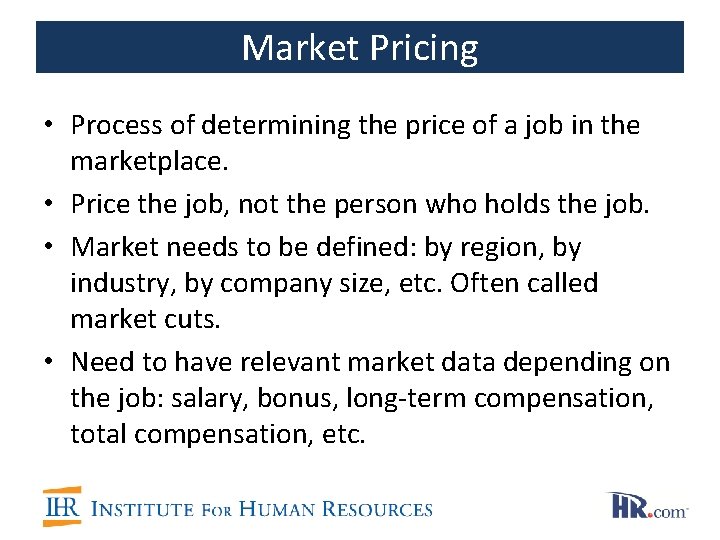
Market Pricing • Process of determining the price of a job in the marketplace. • Price the job, not the person who holds the job. • Market needs to be defined: by region, by industry, by company size, etc. Often called market cuts. • Need to have relevant market data depending on the job: salary, bonus, long-term compensation, total compensation, etc.
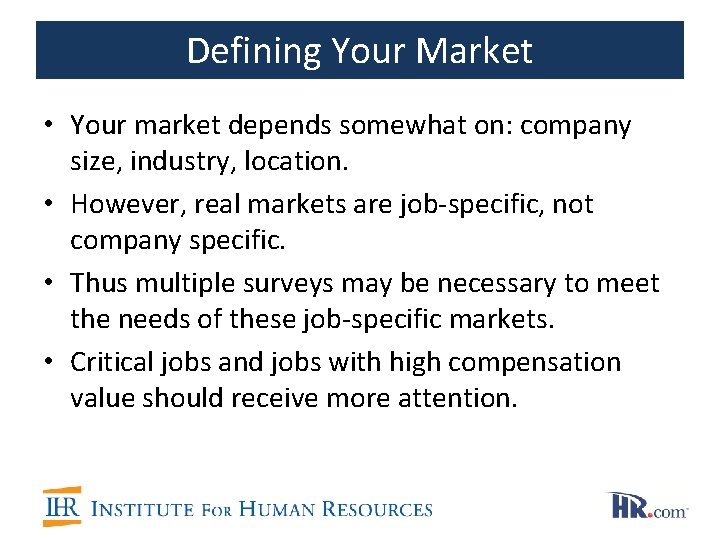
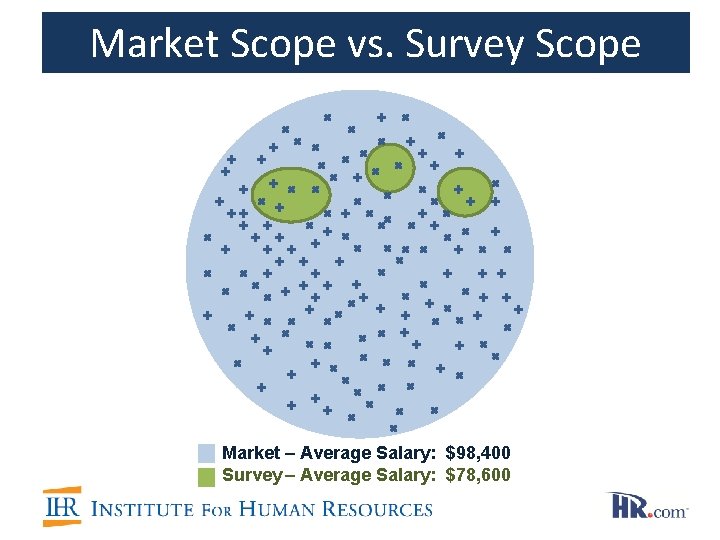
Defining Your Market • Your market depends somewhat on: company size, industry, location. • However, real markets are job-specific, not company specific. • Thus multiple surveys may be necessary to meet the needs of these job-specific markets. • Critical jobs and jobs with high compensation value should receive more attention.
Market Scope vs. Survey Scope Market – Average Salary: $98, 400 Survey – Average Salary: $78, 600
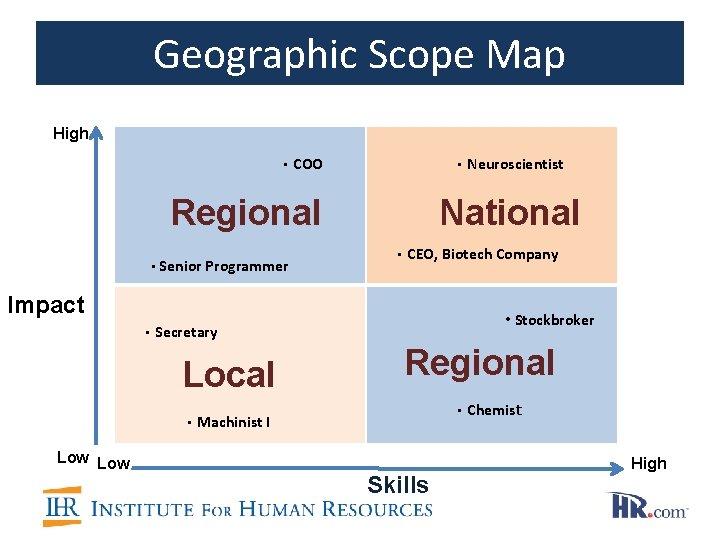
Geographic Scope Map High • COO • Neuroscientist Regional • Senior Programmer National • CEO, Biotech Company Impact • Stockbroker • Secretary Local Regional • Chemist • Machinist I Low Skills High
Pitfalls in Salary Surveys
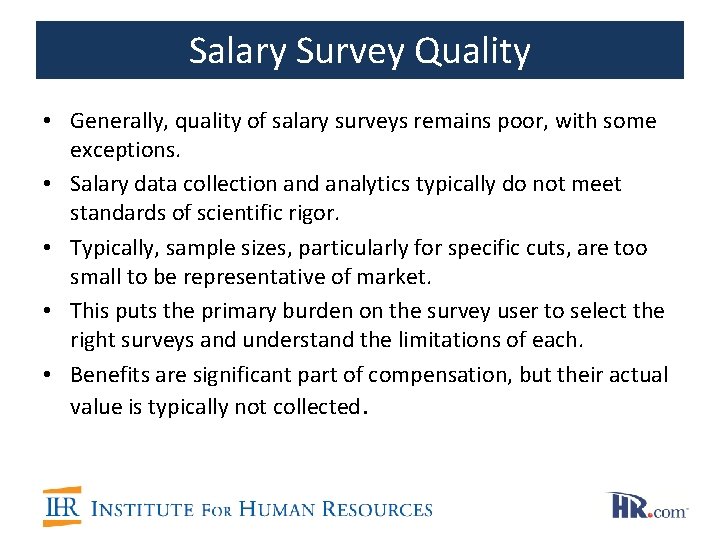
Salary Survey Quality • Generally, quality of salary surveys remains poor, with some exceptions. • Salary data collection and analytics typically do not meet standards of scientific rigor. • Typically, sample sizes, particularly for specific cuts, are too small to be representative of market. • This puts the primary burden on the survey user to select the right surveys and understand the limitations of each. • Benefits are significant part of compensation, but their actual value is typically not collected.
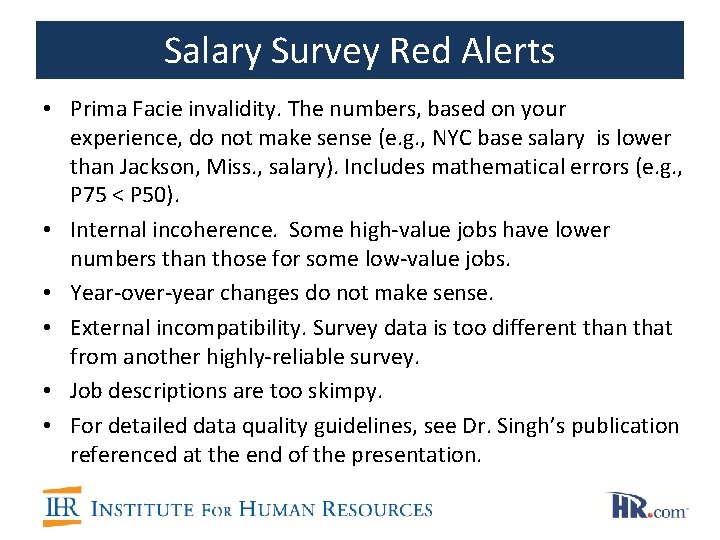
Salary Survey Red Alerts • Prima Facie invalidity. The numbers, based on your experience, do not make sense (e. g. , NYC base salary is lower than Jackson, Miss. , salary). Includes mathematical errors (e. g. , P 75 < P 50). • Internal incoherence. Some high-value jobs have lower numbers than those for some low-value jobs. • Year-over-year changes do not make sense. • External incompatibility. Survey data is too different than that from another highly-reliable survey. • Job descriptions are too skimpy. • For detailed data quality guidelines, see Dr. Singh’s publication referenced at the end of the presentation.
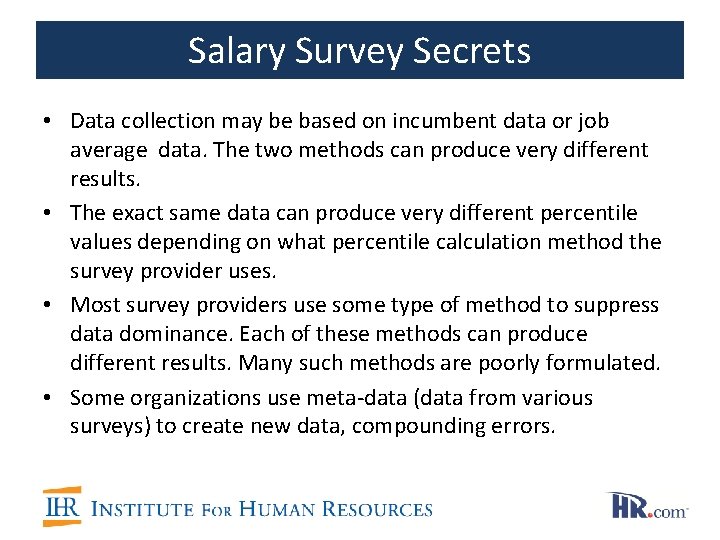
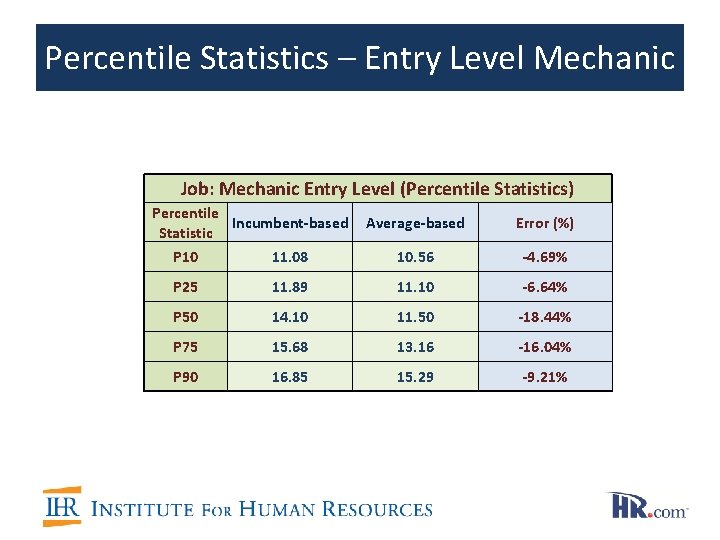
Salary Survey Secrets • Data collection may be based on incumbent data or job average data. The two methods can produce very different results. • The exact same data can produce very different percentile values depending on what percentile calculation method the survey provider uses. • Most survey providers use some type of method to suppress data dominance. Each of these methods can produce different results. Many such methods are poorly formulated. • Some organizations use meta-data (data from various surveys) to create new data, compounding errors.
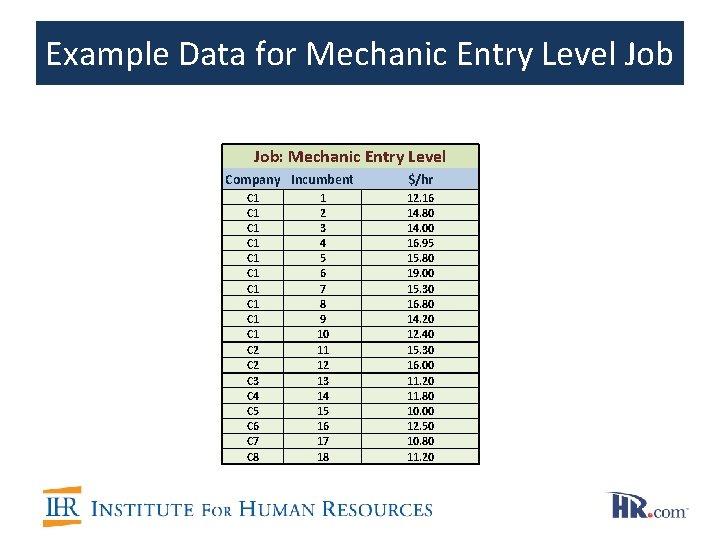
Example Data for Mechanic Entry Level Job: Mechanic Entry Level Company Incumbent C 1 C 1 C 1 C 2 C 3 C 4 C 5 C 6 C 7 C 8 1 2 3 4 5 6 7 8 9 10 11 12 13 14 15 16 17 18 $/hr 12. 16 14. 80 14. 00 16. 95 15. 80 19. 00 15. 30 16. 80 14. 20 12. 40 15. 30 16. 00 11. 20 11. 80 10. 00 12. 50 10. 80 11. 20
Percentile Statistics – Entry Level Mechanic Job: Mechanic Entry Level (Percentile Statistics) Percentile Incumbent-based Statistic Average-based Error (%) P 10 11. 08 10. 56 -4. 69% P 25 11. 89 11. 10 -6. 64% P 50 14. 10 11. 50 -18. 44% P 75 15. 68 13. 16 -16. 04% P 90 16. 85 15. 29 -9. 21%
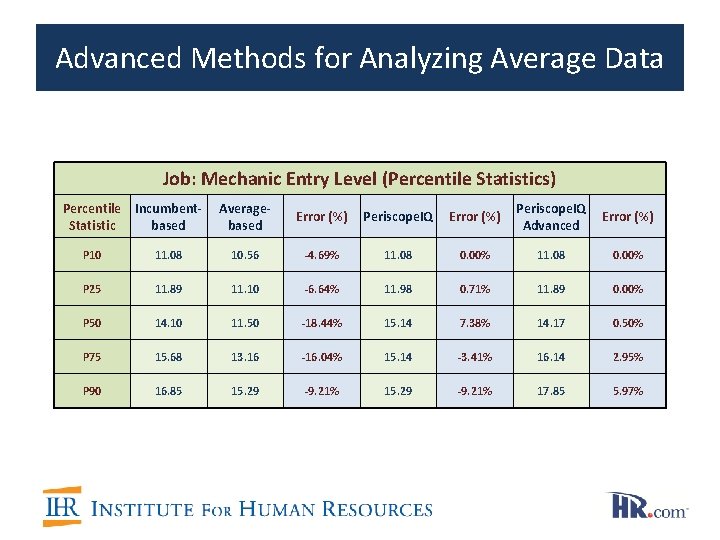
Advanced Methods for Analyzing Average Data Job: Mechanic Entry Level (Percentile Statistics) Percentile Incumbent. Statistic based Averagebased Error (%) Periscope. IQ Advanced Error (%) P 10 11. 08 10. 56 -4. 69% 11. 08 0. 00% P 25 11. 89 11. 10 -6. 64% 11. 98 0. 71% 11. 89 0. 00% P 50 14. 10 11. 50 -18. 44% 15. 14 7. 38% 14. 17 0. 50% P 75 15. 68 13. 16 -16. 04% 15. 14 -3. 41% 16. 14 2. 95% P 90 16. 85 15. 29 -9. 21% 17. 85 5. 97%
Best Practices in Salary Surveys
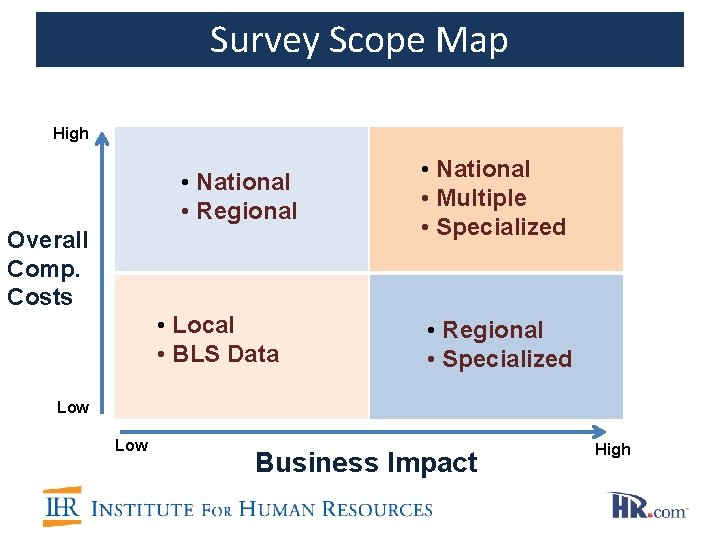
Survey Scope Map High • National • Regional Overall Comp. Costs • Local • BLS Data • National • Multiple • Specialized • Regional • Specialized Low Business Impact High
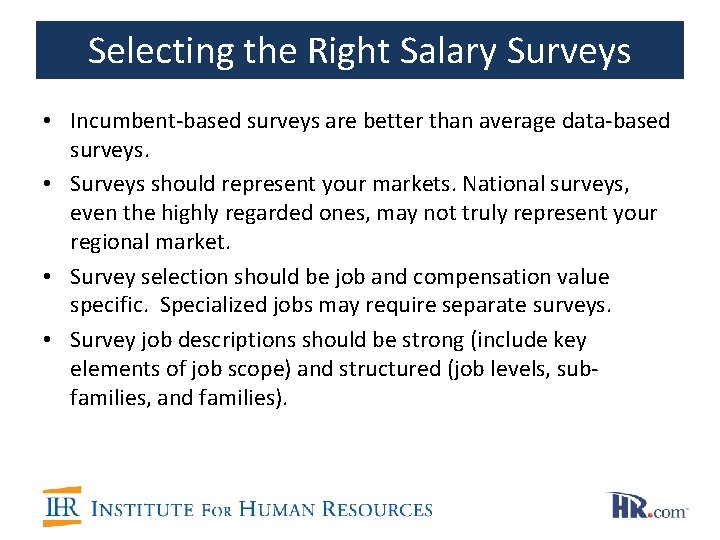
Selecting the Right Salary Surveys • Incumbent-based surveys are better than average data-based surveys. • Surveys should represent your markets. National surveys, even the highly regarded ones, may not truly represent your regional market. • Survey selection should be job and compensation value specific. Specialized jobs may require separate surveys. • Survey job descriptions should be strong (include key elements of job scope) and structured (job levels, subfamilies, and families).
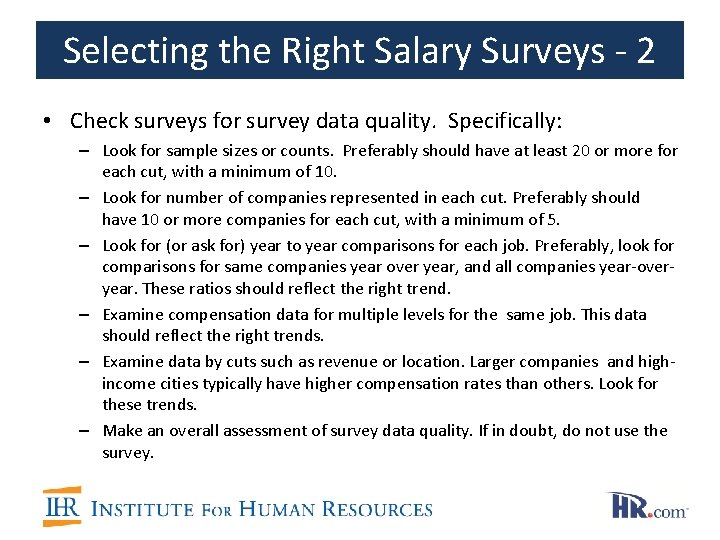
Selecting the Right Salary Surveys - 2 • Check surveys for survey data quality. Specifically: – Look for sample sizes or counts. Preferably should have at least 20 or more for each cut, with a minimum of 10. – Look for number of companies represented in each cut. Preferably should have 10 or more companies for each cut, with a minimum of 5. – Look for (or ask for) year to year comparisons for each job. Preferably, look for comparisons for same companies year over year, and all companies year-overyear. These ratios should reflect the right trend. – Examine compensation data for multiple levels for the same job. This data should reflect the right trends. – Examine data by cuts such as revenue or location. Larger companies and highincome cities typically have higher compensation rates than others. Look for these trends. – Make an overall assessment of survey data quality. If in doubt, do not use the survey.
Selecting the Right Salary Surveys - 3 • After you have made your assessment, check with peers from other organizations. Then select the right surveys, and stick to those unless your market or the survey direction changes. Continue to check survey quality every year.
Using Salary Surveys
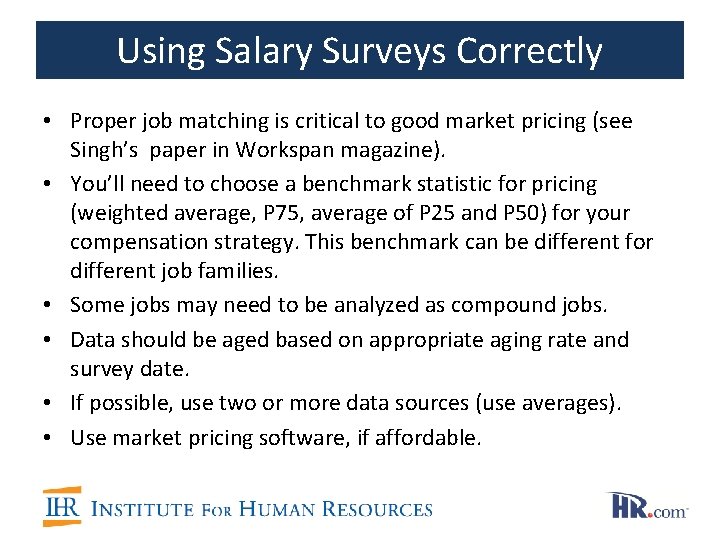
Using Salary Surveys Correctly • Proper job matching is critical to good market pricing (see Singh’s paper in Workspan magazine). • You’ll need to choose a benchmark statistic for pricing (weighted average, P 75, average of P 25 and P 50) for your compensation strategy. This benchmark can be different for different job families. • Some jobs may need to be analyzed as compound jobs. • Data should be aged based on appropriate aging rate and survey date. • If possible, use two or more data sources (use averages). • Use market pricing software, if affordable.
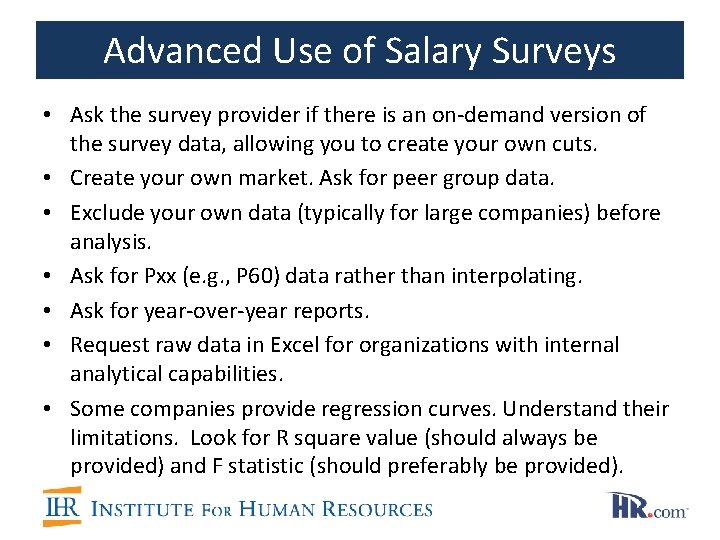
Advanced Use of Salary Surveys • Ask the survey provider if there is an on-demand version of the survey data, allowing you to create your own cuts. • Create your own market. Ask for peer group data. • Exclude your own data (typically for large companies) before analysis. • Ask for Pxx (e. g. , P 60) data rather than interpolating. • Ask for year-over-year reports. • Request raw data in Excel for organizations with internal analytical capabilities. • Some companies provide regression curves. Understand their limitations. Look for R square value (should always be provided) and F statistic (should preferably be provided).
Strategic Role of Compensation
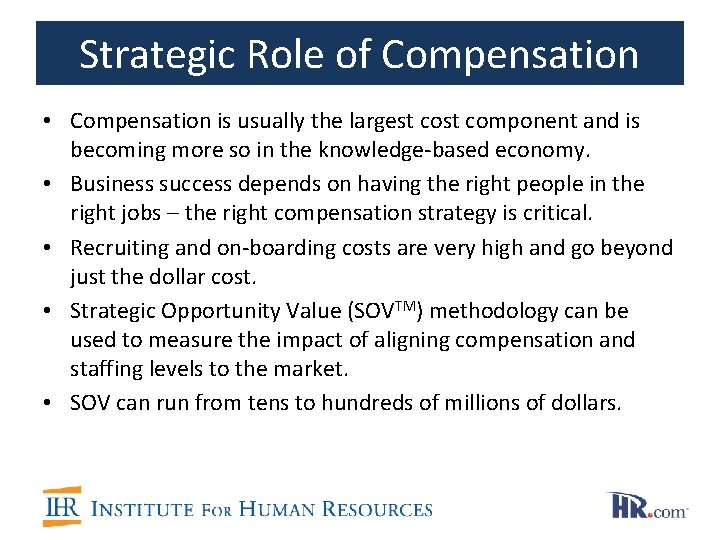
Strategic Role of Compensation • Compensation is usually the largest component and is becoming more so in the knowledge-based economy. • Business success depends on having the right people in the right jobs – the right compensation strategy is critical. • Recruiting and on-boarding costs are very high and go beyond just the dollar cost. • Strategic Opportunity Value (SOVTM) methodology can be used to measure the impact of aligning compensation and staffing levels to the market. • SOV can run from tens to hundreds of millions of dollars.
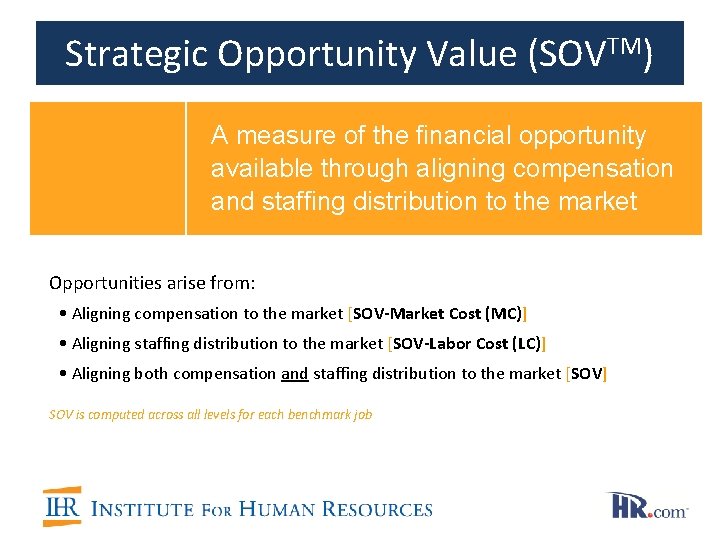
Strategic Opportunity Value (SOVTM) A measure of the financial opportunity available through aligning compensation and staffing distribution to the market Opportunities arise from: • Aligning compensation to the market [SOV-Market Cost (MC)] • Aligning staffing distribution to the market [SOV-Labor Cost (LC)] • Aligning both compensation and staffing distribution to the market [SOV] SOV is computed across all levels for each benchmark job
Summary and Conclusions
Summary and Conclusions • Compensation strategy is critical to business success – it is more than transactional processing. • Having the right compensation strategy is possibly the biggest source of cost savings. • Market pricing is key to proper compensation strategy. • Selecting appropriate salary surveys and using optimal methodologies is critical to market pricing success. • Survey data quality varies – it is critical to understand the strengths and weaknesses of each survey relative to your needs • This presentation offered guidelines, best practices and methodologies to achieve proper market pricing.
References • Singh, P. , ‘The Basics of Benchmarking in the Great Recession, ’ Workspan Magazine, Worldat. Work, Sept. 2010 • Singh, P. , Salary Data Red Alert: ‘Do You Know Where Your Compensation Data Came From, ’ Compensation Focus, Worldat. Work, June 2010 • Singh, P. And Rosen, A. , Transform Compensation into a Strategic Driver, Proceedings of the Total Rewards 2007 Worldat. Work Conference & Exhibition, Orlando, Florida, May 2007.
Resources For any questions after the webinar, please send an email to the presenter at psingh@periscopeiq. com or call Dr. Singh at 484 -863 -9119 x 123.
Thank You