
Making Safety A Culture Not Just an Initiative
- Slides: 56
Making Safety A Culture, Not Just an Initiative Sherry R. Perdue, Ph. D. Safety Performance Solutions 610 N. Main Street Suite 228 Blacksburg, VA 24060 www. safetyperformance. com (540) 951 -7233
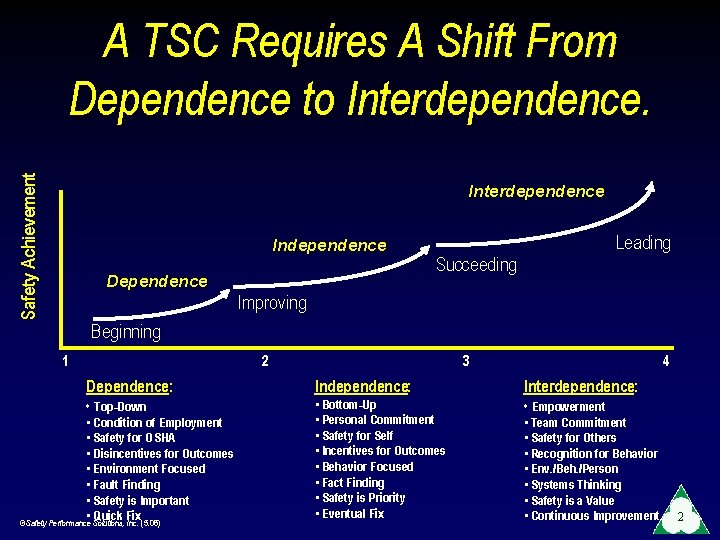
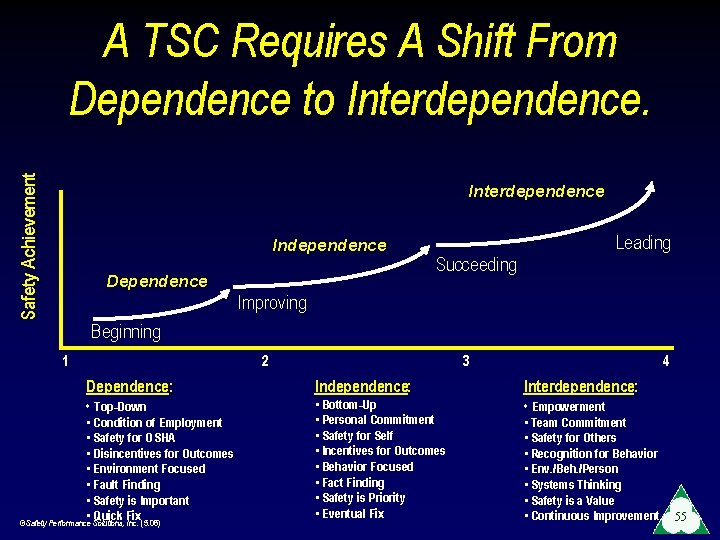
Safety Achievement A TSC Requires A Shift From Dependence to Interdependence Independence Dependence Leading Succeeding Improving Beginning 1 2 3 4 Dependence: Independence: Interdependence: • Top-Down • Bottom-Up • Personal Commitment • Safety for Self • Incentives for Outcomes • Behavior Focused • Fact Finding • Safety is Priority • Eventual Fix • Empowerment • Condition of Employment • Safety for OSHA • Disincentives for Outcomes • Environment Focused • Fault Finding • Safety is Important • Quick Fix ©Safety Performance Solutions, Inc. (5. 06) • Team Commitment • Safety for Others • Recognition for Behavior • Env. /Beh. /Person • Systems Thinking • Safety is a Value • Continuous Improvement 2
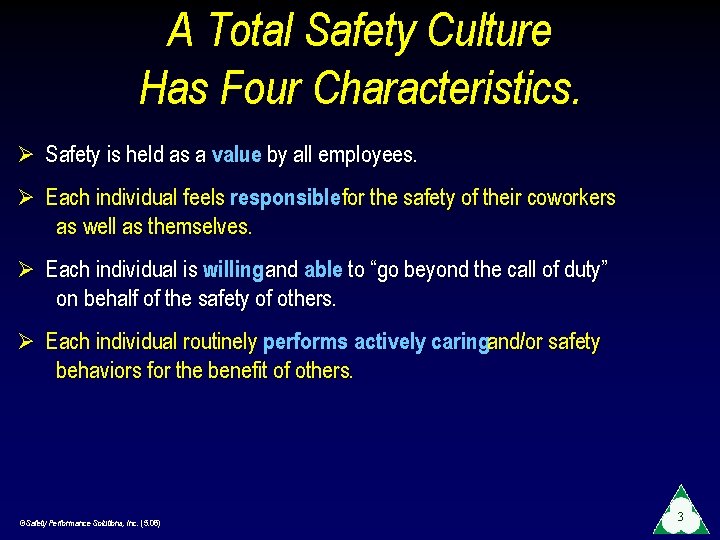
A Total Safety Culture Has Four Characteristics. Ø Safety is held as a value by all employees. Ø Each individual feels responsible for the safety of their coworkers as well as themselves. Ø Each individual is willing and able to “go beyond the call of duty” on behalf of the safety of others. Ø Each individual routinely performs actively caringand/or safety behaviors for the benefit of others. ©Safety Performance Solutions, Inc. (5. 06) 3
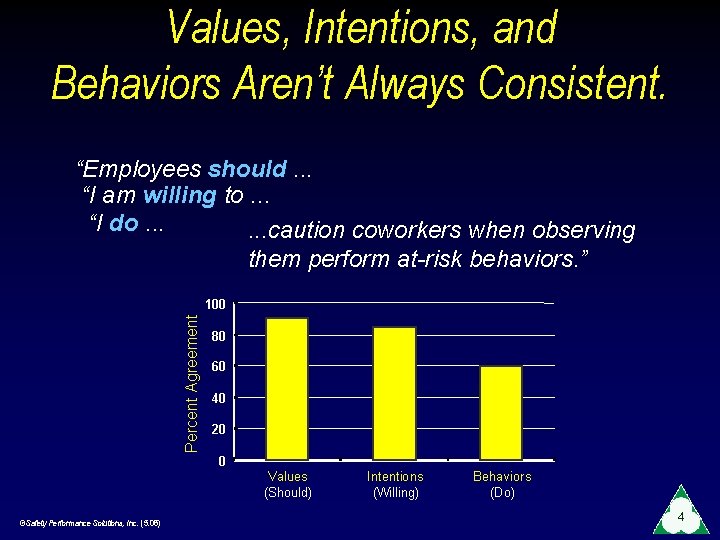
Values, Intentions, and Behaviors Aren’t Always Consistent. “Employees should. . . “I am willing to. . . “I do. . . caution coworkers when observing them perform at-risk behaviors. ” Percent Agreement 100 80 60 40 20 0 Values (Should) ©Safety Performance Solutions, Inc. (5. 06) Intentions (Willing) Behaviors (Do) 4
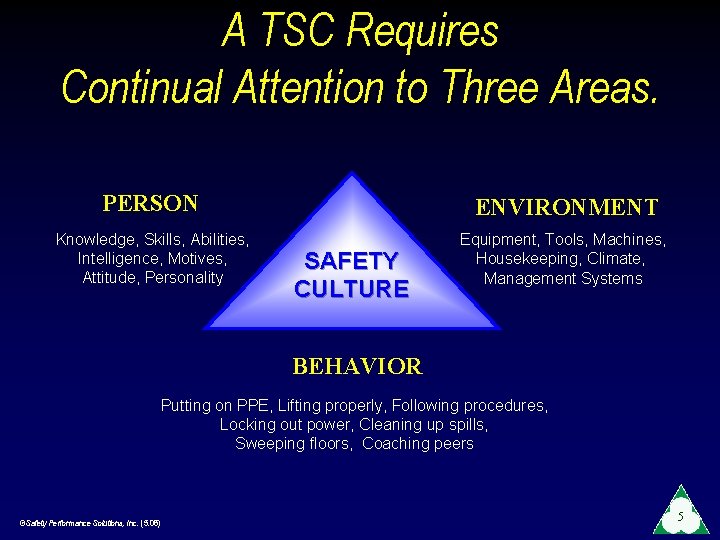
A TSC Requires Continual Attention to Three Areas. PERSON ENVIRONMENT Knowledge, Skills, Abilities, Intelligence, Motives, Attitude, Personality Equipment, Tools, Machines, Housekeeping, Climate, Management Systems SAFETY CULTURE BEHAVIOR Putting on PPE, Lifting properly, Following procedures, Locking out power, Cleaning up spills, Sweeping floors, Coaching peers ©Safety Performance Solutions, Inc. (5. 06) 5
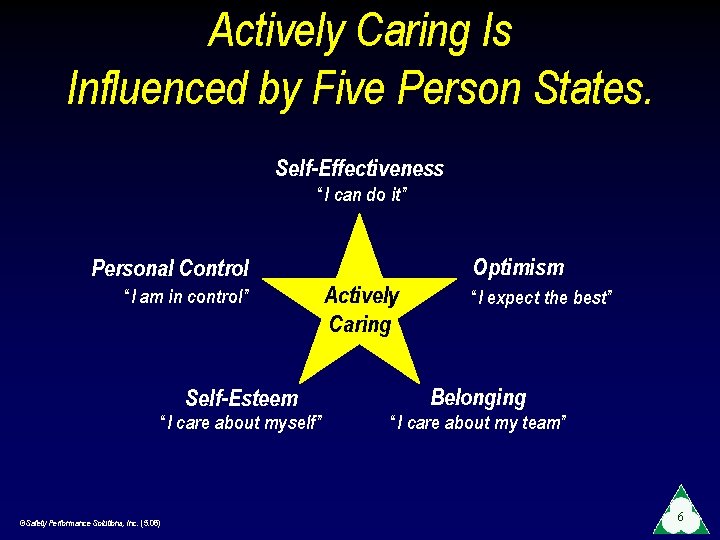
Actively Caring Is Influenced by Five Person States. Self-Effectiveness “I can do it” Personal Control “I am in control” Self-Esteem Optimism Actively Caring “I care about myself” ©Safety Performance Solutions, Inc. (5. 06) “I expect the best” Belonging “I care about my team” 6
“The very things that got us here may be the same things that hold us back from getting better. ” ©Safety Performance Solutions, Inc. (5. 06) 7
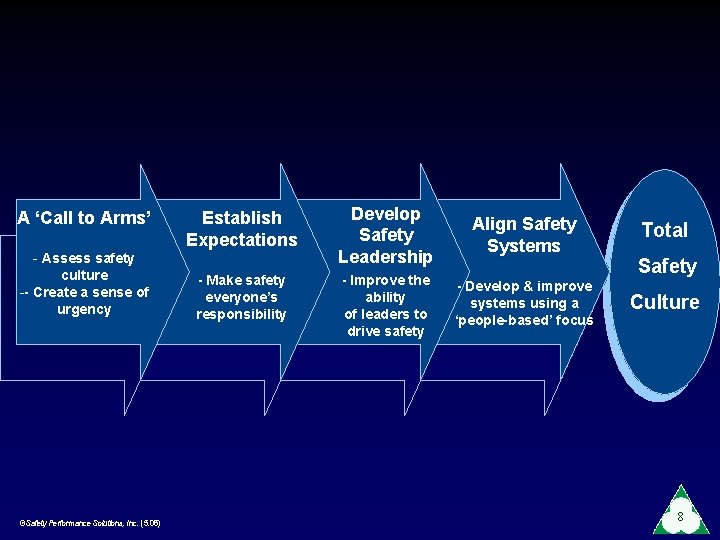
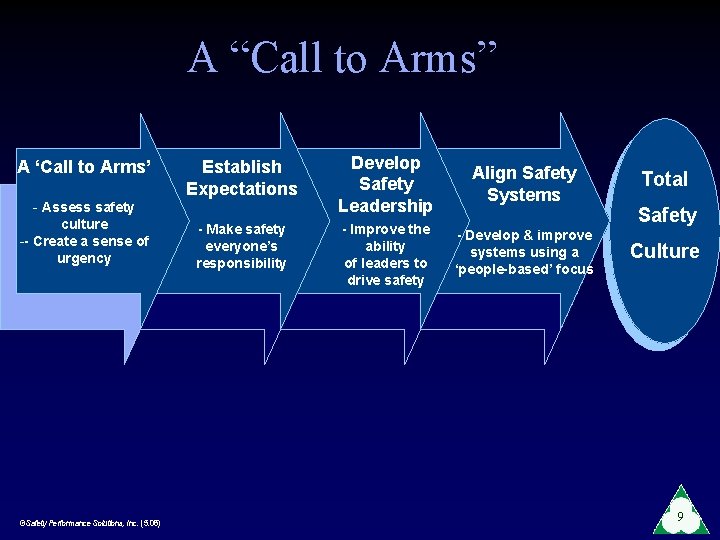
A ‘Call to Arms’ - Assess safety culture -- Create a sense of urgency ©Safety Performance Solutions, Inc. (5. 06) Establish Expectations Develop Safety Leadership Align Safety Systems - Make safety everyone’s responsibility - Improve the ability of leaders to drive safety - Develop & improve systems using a ‘people-based’ focus Total Safety Culture 8
A “Call to Arms” A ‘Call to Arms’ - Assess safety culture -- Create a sense of urgency ©Safety Performance Solutions, Inc. (5. 06) Establish Expectations Develop Safety Leadership Align Safety Systems - Make safety everyone’s responsibility - Improve the ability of leaders to drive safety - Develop & improve systems using a ‘people-based’ focus Total Safety Culture 9
A Safety Culture Survey Measures Employee Perceptions. -Perceptions are “reality” - Although perceptions may be incorrect, they drive behaviors and establish the culture. ©Safety Performance Solutions, Inc. (5. 06) 10
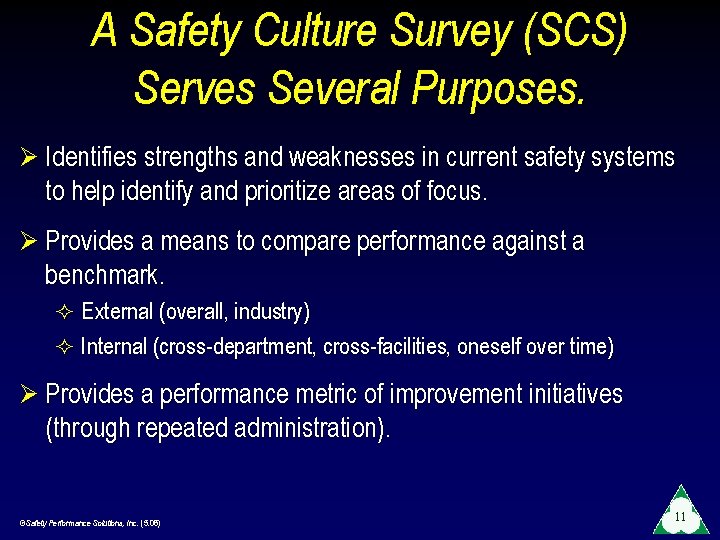
A Safety Culture Survey (SCS) Serves Several Purposes. Ø Identifies strengths and weaknesses in current safety systems to help identify and prioritize areas of focus. Ø Provides a means to compare performance against a benchmark. ² External (overall, industry) ² Internal (cross-department, cross-facilities, oneself over time) Ø Provides a performance metric of improvement initiatives (through repeated administration). ©Safety Performance Solutions, Inc. (5. 06) 11
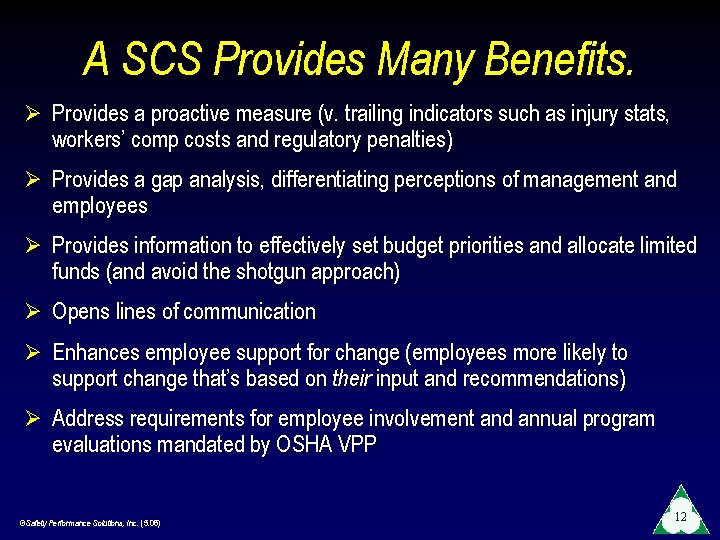
A SCS Provides Many Benefits. Ø Provides a proactive measure (v. trailing indicators such as injury stats, workers’ comp costs and regulatory penalties) Ø Provides a gap analysis, differentiating perceptions of management and employees Ø Provides information to effectively set budget priorities and allocate limited funds (and avoid the shotgun approach) Ø Opens lines of communication Ø Enhances employee support for change (employees more likely to support change that’s based on their input and recommendations) Ø Address requirements for employee involvement and annual program evaluations mandated by OSHA VPP ©Safety Performance Solutions, Inc. (5. 06) 12
A SCS Has Benefits Over Other Information Gathering Tools. Ø Gathers information from all or a representative sample. ² Committees, suggestion systems, and even interviews favor the vocal minority ² Results in better information, as well as “empowered” workforce. Ø Gathers sensitive information from employees in a confidential manner (thus encouraging more frank, candid comments). Ø Relatively quick, easy, and cost-effective. ©Safety Performance Solutions, Inc. (5. 06) 13
A SCS Should Measure A Wide Variety of Issues. Ø Management Support for Safety ² Genuine interest in reducing injuries (v. “keeping the numbers low”) ² Willingness to invest resources (i. e. , time and money) ² Ability to balance safety with other KPI’s (e. g. , productivity, schedule) Ø Peer Support for Safety (“Interdependence” or “Actively Caring”) Ø Personal Responsibility for Safety ©Safety Performance Solutions, Inc. (5. 06) 14
A SCS Should Measure A Wide Variety of Issues. Ø Safety Management Systems, including: ² Incident Reporting & Investigation ² Discipline ² Rewards & Recognition ² Communication ² Safety Accountability ² Training ² Behavior-based Observation & Feedback process ² Employee Involvement ² Facilities Audits & Inspections ©Safety Performance Solutions, Inc. (5. 06) 15
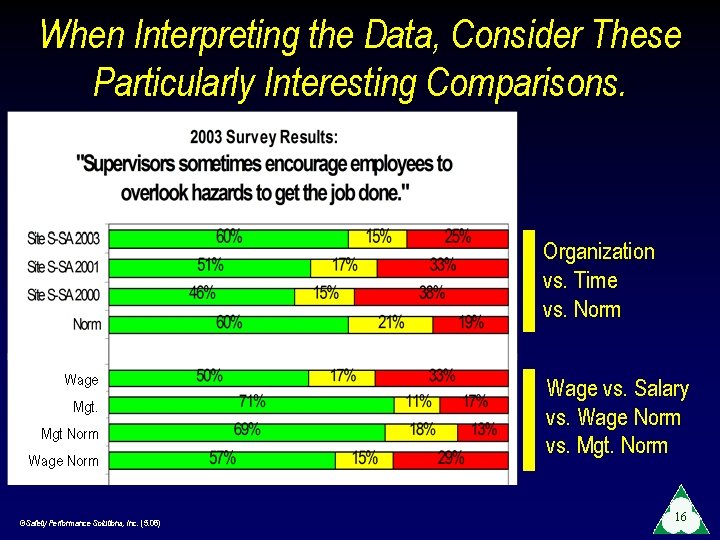
When Interpreting the Data, Consider These Particularly Interesting Comparisons. Organization vs. Time vs. Norm Wage Mgt Norm Wage Norm ©Safety Performance Solutions, Inc. (5. 06) Wage vs. Salary vs. Wage Norm vs. Mgt. Norm 16
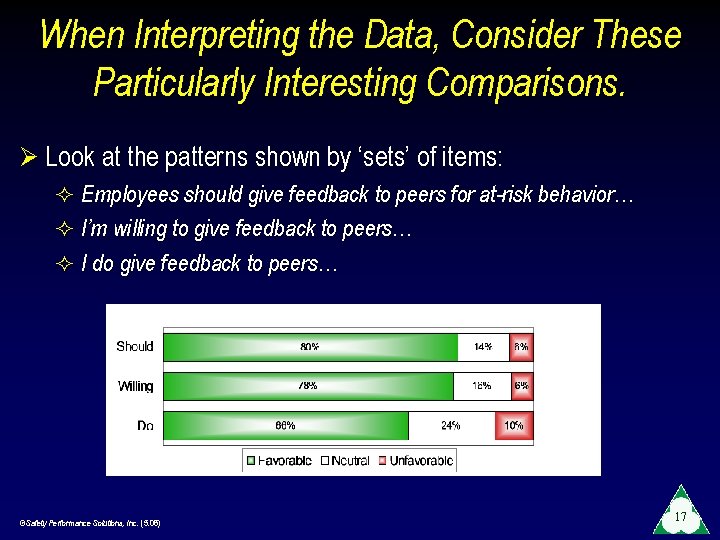
When Interpreting the Data, Consider These Particularly Interesting Comparisons. Ø Look at the patterns shown by ‘sets’ of items: ² Employees should give feedback to peers for at-risk behavior… ² I’m willing to give feedback to peers… ² I do give feedback to peers… ©Safety Performance Solutions, Inc. (5. 06) 17
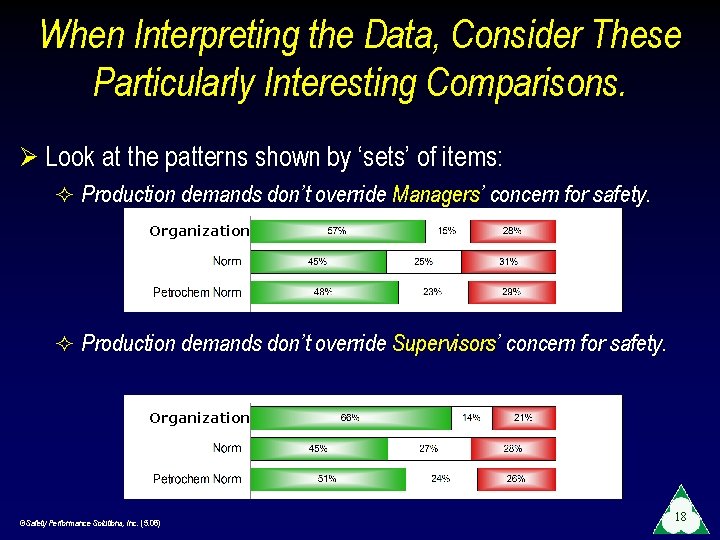
When Interpreting the Data, Consider These Particularly Interesting Comparisons. Ø Look at the patterns shown by ‘sets’ of items: ² Production demands don’t override Managers’ concern for safety. Organization ² Production demands don’t override Supervisors’ concern for safety. Organization ©Safety Performance Solutions, Inc. (5. 06) 18
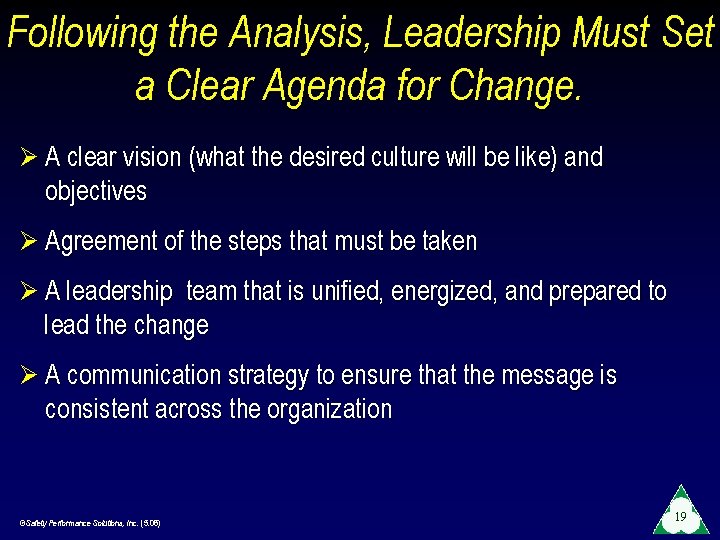
Following the Analysis, Leadership Must Set a Clear Agenda for Change. Ø A clear vision (what the desired culture will be like) and objectives Ø Agreement of the steps that must be taken Ø A leadership team that is unified, energized, and prepared to lead the change Ø A communication strategy to ensure that the message is consistent across the organization ©Safety Performance Solutions, Inc. (5. 06) 19
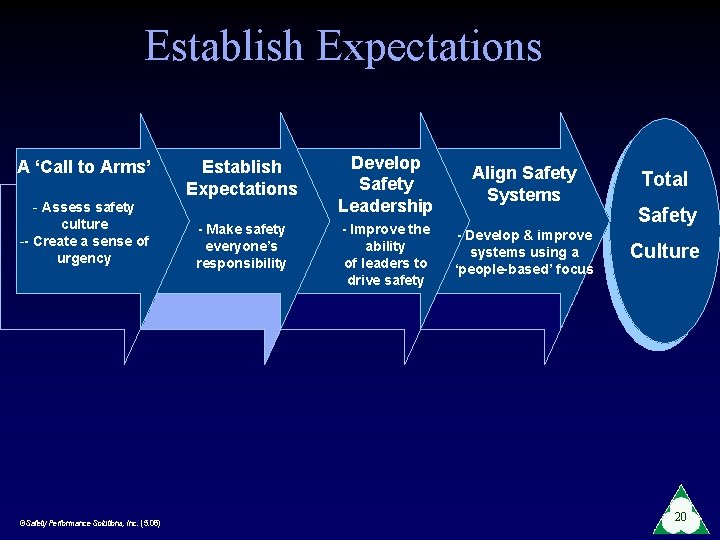
Establish Expectations A ‘Call to Arms’ - Assess safety culture -- Create a sense of urgency ©Safety Performance Solutions, Inc. (5. 06) Establish Expectations Develop Safety Leadership Align Safety Systems - Make safety everyone’s responsibility - Improve the ability of leaders to drive safety - Develop & improve systems using a ‘people-based’ focus Total Safety Culture 20
Poorly Defined Expectations Result In Two Problems. Ø Leaders don’t always understand what they can and should do to support safety. Ø The organization doesn’t recognize or reward those who perform well or help develop those who do not. Ø “What Gets Measured Gets Done”. ©Safety Performance Solutions, Inc. (5. 06) 21
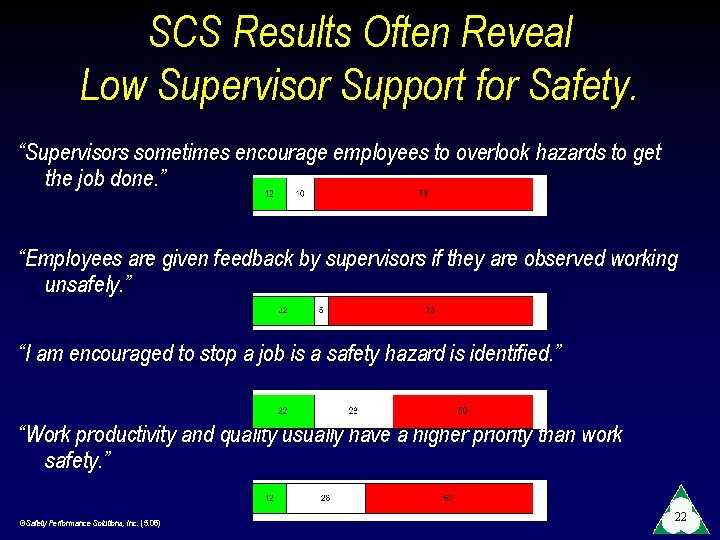
SCS Results Often Reveal Low Supervisor Support for Safety. “Supervisors sometimes encourage employees to overlook hazards to get the job done. ” “Employees are given feedback by supervisors if they are observed working unsafely. ” “I am encouraged to stop a job is a safety hazard is identified. ” “Work productivity and quality usually have a higher priority than work safety. ” ©Safety Performance Solutions, Inc. (5. 06) 22
Further Study Often Reveals Supervisors Have Poorly-Defined Safety Responsibilities. Ø “Give monthly safety meeting talk”. Ø “Make sure everybody’s wearing their PPE”. Ø “Stop an employee if you see them breaking a safety rule”. Ø “Send people to training when required”. Ø “Help new employees or transfers learn the safety rules”. Ø“Keep the injury rate in your group as low as possible. ” ©Safety Performance Solutions, Inc. (5. 06) 23
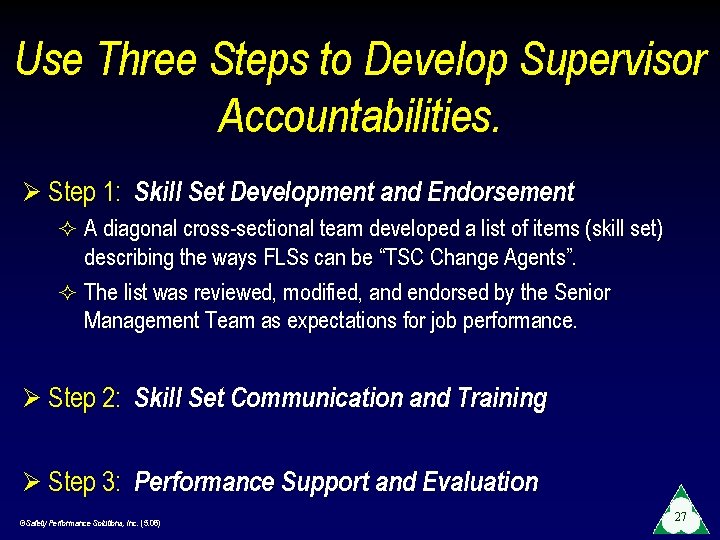
Use Three Steps to Develop Supervisor Accountabilities. Ø Step 1: Skill Set Development and Endorsement ² A representative team develops a list of items describing how supervisors can be “TSC Change Agents”. ² The list is reviewed, modified, and endorsed by the Senior Management Team as expectations for job performance. Ø Step 2: Skill Set Communication and Training Ø Step 3: Performance Support and Evaluation ©Safety Performance Solutions, Inc. (5. 06) 24
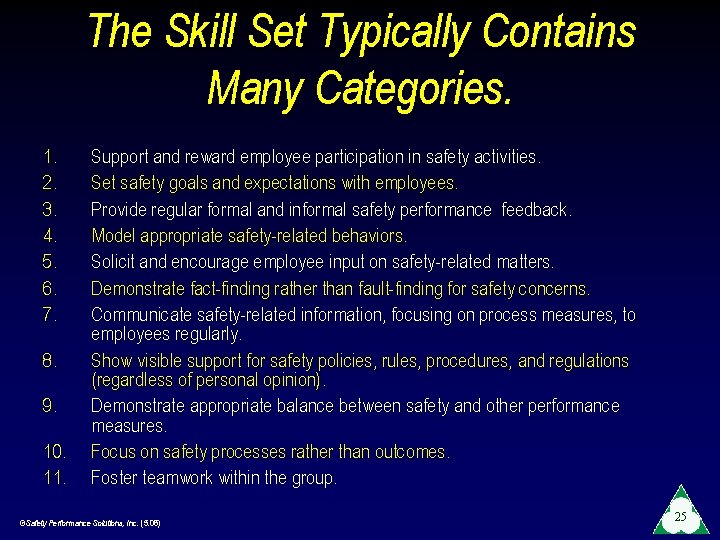
The Skill Set Typically Contains Many Categories. 1. 2. 3. 4. 5. 6. 7. 8. 9. 10. 11. Support and reward employee participation in safety activities. Set safety goals and expectations with employees. Provide regular formal and informal safety performance feedback. Model appropriate safety-related behaviors. Solicit and encourage employee input on safety-related matters. Demonstrate fact-finding rather than fault-finding for safety concerns. Communicate safety-related information, focusing on process measures, to employees regularly. Show visible support for safety policies, rules, procedures, and regulations (regardless of personal opinion). Demonstrate appropriate balance between safety and other performance measures. Focus on safety processes rather than outcomes. Foster teamwork within the group. ©Safety Performance Solutions, Inc. (5. 06) 25
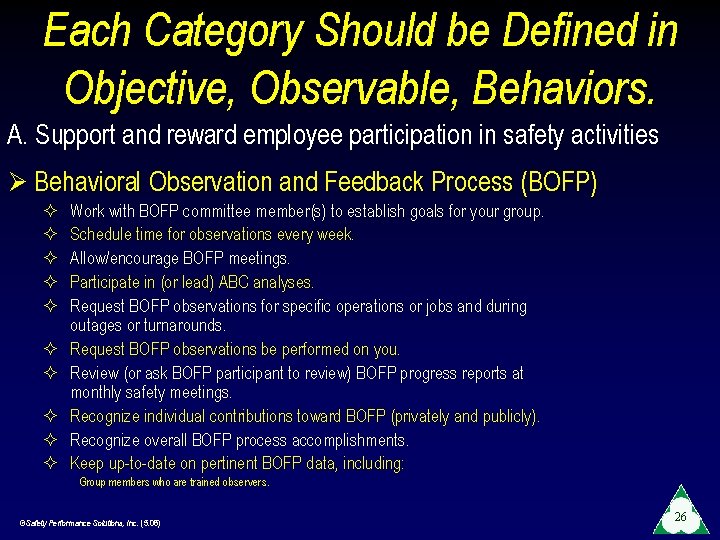
Each Category Should be Defined in Objective, Observable, Behaviors. A. Support and reward employee participation in safety activities Ø Behavioral Observation and Feedback Process (BOFP) ² ² ² ² ² Work with BOFP committee member(s) to establish goals for your group. Schedule time for observations every week. Allow/encourage BOFP meetings. Participate in (or lead) ABC analyses. Request BOFP observations for specific operations or jobs and during outages or turnarounds. Request BOFP observations be performed on you. Review (or ask BOFP participant to review) BOFP progress reports at monthly safety meetings. Recognize individual contributions toward BOFP (privately and publicly). Recognize overall BOFP process accomplishments. Keep up-to-date on pertinent BOFP data, including: Group members who are trained observers. ©Safety Performance Solutions, Inc. (5. 06) 26
Use Three Steps to Develop Supervisor Accountabilities. Ø Step 1: Skill Set Development and Endorsement ² A diagonal cross-sectional team developed a list of items (skill set) describing the ways FLSs can be “TSC Change Agents”. ² The list was reviewed, modified, and endorsed by the Senior Management Team as expectations for job performance. Ø Step 2: Skill Set Communication and Training Ø Step 3: Performance Support and Evaluation ©Safety Performance Solutions, Inc. (5. 06) 27
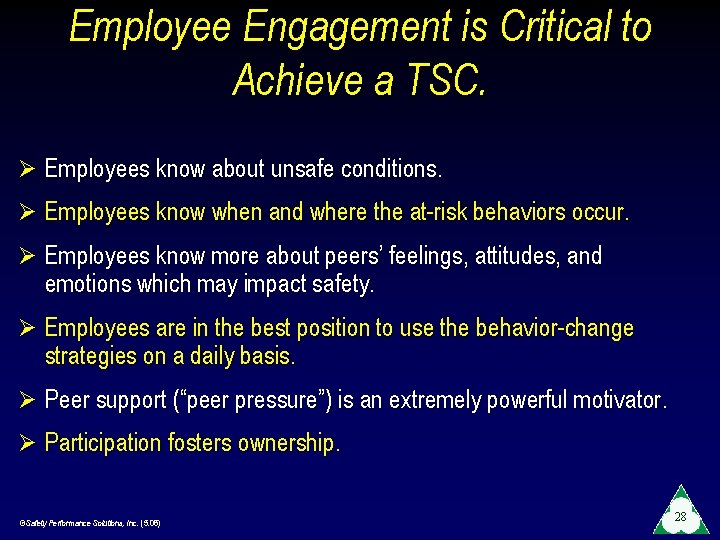
Employee Engagement is Critical to Achieve a TSC. Ø Employees know about unsafe conditions. Ø Employees know when and where the at-risk behaviors occur. Ø Employees know more about peers’ feelings, attitudes, and emotions which may impact safety. Ø Employees are in the best position to use the behavior-change strategies on a daily basis. Ø Peer support (“peer pressure”) is an extremely powerful motivator. Ø Participation fosters ownership. ©Safety Performance Solutions, Inc. (5. 06) 28
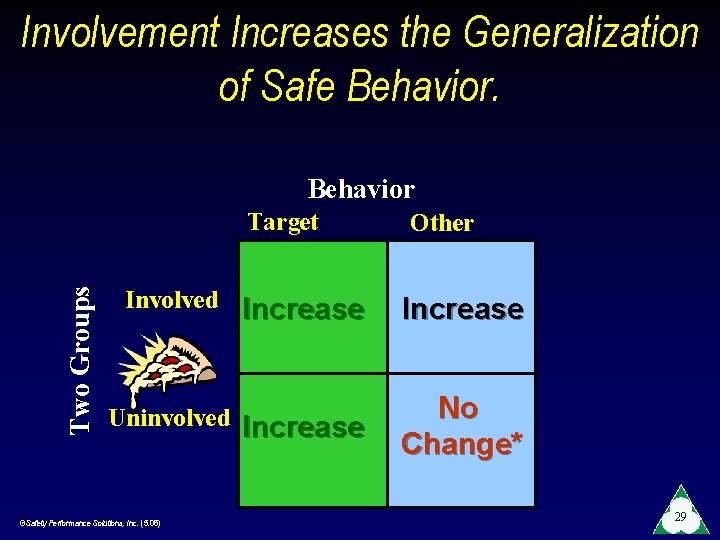
Involvement Increases the Generalization of Safe Behavior Two Groups Target Involved Uninvolved ©Safety Performance Solutions, Inc. (5. 06) Other Increase No Change* 29
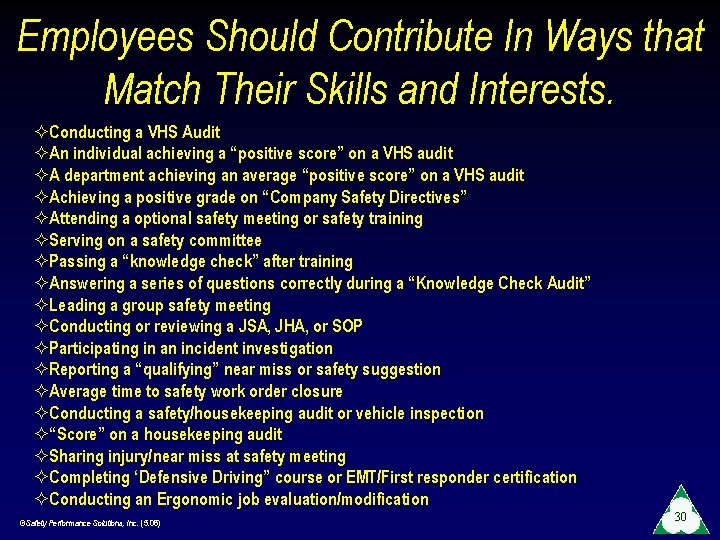
Employees Should Contribute In Ways that Match Their Skills and Interests. ²Conducting a VHS Audit ²An individual achieving a “positive score” on a VHS audit ²A department achieving an average “positive score” on a VHS audit ²Achieving a positive grade on “Company Safety Directives” ²Attending a optional safety meeting or safety training ²Serving on a safety committee ²Passing a “knowledge check” after training ²Answering a series of questions correctly during a “Knowledge Check Audit” ²Leading a group safety meeting ²Conducting or reviewing a JSA, JHA, or SOP ²Participating in an incident investigation ²Reporting a “qualifying” near miss or safety suggestion ²Average time to safety work order closure ²Conducting a safety/housekeeping audit or vehicle inspection ²“Score” on a housekeeping audit ²Sharing injury/near miss at safety meeting ²Completing ‘Defensive Driving” course or EMT/First responder certification ²Conducting an Ergonomic job evaluation/modification ©Safety Performance Solutions, Inc. (5. 06) 30
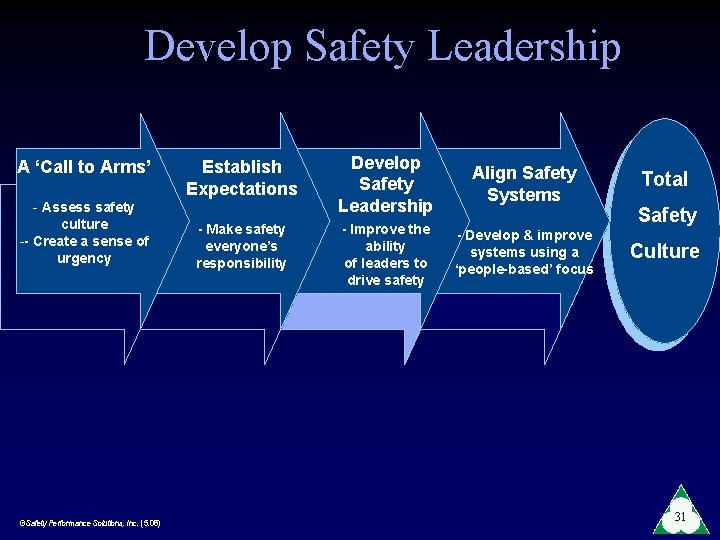
Develop Safety Leadership A ‘Call to Arms’ - Assess safety culture -- Create a sense of urgency ©Safety Performance Solutions, Inc. (5. 06) Establish Expectations Develop Safety Leadership Align Safety Systems - Make safety everyone’s responsibility - Improve the ability of leaders to drive safety - Develop & improve systems using a ‘people-based’ focus Total Safety Culture 31
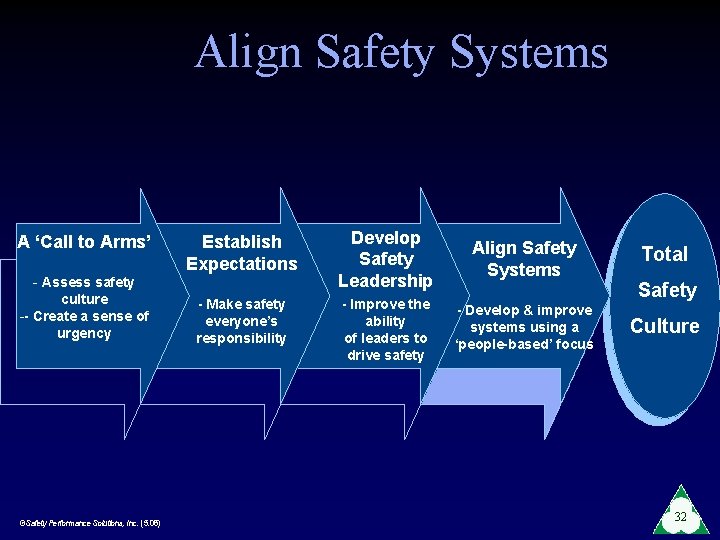
Align Safety Systems A ‘Call to Arms’ - Assess safety culture -- Create a sense of urgency ©Safety Performance Solutions, Inc. (5. 06) Establish Expectations Develop Safety Leadership Align Safety Systems - Make safety everyone’s responsibility - Improve the ability of leaders to drive safety - Develop & improve systems using a ‘people-based’ focus Total Safety Culture 32
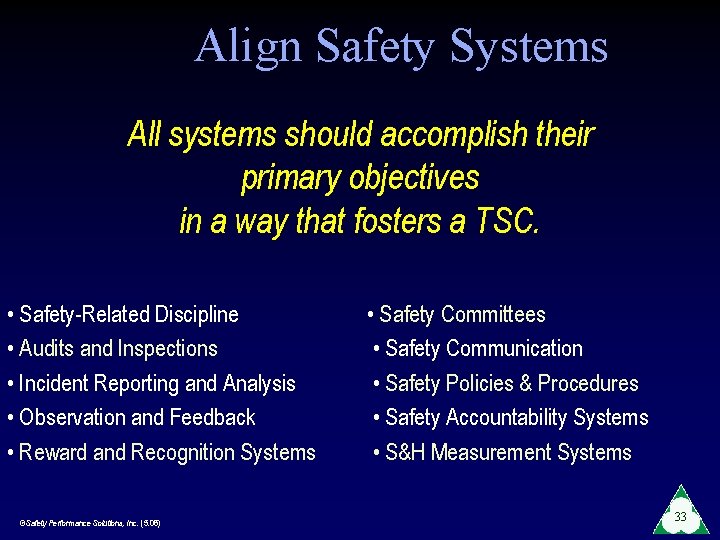
Align Safety Systems All systems should accomplish their primary objectives in a way that fosters a TSC. • Safety-Related Discipline • Audits and Inspections • Incident Reporting and Analysis • Observation and Feedback • Reward and Recognition Systems ©Safety Performance Solutions, Inc. (5. 06) • Safety Committees • Safety Communication • Safety Policies & Procedures • Safety Accountability Systems • S&H Measurement Systems 33
Case Study 1 Safety and Health Measurement System
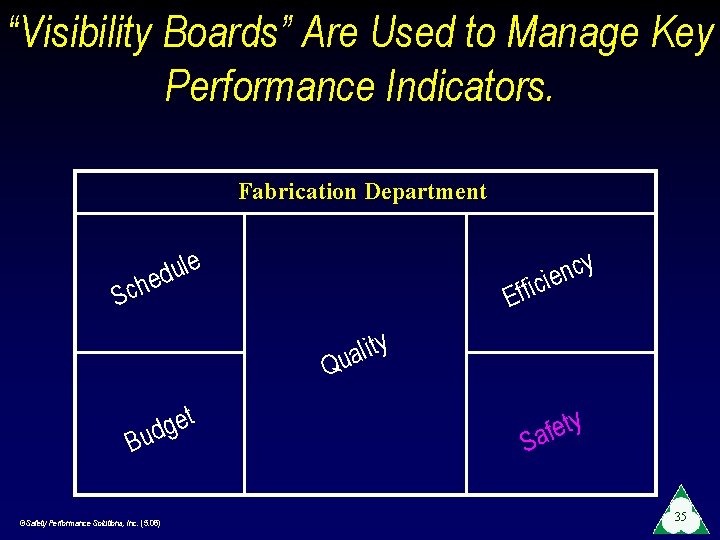
“Visibility Boards” Are Used to Manage Key Performance Indicators. Fabrication Department y c n cie e l u ed Sch Effi ty i l a Qu t e g ud B ©Safety Performance Solutions, Inc. (5. 06) y t e f Sa 35
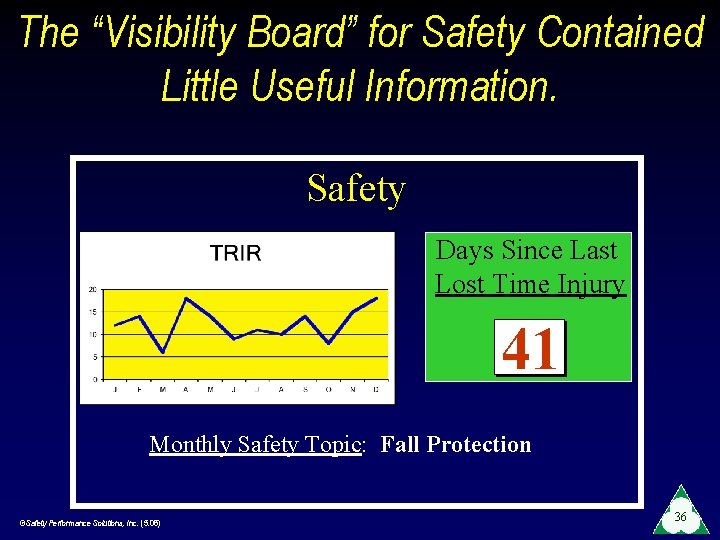
The “Visibility Board” for Safety Contained Little Useful Information. Safety Days Since Last Lost Time Injury 41 Monthly Safety Topic: Fall Protection ©Safety Performance Solutions, Inc. (5. 06) 36
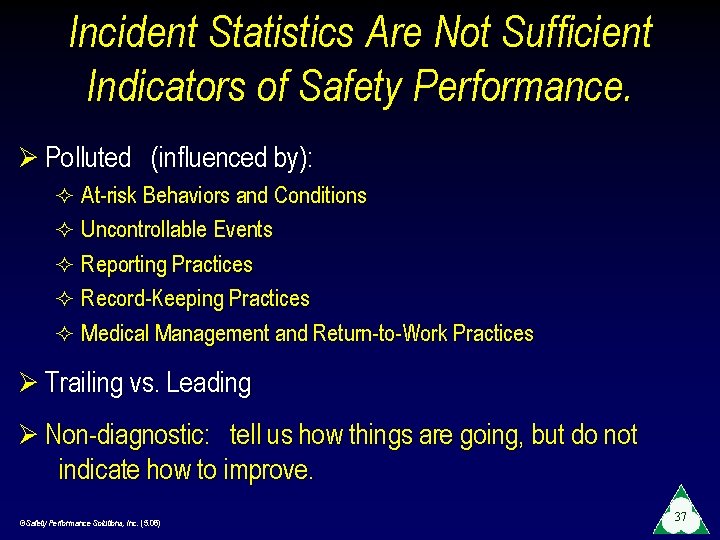
Incident Statistics Are Not Sufficient Indicators of Safety Performance. Ø Polluted (influenced by): ² At-risk Behaviors and Conditions ² Uncontrollable Events ² Reporting Practices ² Record-Keeping Practices ² Medical Management and Return-to-Work Practices Ø Trailing vs. Leading Ø Non-diagnostic: tell us how things are going, but do not indicate how to improve. ©Safety Performance Solutions, Inc. (5. 06) 37
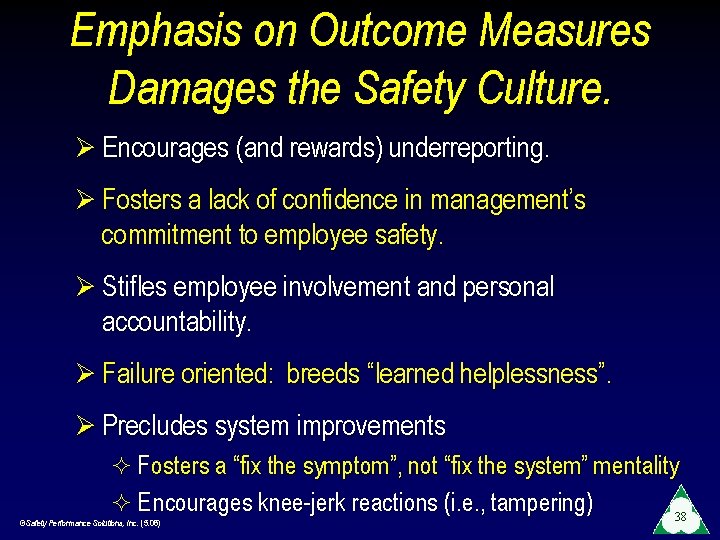
Emphasis on Outcome Measures Damages the Safety Culture. Ø Encourages (and rewards) underreporting. Ø Fosters a lack of confidence in management’s commitment to employee safety. Ø Stifles employee involvement and personal accountability. Ø Failure oriented: breeds “learned helplessness”. Ø Precludes system improvements ² Fosters a “fix the symptom”, not “fix the system” mentality ² Encourages knee-jerk reactions (i. e. , tampering) 38 ©Safety Performance Solutions, Inc. (5. 06)
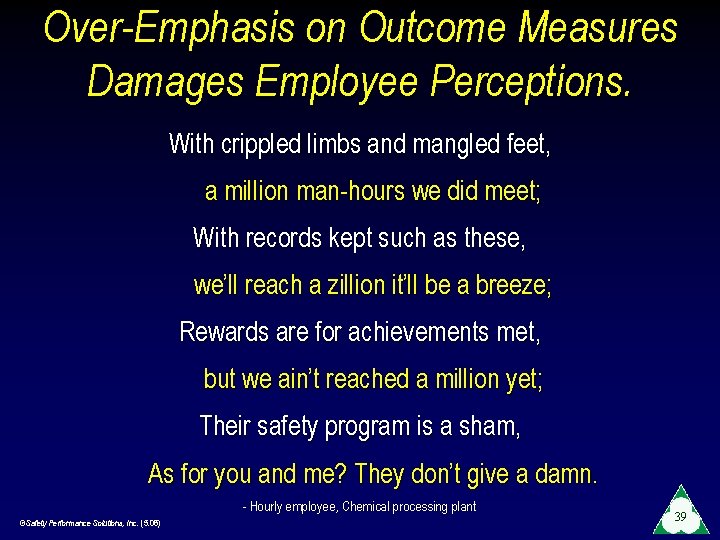
Over-Emphasis on Outcome Measures Damages Employee Perceptions. With crippled limbs and mangled feet, a million man-hours we did meet; With records kept such as these, we’ll reach a zillion it’ll be a breeze; Rewards are for achievements met, but we ain’t reached a million yet; Their safety program is a sham, As for you and me? They don’t give a damn. - Hourly employee, Chemical processing plant ©Safety Performance Solutions, Inc. (5. 06) 39
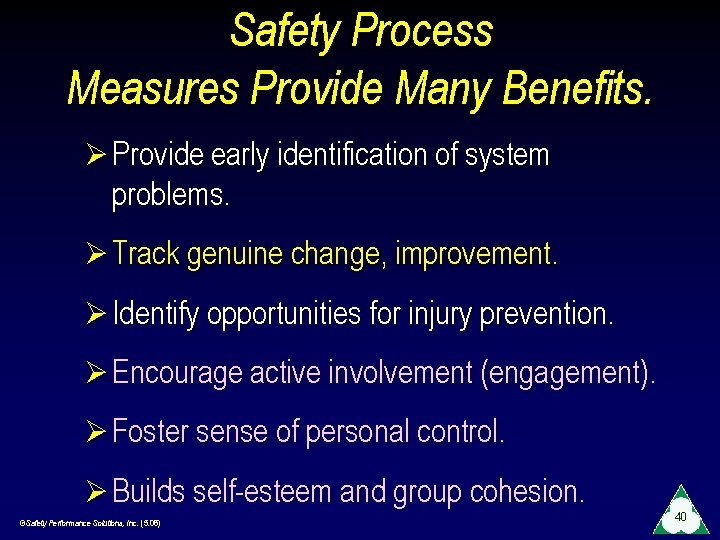
Safety Process Measures Provide Many Benefits. Ø Provide early identification of system problems. Ø Track genuine change, improvement. Ø Identify opportunities for injury prevention. Ø Encourage active involvement (engagement). Ø Foster sense of personal control. Ø Builds self-esteem and group cohesion. ©Safety Performance Solutions, Inc. (5. 06) 40
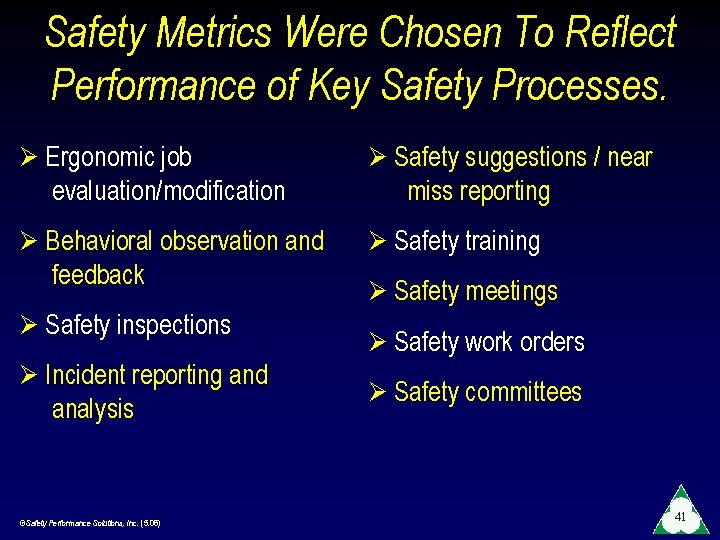
Safety Metrics Were Chosen To Reflect Performance of Key Safety Processes. Ø Ergonomic job evaluation/modification Ø Behavioral observation and feedback Ø Safety inspections Ø Incident reporting and analysis ©Safety Performance Solutions, Inc. (5. 06) Ø Safety suggestions / near miss reporting Ø Safety training Ø Safety meetings Ø Safety work orders Ø Safety committees 41
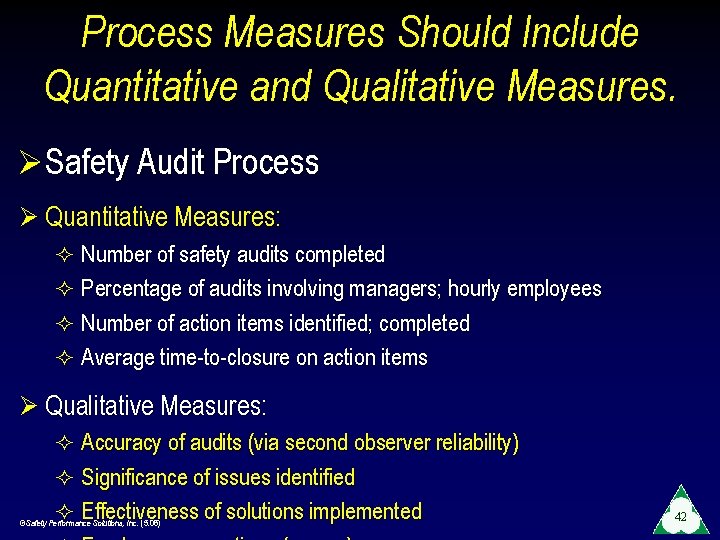
Process Measures Should Include Quantitative and Qualitative Measures. ØSafety Audit Process Ø Quantitative Measures: ² Number of safety audits completed ² Percentage of audits involving managers; hourly employees ² Number of action items identified; completed ² Average time-to-closure on action items Ø Qualitative Measures: ² Accuracy of audits (via second observer reliability) ² Significance of issues identified ² Effectiveness of solutions implemented ©Safety Performance Solutions, Inc. (5. 06) 42
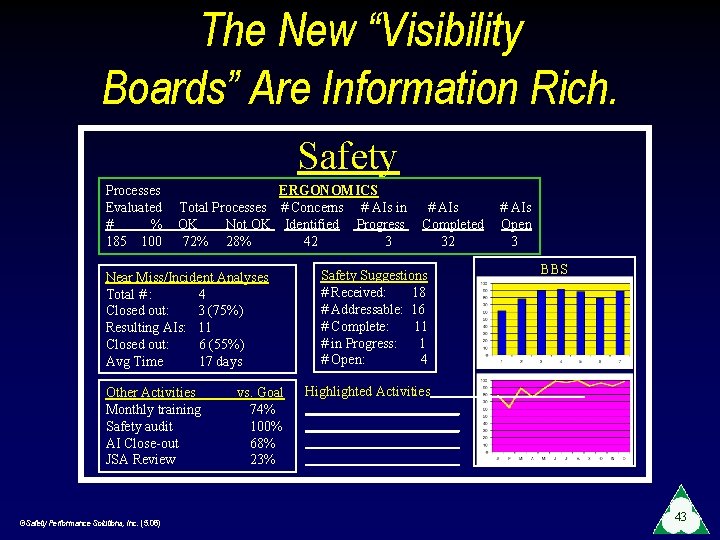
The New “Visibility Boards” Are Information Rich. Safety Processes Evaluated # % 185 100 ERGONOMICS Total Processes # Concerns # AIs in OK Not OK Identified Progress 72% 28% 42 3 Near Miss/Incident Analyses Total # : 4 Closed out: 3 (75%) Resulting AIs: 11 Closed out: 6 (55%) Avg Time 17 days Other Activities Monthly training Safety audit AI Close-out JSA Review ©Safety Performance Solutions, Inc. (5. 06) vs. Goal 74% 100% 68% 23% # AIs Completed 32 Safety Suggestions # Received: 18 # Addressable: 16 # Complete: 11 # in Progress: 1 # Open: 4 # AIs Open 3 BBS Highlighted Activities ______________________ 43
The “Board” Is Reviewed Weekly With Management and Employees. ©Safety Performance Solutions, Inc. (5. 06) 44
Case Study 2 Incident Investigation System Redesign
Management Questioned the Effectiveness of their Process Where Human Behavior was Involved. ? ? Root Causes ? ? ? ©Safety Performance Solutions, Inc. (5. 06) 46
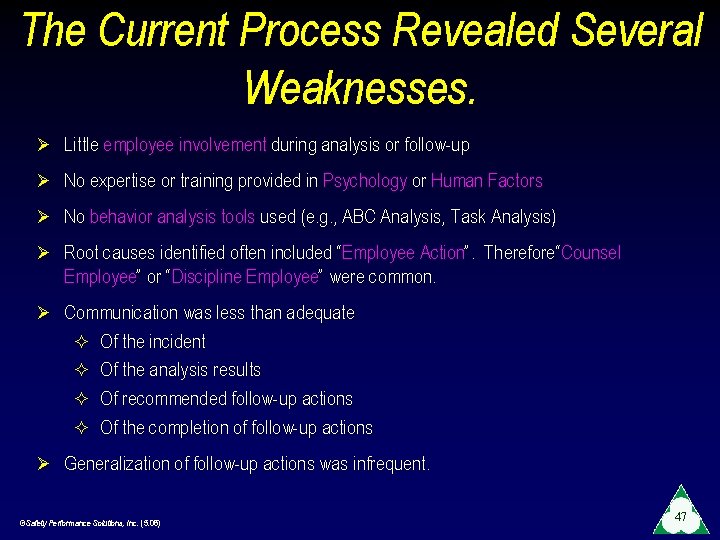
The Current Process Revealed Several Weaknesses. Ø Little employee involvement during analysis or follow-up Ø No expertise or training provided in Psychology or Human Factors Ø No behavior analysis tools used (e. g. , ABC Analysis, Task Analysis) Ø Root causes identified often included “Employee Action”. Therefore“Counsel Employee” or “Discipline Employee” were common. Ø Communication was less than adequate ² Of the incident ² Of the analysis results ² Of recommended follow-up actions ² Of the completion of follow-up actions Ø Generalization of follow-up actions was infrequent. ©Safety Performance Solutions, Inc. (5. 06) 47
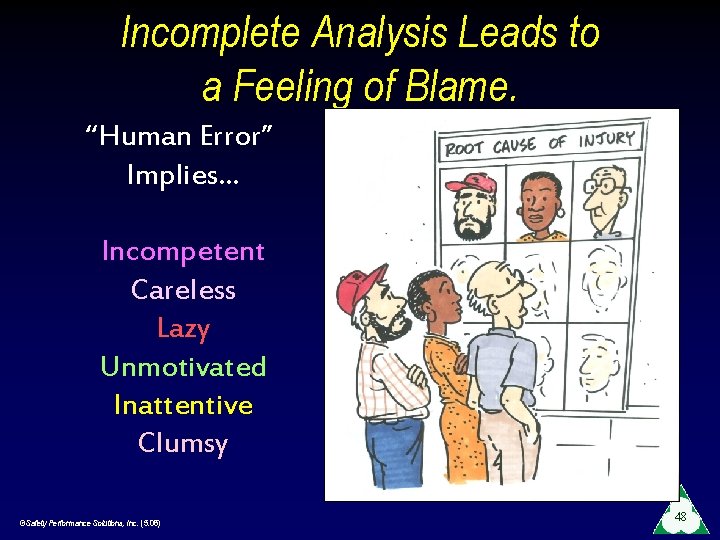
Incomplete Analysis Leads to a Feeling of Blame. “Human Error” Implies… Incompetent Careless Lazy Unmotivated Inattentive Clumsy ©Safety Performance Solutions, Inc. (5. 06) 48
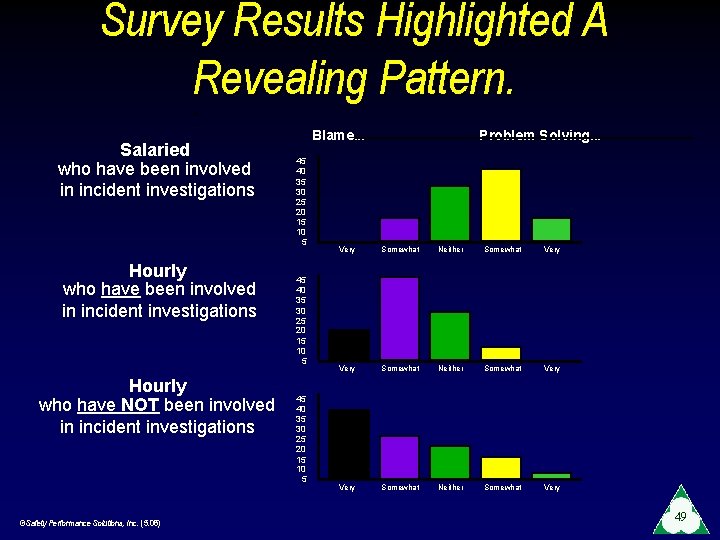
Survey Results Highlighted A Revealing Pattern. Salaried who have been involved in incident investigations Hourly who have NOT been involved in incident investigations ©Safety Performance Solutions, Inc. (5. 06) Blame. . . 45 40 35 30 25 20 15 10 5 Problem Solving. . . Very Somewhat Neither Somewhat Very 49
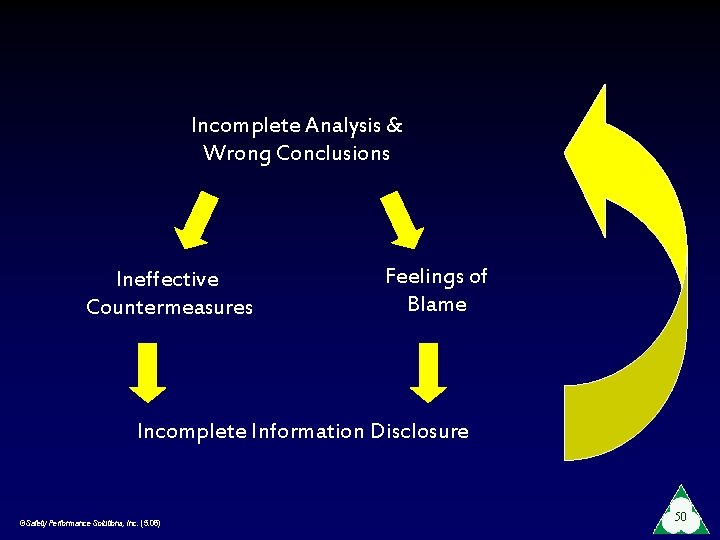
Incomplete Analysis & Wrong Conclusions Ineffective Countermeasures Feelings of Blame Incomplete Information Disclosure ©Safety Performance Solutions, Inc. (5. 06) 50
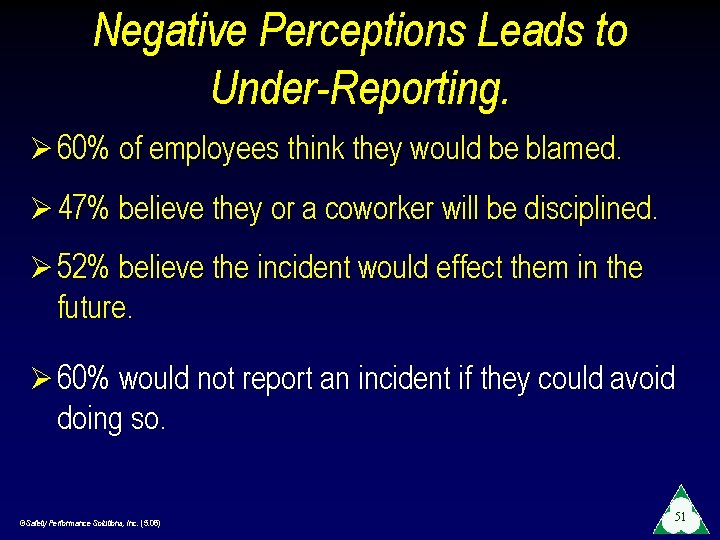
Negative Perceptions Leads to Under-Reporting. Ø 60% of employees think they would be blamed. Ø 47% believe they or a coworker will be disciplined. Ø 52% believe the incident would effect them in the future. Ø 60% would not report an incident if they could avoid doing so. ©Safety Performance Solutions, Inc. (5. 06) 51
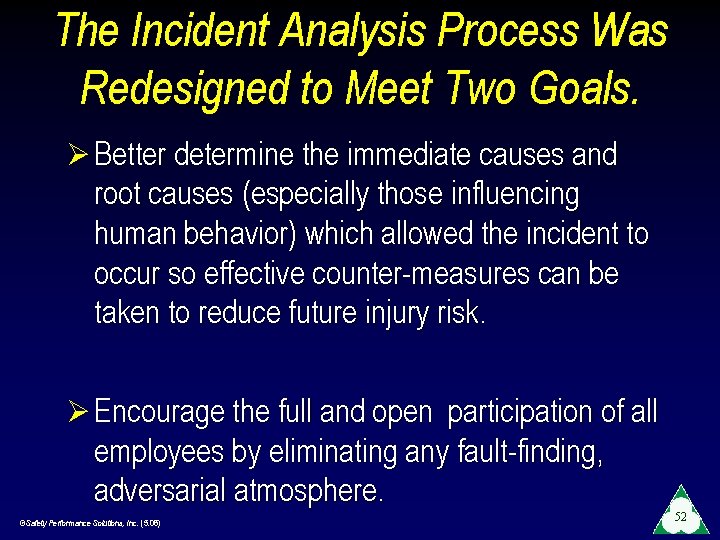
The Incident Analysis Process Was Redesigned to Meet Two Goals. Ø Better determine the immediate causes and root causes (especially those influencing human behavior) which allowed the incident to occur so effective counter-measures can be taken to reduce future injury risk. Ø Encourage the full and open participation of all employees by eliminating any fault-finding, adversarial atmosphere. ©Safety Performance Solutions, Inc. (5. 06) 52
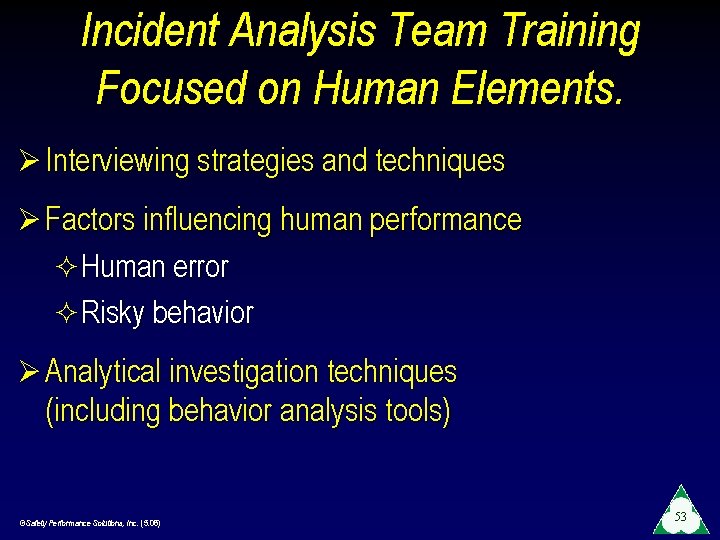
Incident Analysis Team Training Focused on Human Elements. Ø Interviewing strategies and techniques Ø Factors influencing human performance ² Human error ² Risky behavior Ø Analytical investigation techniques (including behavior analysis tools) ©Safety Performance Solutions, Inc. (5. 06) 53
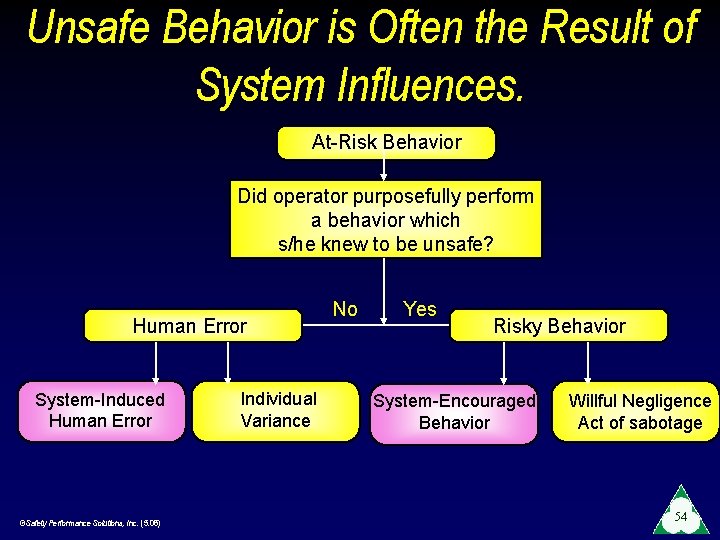
Unsafe Behavior is Often the Result of System Influences. At-Risk Behavior Did operator purposefully perform a behavior which s/he knew to be unsafe? Human Error System-Induced Human Error ©Safety Performance Solutions, Inc. (5. 06) Individual Variance No Yes Risky Behavior System-Encouraged Behavior Willful Negligence Act of sabotage 54
Safety Achievement A TSC Requires A Shift From Dependence to Interdependence Independence Dependence Leading Succeeding Improving Beginning 1 2 3 4 Dependence: Independence: Interdependence: • Top-Down • Bottom-Up • Personal Commitment • Safety for Self • Incentives for Outcomes • Behavior Focused • Fact Finding • Safety is Priority • Eventual Fix • Empowerment • Condition of Employment • Safety for OSHA • Disincentives for Outcomes • Environment Focused • Fault Finding • Safety is Important • Quick Fix ©Safety Performance Solutions, Inc. (5. 06) • Team Commitment • Safety for Others • Recognition for Behavior • Env. /Beh. /Person • Systems Thinking • Safety is a Value • Continuous Improvement 55
Questions ? ? ©Safety Performance Solutions, Inc. (5. 06) 56