
Making Safeguarding Personal Its putting the human touch
- Slides: 29
Making Safeguarding Personal ‘It's putting the human touch back into safeguarding. ’ (Cooper et al 2016: 22) Dr Lindsey Pike Senior Research and Development Officer Research in Practice for Adults 1
2
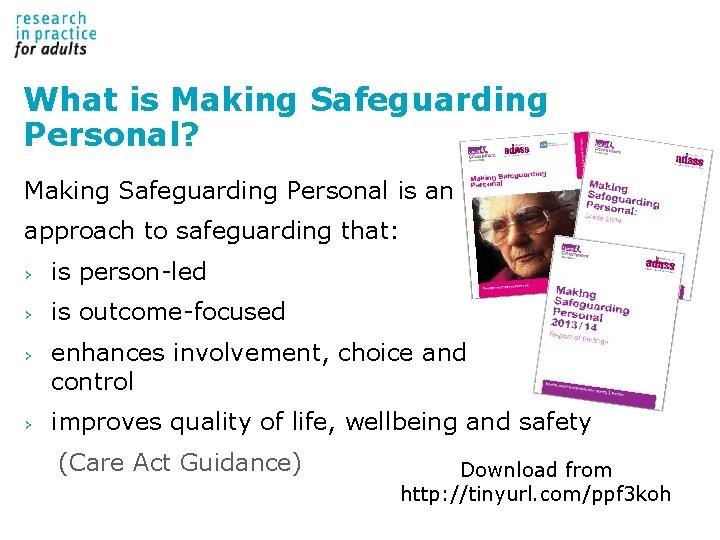
What is Making Safeguarding Personal? Making Safeguarding Personal is an approach to safeguarding that: › is person-led › is outcome-focused › enhances involvement, choice and control › improves quality of life, wellbeing and safety (Care Act Guidance) Download from http: //tinyurl. com/ppf 3 koh
Lord Justice Munby › The emphasis must be on sensible risk appraisal, not striving to avoid all risk, whatever the price, but instead seeking a proper balance and being willing to tolerate manageable or acceptable risks as the price appropriately to be paid in order to achieve some other good – in particular to achieve the vital good of the elderly or vulnerable person’s happiness. What good is it making someone safer if it merely makes them miserable? Munby, Lord Justice (2010) ‘What price dignity? ’, keynote address at LAG Community Care conference: Protecting liberties, London, 14 July.
Human Rights Act ‘The State’s obligations under Article 8 (Human Rights Act) are not merely substantive; they are also procedural. Those affected must be allowed to participate effectively in the decision-making process. It is simply unacceptable (and an actionable breach of Article 8) for a Local Authority to decide, without reference to P and her carers, what is to be done and then merely tell them (to ‘share’ with them) the decision. ’ (Lord Justice Munby, July 2010, Keynote Address to the Community Care Conference 14 th July 2010) 6
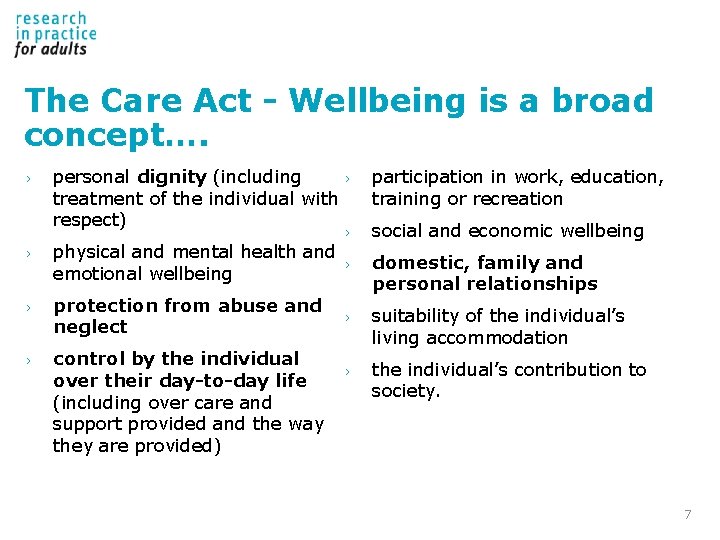
The Care Act - Wellbeing is a broad concept…. › personal dignity (including treatment of the individual with respect) › participation in work, education, training or recreation › social and economic wellbeing › physical and mental health and emotional wellbeing › › protection from abuse and neglect domestic, family and personal relationships › › control by the individual over their day-to-day life (including over care and support provided and the way they are provided) suitability of the individual’s living accommodation › the individual’s contribution to society. 7
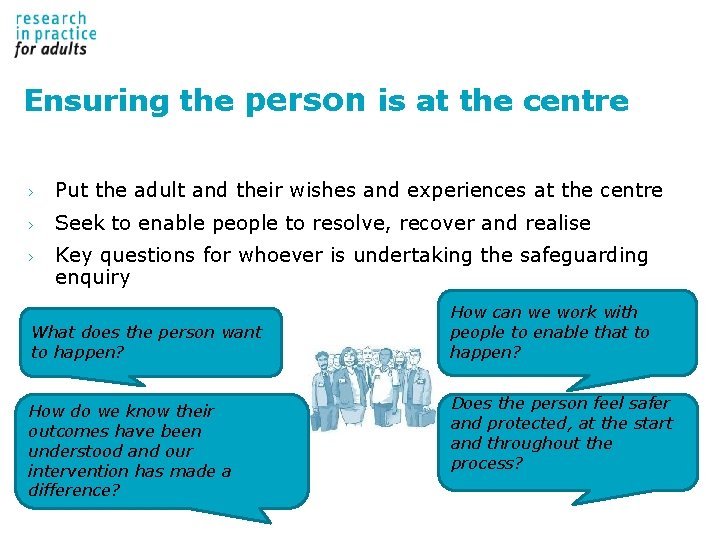
Ensuring the person is at the centre › Put the adult and their wishes and experiences at the centre › Seek to enable people to resolve, recover and realise › Key questions for whoever is undertaking the safeguarding enquiry What does the person want to happen? How do we know their outcomes have been understood and our intervention has made a difference? How can we work with people to enable that to happen? Does the person feel safer and protected, at the start and throughout the process?
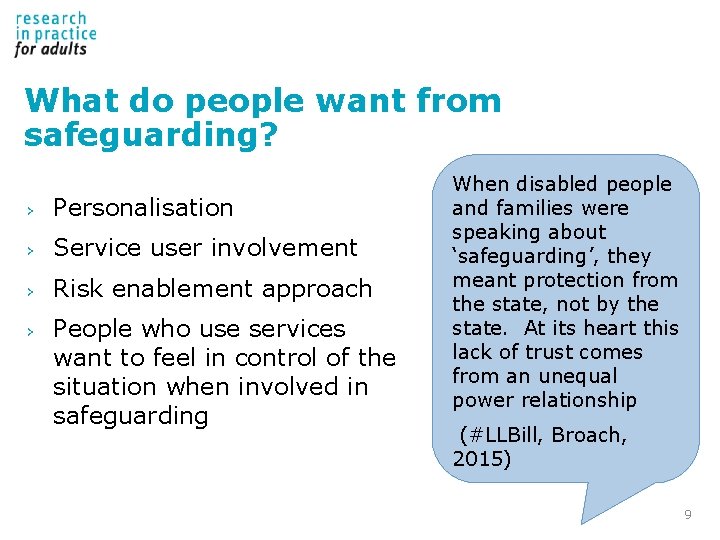
What do people want from safeguarding? › Personalisation › Service user involvement › Risk enablement approach › People who use services want to feel in control of the situation when involved in safeguarding When disabled people and families were speaking about ‘safeguarding’, they meant protection from the state, not by the state. At its heart this lack of trust comes from an unequal power relationship (#LLBill, Broach, 2015) 9
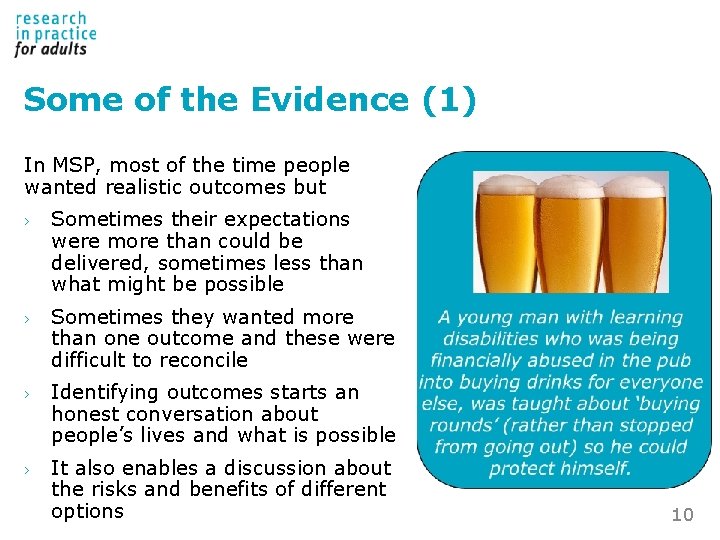
Some of the Evidence (1) In MSP, most of the time people wanted realistic outcomes but › Sometimes their expectations were more than could be delivered, sometimes less than what might be possible › Sometimes they wanted more than one outcome and these were difficult to reconcile › Identifying outcomes starts an honest conversation about people’s lives and what is possible › It also enables a discussion about the risks and benefits of different options 10
Some of the Evidence (2) Despite what one might fear, people tend not to identify unrealistic outcomes – and when they do identify more aspirational outcomes, they don’t expect services to ‘deliver’ them (Harris 2006) With the help of the person’s social networks, ambitious outcomes can be realised (e. g. a woman from an Orkney care home who was enabled to go to a Daniel O’Donnell concert) (Cook and Miller 2012) 11
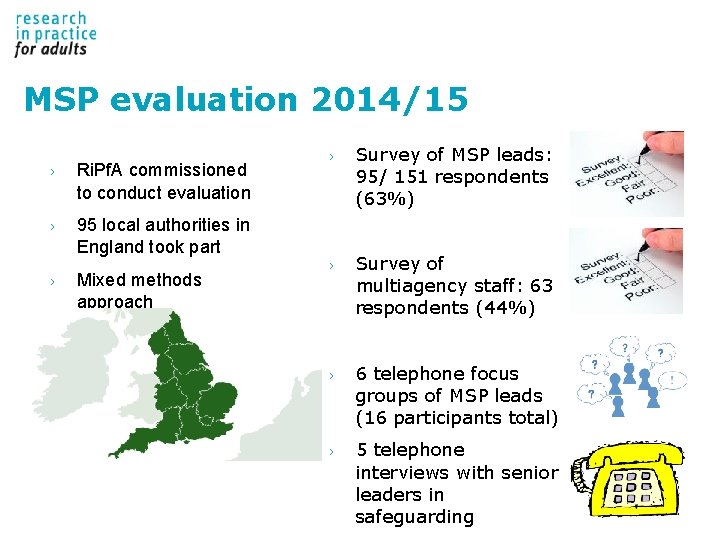
MSP evaluation 2014/15 › Ri. Pf. A commissioned to conduct evaluation › 95 local authorities in England took part › Mixed methods approach › Survey of MSP leads: 95/ 151 respondents (63%) › Survey of multiagency staff: 63 respondents (44%) › 6 telephone focus groups of MSP leads (16 participants total) › 5 telephone interviews with senior leaders in safeguarding
Evaluation findings › 95% of respondents thought MSP was the right approach to be taking in the current context › Many respondents early in MSP journey › Types of work that councils had undertaken included: − − − partnership and project work developing approaches to safeguarding (such as family group conferencing) staff development and awareness raising changing systems using feedback and evaluation
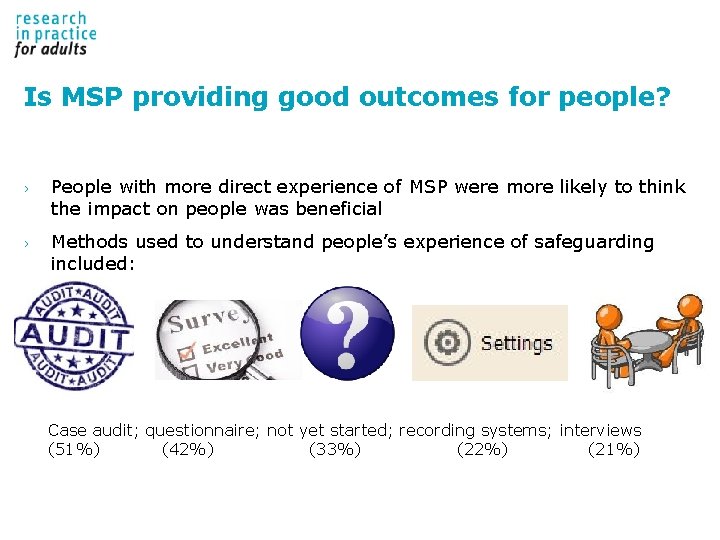
Is MSP providing good outcomes for people? › People with more direct experience of MSP were more likely to think the impact on people was beneficial › Methods used to understand people’s experience of safeguarding included: Case audit; questionnaire; not yet started; recording systems; interviews (51%) (42%) (33%) (22%) (21%)
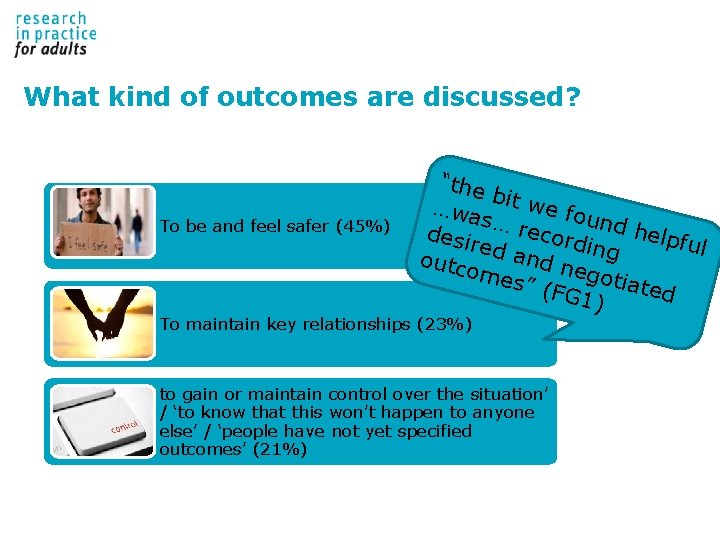
What kind of outcomes are discussed? To be and feel safer (45%) “the b …wa it we fo u s desir … record nd helpf ul ing ed a n outc ome d negot s” (F iated G 1) To maintain key relationships (23%) to gain or maintain control over the situation’ / ‘to know that this won’t happen to anyone else’ / ‘people have not yet specified outcomes’ (21%)
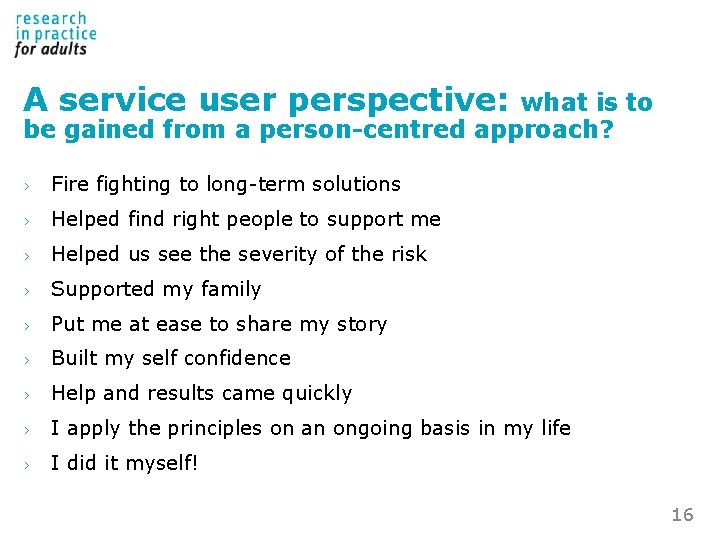
A service user perspective: what is to be gained from a person-centred approach? › Fire fighting to long-term solutions › Helped find right people to support me › Helped us see the severity of the risk › Supported my family › Put me at ease to share my story › Built my self confidence › Help and results came quickly › I apply the principles on an ongoing basis in my life › I did it myself! 16
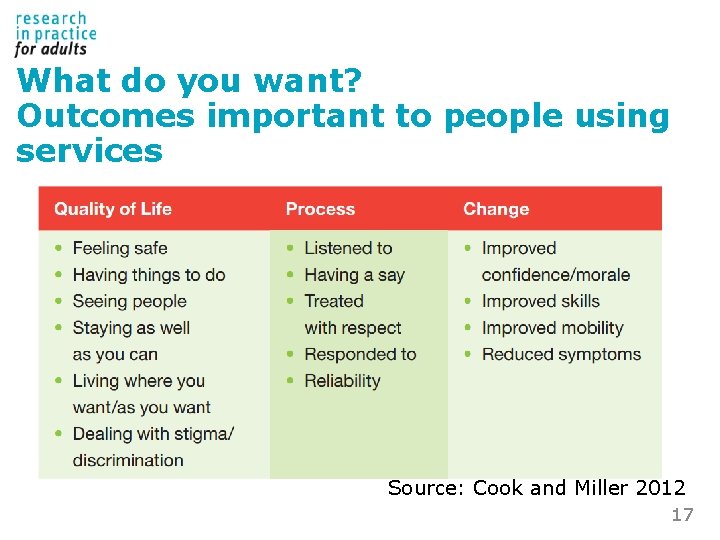
What do you want? Outcomes important to people using services Source: Cook and Miller 2012 17
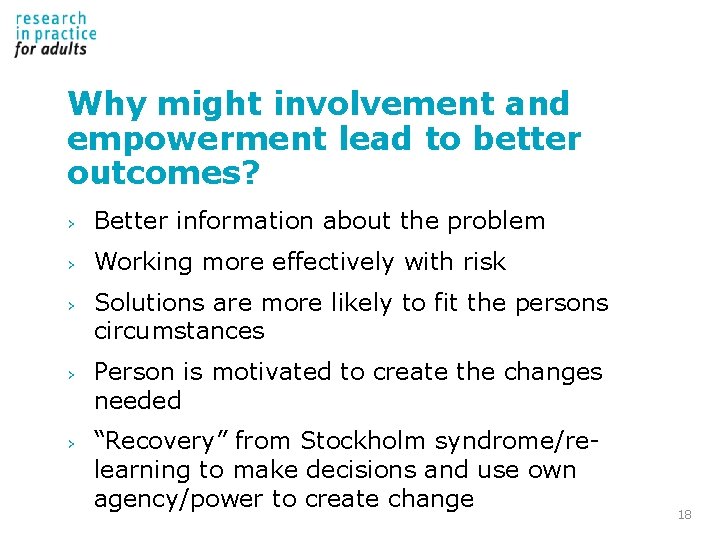
Why might involvement and empowerment lead to better outcomes? › Better information about the problem › Working more effectively with risk › Solutions are more likely to fit the persons circumstances › Person is motivated to create the changes needed › “Recovery” from Stockholm syndrome/relearning to make decisions and use own agency/power to create change 18
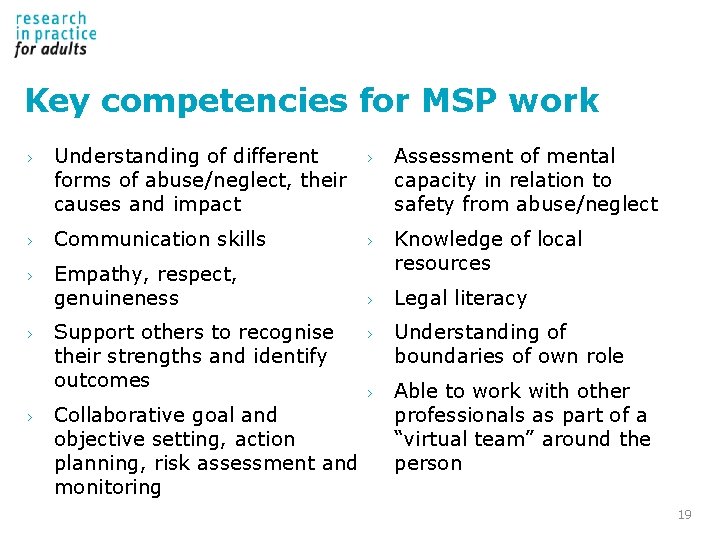
Key competencies for MSP work › Understanding of different forms of abuse/neglect, their causes and impact › Assessment of mental capacity in relation to safety from abuse/neglect › Communication skills › › Empathy, respect, genuineness Knowledge of local resources › Legal literacy › Understanding of boundaries of own role › Able to work with other professionals as part of a “virtual team” around the person › › Support others to recognise their strengths and identify outcomes Collaborative goal and objective setting, action planning, risk assessment and monitoring 19
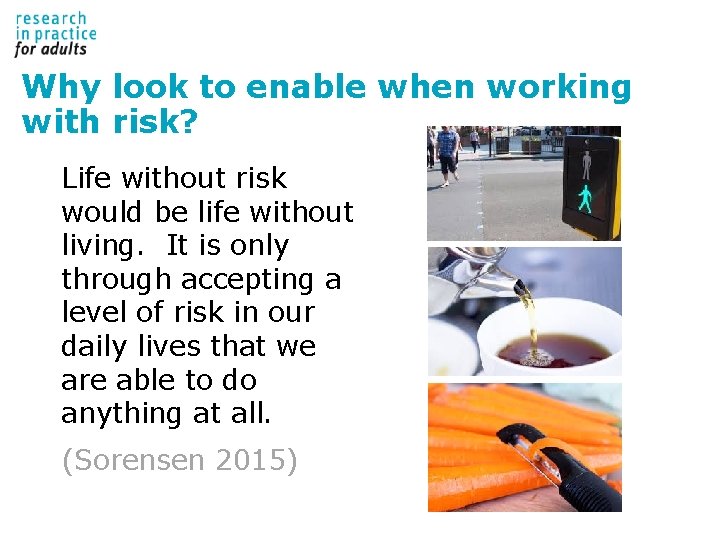
Why look to enable when working with risk? Life without risk would be life without living. It is only through accepting a level of risk in our daily lives that we are able to do anything at all. (Sorensen 2015)
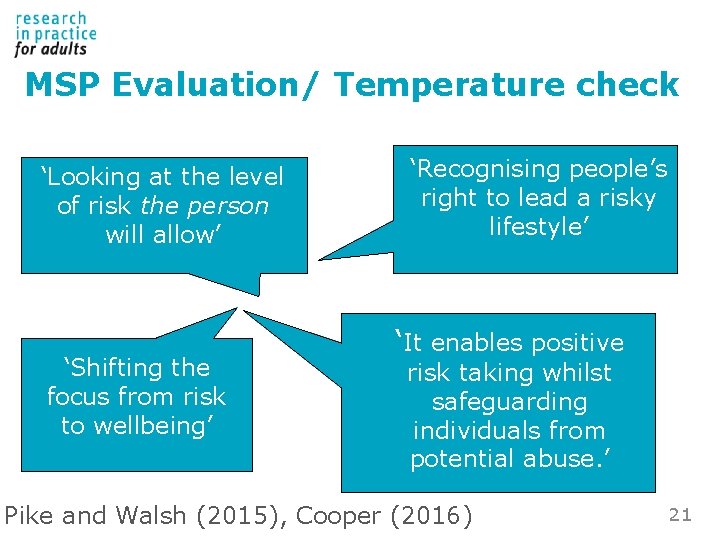
MSP Evaluation/ Temperature check ‘Looking at the level of risk the person will allow’ ‘Shifting the focus from risk to wellbeing’ ‘Recognising people’s right to lead a risky lifestyle’ ‘It enables positive risk taking whilst safeguarding individuals from potential abuse. ’ Pike and Walsh (2015), Cooper (2016) 21
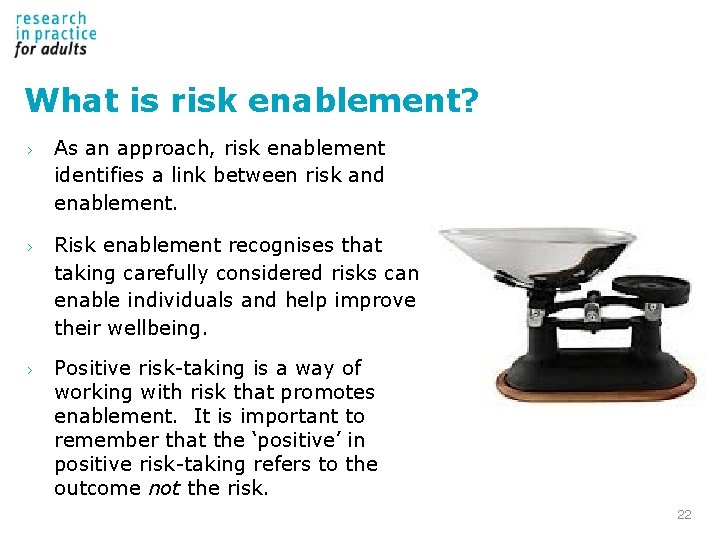
What is risk enablement? › As an approach, risk enablement identifies a link between risk and enablement. › Risk enablement recognises that taking carefully considered risks can enable individuals and help improve their wellbeing. › Positive risk-taking is a way of working with risk that promotes enablement. It is important to remember that the ‘positive’ in positive risk-taking refers to the outcome not the risk. 22
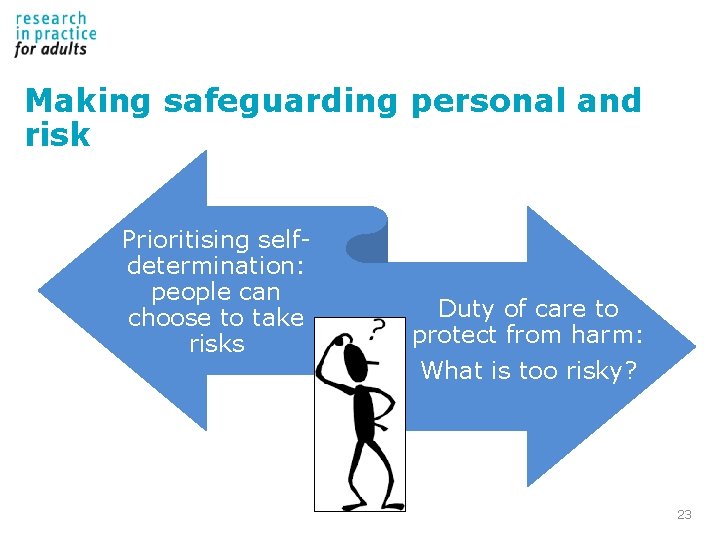
Making safeguarding personal and risk Prioritising selfdetermination: people can choose to take risks Duty of care to protect from harm: What is too risky? 23
Good practice in the MCA is key 24
Check list for future action What’s working well in Cornwall? Which areas need development? ü ‘permission’ to work differently ü meaningful engagement of people who use services ü development of the right skills (including legal literacy) ü revise policy, procedures and systems ü sharing good practice ü effective use of the Mental Capacity Act ü emphasis on and confidence in professional judgement ü support from SAB and involve partners ü acknowledge challenging financial climate and work on understanding longer term resource impact of MSP
Thanks for listening › Questions? 26
References and further reading › Cooper A et al (2016) Making Safeguarding Personal temperature check 2016. London: ADASS › Pike L (2016) Involving people in safeguarding adults: Leaders’ Briefing. Dartington: Research in Practice for Adults › Pike L (2015) Safeguarding adults from abuse. In Walden D (ed) Reimagining Adult Social Care: Evidence Review. Dartington: Research in Practice for Adults › Preston-Shoot M (2015) Safeguarding in light of the Care Act: Leader’s Briefing. Dartington: Research in Practice for Adults › Preston-Shoot, M. , & Cooper, A. , (2015) eds. Special Issue on Making Safeguarding Personal, Journal of Adult Protection, Vol. 17, No. 3 › https: //www. ripfa. org. uk/resources/case-law-summaries/case-law -nov 2016/ 27
Useful Links Knowledge Hub details • MSP - https: //knowledgehub. local. gov. uk/group/makingsafeguardingpersonal • Adult Safeguarding Community Practice https: //knowledgehub. local. gov. uk/group/adultsafeguardingcommunityofpractice Further Information LGA Care and Support reform adult safeguarding page: http: //www. local. gov. uk/care-support-reform//journal_content/56/10180/6523063/ARTICLE • DH Care Act Fact sheets - https: //www. gov. uk/government/publications/care-act 2014 -part-1 -factsheets • SCIE information on the Care Act - http: //www. scie. org. uk/care-act-2014/ and • SCIE on self neglect http: //www. scie. org. uk/publications/reports/69 -self-neglectpolicy-practice-building-an-evidence-base-for-adult-social-care/files/report 69. pdf MSP Materials • MSP Evaluation 2014/15 http: //www. local. gov. uk/web/guest/adult-social-care//journal_content/56/10180/6074789/ARTICLE • LGA Making Safeguarding Personal materials: http: //www. local. gov. uk/web/guest/adult-social-care//journal_content/56/10180/6074789/ARTICLE •
Contact https: //www. ripfa. org. uk ask@ripfa. org. uk @ripfa @lindsey_pike 29