
Making ODL Inclusive The Role of Technology Professor
- Slides: 63
Making ODL Inclusive: The Role of Technology Professor Asha Kanwar President & CEO Muscat, Sultanate of Oman December 19 -21, 2017 Ricky Cheng Knowledge Services Manager
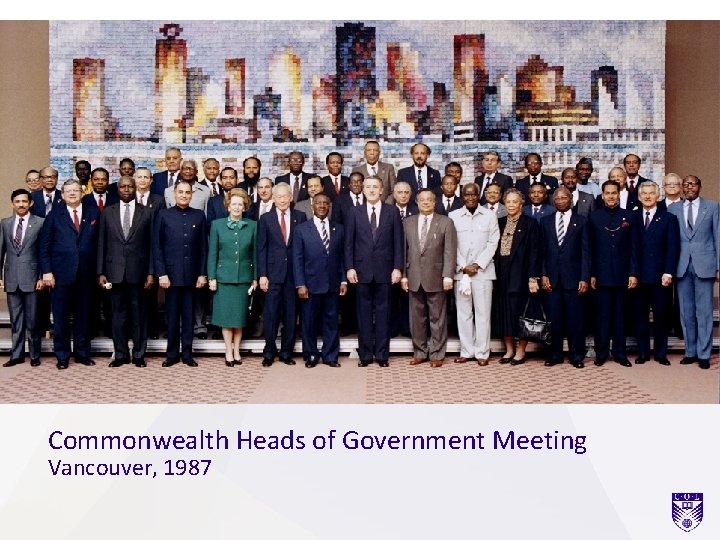
Commonwealth Heads of Government Meeting Vancouver, 1987
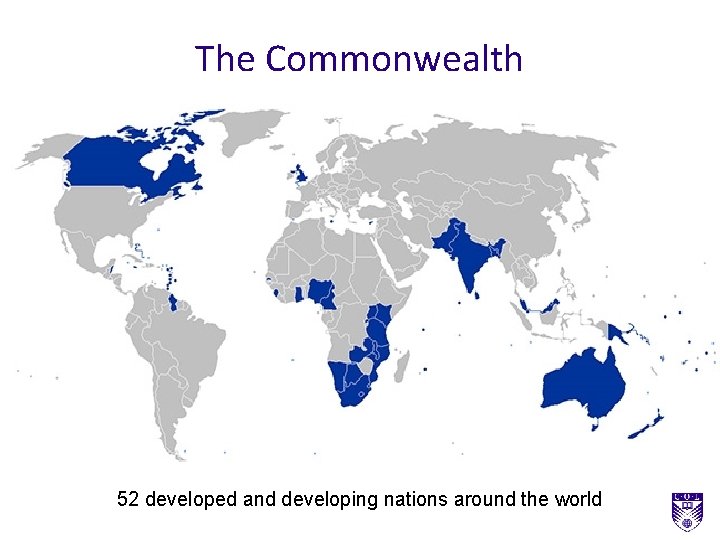
The Commonwealth 52 developed and developing nations around the world
To help Commonwealth governments and institutions use technologies to improve and expand learning for sustainable development
ECONOMIC GROWTH SOCIAL INCLUSION ENVIRONMENTAL CONSERVATION Learning for Sustainable Development
Plan • The Context • What is ODL? • Is ODL Inclusive? • The Role of Technologies • Towards Inclusion
Context
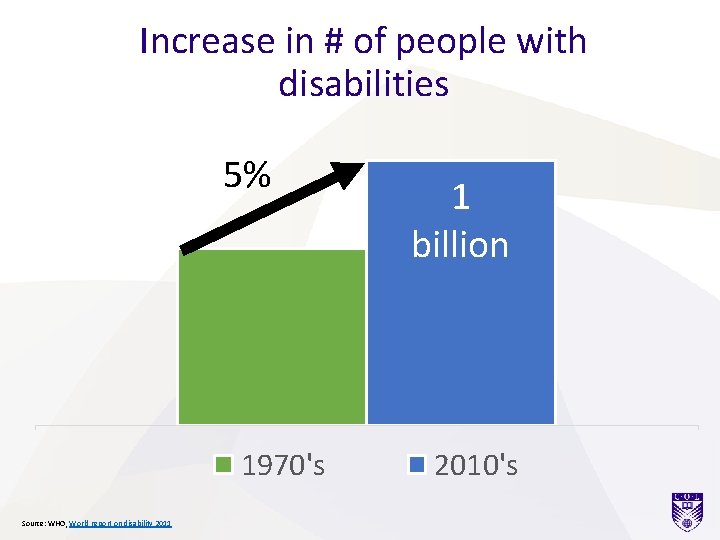
Increase in # of people with disabilities 5% 1970's Source: WHO, World report on disability 2011 1 billion 2010's
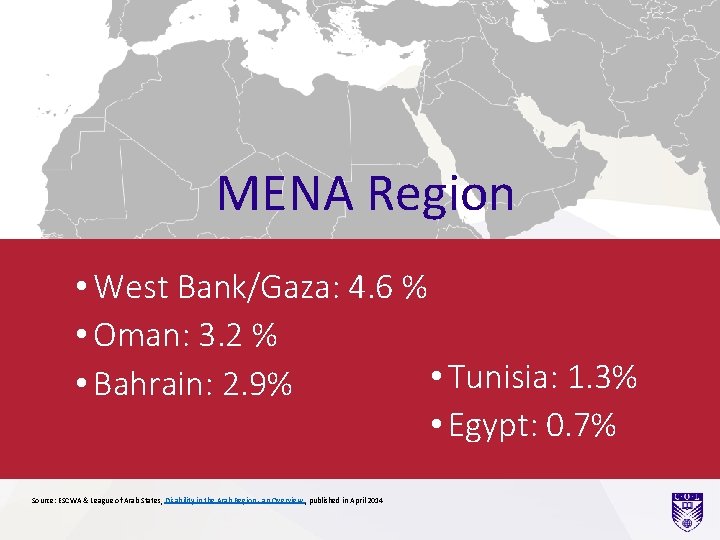
MENA Region • West Bank/Gaza: 4. 6 % • Oman: 3. 2 % • Tunisia: 1. 3% • Bahrain: 2. 9% • Egypt: 0. 7% Source: ESCWA & League of Arab States, Disability in the Arab Region - an Overview , published in April 2014
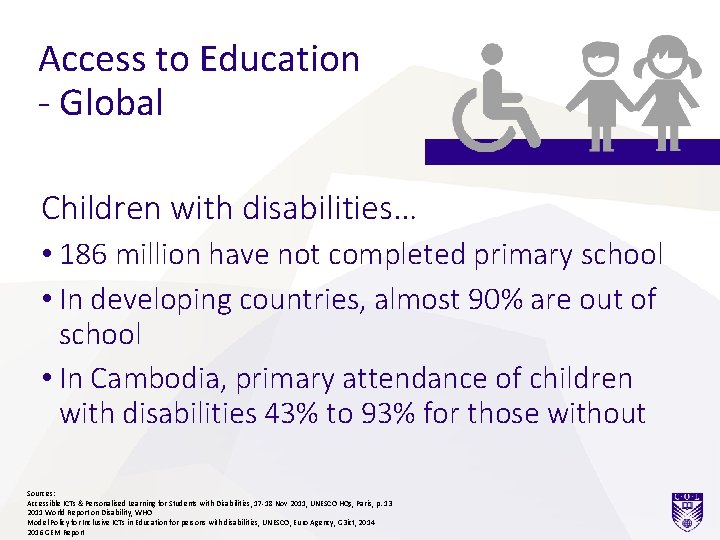
Access to Education - Global Children with disabilities… • 186 million have not completed primary school • In developing countries, almost 90% are out of school • In Cambodia, primary attendance of children with disabilities 43% to 93% for those without Sources: Accessible ICTs & Personalised Learning for Students with Disabilities, 17 -18 Nov 2011, UNESCO HQs, Paris, p. 13 2011 World Report on Disability, WHO Model Policy for Inclusive ICTs in Education for persons with disabilities, UNESCO, Euro Agency, G 3 ict, 2014 2016 GEM Report
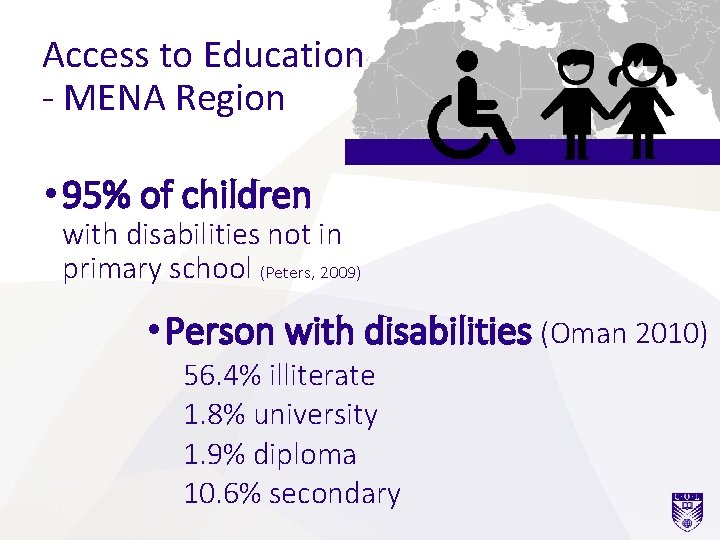
Access to Education - MENA Region • 95% of children with disabilities not in primary school (Peters, 2009) • Person with disabilities (Oman 2010) 56. 4% illiterate 1. 8% university 1. 9% diploma 10. 6% secondary
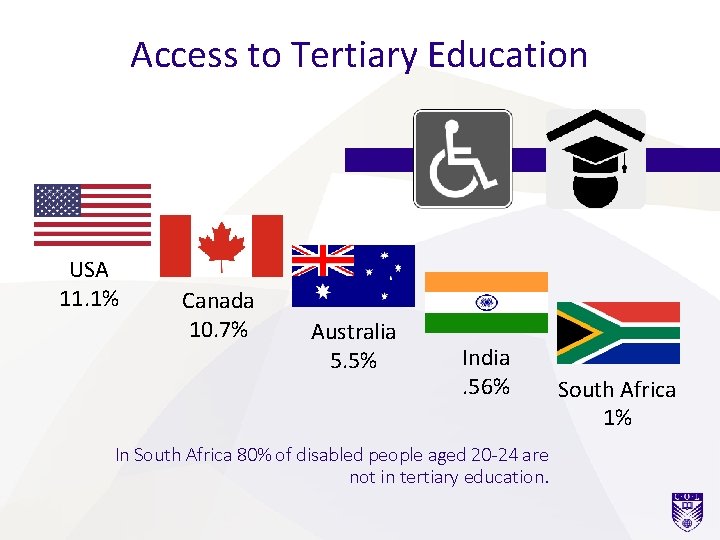
Access to Tertiary Education USA 11. 1% Canada 10. 7% Australia 5. 5% India. 56% In South Africa 80% of disabled people aged 20 -24 are not in tertiary education. South Africa 1%
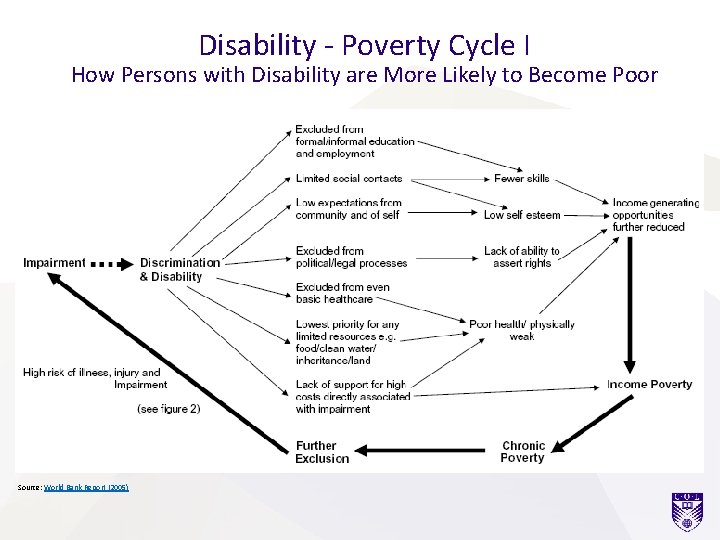
Disability - Poverty Cycle I How Persons with Disability are More Likely to Become Poor Source: World Bank Report (2005)
• UN Convention on the Rights of Persons with Disabilities (2006) • Education • Work and Employment 87 % countries ratified the Convention in 10 years ALECSO countries have ratified the Convention Source: UN Treaty Collection, Convention on the Rights of Persons with Disabilities. Last accessed on 24 November , 2017
Arab Decade for Persons with Disabilities 2004 -13 • Majority of MENA countries have included articles on disability in their constitutions • Most national governments have devised new laws, policies to align with the CRPD • Half the MENA countries had/were developing a national strategy/plan on disability • Legal provisions to provide employment for people with disabilities: quotas (1 -5%) in Egypt Lebanon, Tunisia
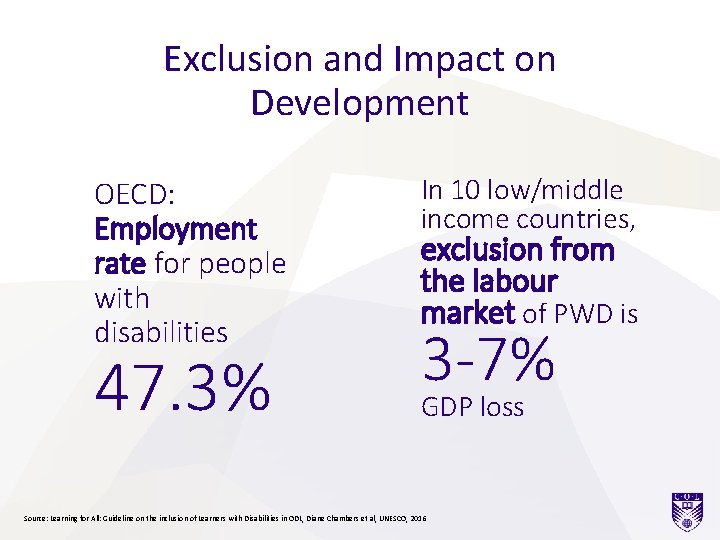
Exclusion and Impact on Development OECD: Employment rate for people with disabilities 47. 3% In 10 low/middle income countries, exclusion from the labour market of PWD is 3 -7% GDP loss Source: Learning for All: Guideline on the inclusion of Learners with Disabilities in ODL, Diane Chambers et al, UNESCO, 2016
Disability and the MDGs The Millennium Development Goals (MDGs) represent a concerted effort to address global poverty. Yet there is a striking gap in the current MDGs: persons with disabilities, that is, the estimated 1 billion people worldwide who live with one or more physical, sensory (blindness/deafness), intellectual or mental health impairments, are not mentioned in any of the 8 Goals or the attendant 21 Targets or 60 Indicators, nor in the Millennium Declaration. Source: United Nations DESA, Disability and the Millennium Development Goals (2012)
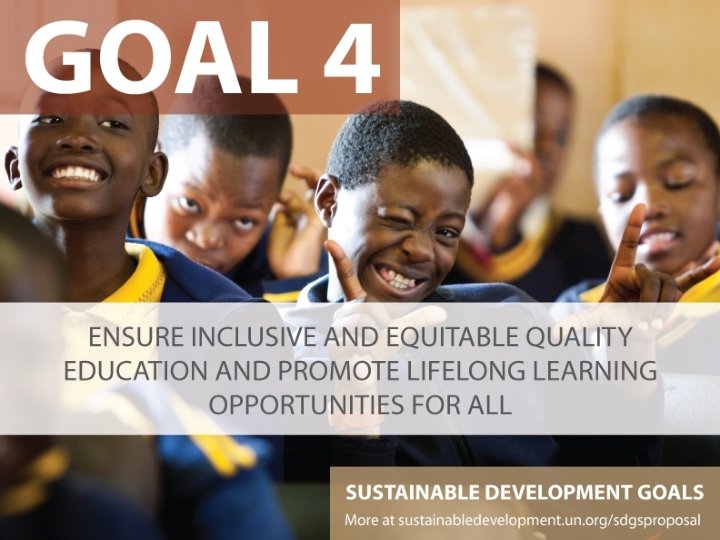
SDG 4 Targets • 4. 5: By 2030, eliminate gender disparities in education and ensure equal access to all levels of education and vocational training for the vulnerable, including people with disabilities…. • 4. a: Build and upgrade education facilities that are child, disability and gender sensitive and provide safe, non-violent, inclusive and effective learning environments for all (adapted infrastructure and materials for students with disabilities)
What is ODL?
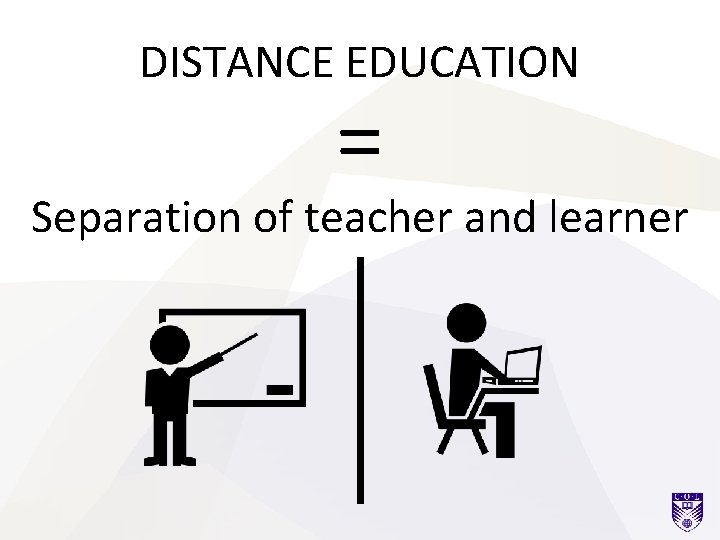
DISTANCE EDUCATION = Separation of teacher and learner
OPEN LEARNING = fewer barriers and is NOT the same as DISTANCE EDUCATION BUT, they are complementary Therefore: ODL
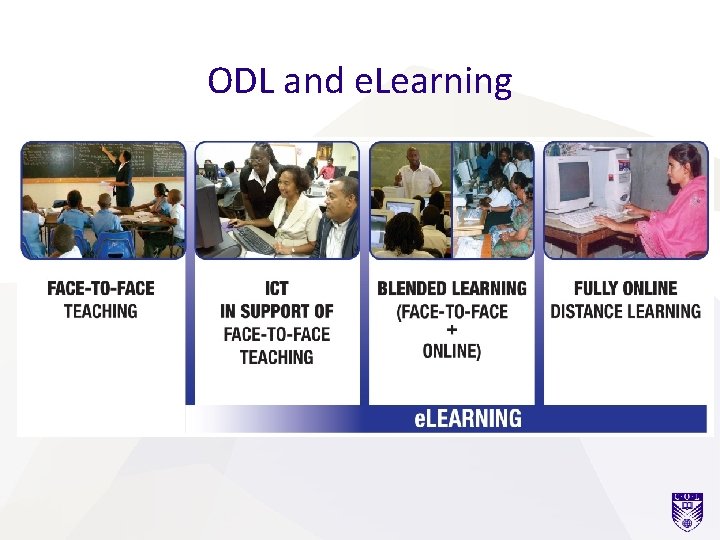
ODL and e. Learning
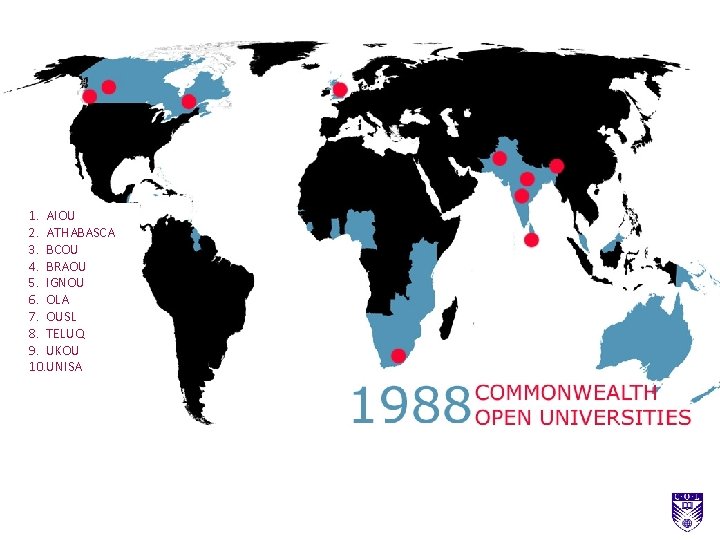
1. AIOU 2. ATHABASCA 3. BCOU 4. BRAOU 5. IGNOU 6. OLA 7. OUSL 8. TELUQ 9. UKOU 10. UNISA
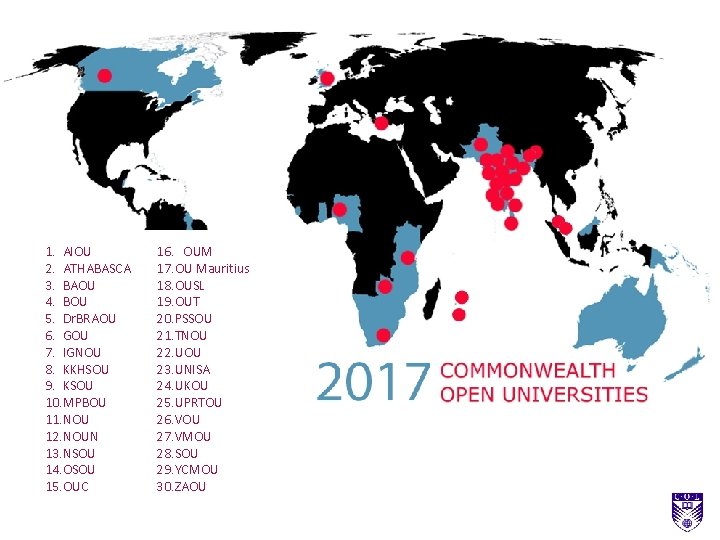
1. AIOU 2. ATHABASCA 3. BAOU 4. BOU 5. Dr. BRAOU 6. GOU 7. IGNOU 8. KKHSOU 9. KSOU 10. MPBOU 11. NOU 12. NOUN 13. NSOU 14. OSOU 15. OUC 16. OUM 17. OU Mauritius 18. OUSL 19. OUT 20. PSSOU 21. TNOU 22. UOU 23. UNISA 24. UKOU 25. UPRTOU 26. VOU 27. VMOU 28. SOU 29. YCMOU 30. ZAOU
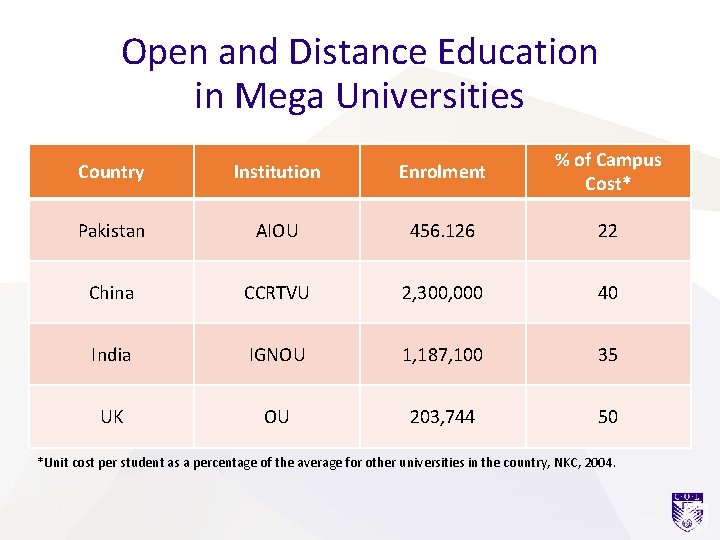
Open and Distance Education in Mega Universities Country Institution Enrolment % of Campus Cost* Pakistan AIOU 456. 126 22 China CCRTVU 2, 300, 000 40 India IGNOU 1, 187, 100 35 UK OU 203, 744 50 *Unit cost per student as a percentage of the average for other universities in the country, NKC, 2004.
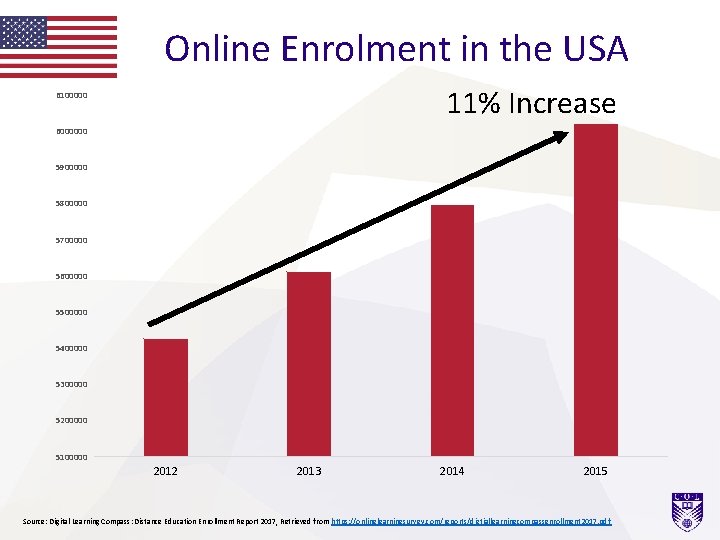
Online Enrolment in the USA 11% Increase 6100000 6000000 5900000 5800000 5700000 5600000 5500000 5400000 5300000 5200000 5100000 2012 2013 2014 2015 Source: Digital Learning Compass: Distance Education Enrollment Report 2017, Retrieved from https: //onlinelearningsurvey. com/reports/digtiallearningcompassenrollment 2017. pdf
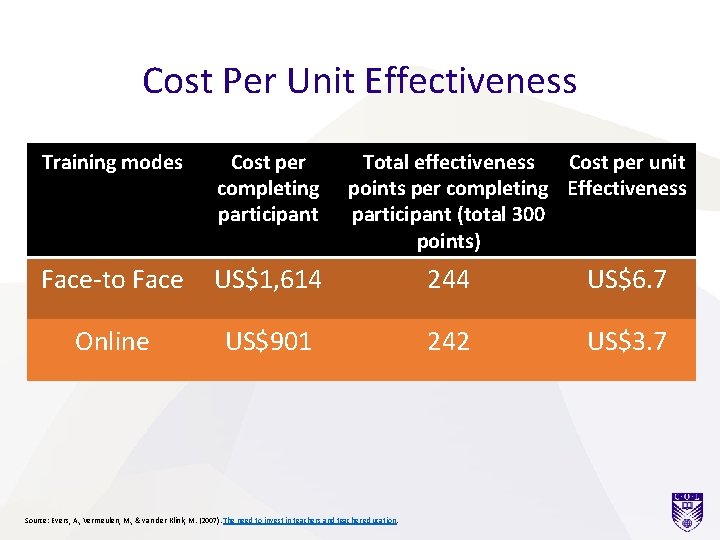
Cost Per Unit Effectiveness Training modes Cost per completing participant Total effectiveness Cost per unit points per completing Effectiveness participant (total 300 points) Face-to Face US$1, 614 244 US$6. 7 Online US$901 242 US$3. 7 Source: Evers, A. , Vermeulen, M. , & van der Klink, M. (2007). The need to invest in teachers and teacher education.
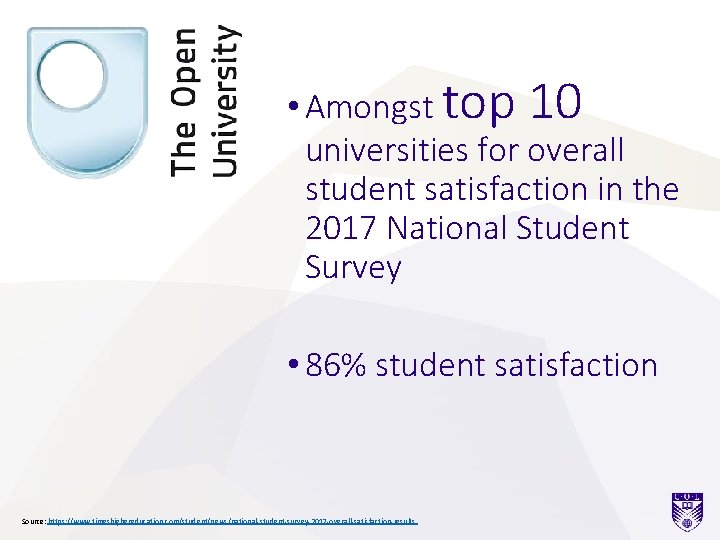
• Amongst top 10 universities for overall student satisfaction in the 2017 National Student Survey • 86% student satisfaction Source: https: //www. timeshighereducation. com/student/news/national-student-survey-2017 -overall-satisfaction-results
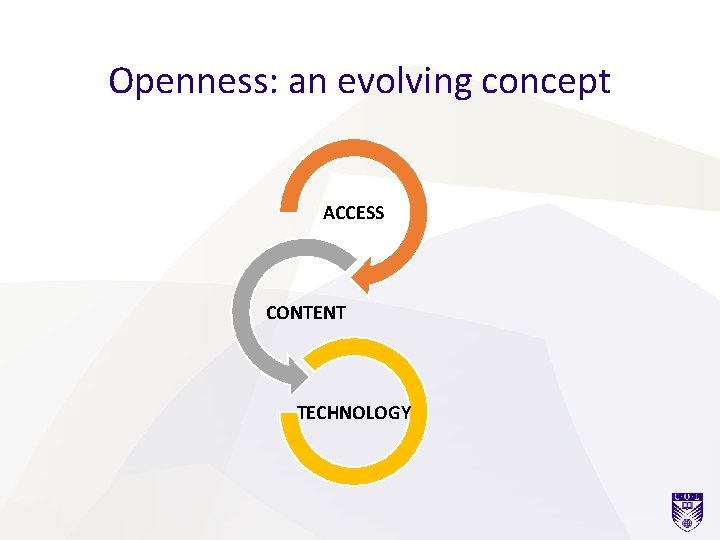
Openness: an evolving concept ACCESS CONTENT TECHNOLOGY
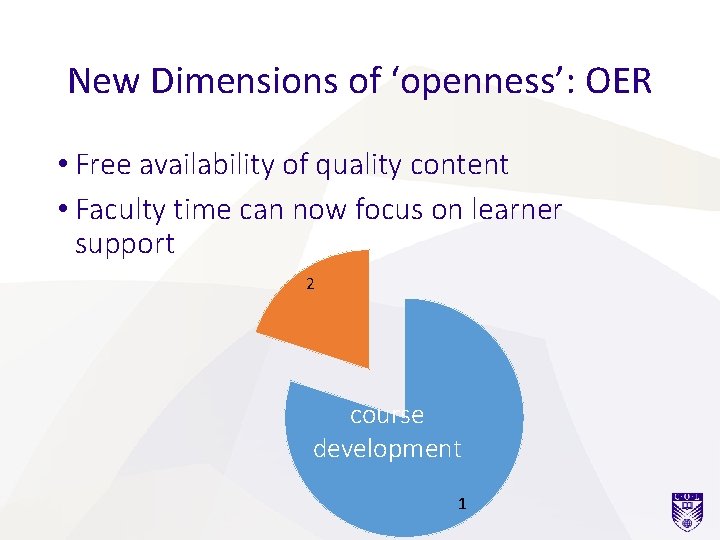
New Dimensions of ‘openness’: OER • Free availability of quality content • Faculty time can now focus on learner support 2 course development 1
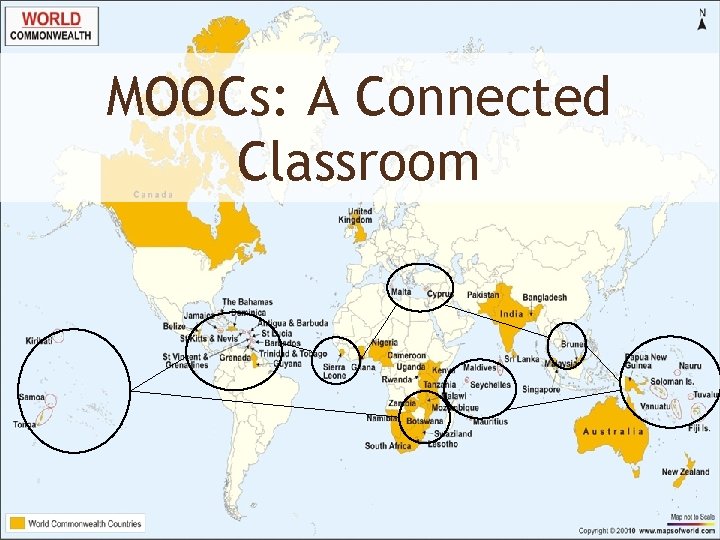
MOOCs: A Connected Classroom
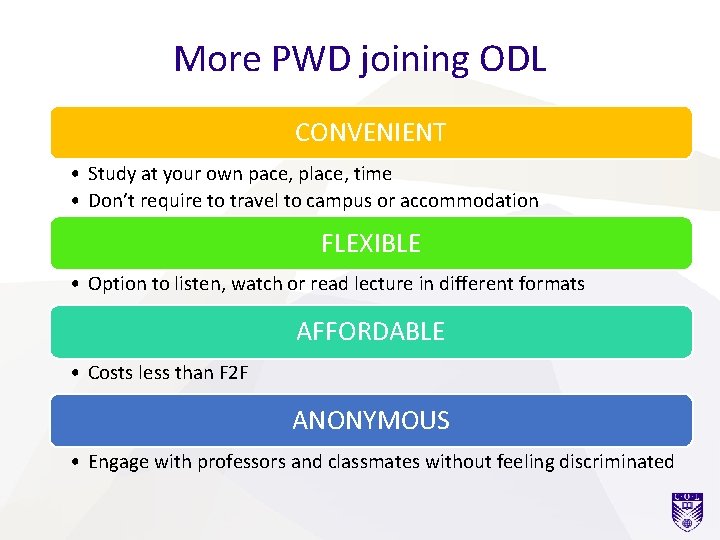
More PWD joining ODL CONVENIENT • Study at your own pace, place, time • Don’t require to travel to campus or accommodation FLEXIBLE • Option to listen, watch or read lecture in different formats AFFORDABLE • Costs less than F 2 F ANONYMOUS • Engage with professors and classmates without feeling discriminated
Is ODL Inclusive?
Legal and Policy Framework on Disability – Australia Disability Discrimination Act 1992: the act prohibits discrimination against persons with disabilities in employment, education, publicly available premises, provision of goods and services, accommodation, clubs and associations, and other contexts. Discrimination is defined to include failing to make reasonable adjustments for the person.
Supporting students with disabilities • The OU strives to make all aspects of study accessible to everyone, which is why more disabled students choose the OU than any other UK University • In 2014, around 19, 000 such students enrolled at the undergraduate level • Securing Greater Accessibility policy in place (2010) • Ensure that all learning objectives must be met regardless of access Source: Open University – Supporting students with disabilities, last accessed on 14 November, 2017
Supporting students with disabilities • Produces study material in alternative formats, including Braille, large print, audio and electronic. • Provides sign language interpretation services in certain of its contact groups. • 2, 469 students (0. 8% of total) enrolled in 2011 has a disability. • The enrolment of students with disabilities has grown by 59. 3% since 2007 Sources: UNISA: Students with disabilities, last accessed on 14 November 2017 An institutional profile: Unisa Facts & Figures HEMIS 2007 – 2011 (2012)
Supporting students with disabilities Services provided by ASD (Access to Students with Disabilities): • Advocacy, Liaison and Referral • Alternative Format Course Materials • Assistive Technology • Course Management Services No statistics • Exam Accommodations available on # • Learning Support Services of disabled students enrolled Source: Athabasca University – Access to students with disabilities last accessed on 14 November 2017
AIOU offers free education for disabled persons up to Ph. D level • The Allama Iqbal Open University will offer free education to physically handicapped, visually and physically impaired students up to the Ph. D level • Students will get enhanced facilities including provision of study material through computerized accessibility network • The number of disabled persons enrolled with AIOU has recently reached 400 Source: Daily Times, AIOU offers free education for disabled persons up to Ph. D level, published on 13 February, 2017
OUT helps people with vision disabilities access ICT People who are blind or low vision in Tanzania can now access Information and Communication Technology (ICT) studies following the introduction of a special program that offers computer courses to people with vision disabilities, an initiative launched recently by Open University of Tanzania (OUT) Source: Global accessibility news - OUT helps people with vision disabilities access ICT, published on 8 January , 2014.
Krishna Kanta Handiqui State Open University (KKHSOU) • Policy for Persons with Disabilities • Content in accessible formats • Provision of various ICT s • Special Educators provided for support with sign language • Resource Centre for Persons with Disabilities • Rehabilitation Support • Appropriate funds and resources
Open Education and Disabilities • Inclusion fits with social mission of open universities • Varying levels of interventions • Emphasis on convergence of ODL and ICTs/Assistive Technologies Services Provided • Course Accommodation • Examination Accommodation • External Support • Assistive Technology
The Role of Technology
Assistive Technology (AT) Definition products, equipment, and systems that enhance learning, working, and daily living for persons with disabilities. Source: Assistive Technology Industry Association(ATi. A), What is AT? , last accessed on 23 November, 2017
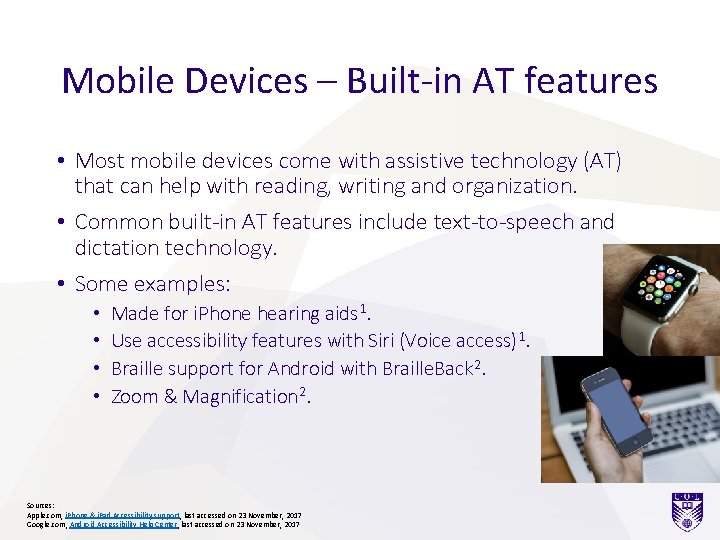
Mobile Devices – Built-in AT features • Most mobile devices come with assistive technology (AT) that can help with reading, writing and organization. • Common built-in AT features include text-to-speech and dictation technology. • Some examples: • • Made for i. Phone hearing aids 1. Use accessibility features with Siri (Voice access)1. Braille support for Android with Braille. Back 2. Zoom & Magnification 2. Sources: Apple. com, i. Phone & i. Pad Accessibility support, last accessed on 23 November, 2017 Google. com, Android Accessibility Help Center, last accessed on 23 November, 2017
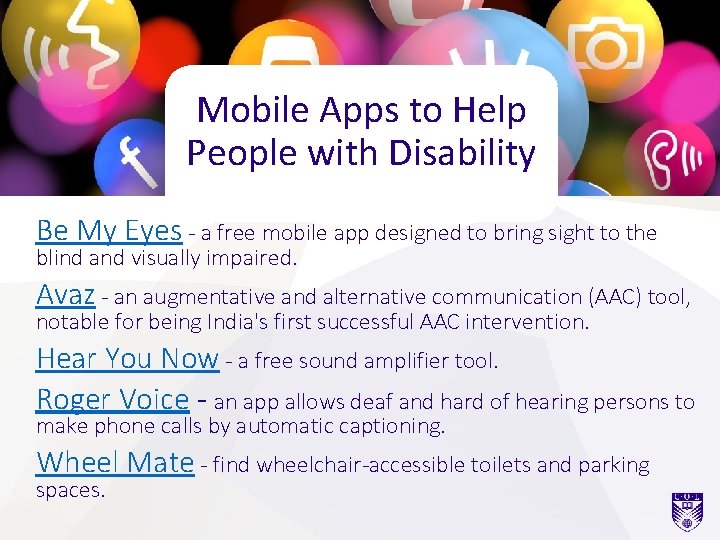
Mobile Apps to Help People with Disability Be My Eyes - a free mobile app designed to bring sight to the blind and visually impaired. Avaz - an augmentative and alternative communication (AAC) tool, notable for being India's first successful AAC intervention. Hear You Now - a free sound amplifier tool. Roger Voice - an app allows deaf and hard of hearing persons to make phone calls by automatic captioning. Wheel Mate - find wheelchair-accessible toilets and parking spaces.
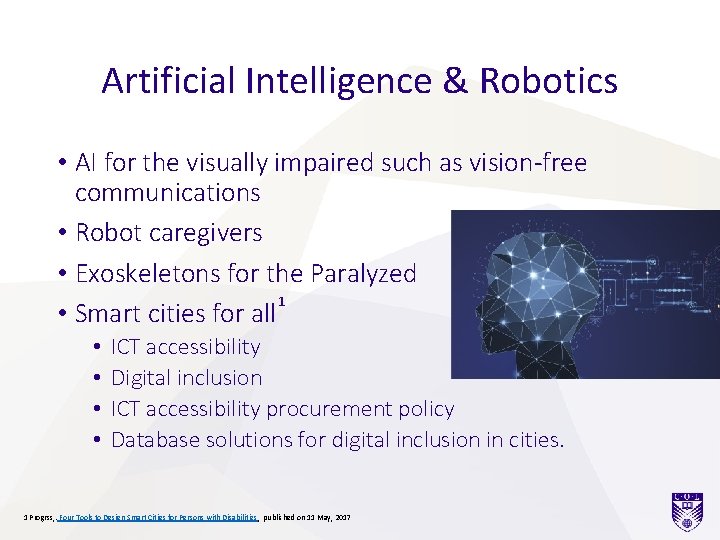
Artificial Intelligence & Robotics • AI for the visually impaired such as vision-free communications • Robot caregivers • Exoskeletons for the Paralyzed 1 • Smart cities for all • • ICT accessibility Digital inclusion ICT accessibility procurement policy Database solutions for digital inclusion in cities. 1 Progrss, . Four Tools to Design Smart Cities for Persons with Disabilities, published on 11 May, 2017
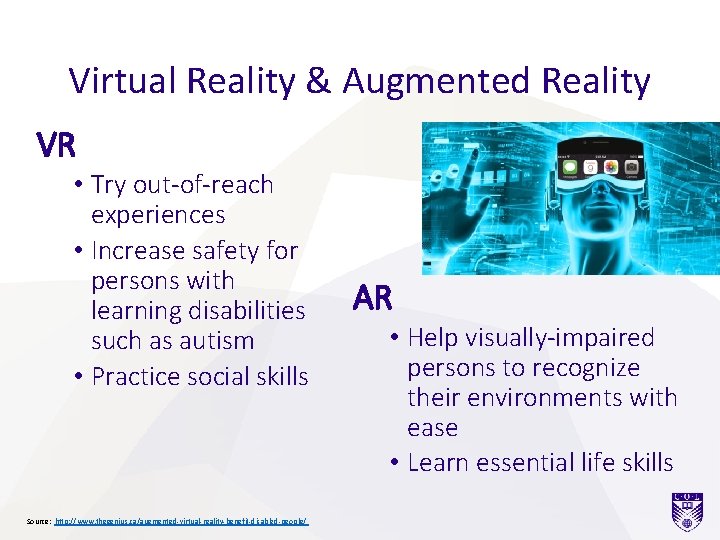
Virtual Reality & Augmented Reality VR • Try out-of-reach experiences • Increase safety for persons with learning disabilities such as autism • Practice social skills Source: http: //www. thegenius. ca/augmented-virtual-reality-benefit-disabled-people/ AR • Help visually-impaired persons to recognize their environments with ease • Learn essential life skills
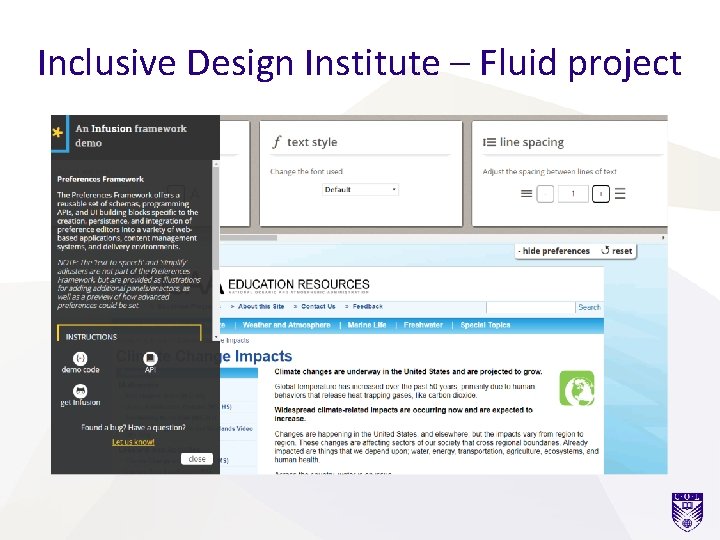
Inclusive Design Institute – Fluid project
Barriers to ICT in Education Physical - access Cognitive - specific learning problems Content - language; software Didactic - teachers lack skills; inflexible learning Financial - cost of devices; hardware and software Model Policy for Inclusive ICTs in Education for Persons with Disabilities, UNESCO, Euro Agency; G 3 ict, 2014, p. 10
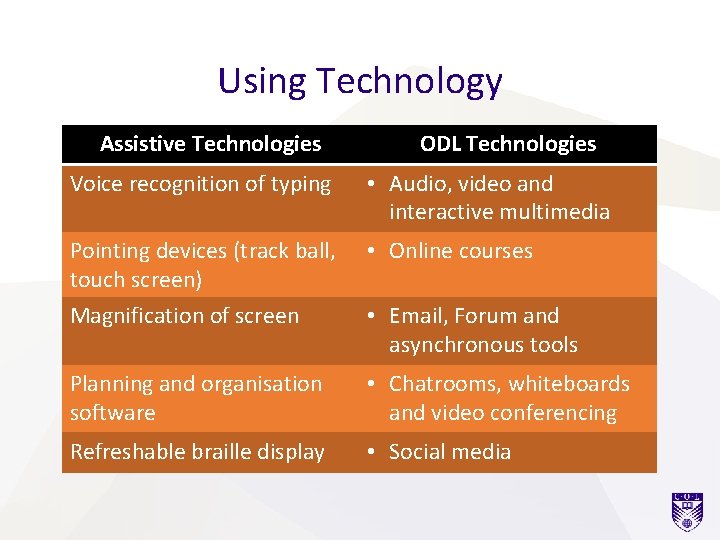
Using Technology Assistive Technologies ODL Technologies Voice recognition of typing • Audio, video and interactive multimedia Pointing devices (track ball, touch screen) • Online courses Magnification of screen • Email, Forum and asynchronous tools Planning and organisation software • Chatrooms, whiteboards and video conferencing Refreshable braille display • Social media
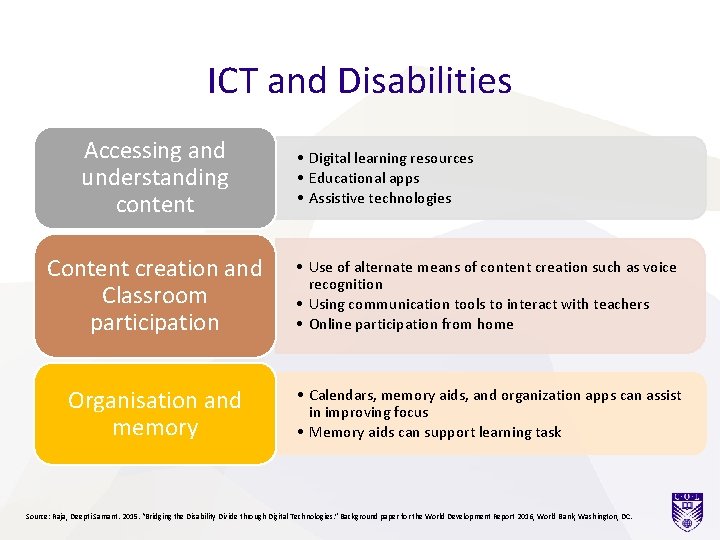
ICT and Disabilities Accessing and understanding content • Digital learning resources • Educational apps • Assistive technologies Content creation and Classroom participation • Use of alternate means of content creation such as voice recognition • Using communication tools to interact with teachers • Online participation from home Organisation and memory • Calendars, memory aids, and organization apps can assist in improving focus • Memory aids can support learning task Source: Raja, Deepti Samant. 2015. “Bridging the Disability Divide through Digital Technologies. ” Background paper for the World Development Report 2016, World Bank, Washington, DC.
Towards inclusion
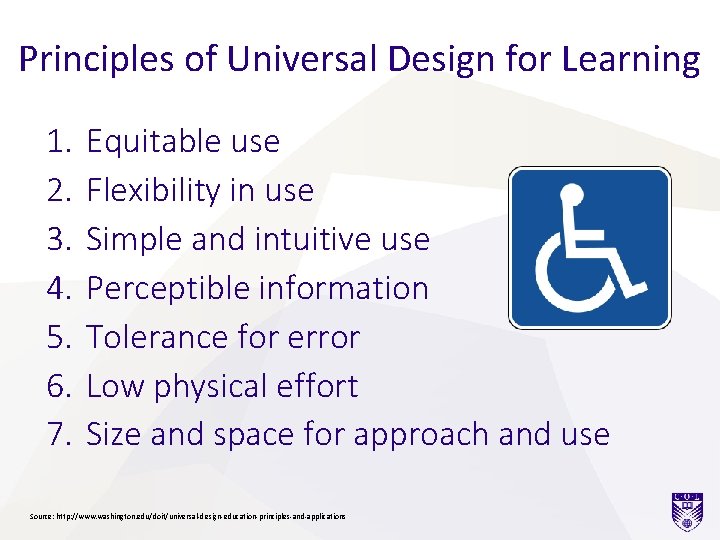
Principles of Universal Design for Learning 1. 2. 3. 4. 5. 6. 7. Equitable use Flexibility in use Simple and intuitive use Perceptible information Tolerance for error Low physical effort Size and space for approach and use Source: http: //www. washington. edu/doit/universal-design-education-principles-and-applications
Benefits ‘There is little doubt that distance education can enhance access to students with disabilities and that disability specific support services can enhance success. ’ - Susan D. Moisey, 2004 ‘making courses accessible to students with disabilities promotes best practices for all students’ - Sheryl Burgstahler ‘learning activities…designed with accessibility in mind …facilitate learning in a variety of ways and usually exhibit well-considered pedagogy…accessibility is a driver for quality in general’ - Martyn Cooper, 2014
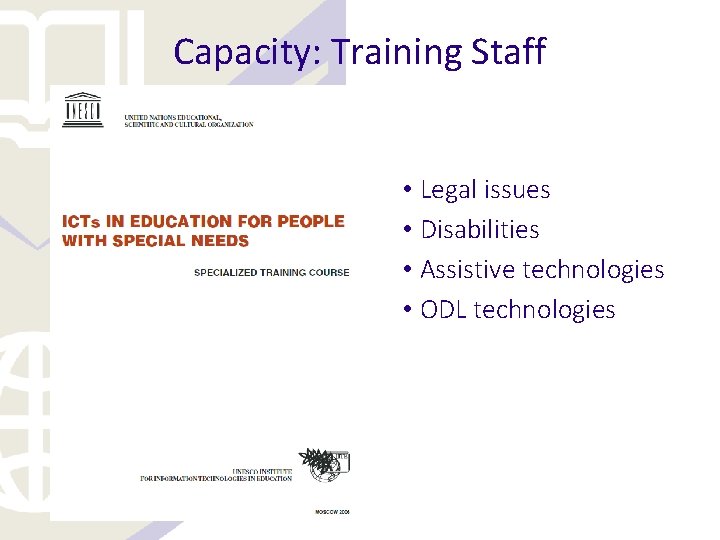
Capacity: Training Staff • Legal issues • Disabilities • Assistive technologies • ODL technologies
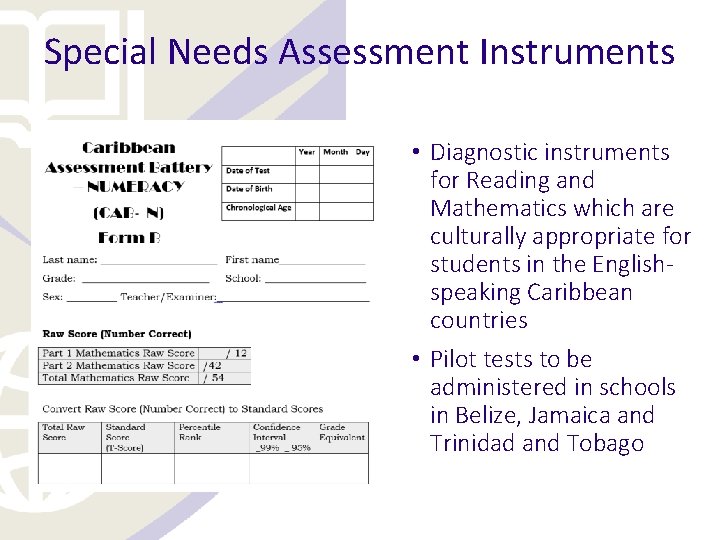
Special Needs Assessment Instruments • Diagnostic instruments for Reading and Mathematics which are culturally appropriate for students in the Englishspeaking Caribbean countries • Pilot tests to be administered in schools in Belize, Jamaica and Trinidad and Tobago
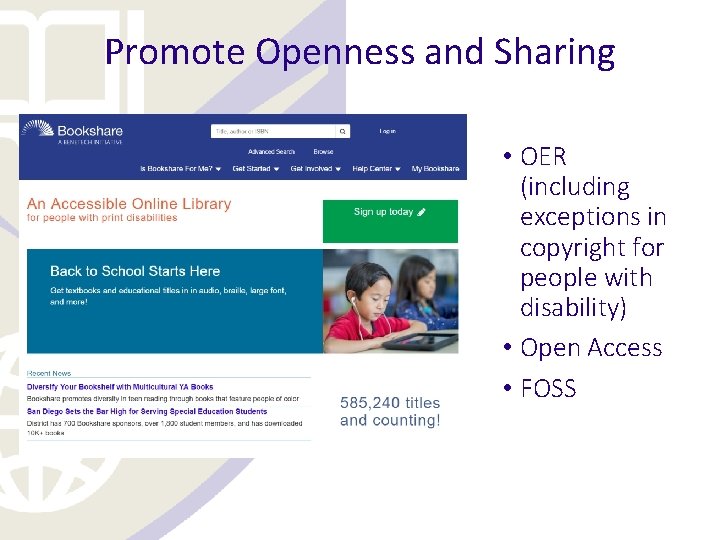
Promote Openness and Sharing • OER (including exceptions in copyright for people with disability) • Open Access • FOSS
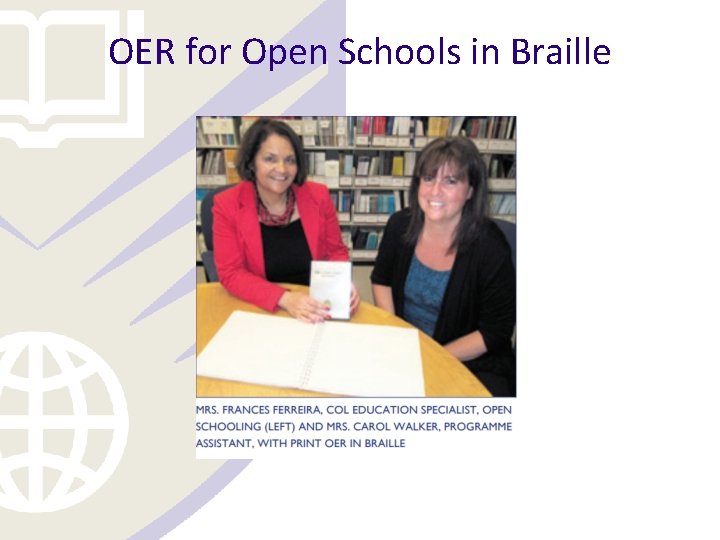
OER for Open Schools in Braille
Way Forward • ODL institutions need to be more proactive in catering to disabilities • ICT by themselves cannot serve the needs of PWD but need to be combined with content and pedagogy • Collect data and monitor the results • Develop open accessible content in Arabic • More Collaboration
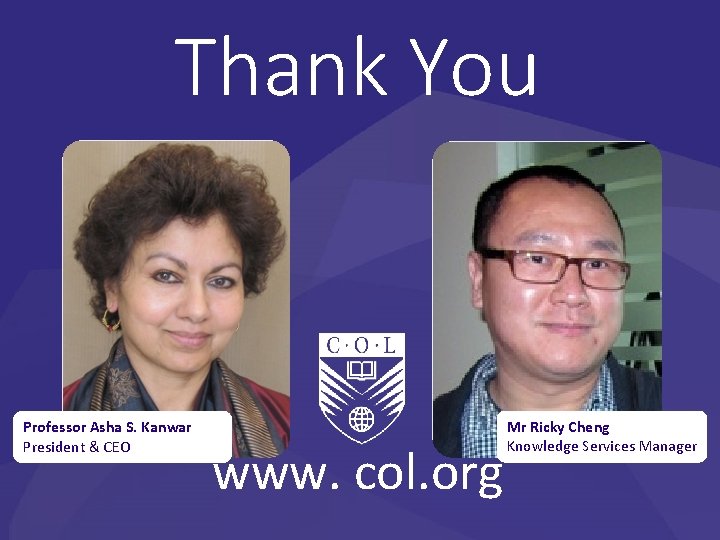
Thank You Professor Asha S. Kanwar President & CEO www. col. org Mr Ricky Cheng Knowledge Services Manager