
Making Library Assessment Work Progress Report of an
Making Library Assessment Work Progress Report of an ARL Project Steve Hiller University of Washington Jim Self University of Virginia Martha Kyrillidou Association of Research Libraries ARL MLAW Participants Meeting San Antonio, Texas 20 January 2006
Making Library Assessment Work: Practical Approaches for Developing and Sustaining Effective Assessment • Association of Research Libraries Project – Under the aegis of Statistics and Measurement Program • Funded by participating libraries • Site visits by Jim and Steve – – Pre-visit survey Presentation Interviews and meetings Written report for each library • Phase I: 7 libraries in Winter/Spring 2005 – Preliminary report at Northumbria Conference 2005 • Phase II: 18 libraries Autumn 2005 -Autumn 2006 • Final report to ARL in late 2006

Why “Making Library Assessment Work”? Using Data Effectively in Libraries • • • Library leadership Organizational culture Library priorities Sufficiency of resources Data infrastructure Assessment skills and expertise Sustainability Analyzing and presenting results Using results to improve libraries
MLAW Process • • Idea discussed with Martha, June 2004 Final proposal written with Martha, August 2004 Invitation to participate sent by ARL in Sept. 2005 17 libraries express interest; 7 chosen for Phase I, remainder for Phase II • Pilot site visit November 2005 • Second call for participants in June 2005; 8 more libraries express interest • Phase II revised to include longer site visit, follow-up project, and community building
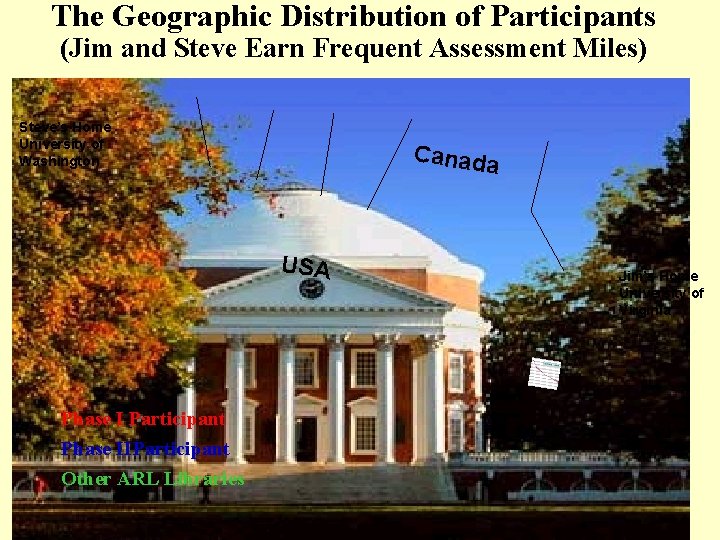
The Geographic Distribution of Participants (Jim and Steve Earn Frequent Assessment Miles) Steve’s Home University of Washington Canada USA Phase I Participant Phase IIParticipant Other ARL Libraries Jim’s Home University of Virginia
Distribution Of Participants by ARL Index Ranking (113 Academic Libraries) 24 Participating Libraries: Mean 51. 5 Median 49. 5
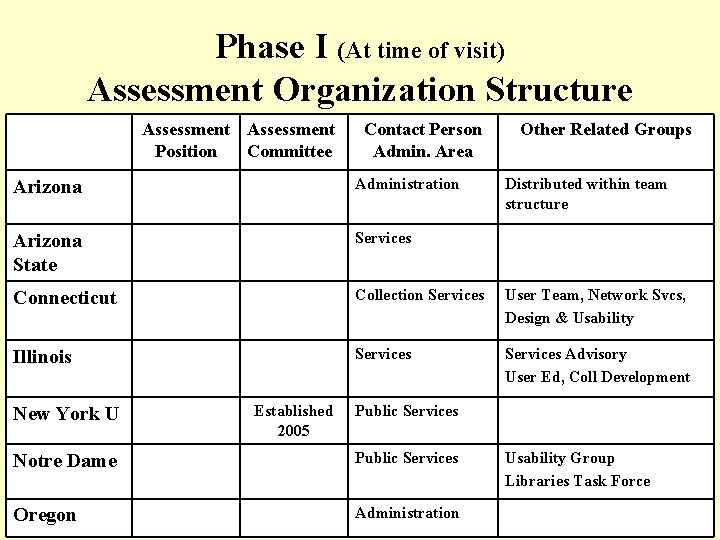
Phase I (At time of visit) Assessment Organization Structure Assessment Position Committee Contact Person Admin. Area Other Related Groups Arizona Administration Arizona State Services Connecticut Collection Services User Team, Network Svcs, Design & Usability Illinois Services Advisory User Ed, Coll Development New York U Established 2005 Distributed within team structure Public Services Notre Dame Public Services Oregon Administration Usability Group Libraries Task Force
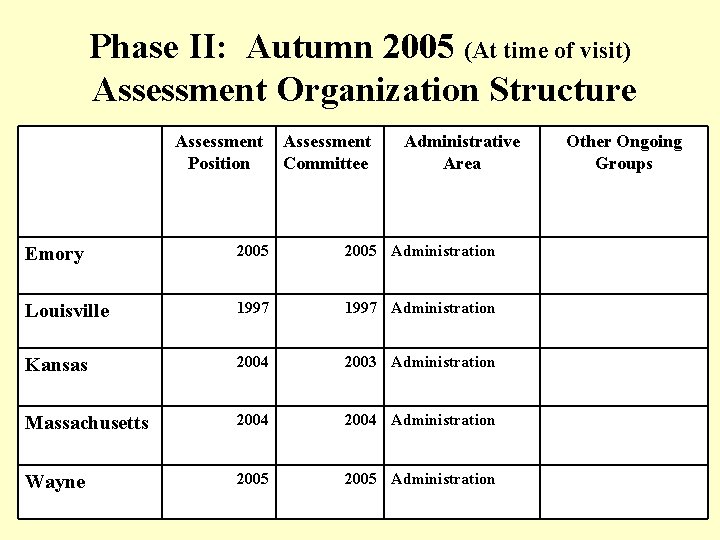
Phase II: Autumn 2005 (At time of visit) Assessment Organization Structure Assessment Position Assessment Committee Administrative Area Emory 2005 Administration Louisville 1997 Administration Kansas 2004 2003 Administration Massachusetts 2004 Administration Wayne 2005 Administration Other Ongoing Groups
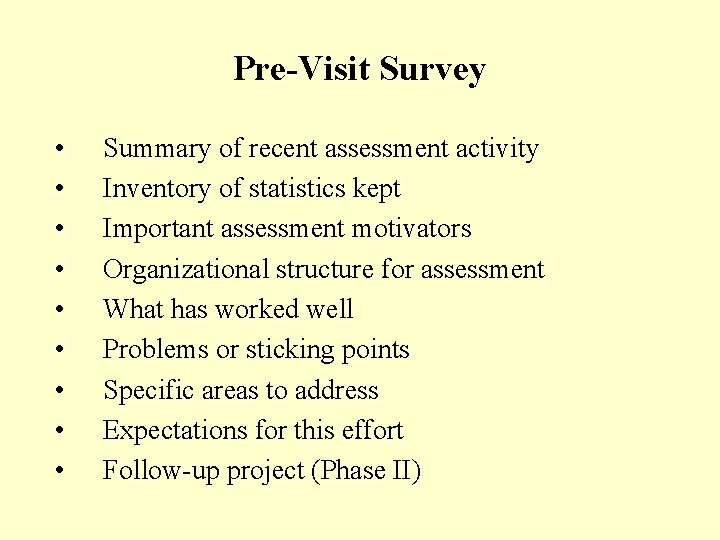
Pre-Visit Survey • • • Summary of recent assessment activity Inventory of statistics kept Important assessment motivators Organizational structure for assessment What has worked well Problems or sticking points Specific areas to address Expectations for this effort Follow-up project (Phase II)
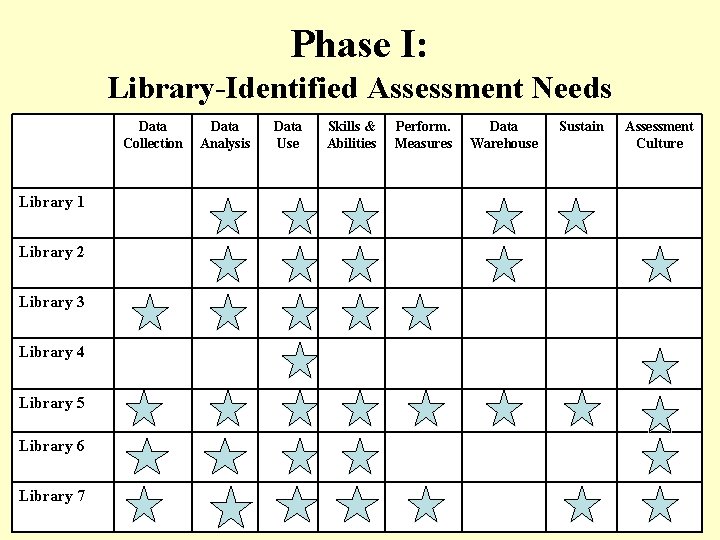
Phase I: Library-Identified Assessment Needs Data Collection Library 1 Library 2 Library 3 Library 4 Library 5 Library 6 Library 7 Data Analysis Data Use Skills & Abilities Perform. Measures Data Warehouse Sustain Assessment Culture
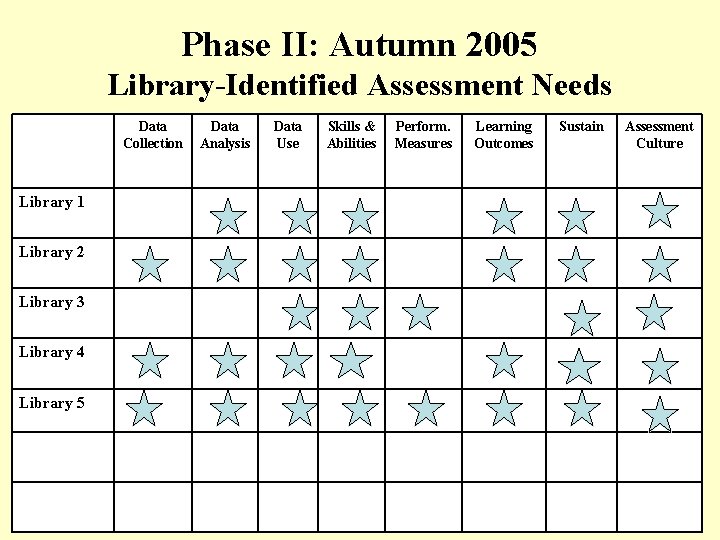
Phase II: Autumn 2005 Library-Identified Assessment Needs Data Collection Library 1 Library 2 Library 3 Library 4 Library 5 Data Analysis Data Use Skills & Abilities Perform. Measures Learning Outcomes Sustain Assessment Culture
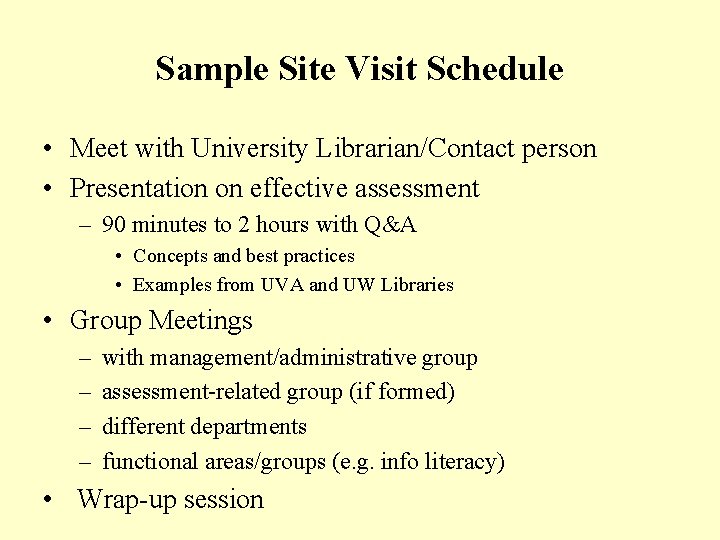
Sample Site Visit Schedule • Meet with University Librarian/Contact person • Presentation on effective assessment – 90 minutes to 2 hours with Q&A • Concepts and best practices • Examples from UVA and UW Libraries • Group Meetings – – with management/administrative group assessment-related group (if formed) different departments functional areas/groups (e. g. info literacy) • Wrap-up session
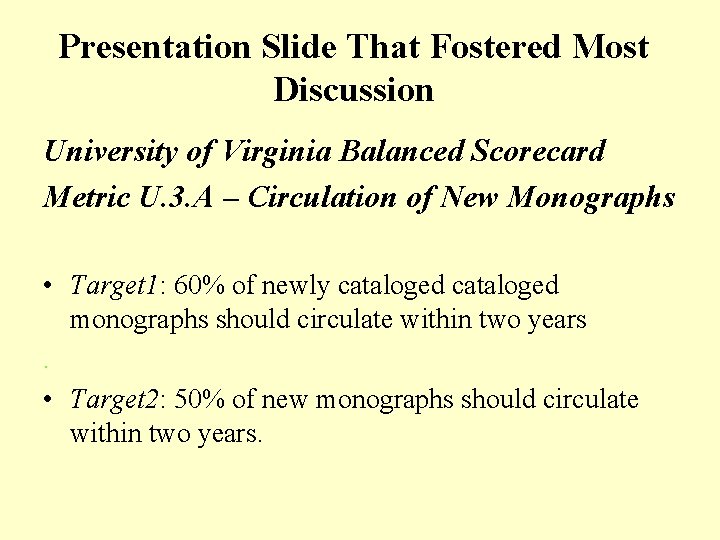
Presentation Slide That Fostered Most Discussion University of Virginia Balanced Scorecard Metric U. 3. A – Circulation of New Monographs • Target 1: 60% of newly cataloged monographs should circulate within two years. • Target 2: 50% of new monographs should circulate within two years.
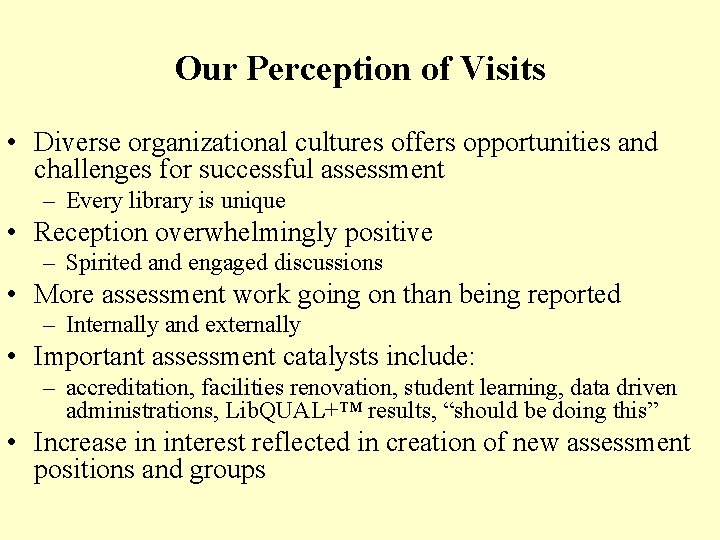
Our Perception of Visits • Diverse organizational cultures offers opportunities and challenges for successful assessment – Every library is unique • Reception overwhelmingly positive – Spirited and engaged discussions • More assessment work going on than being reported – Internally and externally • Important assessment catalysts include: – accreditation, facilities renovation, student learning, data driven administrations, Lib. QUAL+™ results, “should be doing this” • Increase in interest reflected in creation of new assessment positions and groups
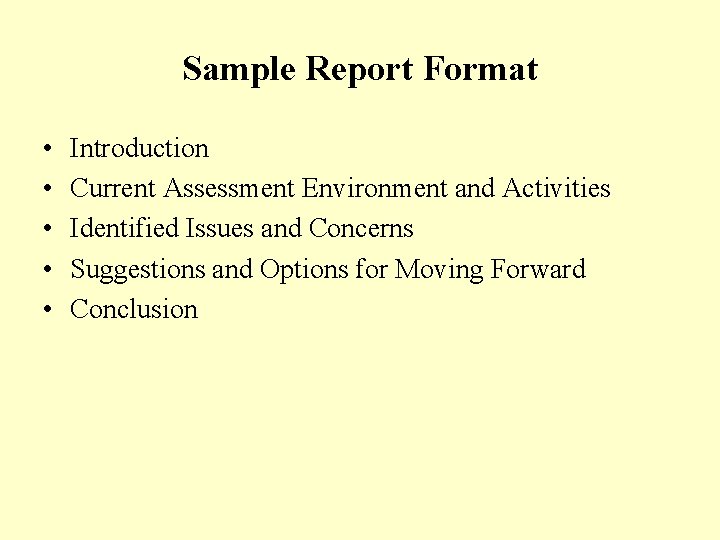
Sample Report Format • • • Introduction Current Assessment Environment and Activities Identified Issues and Concerns Suggestions and Options for Moving Forward Conclusion
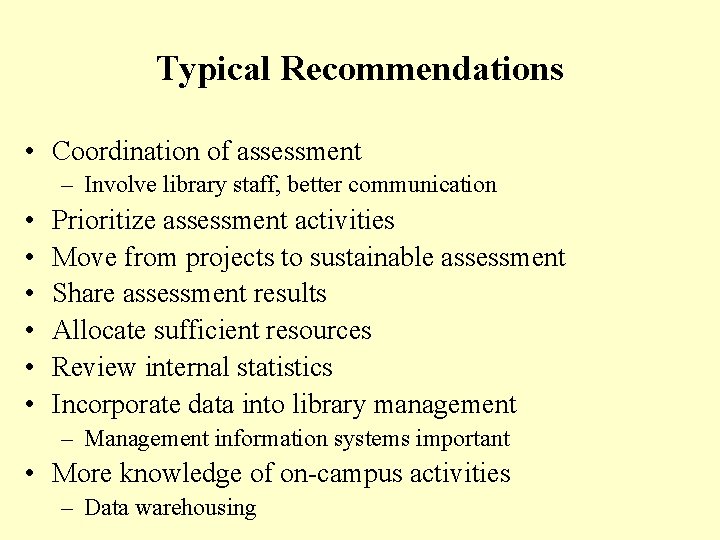
Typical Recommendations • Coordination of assessment – Involve library staff, better communication • • • Prioritize assessment activities Move from projects to sustainable assessment Share assessment results Allocate sufficient resources Review internal statistics Incorporate data into library management – Management information systems important • More knowledge of on-campus activities – Data warehousing
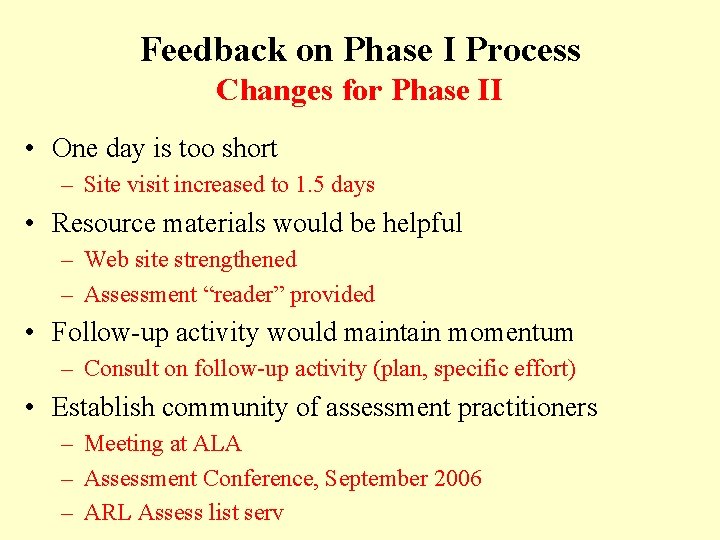
Feedback on Phase I Process Changes for Phase II • One day is too short – Site visit increased to 1. 5 days • Resource materials would be helpful – Web site strengthened – Assessment “reader” provided • Follow-up activity would maintain momentum – Consult on follow-up activity (plan, specific effort) • Establish community of assessment practitioners – Meeting at ALA – Assessment Conference, September 2006 – ARL Assess list serv
What’s Next? Building the Library Assessment Community • Meetings – ALA New Orleans, June 2006 – Assessment Conference, Charlottesville VA September 25 -27, 2006 • Web Site – http: //www. arl. org/stats/Hiller_Self. html • Final Report – Late 2006
- Slides: 18