
Making Laboratories Count Better Integration of Laboratories in

Making Laboratories Count Better Integration of Laboratories in Physics Courses by Jim Sizemore, Ph. D. Physics and Engineering Professor Tyler Junior College, Tyler, TX Greg Sherman, Ph. D. ; Mike Broyles, Ed. D. Physics Professors Collin College, Plano, TX Acknowledgements: Meade Brooks, Ashok Kumar, Paul Johnson
Outline of Talk • Issues – Students don’t take labs seriously – Poor math preparation • Solution – Prelab packets – Quiz on prelab – Objective grading of labs • Preliminary Results and Conclusions
Students don’t take labs seriously • Informal survey of students – Admitted not preparing – Admitted expectation of good grade with only modest effort
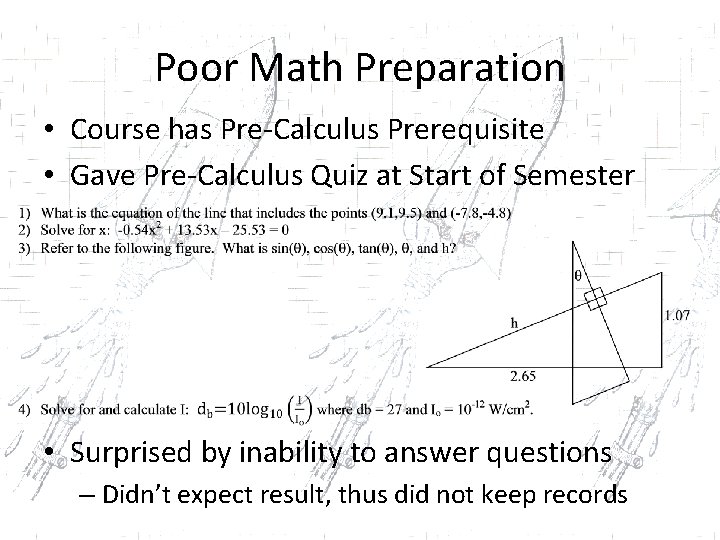
Poor Math Preparation • Course has Pre-Calculus Prerequisite • Gave Pre-Calculus Quiz at Start of Semester • Surprised by inability to answer questions – Didn’t expect result, thus did not keep records
Prelab Packets • Separated Lab into Pre. Lab and Lab Components • Students were required to turn in Prelab at beginning of lab • Example on next slide

Example Prelab
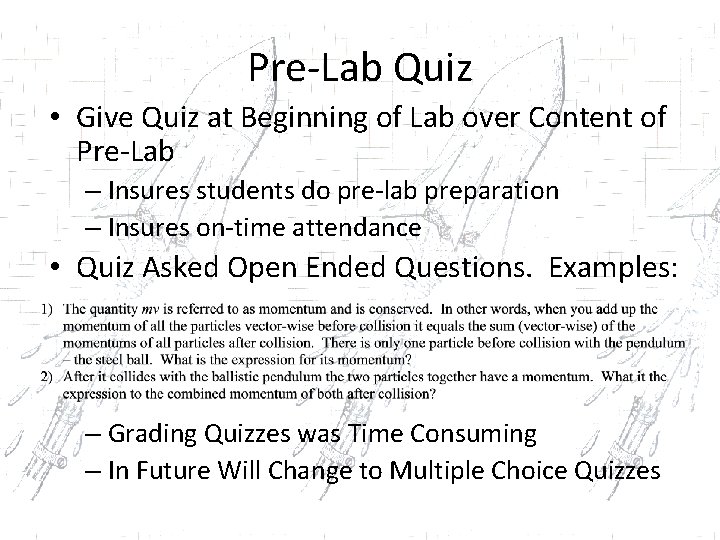
Pre-Lab Quiz • Give Quiz at Beginning of Lab over Content of Pre-Lab – Insures students do pre-lab preparation – Insures on-time attendance • Quiz Asked Open Ended Questions. Examples: – Grading Quizzes was Time Consuming – In Future Will Change to Multiple Choice Quizzes
Objective Grading • Labs Often Taught by Inexperienced Instructors • Tendency to Judge Based on Scale of 1 to 10 • Solution: Precise Point Assignment on 0 to 100 Scale – Example from Previous Slide
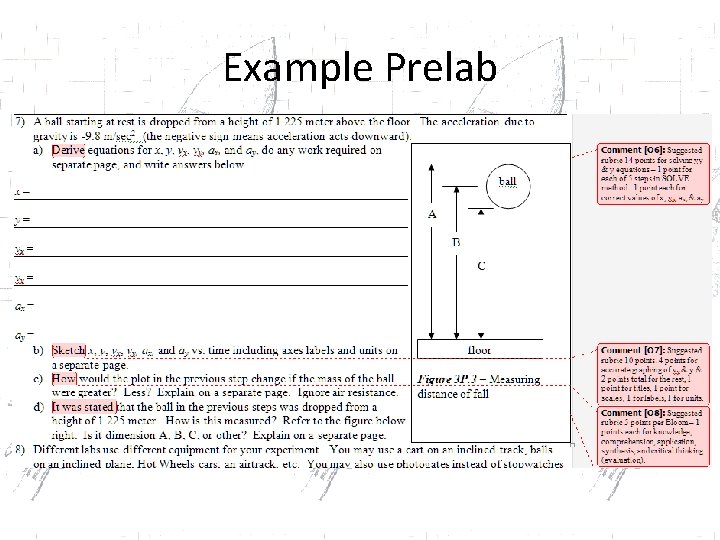
Example Prelab
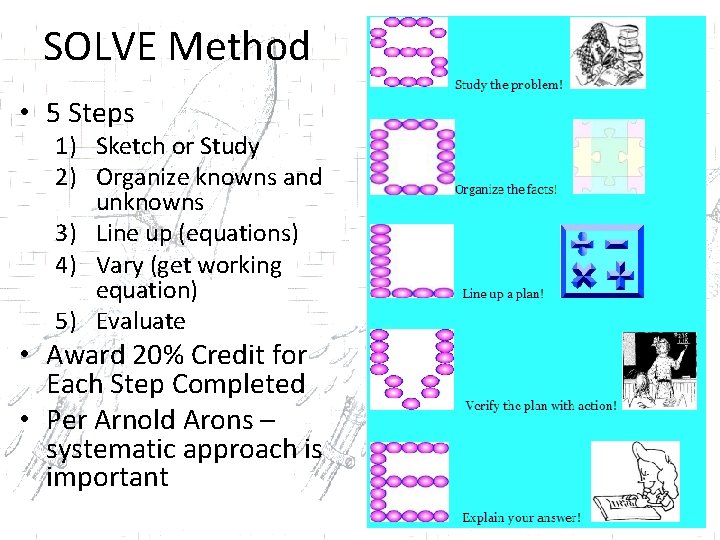
SOLVE Method • 5 Steps 1) Sketch or Study 2) Organize knowns and unknowns 3) Line up (equations) 4) Vary (get working equation) 5) Evaluate • Award 20% Credit for Each Step Completed • Per Arnold Arons – systematic approach is important
Application of Bloom’s Taxonomy to Quantitative Fields • Get Away From Memorizing Equations • Bloom’s Taxonomy Simplified – Know – Understand – Apply – Synthesize – Critique • Award 20% for each step of Bloom’s Taxonomy Completed
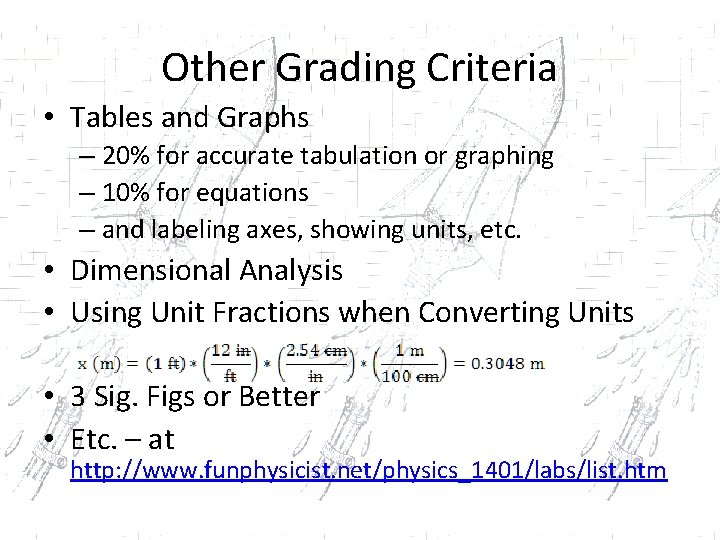
Other Grading Criteria • Tables and Graphs – 20% for accurate tabulation or graphing – 10% for equations – and labeling axes, showing units, etc. • Dimensional Analysis • Using Unit Fractions when Converting Units • 3 Sig. Figs or Better • Etc. – at http: //www. funphysicist. net/physics_1401/labs/list. htm
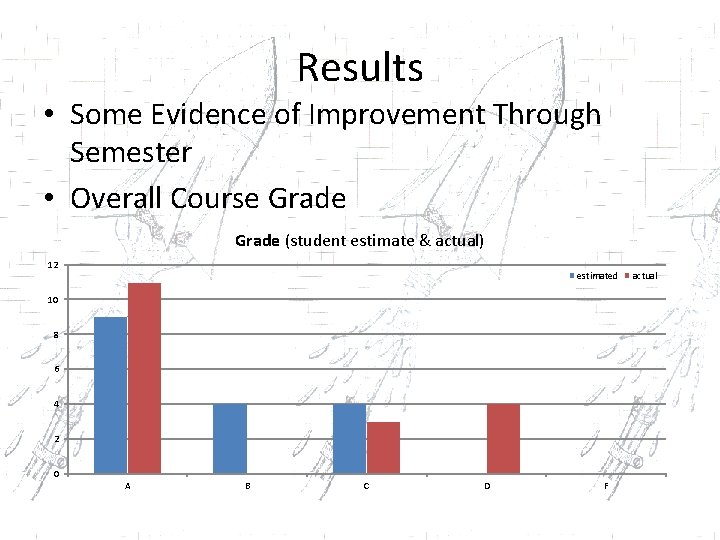
Results • Some Evidence of Improvement Through Semester • Overall Course Grade (student estimate & actual) 12 estimated 10 8 6 4 2 0 A B C D F actual
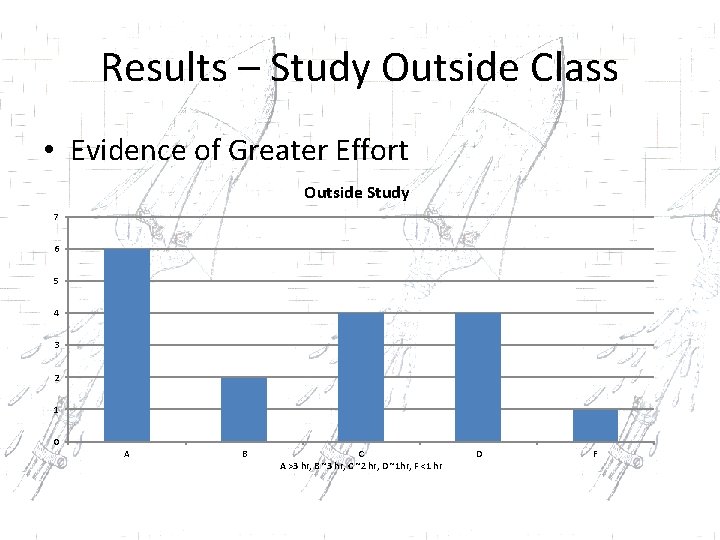
Results – Study Outside Class • Evidence of Greater Effort Outside Study 7 6 5 4 3 2 1 0 A B C A >3 hr, B ~3 hr, C ~2 hr, D ~1 hr, F <1 hr D F
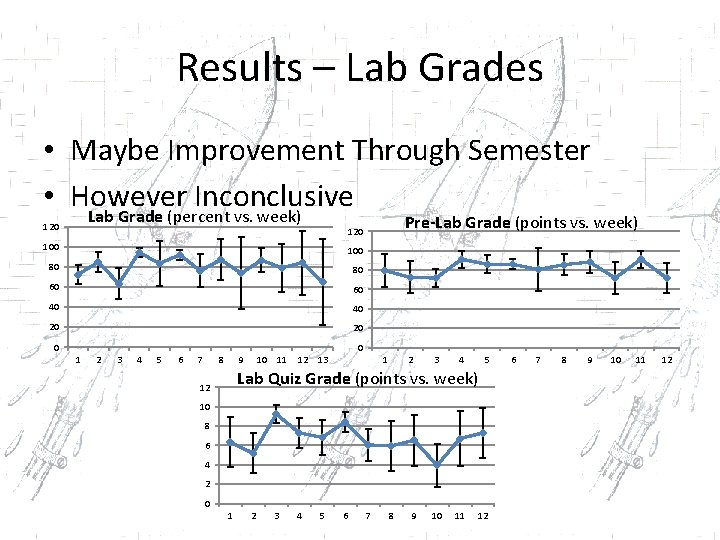
Results – Lab Grades • Maybe Improvement Through Semester • However Inconclusive Lab Grade (percent vs. week) 120 Pre-Lab Grade (points vs. week) 120 100 80 80 60 60 40 40 20 20 0 0 1 2 3 4 5 6 7 8 9 10 11 12 13 1 2 3 4 5 Lab Quiz Grade (points vs. week) 12 10 8 6 4 2 0 1 2 3 4 5 6 7 8 9 10 11 12
Conclusions • Evidence of Better Student Engagement and Effort – Increased effort is appropriate – Underprepared students spend more time, however succeed • Grades Improve • Doesn’t Require New Labs or Rewrites – Develop grading scheme, break out pre-labs, develop multiple choice pre-lab quizzes • Results Not Unequivocal, but are Encouraging
Future Work • Gather Statistics Over Several Semesters to Understand Variability due to Differences Between Labs • Retain Baseline Information of Beginning of Semester Quiz to Compare to Mid-Semester and End-of-Semester Data • Establish Control Group for Comparison
- Slides: 17