
Making It Count The Minnesota Bicycle and Pedestrian

Making It Count: The Minnesota Bicycle and Pedestrian Counting Initiative Lisa Austin, Mark Flinner – Mn. DOT; Jason Pieper, Hennepin County; Greg Lindsey – University of Minnesota

Our presentation today … � Introduction and rationale – Lisa � Traffic monitoring in Minnesota – Mark � Initiative outcomes and results - Greg � A local perspective: Hennepin County – Jason � But first, an overview … http: //www. youtube. com/watch? v=Yoo 2 NYVDx. Ks
Mn. DOT Strategic Directions � 2050 Vision – Minnesota Go: ◦ Multimodal transportation system maximizes the health of people, the environment and our economy. � Complete Streets: ◦ To understand vehicle, bicycle, and pedestrian interactions ◦ Helps achieve transportation goals listed in statue � Toward Zero Deaths: ◦ To assess exposure and effectiveness of safety programs � Performance measures: ◦ To increase bicycling, walking and transit

Why count bike and peds? � Document use and trends � Estimate exposure for safety studies � Create performance measures � Inform pre- and post- studies � Assess traffic controls � Develop counter-measures � Inform planning � Assess investments
Minnesota Bike & Ped Counting Initiative � Research and implementation projects ◦ Develop consistent methods for monitoring nonmotorized traffic in Minnesota ◦ Encourage communities to monitor bikes & pedestrians ◦ Provide training, and technical support for local monitoring programs �Guidance for manual field counts �Support for automated counting programs ◦ Create central repository for count data

Minnesota Bike & Ped Counting Initiative � Guiding principles ◦ Integrate with motor vehicle count program ◦ Build on experience (FHWA, TMG; NBPDP) �FHWA Traffic Monitoring Guide ◦ Produce practical products for practitioners ◦ Provide for institutional sustainability
The Initiative’s activities � Foster local non-motorized traffic monitoring � Develop methods and guidance for monitoring bicycle and pedestrian traffic � Assess commercially available monitoring devices � Provide training and technical support for locals ◦ Guidance for annual field counts ◦ Support for automated counting programs � Create central repository for count data � Develop performance measures

Stakeholders and partners Mn. DOT PRINCIPAL INVESTIGATOR � � � � Lisa Austin – TL - Bike/Ped Jasna Hadzic – TL – Bike/Ped Gene Hicks - TDA Jim Miles D-1 - Traffic Forecasting Bobbie Retzlaff – Mn. DOT Planning Melissa Barnes– Traffic Engineer Bruce Holdhusen – Mn. DOT Research Gina Mitteco – Mn. DOT Metro Greta Alquist – Mn. DOT Bike Plan Carson Gorecki – Equipment Mark Flinner – TDA Tim Mitchell – Bike/Ped Section Supervisor CONSULTANT � Erik Minge - SRF Greg Lindsey – U of M PARTNERS � � � � � Simon Blenski – City of Minneapolis James Gittimeier – Duluth Superior MIC Tim Kelly - DNR Muhammad Khan – Olmsted County Amber Dallman – MDH Heidi Schallberg - Met. Council Thomas Mercier – Three Rivers Park District Reuben Collins – City of Saint Paul Hennepin County TLC

Minnesota Department of Health State Health Improvement Program � Population > 5, 000 � Active Living Plan � Safe Routes to School � Complete Streets

Institutionalizing within Mn. DOT � Plans & Studies ◦ Statewide Bicycle System Plan ◦ Statewide Pedestrian System Plan ◦ Assessing the Economic Impact and Health Benefits of Bicycling in Minnesota Study � Traffic Forecasting & Analysis (TDA) ◦ Integration into Traffic database systems
Statewide Bicycle System Plan Spring 2013 – Winter 2014/2015 � Where should Mn. DOT develop state bikeways? � Where should Mn. DOT address local bicycle needs? � How should Mn. DOT prioritize these investments? � How should Mn. DOT measure progress?
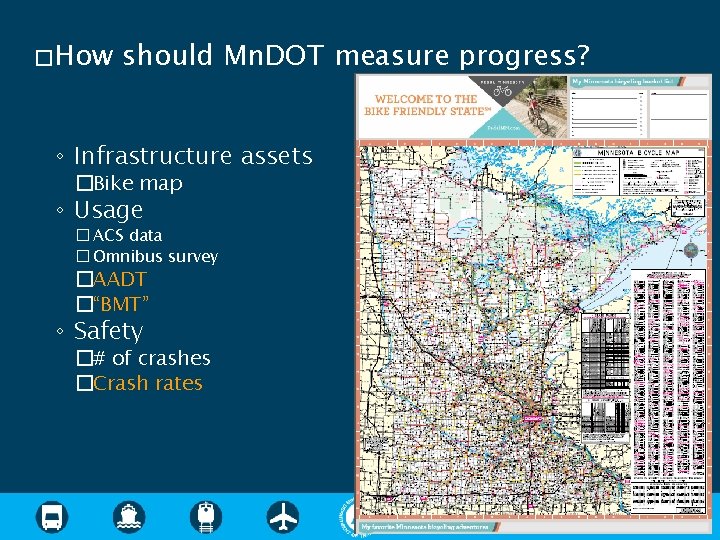
� How should Mn. DOT measure progress? ◦ Infrastructure assets �Bike map ◦ Usage � ACS data � Omnibus survey �AADT �“BMT” ◦ Safety �# of crashes �Crash rates
Statewide Pedestrian System Plan 2014 -2015 � Anticipated ◦ ◦ ◦ ◦ deliverables of the plan Vision for pedestrians in Minnesota Mn. DOT’s role in meeting that vision Priority areas/network identified Parameters for performance measures Methodology for pedestrian data collection Web portal of design guidance for pedestrians Standard design plan sheets Walkable communities workshops
Minnesota’s Traffic Monitoring Program � Over 32, 500 count locations covering o All required HPMS sample sections o Targeted functional classifications o Municipal and County State Aid funding needs determination 1200 short duration vehicle classification locations � Count Cycle Lengths of 1, 2, 4, 6, and 12 years � 100 Continuous Counters (ATRs, WIMs and Wavetronix) � Recounts are requested if adjusted counts are outside of sliding scale ‘Tolerance’ ranges � 11, 600 locations on Rural Minor Collectors and Other; Urban Other functional class systems for state aid needs � Additional Details: http: //www. dot. state. mn. us/traffic/data/coll-methods. html#TVP
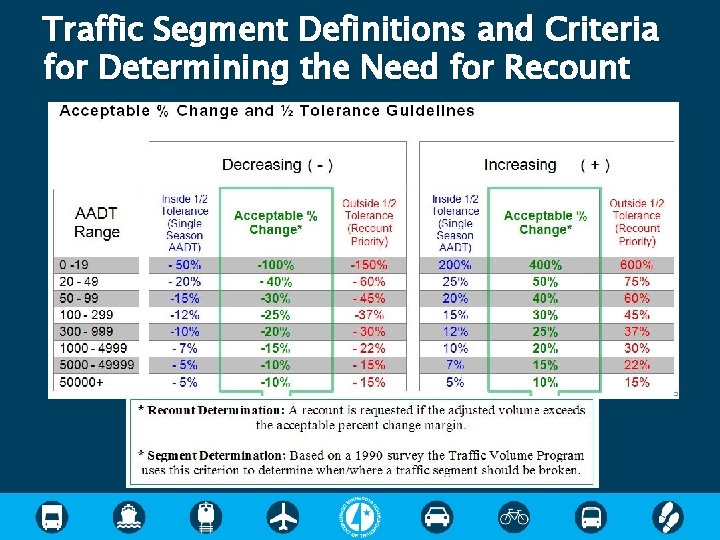
Traffic Segment Definitions and Criteria for Determining the Need for Recount
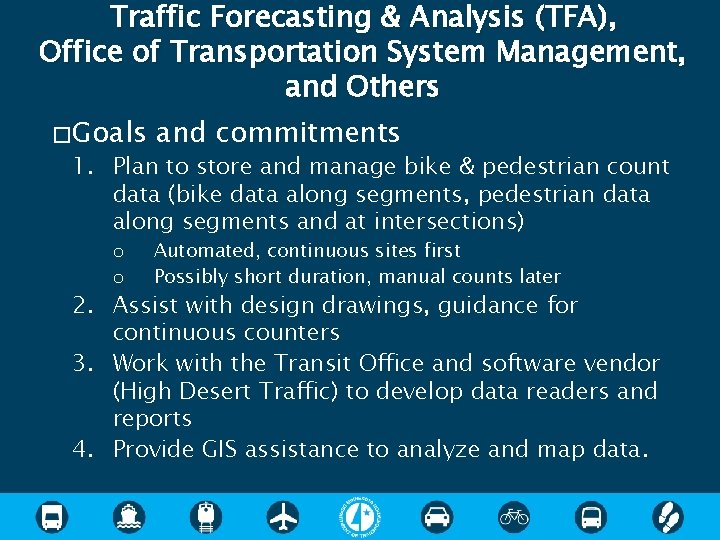
Traffic Forecasting & Analysis (TFA), Office of Transportation System Management, and Others � Goals and commitments 1. Plan to store and manage bike & pedestrian count data (bike data along segments, pedestrian data along segments and at intersections) o o Automated, continuous sites first Possibly short duration, manual counts later 2. Assist with design drawings, guidance for continuous counters 3. Work with the Transit Office and software vendor (High Desert Traffic) to develop data readers and reports 4. Provide GIS assistance to analyze and map data.
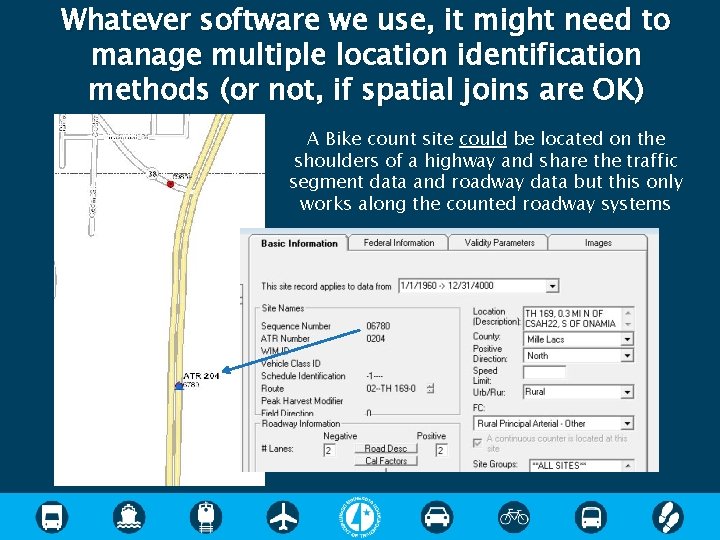
Whatever software we use, it might need to manage multiple location identification methods (or not, if spatial joins are OK) A Bike count site could be located on the shoulders of a highway and share the traffic segment data and roadway data but this only works along the counted roadway systems
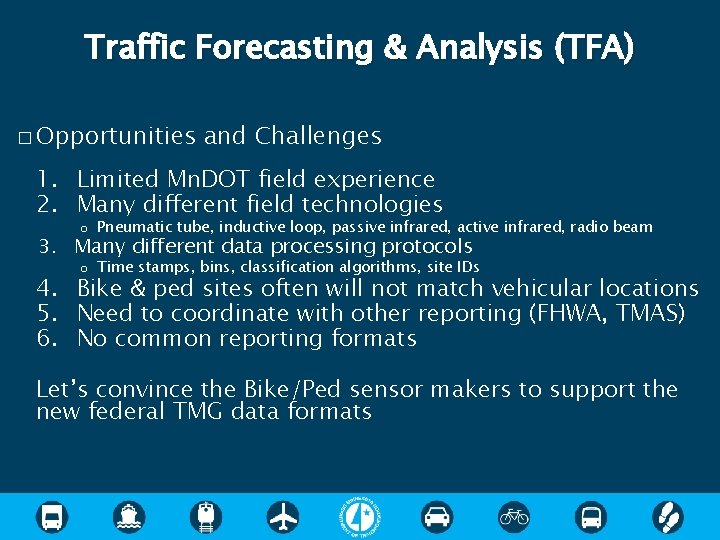
Traffic Forecasting & Analysis (TFA) � Opportunities and Challenges 1. Limited Mn. DOT field experience 2. Many different field technologies o Pneumatic tube, inductive loop, passive infrared, active infrared, radio beam 3. Many different data processing protocols o Time stamps, bins, classification algorithms, site IDs 4. Bike & ped sites often will not match vehicular locations 5. Need to coordinate with other reporting (FHWA, TMAS) 6. No common reporting formats Let’s convince the Bike/Ped sensor makers to support the new federal TMG data formats
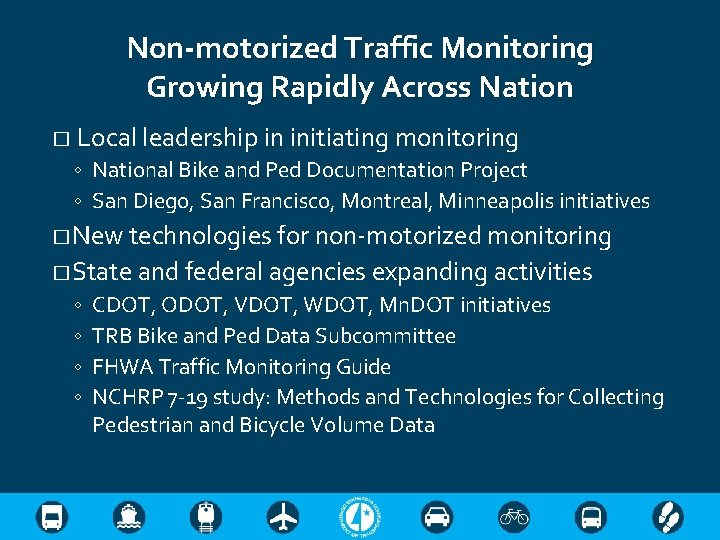
Non-motorized Traffic Monitoring Growing Rapidly Across Nation � Local leadership in initiating monitoring ◦ National Bike and Ped Documentation Project ◦ San Diego, San Francisco, Montreal, Minneapolis initiatives � New technologies for non-motorized monitoring � State and federal agencies expanding activities ◦ ◦ CDOT, ODOT, VDOT, WDOT, Mn. DOT initiatives TRB Bike and Ped Data Subcommittee FHWA Traffic Monitoring Guide NCHRP 7 -19 study: Methods and Technologies for Collecting Pedestrian and Bicycle Volume Data

Minnesota Bike & Ped Counting Initiative: Outcomes and Results � Engaging more communities (locals lead) � Validating commercially available technologies � Developing factoring methods � Estimating performance measures � Institutionalizing counting

Bicycle Counts in Minneapolis Simon Blenski | Bicycle Planner | City of Minneapolis | 612 -616 -7345
Minneapolis Count Program 2007 - 2014 � Initially created to measure the effectiveness of the Federally-funded NTP grant � 30 benchmark locations counted to track change � Over 450 additional locations counted since 2007 � Now a routine operation of Minneapolis Public Works
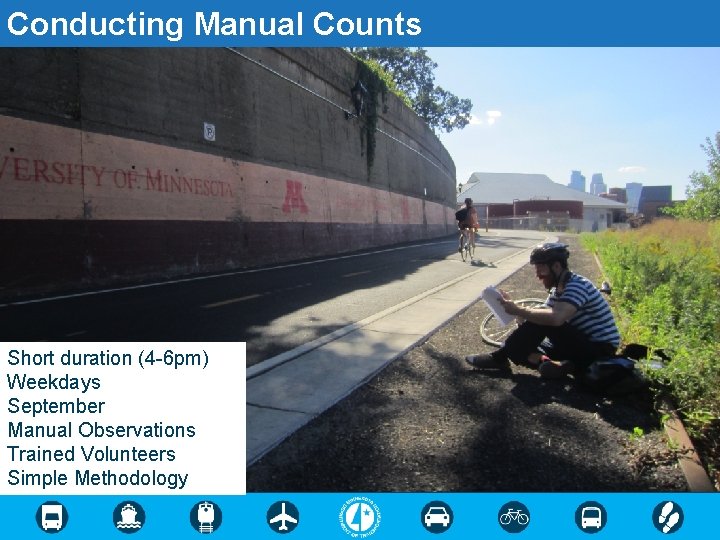
Conducting Manual Counts Short duration (4 -6 pm) Weekdays September Manual Observations Trained Volunteers Simple Methodology
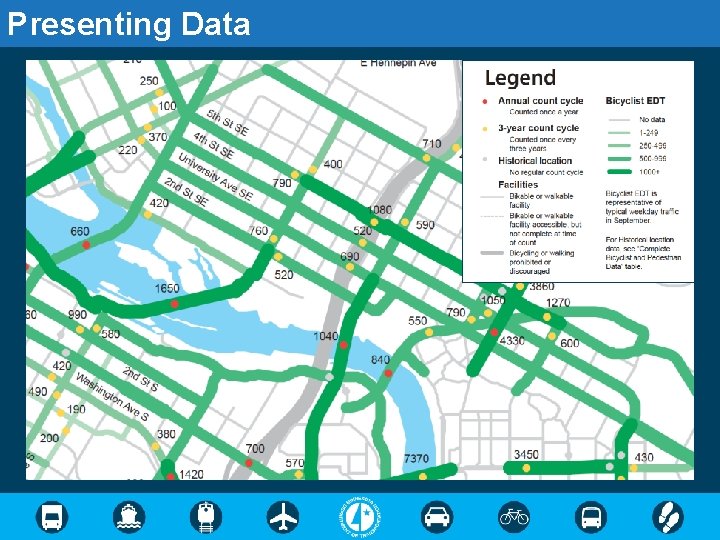
Presenting Data
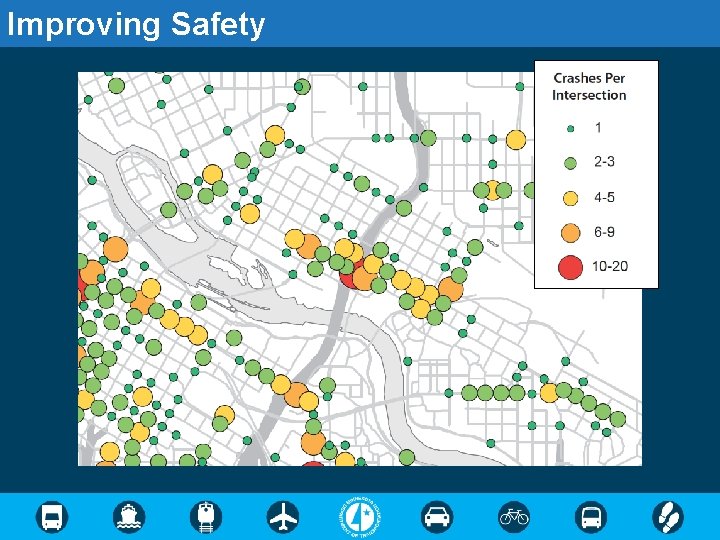
Improving Safety
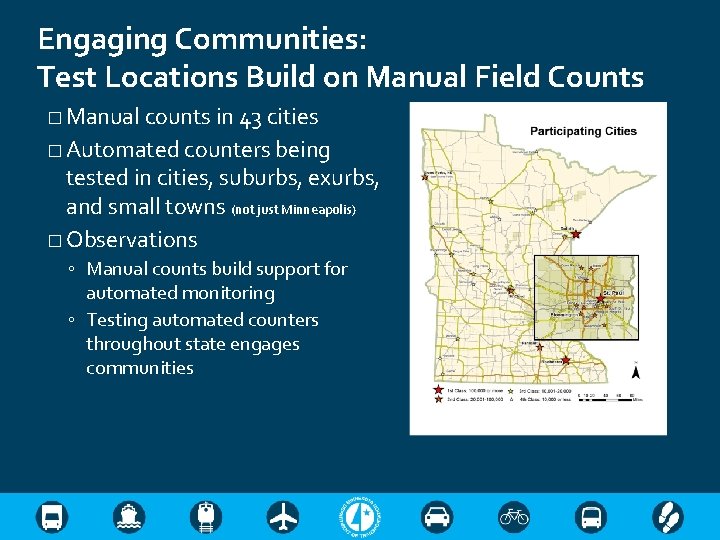
Engaging Communities: Test Locations Build on Manual Field Counts � Manual counts in 43 cities � Automated counters being tested in cities, suburbs, exurbs, and small towns (not just Minneapolis) � Observations ◦ Manual counts build support for automated monitoring ◦ Testing automated counters throughout state engages communities

Bicycle Counts in Duluth Chris Whaley | MIC/HDAC
Duluth-Superior Metropolitan Interstate Council / Arrowhead Regional Development Commission ◦ Counting from 2012 -2014 ◦ Evidence needed to support �Long-range transportation planning �Bicycle and pedestrian planning �Trail planning ◦ Manual field counts (NBPDP/Mn. DOT protocols) ◦ Automated continuous monitoring �Duluth Lake Walk (shared use path) �Scenic Highway 61 (road shoulder)
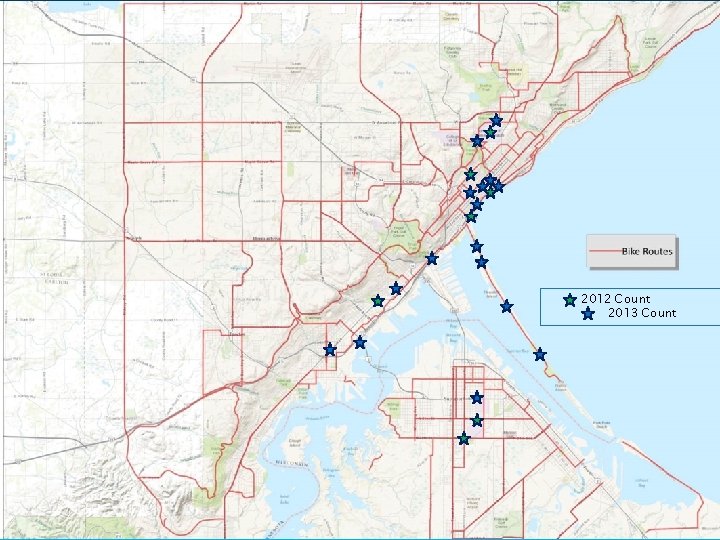
Baseline Counts along upcoming projects 2012 Count 2013 Count
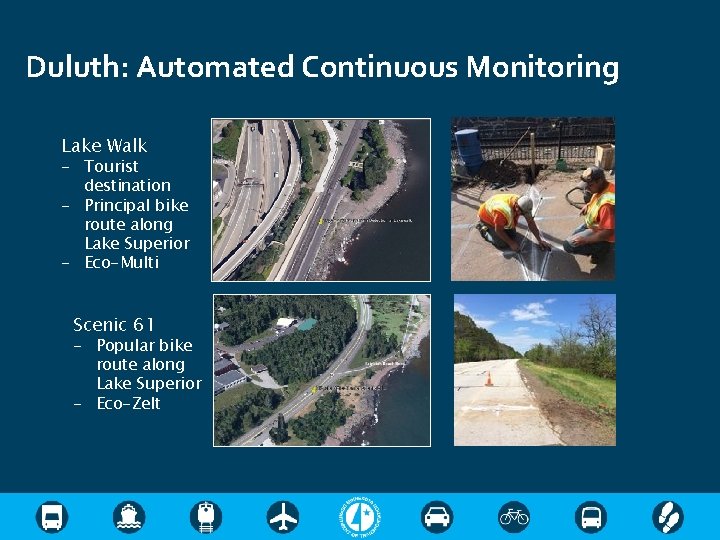
Duluth: Automated Continuous Monitoring Lake Walk - Tourist destination - Principal bike route along Lake Superior - Eco-Multi Scenic 61 - Popular bike route along Lake Superior - Eco-Zelt
Next for Counting Bikes in Duluth • Off-Road Trail System will largely in place (in 2 -3 years) • Lakewalk • Cross City Trail • Up & Down the Hill Corridors • Next - Developing the on-street bikeway system. • Developing Bike & Ped Count Program as Duluth moves to the onstreet bikeways. • 3 -5 year rotation of count sites • Install automated counters as part of new trail & bikeway projects. • Strengthen partnerships with local agencies & jurisdictions to build necessary capacity to sustain the count program
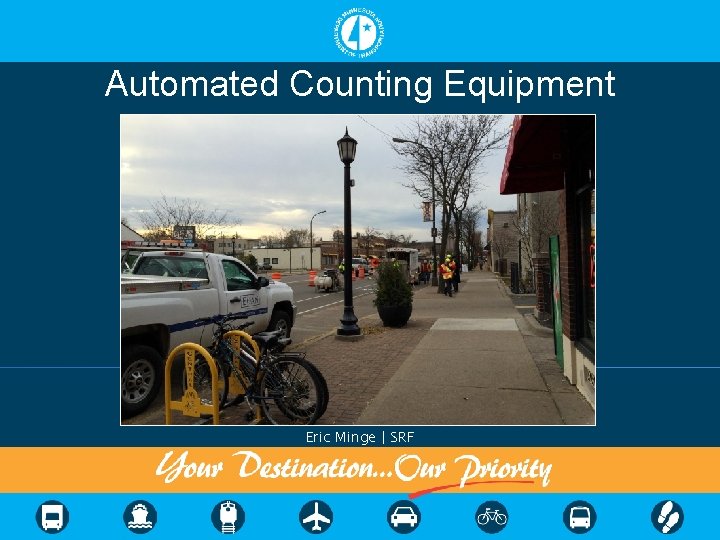
Automated Counting Equipment Eric Minge | SRF
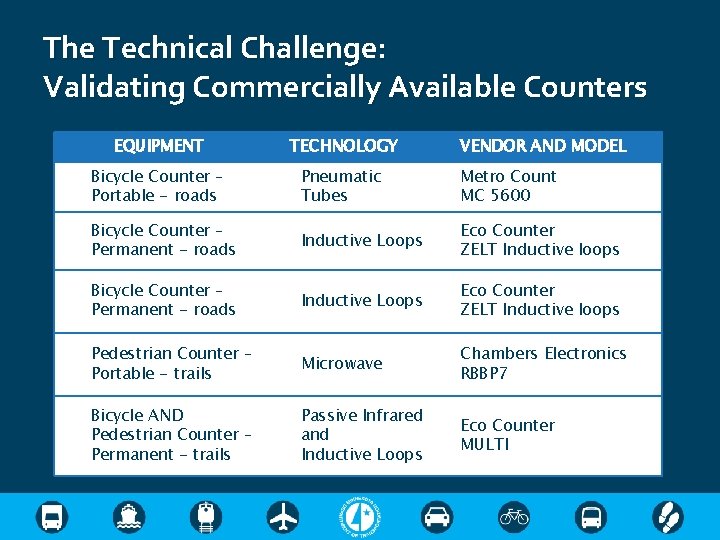
The Technical Challenge: Validating Commercially Available Counters EQUIPMENT TECHNOLOGY VENDOR AND MODEL Bicycle Counter – Portable - roads Pneumatic Tubes Metro Count MC 5600 Bicycle Counter – Permanent - roads Inductive Loops Eco Counter ZELT Inductive loops Pedestrian Counter – Portable - trails Microwave Chambers Electronics RBBP 7 Bicycle AND Pedestrian Counter – Permanent - trails Passive Infrared and Inductive Loops Eco Counter MULTI
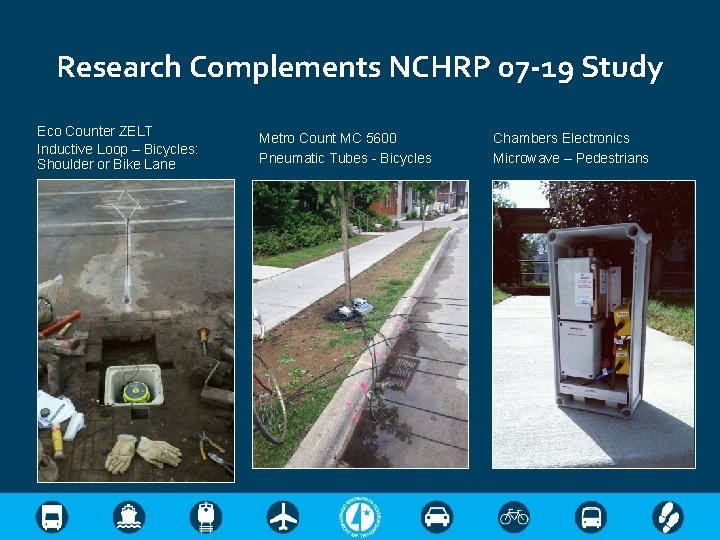
Research Complements NCHRP 07 -19 Study Eco Counter ZELT Inductive Loop – Bicycles: Shoulder or Bike Lane Metro Count MC 5600 Pneumatic Tubes - Bicycles Chambers Electronics Microwave – Pedestrians
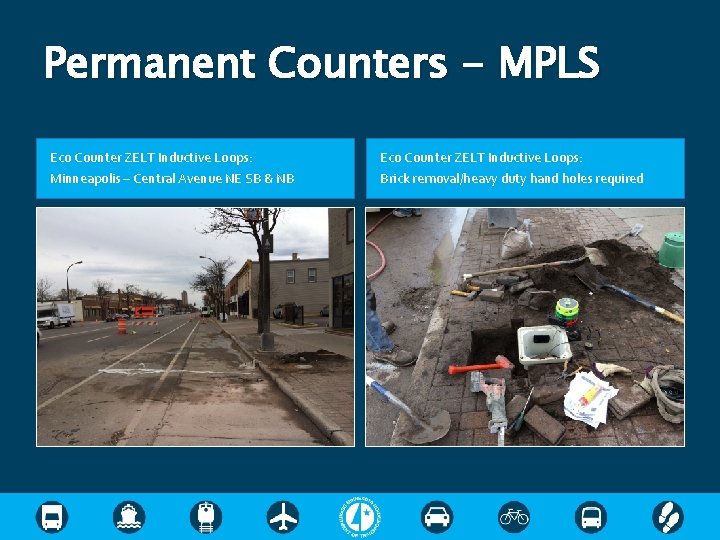
Permanent Counters - MPLS Eco Counter ZELT Inductive Loops: Minneapolis – Central Avenue NE SB & NB Eco Counter ZELT Inductive Loops: Brick removal/heavy duty hand holes required
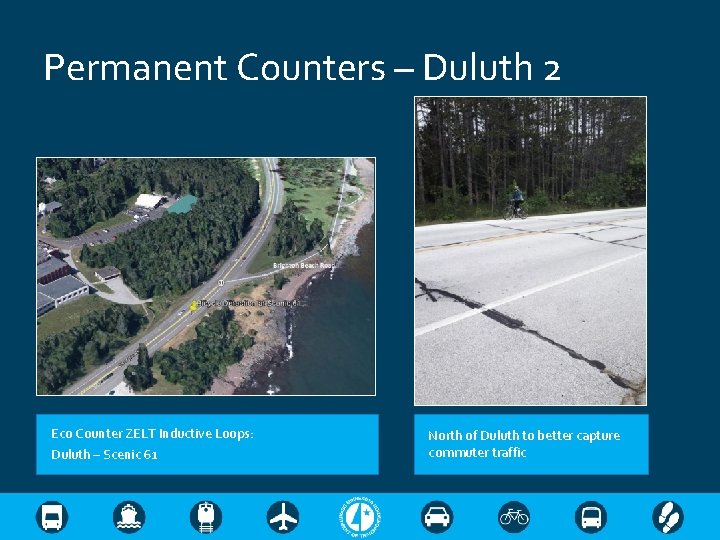
Permanent Counters – Duluth 2 Eco Counter ZELT Inductive Loops: Duluth – Scenic 61 North of Duluth to better capture commuter traffic
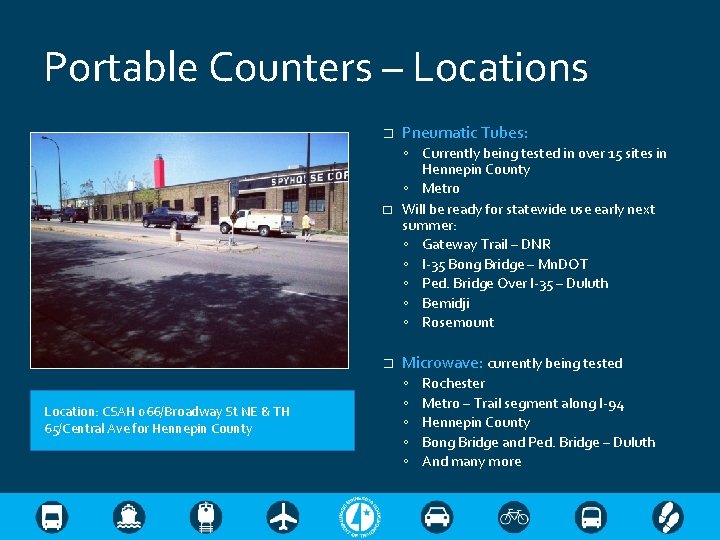
Portable Counters – Locations � � � Location: CSAH 066/Broadway St NE & TH 65/Central Ave for Hennepin County Pneumatic Tubes: ◦ Currently being tested in over 15 sites in Hennepin County ◦ Metro Will be ready for statewide use early next summer: ◦ Gateway Trail – DNR ◦ I-35 Bong Bridge – Mn. DOT ◦ Ped. Bridge Over I-35 – Duluth ◦ Bemidji ◦ Rosemount Microwave: currently being tested ◦ ◦ ◦ Rochester Metro – Trail segment along I-94 Hennepin County Bong Bridge and Ped. Bridge – Duluth And many more

Traffic Models and Factors 250% 200% 150% 100% 50% 0% 2500 2000 1500 1000 500 0 Greg Lindsey – University of Minnesota Motorized (I-. . . Jan Mar. May Jul Sep Nov
FHWA Traffic Monitoring Guide � Goal ◦ Measure and estimate traffic volumes �Average annual daily traffic (AADT) �Vehicle miles traveled (VMT) � Approach ◦ Establish network of permanent and shortduration monitoring sites ◦ Use adjustment factors from reference sites to extrapolate short-duration counts � Challenges in Nonmotorized Monitoring ◦ Traffic variability, technology, resources
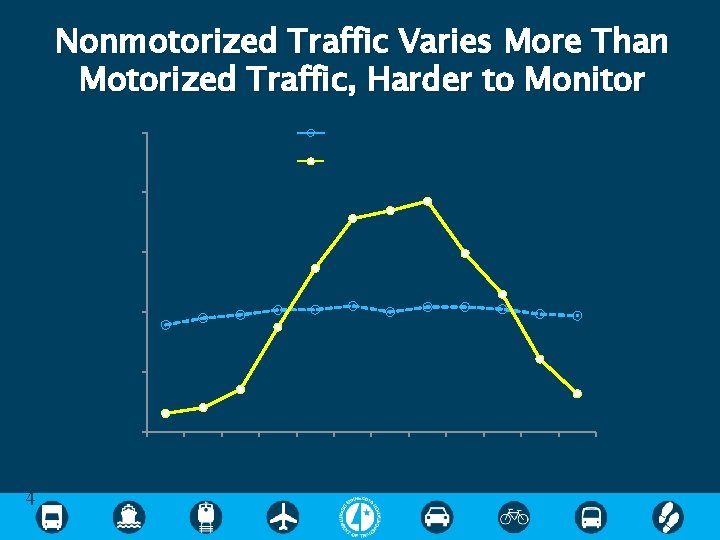
Nonmotorized Traffic Varies More Than Motorized Traffic, Harder to Monitor 250% Motorized (I-35 W) Non-motorized (Hennepin Ave) 200% 150% 100% 50% 0% 4 Jan Feb Mar Apr May Jun Jul Aug Sep Oct Nov Dec
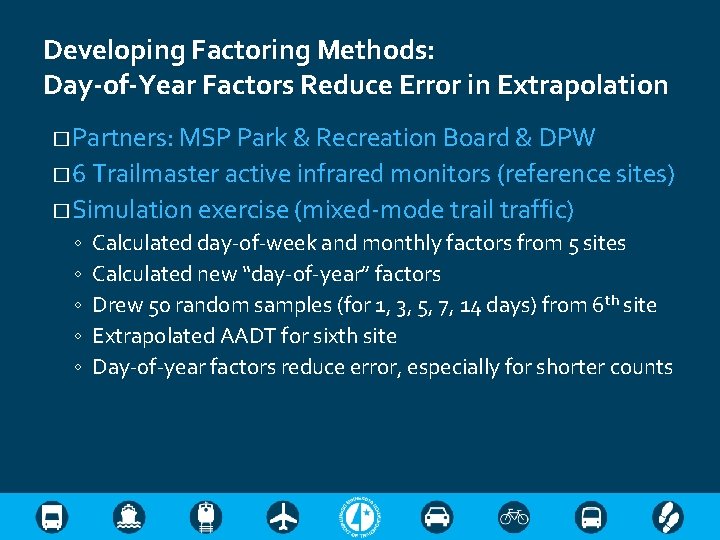
Developing Factoring Methods: Day-of-Year Factors Reduce Error in Extrapolation � Partners: MSP Park & Recreation Board & DPW � 6 Trailmaster active infrared monitors (reference sites) � Simulation exercise (mixed-mode trail traffic) ◦ ◦ ◦ Calculated day-of-week and monthly factors from 5 sites Calculated new “day-of-year” factors Drew 50 random samples (for 1, 3, 5, 7, 14 days) from 6 th site Extrapolated AADT for sixth site Day-0 f-year factors reduce error, especially for shorter counts
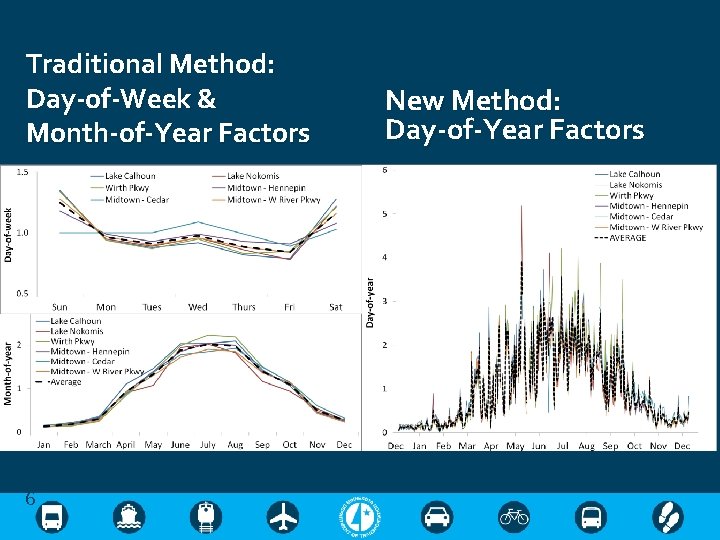
Traditional Method: Day-of-Week & Month-of-Year Factors 6 New Method: Day-of-Year Factors

Day-of-Year Factors Reduce Error in Extrapolation Old scaling method New scaling method Counters needed 15 30% 10 20% 5 10% 0% 0 5 10 15 20 25 Number of short-duration sampling days 7 Number of counters Mean absolute AADT error 40% 0
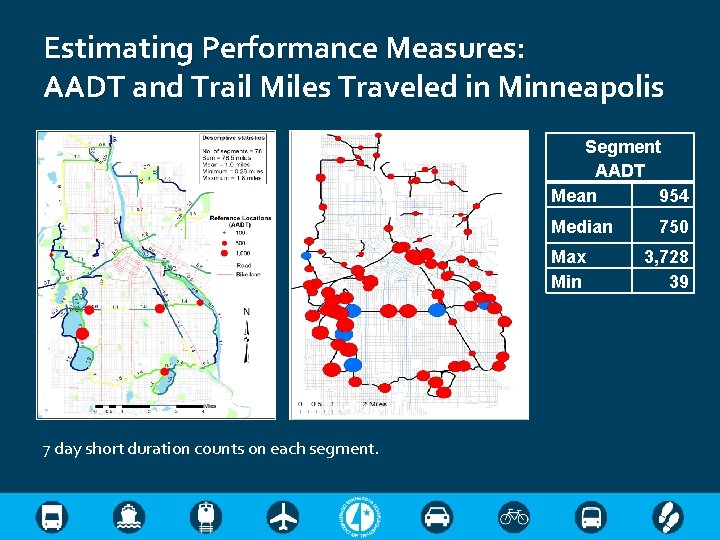
Estimating Performance Measures: AADT and Trail Miles Traveled in Minneapolis Segment AADT Mean 954 Median Max Min 7 day short duration counts on each segment. 750 3, 728 39
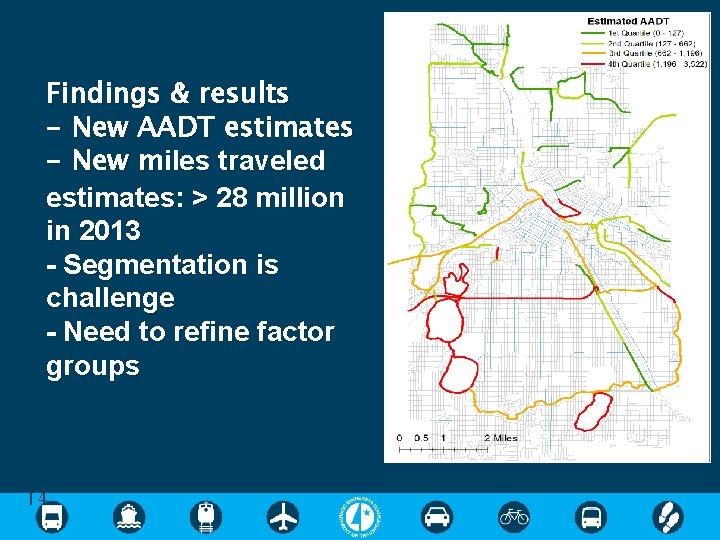
Findings & results - New AADT estimates - New miles traveled estimates: > 28 million in 2013 - Segmentation is challenge - Need to refine factor groups 14
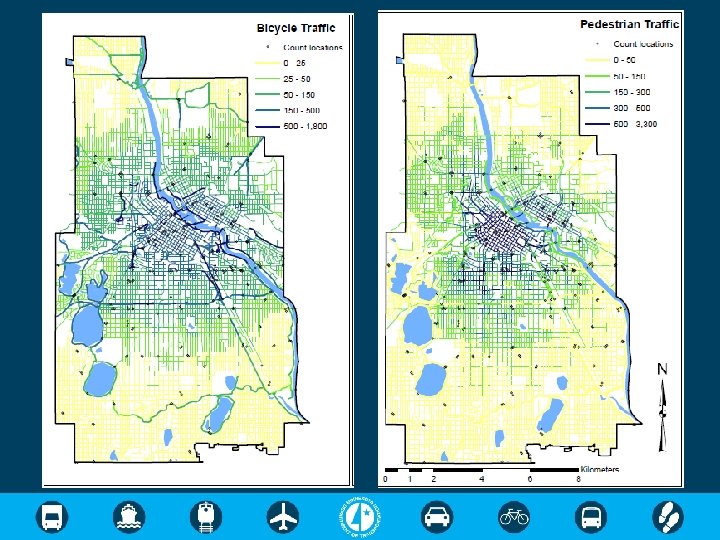
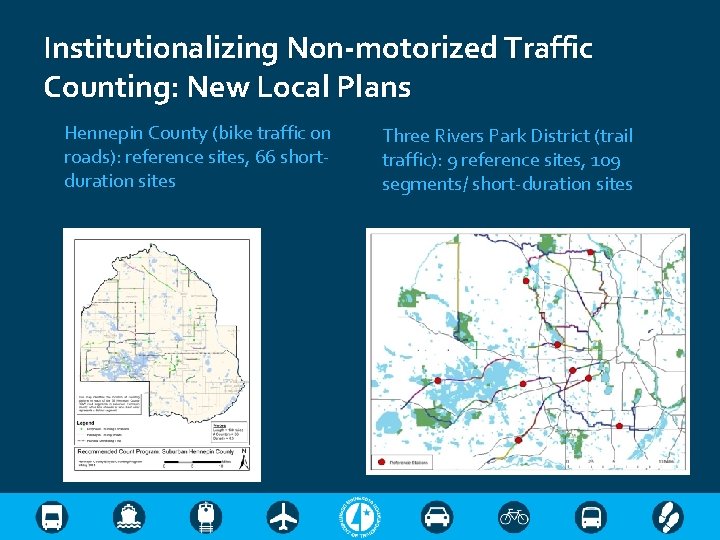
Institutionalizing Non-motorized Traffic Counting: New Local Plans Hennepin County (bike traffic on roads): reference sites, 66 shortduration sites Three Rivers Park District (trail traffic): 9 reference sites, 109 segments/ short-duration sites
The Local Perspective Hennepin County � Collaborate with Mn. DOT intiative – 2013 / 2014 � Initiate bike counting by testing devices – 2013 / 2014* � Track before and after bicycle use along Capital Improvement Program corridors – 2013 & beyond � Build on capstone course work and develop short-duration bike counting plan – 2014 � Implement new program 2014 & beyond � Install permanent bicycle counting equipment at select locations (Sensys Networks) – 2014 & beyond
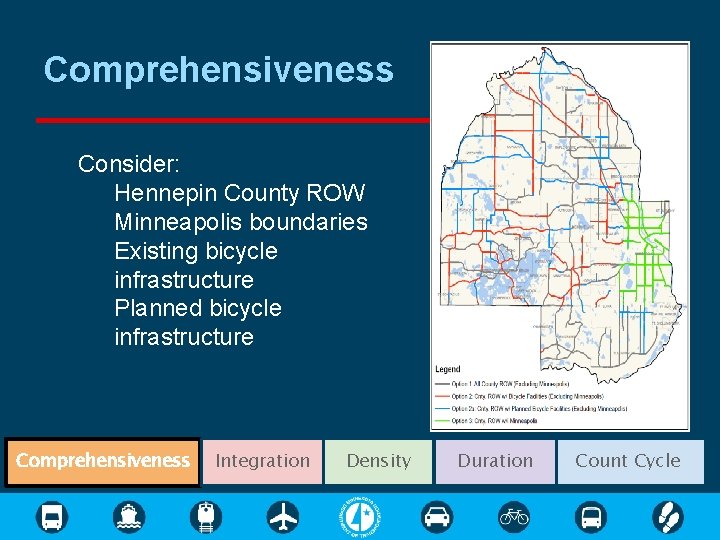
Comprehensiveness ● Consider: o Hennepin County ROW o Minneapolis boundaries o Existing bicycle infrastructure o Planned bicycle infrastructure Comprehensiveness Integration Density Duration Count Cycle
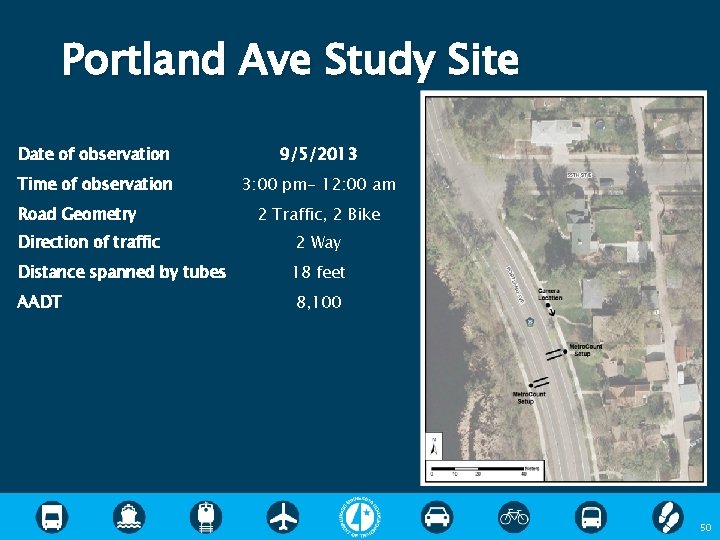
Portland Ave Study Site Date of observation 9/5/2013 Time of observation 3: 00 pm- 12: 00 am Road Geometry 2 Traffic, 2 Bike Direction of traffic 2 Way Distance spanned by tubes 18 feet AADT 8, 100 50
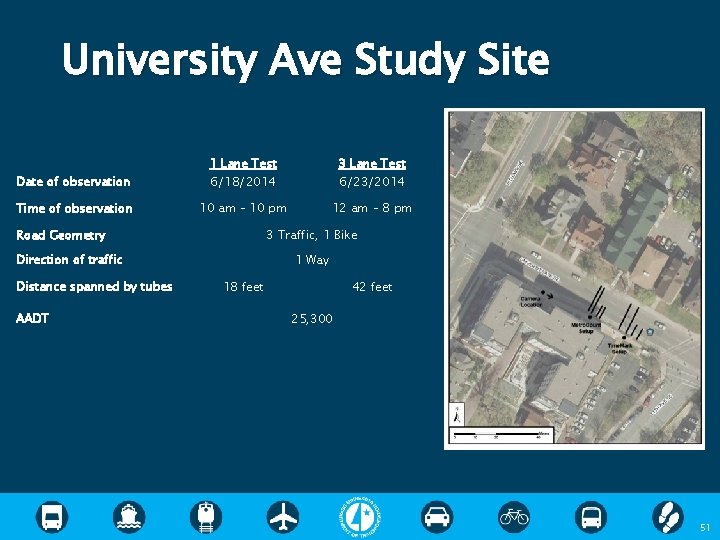
University Ave Study Site Date of observation 1 Lane Test 6/18/2014 3 Lane Test 6/23/2014 Time of observation 10 am – 10 pm 12 am – 8 pm Road Geometry 3 Traffic, 1 Bike Direction of traffic Distance spanned by tubes AADT 1 Way 18 feet 42 feet 25, 300 51
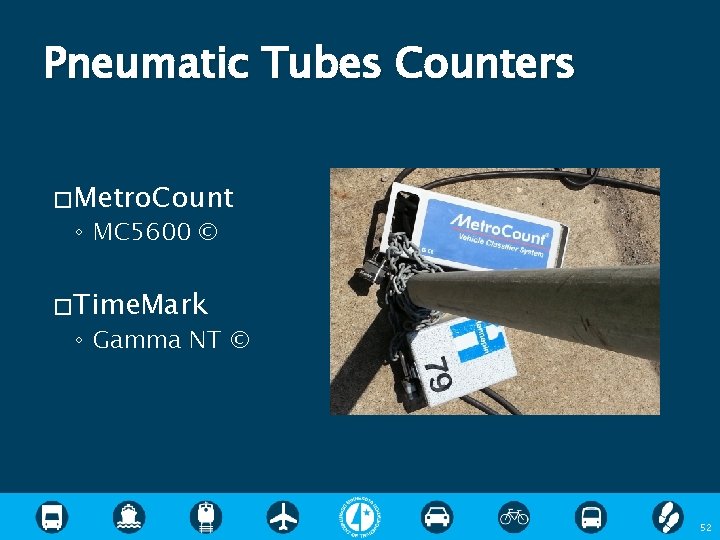
Pneumatic Tubes Counters � Metro. Count ◦ MC 5600 © � Time. Mark ◦ Gamma NT © 52
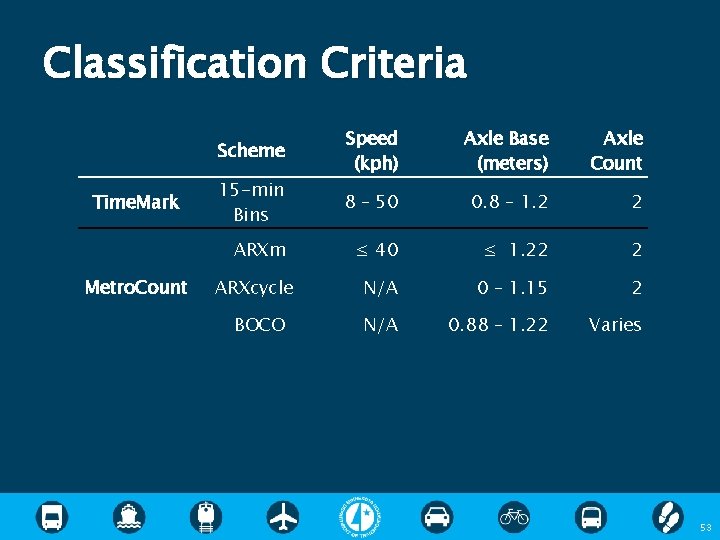
Classification Criteria 15 -min Bins Speed (kph) Axle Base (meters) Axle Count 8 – 50 0. 8 – 1. 2 2 ARXm ≤ 40 ≤ 1. 22 2 N/A 0 – 1. 15 2 N/A 0. 88 – 1. 22 Varies Scheme Time. Mark Metro. Count ARXcycle BOCO 53
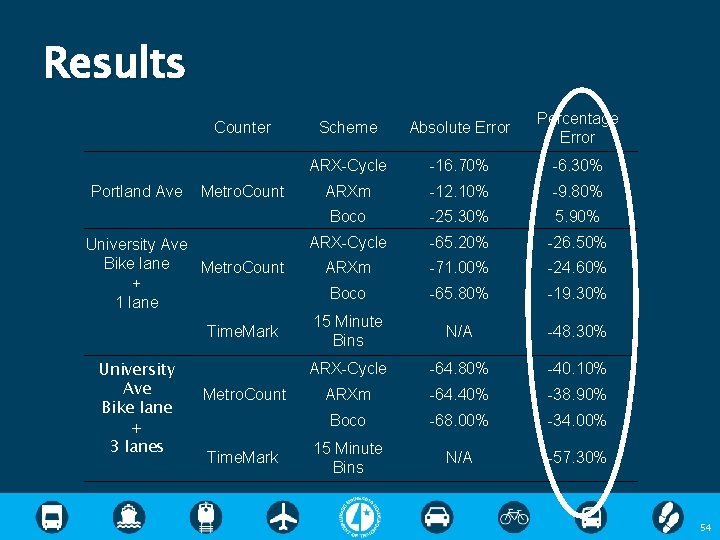
Results Counter Portland Ave Metro. Count University Ave Bike lane Metro. Count + 1 lane Time. Mark University Ave Bike lane + 3 lanes Metro. Count Time. Mark Scheme Absolute Error Percentage Error ARX-Cycle -16. 70% -6. 30% ARXm -12. 10% -9. 80% Boco -25. 30% 5. 90% ARX-Cycle -65. 20% -26. 50% ARXm -71. 00% -24. 60% Boco -65. 80% -19. 30% 15 Minute Bins N/A -48. 30% ARX-Cycle -64. 80% -40. 10% ARXm -64. 40% -38. 90% Boco -68. 00% -34. 00% 15 Minute Bins N/A -57. 30% 54
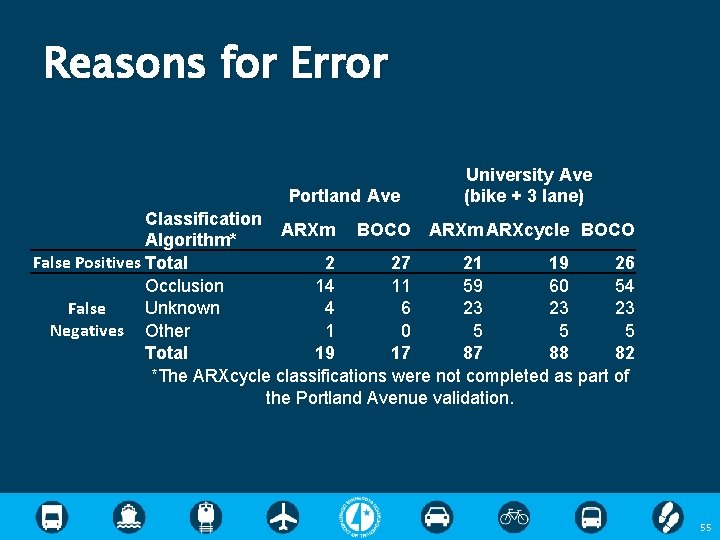
Reasons for Error Portland Ave University Ave (bike + 3 lane) Classification ARXm BOCO ARXm ARXcycle BOCO Algorithm* False Positives Total 2 27 21 19 26 Occlusion 14 11 59 60 54 False Unknown 4 6 23 23 23 Negatives Other 1 0 5 5 5 Total 19 17 87 88 82 *The ARXcycle classifications were not completed as part of the Portland Avenue validation. 55
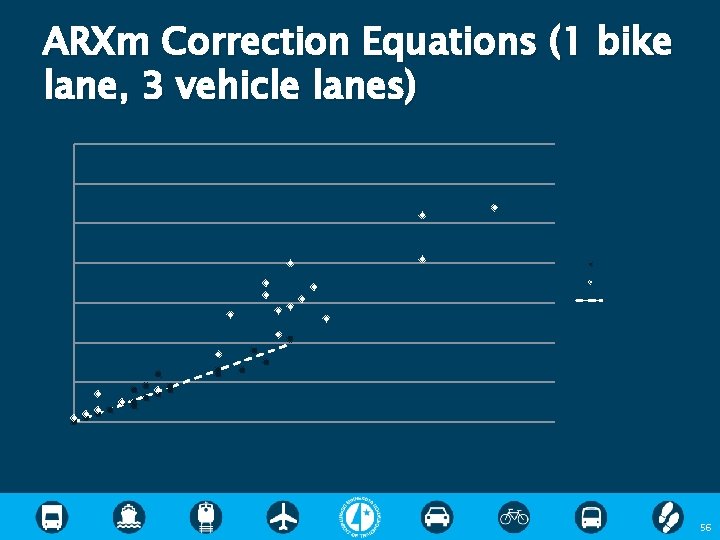
ARXm Correction Equations (1 bike lane, 3 vehicle lanes) 70 60 Manual Counts Using Video 50 R 2 = 0, 9137 R 2 = 0, 8803 40 Portland University Linear(Portland) 30 Linear(University) Linear(Combined) 20 10 0 R 2 = 0, 9227 0 5 10 15 20 25 30 Metro. Count ARXm Hourly Classification Counts 35 40 56
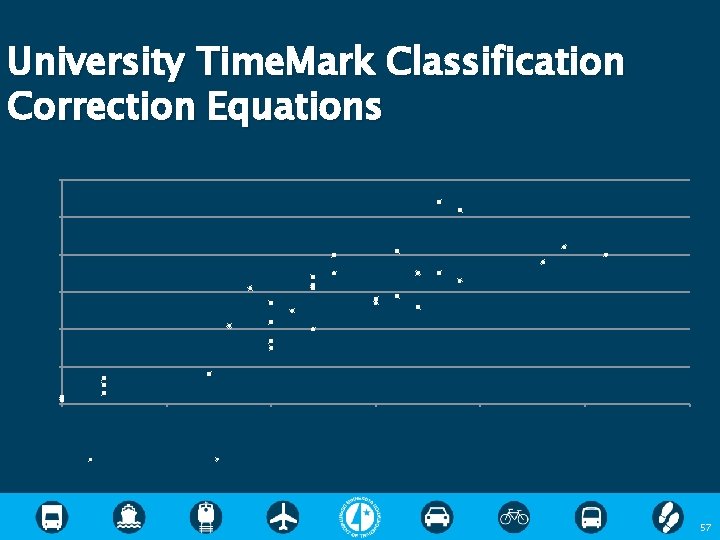
University Time. Mark Classification Correction Equations 60 50 Video Confirmed Counts R 2 = 0, 8298 40 R 2 = 0, 7385 30 20 10 0 0 5 3 Lanes + Bike lane 10 15 Time. Mark Hourly Counts 1 Lane + Bike Lane 20 Linear(3 Lanes + Bike lane) 25 30 Linear(1 Lane + Bike Lane) 57
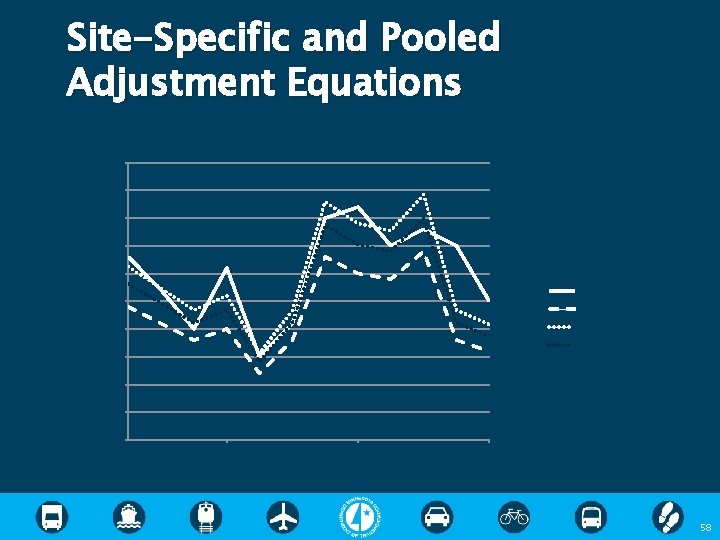
Site-Specific and Pooled Adjustment Equations ARXm University Ave 1 Lane + Bike Lane 50 45 40 Number of Bikes 35 30 MTO Count 25 ARXm Count Corrected 20 Pooled Corrected 15 10 5 0 10: 01 A 12. P 12 14: 00: 01 A 12. P 12 Time 18: 00: 01 A 12. P 12 58
Conclusions � Findings are mixed ◦ Higher accuracy with lower traffic and fewer lanes ◦ Correction factors can be calculated to increase accuracy � Using existing pneumatic tube counters to count bicycles ◦ Potentially cost effective ◦ Limited training required 59
Implications for Practice � Agencies: decide level of accuracy needed � Where no current counts exist, pneumatic tube counts of bicycles may be informative � Where higher accuracy is needed: ◦ Calibration equations can adjust counts ◦ Other methods used: o Inductive loops o Manual reduction of video o Pneumatic tube counters set up in bike lane only 60

Questions? Thank you! Lisa Austin – Mn. DOT lisa. austin@state. mn. us
- Slides: 61