
Making Generalizations What is a generalization n n
- Slides: 11
Making Generalizations
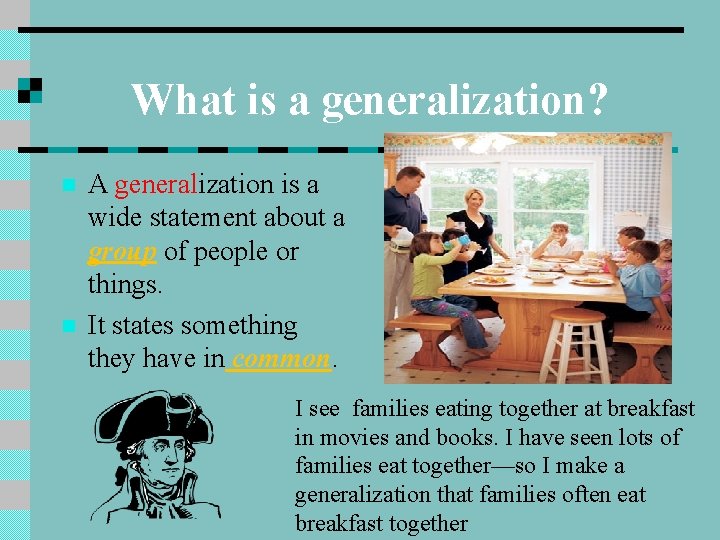
What is a generalization? n n A generalization is a wide statement about a group of people or things. It states something they have in common. I see families eating together at breakfast in movies and books. I have seen lots of families eat together—so I make a generalization that families often eat breakfast together
Key Words to LOOK for… when deciding if something n is a generalization… n n n n Sometimes Always Never Most Many All Generally Everyone
Valid Generalizations n Valid means true. n n Supported by facts Agrees with what you already know about the topic Proven with several examples Ex: You see 5 or 6 students carrying a bookbag—You say “Some students at MCE carry bookbags to school. ” That is a valid generalization because you have proof that some do!
Faulty Generalizations n Faulty means false. n n Not supported by facts Watch for the key words: none, all, always, never, everyone, nobody Ex: you see one kid steal and you say “ALL kids steal. ” That is faulty! n
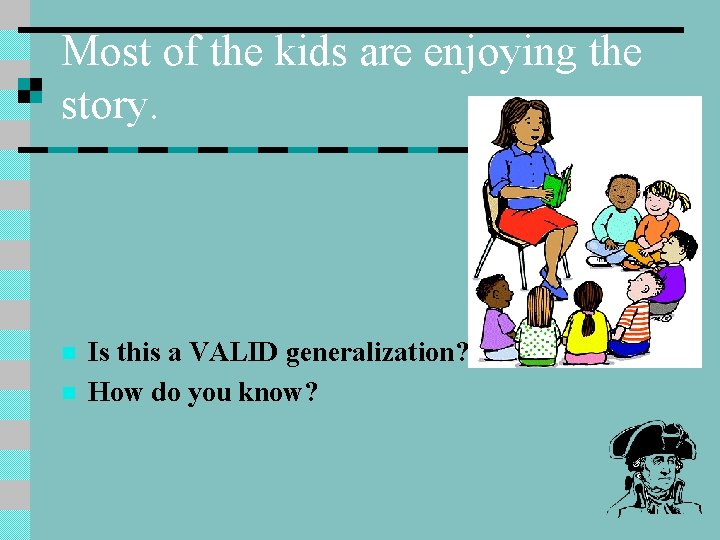
Most of the kids are enjoying the story. n n Is this a VALID generalization? How do you know?
One dog bites me, so I generalize that ALL dogs bite. Is this a valid generalization? n Does the author: n Use facts to support the idea? n Share past experiences to support the idea? n Provide several examples? n Use logical thinking? n
What VALID generalization can you make? Fluffy is one of my favorite pets. Whenever I come home she jumps in my lap and purrs. She sounds like she has a motor in her heart! Fluffy also rubs up on me-walking around my legs. I just love Fluffy!
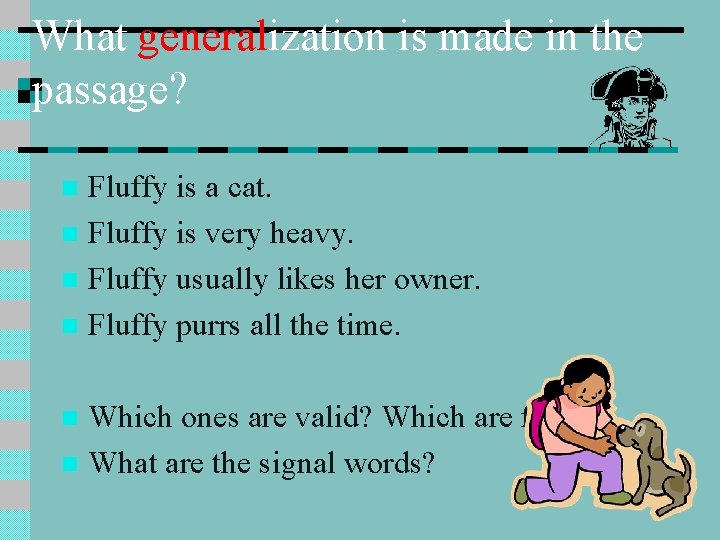
What generalization is made in the passage? Fluffy is a cat. n Fluffy is very heavy. n Fluffy usually likes her owner. n Fluffy purrs all the time. n Which ones are valid? Which are faulty? n What are the signal words? n
Remember: Generalizations make broad statements about a group. n Some a valid, others are faulty. n Valid generalizations are supported by facts, examples, and logical thinking. n Watch for KEY WORDS like all or never, some, mostly, everyone… n
LET’s Write some about the school. . n Tell me one about what kids wear: n Tell me one about what kids eat in the cafeteria: n Tell me one about PE class: (can you tell me a faulty one? )