
Making DBS Microelectrode recordings MER simple Adolfo RamirezZamora
Making DBS Microelectrode recordings (MER) simple Adolfo Ramirez-Zamora, MD Associate Professor of Neurology Division Chief, Movement Disorders University of Florida Norman Fixel Institute for Neurological Diseases May 13 th , 2020
Steps in Performing Successful MER • Step 1 , BE CONSISTENT • Step 2, Plan Stereotaxy with the Neurosurgeon • Indirect targeting- coordinate systems • Direct targeting- image • Be mindful of mapping procedure “based on angle” • Step 3, Eliminate Noise from the Signal • • Turn off lights, cell phones/other , Use headphones Educate the staff to whisper Check wires for integrity (ground, device driver, connections) Keep a list of technical noise problems and run the list
Steps in Performing Successful MER • Step 1 , “Know what to expect” • Based on your image know what to expect • Helpful to have your surgeon follow along verifying what you are seeing is “expected” at depth. • Create 3 -D Physiological Map? • Create a map of a single track and make expert decisions on future tracks or utilize… • Multiple simultaneous tracks or utilize… • Single pass target verification (not 3 -D)
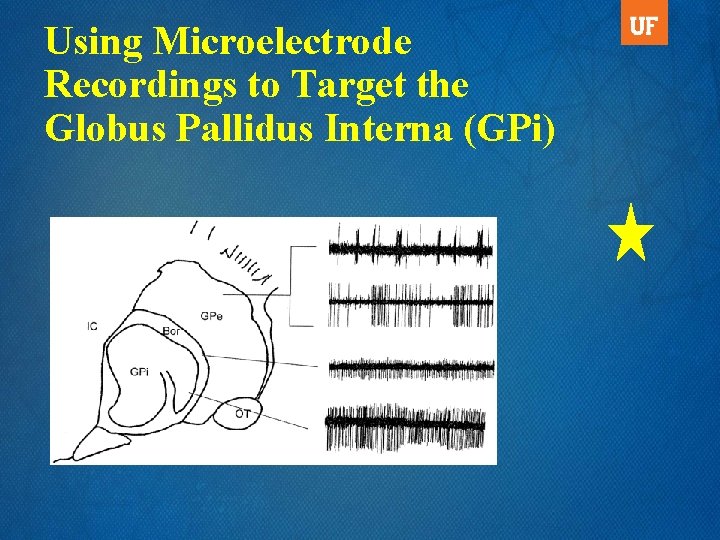
Using Microelectrode Recordings to Target the Globus Pallidus Interna (GPi)
Tips to Remember in Pallidum • Listen for background changes • Know how to differentiate cells from fibers on oscilloscope (action potential direction) • Find the posterior border • Find the medial border • In dystonia GPe sounds like GPi (slower? )

Using Micro-electrode Recordings to Target the Subthalamic Nucleus

Subthalamic Nucleus (STN) Cells and an Example of a Somatosensory Evoked Potential and tremor cell
Tips in the Subthalamic Nucleus • Medial border of STN is lemniscal (sensory) • Lateral and anterior borders of STN are corticospinal fibers (borders can be defined by microstimulation) • Absence of neuronal activity or SNr below STN ( short run) suggest too lateral location • STN identified higher than expected with a larger gap between STN and SNr suggest anterior location
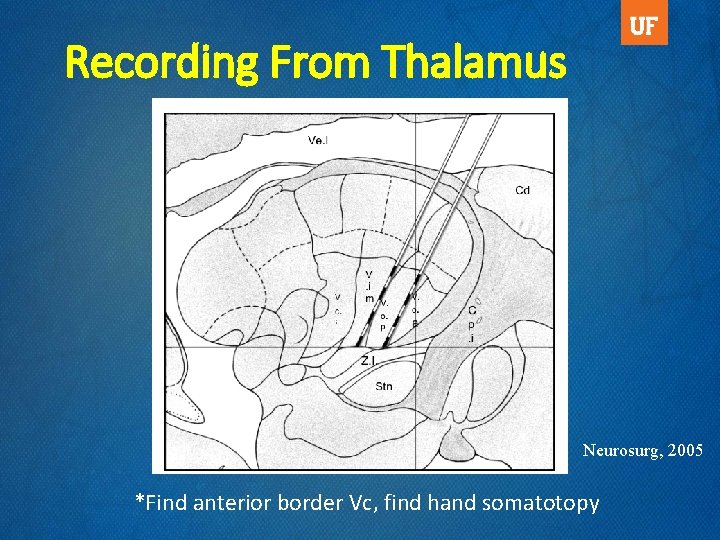
Recording From Thalamus Neurosurg, 2005 *Find anterior border Vc, find hand somatotopy
Tips in thalamic surgery • Mediolateral position is determined by the somototopic organization of motor and sensory cells • (Face/Jaw/Arm/Leg from medial to lateral- different from GPi and STN- reverse) • True for cerebellar VIM and Pallidal Voa, Vop receiving areas; and for sensory Vc • Too posterior sensory • Too lateral capsule • Microstimulation allows easy identification of Vc • *During MER can be “too lateral or too medial” and miss Vc
- Slides: 10