
Making Course Documents Materials Accessible to All Students
Making Course Documents & Materials Accessible to All Students UO Libraries Workshop January 31, 2018 Knight Library 41 1
Karen Matson Instructional Technologist & Designer kmatson@uoregon. edu Pat Fellows Instructional Technologist & Designer pfellows@uoregon. edu 2
Learning Outcomes: • Understand Universal Design for Learning and inclusivity concepts • Create accessible word documents • Create accessible PDFs from a word document • Create accessible PDFs from a scanned text (book, articles, etc. ) • Learn how to check accessibility in Word and PDFs 3
What is Universal Design for Learning (UDL)? Universal Design for Learning (UDL) is a framework to improve and optimize teaching and learning for all people based on scientific insights into how humans learn. Principles: • Presentation – to offer learners various ways of acquiring information and knowledge – “the what” • Expression – to provide students alternatives for demonstrating what they know – “the how” • Engagement – to tap into students’ interest, challenge them appropriately, and motivate them to learn – “the why” - Center for Applied Special Technology (CAST) 4
5
How to make a Word document accessible • Open up a current word document • If you don’t have one, download a mock document from: library. uoregon. edu/calendar 6
How to make a PDF accessible • Open up a current PDF 7
How to make a scanned PDF accessible • Best to use Adobe Acrobat for existing pdfs from scanned documents • For newly scanned documents, change settings that scan for OCR 8
UDL & Canvas • Adding an image • Using styles in the rich text editor 9
Thank you! Educational Technology & Canvas Support Knight Library, room 19 LMS-support@ithelp. uoregon. edu (541) 346 -1942 library. uoregon. edu/cmet/edtech 10
How can you use UDL to inform the design of instruction and materials? • Examples: • Create documents such as your syllabus and lecture notes in multiple electronic formats (Word, PDF, HTML) • Mix up the method on how you instruct • Have multiples ways for a student to show that they have learned the concept (test, presentation, online quizzes, website creation, skit) Can you think of anything? 11
Why Use UDL? • "Everyone is disabled in some way, and most people are likely to encounter serious disabilities as they age. " • Such as injuries, situational disabilities (noisy room, one hand is occupied, misplaced your glasses, particularly fatigued), or technology not cooperating • Survey of individuals with a mental health diagnosis enrolled in college in past five years: • 64% of those who did not graduate claimed a direct relationship with a mental-health-related reason • 50% did not disclose mental health conditions to their college • 45% did not receive support or accommodations • 12. 5% of working-age Americans with disabilities have attained a Bachelor’s degree or higher • Compared to 31. 2% of their peers without disabilities (Bias & Mayhew, 2005; Miller & Lang, 2016; Erickson, Lee, & von Schrader, 2012) 12
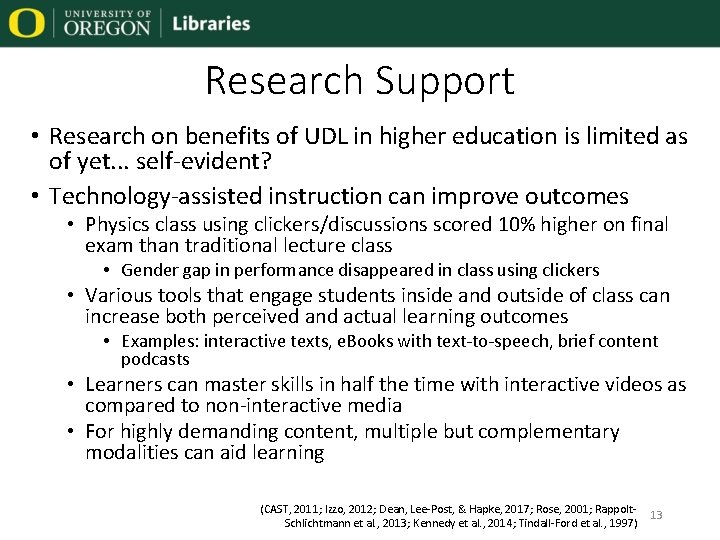
Research Support • Research on benefits of UDL in higher education is limited as of yet. . . self-evident? • Technology-assisted instruction can improve outcomes • Physics class using clickers/discussions scored 10% higher on final exam than traditional lecture class • Gender gap in performance disappeared in class using clickers • Various tools that engage students inside and outside of class can increase both perceived and actual learning outcomes • Examples: interactive texts, e. Books with text-to-speech, brief content podcasts • Learners can master skills in half the time with interactive videos as compared to non-interactive media • For highly demanding content, multiple but complementary modalities can aid learning (CAST, 2011; Izzo, 2012; Dean, Lee-Post, & Hapke, 2017; Rose, 2001; Rappolt. Schlichtmann et al. , 2013; Kennedy et al. , 2014; Tindall-Ford et al. , 1997) 13
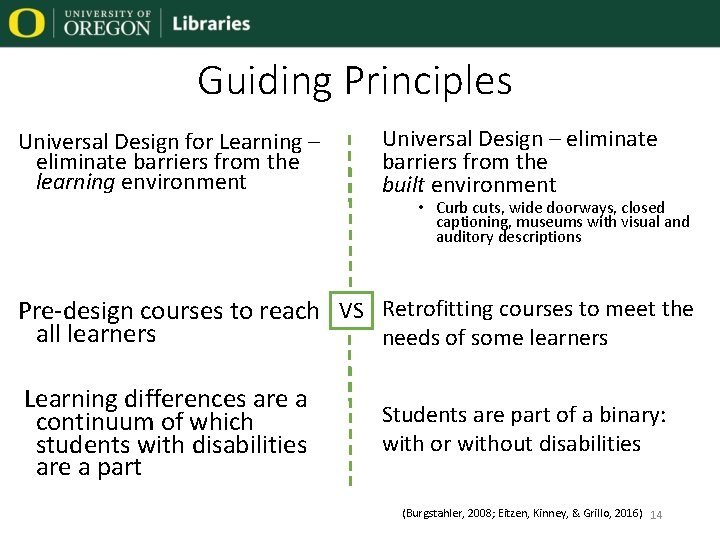
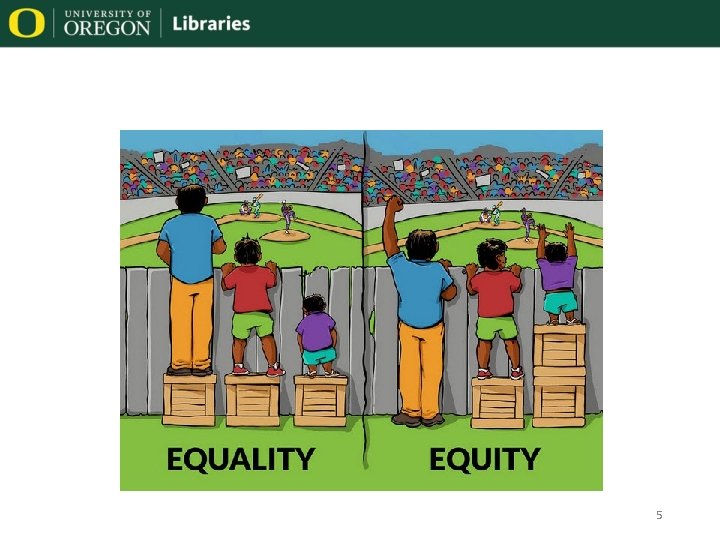
Guiding Principles Universal Design for Learning – eliminate barriers from the learning environment Universal Design – eliminate barriers from the built environment • Curb cuts, wide doorways, closed captioning, museums with visual and auditory descriptions Pre-design courses to reach VS Retrofitting courses to meet the all learners needs of some learners Learning differences are a continuum of which students with disabilities are a part Students are part of a binary: with or without disabilities (Burgstahler, 2008; Eitzen, Kinney, & Grillo, 2016) 14
- Slides: 14