
Making Communities Disaster Resilient The Sarvodaya Approach Dr
- Slides: 23
Making Communities Disaster Resilient; The Sarvodaya Approach Dr. Vinya S. Ariyaratne Executive Director Sarvodaya Shramadana Movement Sri Lanka
Overview • Disaster Risk Reduction in the community • Sarvodaya approach to development • Creating disaster resilient communities – The Sarvodaya approach • Lessons Learnt
Disaster Vulnerability of Sri Lanka • • Floods Landslides Cyclones Drought Coastal erosion Tsunami Other natural disasters of lesser frequency
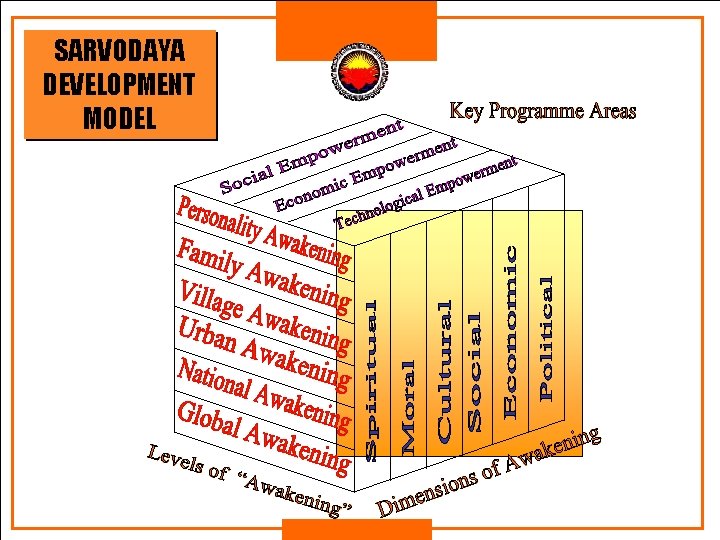
SARVODAYA DEVELOPMENT MODEL
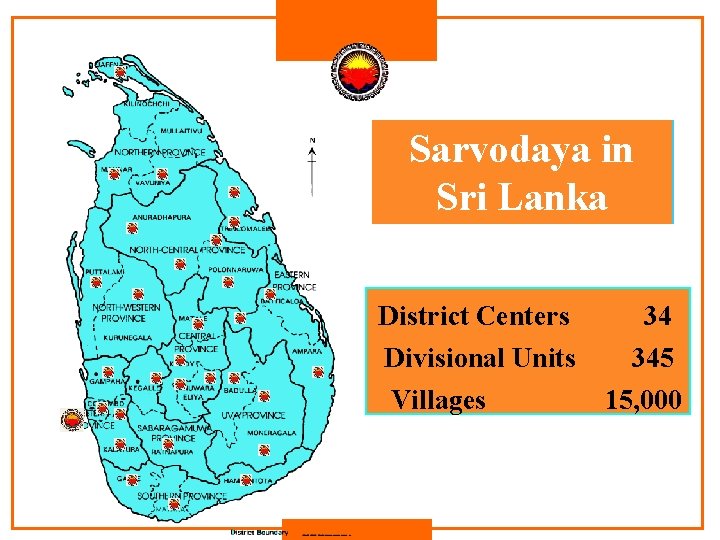
Sarvodaya in Sri Lanka District Centers Divisional Units Villages 34 345 15, 000
Objectives of the Sarvodaya Community Disaster Management Centre (SCDMC) • To make all Sarvodaya Villages Disaster Resilient and Responsive • To enhance Sarvodaya Disaster Management Capacity and Practice
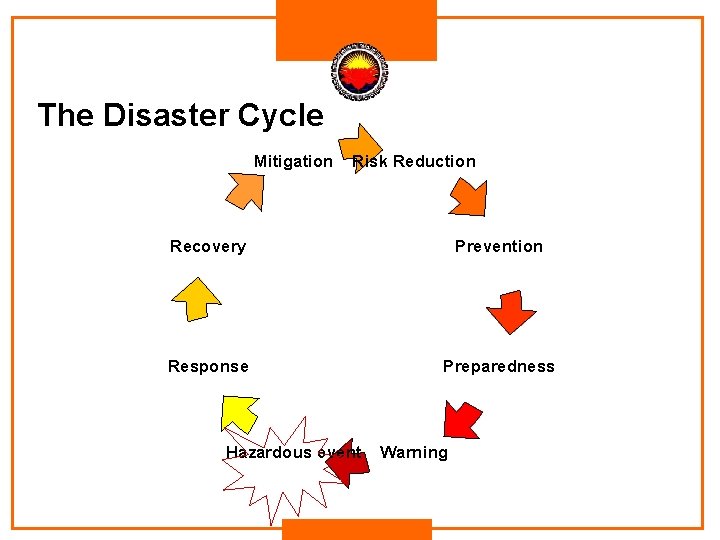
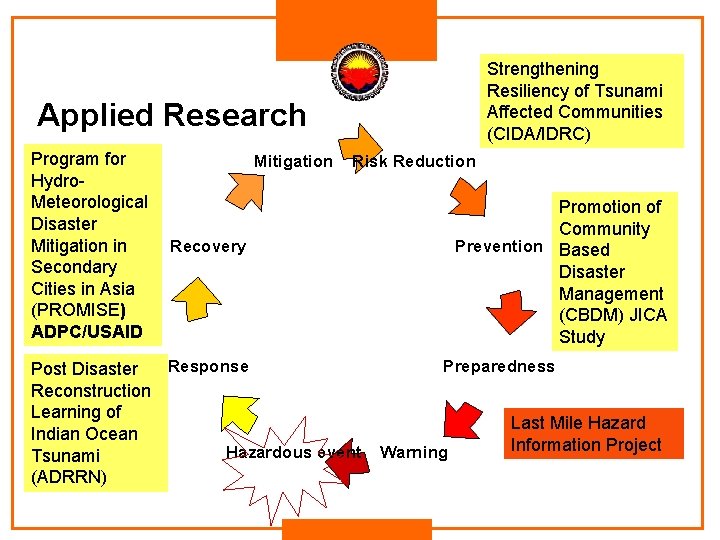
The Disaster Cycle Mitigation Risk Reduction Recovery Prevention Response Preparedness Hazardous event Warning
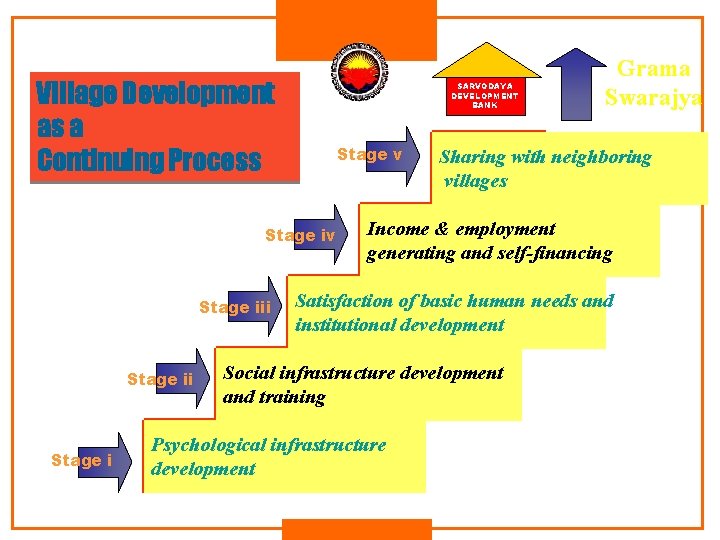
Village Development as a Continuing Process SARVODAYA DEVELOPMENT BANK Stage v Stage iii Stage i Grama Swarajya Sharing with neighboring villages Income & employment generating and self-financing Satisfaction of basic human needs and institutional development Social infrastructure development and training Psychological infrastructure development
Components • Community-based Disaster Risk Management and Village Resiliency • Integration of Disaster Management Practice within Sarvodaya – Capacity Building – Communications and Command Center
Objectives for Component I: Village Resiliency • To formulate a village resiliency model based upon the five-stage Sarvodaya village development model. • To further develop existing hazard warning system capability by providing community disaster management training to strengthen village resiliency. • To create a viable knowledge and expertise foundation in community-based disaster risk management at the SCDMC so that it can maintain, disseminate and receive relevant disaster information to and from Sarvodaya communities.
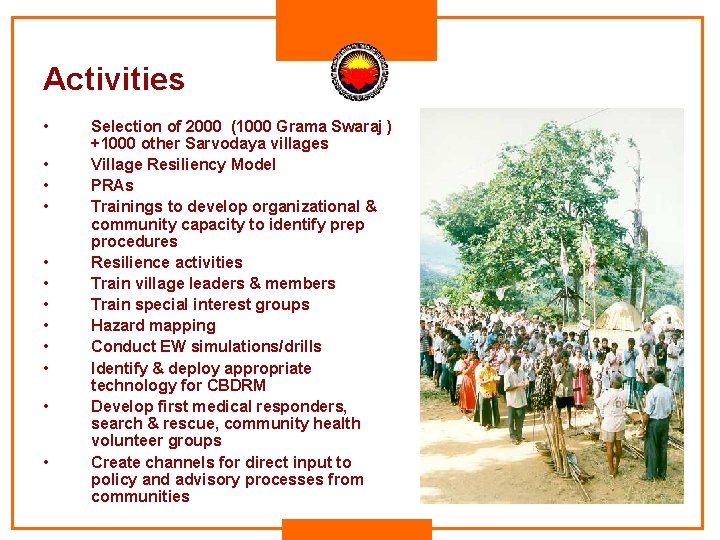
Activities • • • Selection of 2000 (1000 Grama Swaraj ) +1000 other Sarvodaya villages Village Resiliency Model PRAs Trainings to develop organizational & community capacity to identify prep procedures Resilience activities Train village leaders & members Train special interest groups Hazard mapping Conduct EW simulations/drills Identify & deploy appropriate technology for CBDRM Develop first medical responders, search & rescue, community health volunteer groups Create channels for direct input to policy and advisory processes from communities
Objectives for Component II: Capacity Building • To train a cadre of disaster management staff, introduce the elements of disaster risk management to Sarvodaya program directors and senior management as well as train district coordinators in community-based disaster risk management. • To develop and implement action plans based on documented tacit knowledge for integrating disaster risk management (DRM) within Sarvodaya programs focusing on Sarvodaya’s unique communitybased attributes and potential contributions to the field of community -based disaster risk management. • To develop a Sarvodaya Emergency Response Plan to organize internal disaster response to disasters affecting staff at headquarters, district level as well as Sarvodaya villages.
Objective for Component II (cont’d) • To establish national (and international) partnerships with research and educational institutions to enhance SCDMC knowledge and expertise and to share SCDMC knowledge and expertise in community-based disaster risk management. • To link hotel industry experts and SCDMC disaster management staff through sustainability workshops designed to exchange and share best practices in security and disaster management.
Activities 1. 2. 3. 4. 5. 6. 7. 8. Train 8 SCDMC staff Analyze & integrate Sarvodaya community development programs contributions to SCDMC community-based disaster risk management. Develop action plans Conduct CBDRM training/workshops Conduct CBDRM trainings with district coordinators Integrate all disaster projects within Sarvodaya Initiate partnerships with national (& international) education and research institutions for knowledge transfer Select hotel industry experts and SCDMC staff for workshop to share ideas in security and DM.
Objectives for Component III: Communications and Command Center • To improve the relationship between Sarvodaya and its internal stakeholders through the establishment of a Sarvodaya-tailored state-of-the-art communications system. • To promote sustainability by continuing the development of early warning systems (such as the one piloted under the Last Mile Hazard Warning System project). • To develop a communications strategy designed to enhance the role of the SCDMC in community-based disaster risk management nationally and internationally and to establish the SCDMC.
Objectives for Component III (cont’d) • To establish a comprehensive emergency contact database that will list important contact details for villages, district and national level Sarvodaya staff as well as relevant donors, affiliates, government staff, etc. • To create partnerships with select media to commence island-wide disaster awareness programs in Sarvodaya villages.
Activities 1. 2. Emergency contact database Consultation with internal Sarvodaya stakeholders, communications experts, disaster management experts, etc. 3. Communications strategy 4. SCDMC website 5. Radio ASR link 6. Continued development of early warning mechanisms 7. SCDMC command center 8. 24/7 operability of Hazard Information Hub (HIH) 9. Island-wide Sarvodaya village disaster awareness programs 10. Establish a hazard education center/museum at Ambalangoda
Strengthening Resiliency of Tsunami Affected Communities (CIDA/IDRC) Applied Research Program for Hydro. Meteorological Disaster Mitigation in Secondary Cities in Asia (PROMISE) ADPC/USAID Mitigation Risk Reduction Promotion of Community Prevention Based Disaster Management (CBDM) JICA Study Recovery Response Post Disaster Reconstruction Learning of Indian Ocean Hazardous event Tsunami (ADRRN) Preparedness Warning Last Mile Hazard Information Project
Community Hazard Mapping
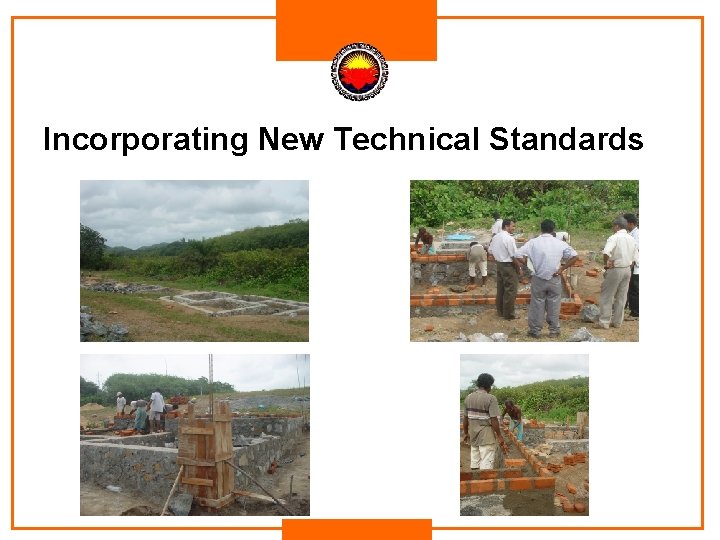
Incorporating New Technical Standards
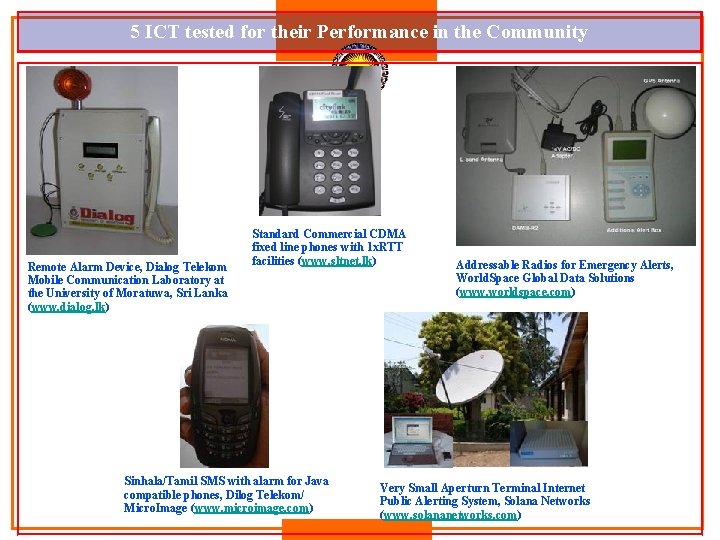
5 ICT tested for their Performance in the Community Remote Alarm Device, Dialog Telekom Mobile Communication Laboratory at the University of Moratuwa, Sri Lanka (www. dialog. lk) Standard Commercial CDMA fixed line phones with 1 x. RTT facilities (www. sltnet. lk) Sinhala/Tamil SMS with alarm for Java compatible phones, Dilog Telekom/ Micro. Image (www. microimage. com) Addressable Radios for Emergency Alerts, World. Space Global Data Solutions (www. worldspace. com) Very Small Aperturn Terminal Internet Public Alerting System, Solana Networks (www. solananetworks. com)
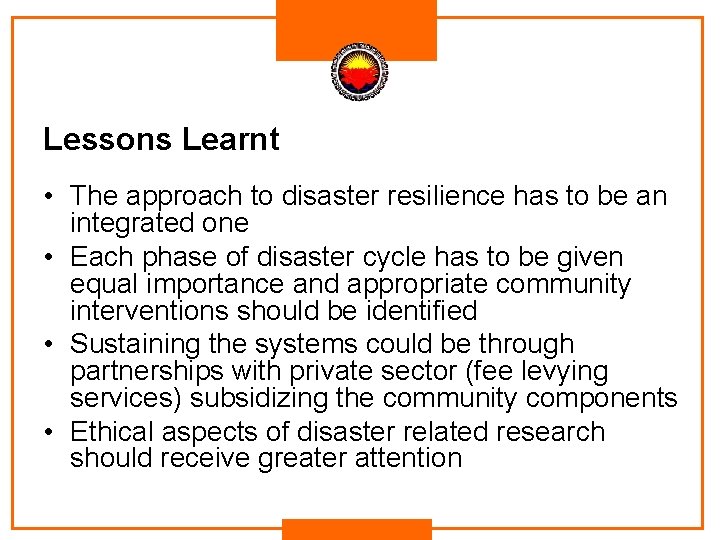
Lessons Learnt • The approach to disaster resilience has to be an integrated one • Each phase of disaster cycle has to be given equal importance and appropriate community interventions should be identified • Sustaining the systems could be through partnerships with private sector (fee levying services) subsidizing the community components • Ethical aspects of disaster related research should receive greater attention
Thank You