
Making Choices Factors that Impact Residency Program Selection
- Slides: 1
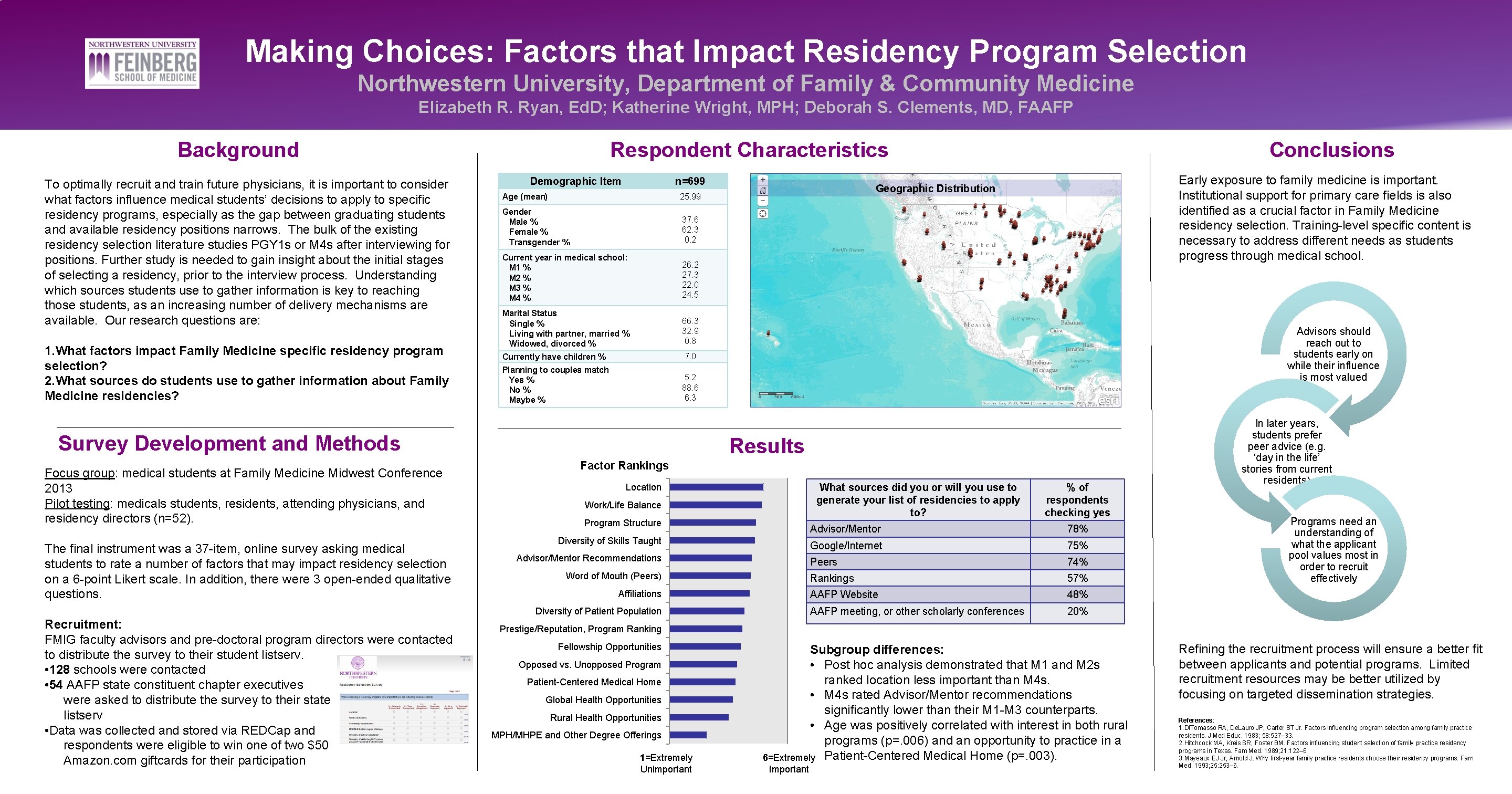
Making Choices: Factors that Impact Residency Program Selection Northwestern University, Department of Family & Community Medicine Elizabeth R. Ryan, Ed. D; Katherine Wright, MPH; Deborah S. Clements, MD, FAAFP Respondent Characteristics Background To optimally recruit and train future physicians, it is important to consider what factors influence medical students’ decisions to apply to specific residency programs, especially as the gap between graduating students and available residency positions narrows. The bulk of the existing residency selection literature studies PGY 1 s or M 4 s after interviewing for positions. Further study is needed to gain insight about the initial stages of selecting a residency, prior to the interview process. Understanding which sources students use to gather information is key to reaching those students, as an increasing number of delivery mechanisms are available. Our research questions are: 1. What factors impact Family Medicine specific residency program selection? 2. What sources do students use to gather information about Family Medicine residencies? Demographic Item n=699 Age (mean) 25. 99 Gender Male % Female % Transgender % 37. 6 62. 3 0. 2 Current year in medical school: M 1 % M 2 % M 3 % M 4 % 26. 2 27. 3 22. 0 24. 5 Marital Status Single % Living with partner, married % Widowed, divorced % 66. 3 32. 9 0. 8 Currently have children % 7. 0 Planning to couples match Yes % No % Maybe % 5. 2 88. 6 6. 3 Survey Development and Methods Focus group: medical students at Family Medicine Midwest Conference 2013 Pilot testing: medicals students, residents, attending physicians, and residency directors (n=52). The final instrument was a 37 -item, online survey asking medical students to rate a number of factors that may impact residency selection on a 6 -point Likert scale. In addition, there were 3 open-ended qualitative questions. Early exposure to family medicine is important. Institutional support for primary care fields is also identified as a crucial factor in Family Medicine residency selection. Training-level specific content is necessary to address different needs as students progress through medical school. Geographic Distribution Advisors should reach out to students early on while their influence is most valued Results Factor Rankings What sources did you or will you use to generate your list of residencies to apply to? Location Work/Life Balance Program Structure Diversity of Skills Taught Advisor/Mentor Recommendations Word of Mouth (Peers) Affiliations Diversity of Patient Population Recruitment: FMIG faculty advisors and pre-doctoral program directors were contacted to distribute the survey to their student listserv. • 128 schools were contacted • 54 AAFP state constituent chapter executives were asked to distribute the survey to their state listserv • Data was collected and stored via REDCap and respondents were eligible to win one of two $50 Amazon. com giftcards for their participation Conclusions % of respondents checking yes Advisor/Mentor 78% Google/Internet 75% Peers 74% Rankings 57% AAFP Website 48% AAFP meeting, or other scholarly conferences 20% In later years, students prefer peer advice (e. g. ‘day in the life’ stories from current residents) Programs need an understanding of what the applicant pool values most in order to recruit effectively Prestige/Reputation, Program Ranking Fellowship Opportunities Opposed vs. Unopposed Program Patient-Centered Medical Home Global Health Opportunities Rural Health Opportunities MPH/MHPE and Other Degree Offerings 1=Extremely Unimportant Subgroup differences: • Post hoc analysis demonstrated that M 1 and M 2 s ranked location less important than M 4 s. • M 4 s rated Advisor/Mentor recommendations significantly lower than their M 1 -M 3 counterparts. • Age was positively correlated with interest in both rural programs (p=. 006) and an opportunity to practice in a 6=Extremely Patient-Centered Medical Home (p=. 003). Important Refining the recruitment process will ensure a better fit between applicants and potential programs. Limited recruitment resources may be better utilized by focusing on targeted dissemination strategies. References: 1. Di. Tomasso RA, De. Lauro JP, Carter ST Jr. Factors influencing program selection among family practice residents. J Med Educ. 1983; 58: 527– 33. 2. Hitchcock MA, Kreis SR, Foster BM. Factors influencing student selection of family practice residency programs in Texas. Fam Med. 1989; 21: 122– 6. 3. Mayeaux EJ Jr, Arnold J. Why first-year family practice residents choose their residency programs. Fam Med. 1993; 25: 253– 6.