
Making Change Happen Kari Lock Morgan STAT 790
- Slides: 55
Making Change Happen Kari Lock Morgan STAT 790: Teaching Statistics 10/24/12
Introducing Inference with Simulation Methods
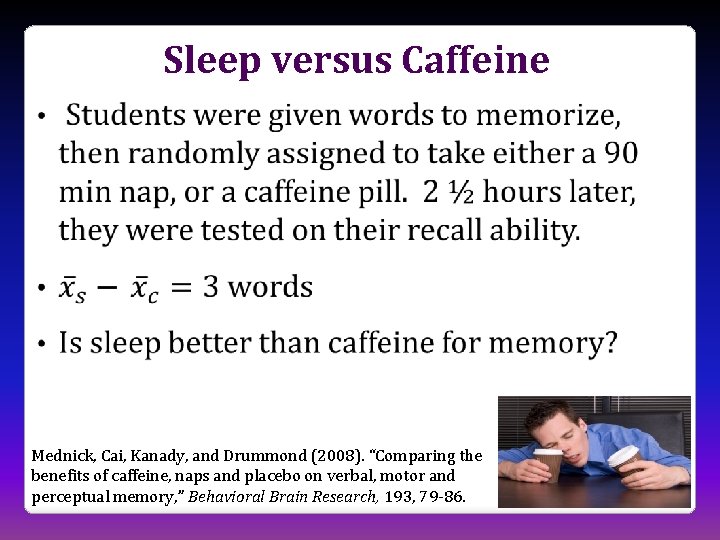
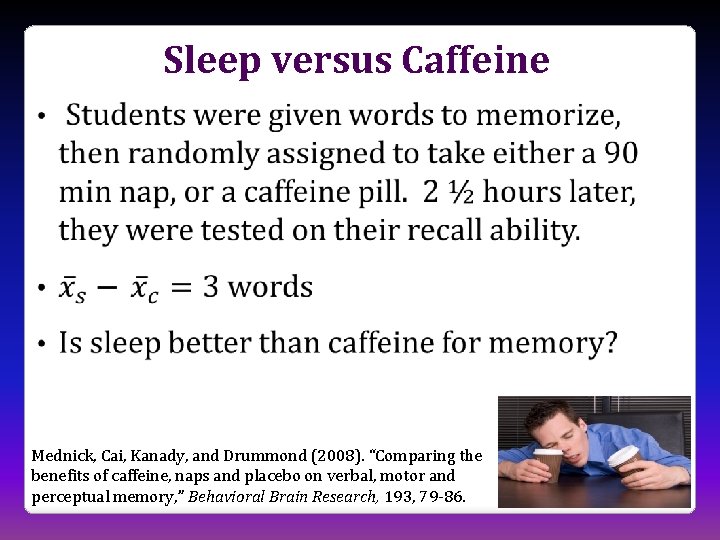
Sleep versus Caffeine Mednick, Cai, Kanady, and Drummond (2008). “Comparing the benefits of caffeine, naps and placebo on verbal, motor and perceptual memory, ” Behavioral Brain Research, 193, 79 -86.
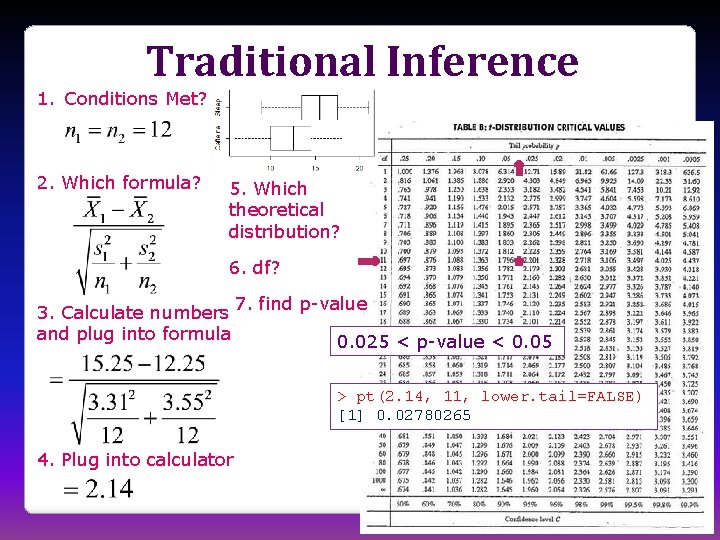
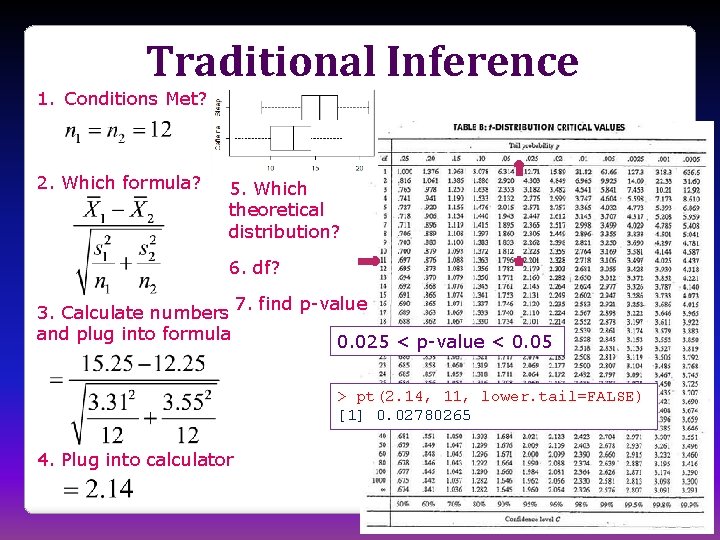
Traditional Inference 1. Conditions Met? 2. Which formula? 5. Which theoretical distribution? 6. df? 3. Calculate numbers 7. find p-value and plug into formula 0. 025 < p-value < 0. 05 > pt(2. 14, 11, lower. tail=FALSE) [1] 0. 02780265 4. Plug into calculator
Traditional Inference • Confidence intervals and hypothesis tests using the normal and t-distributions • With a different formula for each situation, students often get mired in the details and fail to see the big picture • Plugging numbers into formulas does little to help reinforce conceptual understanding
Simulation Methods • Simulation methods (bootstrapping and randomization) are a computationally intensive alternative to the traditional approach • Rather than relying on theoretical distributions for specific test statistics, we can directly simulate the distribution of any statistic • Great for conceptual understanding!
Hypothesis Testing To generate a distribution assuming H 0 is true: • Traditional Approach: Calculate a test statistic which should follow a known distribution if the null hypothesis is true (under some conditions) • Randomization Approach: Decide on a statistic of interest. Simulate many randomizations assuming the null hypothesis is true, and calculate this statistic for each randomization
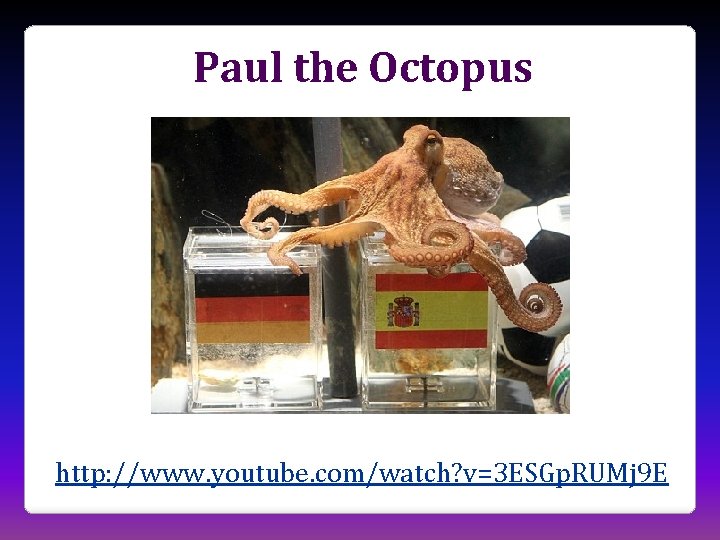
Paul the Octopus http: //www. youtube. com/watch? v=3 ESGp. RUMj 9 E
Paul the Octopus • Paul the Octopus predicted 8 World Cup games, and predicted them all correctly • Is this evidence that Paul actually has psychic powers? • How unusual would this be if he was just randomly guessing (with a 50% chance of guessing correctly)? • How could we figure this out?
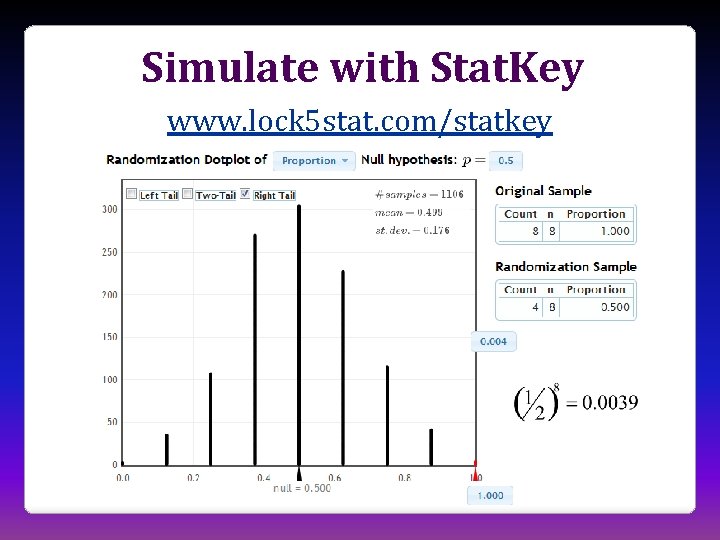
Simulate with Students • Students each flip a coin 8 times, and count the number of heads • Count the number of students with all 8 heads by a show of hands (will probably be 0) • If Paul was just guessing, it would be very unlikely for him to get all 8 correct! • How unlikely? Simulate many times!!!
Simulate with Stat. Key www. lock 5 stat. com/statkey
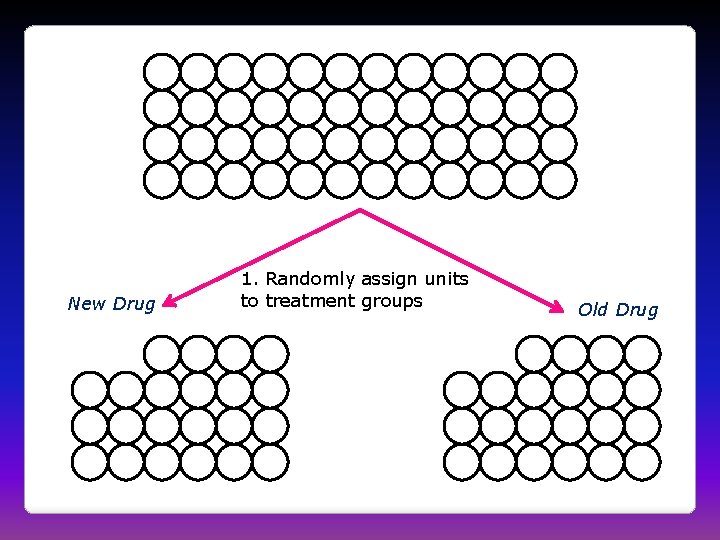
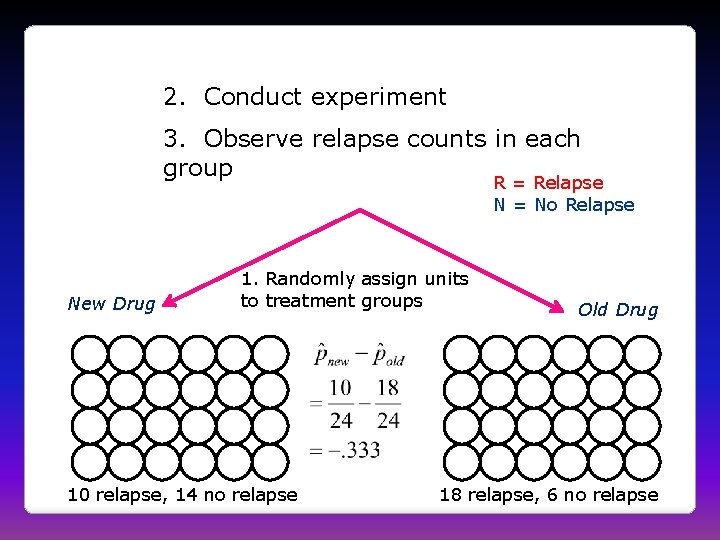
Cocaine Addiction • In a randomized experiment on treating cocaine addiction, 48 people were randomly assigned to take either Desipramine (a new drug), or Lithium (an existing drug) • The outcome variable is whether or not a patient relapsed • Is Desipramine significantly better than Lithium at treating cocaine addiction?
R R R R R R R R R R R R 1. Randomly assign units to treatment groups New Drug R R Old Drug R R R R R R R R R R
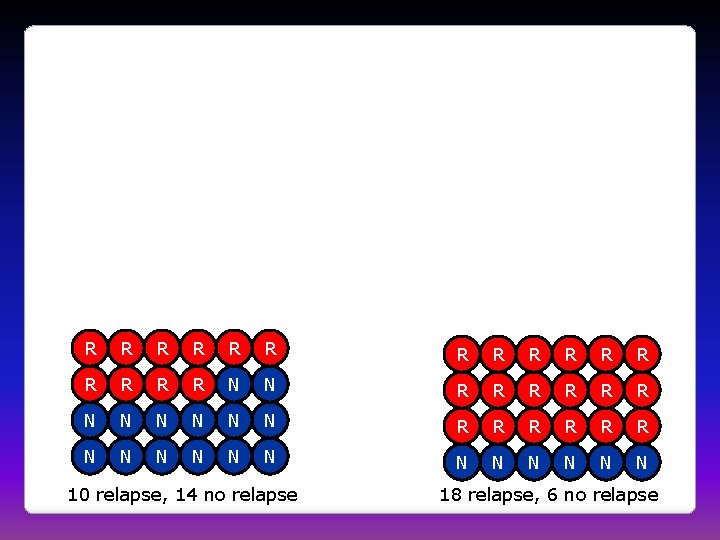
2. Conduct experiment 3. Observe relapse counts in each group R = Relapse N = No Relapse 1. Randomly assign units to treatment groups New Drug Old Drug R R R R N R R R R N R N N R R R N N N 10 relapse, 14 no relapse 18 relapse, 6 no relapse
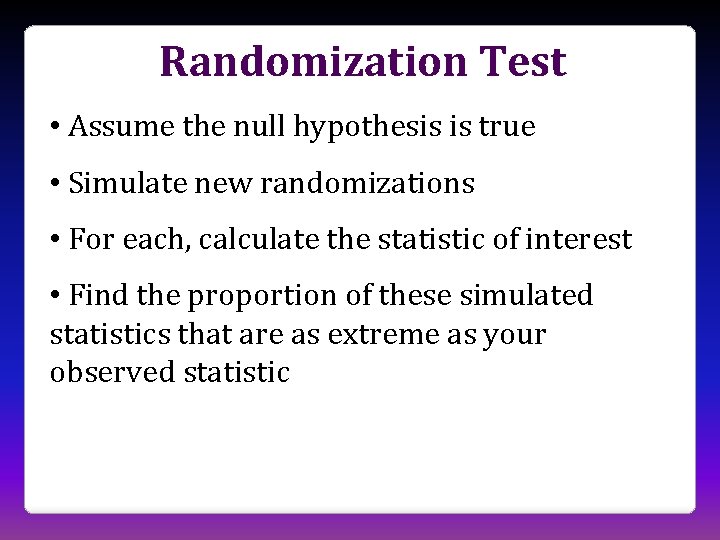
Randomization Test • Assume the null hypothesis is true • Simulate new randomizations • For each, calculate the statistic of interest • Find the proportion of these simulated statistics that are as extreme as your observed statistic
R R R R N N R R R N N N N 10 relapse, 14 no relapse 18 relapse, 6 no relapse
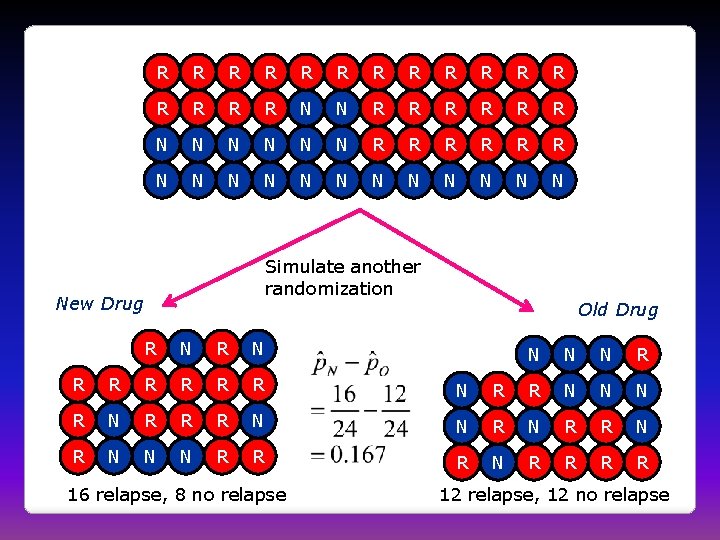
R R R R N N R R R N N N N Simulate another randomization New Drug R N Old Drug N N N R R R R N N N R R R N N N R R R R 16 relapse, 8 no relapse 12 relapse, 12 no relapse
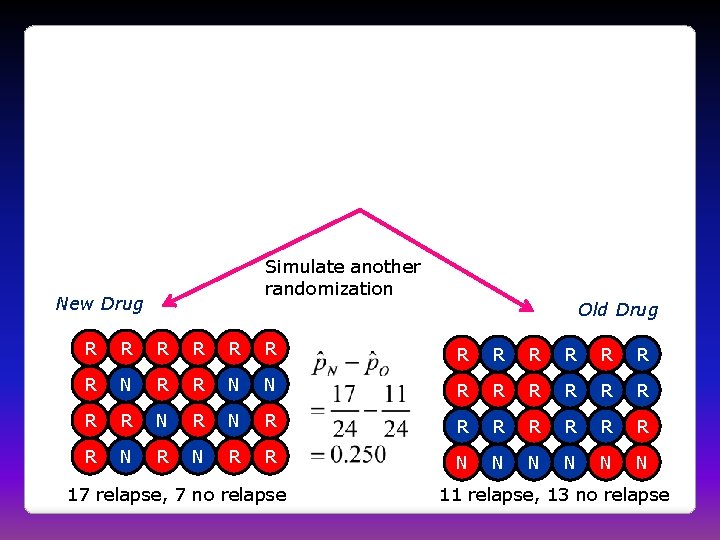
Simulate another randomization New Drug Old Drug R R R R N R R N N R R R R N R N R R N N N 17 relapse, 7 no relapse 11 relapse, 13 no relapse
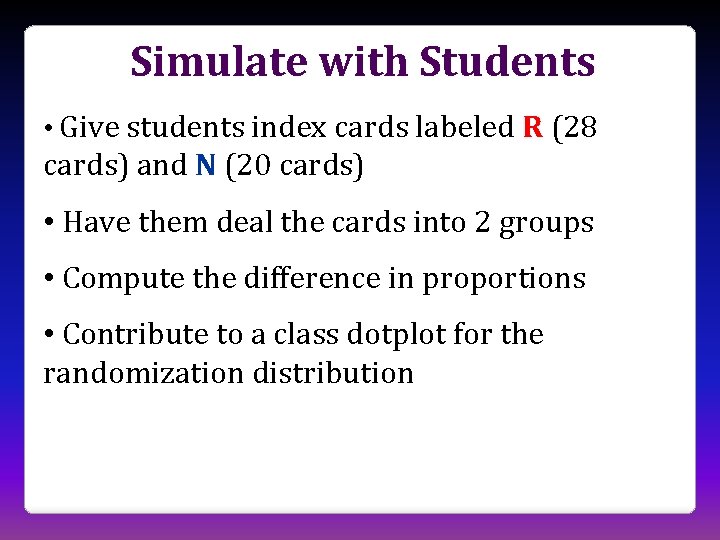
Simulate with Students • Give students index cards labeled R (28 cards) and N (20 cards) • Have them deal the cards into 2 groups • Compute the difference in proportions • Contribute to a class dotplot for the randomization distribution
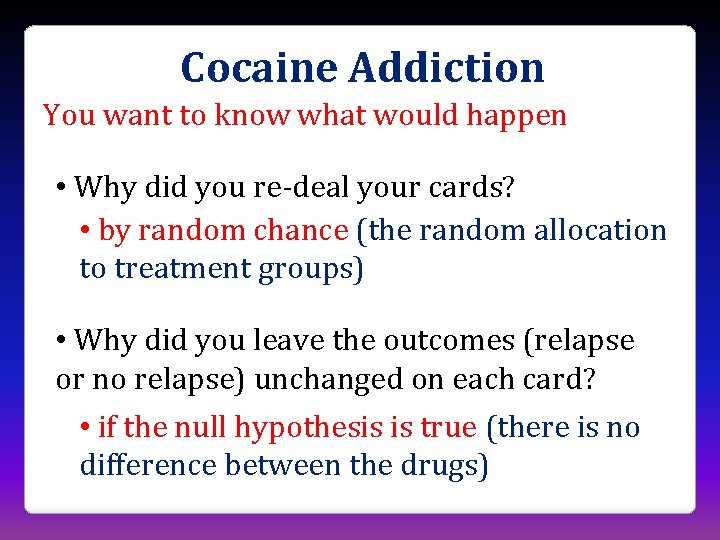
Cocaine Addiction You want to know what would happen • Why did you re-deal your cards? • by random chance (the random allocation to treatment groups) • Why did you leave the outcomes (relapse or no relapse) unchanged on each card? • if the null hypothesis is true (there is no difference between the drugs)
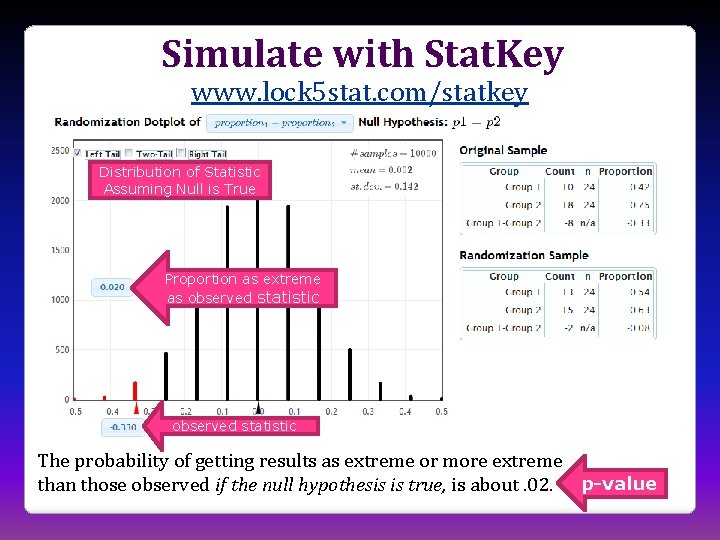
Simulate with Stat. Key www. lock 5 stat. com/statkey Distribution of Statistic Assuming Null is True Proportion as extreme as observed statistic The probability of getting results as extreme or more extreme than those observed if the null hypothesis is true, is about. 02. p-value
Sleep versus Caffeine Mednick, Cai, Kanady, and Drummond (2008). “Comparing the benefits of caffeine, naps and placebo on verbal, motor and perceptual memory, ” Behavioral Brain Research, 193, 79 -86.
Simulation Inference • How extreme would a sample difference of 3 be, if there were no difference between sleep and caffeine for word recall? • What kind of differences would we observe, just by random chance? • Simulate many randomizations, assuming no difference • Calculate the p-value as the proportion of simulated randomizations that yield differences as extreme as the observed 3
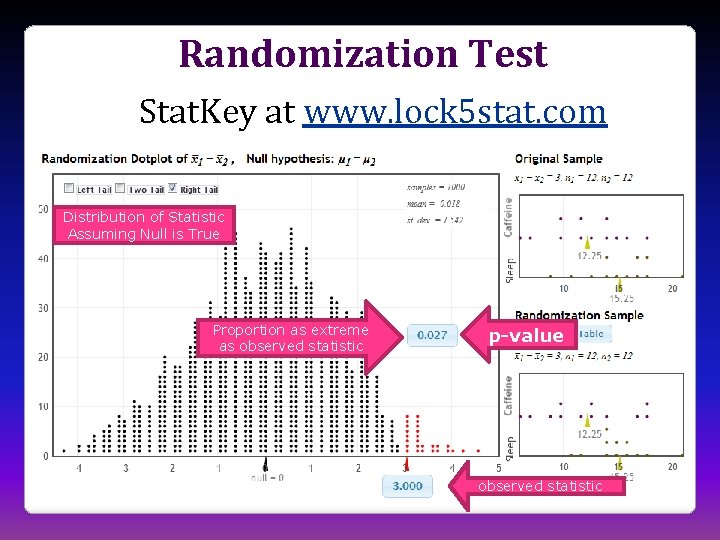
Randomization Test Stat. Key at www. lock 5 stat. com Distribution of Statistic Assuming Null is True Proportion as extreme as observed statistic p-value observed statistic
Traditional Inference 1. Conditions Met? 2. Which formula? 5. Which theoretical distribution? 6. df? 3. Calculate numbers 7. find p-value and plug into formula 0. 025 < p-value < 0. 05 > pt(2. 14, 11, lower. tail=FALSE) [1] 0. 02780265 4. Plug into calculator
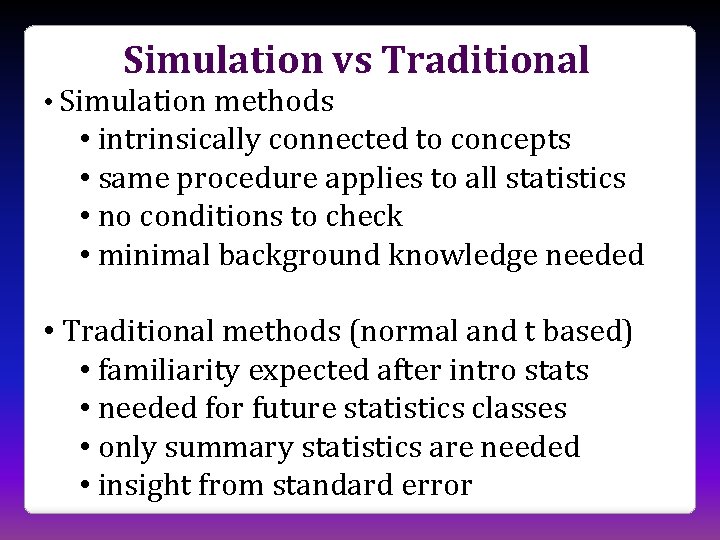
Simulation vs Traditional • Simulation methods • intrinsically connected to concepts • same procedure applies to all statistics • no conditions to check • minimal background knowledge needed • Traditional methods (normal and t based) • familiarity expected after intro stats • needed for future statistics classes • only summary statistics are needed • insight from standard error
Simulation AND Traditional? • We introduces inference with simulation methods, then cover the traditional methods • Students have seen the normal distribution appear repeatedly via simulation; use this common shape to motivate traditional inference • “Shortcut” formulas give the standard error, avoiding the need for thousands of simulations • Students already know the concepts, so can go relatively fast through the mechanics
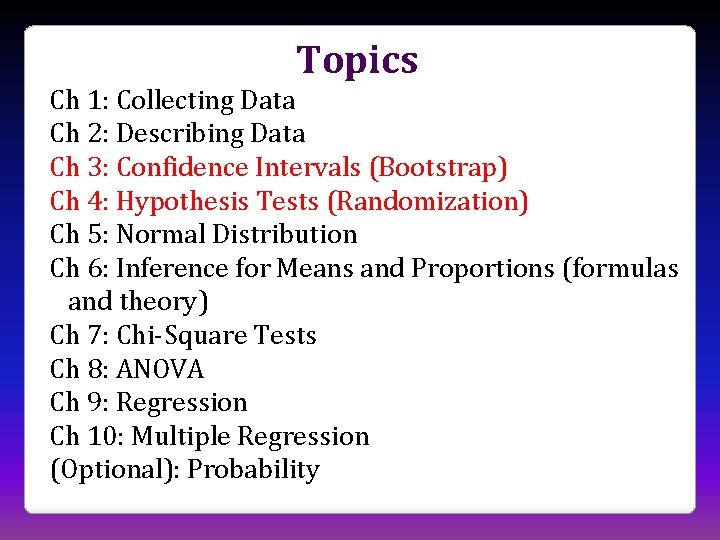
Topics Ch 1: Collecting Data Ch 2: Describing Data Ch 3: Confidence Intervals (Bootstrap) Ch 4: Hypothesis Tests (Randomization) Ch 5: Normal Distribution Ch 6: Inference for Means and Proportions (formulas and theory) Ch 7: Chi-Square Tests Ch 8: ANOVA Ch 9: Regression Ch 10: Multiple Regression (Optional): Probability
Theoretical Approach • Normal and t-based inference after bootstrapping and randomization: • Students have seen the normal distribution repeatedly – CLT easy! • Same idea, just using formula for SE and comparing to theoretical distribution • Can go very quickly through this!
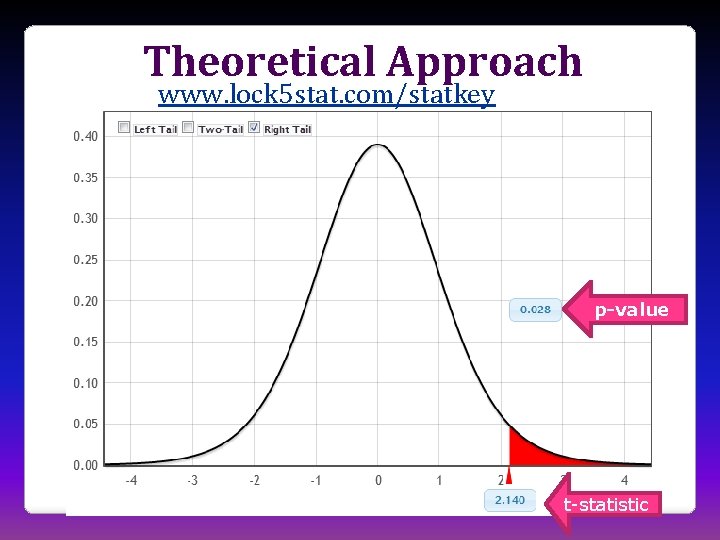
Theoretical Approach www. lock 5 stat. com/statkey p-value t-statistic
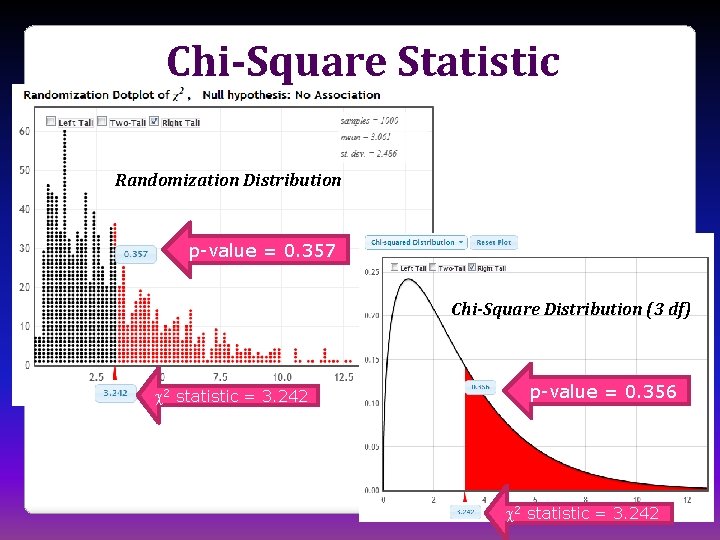
Chi-Square and ANOVA • Introduce new statistic - 2 or F • Students know that these can be compared to either a randomization distribution or a theoretical distribution • Students are comfortable using either method, and see the connection! • If conditions are met, the randomization and theoretical distributions are the same!
Chi-Square Statistic Randomization Distribution p-value = 0. 357 Chi-Square Distribution (3 df) 2 statistic = 3. 242 p-value = 0. 356 2 statistic = 3. 242
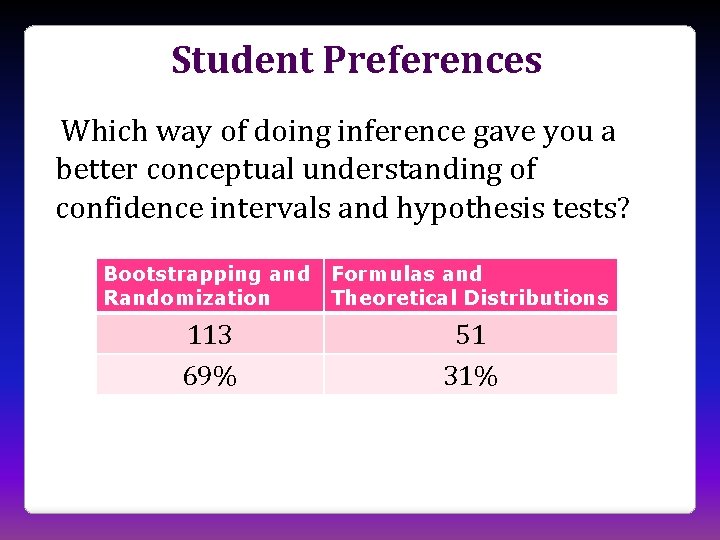
Student Preferences Which way of doing inference gave you a better conceptual understanding of confidence intervals and hypothesis tests? Bootstrapping and Randomization Formulas and Theoretical Distributions 113 69% 51 31%
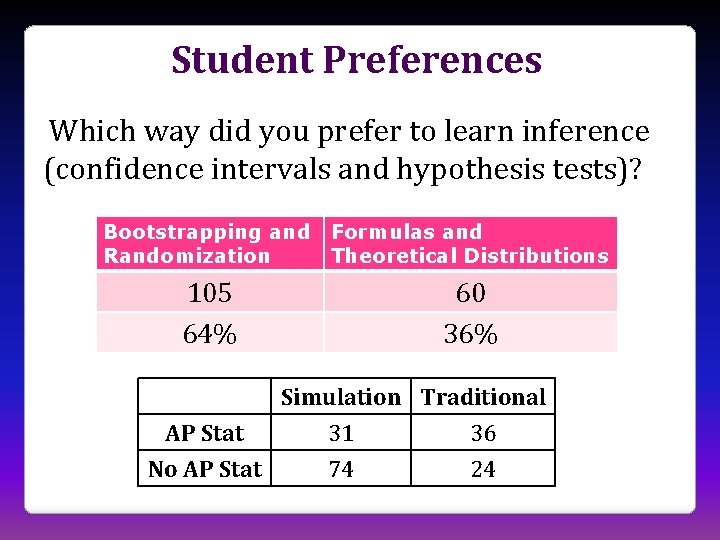
Student Preferences Which way did you prefer to learn inference (confidence intervals and hypothesis tests)? Bootstrapping and Randomization Formulas and Theoretical Distributions 105 64% 60 36% Simulation Traditional AP Stat 31 36 No AP Stat 74 24
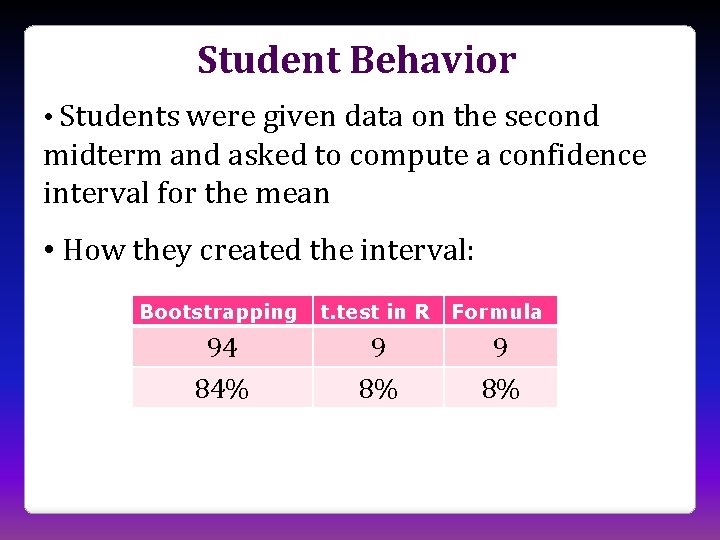
Student Behavior • Students were given data on the second midterm and asked to compute a confidence interval for the mean • How they created the interval: Bootstrapping t. test in R Formula 94 84% 9 8%
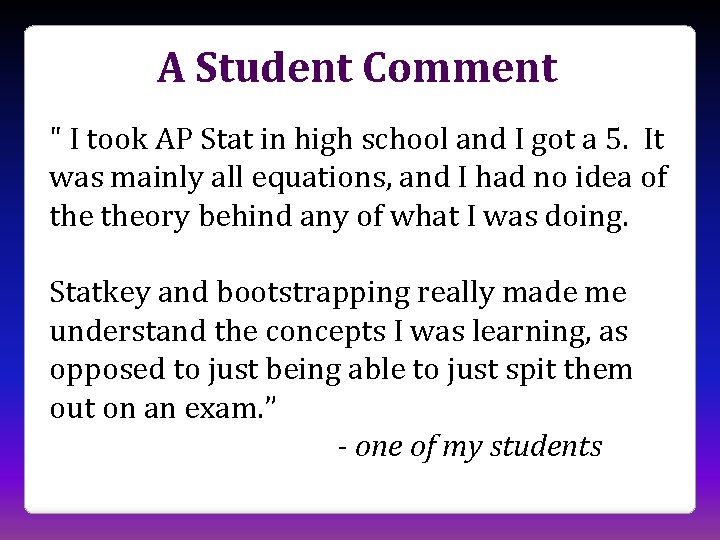
A Student Comment " I took AP Stat in high school and I got a 5. It was mainly all equations, and I had no idea of theory behind any of what I was doing. Statkey and bootstrapping really made me understand the concepts I was learning, as opposed to just being able to just spit them out on an exam. ” - one of my students
It is the way of the past… "Actually, the statistician does not carry out this very simple and very tedious process [the randomization test], but his conclusions have no justification beyond the fact that they agree with those which could have been arrived at by this elementary method. " -- Sir R. A. Fisher, 1936
… and the way of the future “. . . the consensus curriculum is still an unwitting prisoner of history. What we teach is largely the technical machinery of numerical approximations based on the normal distribution and its many subsidiary cogs. This machinery was once necessary, because the conceptually simpler alternative based on permutations was computationally beyond our reach. Before computers statisticians had no choice. These days we have no excuse. Randomization-based inference makes a direct connection between data production and the logic of inference that deserves to be at the core of every introductory course. ” -- Professor George Cobb, 2007
Confidence Intervals • How to assess the variability of sample statistics? • Sample repeatedly from the population to create a sampling distribution to compute the standard error? • Reality: We only have one sample! • How do we determine how much statistics vary from sample to sample, if we only have one sample? ? ?
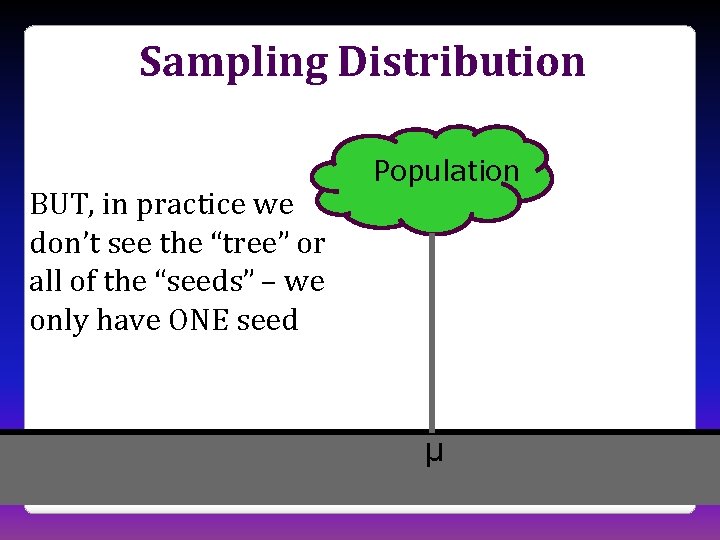
Sampling Distribution BUT, in practice we don’t see the “tree” or all of the “seeds” – we only have ONE seed Population µ
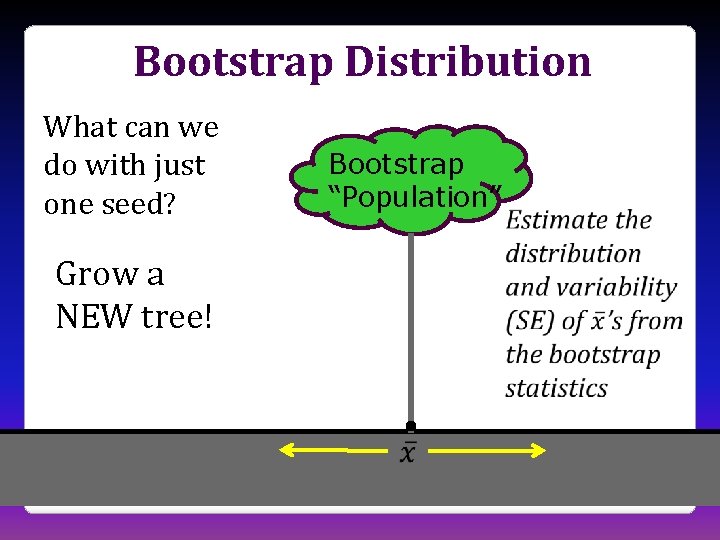
Bootstrap Distribution What can we do with just one seed? Bootstrap “Population” Grow a NEW tree!
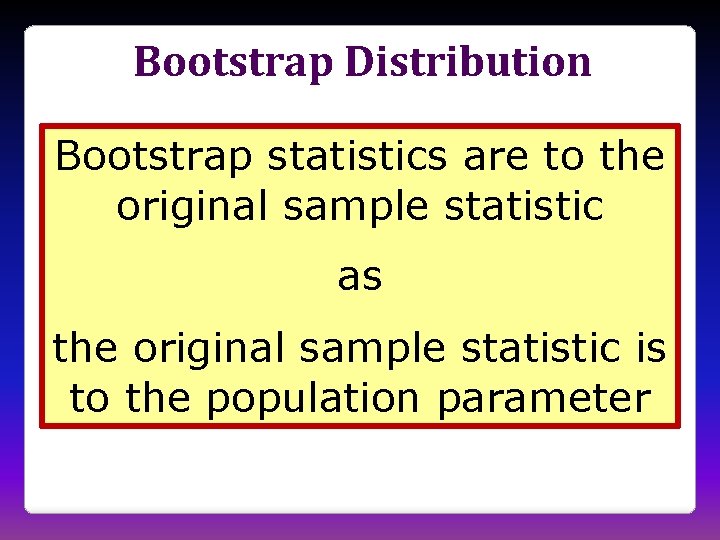
Bootstrap Distribution Bootstrap statistics are to the original sample statistic as the original sample statistic is to the population parameter
Standard Error • The variability of the bootstrap statistics is similar to the variability of the sample statistics • The standard error of a statistic can be estimated using the standard deviation of the bootstrap distribution!
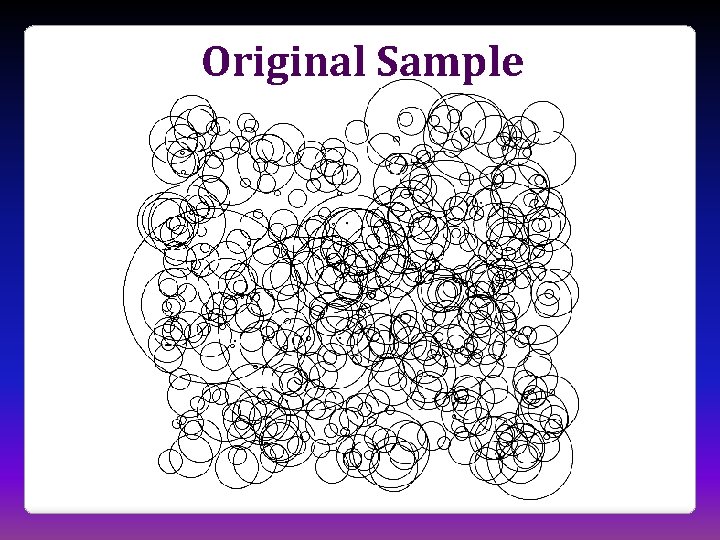
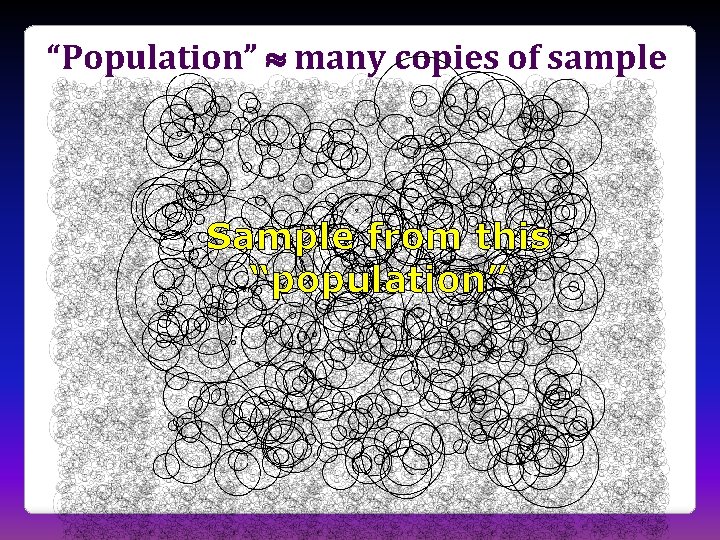
Bootstrap Distribution • Imagine the population is many, many copies of the original sample (what do you have to assume? ) • Sample repeatedly from this mock population • This is done by sampling with replacement from the original sample
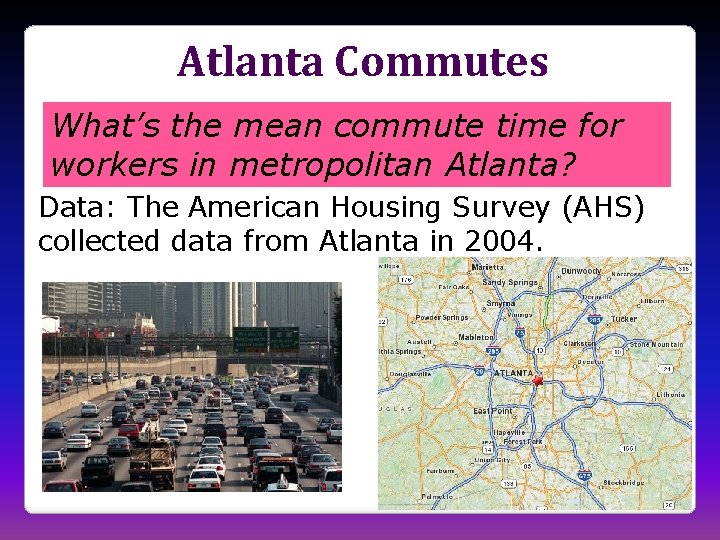
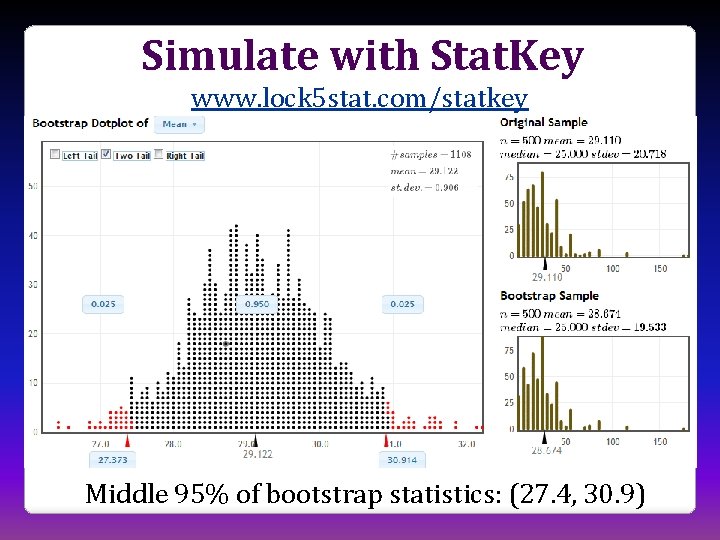
Atlanta Commutes What’s the mean commute time for workers in metropolitan Atlanta? Data: The American Housing Survey (AHS) collected data from Atlanta in 2004.
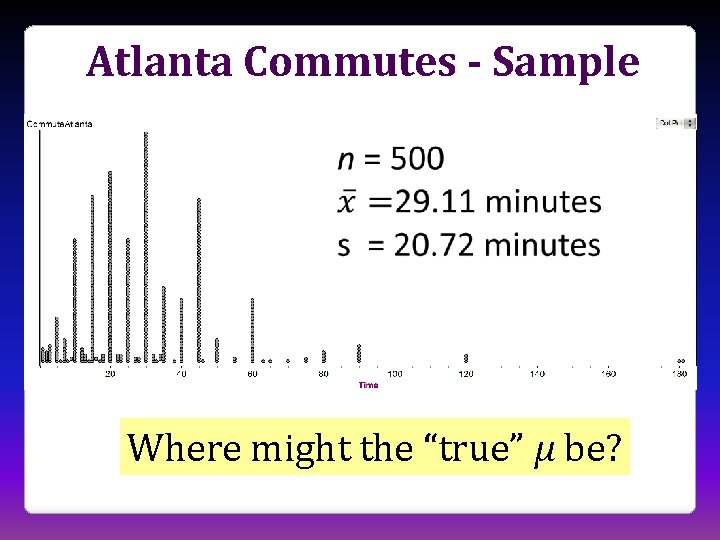
Atlanta Commutes - Sample Where might the “true” μ be?
Original Sample
“Population” many copies of sample Sample from this “population”
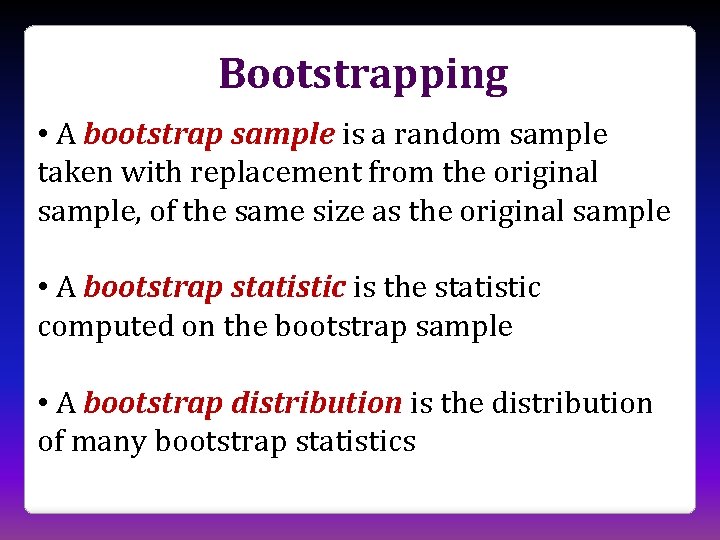
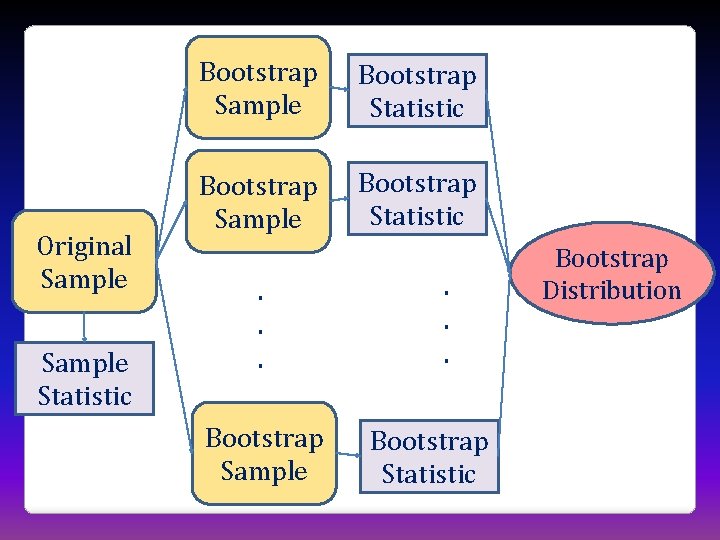
Bootstrapping • A bootstrap sample is a random sample taken with replacement from the original sample, of the same size as the original sample • A bootstrap statistic is the statistic computed on the bootstrap sample • A bootstrap distribution is the distribution of many bootstrap statistics
Original Sample Statistic Bootstrap Sample Bootstrap Statistic . . . Bootstrap Sample . . . Bootstrap Statistic Bootstrap Distribution
Simulate with Stat. Key www. lock 5 stat. com/statkey Middle 95% of bootstrap statistics: (27. 4, 30. 9)
Other Changes • More Bayesian inference in undergraduate courses? • More emphasis on analysis of big datasets? • ?
Making Change Happen • You are the next generation of statistics professors… you are best suited to implement change! • Think hard about the existing curriculum and pedagogy… is it best for the students? • If not, how could it be made better? • Talk to colleagues, attend conferences, …
Making Change Happen • The 2013 United States Conference on Teaching Statistics (USCOTS) will be in the Research Triangle Park! • May 16 -18, 2013 • Conference theme: “Making Change Happen” • Plenary sessions, breakout sessions, posters • You are all encouraged to attend!
Practice Teaching • 12 min, any statistics topic • “It’s not what you teach, it’s what they learn” • Motivate the topic • Use examples, and real data if possible • Stress conceptual understanding • Try visuals to clarify concepts • What are the key points? • Computer or board? • Engage the students!