
Making Assessment Meaningful Using Assessment Results to Improve



- Slides: 32
Making Assessment Meaningful: Using Assessment Results to Improve Student Learning Dr. Elizabeth Wemlinger 4. 7. 15
Assessment / Evaluation • Purpose of evaluating program through student learning outcomes 1. Demonstrate 2. Provide feedback 3. Improve
Improve • How can student learning outcomes help improve program 1. Identify gaps in learning 2. Identify gaps in curriculum 3. Identify gaps in instruction
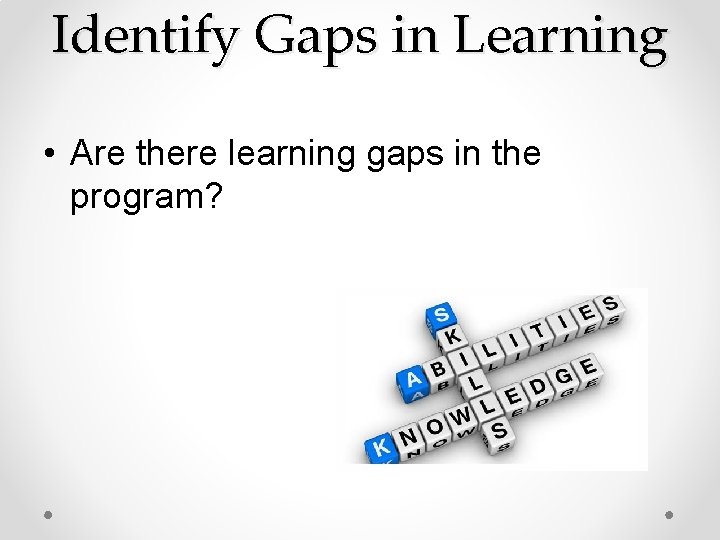
Identify Gaps in Learning • Are there learning gaps in the program?
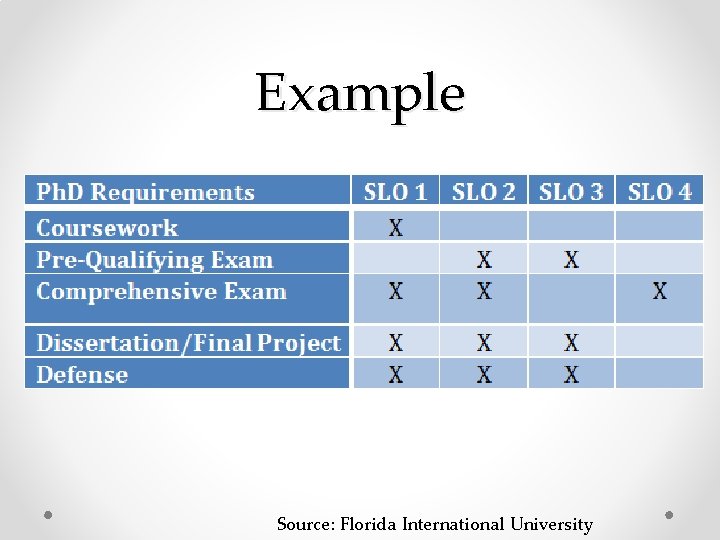
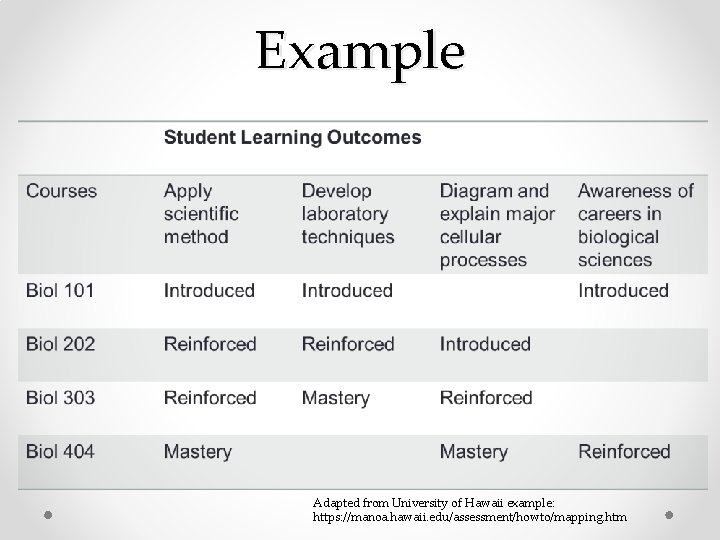
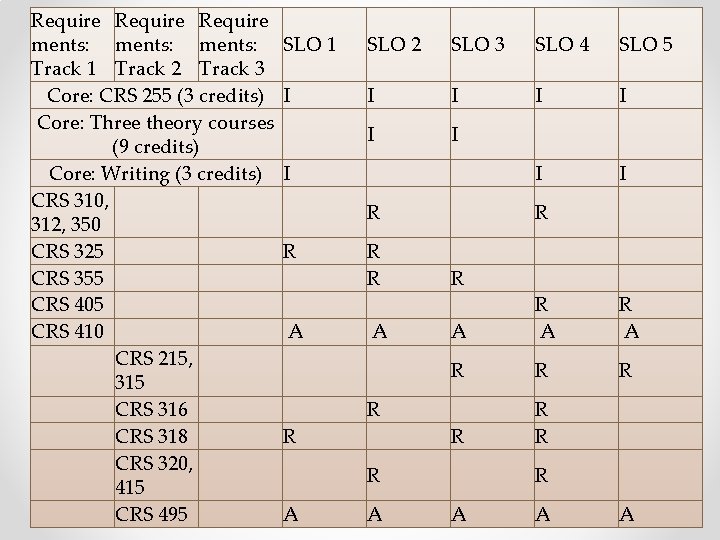
What is Curriculum Mapping? • Curriculum mapping is the process indexing or diagraming a curriculum to identify and address academic gaps, redundancies, and misalignments for purposes of improving the overall coherence of a course of study and, by extension, its effectiveness Source: The Glossary of Education Reform
Example Source: Florida International University
Example Adapted from University of Hawaii example: https: //manoa. hawaii. edu/assessment/howto/mapping. htm
Require ments: Track 1 Track 2 Track 3 Core: CRS 255 (3 credits) Core: Three theory courses (9 credits) Core: Writing (3 credits) CRS 310, 312, 350 CRS 325 CRS 355 CRS 405 CRS 410 CRS 215, 315 CRS 316 CRS 318 CRS 320, 415 CRS 495 SLO 1 SLO 2 SLO 3 SLO 4 SLO 5 I I I I I R R A R A R R R R A A A
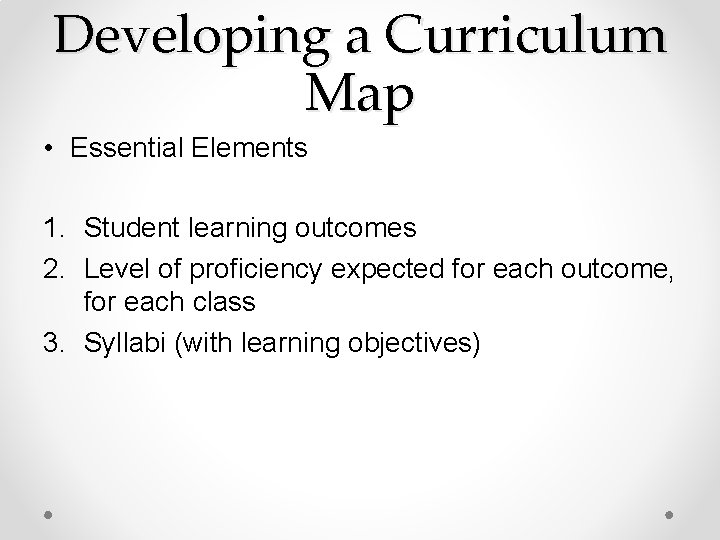
Developing a Curriculum Map • Essential Elements 1. Student learning outcomes 2. Level of proficiency expected for each outcome, for each class 3. Syllabi (with learning objectives)
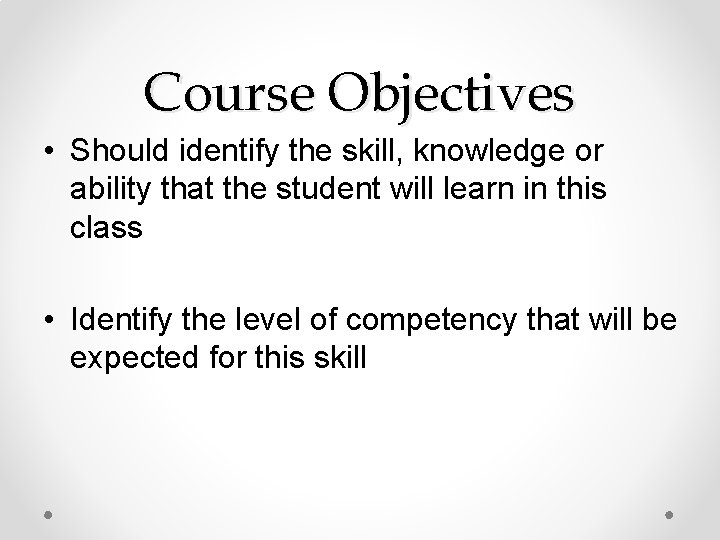
Course Objectives • Should identify the skill, knowledge or ability that the student will learn in this class • Identify the level of competency that will be expected for this skill
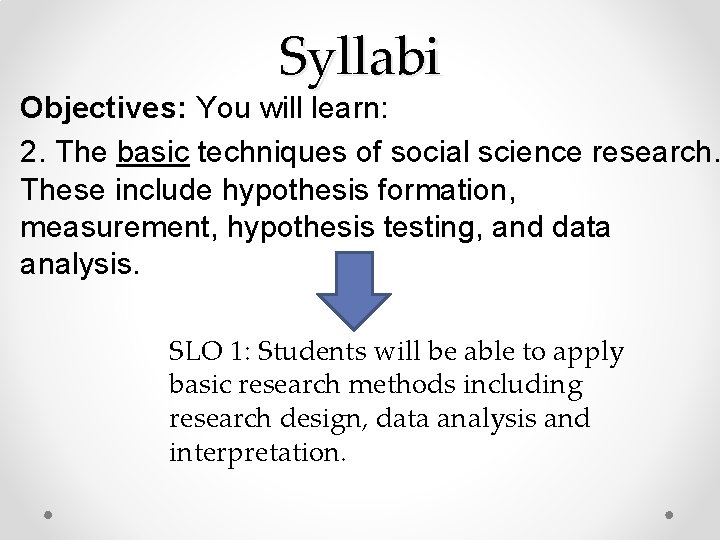
Syllabi Objectives: You will learn: 2. The basic techniques of social science research. These include hypothesis formation, measurement, hypothesis testing, and data analysis. SLO 1: Students will be able to apply basic research methods including research design, data analysis and interpretation.
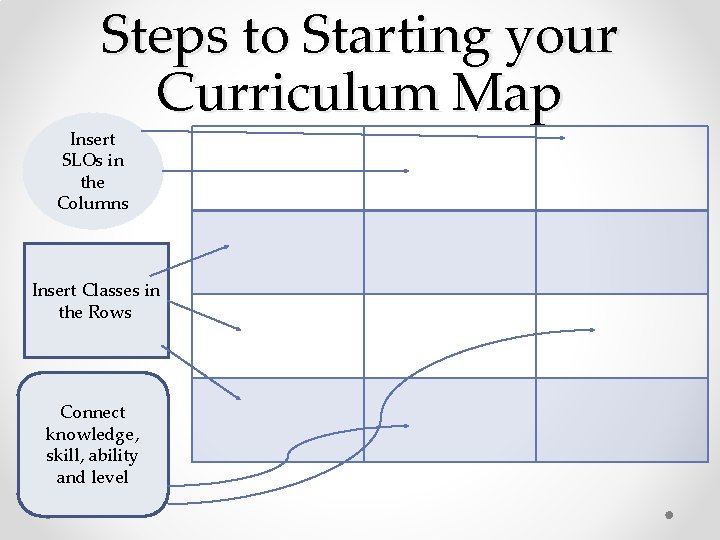
Steps to Starting your Curriculum Map Insert SLOs in the Columns Insert Classes in the Rows Connect knowledge, skill, ability and level
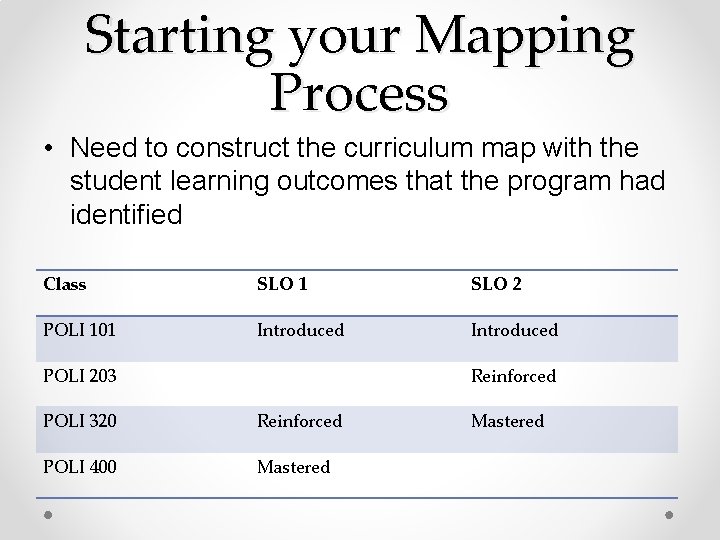
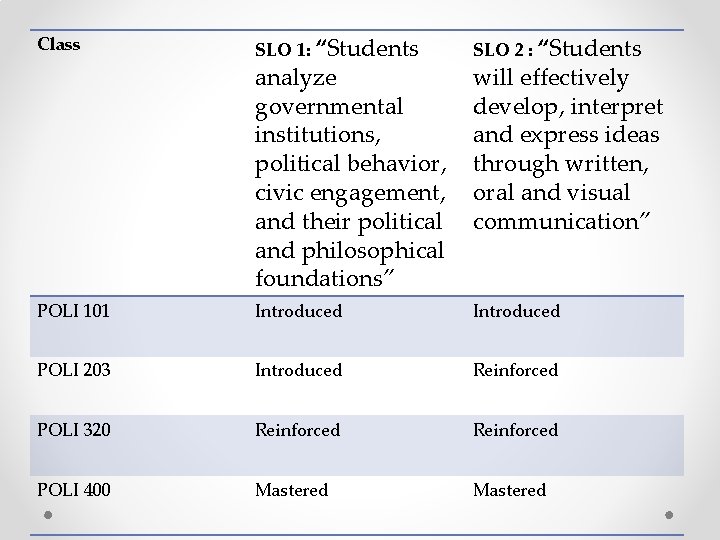
Starting your Mapping Process • Need to construct the curriculum map with the student learning outcomes that the program had identified Class SLO 1 SLO 2 POLI 101 Introduced POLI 203 Reinforced POLI 320 Reinforced POLI 400 Mastered
SLO 1: “Students SLO 2 : “Students POLI 101 Introduced POLI 203 Introduced Reinforced POLI 320 Reinforced POLI 400 Mastered Class analyze governmental institutions, political behavior, civic engagement, and their political and philosophical foundations” will effectively develop, interpret and express ideas through written, oral and visual communication”
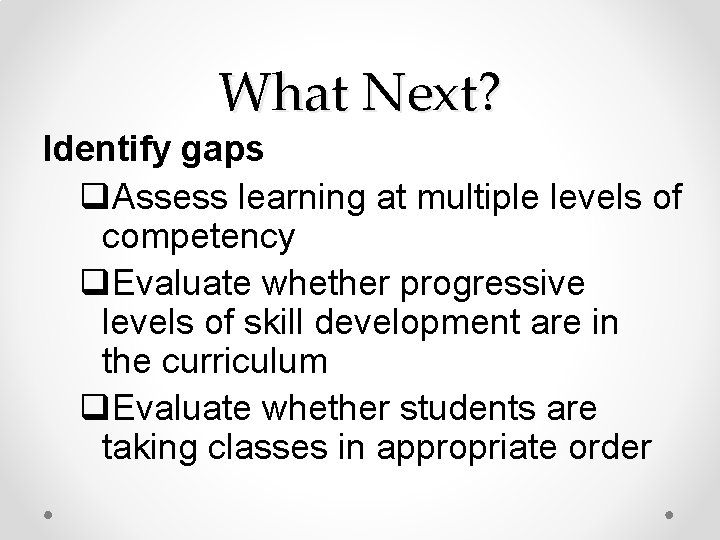
What Next? Identify gaps q. Assess learning at multiple levels of competency q. Evaluate whether progressive levels of skill development are in the curriculum q. Evaluate whether students are taking classes in appropriate order
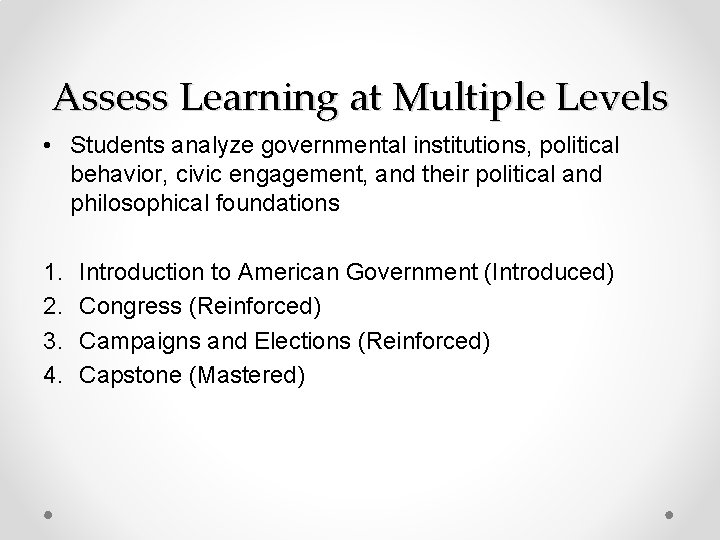
Assess Learning at Multiple Levels • Students analyze governmental institutions, political behavior, civic engagement, and their political and philosophical foundations 1. 2. 3. 4. Introduction to American Government (Introduced) Congress (Reinforced) Campaigns and Elections (Reinforced) Capstone (Mastered)
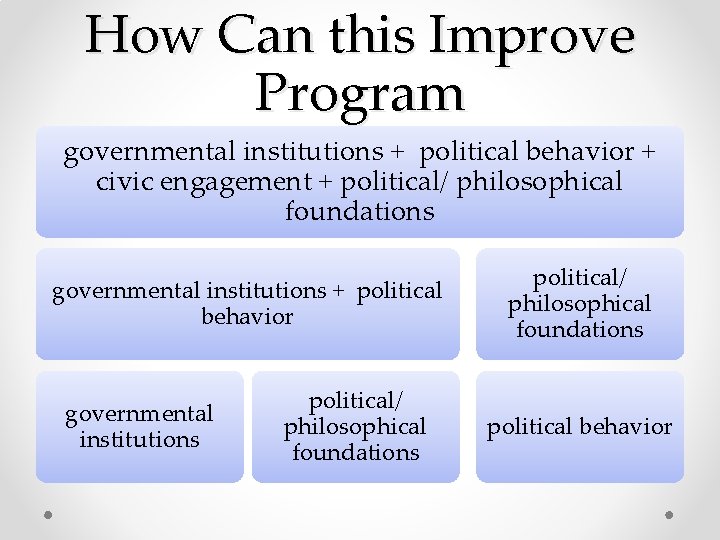
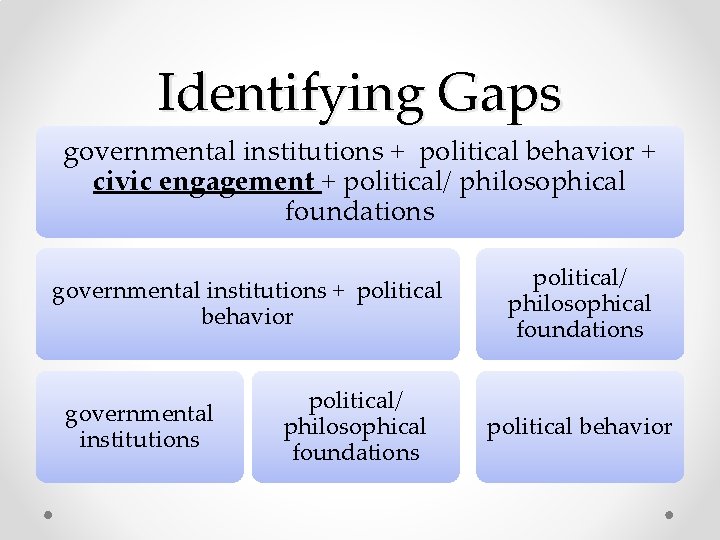
How Can this Improve Program governmental institutions + political behavior + civic engagement + political/ philosophical foundations governmental institutions + political behavior governmental institutions political/ philosophical foundations political behavior
Identifying Gaps governmental institutions + political behavior + civic engagement + political/ philosophical foundations governmental institutions + political behavior governmental institutions political/ philosophical foundations political behavior
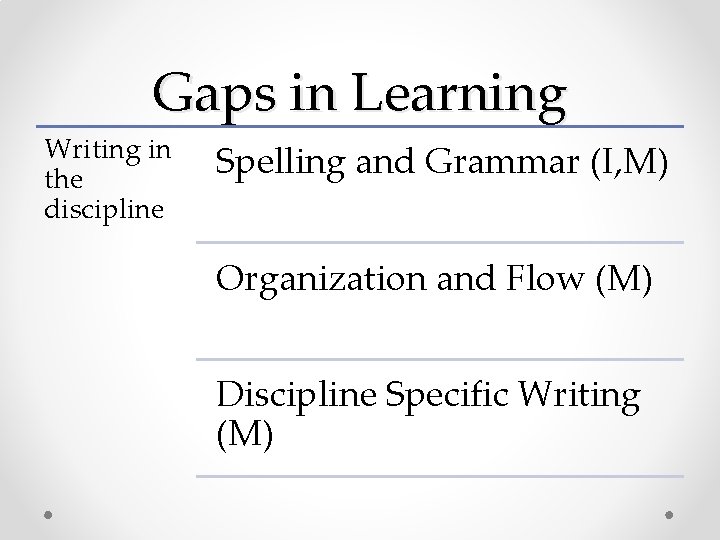
Gaps in Learning Writing in the discipline Spelling and Grammar (I, M) Organization and Flow (M) Discipline Specific Writing (M)
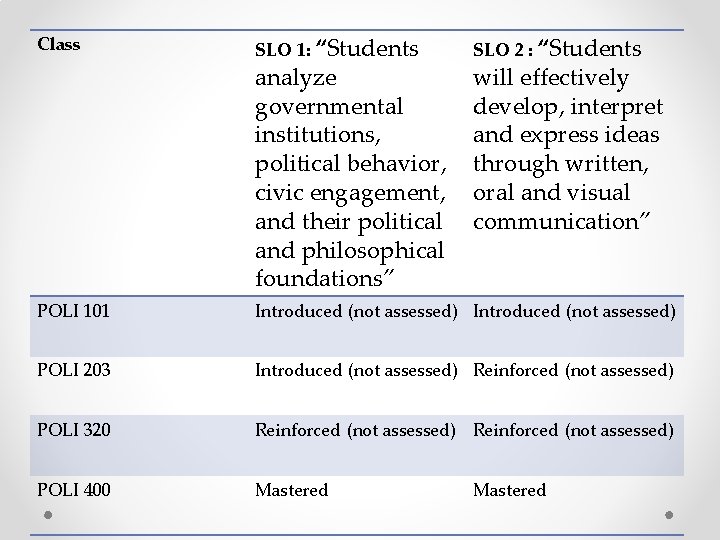
Class SLO 1: “Students analyze governmental institutions, political behavior, civic engagement, and their political and philosophical foundations” SLO 2 : “Students will effectively develop, interpret and express ideas through written, oral and visual communication” POLI 101 Introduced (not assessed) POLI 203 Introduced (not assessed) Reinforced (not assessed) POLI 320 Reinforced (not assessed) POLI 400 Mastered
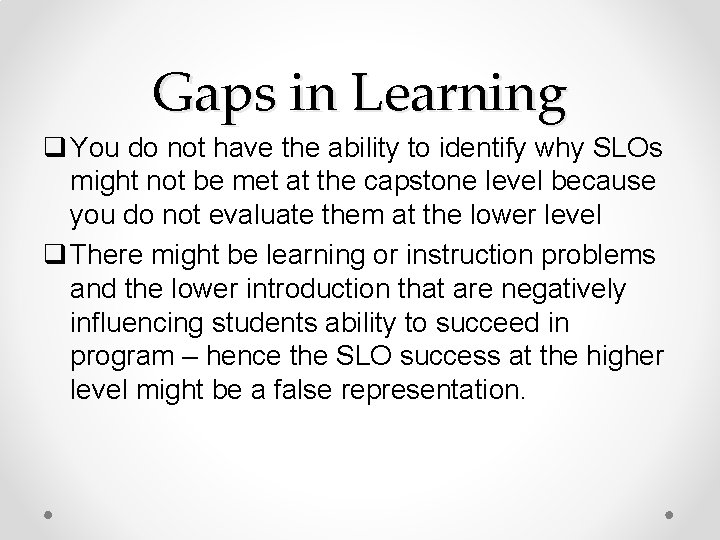
Gaps in Learning q You do not have the ability to identify why SLOs might not be met at the capstone level because you do not evaluate them at the lower level q There might be learning or instruction problems and the lower introduction that are negatively influencing students ability to succeed in program – hence the SLO success at the higher level might be a false representation.
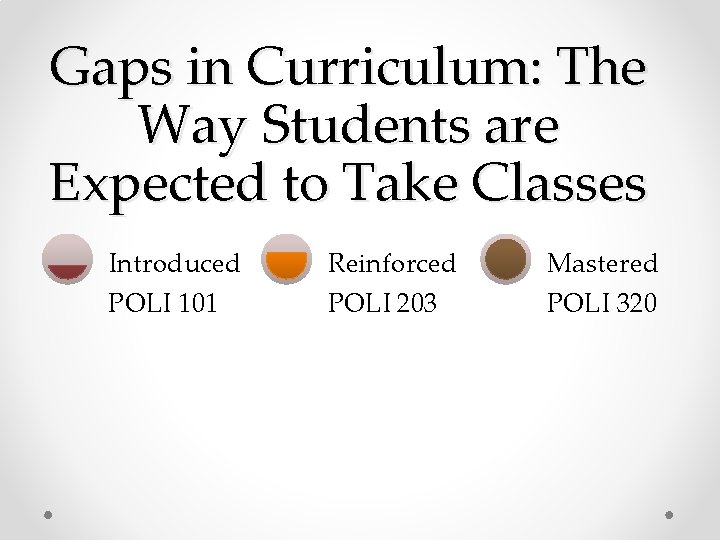
Gaps in Curriculum: The Way Students are Expected to Take Classes Introduced POLI 101 Reinforced POLI 203 Mastered POLI 320
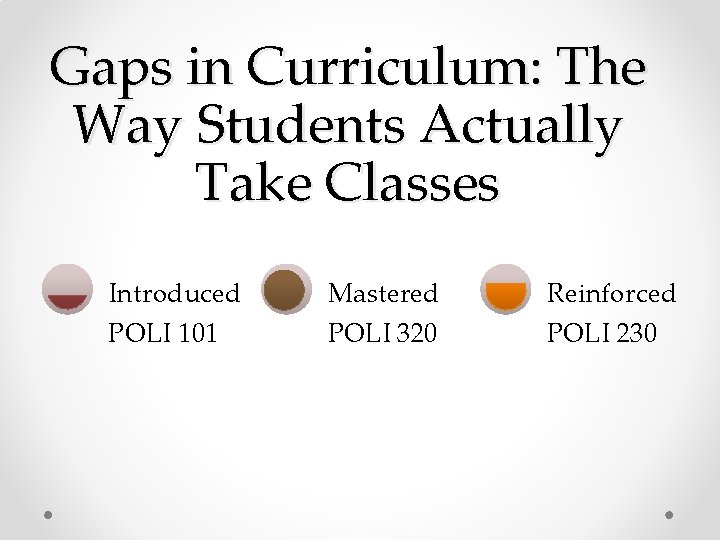
Gaps in Curriculum: The Way Students Actually Take Classes Introduced POLI 101 Mastered POLI 320 Reinforced POLI 230
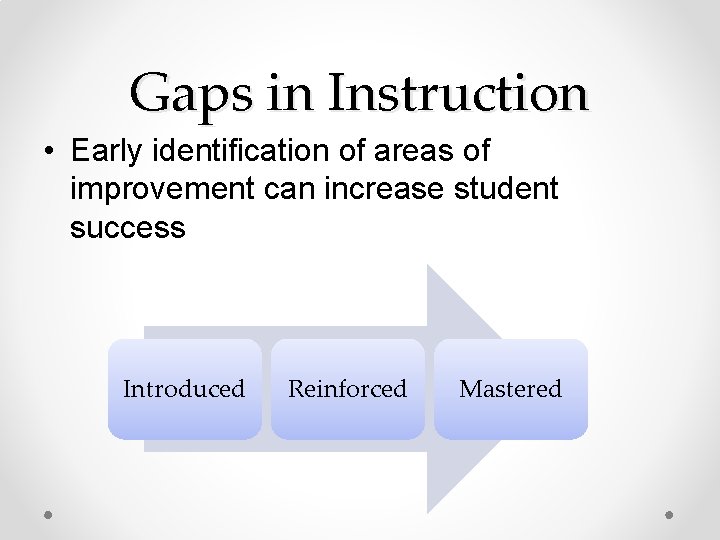
Gaps in Instruction • Early identification of areas of improvement can increase student success Introduced Reinforced Mastered
How to Start the Mapping Process 1. Identify Student Learning Outcomes 2. Identify where students should be learning this knowledge, skill, or ability 3. Identify at what level of competency is expected for each class 4. Consider how to assess this at each point in the process.
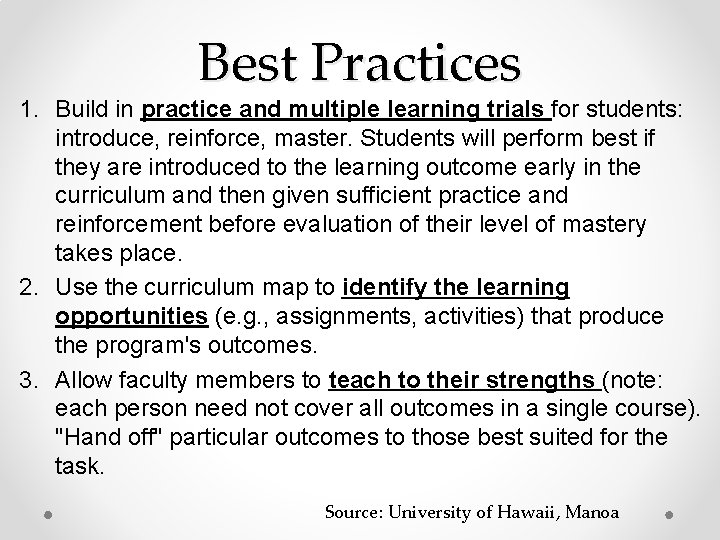
Best Practices 1. Build in practice and multiple learning trials for students: introduce, reinforce, master. Students will perform best if they are introduced to the learning outcome early in the curriculum and then given sufficient practice and reinforcement before evaluation of their level of mastery takes place. 2. Use the curriculum map to identify the learning opportunities (e. g. , assignments, activities) that produce the program's outcomes. 3. Allow faculty members to teach to their strengths (note: each person need not cover all outcomes in a single course). "Hand off" particular outcomes to those best suited for the task. Source: University of Hawaii, Manoa
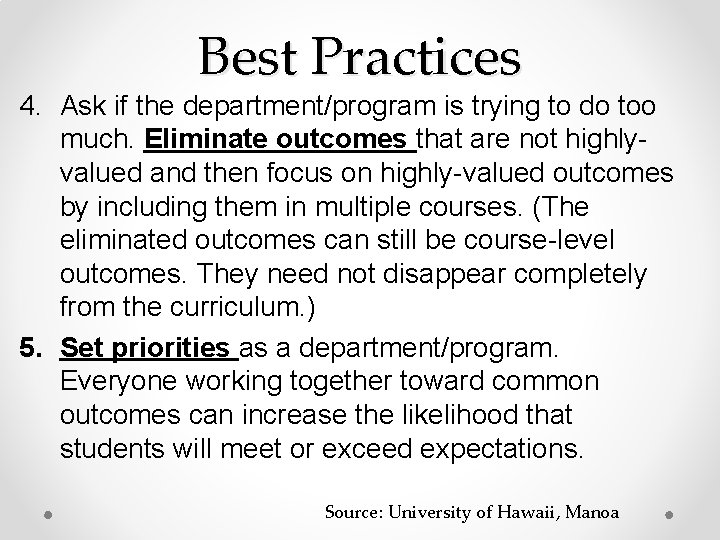
Best Practices 4. Ask if the department/program is trying to do too much. Eliminate outcomes that are not highlyvalued and then focus on highly-valued outcomes by including them in multiple courses. (The eliminated outcomes can still be course-level outcomes. They need not disappear completely from the curriculum. ) 5. Set priorities as a department/program. Everyone working together toward common outcomes can increase the likelihood that students will meet or exceed expectations. Source: University of Hawaii, Manoa
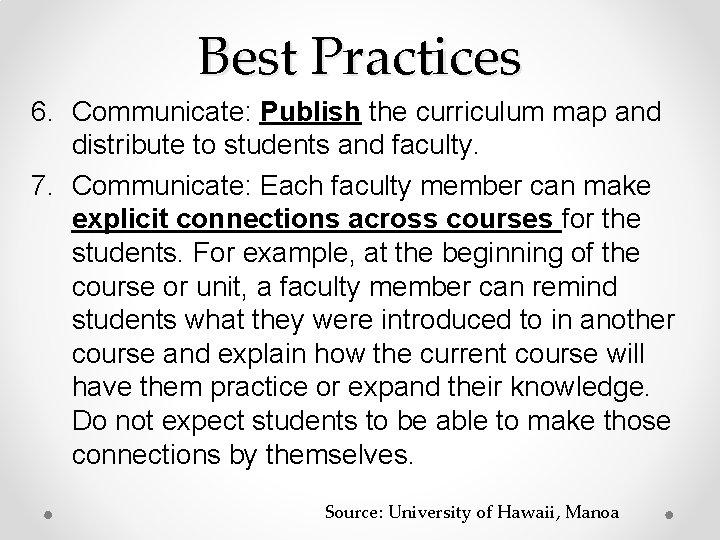
Best Practices 6. Communicate: Publish the curriculum map and distribute to students and faculty. 7. Communicate: Each faculty member can make explicit connections across courses for the students. For example, at the beginning of the course or unit, a faculty member can remind students what they were introduced to in another course and explain how the current course will have them practice or expand their knowledge. Do not expect students to be able to make those connections by themselves. Source: University of Hawaii, Manoa
Additional Resources • https: //manoa. hawaii. edu/assessment/howto/mapping. ht m (University of Hawaii, Manoa) • https: //manoa. hawaii. edu/assessment/workshops/pdf/SL Os_curriculummaps 2008 -10. pdf (University of Hawaii, Manoa) • http: //www. nyu. edu/academics/academicresources/academic-assessment/guidance-for-academic -programs/student-learning-outcomes/Curriculum. Mapping. html (New York University)
Curriculum Map for Your Program?