
making a success of agile working 1 what


- Slides: 50
making a success of agile working 1
what is agile working? 2
Agile working means empowering employees to work where, how and when they choose, to maximise their productivity and deliver the greatest value to the business 3
successful agile working: • Encourages a culture in which employees are appraised on their output / results, rather than ‘face time’ or perceived effort 4
successful agile working: • Empowers employees to define their own optimal work styles 5
successful agile working: • Balances the desires / needs of employees with those of the business 6
successful agile working: • Enables both remote working and dynamic working on site 7
successful agile working: • Requires 100% trust to be conferred on employees from the outset 8
successful agile working: • Relies on a solid foundation of reciprocity between team members and their managers 9
successful agile working: • Can facilitate a reduction in Real Estate space and costs • Although productivity should be the driving factor 10
the benefits 11
If agile working is successfully implemented, there is a wide array of potential benefits for individuals and the business … 12
benefits for employees… • Maximised productivity, creativity and job satisfaction • A high level of personal control in delivering work • A better work / life balance • Reduced stress and less time wasted 13
benefits for the business… • Greater employee productivity • Attraction and retention of the best talent • Potential to reduce real estate costs • Potential to reduce CO 2 output from commuter travel • A leaner, more responsive, more efficient organisation 14
there is a growing trend for agile working… 15
…yet the speed of successful adoption can be slow This is often due to… 16
1. complexity • Companies become mired in the complexity of finding the right operational solutions • This can lead to a stalemate that lasts (in some cases) for years 17
2. scale • The scale of strategic and behavioural changes necessary to deliver agile working successfully can seem overwhelming 18
3. focus • Many organisations focus too heavily on the potential cost reduction benefits of agile working • This forsakes opportunities for developing value via increased employee productivity and loyalty 19
The Workplace Intelligence Unit Agile Working Toolkit seeks to overcome these challenges by… 20
1. Equipping the business with valuable information on employee workstyles… • So the best solutions can be sought 21
2. Focussing on the value-added side of the case for agile working… • Enabling change champions to transform the ‘CEO conversation’ by tangibly demonstrating the gains of agile working 22
3. Reassuring the leadership that agile working can improve social capital (i. e. the strength of relationships in the corporate community) 23
there are 2 tools in the toolkit 1. The Agile Working Profile Tool 2. The Agile Working Impact Survey 24
1. getting it right The Agile Working Profile Tool • A self-assessment employee survey to diagnose individual requirements for optimal productivity in an agile working environment • Provides detailed diagnostics to guide essential manager / employee ‘agreements’ for agile working • Segments groups of employees by ‘type’ to guide best-fit space design and training solutions 25
agile working and productivity • Workplace Intelligence Unit research has shown that there are 10 key drivers of productivity… 26
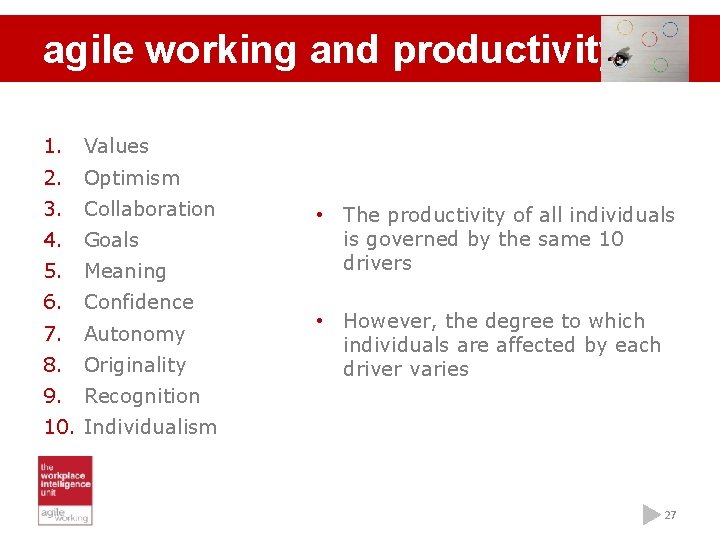
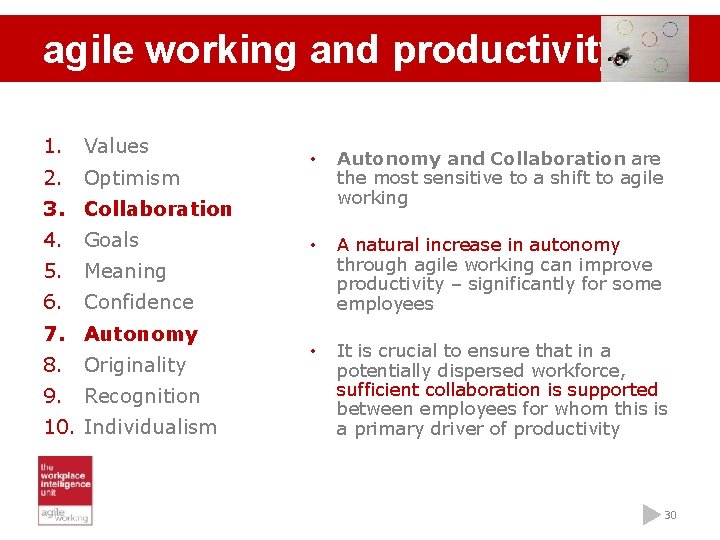
agile working and productivity 1. Values 2. Optimism 3. Collaboration 4. Goals 5. Meaning 6. Confidence 7. Autonomy 8. Originality • The productivity of all individuals is governed by the same 10 drivers • However, the degree to which individuals are affected by each driver varies 9. Recognition 10. Individualism 27
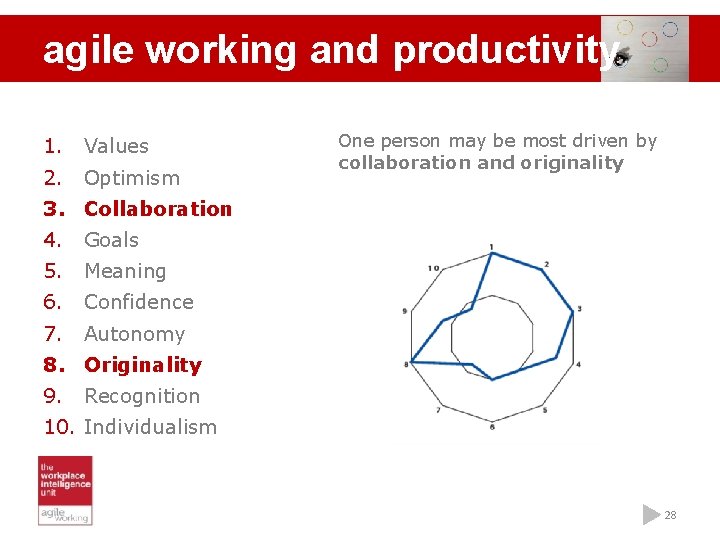
agile working and productivity 1. Values 2. Optimism One person may be most driven by collaboration and originality 3. Collaboration 4. Goals 5. Meaning 6. Confidence 7. Autonomy 8. Originality 9. Recognition 10. Individualism 28
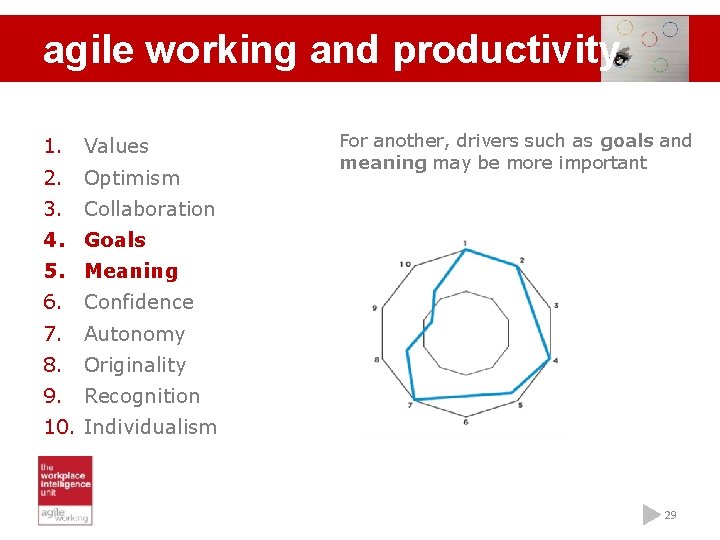
agile working and productivity 1. Values 2. Optimism For another, drivers such as goals and meaning may be more important 3. Collaboration 4. Goals 5. Meaning 6. Confidence 7. Autonomy 8. Originality 9. Recognition 10. Individualism 29
agile working and productivity 1. Values 2. Optimism • Autonomy and Collaboration are the most sensitive to a shift to agile working • A natural increase in autonomy through agile working can improve productivity – significantly for some employees • It is crucial to ensure that in a potentially dispersed workforce, sufficient collaboration is supported between employees for whom this is a primary driver of productivity 3. Collaboration 4. Goals 5. Meaning 6. Confidence 7. Autonomy 8. Originality 9. Recognition 10. Individualism 30
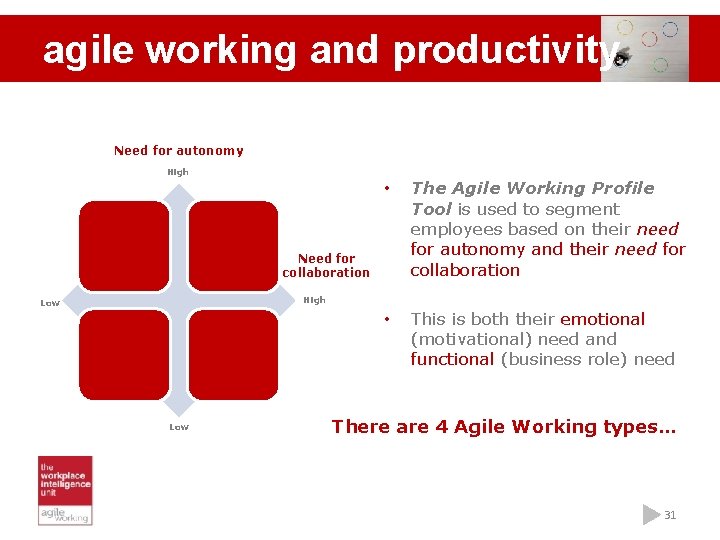
agile working and productivity Need for autonomy High • The Agile Working Profile Tool is used to segment employees based on their need for autonomy and their need for collaboration • This is both their emotional (motivational) need and functional (business role) need Need for collaboration High Low There are 4 Agile Working types… 31
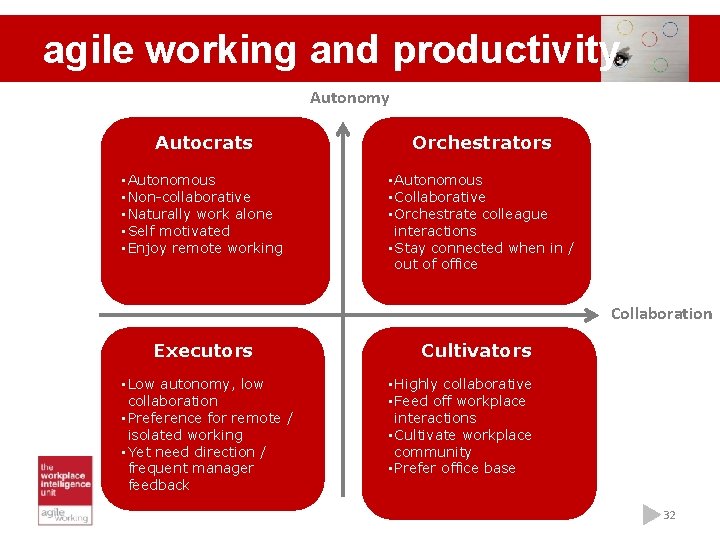
agile working and productivity Autonomy Autocrats Orchestrators • Autonomous • Non-collaborative • Naturally work alone • Self motivated • Enjoy remote working • Autonomous • Collaborative • Orchestrate colleague interactions • Stay connected when in / out of office Collaboration Executors • Low autonomy, low collaboration • Preference for remote / isolated working • Yet need direction / frequent manager feedback Cultivators • Highly collaborative • Feed off workplace interactions • Cultivate workplace community • Prefer office base 32
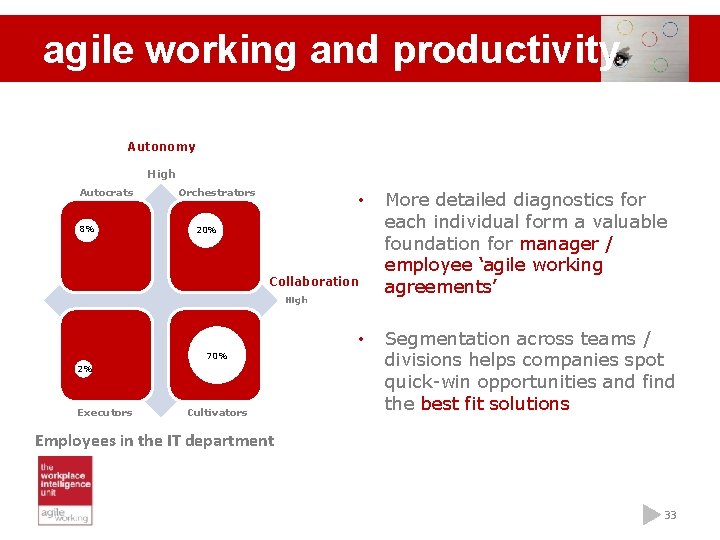
agile working and productivity Autonomy High Autocrats 8% Orchestrators • 20% Collaboration High • 70% 2% Executors Cultivators More detailed diagnostics for each individual form a valuable foundation for manager / employee ‘agile working agreements’ Segmentation across teams / divisions helps companies spot quick-win opportunities and find the best fit solutions Employees in the IT department 33
2. proving it works The Agile Working Impact Survey • A single integrated, electronically deployed employee survey • Conducted pre- and post- move to agile working 34
2. proving it works The Agile Working Impact Survey 1. Proves the increase in employee productivity as a result of agile working 2. Tracks change in strength and dynamics of social capital (community) 3. Measures the shift in employee satisfaction with the working environment 35
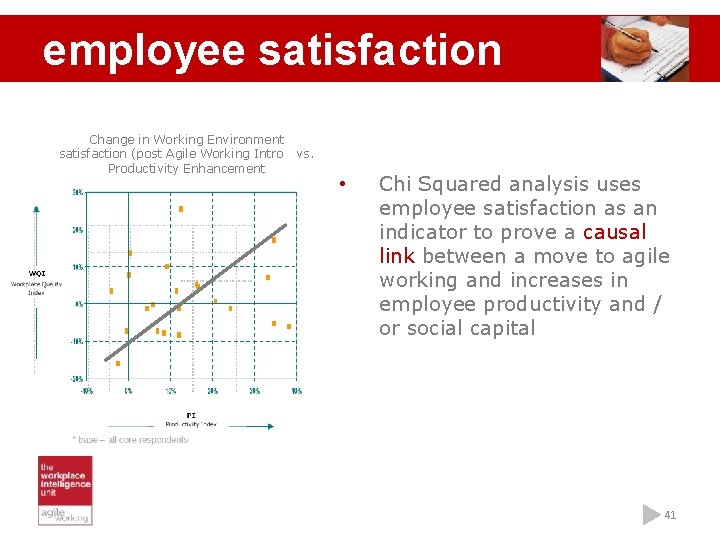
measuring productivity The tool scores productivity in a way that is: • Objective – psychometric questions subtly probe the Objective underlying drivers of productivity. Employees are unaware they are asked to evaluate their productivity • Focussed – other factors affecting productivity, e. g. Focussed pay increases, are ‘stripped out’ using a control group • Transparent – proving a causal link between change in productivity and change in employee satisfaction using Chi Squared analysis 36
social capital • Refers to the strength of workplace community • If strong, it can bring benefits such as: • – Higher retention rates – Lower transaction times – Greater business responsiveness – Greater knowledge sharing and innovation In an agile working environment, it becomes more critical for social capital to be carefully measured and managed 37
social capital The WIU Impact Survey results in 3 social capital scores: • • Overall social capital – the total strength of social capital in teams / departments • Bridging social capital – a score for the strength of relationships between different teams • Bonding social capital – scoring the strength of relationships between members of the same team 38
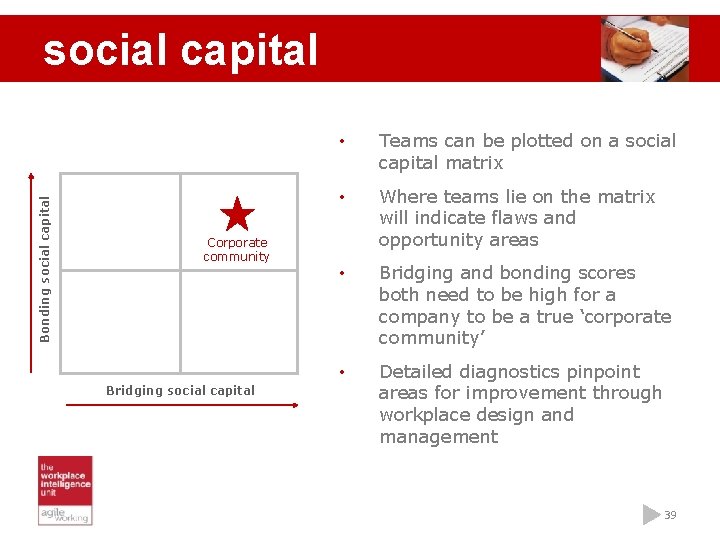
Bonding social capital Corporate community Bridging social capital • Teams can be plotted on a social capital matrix • Where teams lie on the matrix will indicate flaws and opportunity areas • Bridging and bonding scores both need to be high for a company to be a true ‘corporate community’ • Detailed diagnostics pinpoint areas for improvement through workplace design and management 39
employee satisfaction A simple set of workplace satisfaction questions measures employee satisfaction with: • • • the physical workplace design • the cultural environment Which together constitute the employee experience of an agile working model 40
employee satisfaction Change in Working Environment satisfaction (post Agile Working Intro Productivity Enhancement vs. • Chi Squared analysis uses employee satisfaction as an indicator to prove a causal link between a move to agile working and increases in employee productivity and / or social capital 41
in summary… 42
the WIU agile working toolkit helps HR… • Pre-empt the challenges of cultural change and prepare management for a shift in style and skills • Monitor and manage the impact of agile working on employee performance and social capital • Foster greater employee satisfaction and reduce voluntary turnover 43
the WIU agile working toolkit helps Facilities Management and Real Estate… • Identify ‘quick win’ opportunities for successful pilots and space reduction • Achieve clarity on the scale of the physical change necessary for successful agile working • Identify the most appropriate ‘best fit’ solutions 44
the WIU agile working toolkit helps Managers… • Understand the challenges of managing a potentially dispersed team • Identify the most critical issues on which to spend time and energy • Manage the shift to agile working without losing business performance across teams 45
the WIU agile working toolkit helps Employees… • Have input into the working model • Take ownership of their workstyles and daily routine • Foster working relationships based on trust and satisfaction 46
the WIU agile working toolkit helps ‘The business’…. • Grow the value of intangible assets (people, relationships and culture), which drive revenue generation • Monitor the performance of an agile working model and make incremental improvements • Test the effectiveness of pilot studies and identify prime opportunities for rollout 47
to find out more… 48
Please contact: Ami Brabbins ami. b@forwardthinkinginc. com +44 (0)20 8939 2330 Or your Herman Miller representative 49
making a success of agile working 50