
Making a difference together Understanding loss and bereavement
Making a difference together: Understanding loss and bereavement Sue Read, Professor of Learning Disability Nursing, School of Nursing and Midwifery, Keele University s. c. read@keele. ac. uk
Importance of loss “I thought that it sometimes seems as if all our lives we are trying to cope with loss – either the fear of it, or the memory of it or its raw immediate presence. ” (Oswin, 1991: 15)
Importance of loss ‘If we understand the different ways people react to loss, we understand something about what it means to be human… …something about the way we experience life and death, love and meaning, sadness and joy. ’ (Bonannno, 2009: 3)
Why hearing the words is difficult • Cultural and societal taboos generally • Emotional needs often remain neglected (Arthur, 2003) • Perceptions of ability to grieve (Mc. Loughlin, 1986; Elliot, 1995; Read, 1996) • Cultural and societal taboos specifically: death and disability (Oswin, 1991) • Carers feelings of fear, inadequacy and uncertainty (Emerson, 1976; Thurm, 1989; Oswin, 1991) • Over protectiveness (Deutsch, 1985)

Why hearing the words is difficult “…failure to recognise the impact of loss on people with learning disabilities arises from our need to see such people as lacking in effective emotional apparatus…. . this conveniently feeds our own need to avoid discussion of pain and grief and so the cycle of ignorance and inaction has been perpetuated” (Conboy-Hill, 1992: 151)

Listening to the voices of others • People with learning disabilities do experience grief (Oswin, 1990; 2000; Hollins & Esterhyuzen, 1997) • Impact of grief is varied and often complex (Conboy-Hill, 1992; Hollins & Esterhyzen, 1997; Sheldon, 1998; Mac. Hale & Carey, 2002)
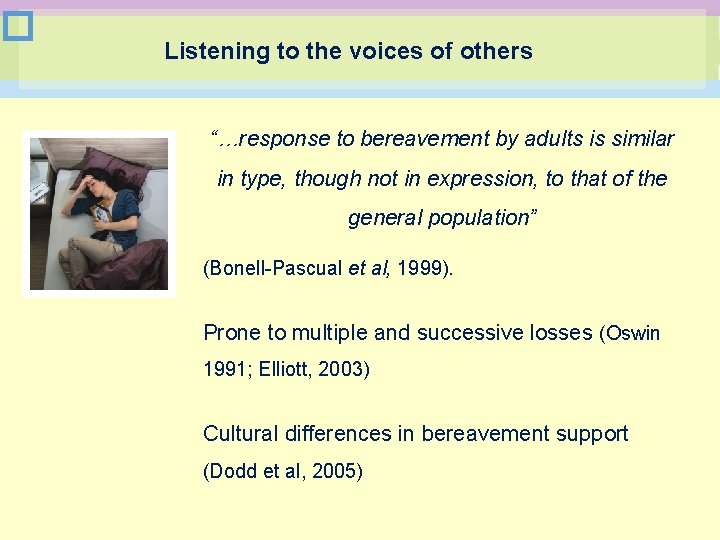
� Listening to the voices of others “…response to bereavement by adults is similar in type, though not in expression, to that of the general population” (Bonell-Pascual et al, 1999). Prone to multiple and successive losses (Oswin 1991; Elliott, 2003) Cultural differences in bereavement support (Dodd et al, 2005)
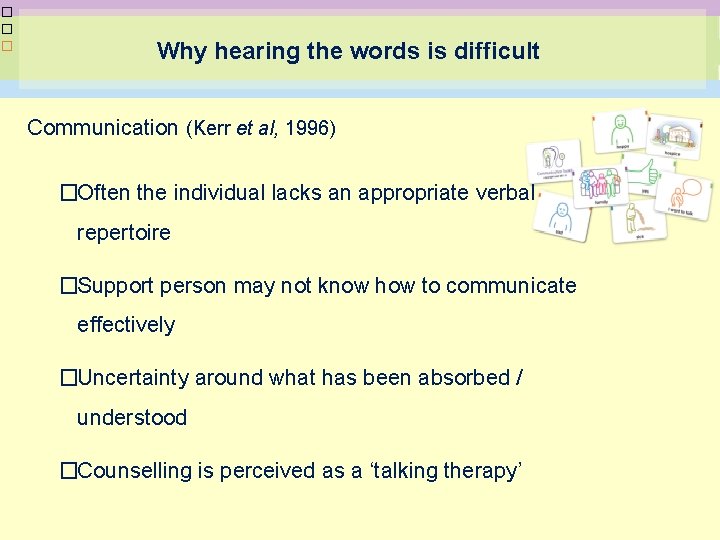
� � � Why hearing the words is difficult Communication (Kerr et al, 1996) �Often the individual lacks an appropriate verbal repertoire �Support person may not know how to communicate effectively �Uncertainty around what has been absorbed / understood �Counselling is perceived as a ‘talking therapy’
� � Why hearing the words is difficult �Combination of cognitive ability, attention span and limited emotional vocabulary (Conboy-Hill, 1982) �Low expectations, stereotyping and stigma (Kitching, 1987) �Limited experience of grief and grief rituals (Cathcart, 1985)

Disenfranchised grief (Doka 1989; 2002) “. . . the grief that persons experience when they incur a loss that cannot be openly acknowledged, publicly mourned, or socially supported. . . ” • The relationship is not recognised • The loss is not recognised • The griever not recognised (1989) • The ways that individuals grieve • The circumstances surrounding the death (2002)

Responding to disenfranchised grief (Doka, 2002) • Acknowledging the loss and legitimise the emotional pain • Active listening • Empathy (making sense of life experiences by interacting with others, sharing and supporting) • Meaning making (finding benefits)
Responding to disenfranchised grief (Doka, 2002) Constructive use of ritual (powerful therapeutic tool): �Funerals �Rituals of continuity (lighting candles on certain days) �Rituals of transition (mark the change or transition stage) �Rituals of reconciliation (allow person to offer or accept forgiveness or to complete some degree of unfinished business) �Rituals of affirmation (allow individuals to affirm the loss and recognise any good things that have come out of the loss experience).

Rituals and endings ‘Saying goodbye is never easy, but you have to say goodbye before you can move on. It has not been easy saying goodbye, but it felt important to do this for Joshua and myself. ’

How we can help Helping people to understand about loss using proactive and reactive education: – Group work (Read et al 2000; Read & Papakosta. Harvey, 2004) – Openly sharing feelings and responses to loss – Retaining tangible memorise (life story work) – Telling and sharing stories (Jennings, 2005)
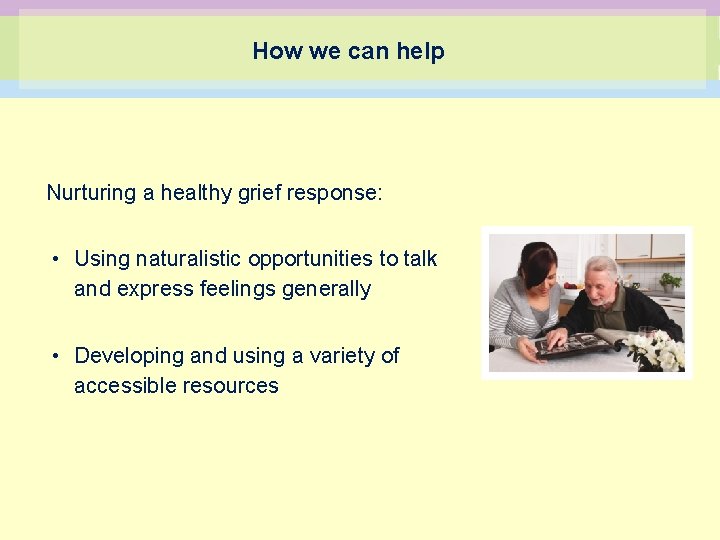
How we can help Nurturing a healthy grief response: • Using naturalistic opportunities to talk and express feelings generally • Developing and using a variety of accessible resources
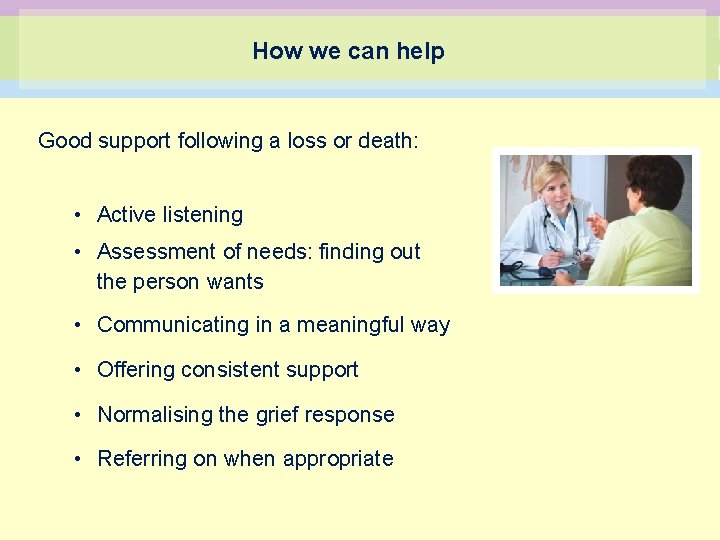
How we can help Good support following a loss or death: • Active listening • Assessment of needs: finding out the person wants • Communicating in a meaningful way • Offering consistent support • Normalising the grief response • Referring on when appropriate what
Access to counselling “Access to ordinary counselling services would be ideal, but as yet, the practitioners within these services are not geared to our clients’ needs and the services themselves are not free”. (Conboy –Hill, 1992: 168)
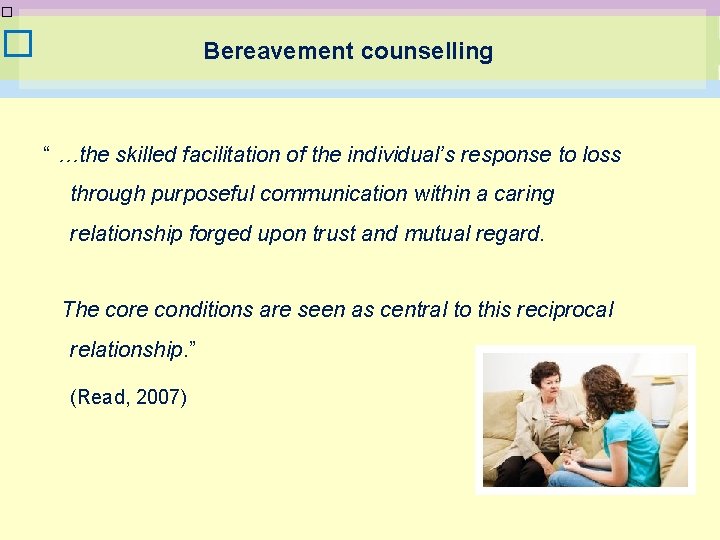
� � Bereavement counselling “ …the skilled facilitation of the individual’s response to loss through purposeful communication within a caring relationship forged upon trust and mutual regard. The core conditions are seen as central to this reciprocal relationship. ” (Read, 2007)
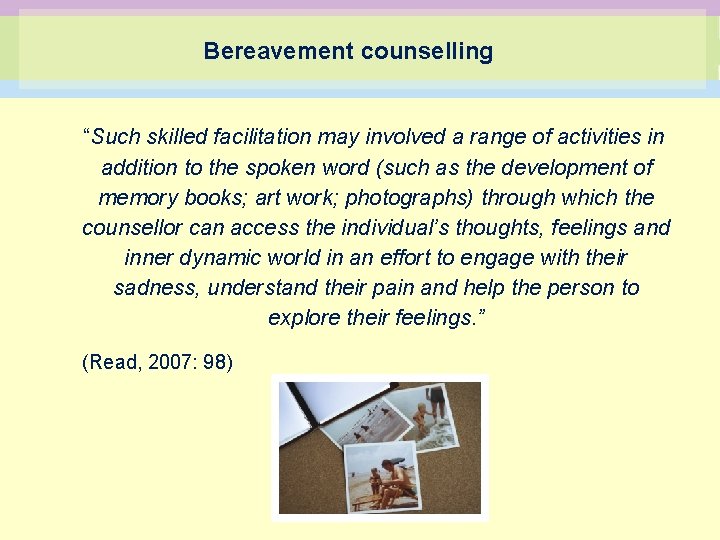
Bereavement counselling “Such skilled facilitation may involved a range of activities in addition to the spoken word (such as the development of memory books; art work; photographs) through which the counsellor can access the individual’s thoughts, feelings and inner dynamic world in an effort to engage with their sadness, understand their pain and help the person to explore their feelings. ” (Read, 2007: 98)
References Arthur, A. R. (2003) ‘The emotional lives of people with learning disability. ’ British Journal of Learning Disabilities 31, 25– 30. Cathcart, F. (1995). Death and people with learning disabilities: Interventions to support clients and carers. British Journal of clinical Psychology, 34, 165175. Conboy-Hill, S. (1992). Grief, loss and people with learning disabilities. In A. Waitman, & S. Conboy-Hill, (Edits. ) (1992) Psychotherapy and mental handicap. (pp. 150 -170) London: Sage Publ. Deutsch, H. (1985) ‘Grief counselling with the mentally retarded clients. ’ Psychiatric Aspects of Mental Retardation Reviews 4, 17 -20. Dodd P. , Mc. Evoy J. , Guerin S. , Mc. Govern E. , Smith E. and Hillary J. (2005) ‘Attitudes to bereavement and intellectual disabilities in an Irish context. ’ Journal of Applied Research in Intellectual Disabilities 18, 237 -243. Doka, K. J. , (1989). Disenfranchised grief: Recognising hidden sorrow. Toronto, Canada: Lexington Books.
References Doka, K. J. (Edit. ) (2002). Disenfranchised grief: New directions, challenges and strategies for practice. Illinois: Research Press. Emerson, P, (1977) ‘Covert grief reactions in mentally retarded clients. ’ Mental Retardation 15, 6, 46 -47. Elliott, D. (1995). Helping people with learning disabilities to handle grief. Nursing Times, 91(43), 27 -29. Elliott, D. (2003). Loss and bereavement. In: M. Jukes & M. Bollard (edits. ) (2003). Contemporary learning disability practice. Wiltshire: Quay Books. Hollins, S. , & Esterhuyzen, A. (1997) Bereavement and grief in adults with learning disabilities. British Journal of Psychiatry, 170, 497 -501. Jennings, S. (2005). Creative storytelling with adults at risk. Bicester, Oxon: Speechmark.
References Kerr, M. , Fraser, W. and Felce, D. (1996) ‘Primary healthcare for people with a learning disability. ’ British Journal of Learning Disabilities 24, 1, 2 -8. Kitching, N. (1987). Helping people with mental handicaps cope with bereavement: A case study with discussion. Mental Handicap, 15, 61 -63. Mac. Hale, R. , & Carey, S. (2002). An investigation into the effects of bereavement on mental health and challenging behaviour in adults with learning disability. British Journal of Learning Disabilities, 30, 113 -117. Mc. Loughlin, J. (1986) ‘Bereavement in the mentally handicapped. ’ British Journal of Hospital Medicine 36, 4, 256 -60. Oswin, M. (1991). Am I allowed to cry? London: Souvenir Press. Read, S. , Papakosta-Harvey, V. & Bower, S. (2001). Using workshops on loss for adults with learning disabilities. Groupwork, 12 (2), 6 -26.
References Read, S. Papakosta-Harvey, V. (2004). Using workshops on loss for adults with learning disabilities: A second study. Journal of Learning Disabilities, 8(2), 191 -208. Read, S. (2007). Bereavement counselling and support: A manual to develop practice. London: Quay Books. Sheldon, F. (1998). ABC of palliative care: Bereavement. British Medical Journal, 316, 456 -458. Thurm, A. (1989). I’ve lost a good friend. Nursing Times, 85 (32), 66 -68.
- Slides: 23