
Making a Difference Safeguarding Adult Reviews in the

- Slides: 21
Making a Difference? Safeguarding Adult Reviews in the South West challenges and emergent themes Kate Spreadbury
Impact of legislation on numbers of SARs commissioned A Safeguarding Adults Board MUST conduct any safeguarding adults review in accordance with Section 44 of the Act, i. e. when an adult in its area dies as a result of abuse or neglect…AND there is concern that partner agencies could have worked more effectively to protect the adult. SABs must also arrange a SAR if an adult in its area has not died but the SAB knows or suspects that the adult has experienced serious abuse or neglect. SARs may also be used to explore examples of good practice where this is likely to identify lessons that can be applied to future cases. The SAB should be primarily concerned with weighing up what type of ‘review’ process will promote effective learning and improvement action to prevent future deaths or serious harm occurring again.
Numbers of SARs commissioned by SABs in England 2013 - 2017 2013 – 2014: 56 Serious Case Reviews (SCRs) 2014 – 2015: 65 Serious Case Reviews (SCRs) 2015 – 2016: 90 SCRs/Safeguarding Adults Reviews (SARs) 2016 – 2017: 110 SARs 2017 – 2018 - ? Source: NHS Digital In the South West there are currently 30 SARs in progress with 4 about to be initiated (January 2018)
Reported challenges in commissioning SARs in the South West SABs are unsure of how to commission, manage and learn from SARs, misunderstandings and errors may be amplified when undertaking multiple SARs. Quality Markers for SARs exist but are under development and not as yet widely used The cost of SARs, in all forms of resource. Small pool of lead reviewers, some inexperienced, little recognised training available. Keeping the SAR to the statutory timescale Some SABs are attempting to implement more than one post SAR action plan, and may have recommendations from LSCB SCRs and DHRs to implement too.
Review of SCRs/SARs in the South West: 2017 Commissioned research on 37 SCRs and SARs undertaken between January 2013 and 31 st July 2017. The original intention was to identify the common themes and learning in the South West, but in view of the challenges identified by SABs, the terms were extended to include reflections on the commissioning and management of SARs and the dissemination of learning derived from SAR activity. Michael Preston Shoot presented the findings and recommendations from the Review in November 2017.
Some conclusions from the south west SCR/SAR Review “Typically, the focus fell on all layers of the system, from individual interaction through to interagency governance, but less frequently beyond to the broader policy, legislative and economic contexts which directly affect SABs and their partner agencies, and impact profoundly on practice” The key challenge for SABs, in their mission to prevent future similar patterns from occurring, is certainly to be proactive in implementing recommendations relating to local policy, procedures and practices, but also then in auditing the impact of that implementation on practice and the management of practice. Another challenge for SABs is to involve regional and national policy makers in order to promote whole system contribution to service development. Michael Preston Shoot 2017
Learning from SARs – “we are not surprised…. ” The repetition of themes is discouraging and concerning. How do we break that cycle and make SARs more effectively “impactful”, recognising that SARs are not ends in themselves?
Somerset Safeguarding Adults Board: Impactful Learning “Our assertion is that innovation, change and adaptability are essential ingredients if we wish to secure different results …. from Safeguarding Adults Reviews” “Culture eats strategy for breakfast” From: “Impactful Reviews: Disseminating and embedding the learning” presented at the SW ADASS conference on 20 November 2017
Barriers to learning: Process and Publication The process of the SAR and The publication of the Report Can create barriers to learning and culture change
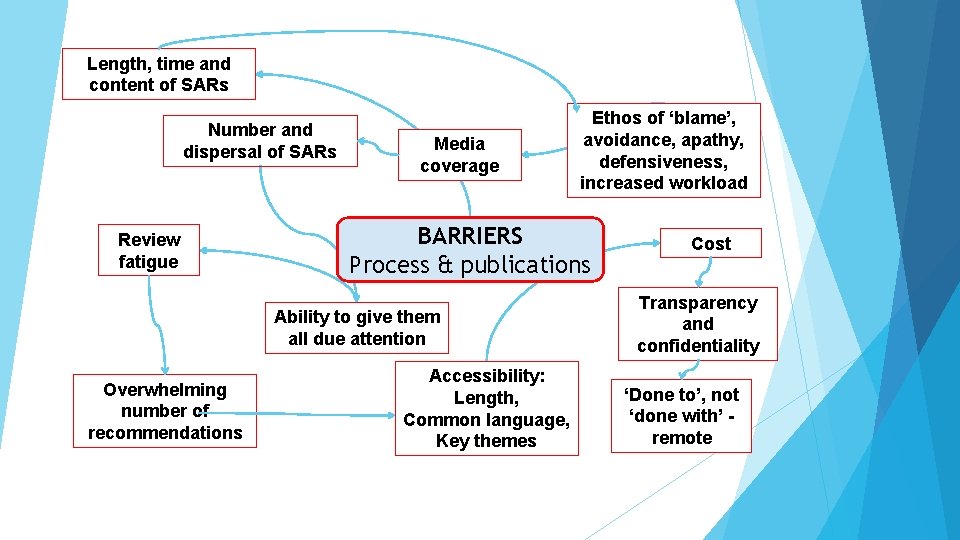
Length, time and content of SARs Number and dispersal of SARs Review fatigue Media coverage BARRIERS Process & publications Ability to give them all due attention Overwhelming number of recommendations Ethos of ‘blame’, avoidance, apathy, defensiveness, increased workload Accessibility: Length, Common language, Key themes Cost Transparency and confidentiality ‘Done to’, not ‘done with’ remote
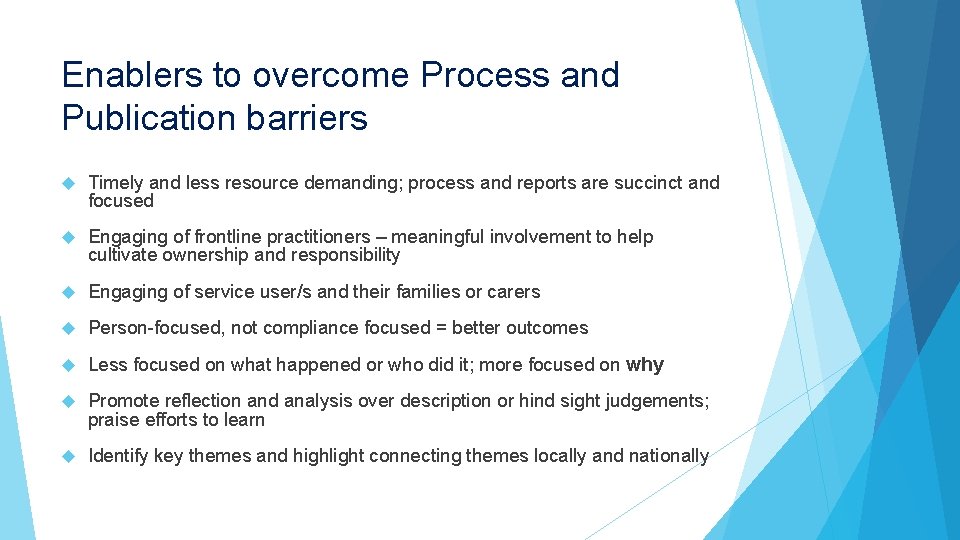
Enablers to overcome Process and Publication barriers Timely and less resource demanding; process and reports are succinct and focused Engaging of frontline practitioners – meaningful involvement to help cultivate ownership and responsibility Engaging of service user/s and their families or carers Person-focused, not compliance focused = better outcomes Less focused on what happened or who did it; more focused on why Promote reflection and analysis over description or hind sight judgements; praise efforts to learn Identify key themes and highlight connecting themes locally and nationally
Barriers to Learning: Learning Transfer and Changing Culture Learning is not merely the acquisition of knowledge, but encompasses a wide range of social and cultural activity
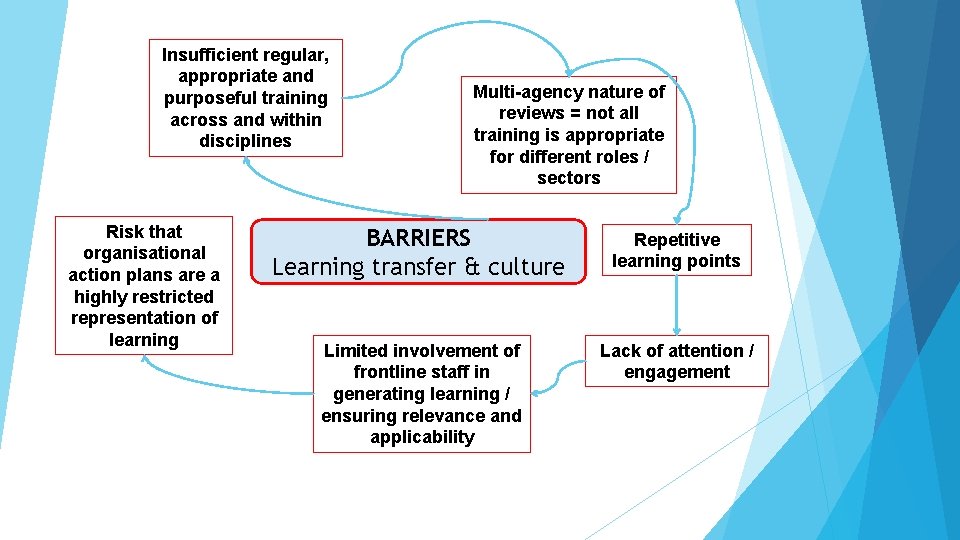
Insufficient regular, appropriate and purposeful training across and within disciplines Risk that organisational action plans are a highly restricted representation of learning Multi-agency nature of reviews = not all training is appropriate for different roles / sectors BARRIERS Learning transfer & culture Repetitive learning points Limited involvement of frontline staff in generating learning / ensuring relevance and applicability Lack of attention / engagement
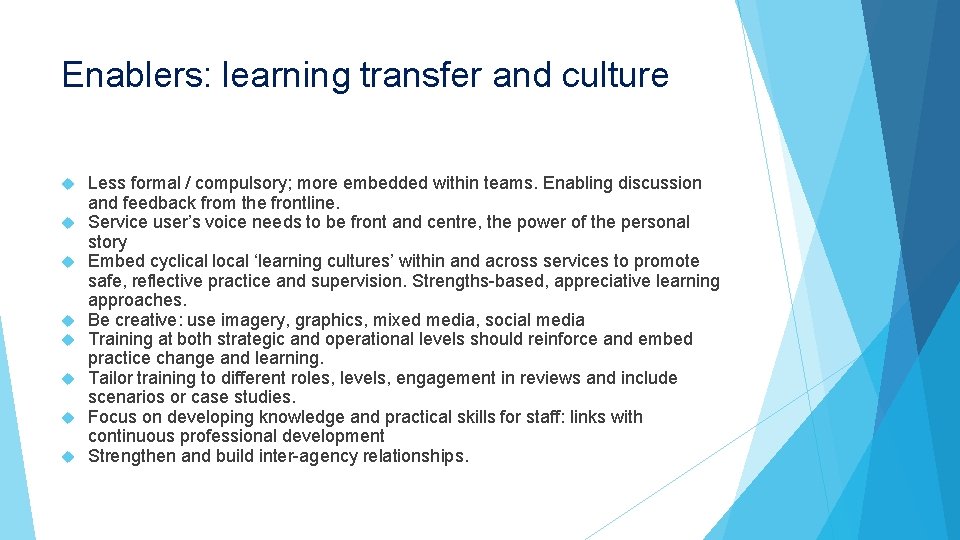
Enablers: learning transfer and culture Less formal / compulsory; more embedded within teams. Enabling discussion and feedback from the frontline. Service user’s voice needs to be front and centre, the power of the personal story Embed cyclical local ‘learning cultures’ within and across services to promote safe, reflective practice and supervision. Strengths-based, appreciative learning approaches. Be creative: use imagery, graphics, mixed media, social media Training at both strategic and operational levels should reinforce and embed practice change and learning. Tailor training to different roles, levels, engagement in reviews and include scenarios or case studies. Focus on developing knowledge and practical skills for staff: links with continuous professional development Strengthen and build inter-agency relationships.
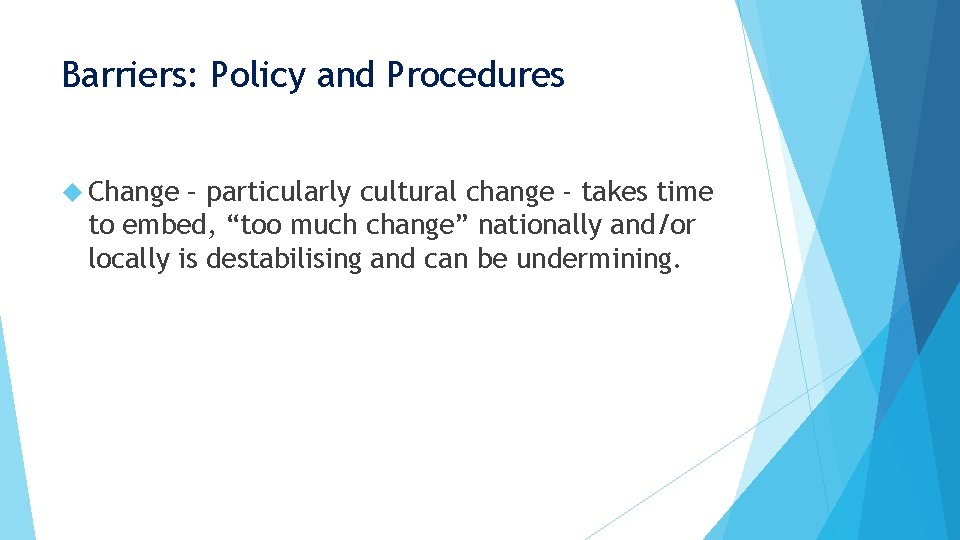
Barriers: Policy and Procedures Change – particularly cultural change - takes time to embed, “too much change” nationally and/or locally is destabilising and can be undermining.
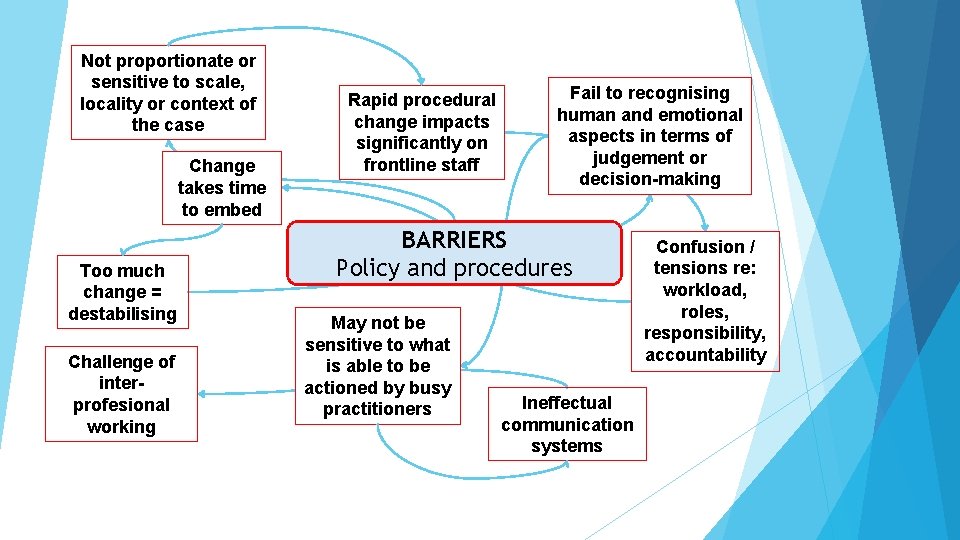
Not proportionate or sensitive to scale, locality or context of the case Change takes time to embed Too much change = destabilising Challenge of interprofesional working Rapid procedural change impacts significantly on frontline staff Fail to recognising human and emotional aspects in terms of judgement or decision-making BARRIERS Policy and procedures May not be sensitive to what is able to be actioned by busy practitioners Ineffectual communication systems Confusion / tensions re: workload, roles, responsibility, accountability
Enablers: Policy and procedures Involve front line staff in designing and testing new procedures Be cautious of over-proceduralisation; it can ‘squeeze out’ professional practice, judgement and accountability Maintain a focus on frontline managers and supervision – they are crucial in changing, supporting and quality assuring practice, as well as enhancing and sustaining practice Strategic leadership within and across organisations is critical in ensuring attention is given to learning and changes generated by Reviews Pay more attention to auditing the impact of changes and the process of embedding. Be mindful of the time it takes to embed change, how long does the focus on a cultural change need to be maintained?
Somerset Safeguarding Adults Board: What has worked well? The development and promotion of themed, succinct Practice Briefing Sheets The involvement of family members in contributing to the content of these The hosting of themed, multi-agency learning events The dissemination and promotion of learning beyond Somerset The development of multi-agency owned tools on the back of reviews
Somerset SAR Practice Briefing Notes http: //ssab. safeguardingsomerset. org. uk/wp-content/uploads/Damien-Practice. Briefing-Note-v 2. pdf http: //ssab. safeguardingsomerset. org. uk/wp-content/uploads/2016/02/Ms-CPractice-Briefing-Note-FINAL. pdf
Sources Care and Support Statutory Guidance accessed February 2018 https: //www. gov. uk/government/publications/care-act-statutory-guidance/care-andsupport-statutory-guidance Pike, L et al 2010 “Bridging the gap between learning and practice: from where we were to where we are now” The Journal of Adult Protection Volume 12 Issue 2 Preston-Shoot, Michael 2017: “What difference does legislation make? Adult Safeguarding through the Lens of Serious Case Reviews and Safeguarding Adult Reviews. A Report for South West region Safeguarding Adults Boards” 2017 available on http: //admin. southwest-ra. gov. uk/nqcontent. cfm? a_id=12526 Somerset Safeguarding Adults Board; Niki Shaw 2017; “Impactful Reviews: Disseminating and embedding the learning” presented at the SW ADASS conference on 20 November 2017.
Contacts For further information you are welcome to contact: Kate Spreadbury: kspreadbury 1@hotmail. co. uk Somerset Safeguarding Adults Board: ssab@somerset. gov. uk