
MAKING A CONTRIBUTION TO THEORY Professor Trish Corner

MAKING A CONTRIBUTION TO THEORY Professor Trish Corner Auckland University of Technology (AUT) ANZAM Doctoral Workshop 5 December 2011
Where are You? How many using quantitative methods? How many using qualitative methods? How many using a pre-existing theory/ conceptual framework to guide thesis research? How many generated a “novel” conceptual framework to guide thesis research? ANZAM Doctoral Workshop 5 December 2011

Some tips Borrowed some from “resources for authors” on Academy of Management Journal website ANZAM Doctoral Workshop 5 December 2011
Choose an interesting topic • Examine relationships or phenomena where the end isn’t obvious or predictable ANZAM Doctoral Workshop 5 December 2011
Common Pitfalls • Paper summarizes findings, but not what we learn from them • Paper makes a narrow or incremental contribution • Paper makes an empirical contribution, but not a theoretical contribution (new knowledge gained) • Supports dominant theories • Replicates previous findings • Fails to surprise, challenge assumptions, or question intuitions ANZAM Doctoral Workshop 5 December 2011
Suggestion #1: Join Multiple Conversations What other theoretical perspectives have addressed your research question? How do your findings change, challenge, complicate, or advance these perspectives? How do your findings alter theoretical perspective on which you draw? ANZAM Doctoral Workshop 5 December 2011
Suggestion #2: Perspective-Taking • What would the experts say? – • What problem are you solving? – • Who are the 3 most important contributors to your topic, and what would they find most interesting about your research? What puzzle, tension, or controversy has plagued others in your domain, and how does your research address it? As the audience. . – If you were a reviewer of this paper, what would surprise you the most? ANZAM Doctoral Workshop 5 December 2011
Suggestion # 3: See Murray Davis “what is interesting” • • • http: //www. sfu. ca/~palys/interest. htm Davis is the one who said that a good theory is not a true theory but an interesting one. Examples What we thought was organized is really unorganized – What we thought was a homogeneous, holistic phenomenon is really made up of multiple, heterogeneous constituents – ANZAM Doctoral Workshop 5 December 2011
Examples from my research (Qualitative) Qualitative Example Corner, P. and Wu, S. 2011. Dynamic capability emergence in the venture creation process. International Small Business Journal. DOI: 10. 1177/0266242611431092. (an “A” journal on the ABDC list) ANZAM Doctoral Workshop 5 December 2011
Example (Qualitative) • • Original title “Action and agency: microprocesses in new venture capability and product market coemergence” Submitted to AMJ special issue on Process Studies of Change in Organization and Management (31 August 2010) Rejected 3 November 2010 Revised substantially and submitted to ISBJ on 10 February 2011 (spent my summer revising this) ANZAM Doctoral Workshop 5 December 2011
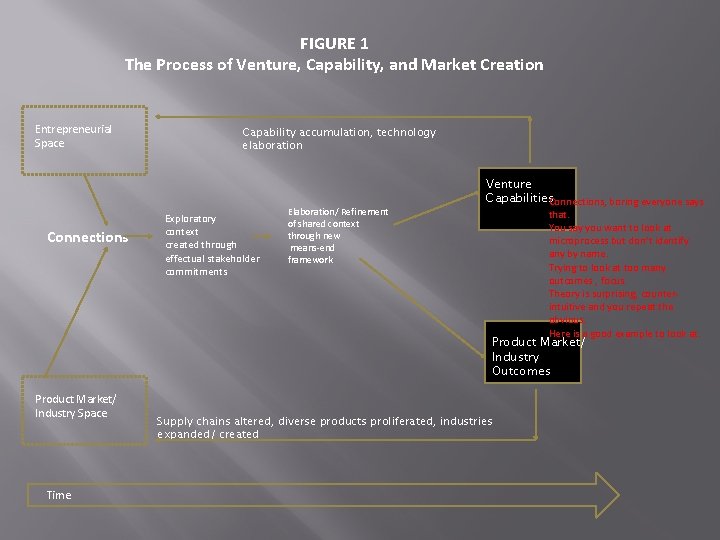
FIGURE 1 The Process of Venture, Capability, and Market Creation Entrepreneurial Space Connections Capability accumulation, technology elaboration Exploratory context created through effectual stakeholder commitments Elaboration/ Refinement of shared context through new means-end framework Venture Capabilities. Connections, boring everyone says that. You say you want to look at microprocess but don’t identify any by name. Trying to look at too many outcomes , focus. Theory is surprising, counterintuitive and you repeat the obvious. Here is a good example to look at. Product Market/ Industry Outcomes Product Market/ Industry Space Time Supply chains altered, diverse products proliferated, industries expanded/ created
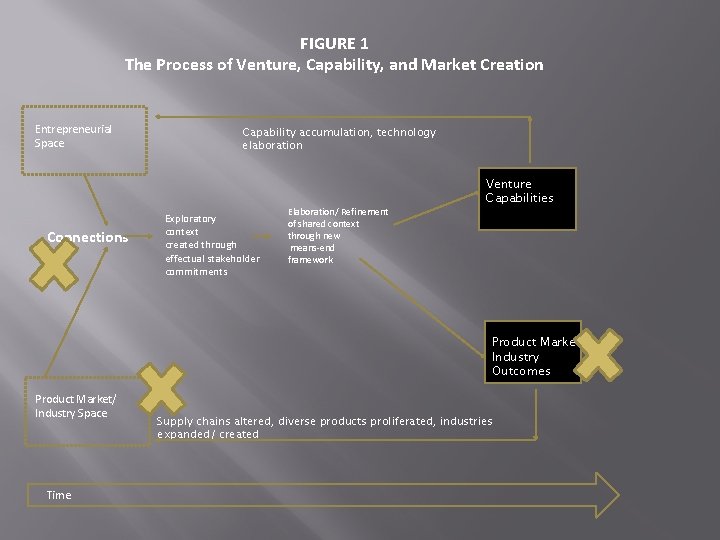
FIGURE 1 The Process of Venture, Capability, and Market Creation Entrepreneurial Space Connections Capability accumulation, technology elaboration Exploratory context created through effectual stakeholder commitments Elaboration/ Refinement of shared context through new means-end framework Venture Capabilities Product Market/ Industry Outcomes Product Market/ Industry Space Time Supply chains altered, diverse products proliferated, industries expanded/ created
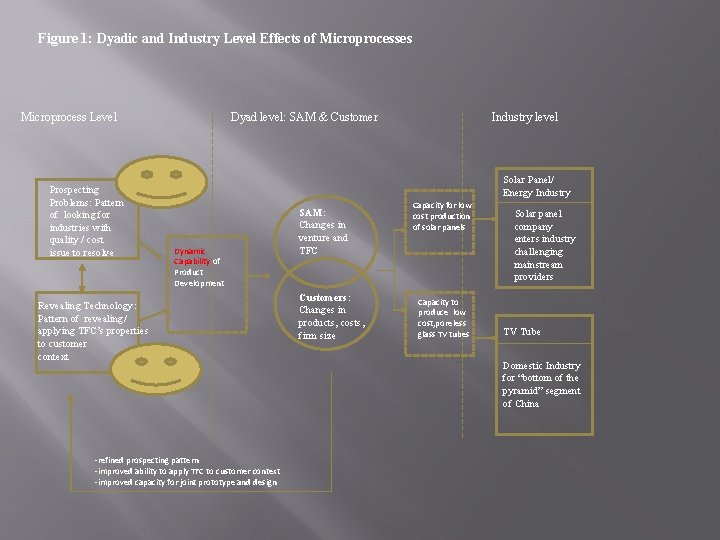
Figure 1: Dyadic and Industry Level Effects of Microprocesses Microprocess Level Prospecting Problems: Pattern of looking for industries with quality / cost issue to resolve Dyad level: SAM & Customer Industry level Solar Panel/ Energy Industry Dynamic Capability of Product Development Revealing Technology: Pattern of revealing/ applying TFC’s properties to customer context -refined prospecting pattern -improved ability to apply TFC to customer context -improved capacity for joint prototype and design SAM: Changes in venture and TFC Customers: Changes in products, costs, firm size Capacity for low cost production of solar panels Capacity to produce low cost, poreless glass TV tubes Solar panel company enters industry challenging mainstream providers TV Tube Domestic Industry for “bottom of the pyramid” segment of China
Quantitative Example • • • Developed a theoretical framework to test for my Ph. D dissertation (I was interested in collective cognition that might be happening among TMT members when making strategic decisions, early 90 s) Turned it into a manuscript, sent to AMR, got invited for revision but ultimately rejected Revised it for Organization Science based on feedback I got 2/ 3 people who had published on topic of “cognition” in strategy area ANZAM Doctoral Workshop 5 December 2011
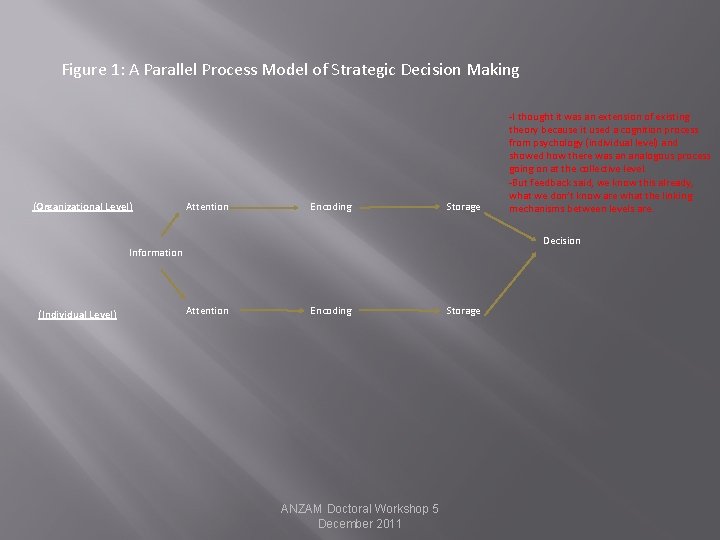
Figure 1: A Parallel Process Model of Strategic Decision Making (Organizational Level) Attention Encoding Storage Decision Information (Individual Level) -I thought it was an extension of existing theory because it used a cognition process from psychology (individual level) and showed how there was an analogous process going on at the collective level. -But feedback said, we know this already, what we don’t know are what the linking mechanisms between levels are. Attention Encoding ANZAM Doctoral Workshop 5 December 2011 Storage
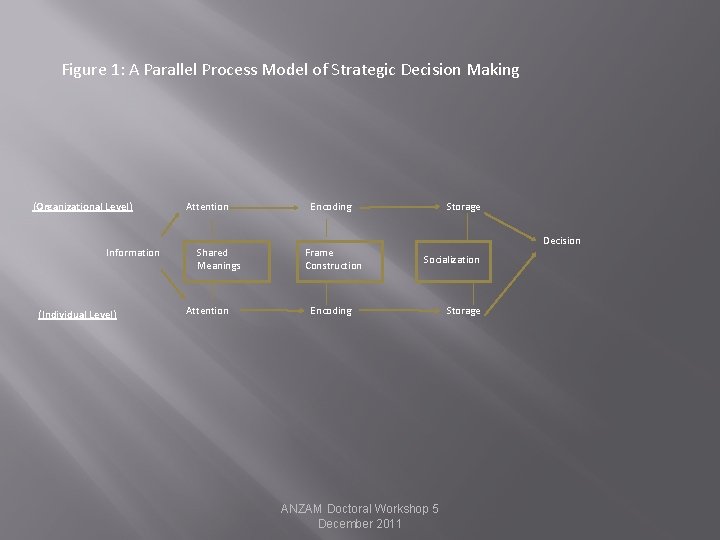
Figure 1: A Parallel Process Model of Strategic Decision Making (Organizational Level) Information (Individual Level) Attention Shared Meanings Attention Encoding Frame Construction Storage Decision Socialization Encoding ANZAM Doctoral Workshop 5 December 2011 Storage
Outcome Corner, P. , Kinicki, A. , Keats, B. , 1994. Integrating organizational and individual information processing perspectives on choice. Organization Science. 294 -308. (A* journal) ANZAM Doctoral Workshop 5 December 2011
- Slides: 17