
MAKE TO INNOVATE Final Review Spring 2019 Eagle










- Slides: 54
MAKE TO INNOVATE Final Review – Spring 2019 Eagle Eye
Project Overview Activity Report Design Review AGENDA • • Design Constraints Current Design Proposed Changes Design Risks Budget Status Conclusion
PROJECT OVERVIEW Project Executive Summary
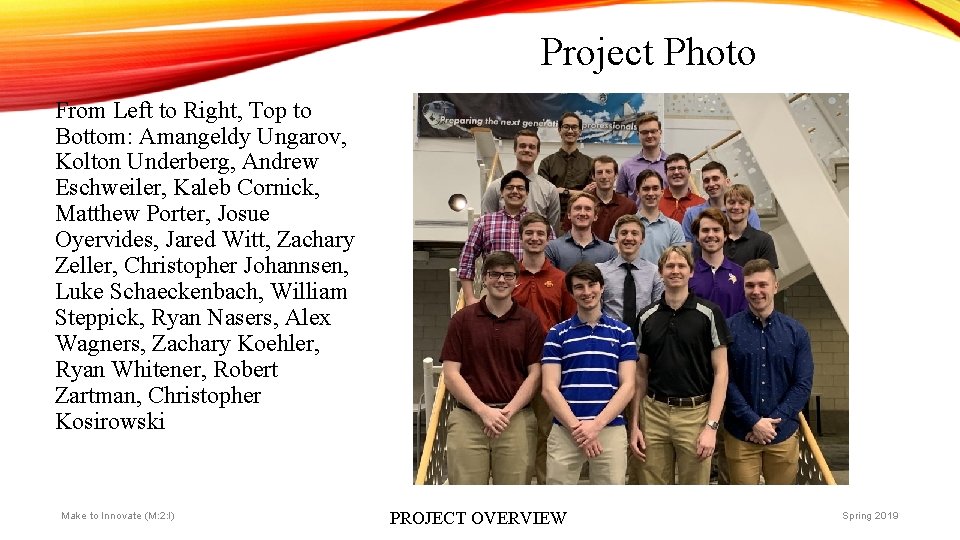
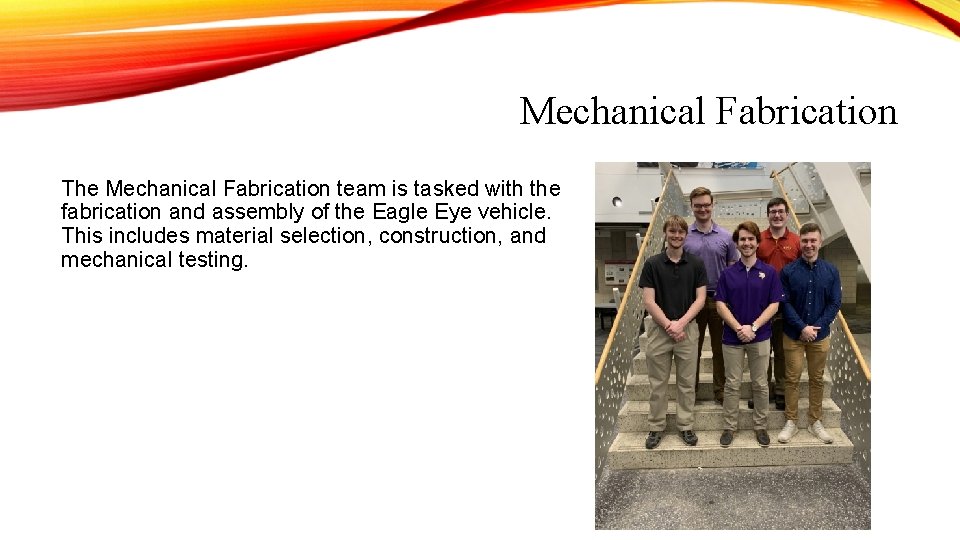
Project Photo From Left to Right, Top to Bottom: Amangeldy Ungarov, Kolton Underberg, Andrew Eschweiler, Kaleb Cornick, Matthew Porter, Josue Oyervides, Jared Witt, Zachary Zeller, Christopher Johannsen, Luke Schaeckenbach, William Steppick, Ryan Nasers, Alex Wagners, Zachary Koehler, Ryan Whitener, Robert Zartman, Christopher Kosirowski Make to Innovate (M: 2: I) PROJECT OVERVIEW Spring 2019
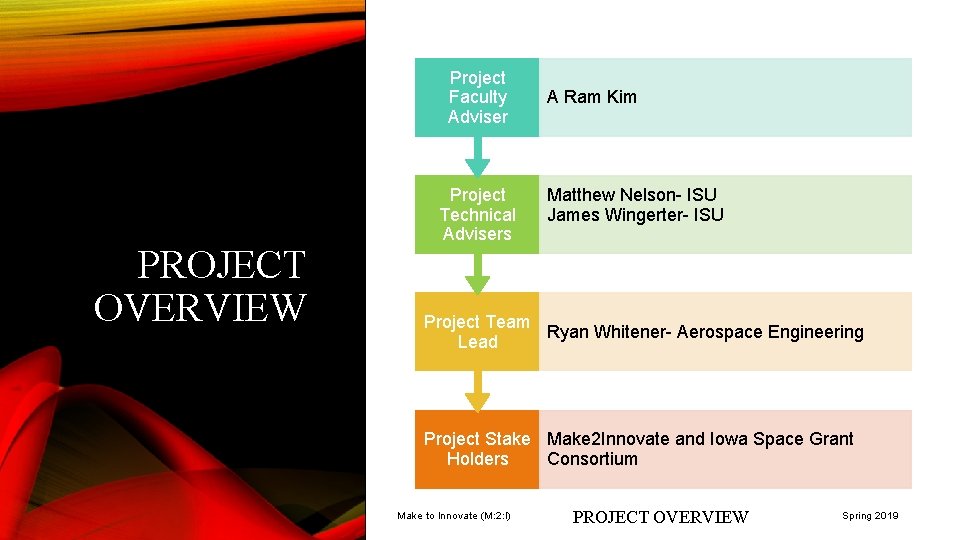
Project Faculty Adviser PROJECT OVERVIEW Project Technical Advisers A Ram Kim Matthew Nelson- ISU James Wingerter- ISU Project Team Ryan Whitener- Aerospace Engineering Lead Project Stake Make 2 Innovate and Iowa Space Grant Consortium Holders Make to Innovate (M: 2: I) PROJECT OVERVIEW Spring 2019
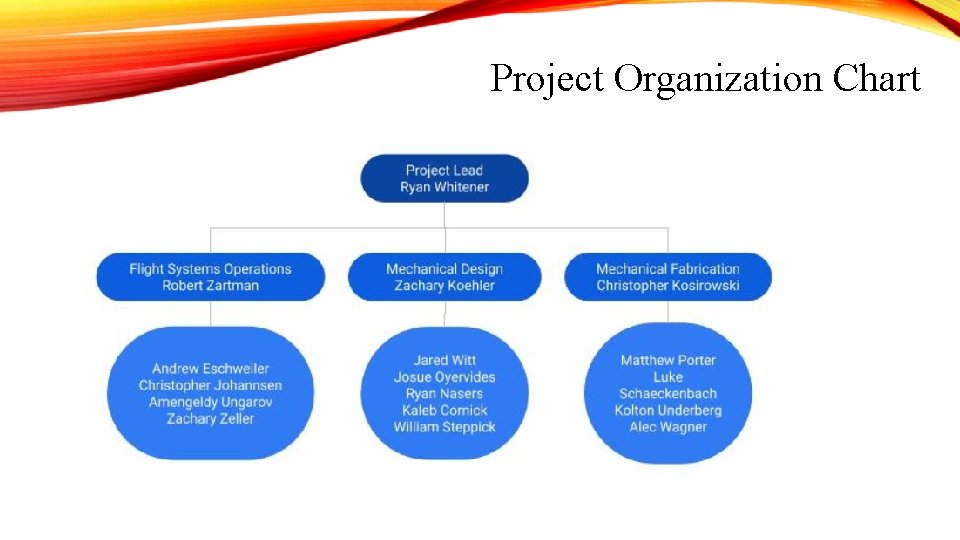
Project Organization Chart
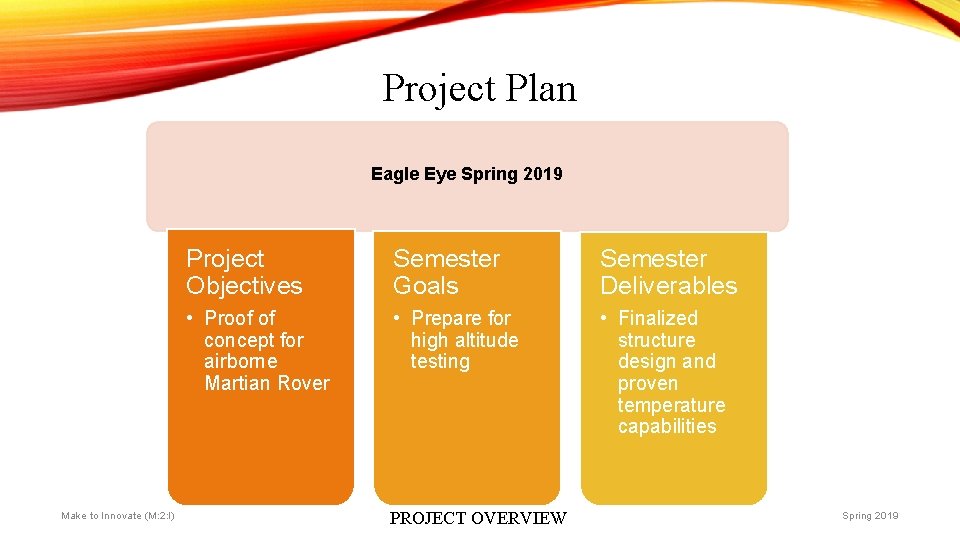
Project Plan Eagle Eye Spring 2019 Make to Innovate (M: 2: I) Project Objectives Semester Goals Semester Deliverables • Proof of concept for airborne Martian Rover • Prepare for high altitude testing • Finalized structure design and proven temperature capabilities PROJECT OVERVIEW Spring 2019
ACTIVITY REPORT Milestones, Tasks, and Health Report
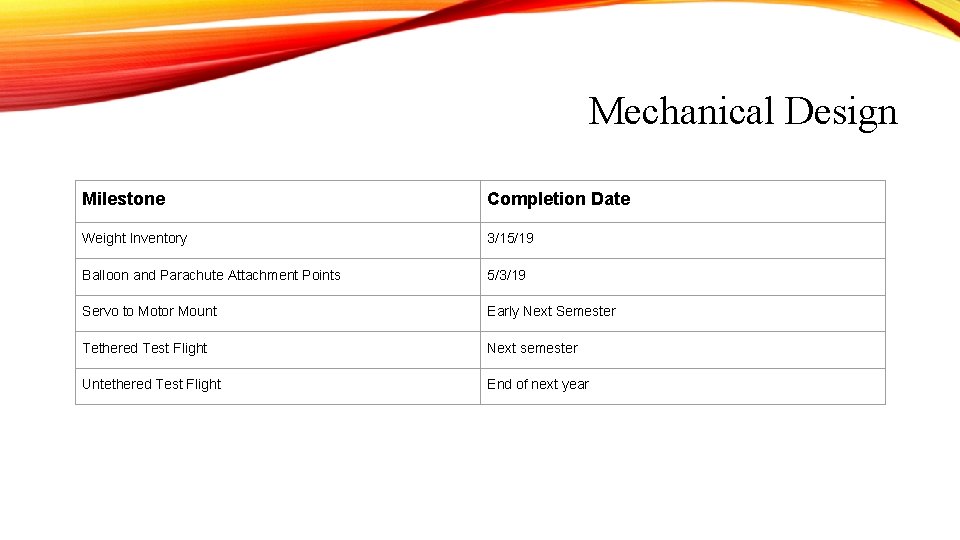
Mechanical Design Milestone Completion Date Weight Inventory 3/15/19 Balloon and Parachute Attachment Points 5/3/19 Servo to Motor Mount Early Next Semester Tethered Test Flight Next semester Untethered Test Flight End of next year
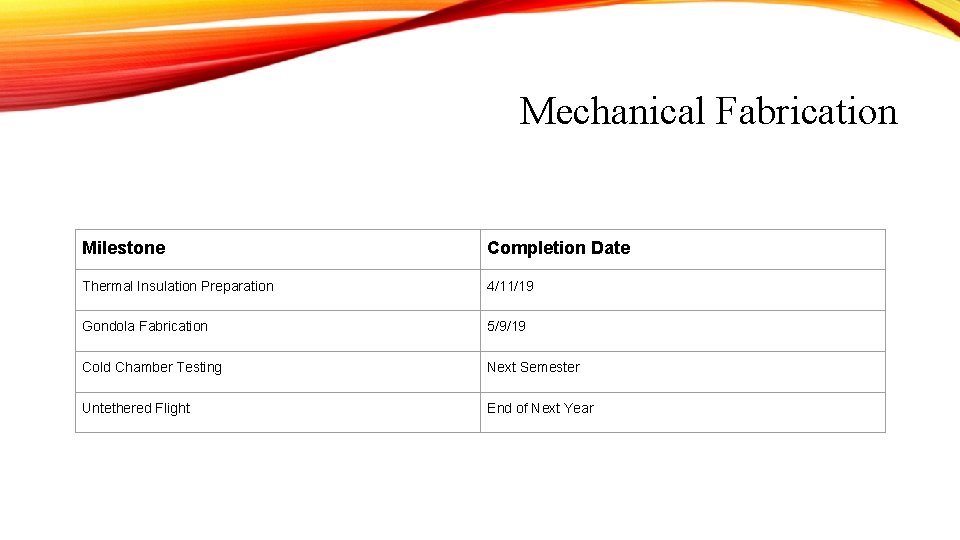
Mechanical Fabrication Milestone Completion Date Thermal Insulation Preparation 4/11/19 Gondola Fabrication 5/9/19 Cold Chamber Testing Next Semester Untethered Flight End of Next Year
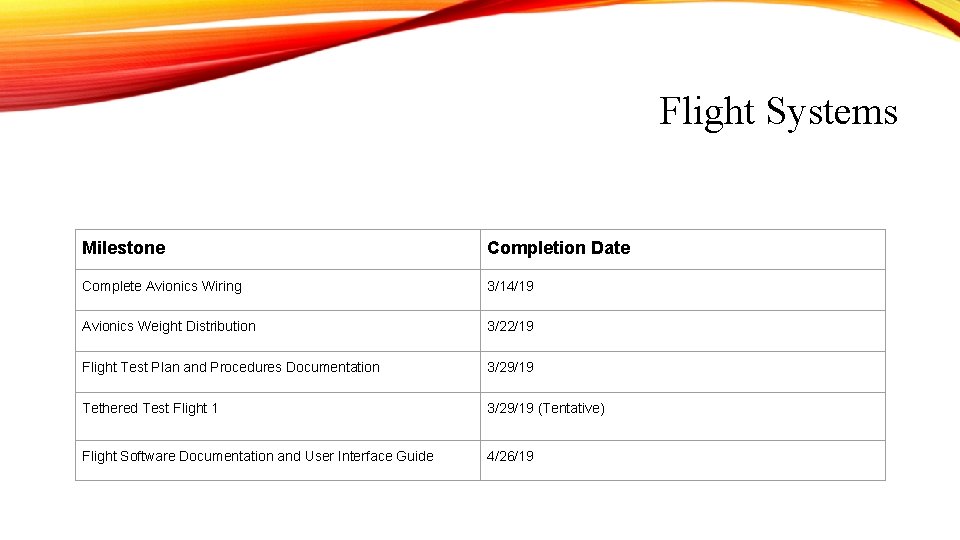
Flight Systems Milestone Completion Date Complete Avionics Wiring 3/14/19 Avionics Weight Distribution 3/22/19 Flight Test Plan and Procedures Documentation 3/29/19 Tethered Test Flight 1 3/29/19 (Tentative) Flight Software Documentation and User Interface Guide 4/26/19
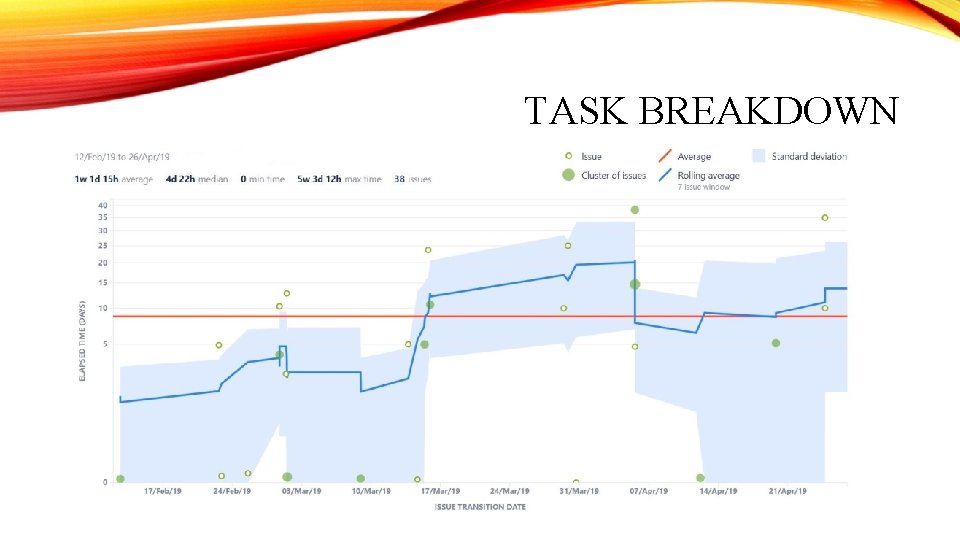
TASK BREAKDOWN • Generated summary from Jira
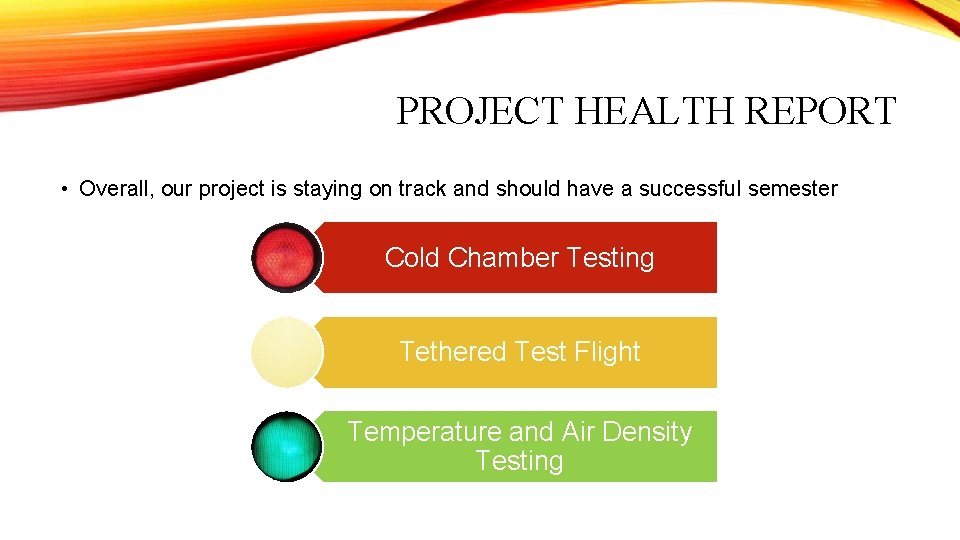
PROJECT HEALTH REPORT • Overall, our project is staying on track and should have a successful semester Cold Chamber Testing Tethered Test Flight Temperature and Air Density Testing
DESIGN REVIEW Overview
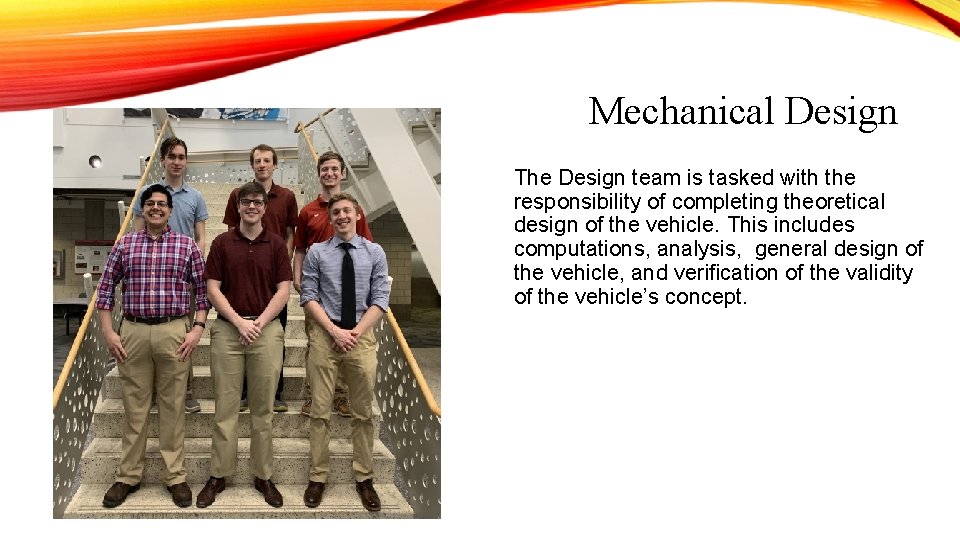
Mechanical Design The Design team is tasked with the responsibility of completing theoretical design of the vehicle. This includes computations, analysis, general design of the vehicle, and verification of the validity of the vehicle’s concept.
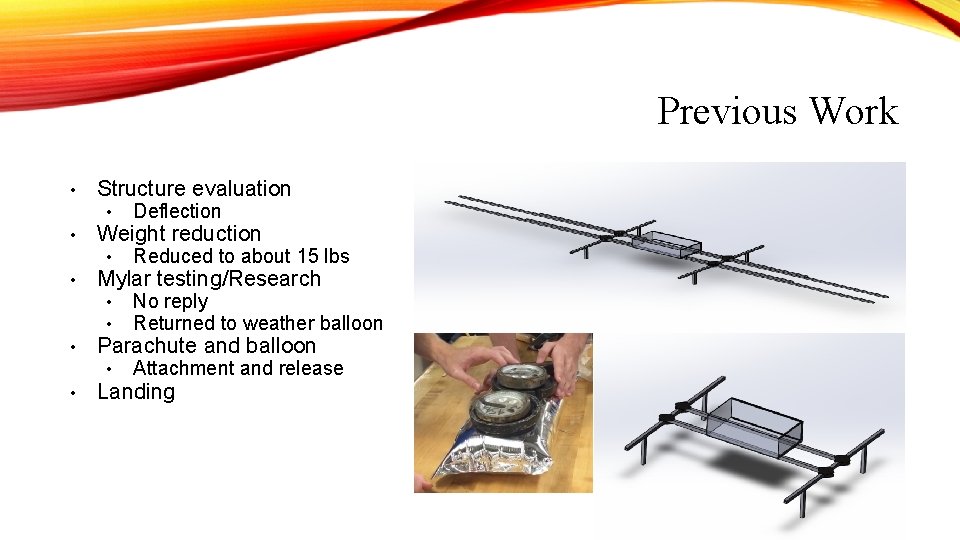
Previous Work • • • Structure evaluation • Deflection • Reduced to about 15 lbs • • No reply Returned to weather balloon • Attachment and release Weight reduction Mylar testing/Research Parachute and balloon Landing
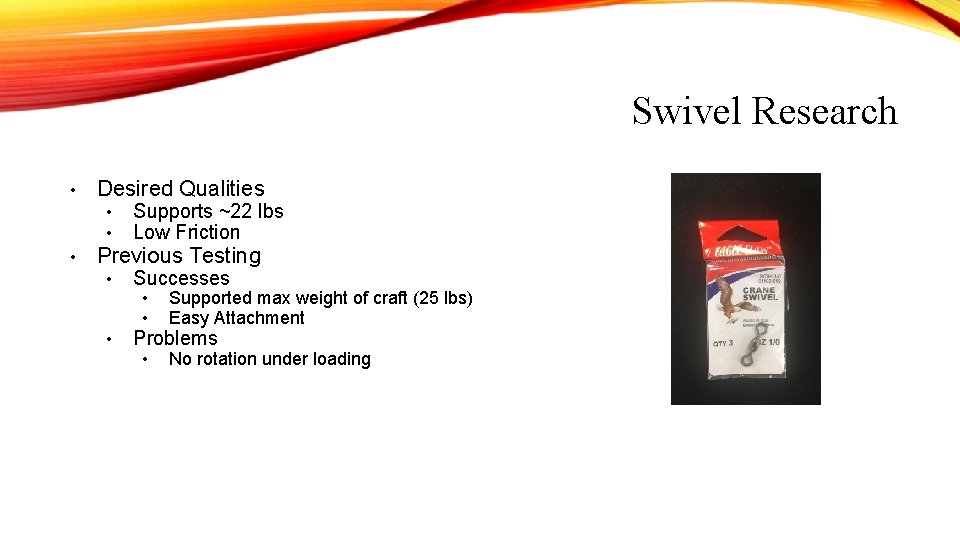
Swivel Research • • Desired Qualities • • Supports ~22 lbs Low Friction • Successes • Problems Previous Testing • • Supported max weight of craft (25 lbs) Easy Attachment • No rotation under loading
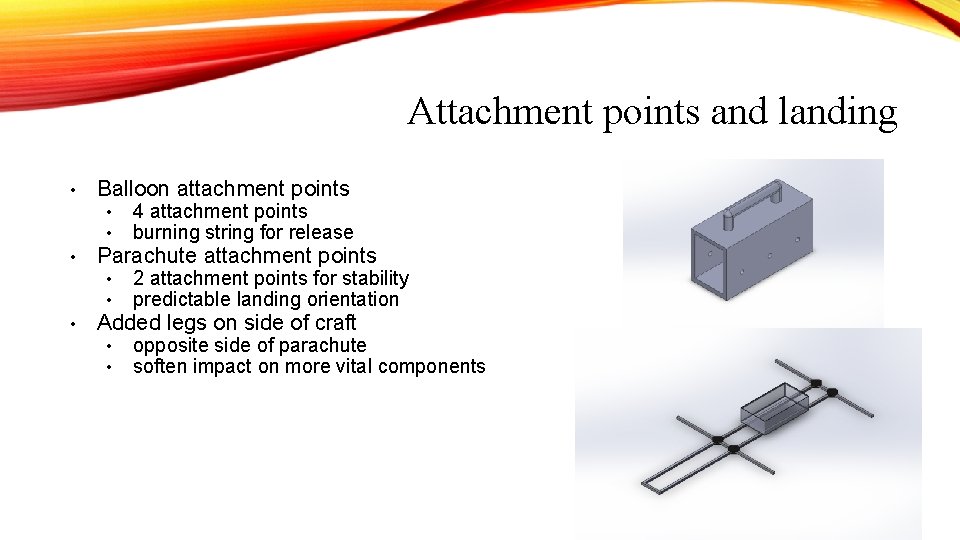
Attachment points and landing • • • Balloon attachment points • • 4 attachment points burning string for release • • 2 attachment points for stability predictable landing orientation • • opposite side of parachute soften impact on more vital components Parachute attachment points Added legs on side of craft
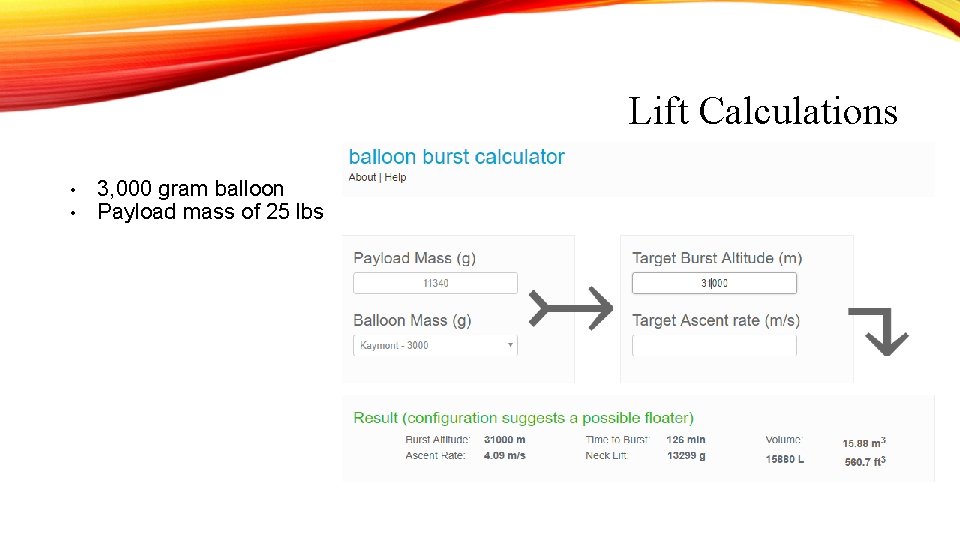
Lift Calculations • • 3, 000 gram balloon Payload mass of 25 lbs
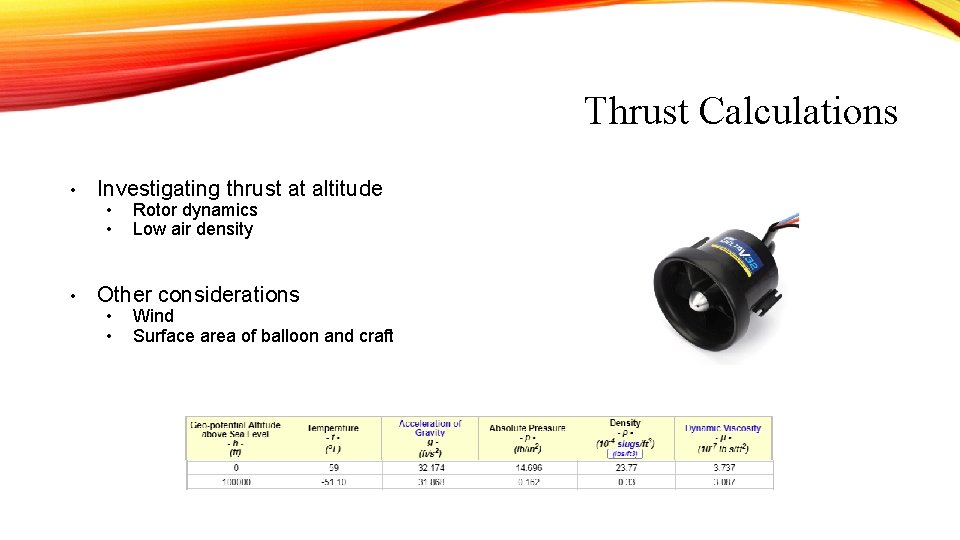
Thrust Calculations • Investigating thrust at altitude • • • Rotor dynamics Low air density Other considerations • • Wind Surface area of balloon and craft
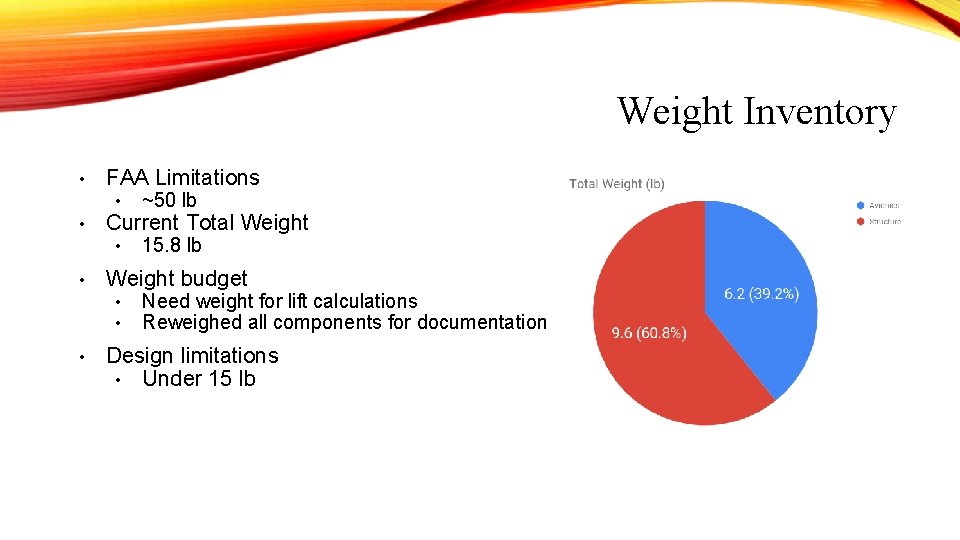
Weight Inventory • • • FAA Limitations • ~50 lb • 15. 8 lb Current Total Weight budget • • • Need weight for lift calculations Reweighed all components for documentation Design limitations • Under 15 lb
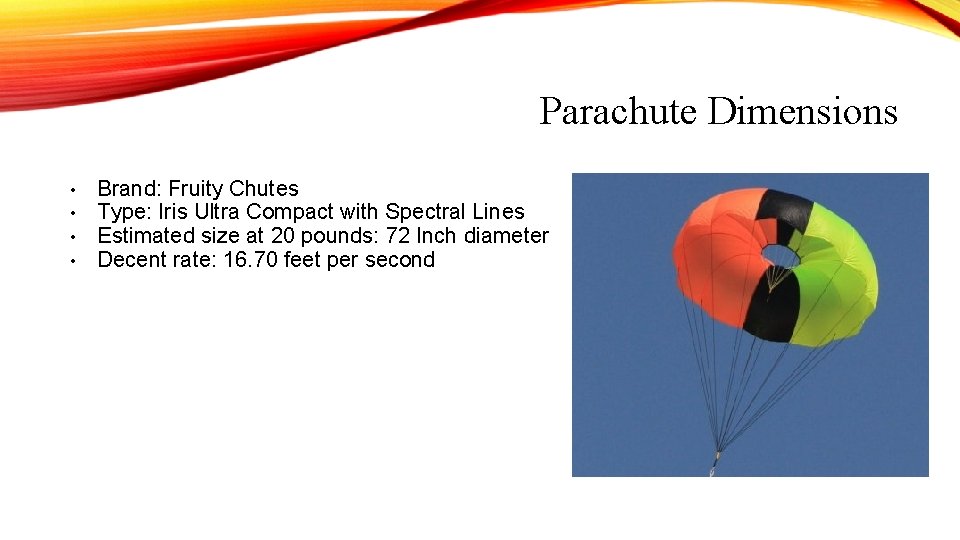
Parachute Dimensions • • Brand: Fruity Chutes Type: Iris Ultra Compact with Spectral Lines Estimated size at 20 pounds: 72 Inch diameter Decent rate: 16. 70 feet per second
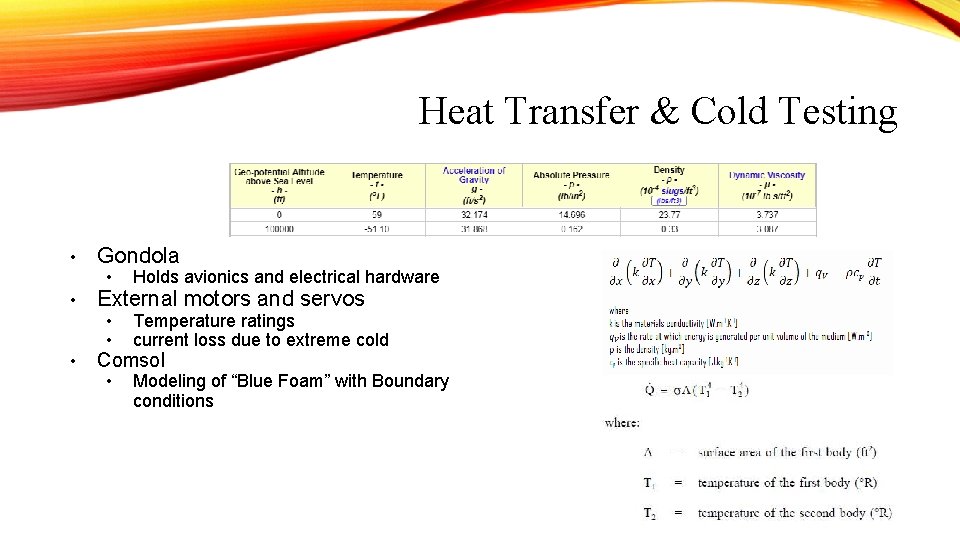
Heat Transfer & Cold Testing • • • Gondola • Holds avionics and electrical hardware • • Temperature ratings current loss due to extreme cold • Modeling of “Blue Foam” with Boundary conditions External motors and servos Comsol
Mechanical Fabrication The Mechanical Fabrication team is tasked with the fabrication and assembly of the Eagle Eye vehicle. This includes material selection, construction, and mechanical testing.
Previous Work • Fabrication of the gondola • • Installment of blue styrofoam insulation • • Used a 1: 1 ratio of West Systems Hardener and Resin to adhere foam to fiberglass Holes drilled in gondola • • Fiberglass side panels made with dimensions of 23. 5”x 20. 5”x 7” Drilled holes in the sides of the gondola for wires to connect to batteries Development of filling system • Rubber plugs at the end of filling tubes to attach to the balloon
Thermal Insulation Research • Boyd Corporation • Solimide AC-550(H) Insulation • https: //www. boydcorp. com/datasheets/SOLIMIDE-AC-550 -Data-Sheet. pdf • Temperature range: -200 to +200 degrees Celsius • Semi-open-celled foam which will allow for adjustments to pressure changes • R value of 3. 33 per in. • Very expensive
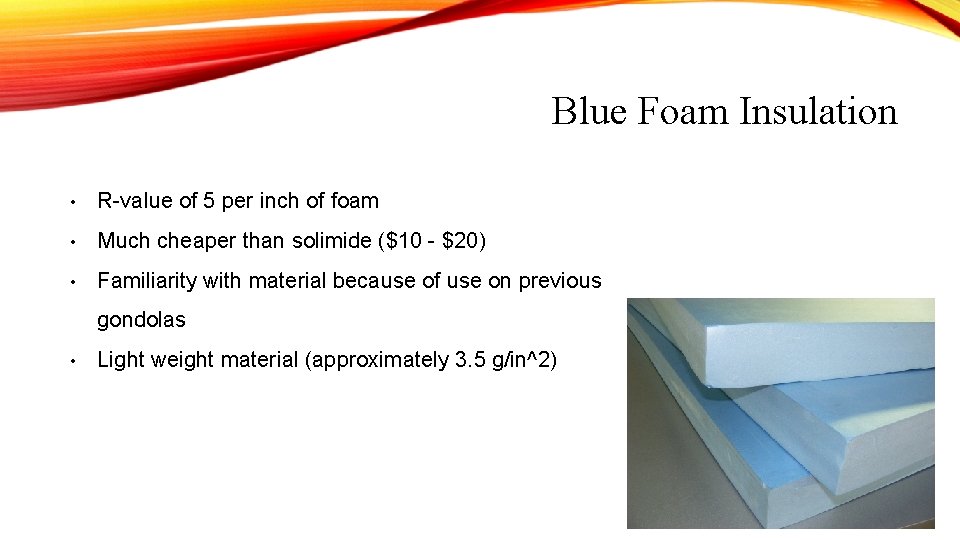
Blue Foam Insulation • R-value of 5 per inch of foam • Much cheaper than solimide ($10 - $20) • Familiarity with material because of use on previous gondolas • Light weight material (approximately 3. 5 g/in^2)
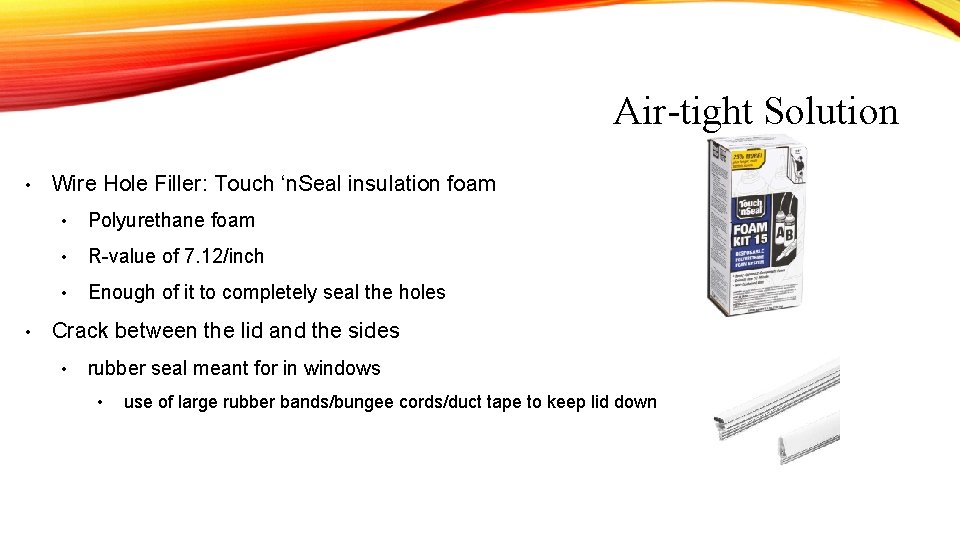
Air-tight Solution • • Wire Hole Filler: Touch ‘n. Seal insulation foam • Polyurethane foam • R-value of 7. 12/inch • Enough of it to completely seal the holes Crack between the lid and the sides • rubber seal meant for in windows • use of large rubber bands/bungee cords/duct tape to keep lid down
Gondola Construction • Dimensions for the space given for the electronics is 15”x 13”x 4” inside the gondola • Using blue foam in place of solimide, due to price and R-Value • Being a max of 2 inches thick (blue foam), 2 additional layers are needed to make it a total of 5 in. thick • A 5” thickness is desired to keep the electronics just above 32 degrees fahrenheit • Cut each piece to size using hot wire and adjusting to proper size using sandpaper
Cold Chamber Testing • Test will be at Winegard next semester • Simulates the temperatures we will encounter at 100, 000 foot altitude • Temperature reaches approximately -50 degrees • Testing to check if gondola properly insulates the electronics
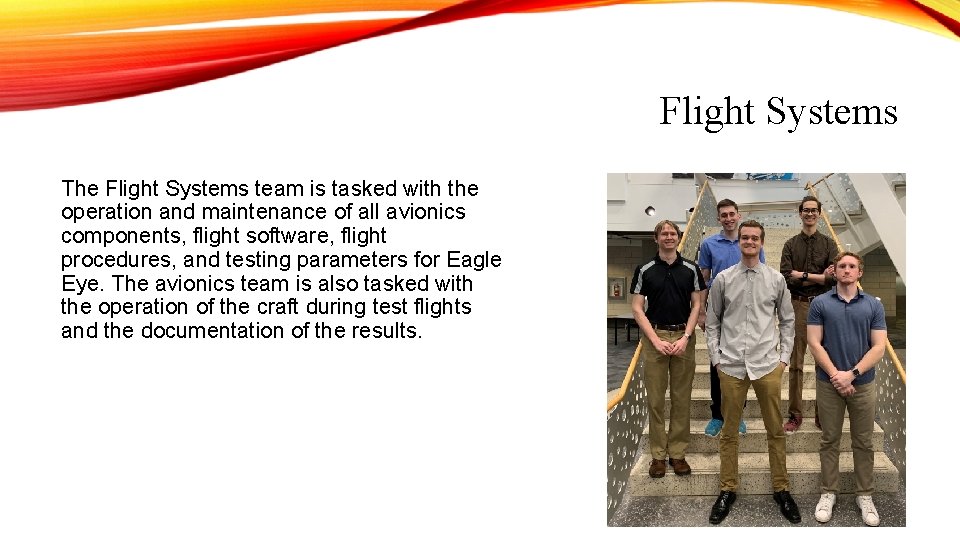
Flight Systems The Flight Systems team is tasked with the operation and maintenance of all avionics components, flight software, flight procedures, and testing parameters for Eagle Eye. The avionics team is also tasked with the operation of the craft during test flights and the documentation of the results.
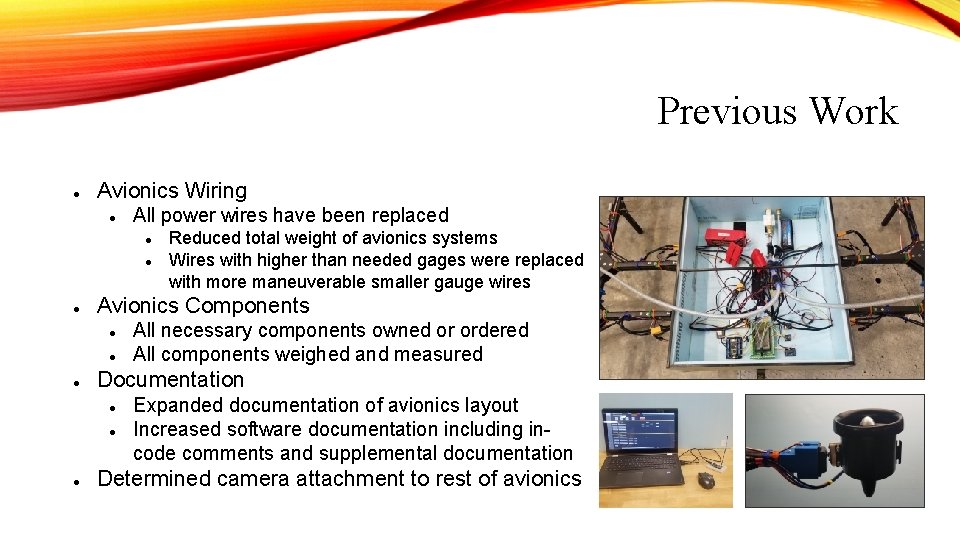
Previous Work ● Avionics Wiring ● All power wires have been replaced ● ● ● Avionics Components ● ● ● All necessary components owned or ordered All components weighed and measured Documentation ● ● ● Reduced total weight of avionics systems Wires with higher than needed gages were replaced with more maneuverable smaller gauge wires Expanded documentation of avionics layout Increased software documentation including incode comments and supplemental documentation Determined camera attachment to rest of avionics
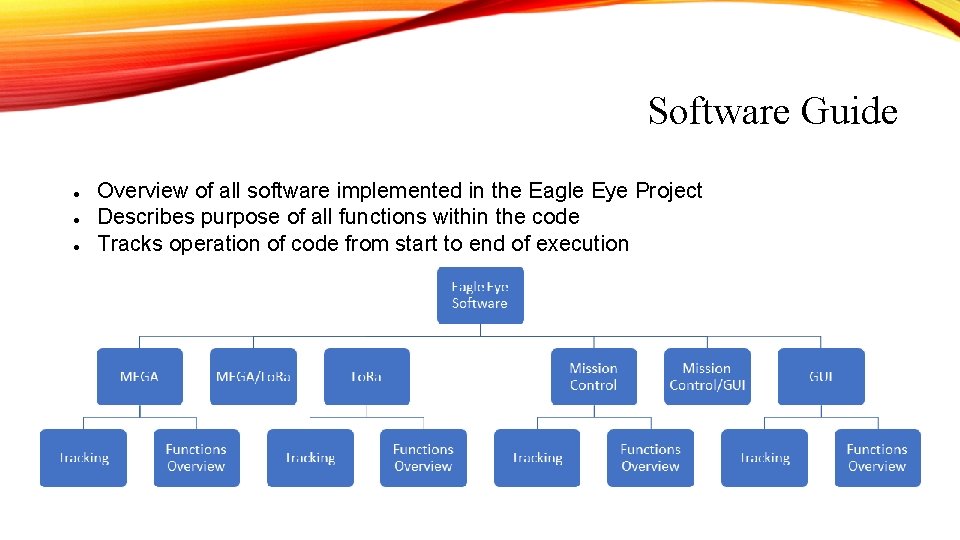
Software Guide ● ● ● Overview of all software implemented in the Eagle Eye Project Describes purpose of all functions within the code Tracks operation of code from start to end of execution
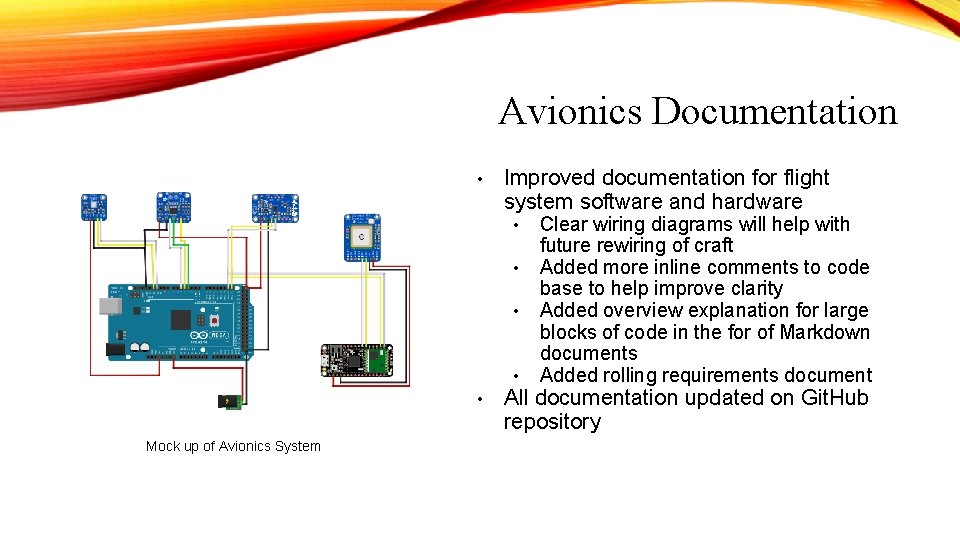
Avionics Documentation • Improved documentation for flight system software and hardware • • • Mock up of Avionics System Clear wiring diagrams will help with future rewiring of craft Added more inline comments to code base to help improve clarity Added overview explanation for large blocks of code in the for of Markdown documents Added rolling requirements document All documentation updated on Git. Hub repository
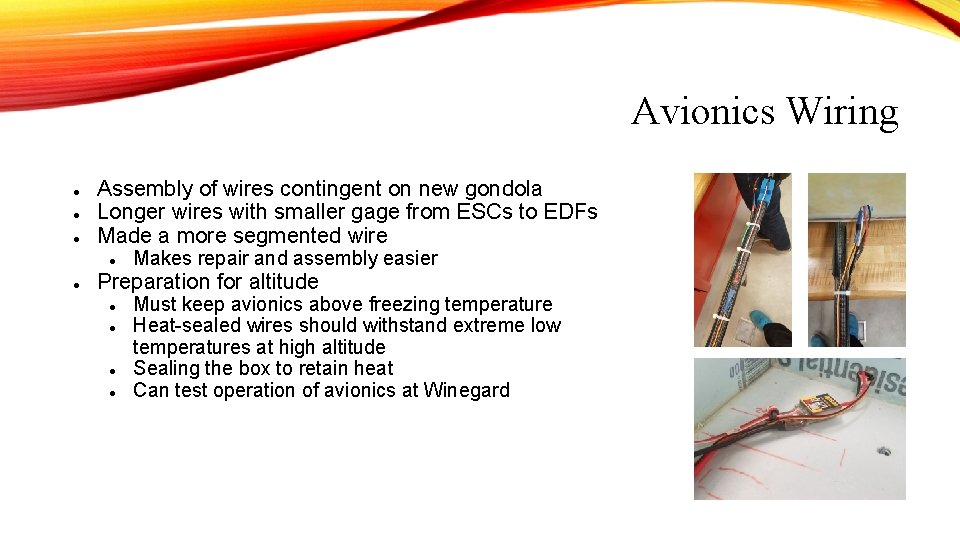
Avionics Wiring ● ● ● Assembly of wires contingent on new gondola Longer wires with smaller gage from ESCs to EDFs Made a more segmented wire ● ● Makes repair and assembly easier Preparation for altitude ● ● Must keep avionics above freezing temperature Heat-sealed wires should withstand extreme low temperatures at high altitude Sealing the box to retain heat Can test operation of avionics at Winegard
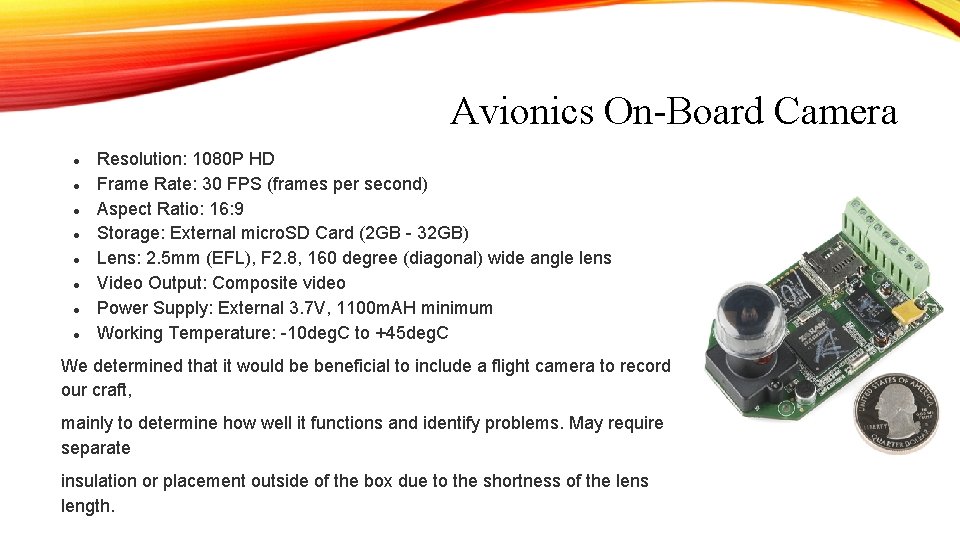
Avionics On-Board Camera ● ● ● ● Resolution: 1080 P HD Frame Rate: 30 FPS (frames per second) Aspect Ratio: 16: 9 Storage: External micro. SD Card (2 GB - 32 GB) Lens: 2. 5 mm (EFL), F 2. 8, 160 degree (diagonal) wide angle lens Video Output: Composite video Power Supply: External 3. 7 V, 1100 m. AH minimum Working Temperature: -10 deg. C to +45 deg. C We determined that it would be beneficial to include a flight camera to record our craft, mainly to determine how well it functions and identify problems. May require separate insulation or placement outside of the box due to the shortness of the lens length.
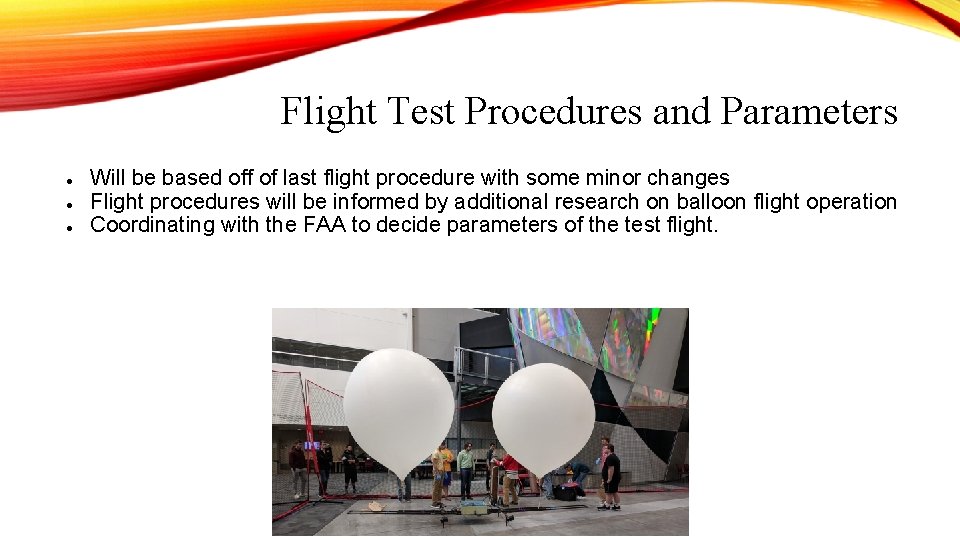
Flight Test Procedures and Parameters ● ● ● Will be based off of last flight procedure with some minor changes Flight procedures will be informed by additional research on balloon flight operation Coordinating with the FAA to decide parameters of the test flight.
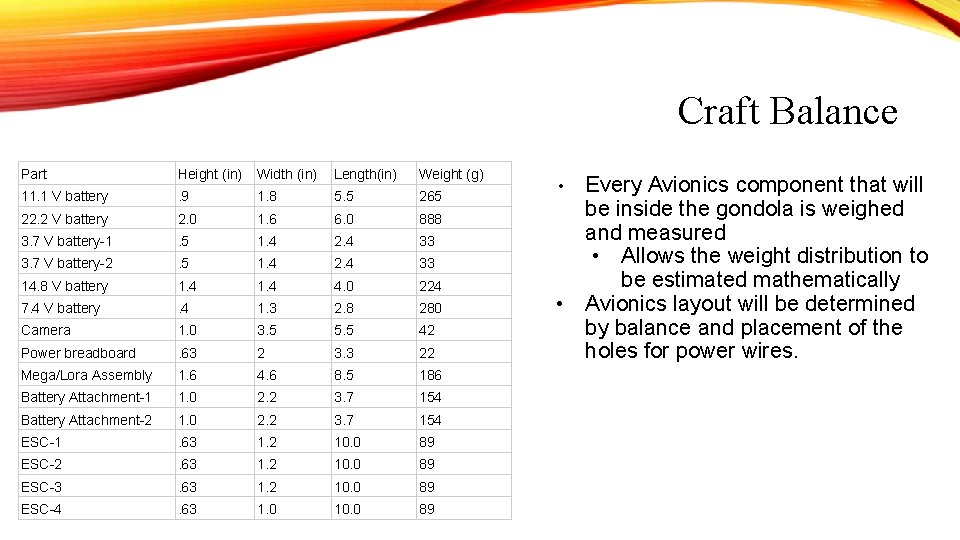
Craft Balance Part Height (in) Width (in) Length(in) Weight (g) 11. 1 V battery . 9 1. 8 5. 5 265 22. 2 V battery 2. 0 1. 6 6. 0 888 3. 7 V battery-1 . 5 1. 4 2. 4 33 3. 7 V battery-2 . 5 1. 4 2. 4 33 14. 8 V battery 1. 4 4. 0 224 7. 4 V battery . 4 1. 3 2. 8 280 Camera 1. 0 3. 5 5. 5 42 Power breadboard . 63 2 3. 3 22 Mega/Lora Assembly 1. 6 4. 6 8. 5 186 Battery Attachment-1 1. 0 2. 2 3. 7 154 Battery Attachment-2 1. 0 2. 2 3. 7 154 ESC-1 . 63 1. 2 10. 0 89 ESC-2 . 63 1. 2 10. 0 89 ESC-3 . 63 1. 2 10. 0 89 ESC-4 . 63 1. 0 10. 0 89 Every Avionics component that will be inside the gondola is weighed and measured • Allows the weight distribution to be estimated mathematically • Avionics layout will be determined by balance and placement of the holes for power wires. •
DESIGN REVIEW Constraints
DESIGN CONSTRAINTS • Temperature Insulation • Ranges from -50 degrees Celsius to 20 degrees Celsius • Air Density Performance • Must generate enough thrust to maneuver • Weight Limitations • FAA guideline weight limitation of 55 lbs
DESIGN REVIEW Current Design
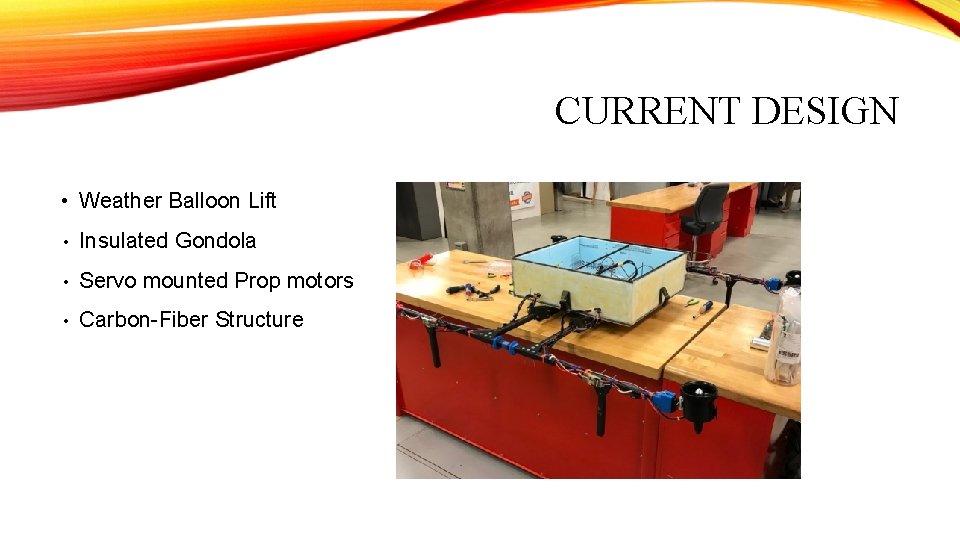
CURRENT DESIGN • Weather Balloon Lift • Insulated Gondola • Servo mounted Prop motors • Carbon-Fiber Structure
DESIGN REVIEW Proposed Changes
PROPOSED CHANGES • Moving forward we are adjusting our design based on a redefined scope and enhanced mission statement: Eagle Eye's goal is to make a proof of concept vehicle for an airborne Martian rover that can maneuver in the Martian atmosphere and collect topographical and meteorological data. The end goal for Eagle Eye is for this project to be utilized by a space-bound organization to aid in spatial body exploration.
Mechanical Design • • Detailed weight inventory spreadsheet Everything accounted for • Able to withstand opening force • Propellers at altitude Parachute attachment Thrust calculations Thermal testing • • • Winegard Prepare for testing
Mechanical Fabrication • • Revamp the gondola to be airtight Change the insulation within gondola • • Polystyrene Blue Foam Board Insulation Higher R-Value than Solimide • Idea of using 1 bladder instead of 2 • Find best attachment point based on the forces being exerted by the parachute Move away from using an envelop for the craft Parachute attachment implemented onto the structure
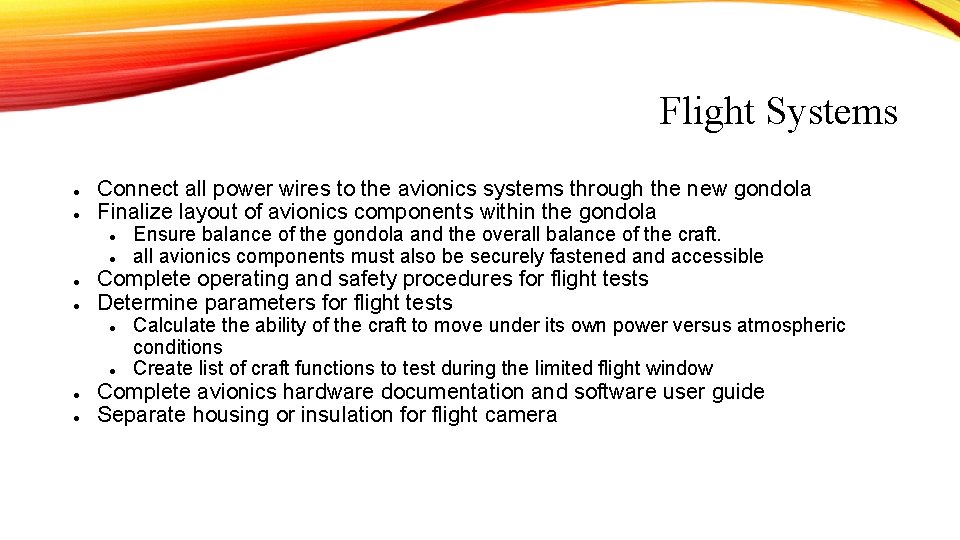
Flight Systems ● ● Connect all power wires to the avionics systems through the new gondola Finalize layout of avionics components within the gondola ● ● Complete operating and safety procedures for flight tests Determine parameters for flight tests ● ● Ensure balance of the gondola and the overall balance of the craft. all avionics components must also be securely fastened and accessible Calculate the ability of the craft to move under its own power versus atmospheric conditions Create list of craft functions to test during the limited flight window Complete avionics hardware documentation and software user guide Separate housing or insulation for flight camera
DESIGN REVIEW Design Risks
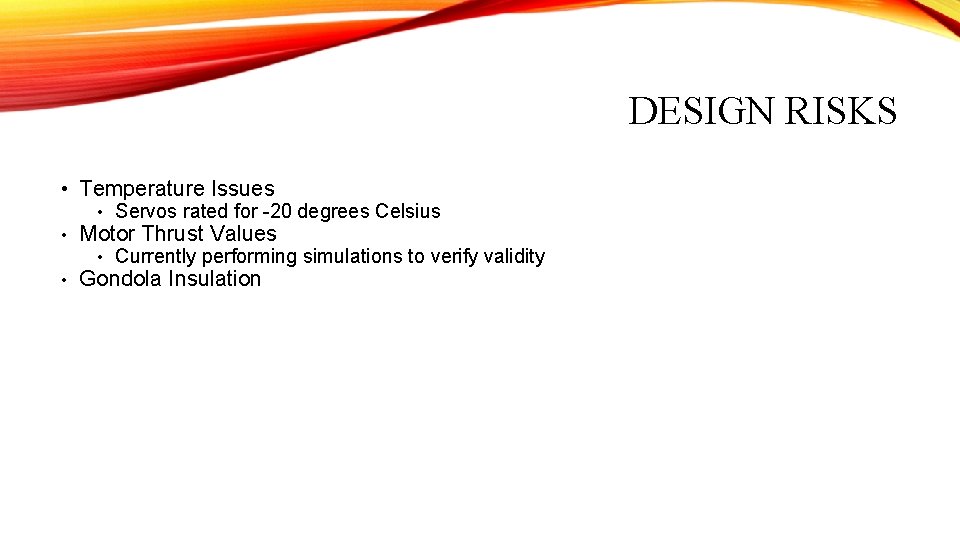
DESIGN RISKS • Temperature Issues • Servos rated for -20 degrees Celsius • Motor Thrust Values • Currently performing simulations to verify validity • Gondola Insulation
BUDGET
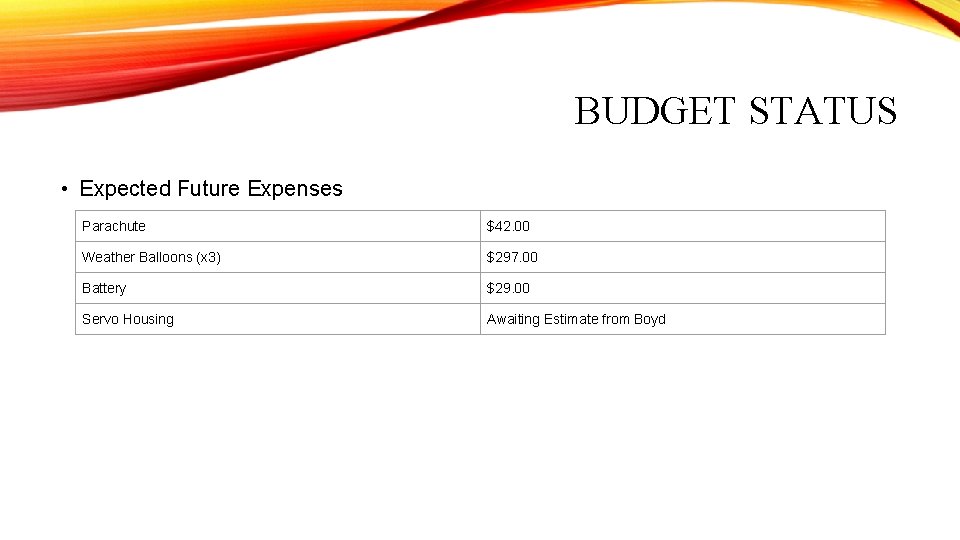
BUDGET STATUS • Expected Future Expenses Parachute $42. 00 Weather Balloons (x 3) $297. 00 Battery $29. 00 Servo Housing Awaiting Estimate from Boyd
BUDGET REQUESTS • We require no current change in budget
CONCLUSION
Questions?