
Make it StickStudy Strategies for Retention Project IMPACT




- Slides: 19
“Make it Stick”Study Strategies for Retention Project IMPACT Workshop Series
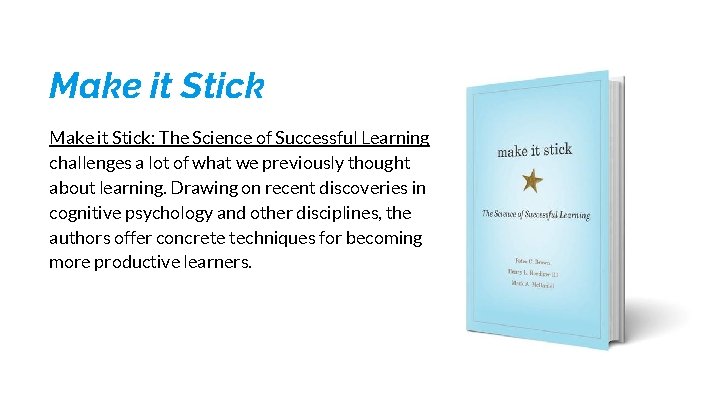
Make it Stick: The Science of Successful Learning challenges a lot of what we previously thought about learning. Drawing on recent discoveries in cognitive psychology and other disciplines, the authors offer concrete techniques for becoming more productive learners.
What does NOT work Many of the most common study strategies are not effective for retaining information. ➔ Underlining: Draws too much focus on small details ➔ Rereading notes: Creates familiarity with subject, but does not lead to mastery. ➔ Rewriting notes: Better than just rereading, but still does not give you a chance to see how well you learned something
To start, you need to know 2 things about studying. . . ● Embrace the challenging moments of studying ○ The harder it is to recall something from memory, the better you will remember it! ● Learn the difference between familiarity and mastery.
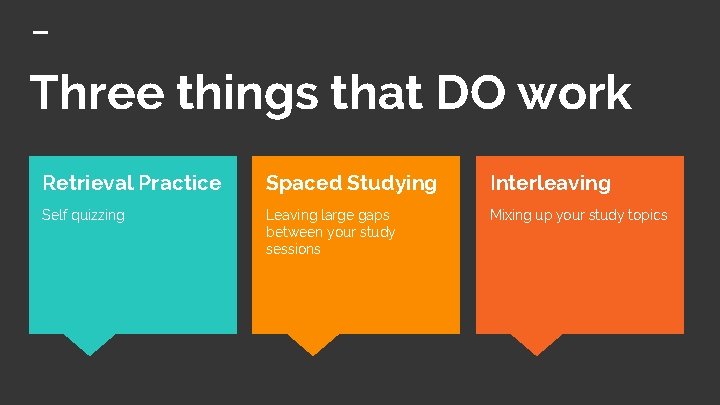
Three things that DO work Retrieval Practice Spaced Studying Interleaving Self quizzing Leaving large gaps between your study sessions Mixing up your study topics
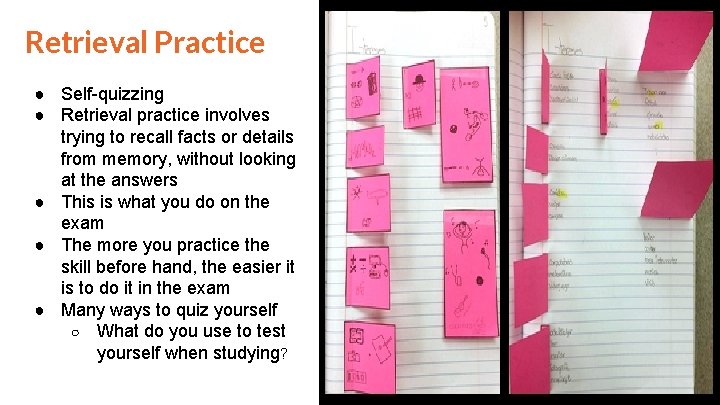
Retrieval Practice ● Self-quizzing ● Retrieval practice involves trying to recall facts or details from memory, without looking at the answers ● This is what you do on the exam ● The more you practice the skill before hand, the easier it is to do it in the exam ● Many ways to quiz yourself ○ What do you use to test yourself when studying?
Spaced Studying It may sound counter-intuitive, but leaving gaps between your study sessions leads to stronger retention of material “Spacing” your study sessions gives the brain time to forget the answer. The process of working hard to recall the fact actually leads to stronger memories It also is important in transferring information from short term
Interleaving ● Interleaving involves mixing up the topics you are studying ● For example, in your retrieval practice, you may ask yourself a question from chapter 1, then chapter 4, then chapter 1. ● This is much harder than going in order! But it leads to mastery quicker ● It also replicates the exam scenario more realistically. Tests
Strategies you can try Use memory cues Elaborate Generate Mnemonics, visual mnemonics Expand on the concepts you study Try to solve problems before you know how to
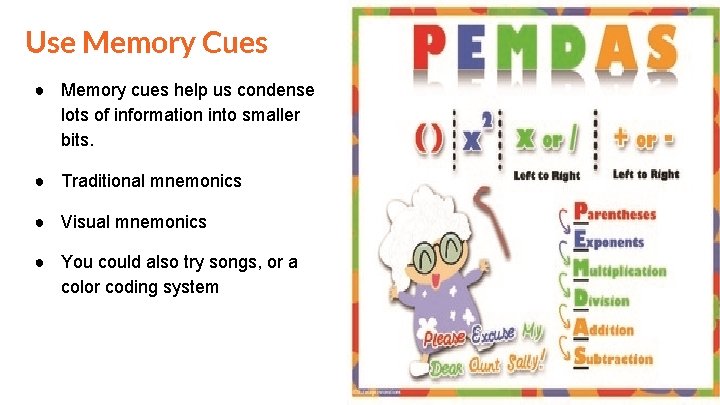
Use Memory Cues ● Memory cues help us condense lots of information into smaller bits. ● Traditional mnemonics ● Visual mnemonics ● You could also try songs, or a color coding system
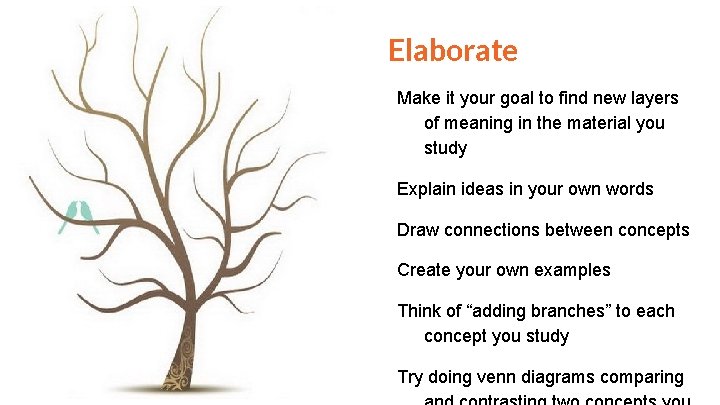
Elaborate Make it your goal to find new layers of meaning in the material you study Explain ideas in your own words Draw connections between concepts Create your own examples Think of “adding branches” to each concept you study Try doing venn diagrams comparing
Generate ● Try and solve a problem BEFORE being taught how to! ● Try to figure out what makes sense and guess how you would go about solving it ● Rely on your logic ● Even if you don't figure it out, when you review how to solve the problem, it may make more sense and will likely stick better
Other findings Go beyond learning styles There are many types of intelligences & explore multimodal learning Reflect Calibrate Check in with yourself Abby Author, NYC
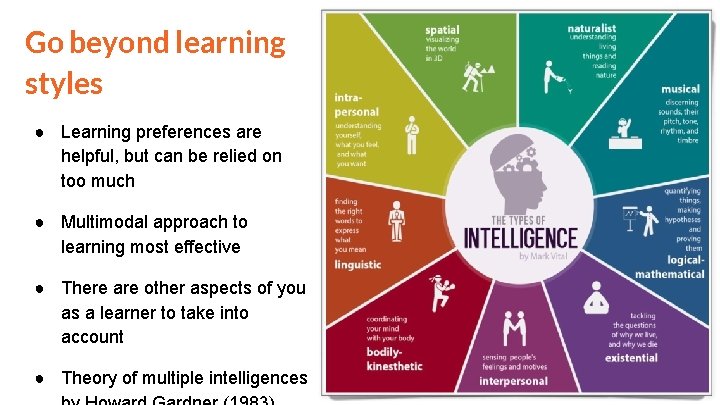
Go beyond learning styles ● Learning preferences are helpful, but can be relied on too much ● Multimodal approach to learning most effective ● There are other aspects of you as a learner to take into account ● Theory of multiple intelligences
Multiple Intelligences https: //www. youtube. com/watch? v=s 2 Edujr 0 v. A
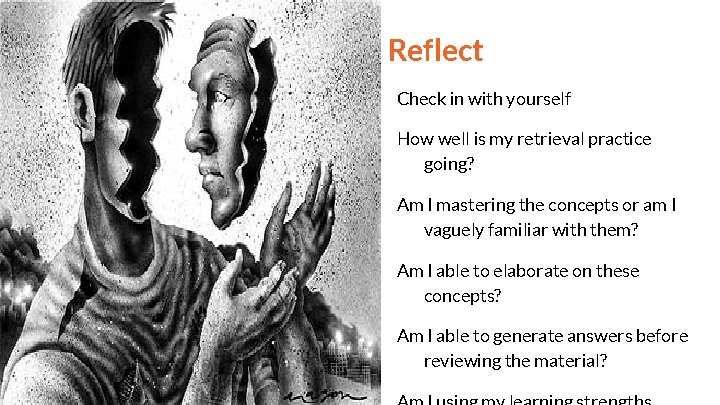
Reflect Check in with yourself How well is my retrieval practice going? Am I mastering the concepts or am I vaguely familiar with them? Am I able to elaborate on these concepts? Am I able to generate answers before reviewing the material?
Metacognition https: //youtu. be/7 CVssa. GGPDM
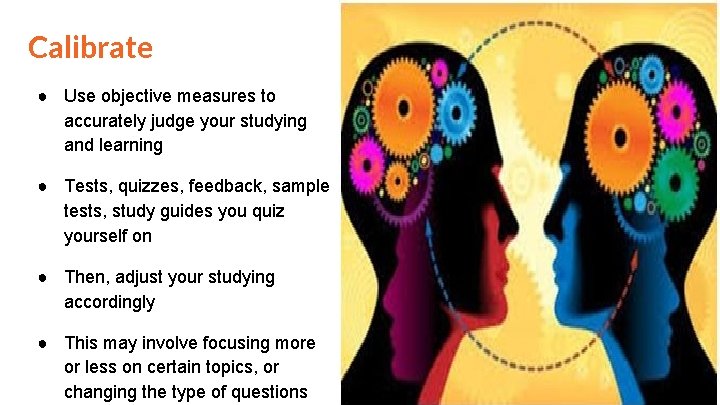
Calibrate ● Use objective measures to accurately judge your studying and learning ● Tests, quizzes, feedback, sample tests, study guides you quiz yourself on ● Then, adjust your studying accordingly ● This may involve focusing more or less on certain topics, or changing the type of questions
Wrap up. ● Two things to know ○ When it's harder, real learning is happening ○ Mastery, not familiarity ● What doesn’t work ● Three things that do work ○ Retrieval practice ○ Spaced studying ○ Interleaving ● Strategies you can try ○ Memory cues ○ Elaboration ○ Generate ● Other findings ○ Go beyond learning preferences ○ Reflect ○ Calibrate