
Make Every School Bus Better Thomas Bus Steve
Make Every School Bus Better. Thomas Bus Steve D Goss Oct 4, 2011 Sanjay Kumar Jim Lannan
Agenda 1. Update on successes 2. IC Bus ‘Fluid’ Economy Claims 3. Cummins Fuel Economy 4. How to sell Cummins
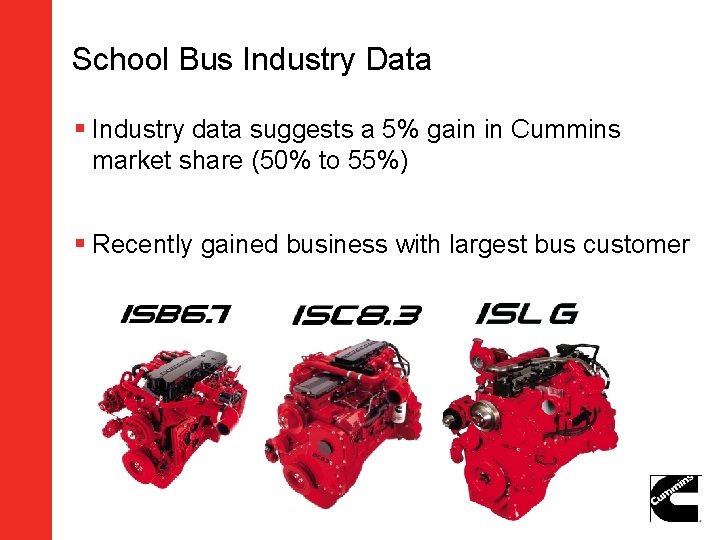
School Bus Industry Data § Industry data suggests a 5% gain in Cummins market share (50% to 55%) § Recently gained business with largest bus customer
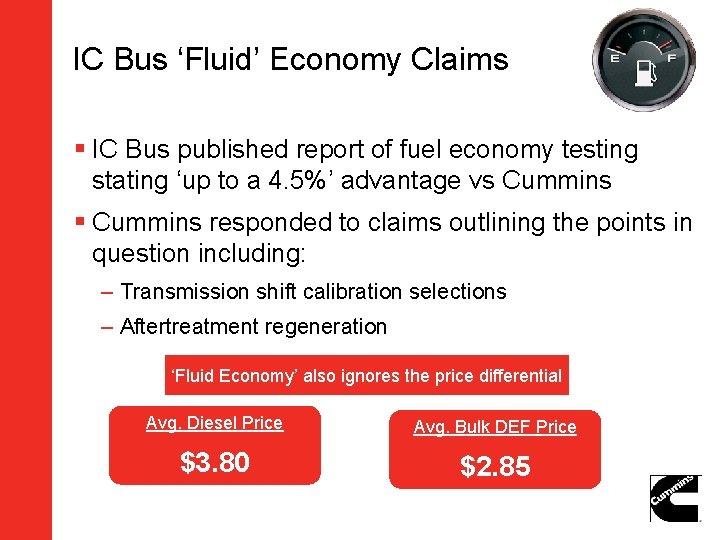
IC Bus ‘Fluid’ Economy Claims § IC Bus published report of fuel economy testing stating ‘up to a 4. 5%’ advantage vs Cummins § Cummins responded to claims outlining the points in question including: – Transmission shift calibration selections – Aftertreatment regeneration ‘Fluid Economy’ also ignores the price differential Avg. Diesel Price Avg. Bulk DEF Price $3. 80 $2. 85
Transmission shift calibrations § IC Bus did not outline what shift calibrations were used during testing § Cummins testing validates that proper selection can result in significant fuel economy gains
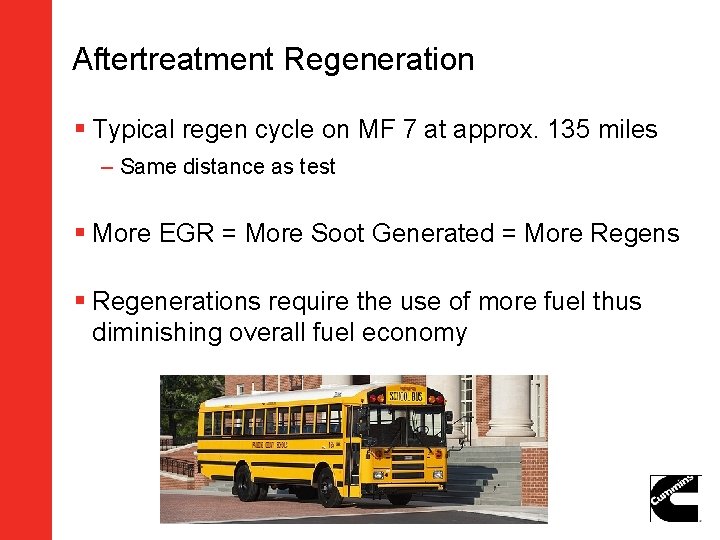
Aftertreatment Regeneration § Typical regen cycle on MF 7 at approx. 135 miles – Same distance as test § More EGR = More Soot Generated = More Regens § Regenerations require the use of more fuel thus diminishing overall fuel economy
‘Fluid’ Economy § IC’s claims of ‘fluid’ economy inaccurately represent total cost of ownership § No mention of DEF consumption thus inability to analyze actual DEF usage for test § Differences in DEF and diesel fuel pricing vary significantly so need to be analyzed separately
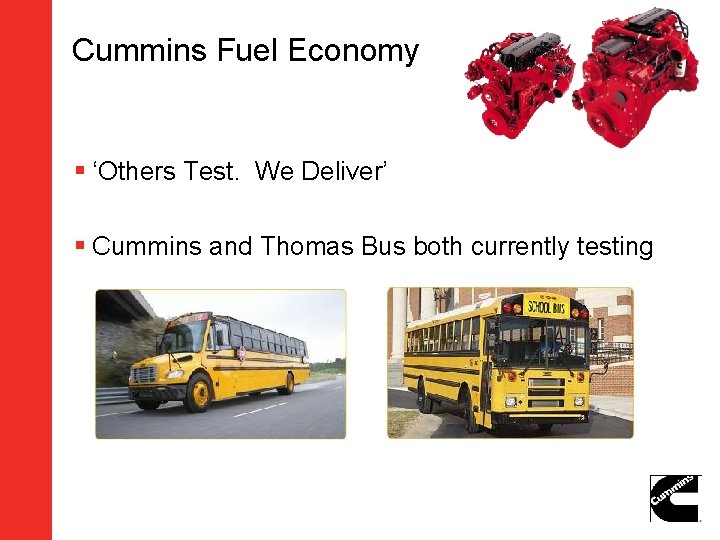
Cummins Fuel Economy § ‘Others Test. We Deliver’ § Cummins and Thomas Bus both currently testing
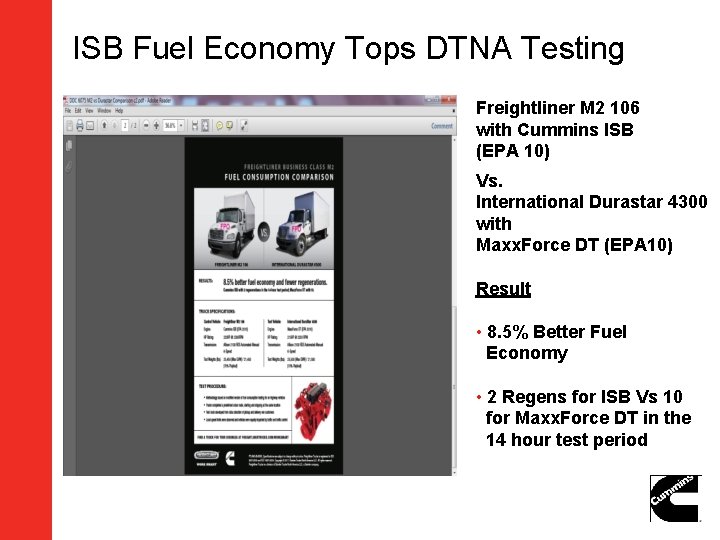
ISB Fuel Economy Tops DTNA Testing Freightliner M 2 106 with Cummins ISB (EPA 10) Vs. International Durastar 4300 with Maxx. Force DT (EPA 10) Result • 8. 5% Better Fuel Economy • 2 Regens for ISB Vs 10 for Maxx. Force DT in the 14 hour test period
In Cylinder NOx Control Challenges § Fuel economy significantly compromised § Increased risk of EGR condensation § Significant increase in heat rejection § Complex system integration § Driver satisfaction significantly compromised § Power density and torque limitations
In Cylinder NOx Control Challenges Fuel Economy Significantly Compromised § 5 -9% disadvantage § Combustion efficiency degradation: – Higher engine pumping losses – Increased intake & exhaust manifold pressures – Increased Particulate Filter regenerations
In Cylinder NOx Control Challenges Increased Risk of EGR Condensation § Higher EGR flow produces excessive acidic condensation § Power cylinder corrosion – Rapid deterioration of lube oil § Reliability and durability compromised
In Cylinder NOx Control Challenges Significant Increase in Heat Rejection § 20% increase § Higher EGR flow: – Multiple EGR coolers on & off engine – Larger vehicle cooling package – Major redesign of radiator / Charge Air Cooler / Fan systems
In Cylinder NOx Control Challenges Complex System Integration § Higher EGR flow § Air handling system § Vehicle cooling system
In Cylinder NOx Control Challenges Driver Satisfaction Significantly Compromised § Higher EGR Flow – Throttle Response
In Cylinder NOx Control Challenges Power Density and Torque Limitations § Deterioration of 50 – 100 hp for same displacement § Higher EGR flow & EGR controls compromises engine performance
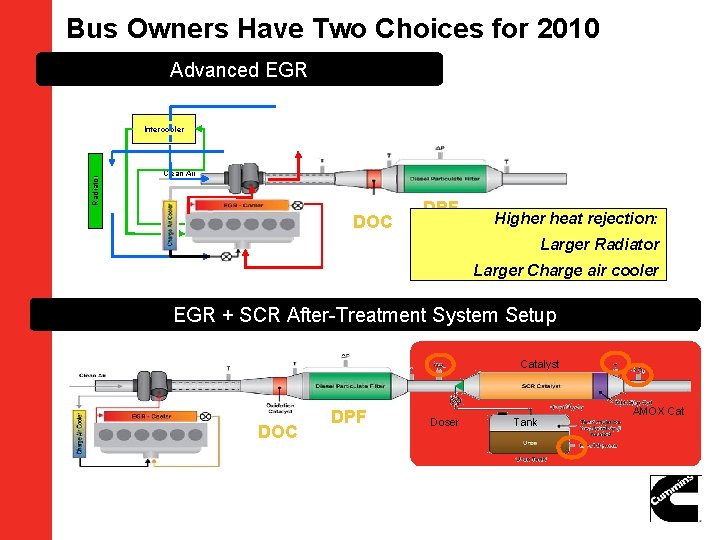
Bus Owners Have Two Choices for 2010 Advanced EGR Radiator Intercooler Clean Air DOC DPF Higher heat rejection: Larger Radiator Larger Charge air cooler EGR + SCR After-Treatment System Setup Catalyst DOC DPF Doser Tank AMOX Cat
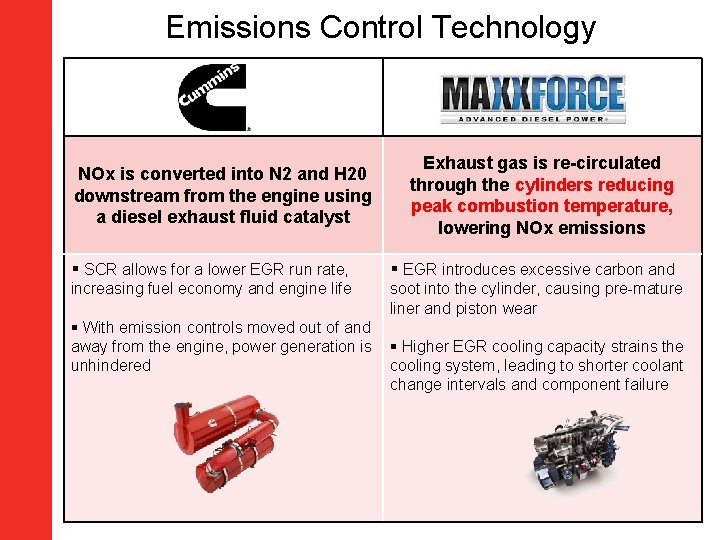
Emissions Control Technology NOx is converted into N 2 and H 20 downstream from the engine using a diesel exhaust fluid catalyst Exhaust gas is re-circulated through the cylinders reducing peak combustion temperature, lowering NOx emissions § SCR allows for a lower EGR run rate, § EGR introduces excessive carbon and increasing fuel economy and engine life soot into the cylinder, causing pre-mature liner and piston wear § With emission controls moved out of and away from the engine, power generation is unhindered § Higher EGR cooling capacity strains the cooling system, leading to shorter coolant change intervals and component failure
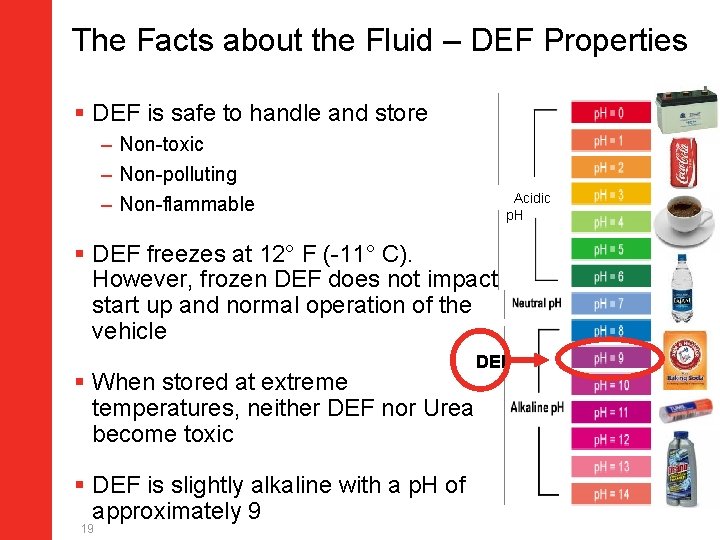
The Facts about the Fluid – DEF Properties § DEF is safe to handle and store – Non-toxic – Non-polluting – Non-flammable Acidic p. H § DEF freezes at 12° F (-11° C). However, frozen DEF does not impact start up and normal operation of the vehicle § When stored at extreme temperatures, neither DEF nor Urea become toxic § DEF is slightly alkaline with a p. H of approximately 9 19 DEF
DEF - Myths & Facts § Navistar’s claim of ammonia level being close to 1000 ppm in a near empty DEF tank is a ‘stretch of imagination’ § DEF, when heated and maintained at a constant temperature 120 degrees Fahrenheit, will very slowly start to form small amounts of ammonia § It would take over two years at this constant temperature to convert DEF into levels of 1000 ppm of ammonia § Such a situation can be probably modeled in ‘laboratory setting’ but not in the real world
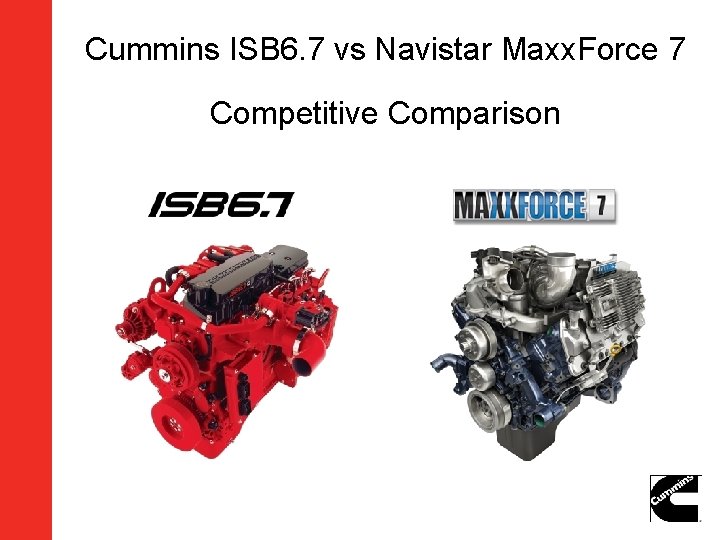
Cummins ISB 6. 7 vs Navistar Maxx. Force 7 Competitive Comparison
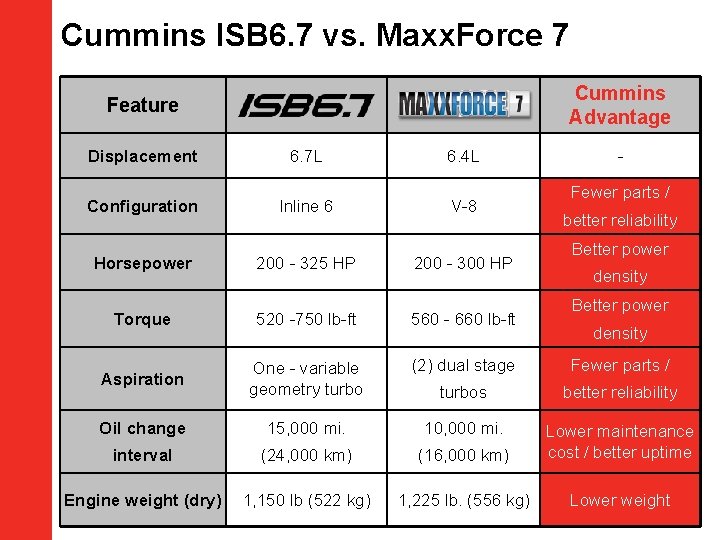
Cummins ISB 6. 7 vs. Maxx. Force 7 Cummins Advantage Feature Displacement Configuration Horsepower 6. 7 L Inline 6 200 - 325 HP 6. 4 L V-8 200 - 300 HP Fewer parts / better reliability Better power density Better power Torque 520 -750 lb-ft 560 - 660 lb-ft Aspiration One - variable geometry turbo (2) dual stage Fewer parts / turbos better reliability Oil change 15, 000 mi. 10, 000 mi. interval (24, 000 km) (16, 000 km) Lower maintenance cost / better uptime Engine weight (dry) 1, 150 lb (522 kg) 1, 225 lb. (556 kg) Lower weight density
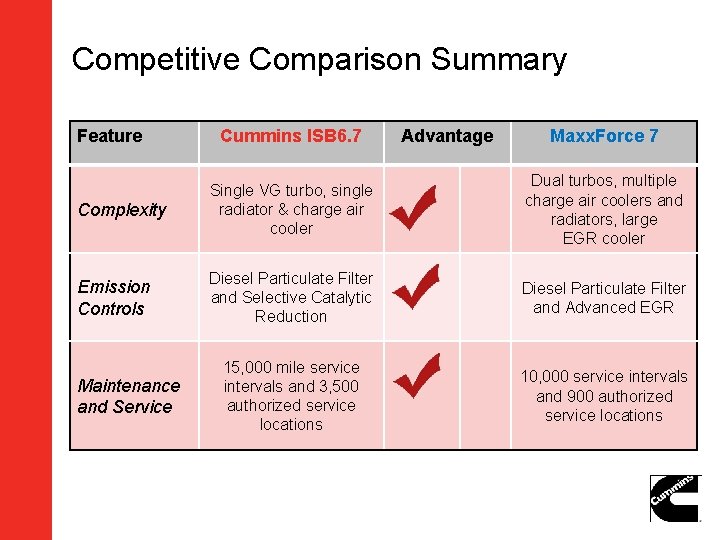
Competitive Comparison Summary Feature Cummins ISB 6. 7 Advantage Maxx. Force 7 Complexity Single VG turbo, single radiator & charge air cooler Dual turbos, multiple charge air coolers and radiators, large EGR cooler Emission Controls Diesel Particulate Filter and Selective Catalytic Reduction Diesel Particulate Filter and Advanced EGR 15, 000 mile service intervals and 3, 500 authorized service locations 10, 000 service intervals and 900 authorized service locations Maintenance and Service
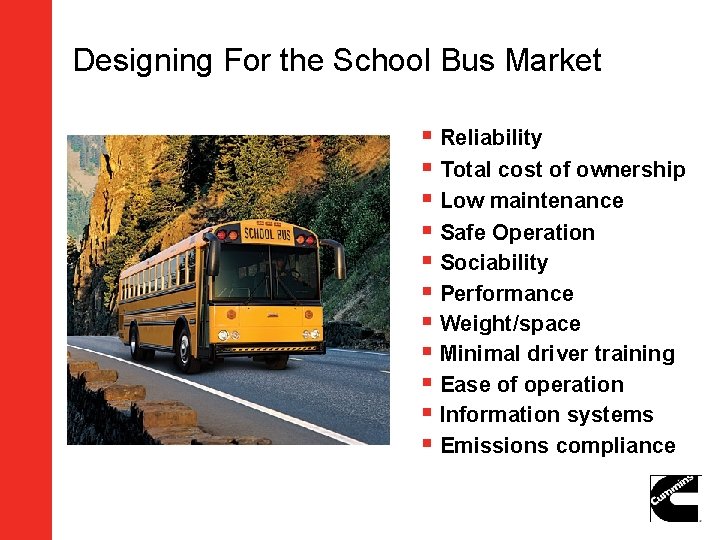
Designing For the School Bus Market § Reliability § Total cost of ownership § Low maintenance § Safe Operation § Sociability § Performance § Weight/space § Minimal driver training § Ease of operation § Information systems § Emissions compliance
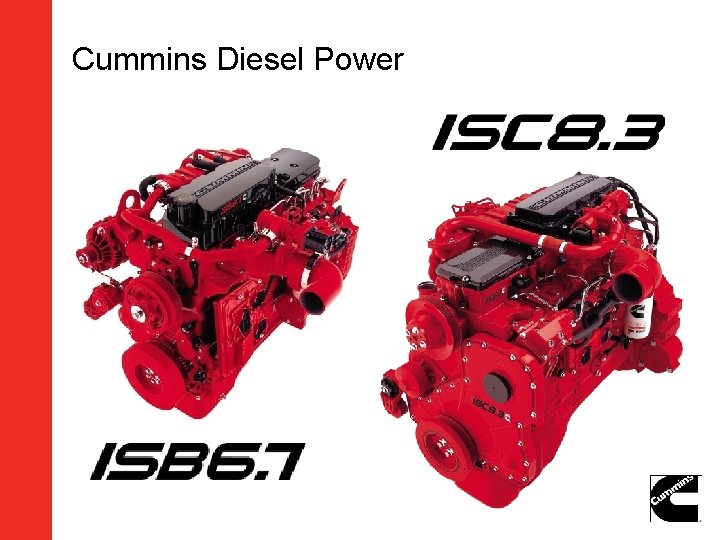
Cummins Diesel Power
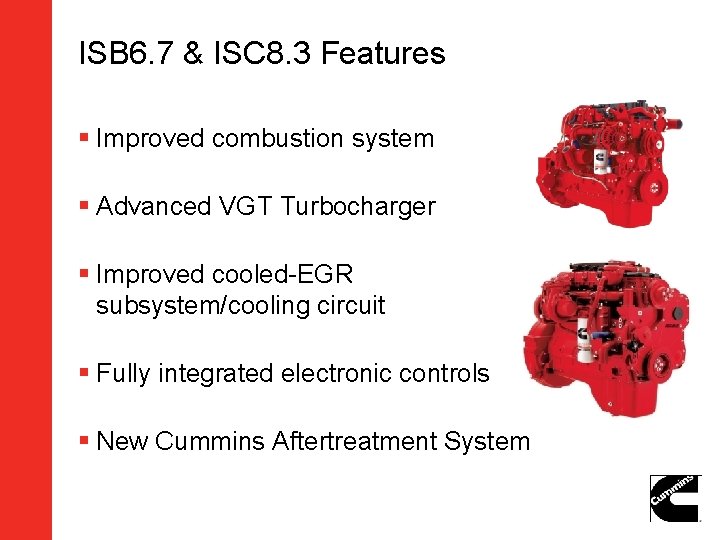
ISB 6. 7 & ISC 8. 3 Features § Improved combustion system § Advanced VGT Turbocharger § Improved cooled-EGR subsystem/cooling circuit § Fully integrated electronic controls § New Cummins Aftertreatment System
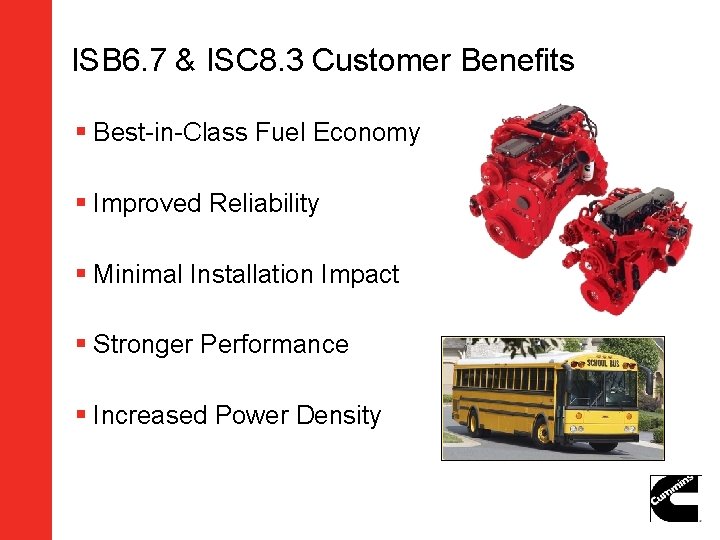
ISB 6. 7 & ISC 8. 3 Customer Benefits § Best-in-Class Fuel Economy § Improved Reliability § Minimal Installation Impact § Stronger Performance § Increased Power Density
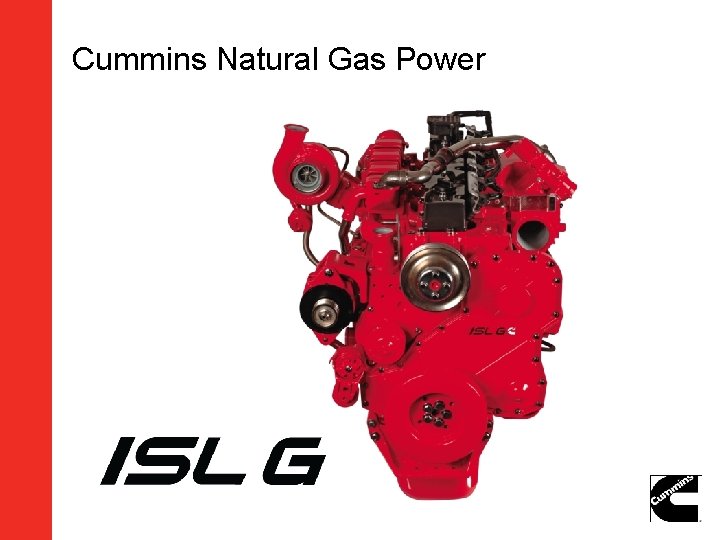
Cummins Natural Gas Power
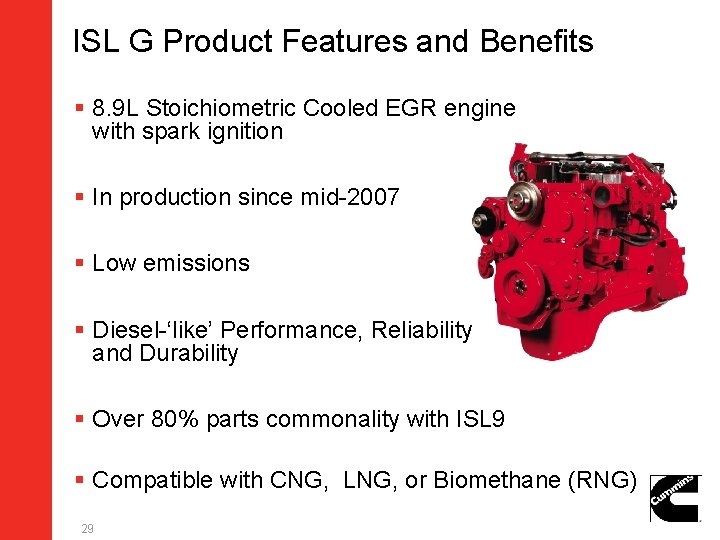
ISL G Product Features and Benefits § 8. 9 L Stoichiometric Cooled EGR engine with spark ignition § In production since mid-2007 § Low emissions § Diesel-‘like’ Performance, Reliability and Durability § Over 80% parts commonality with ISL 9 § Compatible with CNG, LNG, or Biomethane (RNG) 29
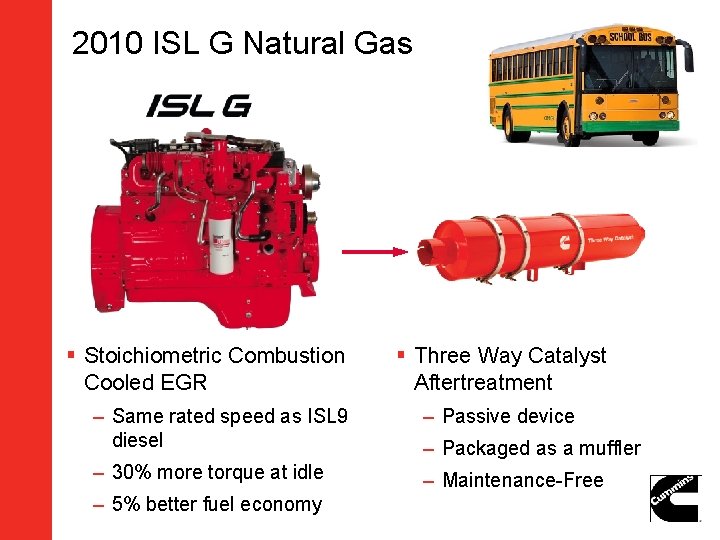
2010 ISL G Natural Gas § Stoichiometric Combustion Cooled EGR § Three Way Catalyst Aftertreatment – Same rated speed as ISL 9 diesel – Passive device – 30% more torque at idle – Maintenance-Free – 5% better fuel economy – Packaged as a muffler
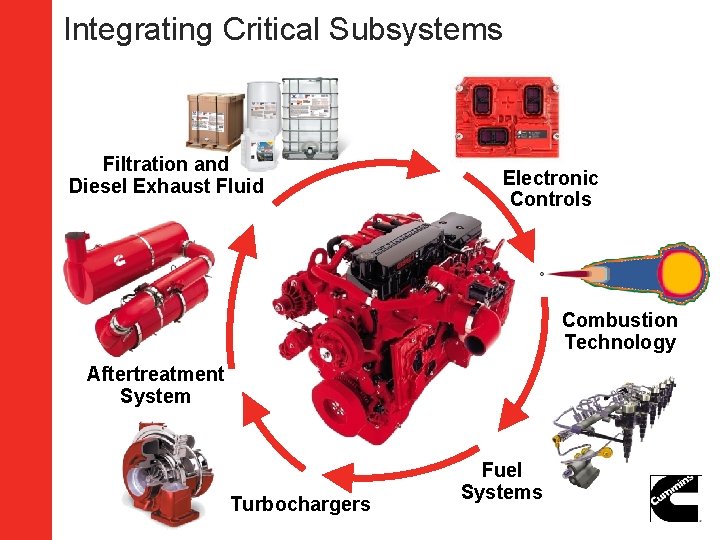
Integrating Critical Subsystems Filtration and Diesel Exhaust Fluid Electronic Controls Combustion Technology Aftertreatment System Turbochargers Fuel Systems
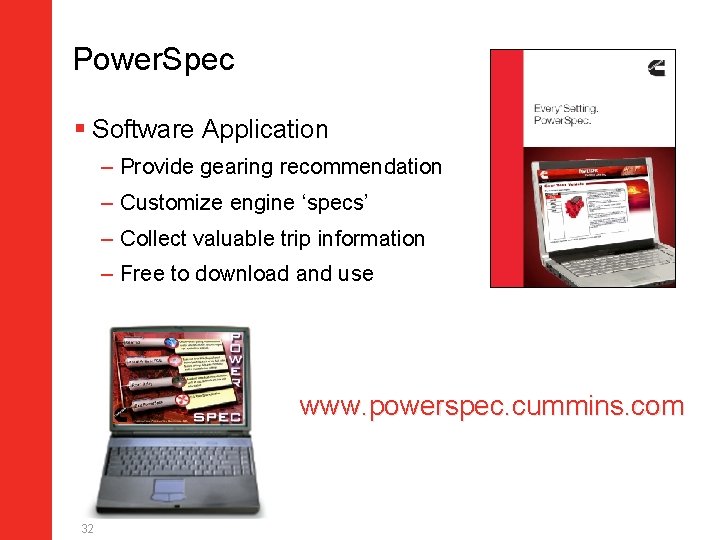
Power. Spec § Software Application – Provide gearing recommendation – Customize engine ‘specs’ – Collect valuable trip information – Free to download and use www. powerspec. cummins. com 32
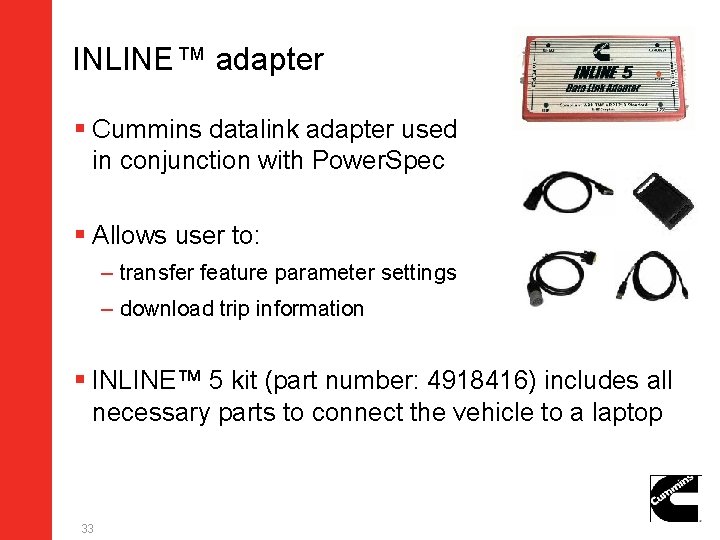
INLINE™ adapter § Cummins datalink adapter used in conjunction with Power. Spec § Allows user to: – transfer feature parameter settings – download trip information § INLINE™ 5 kit (part number: 4918416) includes all necessary parts to connect the vehicle to a laptop 33
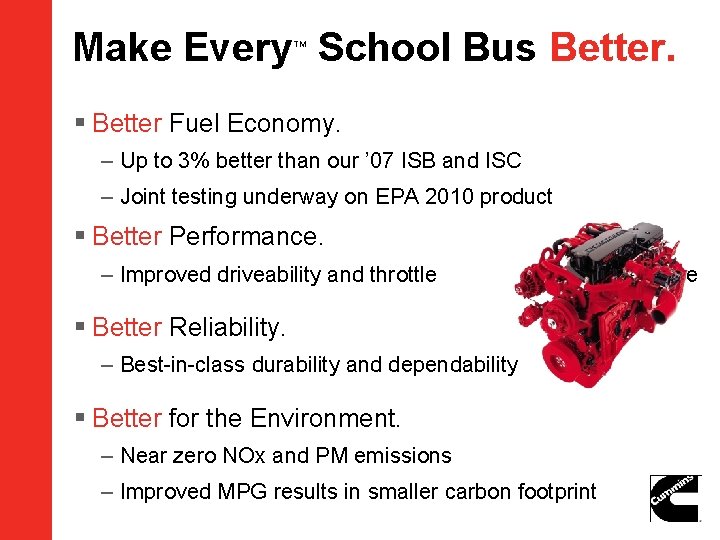
Make Every School Bus Better. TM § Better Fuel Economy. – Up to 3% better than our ’ 07 ISB and ISC – Joint testing underway on EPA 2010 product § Better Performance. – Improved driveability and throttle § Better Reliability. – Best-in-class durability and dependability § Better for the Environment. – Near zero NOx and PM emissions – Improved MPG results in smaller carbon footprint response
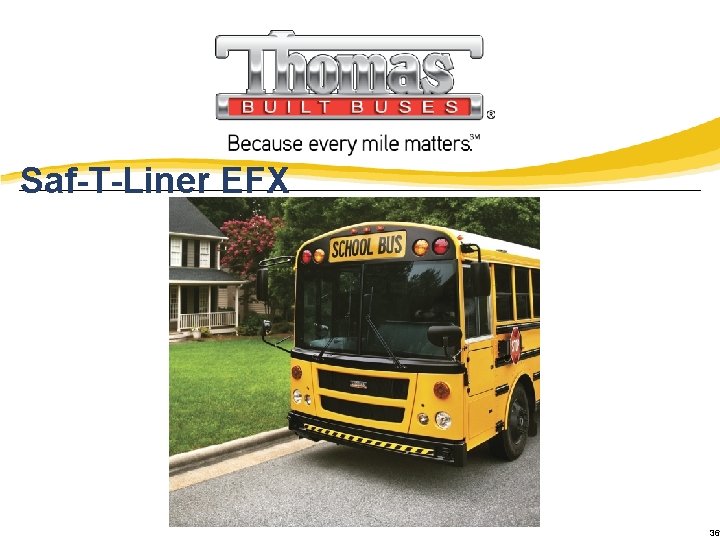
Saf-T-Liner EFX 36
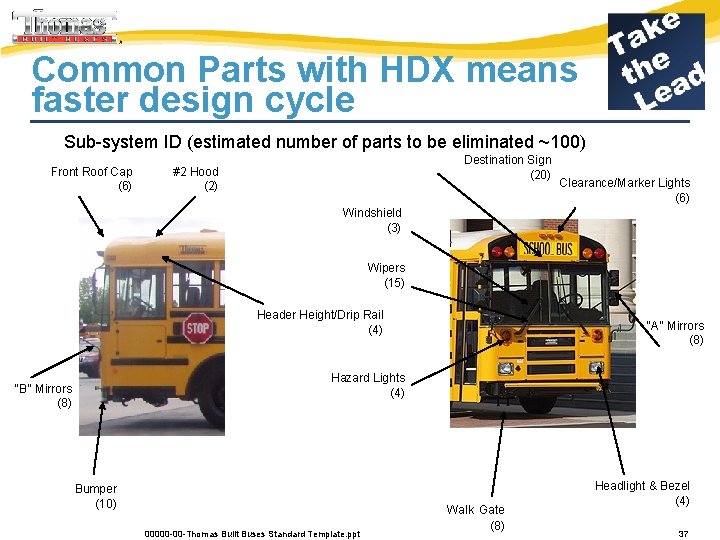
Common Parts with HDX means faster design cycle Sub-system ID (estimated number of parts to be eliminated ~100) Front Roof Cap (6) Destination Sign (20) #2 Hood (2) Clearance/Marker Lights (6) Windshield (3) Wipers (15) Header Height/Drip Rail (4) “A” Mirrors (8) Hazard Lights (4) “B” Mirrors (8) Bumper (10) 00000 -00 -Thomas Built Buses Standard Template. ppt Walk Gate (8) Headlight & Bezel (4) 37
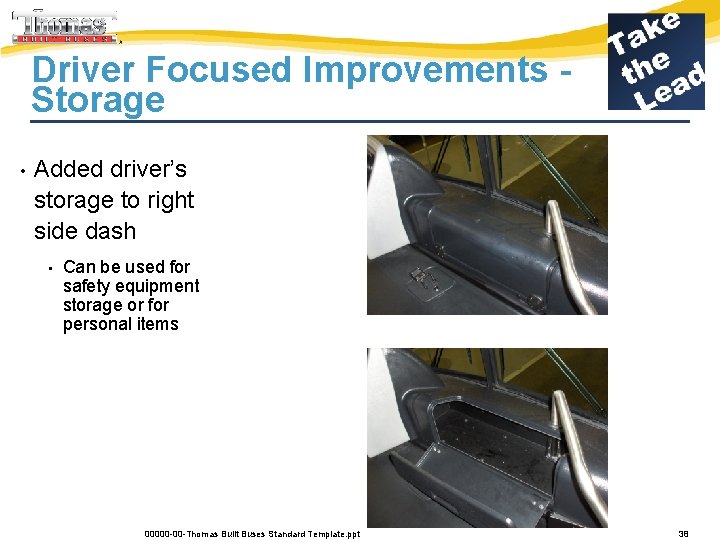
Driver Focused Improvements Storage • Added driver’s storage to right side dash • Can be used for safety equipment storage or for personal items 00000 -00 -Thomas Built Buses Standard Template. ppt 38
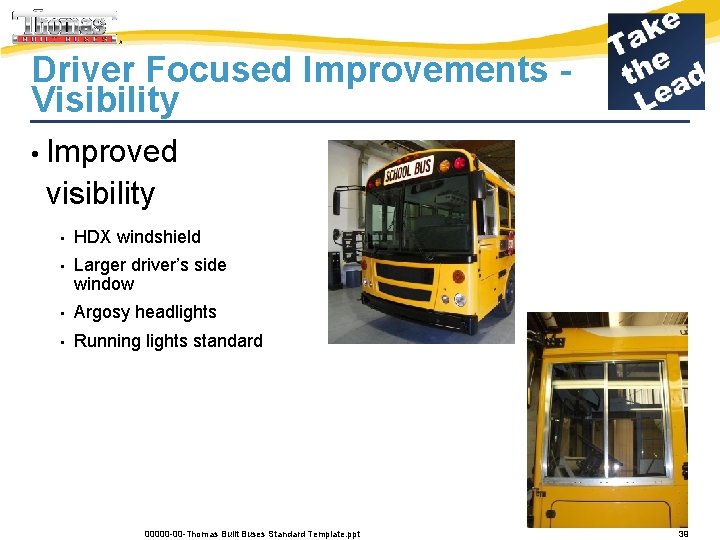
Driver Focused Improvements Visibility • Improved visibility • HDX windshield • Larger driver’s side window • Argosy headlights • Running lights standard 00000 -00 -Thomas Built Buses Standard Template. ppt 39
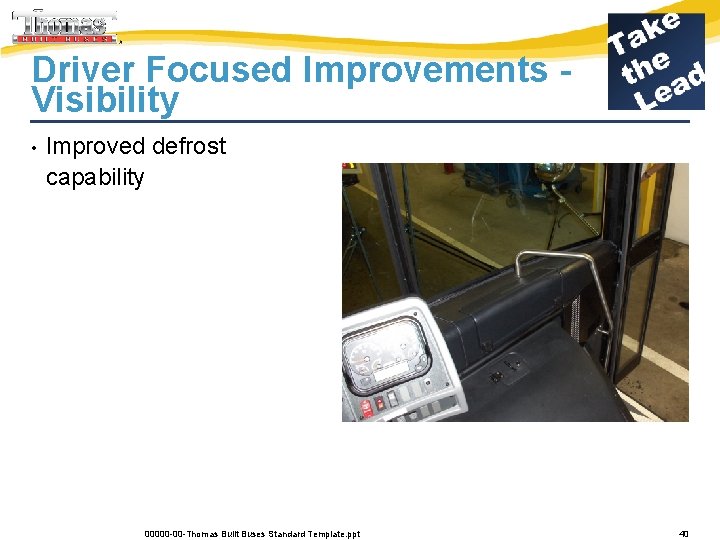
Driver Focused Improvements Visibility • Improved defrost capability 00000 -00 -Thomas Built Buses Standard Template. ppt 40
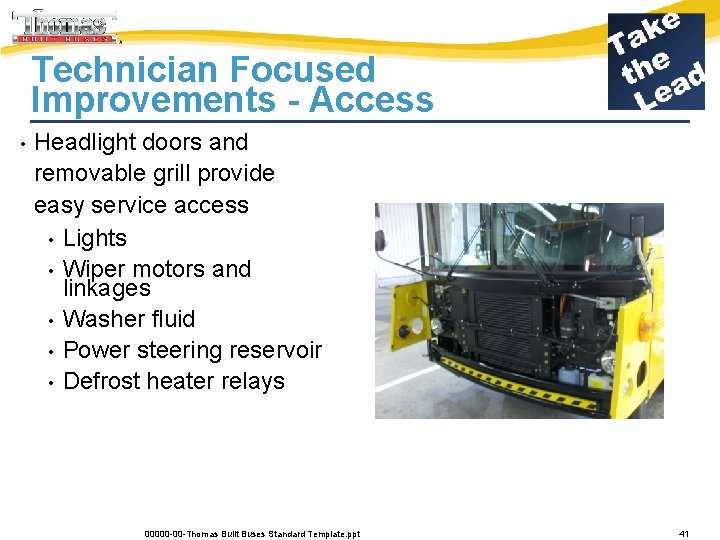
Technician Focused Improvements - Access • Headlight doors and removable grill provide easy service access • Lights • Wiper motors and linkages • Washer fluid • Power steering reservoir • Defrost heater relays 00000 -00 -Thomas Built Buses Standard Template. ppt 41
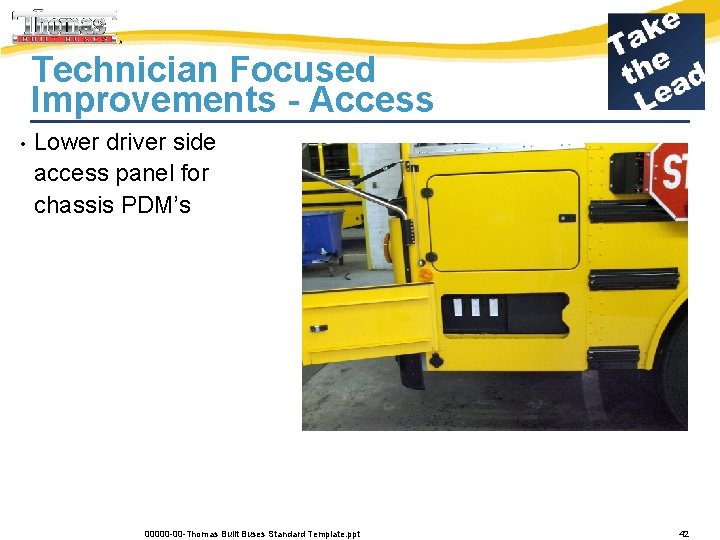
Technician Focused Improvements - Access • Lower driver side access panel for chassis PDM’s 00000 -00 -Thomas Built Buses Standard Template. ppt 42
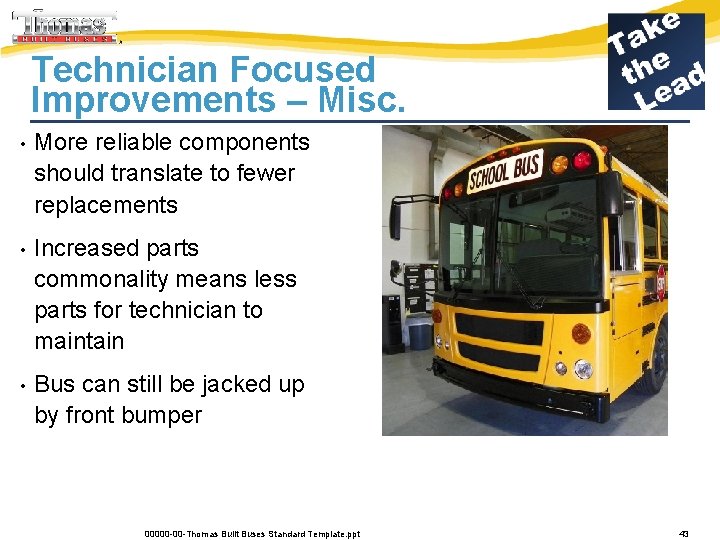
Technician Focused Improvements – Misc. • More reliable components should translate to fewer replacements • Increased parts commonality means less parts for technician to maintain • Bus can still be jacked up by front bumper 00000 -00 -Thomas Built Buses Standard Template. ppt 43
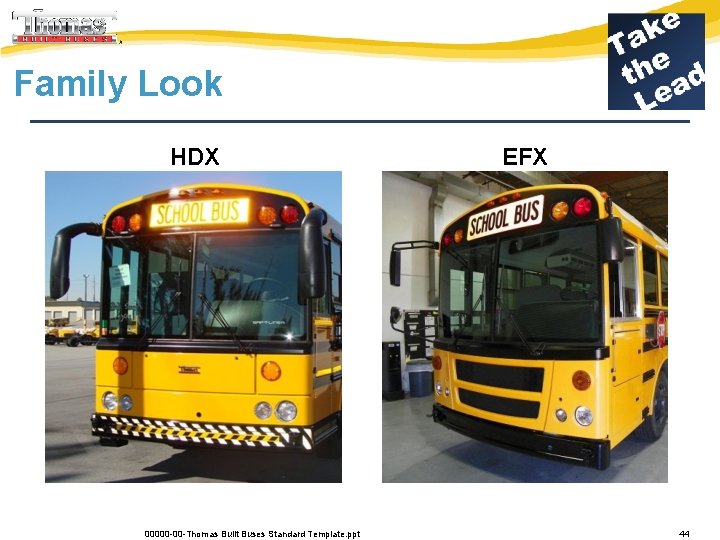
Family Look HDX 00000 -00 -Thomas Built Buses Standard Template. ppt EFX 44
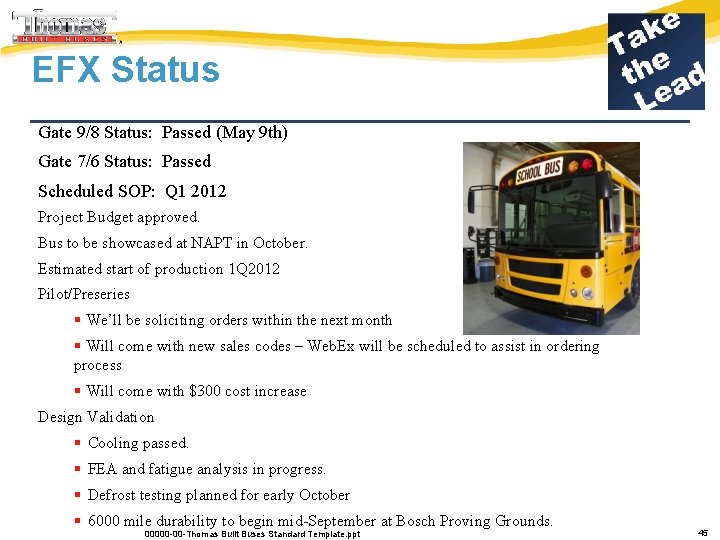
EFX Status Gate 9/8 Status: Passed (May 9 th) Gate 7/6 Status: Passed Scheduled SOP: Q 1 2012 Project Budget approved. Bus to be showcased at NAPT in October. Estimated start of production 1 Q 2012 Pilot/Preseries § We’ll be soliciting orders within the next month § Will come with new sales codes – Web. Ex will be scheduled to assist in ordering process § Will come with $300 cost increase Design Validation § Cooling passed. § FEA and fatigue analysis in progress. § Defrost testing planned for early October § 6000 mile durability to begin mid-September at Bosch Proving Grounds. 00000 -00 -Thomas Built Buses Standard Template. ppt 45
Questions? Thomas Built Buses Dealer Sales Meeting 2012 46
- Slides: 46