
Make Do and Mend Teaching the history of
- Slides: 13
Make Do and Mend Teaching the history of women in World War Two to KS 2
A Cross-Curricular Approach • A deeper, more complex understanding, achieved with a more efficient use of time • Likely implications of the Rose Review • Human, Social and Environmental Understanding
What subjects? • English / literacy: reading…. Goodnight Mr Tom, When Hitler Stole Pink Rabbit, War Boy? ; writing… • Maths / numeracy: calculations to do with rationing? • Science / Geography: environment, materials and growing things? • Design / Technology: knitting, mending and ration-book cookery? • Art / Design: posters, memorials?
Historical skills and concepts • • Communicating about the past. Using and manipulating evidence. Causation – why do people act in certain ways? Significance – what should we remember and why? • Chronology – shortages and rationing; women’s lives? • Diversity – different experiences of living through the war.
War-time cooking • Concerns about stereotyping women’s lives… balanced by facts of history! • Children’s interest? • Practicals? • Cross-curricular opportunities: geography, maths, food tech. . . ? • Every Child Matters agenda – can lead into discussions on healthy eating, as well as safety in the kitchen, household budgeting (? ) etc
Victory Sponge • • 1 large raw potato, finely grated 2 medium raw carrots, finely grated 1 breakfastcupful breadcrumbs 1 tablespoon self-raising flour 2 tablespoons sugar ½ teaspoonful vanilla or lemon flavouring 1 teaspoonful baking powder 2/3 tablespoons of jam
• How is this different to cakes / puddings made today? • Why is this different? • Where does sugar grow? • How does Britain feed her people? Then? Now? • What did Britain’s enemies do? • Why are carrots included in this recipe? (Carrot halwa) • What does this tell us about people’s lives at home during World War Two? • What other things might they have to do? • What do you think people at the time felt about the food?
Clothing • Similarities to sugar – shortages • Discussions of textiles, different qualities of them. • Discussions of clothes, and why they are so important to people. • How can you mend things? Sewing on buttons, sides to middle etc. • Why was this women’s work in the war? Not in the war?
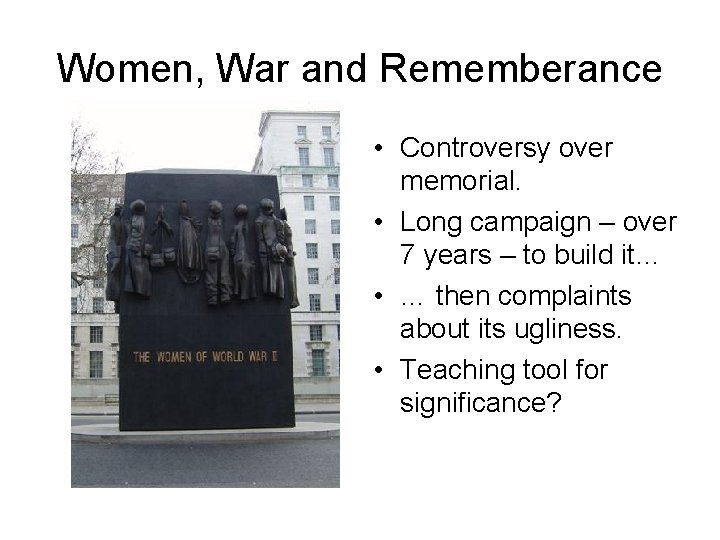
Women, War and Rememberance • Controversy over memorial. • Long campaign – over 7 years – to build it… • … then complaints about its ugliness. • Teaching tool for significance?
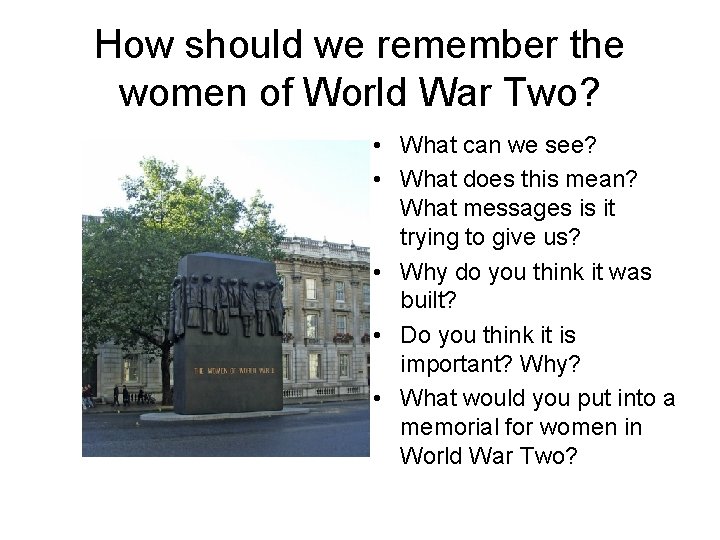
How should we remember the women of World War Two? • What can we see? • What does this mean? What messages is it trying to give us? • Why do you think it was built? • Do you think it is important? Why? • What would you put into a memorial for women in World War Two?
Human, Social and Environmental Understanding? • What happens when people’s resources are limited? • How can people best maximise the use of available resources? • Why do people make the choices they do, about the resources they have?
Some further ideas / reading • Temple, Sue, “Justifying the links – Art and History”, Primary History, Summer 2008 • Vass, Peter, “Dealing with the Dead”, Primary History, Summer 2007 • Wrenn, Andrew, “Engaging with globalisation”, Primary Subjects, Spring 2009 • Wrenn, Andrew, “Oh no – not more extended writing!” E-CPD Unit 2, The HA website