
Make any IACUC More Effective A VA Perspective



- Slides: 45
Make any IACUC More Effective: A VA Perspective Workshop A 3 1 April 2016
Who We Are Office of the Chief Veterinary Medical Officer Office of Research and Development Department of Veterans Affairs Alice Huang, Ph. D, CPIA Staff Scientist and Deputy for IACUC Guidance MA Mc. Crackin, DVM, Ph. D, DACVS, DACLAM, CMAR Special Consultant on Regulatory Affairs Joan T Richerson, MS, DVM, MS, DACLAM, CPIA Assistant Chief Veterinary Medical Officer
Disclosure of Conflicts of Interest Alice Huang, MA Mc. Crackin, and Joan Richerson have no relevant personal/professional/financial relationship(s) with respect to this educational activity
Learning Objectives 1. Addressing and documenting deficiencies 2. Managing potential Guide deviations 3. Recent hot button issues in AAALAC site visits 4. VA updates (brief)
What Do We Do with Deficiencies That We Find? Alice Huang, Ph. D, CPIA
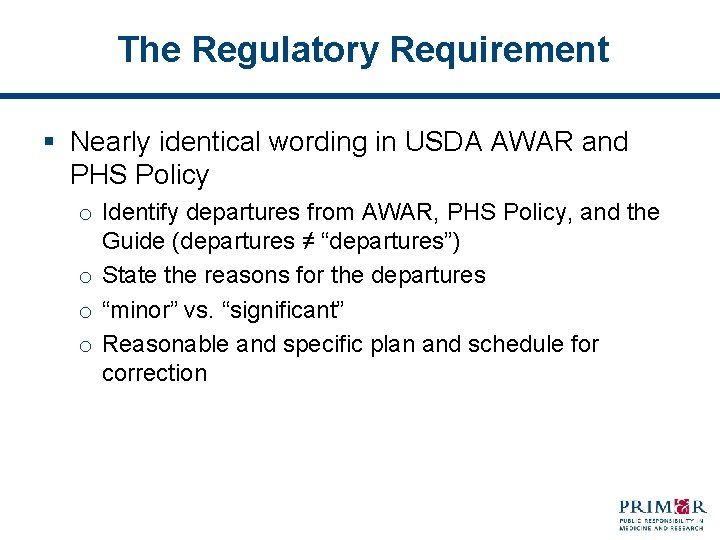
The Regulatory Requirement § Nearly identical wording in USDA AWAR and PHS Policy o Identify departures from AWAR, PHS Policy, and the Guide (departures ≠ “departures”) o State the reasons for the departures o “minor” vs. “significant” o Reasonable and specific plan and schedule for correction
What’s the Point? § A tool for improvement § NOT o Forced confession o Busy work
Consider … § A member of the semiannual inspection team enters a post-op recovery room and sees a pile of bloody surgical towels on the floor, and a puddle of clear liquid nearby. § There are no research personnel present § What should the inspection team do?
VA Forms for Semiannual Reports Available online http: //www. research. va. gov/programs/ animal_research/documents. cfm Forms for Semiannual Evaluations of the Institutional Care and Use Program and Facilities www. primr. org/IACUC 16 The PRIM&R IACUC 16 Conference Portal
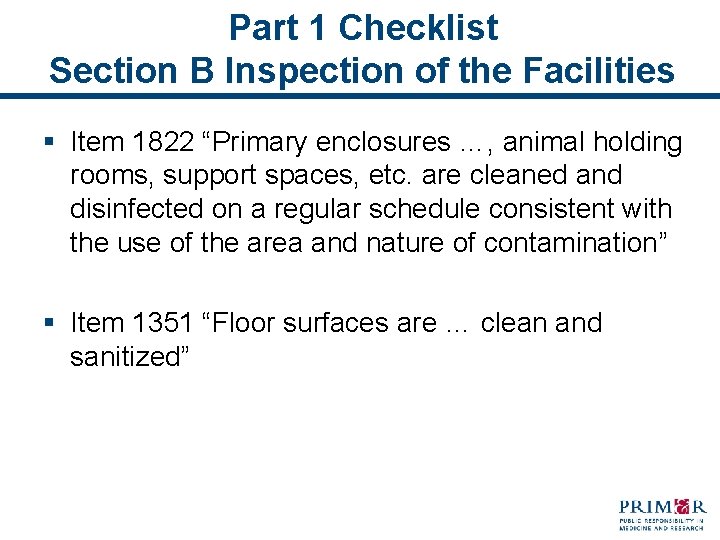
Part 1 Checklist Section B Inspection of the Facilities § Item 1822 “Primary enclosures …, animal holding rooms, support spaces, etc. are cleaned and disinfected on a regular schedule consistent with the use of the area and nature of contamination” § Item 1351 “Floor surfaces are … clean and sanitized”
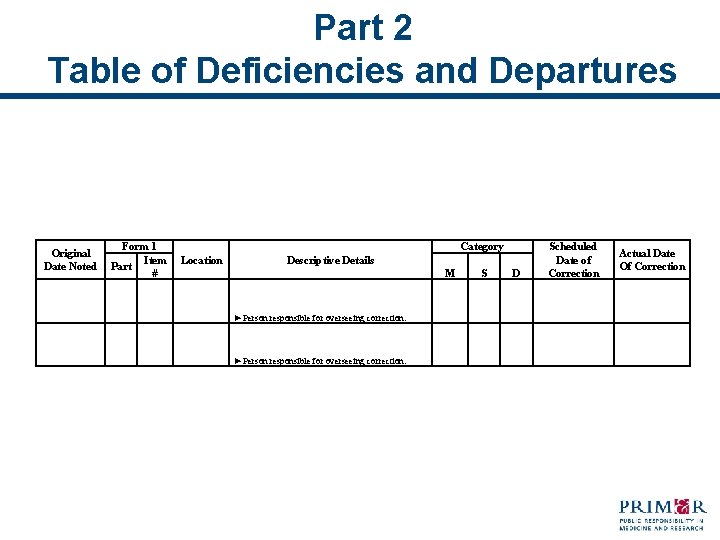
Part 2 Table of Deficiencies and Departures Original Date Noted Form 1 Item Part # Category Location Descriptive Details M ►Person responsible for overseeing correction: S D Scheduled Date of Correction Actual Date Of Correction
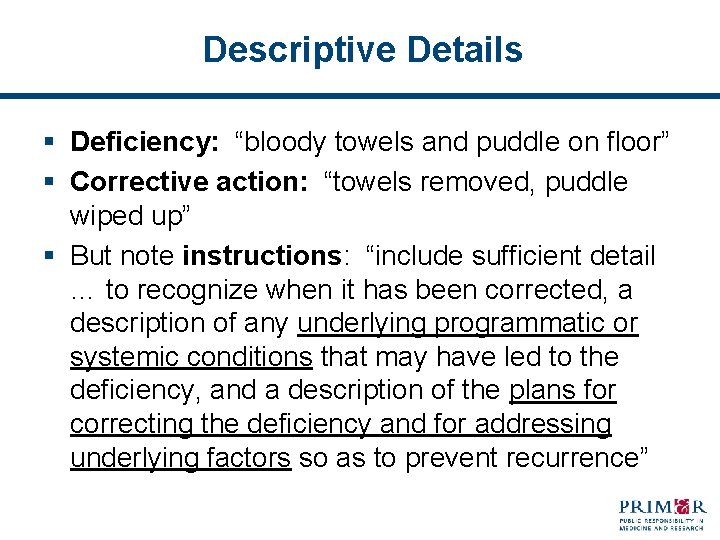
Descriptive Details § Deficiency: “bloody towels and puddle on floor” § Corrective action: “towels removed, puddle wiped up” § But note instructions: “include sufficient detail … to recognize when it has been corrected, a description of any underlying programmatic or systemic conditions that may have led to the deficiency, and a description of the plans for correcting the deficiency and for addressing underlying factors so as to prevent recurrence”
Look for a cure, don’t just treat the symptoms § Identify specific factors that led to the deficiency § Focus on the factors that the institution can do something about § Find these by considering the bigger picture – what is the context of the deficiency?
What if … § Another member of the inspection team had entered the room a moment earlier and witnessed a member of a research team leaving the room with a post-op animal and its water bowl, to return the animal to its home cage?
What if … § The room was dark when the door was opened, and the calendar in the room showed that the last scheduled use of the room was a week ago?
In all depends on context … § Whether the observation reflects a deficiency § The significance of the deficiency § The appropriate corrective action § The appropriate timeline for correction
Next up … Documenting potential “departures” from the Guide Joan T Richerson, MS, DVM, MS, DACLAM, CPIA
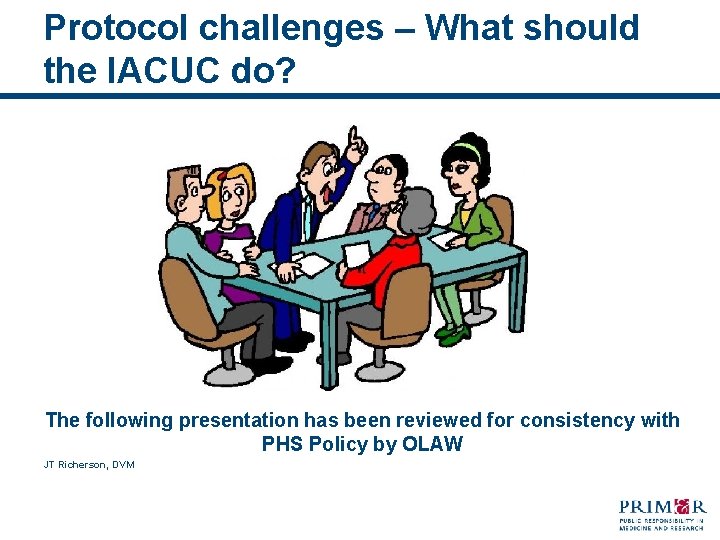
Protocol challenges – What should the IACUC do? The following presentation has been reviewed for consistency with PHS Policy by OLAW JT Richerson, DVM
Protocol challenges – What should the IACUC do? IACUC Issue: The Hometown VA - IACUC is struggling with a Guide “should” statement regarding surgical site preparation for nonsurvival surgeries. On page 118, the Guide states “It may not be necessary to follow all the techniques outlined in this section if nonsurvival surgery is performed but, at a minimum, the surgical site should be clipped, the surgeon should wear gloves, and the instruments and surrounding area should be clean (Slattum et al. 1991). ”
IACUC Issue continued… A few members of the IACUC are advocating for a policy that would not require hair/fur clipping for acute terminal procedures. The IACUC Chair asked how will we justify not clipping the surgical site when the Guide clearly states it is required for nonsurvival surgery.
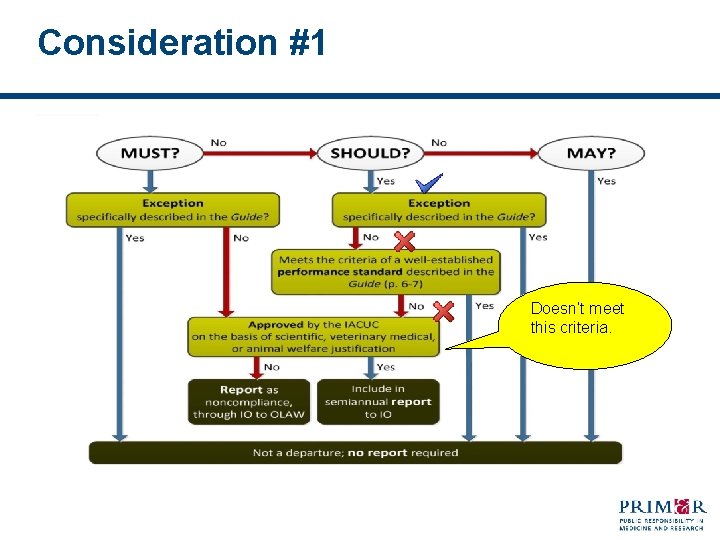
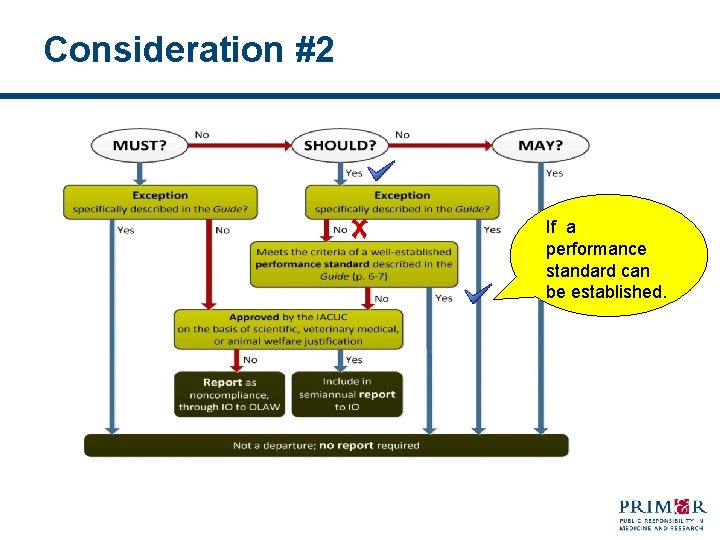
Consideration # 1 Could the IACUC justify approving a deviation from a “should” statement in the Guide (i. e. an approved departure) to allow nonsurvival surgery to be performed without clipping the surgical site? § Note: A performance standard has not been established by the IACUC.
Consideration #1 Doesn’t meet this criteria.
Consideration #1 § Conclusion: The IACUC cannot support an approved departure for not clipping the surgical site when a non-survival surgery is performed because of a lack of justification on a scientific, veterinary medical or animal welfare basis.
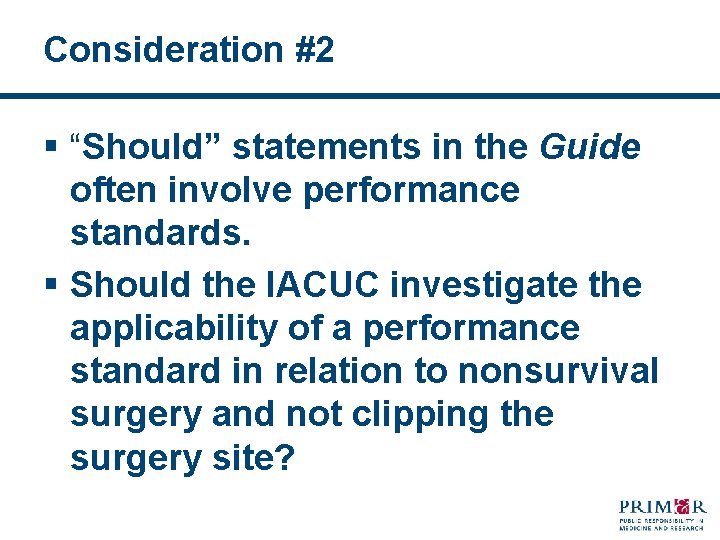
Consideration #2 § “Should” statements in the Guide often involve performance standards. § Should the IACUC investigate the applicability of a performance standard in relation to nonsurvival surgery and not clipping the surgery site?
Consideration #2 If a performance standard can be established.
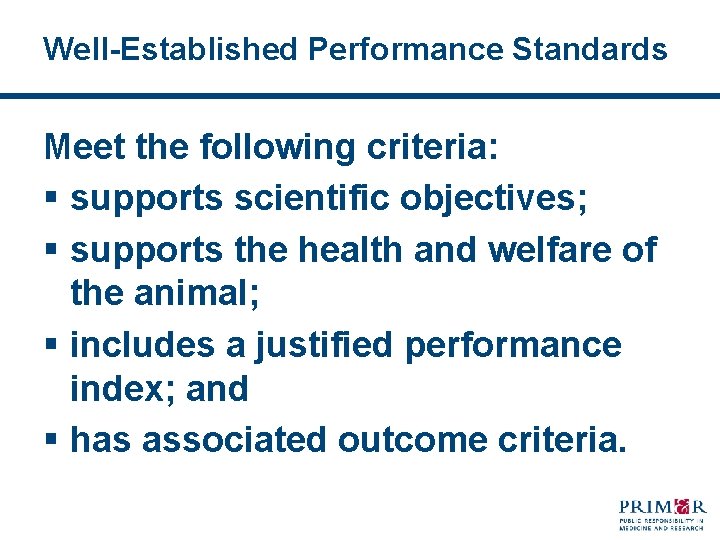
Well-Established Performance Standards Meet the following criteria: § supports scientific objectives; § supports the health and welfare of the animal; § includes a justified performance index; and § has associated outcome criteria.
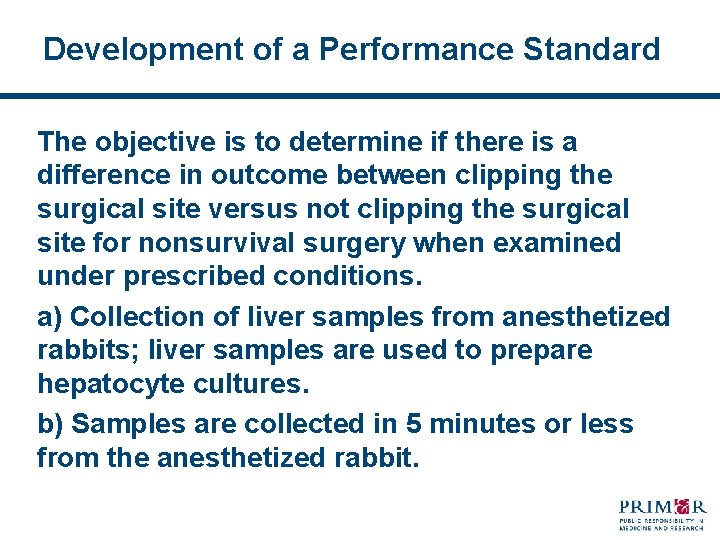
Development of a Performance Standard The objective is to determine if there is a difference in outcome between clipping the surgical site versus not clipping the surgical site for nonsurvival surgery when examined under prescribed conditions. a) Collection of liver samples from anesthetized rabbits; liver samples are used to prepare hepatocyte cultures. b) Samples are collected in 5 minutes or less from the anesthetized rabbit.
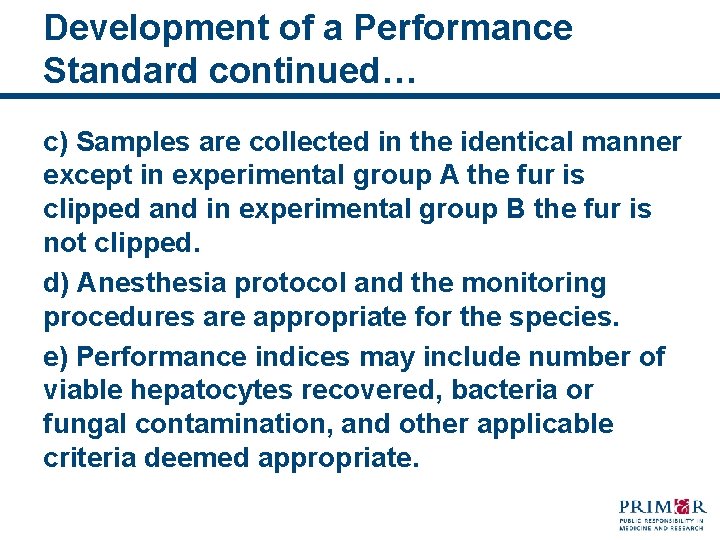
Development of a Performance Standard continued… c) Samples are collected in the identical manner except in experimental group A the fur is clipped and in experimental group B the fur is not clipped. d) Anesthesia protocol and the monitoring procedures are appropriate for the species. e) Performance indices may include number of viable hepatocytes recovered, bacteria or fungal contamination, and other applicable criteria deemed appropriate.
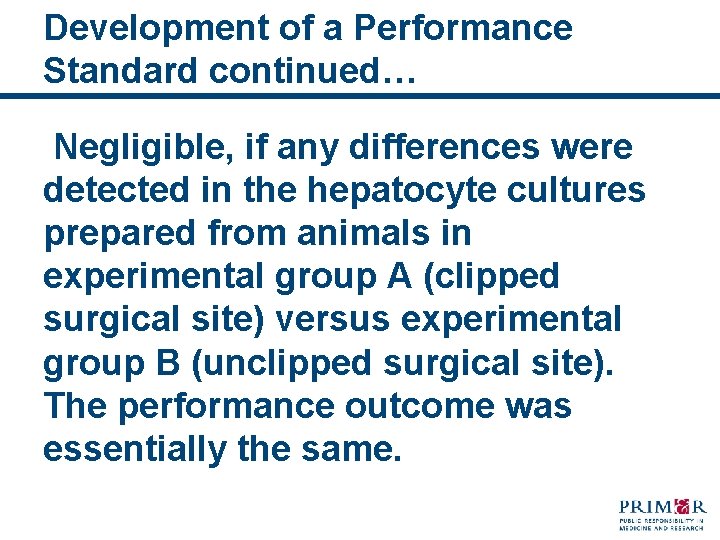
Development of a Performance Standard continued… Negligible, if any differences were detected in the hepatocyte cultures prepared from animals in experimental group A (clipped surgical site) versus experimental group B (unclipped surgical site). The performance outcome was essentially the same.
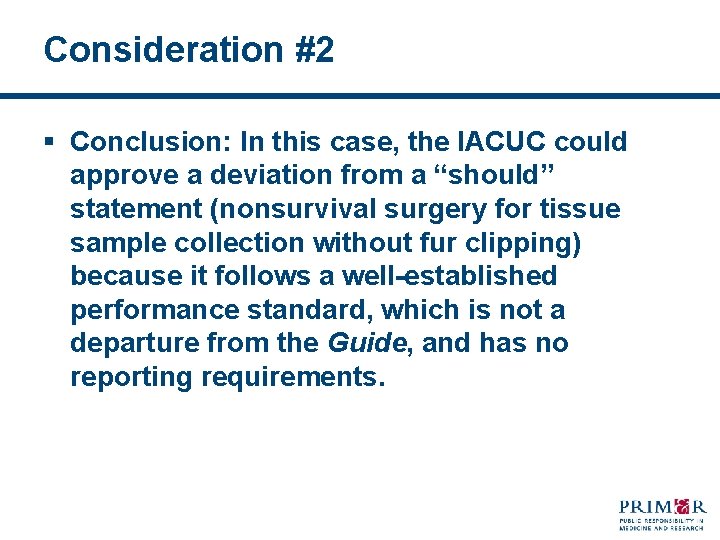
Consideration #2 § Conclusion: In this case, the IACUC could approve a deviation from a “should” statement (nonsurvival surgery for tissue sample collection without fur clipping) because it follows a well-established performance standard, which is not a departure from the Guide, and has no reporting requirements.
Take home point: § Performance standards may be described in: § a Standard Operating Procedure or § a protocol depending on the circumstances.
Next up … AAALAC Site Visits – Perspectives of an Ad hoc Member of Site Visit Teams MA Mc. Crackin DVM, Ph. D, DACVS, DACLAM, CMAR
AAALAC Site Visits: HOT BUTTON ISSUES MA Mc. Crackin DVM, Ph. D, DACVS, DACLAM, CMAR
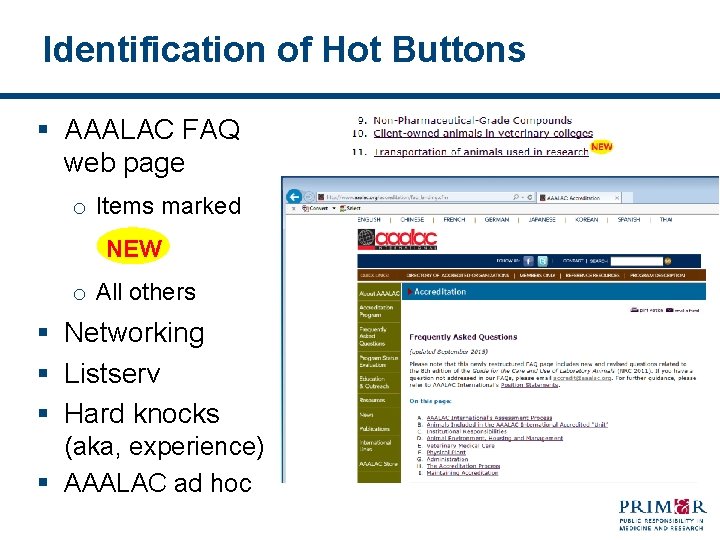
Identification of Hot Buttons § AAALAC FAQ web page o Items marked NEW o All others § Networking § Listserv § Hard knocks (aka, experience) § AAALAC ad hoc
Ad hoc Experience § Council members lead visit § Ad hocs participate § Learn current trends by observation, discussion, osmosis § Opinions today are mine – not AAALAC’s § Many findings can be traced back to the Guide Credit: http: //images. nap. edu/images/cover. php? id=12910& type=covers 450
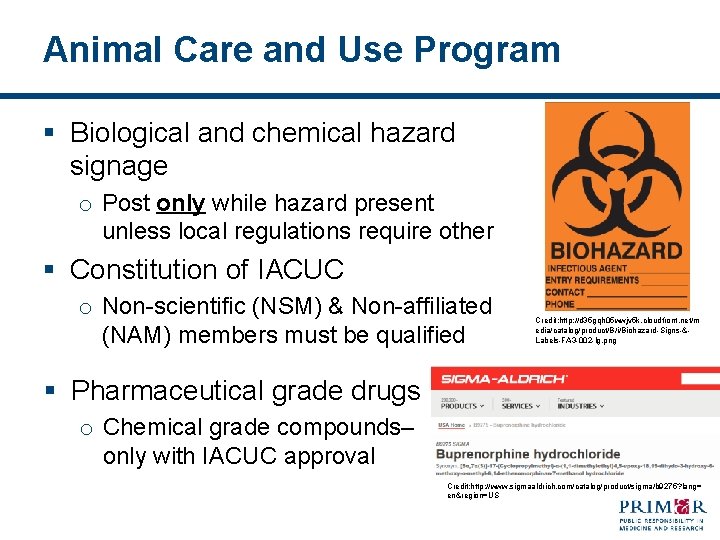
Animal Care and Use Program § Biological and chemical hazard signage o Post only while hazard present unless local regulations require other § Constitution of IACUC o Non-scientific (NSM) & Non-affiliated (NAM) members must be qualified Credit: http: //d 35 gqh 05 wwjv 5 k. cloudfront. net/m edia/catalog/product/B/i/Biohazard-Signs-&Labels-FA 3 -002 -lg. png § Pharmaceutical grade drugs o Chemical grade compounds– only with IACUC approval Credit: http: //www. sigmaaldrich. com/catalog/product/sigma/b 9275? lang= en®ion=US
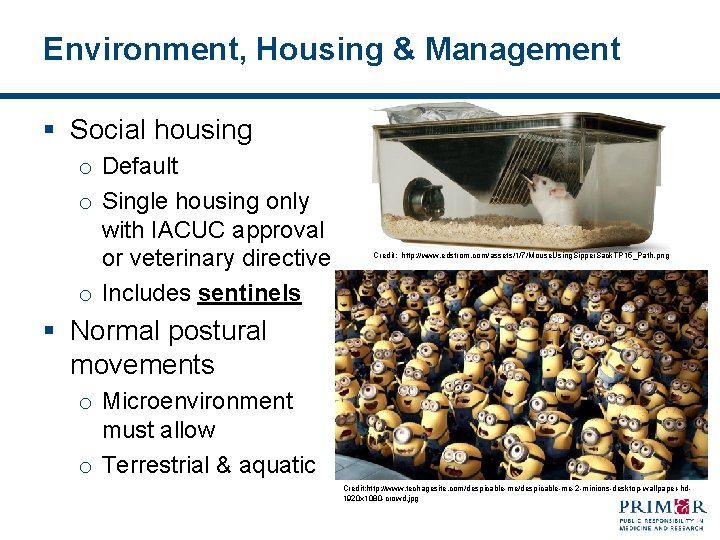
Environment, Housing & Management § Social housing o Default o Single housing only with IACUC approval or veterinary directive o Includes sentinels Credit: http: //www. edstrom. com/assets/1/7/Mouse. Using. Sipper. Sack. TP 15_Path. png § Normal postural movements o Microenvironment must allow o Terrestrial & aquatic Credit: http: //www. techagesite. com/despicable-me-2 -minions-desktop-wallpaper-hd 1920 x 1080 -crowd. jpg
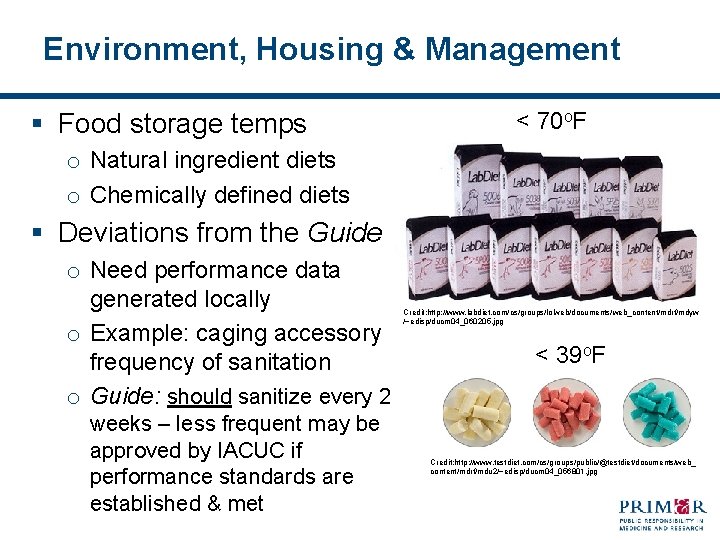
Environment, Housing & Management § Food storage temps < 70 o. F o Natural ingredient diets o Chemically defined diets § Deviations from the Guide o Need performance data generated locally o Example: caging accessory frequency of sanitation o Guide: should sanitize every 2 weeks – less frequent may be approved by IACUC if performance standards are established & met Credit: http: //www. labdiet. com/cs/groups/lolweb/documents/web_content/mdrf/mdyw /~edisp/ducm 04_060205. jpg < 39 o. F Credit: http: //www. testdiet. com/cs/groups/public/@testdiet/documents/web_ content/mdrf/mdu 2/~edisp/ducm 04_056801. jpg
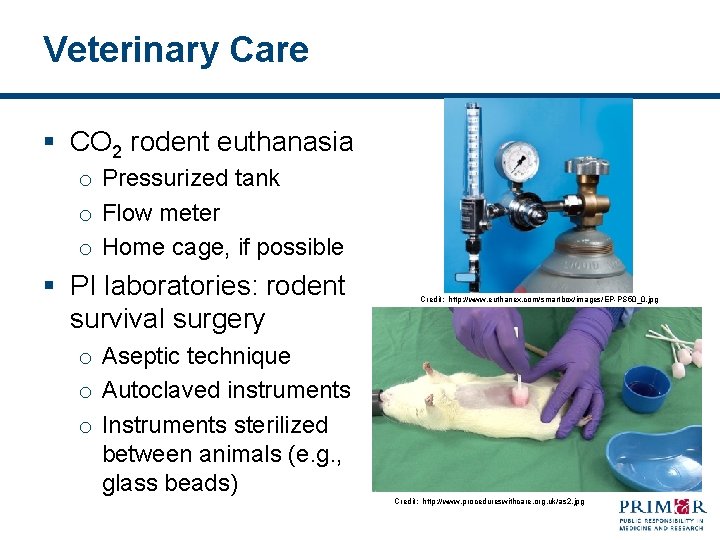
Veterinary Care § CO 2 rodent euthanasia o Pressurized tank o Flow meter o Home cage, if possible § PI laboratories: rodent survival surgery Credit: http: //www. euthanex. com/smartbox/images/EP-PS 50_0. jpg o Aseptic technique o Autoclaved instruments o Instruments sterilized between animals (e. g. , glass beads) Credit: http: //www. procedureswithcare. org. uk/as 2. jpg
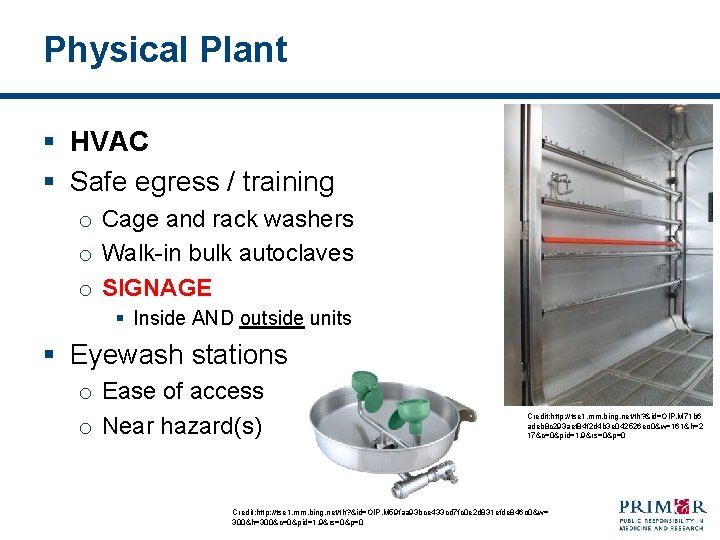
Physical Plant § HVAC § Safe egress / training o Cage and rack washers o Walk-in bulk autoclaves o SIGNAGE § Inside AND outside units § Eyewash stations o Ease of access o Near hazard(s) Credit: http: //tse 1. mm. bing. net/th? &id=OIP. M 71 b 6 adeb 8 c 293 aef 84 f 2 d 4 b 3 e 042526 eo 0&w=161&h=2 17&c=0&pid=1. 9&rs=0&p=0 Credit: http: //tse 1. mm. bing. net/th? &id=OIP. M 59 faa 93 bce 433 cd 7 fc 0 e 2 d 831 efde 846 o 0&w= 300&h=300&c=0&pid=1. 9&rs=0&p=0
Next up … A few VA updates Alice Huang Ph. D, CPIA
VA Updates § Renewal interval for Animal Research training is now THREE years. § Records Control Schedule for VA ORD released, effective 7/10/15 (DAA-0015 -2015 -0004) -- Many locally specific details require consultation with local VHA Records Manager o identification of which records must be retained, o proper procedures for storage and destruction
Generally, Requirements for Records Retention § Most to be held for 3 -6 years after they are no longer in effect § Copies (labeled as such) do not have to be retained § Paper records may be digitalized and retained in digitized form
Questions?
Thank you!