
Major Underground Design John Perez Underground Engineering Design
- Slides: 11
Major Underground Design John Perez
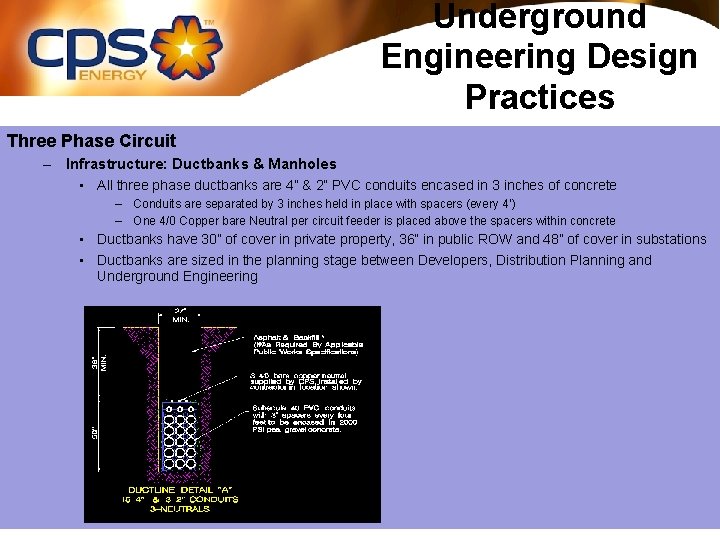
Underground Engineering Design Practices Three Phase Circuit – Infrastructure: Ductbanks & Manholes • All three phase ductbanks are 4” & 2” PVC conduits encased in 3 inches of concrete – Conduits are separated by 3 inches held in place with spacers (every 4’) – One 4/0 Copper bare Neutral per circuit feeder is placed above the spacers within concrete • Ductbanks have 30” of cover in private property, 36” in public ROW and 48” of cover in substations • Ductbanks are sized in the planning stage between Developers, Distribution Planning and Underground Engineering
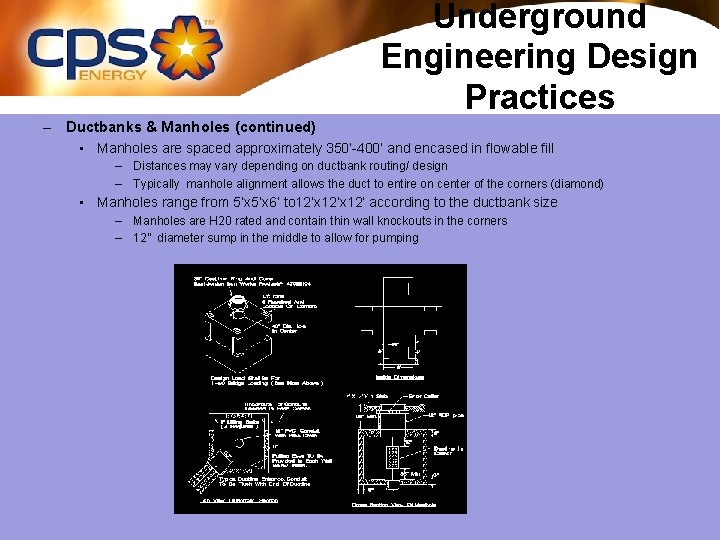
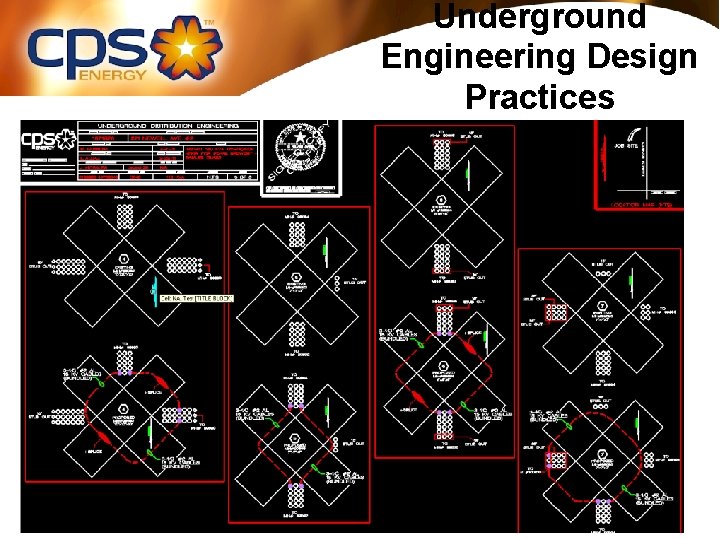
Underground Engineering Design Practices – Ductbanks & Manholes (continued) • Manholes are spaced approximately 350’-400’ and encased in flowable fill – Distances may vary depending on ductbank routing/ design – Typically manhole alignment allows the duct to entire on center of the corners (diamond) • Manholes range from 5’x 6’ to 12’x 12’ according to the ductbank size – Manholes are H 20 rated and contain thin wall knockouts in the corners – 12” diameter sump in the middle to allow for pumping
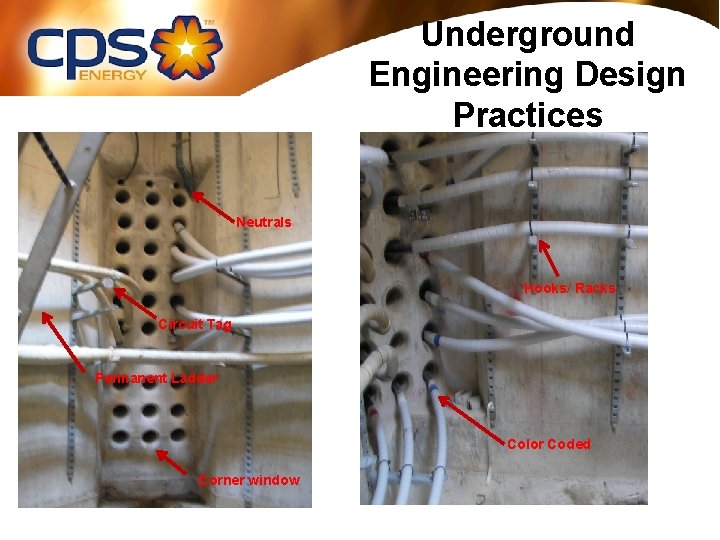
Underground Engineering Design Practices Neutrals Hooks/ Racks Circuit Tag Permanent Ladder Color Coded Corner window
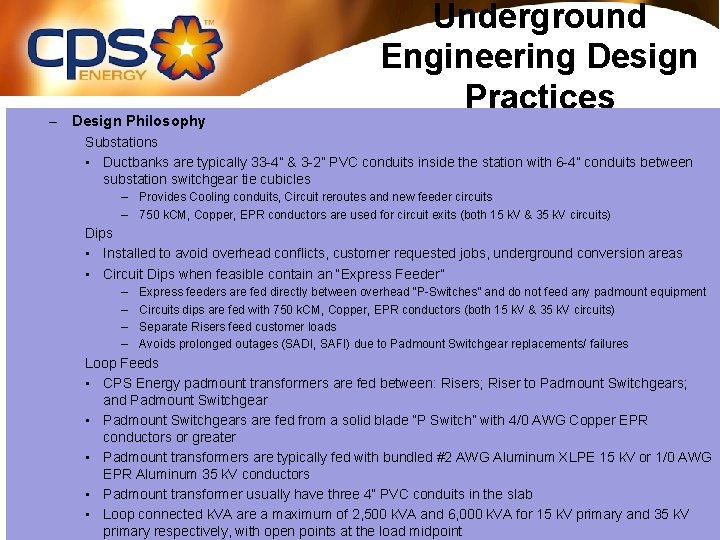
– Design Philosophy Underground Engineering Design Practices Substations • Ductbanks are typically 33 -4” & 3 -2” PVC conduits inside the station with 6 -4” conduits between substation switchgear tie cubicles – Provides Cooling conduits, Circuit reroutes and new feeder circuits – 750 k. CM, Copper, EPR conductors are used for circuit exits (both 15 k. V & 35 k. V circuits) Dips • Installed to avoid overhead conflicts, customer requested jobs, underground conversion areas • Circuit Dips when feasible contain an “Express Feeder” – – Express feeders are fed directly between overhead “P-Switches” and do not feed any padmount equipment Circuits dips are fed with 750 k. CM, Copper, EPR conductors (both 15 k. V & 35 k. V circuits) Separate Risers feed customer loads Avoids prolonged outages (SADI, SAFI) due to Padmount Switchgear replacements/ failures Loop Feeds • CPS Energy padmount transformers are fed between: Risers; Riser to Padmount Switchgears; and Padmount Switchgear • Padmount Switchgears are fed from a solid blade “P Switch” with 4/0 AWG Copper EPR conductors or greater • Padmount transformers are typically fed with bundled #2 AWG Aluminum XLPE 15 k. V or 1/0 AWG EPR Aluminum 35 k. V conductors • Padmount transformer usually have three 4” PVC conduits in the slab • Loop connected k. VA are a maximum of 2, 500 k. VA and 6, 000 k. VA for 15 k. V primary and 35 k. V primary respectively, with open points at the load midpoint
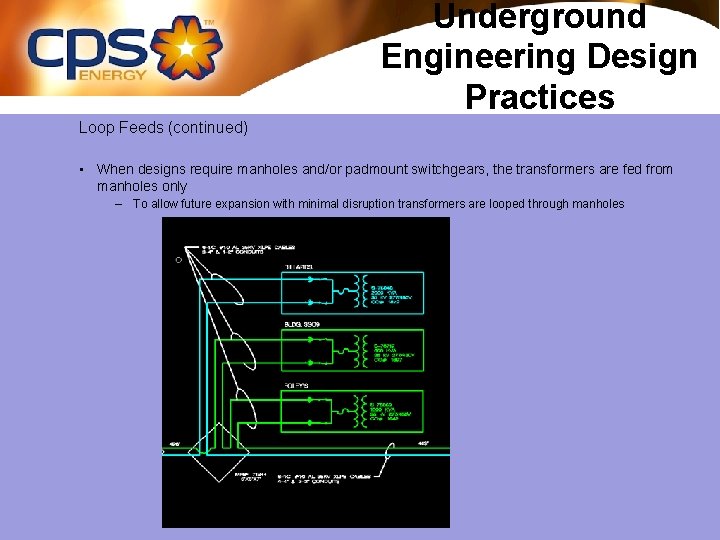
Underground Engineering Design Practices Loop Feeds (continued) • When designs require manholes and/or padmount switchgears, the transformers are fed from manholes only – To allow future expansion with minimal disruption transformers are looped through manholes
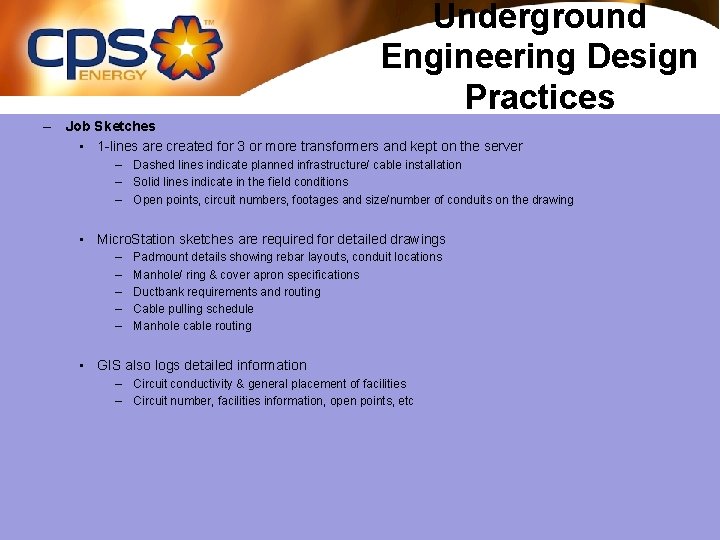
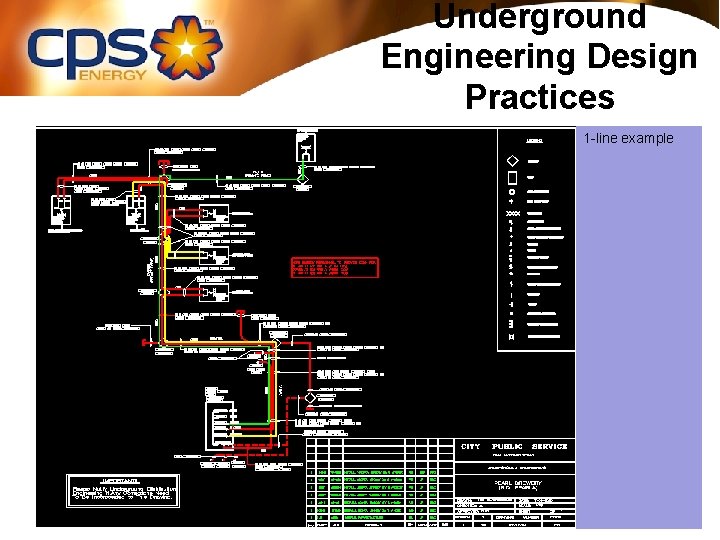
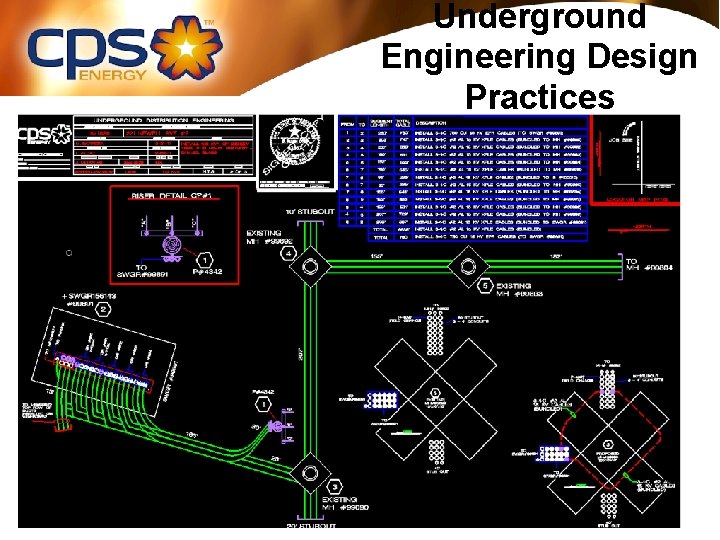
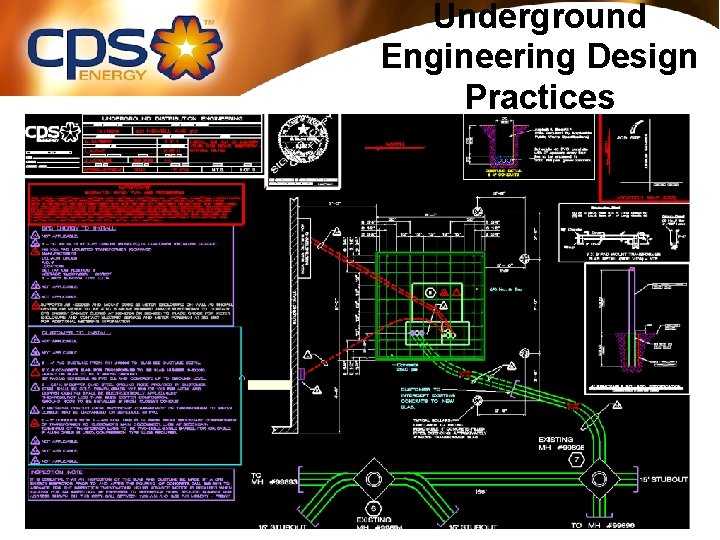
Underground Engineering Design Practices – Job Sketches • 1 -lines are created for 3 or more transformers and kept on the server – Dashed lines indicate planned infrastructure/ cable installation – Solid lines indicate in the field conditions – Open points, circuit numbers, footages and size/number of conduits on the drawing • Micro. Station sketches are required for detailed drawings – – – Padmount details showing rebar layouts, conduit locations Manhole/ ring & cover apron specifications Ductbank requirements and routing Cable pulling schedule Manhole cable routing • GIS also logs detailed information – Circuit conductivity & general placement of facilities – Circuit number, facilities information, open points, etc
Underground Engineering Design Practices 1 -line example
Underground Engineering Design Practices
Underground Engineering Design Practices
Underground Engineering Design Practices