
Major tasks of a project audit 1 Evaluate
- Slides: 20
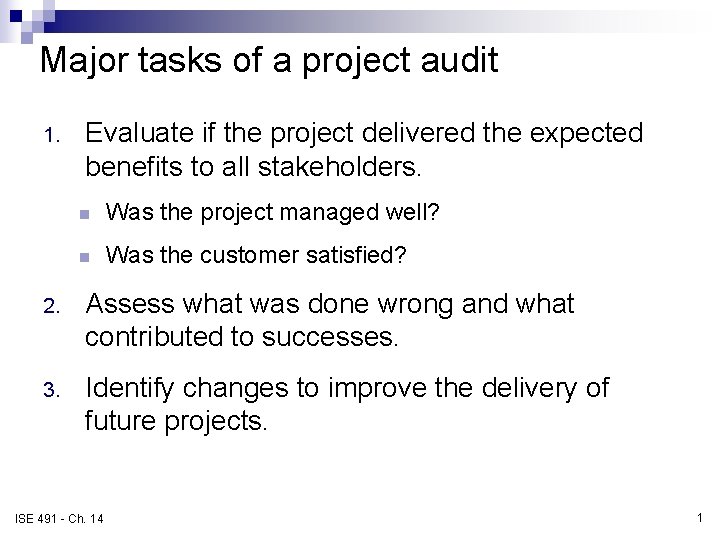
Major tasks of a project audit 1. Evaluate if the project delivered the expected benefits to all stakeholders. n Was the project managed well? n Was the customer satisfied? 2. Assess what was done wrong and what contributed to successes. 3. Identify changes to improve the delivery of future projects. ISE 491 - Ch. 14 1
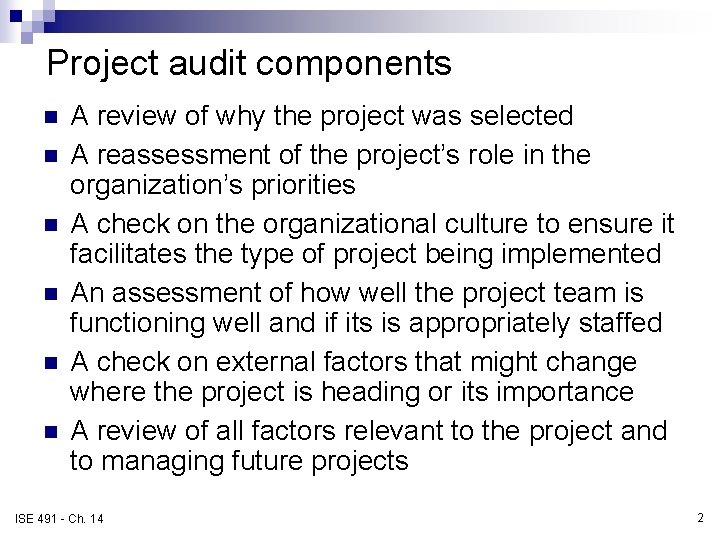
Project audit components n n n A review of why the project was selected A reassessment of the project’s role in the organization’s priorities A check on the organizational culture to ensure it facilitates the type of project being implemented An assessment of how well the project team is functioning well and if its is appropriately staffed A check on external factors that might change where the project is heading or its importance A review of all factors relevant to the project and to managing future projects ISE 491 - Ch. 14 2
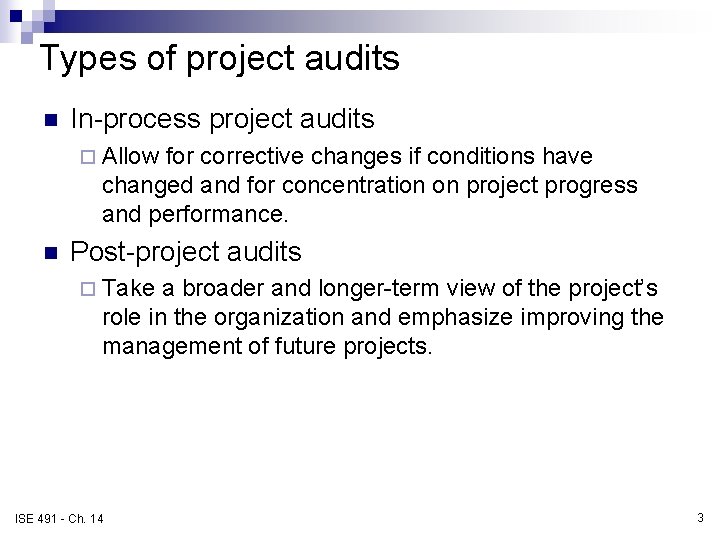
Types of project audits n In-process project audits ¨ Allow for corrective changes if conditions have changed and for concentration on project progress and performance. n Post-project audits ¨ Take a broader and longer-term view of the project’s role in the organization and emphasize improving the management of future projects. ISE 491 - Ch. 14 3
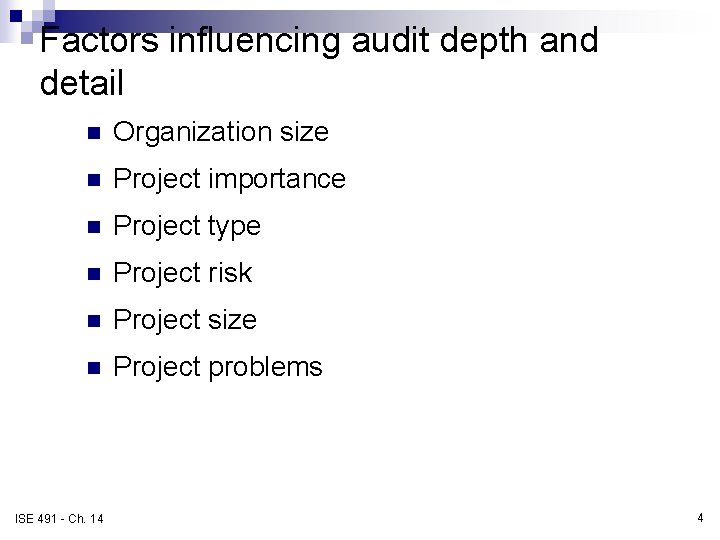
Factors influencing audit depth and detail n Organization size n Project importance n Project type n Project risk n Project size n Project problems Table 14. 1 ISE 491 - Ch. 14 4
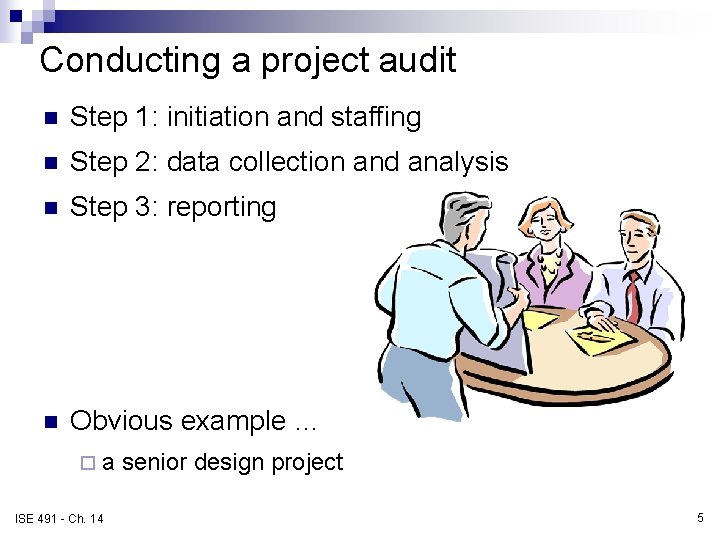
Conducting a project audit n Step 1: initiation and staffing n Step 2: data collection and analysis n Step 3: reporting n Obvious example … ¨a ISE 491 - Ch. 14 senior design project 5
Characteristics of audit leaders 1. No direct involvement or direct interest in the project 2. Respect (perceived as impartial and fair) of senior management and other project stakeholders 3. Willingness to listen 4. Independence and authority to report audit results without fear of recriminations from special interests 5. Perceived as having the best interests of the organization in making decisions 6. Broad-based experience in the organization or industry ISE 491 - Ch. 14 6
Step 2: data collection and analysis n Organization view ¨ Was the organizational culture supportive and correct? ¨ Was senior management’s support adequate? ¨ Did the project accomplish its intended purpose? ¨ Were risks appropriately identified and assessed? ¨ Were the right people and talents assigned? ¨ Have staff been fairly reassigned to new projects? ¨ What does evaluation from contractors suggest? ¨ Were the project start-up and hand-off successful? ¨ Is the customer satisfied? ISE 491 - Ch. 14 7
Step 2: data collection and analysis n Project team view ¨ Were the project planning and control systems appropriate for this type of project? ¨ Should all similar projects use these systems? ¨ Did the project conform to plan for budget and schedule? ¨ Were interfaces with stakeholders effective? ¨ Have staff been fairly assigned to new projects? ¨ Did the team have adequate resources? Were there resource conflicts? ¨ Was the team managed well? ¨ What does evaluation from contractors suggest? ISE 491 - Ch. 14 8
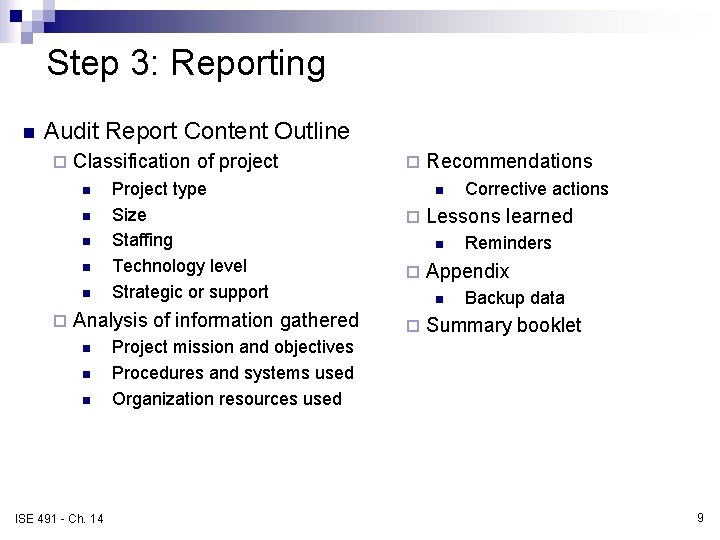
Step 3: Reporting n Audit Report Content Outline ¨ Classification of project n n n ¨ Project type Size Staffing Technology level Strategic or support Analysis of information gathered n n n ISE 491 - Ch. 14 ¨ Recommendations n ¨ Lessons learned n ¨ Reminders Appendix n ¨ Corrective actions Backup data Summary booklet Project mission and objectives Procedures and systems used Organization resources used 9
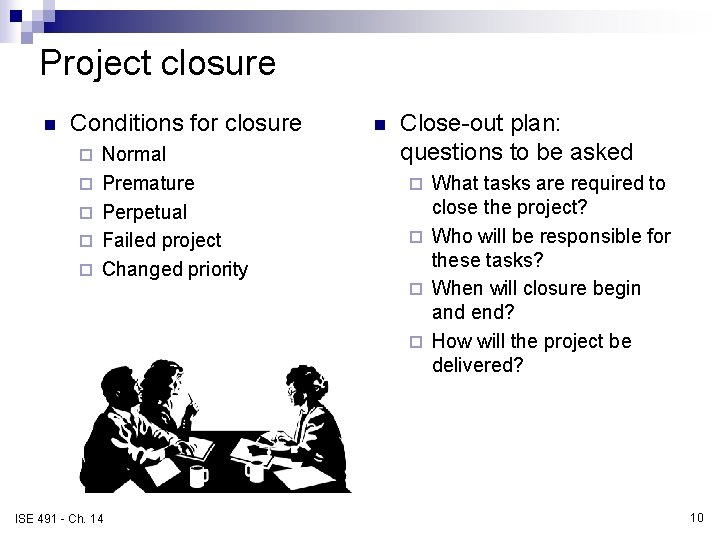
Project closure n Conditions for closure ¨ ¨ ¨ Normal Premature Perpetual Failed project Changed priority ISE 491 - Ch. 14 n Close-out plan: questions to be asked What tasks are required to close the project? ¨ Who will be responsible for these tasks? ¨ When will closure begin and end? ¨ How will the project be delivered? ¨ 10
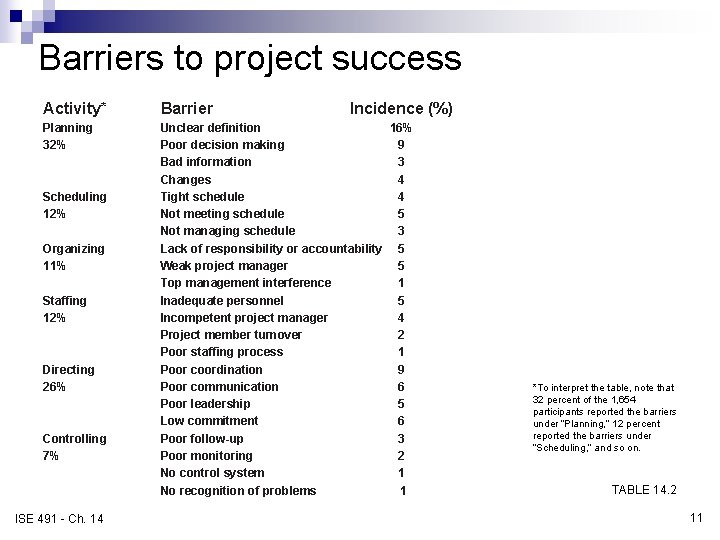
Barriers to project success Activity* Barrier Planning 32% Unclear definition 16% Poor decision making 9 Bad information 3 Changes 4 Tight schedule 4 Not meeting schedule 5 Not managing schedule 3 Lack of responsibility or accountability 5 Weak project manager 5 Top management interference 1 Inadequate personnel 5 Incompetent project manager 4 Project member turnover 2 Poor staffing process 1 Poor coordination 9 Poor communication 6 Poor leadership 5 Low commitment 6 Poor follow-up 3 Poor monitoring 2 No control system 1 No recognition of problems 1 Scheduling 12% Organizing 11% Staffing 12% Directing 26% Controlling 7% ISE 491 - Ch. 14 Incidence (%) *To interpret the table, note that 32 percent of the 1, 654 participants reported the barriers under “Planning, ” 12 percent reported the barriers under “Scheduling, ” and so on. TABLE 14. 2 11
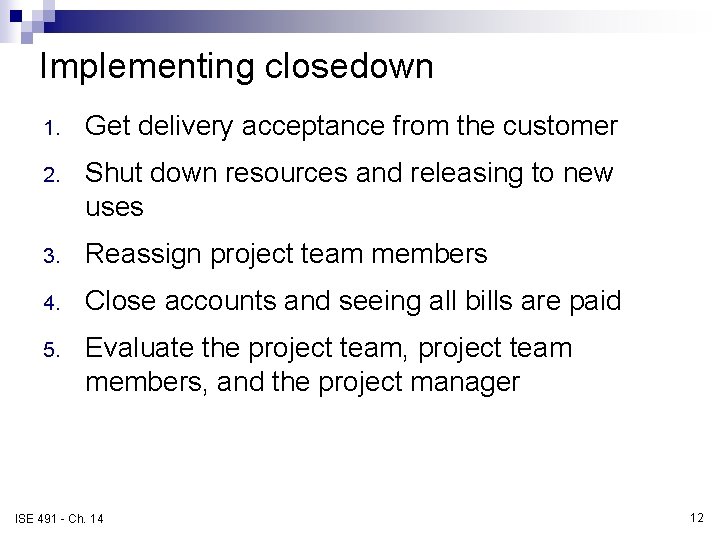
Implementing closedown 1. Get delivery acceptance from the customer 2. Shut down resources and releasing to new uses 3. Reassign project team members 4. Close accounts and seeing all bills are paid 5. Evaluate the project team, project team members, and the project manager ISE 491 - Ch. 14 12
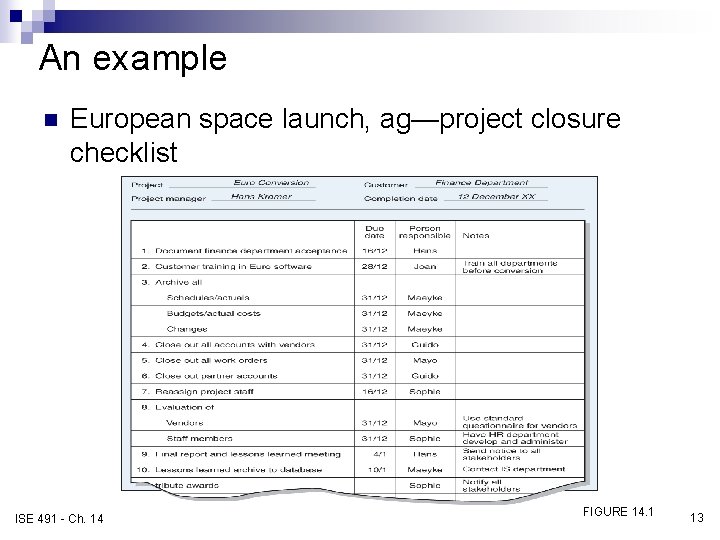
An example n European space launch, ag—project closure checklist ISE 491 - Ch. 14 FIGURE 14. 1 13
Project performance evaluations n Reasons for poor-quality project performance evaluations: ¨ Evaluations of individuals are still left to supervisors of the team member’s home department. ¨ Typical measures of team performance center on time, cost, and specifications. ISE 491 - Ch. 14 14
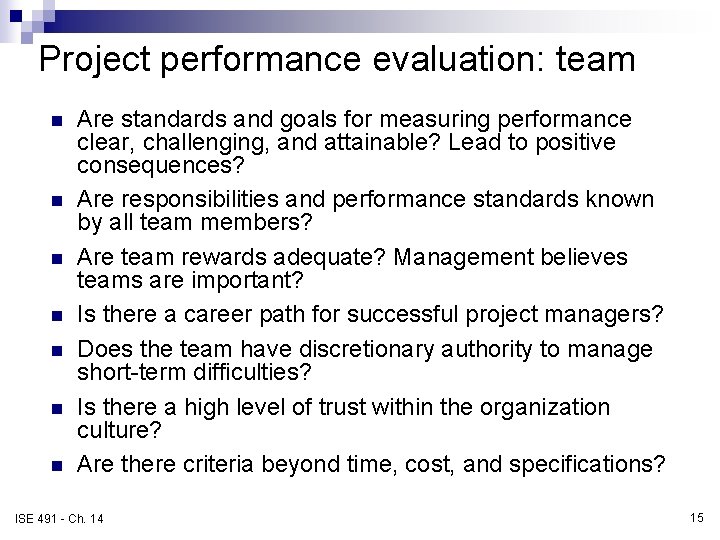
Project performance evaluation: team n n n n Are standards and goals for measuring performance clear, challenging, and attainable? Lead to positive consequences? Are responsibilities and performance standards known by all team members? Are team rewards adequate? Management believes teams are important? Is there a career path for successful project managers? Does the team have discretionary authority to manage short-term difficulties? Is there a high level of trust within the organization culture? Are there criteria beyond time, cost, and specifications? ISE 491 - Ch. 14 15
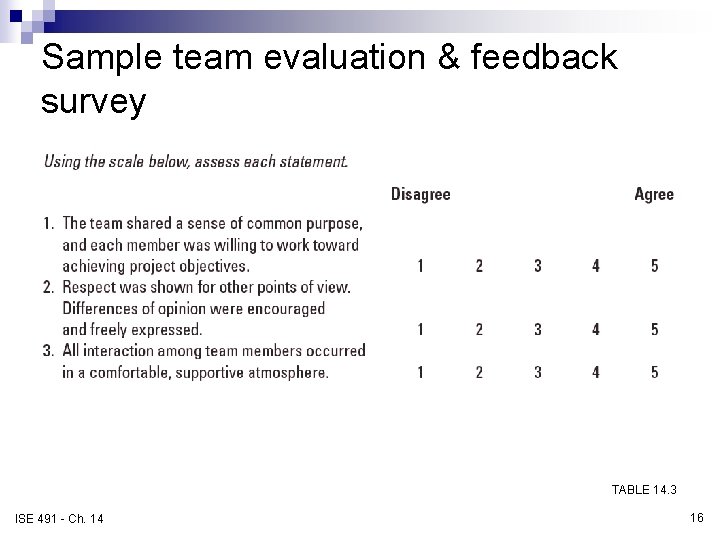
Sample team evaluation & feedback survey TABLE 14. 3 ISE 491 - Ch. 14 16
Project performance evaluation: individual n Responsibility for assessing performance ¨ Functional organization or functional matrix: the individual’s area manager n The area manager may solicit the project manager’s opinion of the individual’s performance on a specific project. ¨ Balanced matrix: the project manager and the area manager jointly evaluate an individual’s performance. ¨ Project matrix and project organizations: the project manager is responsible for appraising individual performance. ISE 491 - Ch. 14 17
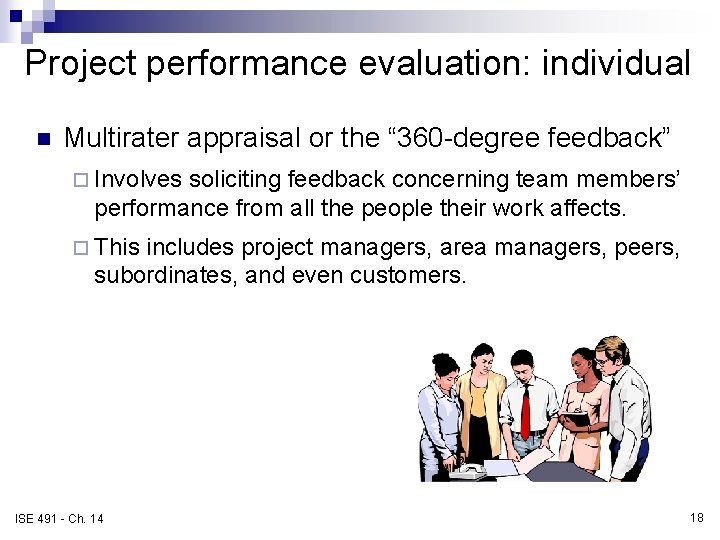
Project performance evaluation: individual n Multirater appraisal or the “ 360 -degree feedback” ¨ Involves soliciting feedback concerning team members’ performance from all the people their work affects. ¨ This includes project managers, area managers, peers, subordinates, and even customers. ISE 491 - Ch. 14 18
Conducting performance reviews n Begin by asking the individual to evaluate his or her own performance. n Avoid drawing comparisons with other team members; rather, assess the individual in terms of established standards and expectations. n Focus criticism on specific behaviors rather than on the individual personally. n Be consistent and fair in your treatment of all team members. n Treat the review as one point in an ongoing process. ISE 491 - Ch. 14 19
Key points in conducting audits n n n n Have automatic times or points when audits will take place. Surprises should be avoided. Conduct audits carefully and with sensitivity. Audit staff must independent from the project. Audit reports need to be used and accessible. Audits support organizational culture. Project closures should be planned and orderly. Certain “core conditions” must be in place to support team and individual evaluation. Conduct individual and team evaluations separate from pay or merit reviews. ISE 491 - Ch. 14 20