
Major Physical Development Milestones By Group 4 Culminating

Major Physical Development Milestones By: Group 4
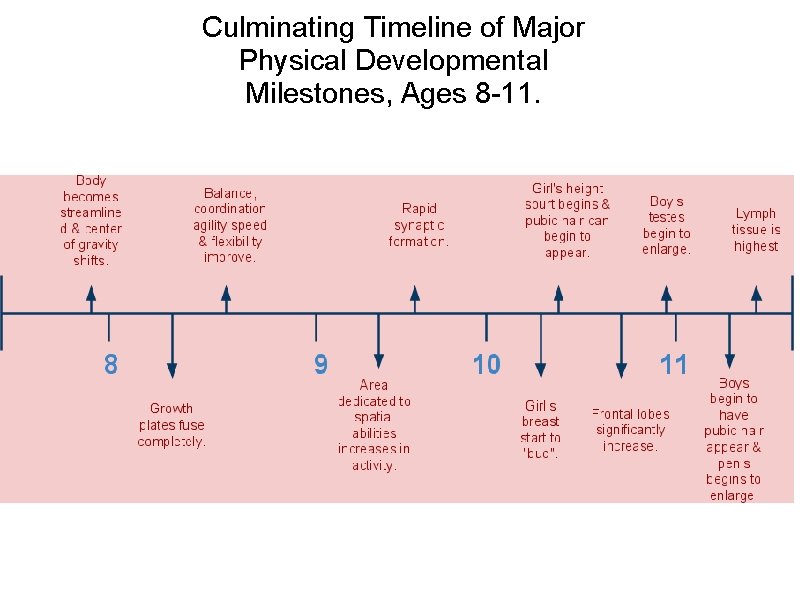
Culminating Timeline of Major Physical Developmental Milestones, Ages 8 -11.
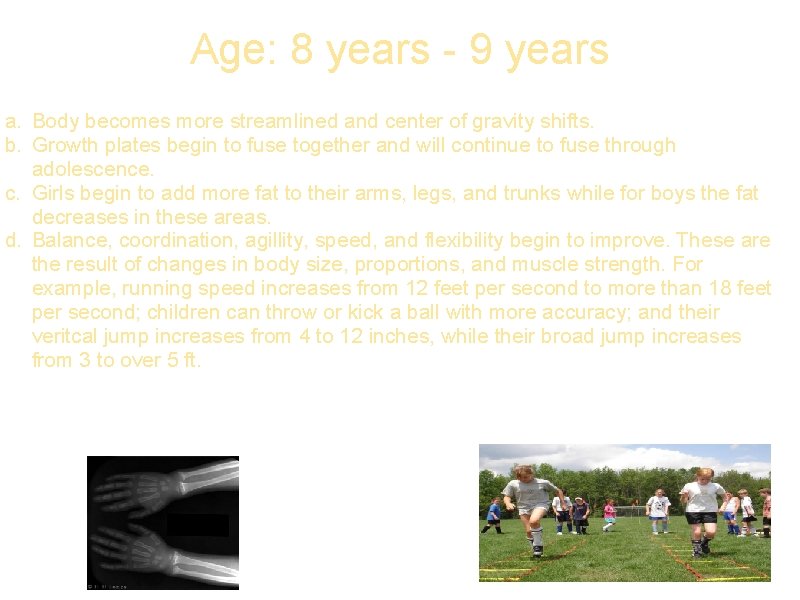
Age: 8 years - 9 years a. Body becomes more streamlined and center of gravity shifts. b. Growth plates begin to fuse together and will continue to fuse through adolescence. c. Girls begin to add more fat to their arms, legs, and trunks while for boys the fat decreases in these areas. d. Balance, coordination, agillity, speed, and flexibility begin to improve. These are the result of changes in body size, proportions, and muscle strength. For example, running speed increases from 12 feet per second to more than 18 feet per second; children can throw or kick a ball with more accuracy; and their veritcal jump increases from 4 to 12 inches, while their broad jump increases from 3 to over 5 ft.
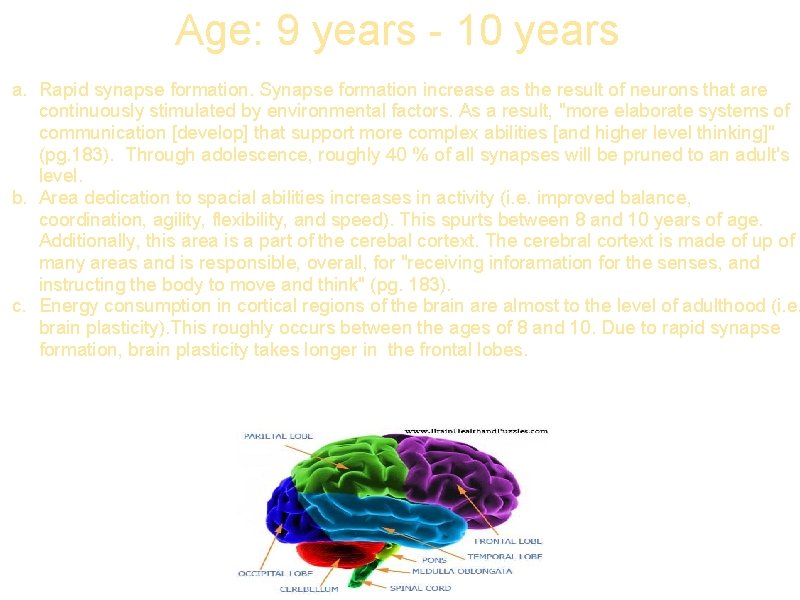
Age: 9 years - 10 years a. Rapid synapse formation. Synapse formation increase as the result of neurons that are continuously stimulated by environmental factors. As a result, "more elaborate systems of communication [develop] that support more complex abilities [and higher level thinking]" (pg. 183). Through adolescence, roughly 40 % of all synapses will be pruned to an adult's level. b. Area dedication to spacial abilities increases in activity (i. e. improved balance, coordination, agility, flexibility, and speed). This spurts between 8 and 10 years of age. Additionally, this area is a part of the cerebal cortext. The cerebral cortext is made of up of many areas and is responsible, overall, for "receiving inforamation for the senses, and instructing the body to move and think" (pg. 183). c. Energy consumption in cortical regions of the brain are almost to the level of adulthood (i. e. brain plasticity). This roughly occurs between the ages of 8 and 10. Due to rapid synapse formation, brain plasticity takes longer in the frontal lobes.

Age: 10 years - 11 years a. Girl's breasts start to "bud". b. Brains frontal lobes continue to develop. Myelination and rapid synapse formation are still occuring in this region. This results in the "refinement of complex cognitive" abilities (ex. improved impulse control, better and longer attention/concenstration span, and refined ability to integrate information more easily) (pg. 184). c. Girl's height spurt begins and pubic hair can begin to appear. d. Girls have an increase in weight. Increases in height, weight and breast development are the result of the onset of puberty, which occurs first in girls (around age 10), and up to two years or more later in boys. e. Testes begin to enlarge in boys. f. Girl's strength begins to peak.

Age: 11 years to End of Puberty a. Lymph tissue/glads increase during childhood and pre-adolescence, but begin to decline after the onset of puberty (around the age of 12). The lymph system plays a vital role in the overall health and survival of children. For example, it aids in fighting infection and assisting the body with absorbing nutrients. During adolescence, children typically exhibit poor and unhealthy eating habits, resulting in one or more mineral/vitamin deficiencies. Promoting healthy eating habits assists with healthier brain and physical development. b. Boy's penis begins to enlarge and pubic hair begins to appear. c. Some girls experience their first menstruation.

Bibliography a. Berk, L. E. (2006). Child development. Boston: Allyn and Bacon.
- Slides: 7