
Major Incidents By Peter Mc Goldrick and Lina
Major Incidents By Peter Mc. Goldrick and Lina Yow (3 rd Year Medical Students
Definition Major Incident An incident which, because of the number or severity of the casualties, will have an overwhelming impact on the normal emergency department and other hospital services and which requires the extraordinary mobilisation of medical, nursing, social services and other services. or An incident because of the nature and type of major emergency will result in the abnormal demand upon the Trusts resources necessitating special arrangements to deal with the situation.
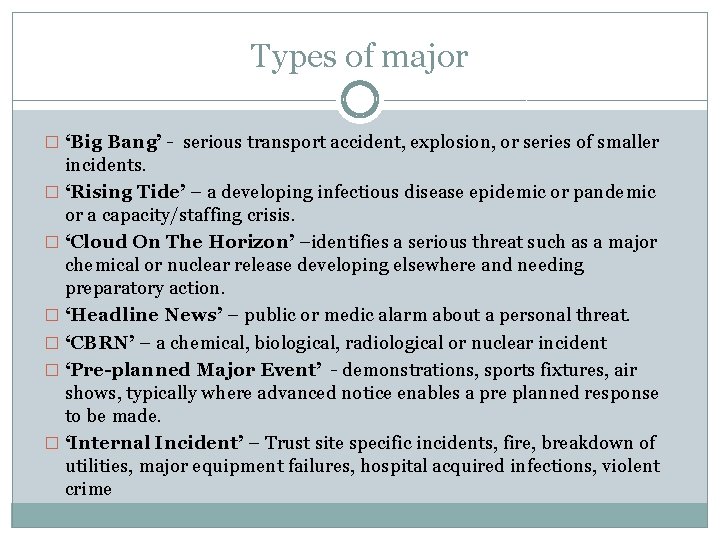
Types of major � ‘Big Bang’ - serious transport accident, explosion, or series of smaller incidents. � ‘Rising Tide’ – a developing infectious disease epidemic or pandemic or a capacity/staffing crisis. � ‘Cloud On The Horizon’ –identifies a serious threat such as a major chemical or nuclear release developing elsewhere and needing preparatory action. � ‘Headline News’ – public or medic alarm about a personal threat. � ‘CBRN’ – a chemical, biological, radiological or nuclear incident � ‘Pre-planned Major Event’ - demonstrations, sports fixtures, air shows, typically where advanced notice enables a pre planned response to be made. � ‘Internal Incident’ – Trust site specific incidents, fire, breakdown of utilities, major equipment failures, hospital acquired infections, violent crime
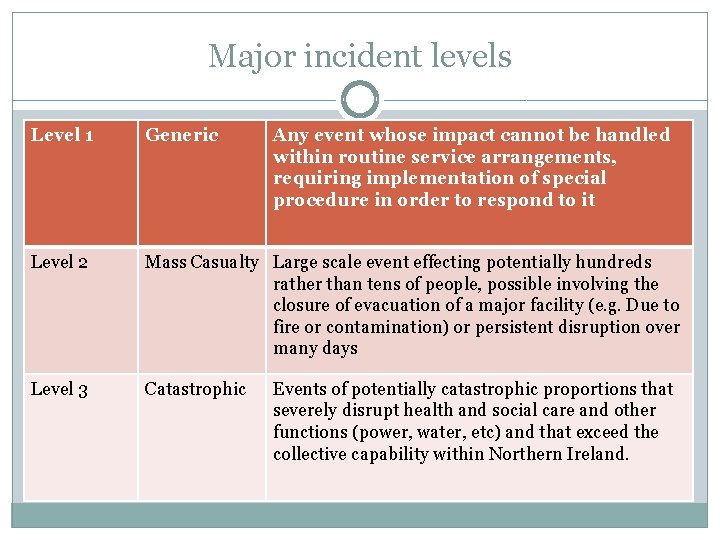
Major incident levels Level 1 Generic Any event whose impact cannot be handled within routine service arrangements, requiring implementation of special procedure in order to respond to it Level 2 Mass Casualty Large scale event effecting potentially hundreds rather than tens of people, possible involving the closure of evacuation of a major facility (e. g. Due to fire or contamination) or persistent disruption over many days Level 3 Catastrophic Events of potentially catastrophic proportions that severely disrupt health and social care and other functions (power, water, etc) and that exceed the collective capability within Northern Ireland.
Activation of Major Incident Plan �ED notifies Switchboard “Major Incident Declared”. �Switchboard activate group pagers and commence call-out cascade. �Teams around the hospital and trust are notified. �Other A&E departments are put on standby for all routine A&E attendances.
Areas of Responsibility �Level 1 Command - Staff within the emergency department. Coordinated by the ED Consultant and ED Sister �Level 2 Command -Trust Control and Information team will lead the hospitals overall response but will not directly treat patients. (Nurse leads, Bed management, Assistant Directors, Management, etc) �Level 3 Command – Trust Command Control team will lead the Trust in their response to the Major Incident ( not normally needed unless a very large Major incident is called or multiple Major incidences are called at once).
Activation Procedures �A major incident can be activated by: NIAS control staff 2. PSNI/NIF&R/Local council 3. Internally within the Hospital (Only activated by the Director) (If NIAS do not activate the Major Incident then need to be informed immediately) � There are circumstances where the community and hospital will be required to respond to the same incident i. e. . Aviation Accident, Internal Fire. 1.
Notification of Activation Major incident pager holders � Director of Acute hospital � ED Consultant services � Director Nursing and user Experience � Assistance Director of Acute Hospital Services � Emergency Planning & Buisness Continuity Manager � ED Sister � Acute General Manager on call � Patient flow Co-ordinator � Site Support Services Manager
Response to Major Incident Declared �Hospital staff who are notified of the Major Incident should make their way to the ED and take up their roles as per the instruction of the ED staff who are marked (with cards) as in charge of the area to which the staff member has been assigned.
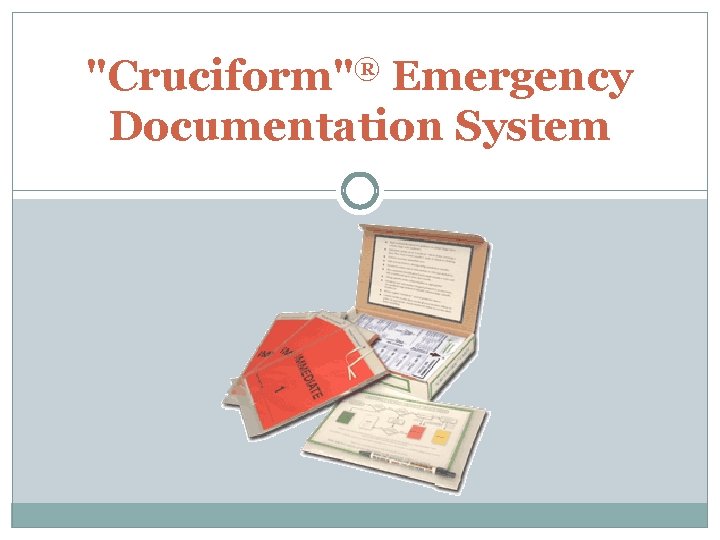
"Cruciform"® Emergency Documentation System
Purpose of "Cruciform"® Emergency Documentation System � An effective system of allocating and relaying information about the casualties from an incident scene to the final appropriate treatment area. � Each patient will have a unique number/barcode number strip with numbered wrist band to help in identification Each Cruciform box contains: � A Triage Sieve guidance and casualty numbers card � 10 or 25 expandable, amendable Cruciform® cards (secured via elastic loop and contained in a liquid-proof, sealable bag) � Each card have a set of uniquely numbered/GS 1 bar-coded stickers with wristband � Other supporting documentation and pen
Overview of "Cruciform"® Emergency Documentation System Numbering the patient 2. Triage sieve 3. Cruciform® cards 1. a) b) c) d) e) Color Module Casualty Assessment Module Trauma Score Module Casualty Details Module Additional Observation/ Treatment Given/ Comments Module
1. Numbering the patient Each patient will have a unique number/barcode number strip with numbered wrist band to help in identification
2. The Triage Sieve � A quick initial triage can help to sort the casualties and victims � The Cruciform Triage Sieve card provides a quick reference guide to assist the user in prioritising the patients based on the severity of their injuries. � It is extremely useful for juniors, medics and volunteers that may be unfamiliar with the process as it provides a quick reference � For query contaminated patients, the CBRN-E (Chemical, Biological, Radiological, Nuclear and high- yield Explosives) “Flag” must be placed on the outside of the plastic sleeve � After initial triage, the elastic cord of the Cruciform® cards are placed over the necks of the victim or attached to the most convenient part of the victim or clothing.
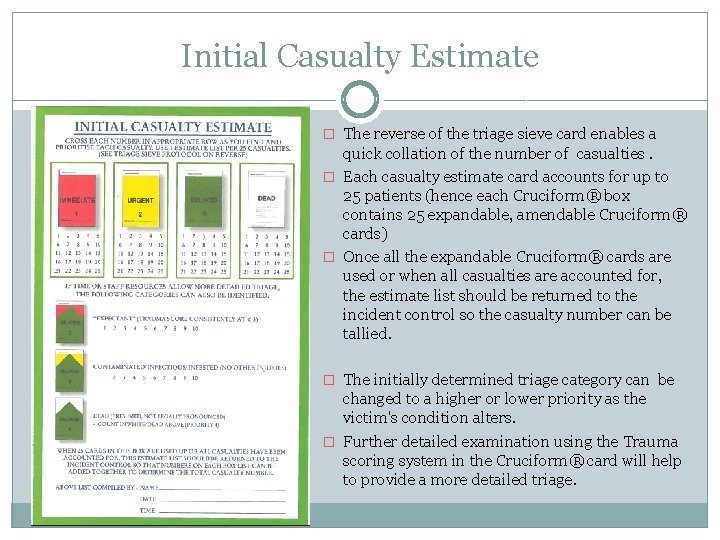
Initial Casualty Estimate � The reverse of the triage sieve card enables a quick collation of the number of casualties. � Each casualty estimate card accounts for up to 25 patients (hence each Cruciform® box contains 25 expandable, amendable Cruciform® cards) � Once all the expandable Cruciform® cards are used or when all casualties are accounted for, the estimate list should be returned to the incident control so the casualty number can be tallied. � The initially determined triage category can be changed to a higher or lower priority as the victim's condition alters. � Further detailed examination using the Trauma scoring system in the Cruciform® card will help to provide a more detailed triage.
3. Cruciform® cards The card is divided into several modules: a) b) c) d) e) Color Module Casualty Assessment Module Trauma Score Module Casualty Details Module Additional Observation/ Treatment Given/ Comments Module
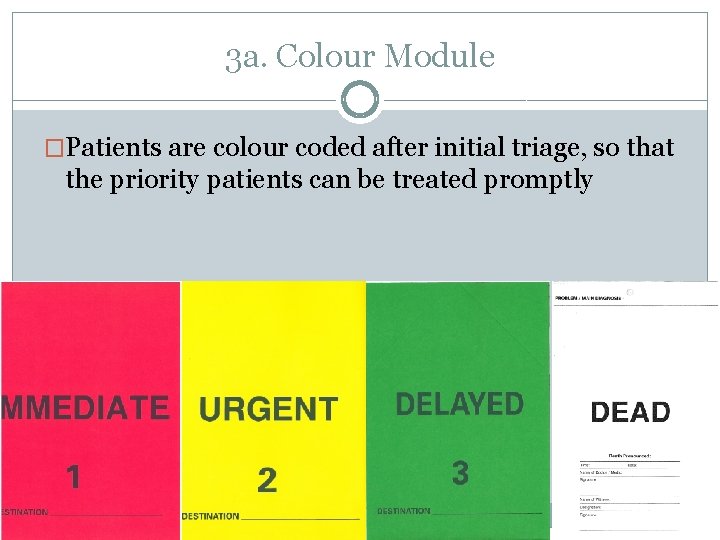
3 a. Colour Module �Patients are colour coded after initial triage, so that the priority patients can be treated promptly
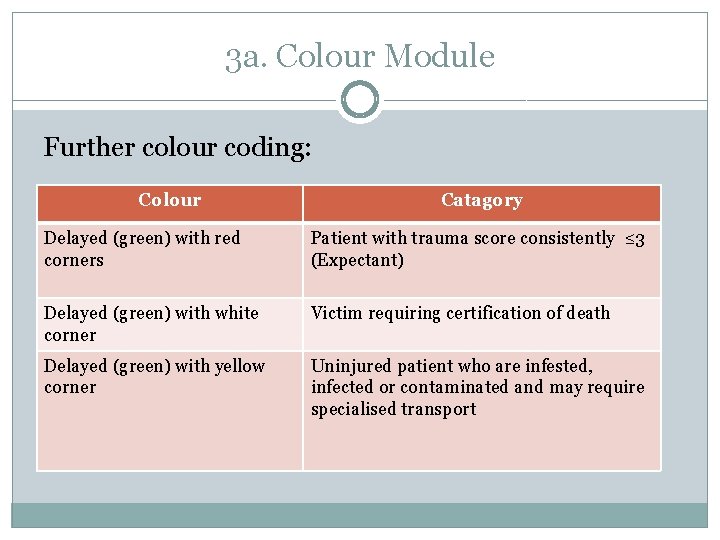
3 a. Colour Module Further colour coding: Colour Catagory Delayed (green) with red corners Patient with trauma score consistently ≤ 3 (Expectant) Delayed (green) with white corner Victim requiring certification of death Delayed (green) with yellow corner Uninjured patient who are infested, infected or contaminated and may require specialised transport
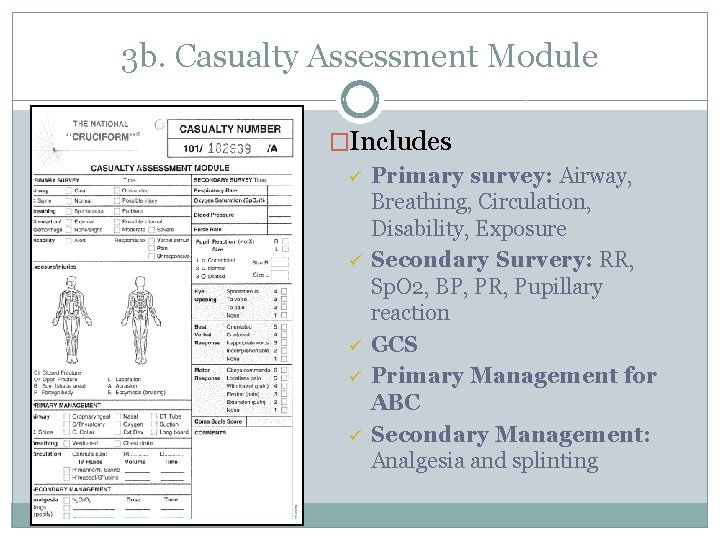
3 b. Casualty Assessment Module �Includes ü ü ü Primary survey: Airway, Breathing, Circulation, Disability, Exposure Secondary Survery: RR, Sp. O 2, BP, PR, Pupillary reaction GCS Primary Management for ABC Secondary Management: Analgesia and splinting
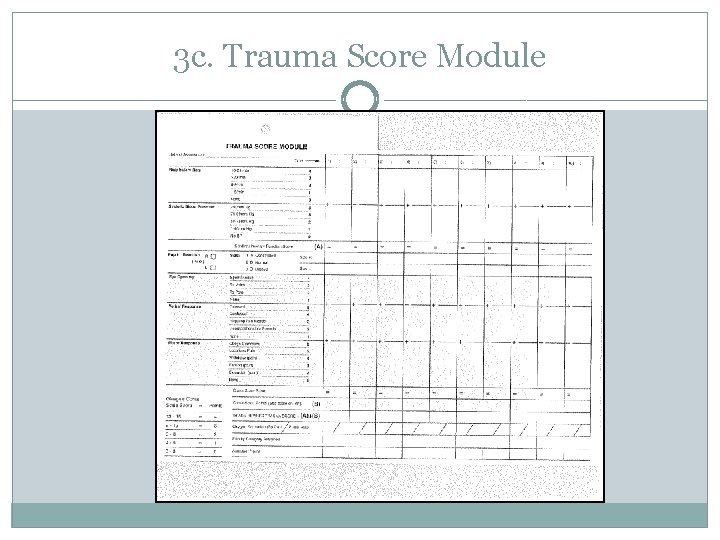
3 c. Trauma Score Module
3 c. Trauma Score Module �Allows further observations of patients vital signs. �If the patient is consistently scoring ≤ 3, their prognosis is poor regardless of medical intervention. Priority of treatment may be given to patients scoring between 4 -12. �Patient who are consistently scoring ≤ 3 may be classed as "expectant" (labelled Delayed (green) with red corners)
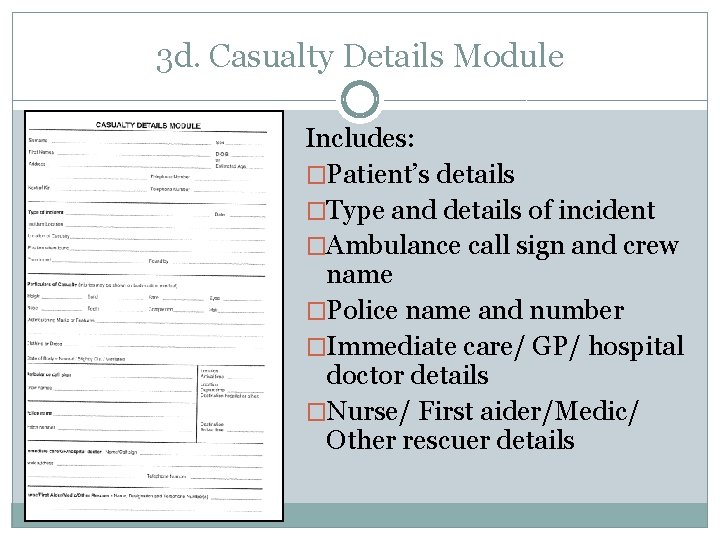
3 d. Casualty Details Module Includes: �Patient’s details �Type and details of incident �Ambulance call sign and crew name �Police name and number �Immediate care/ GP/ hospital doctor details �Nurse/ First aider/Medic/ Other rescuer details
3 e. Additional Observation/ Treatment Given/ Comments Module
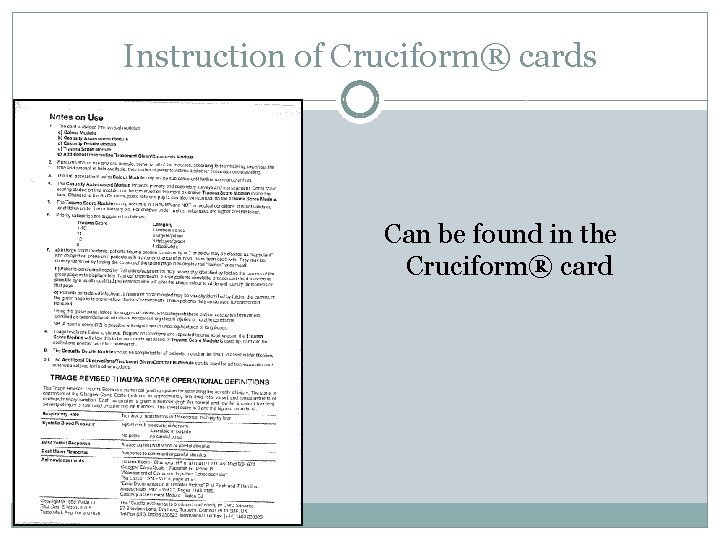
Instruction of Cruciform® cards Can be found in the Cruciform® card
Conclusion �In conclusion, this presentation highlights the types of major incidents and it’s classification. �The flow of activation and management is mentioned. �Most importantly, it is crucial to understand the "Cruciform"® Emergency Documentation System to ensure an effective treatment of patients in a major incident.
- Slides: 25