
Major incident triage the derivation and comparative analysis

- Slides: 11
Major incident triage: the derivation and comparative analysis of a modified physiological triage tool Jamie Vassallo 1, 2, J Beavis 3, S Ball 4, Jason E Smith 5, 6 1 - Division of Emergency Medicine, University of Cape Town, South Africa. 2 - Institute of Naval Medicine, Alverstoke, Gosport, UK. 3 - Visiting Research Fellow, Faculty of Science & Technology, Bournemouth University, Bournemouth, UK. 4 - Centre for Medical Statistics and Bioinformatics, Peninsula Schools of Medicine and Dentistry, Plymouth. 5 - Emergency Department, Derriford Hospital, Plymouth, UK. 6 - Academic Department of Military Emergency Medicine, Royal Centre for Defence Medicine (Research & Academia), Medical Directorate, Birmingham, UK.
Major Incidents – background • Occur worldwide on a near daily basis • No formal training in their management until early 1990’s • “an incident where the number, location, severity or type of casualties requires extraordinary resources” 1 1 - Advanced Life Support Group. Major Incident medical management and support: the practical approach. 3 rd edition. London, England
Triage – background • “The process of sorting patients and categorising them on the basis of clinical acuity” 2 • Used daily in a variety of healthcare settings • Major Incident Triage • Concept of ‘Life-Saving Intervention’ 2 - Identifying priority one adult patients during major incident triage: A modified Delphi study provides consensus on what constitutes a life-saving intervention (unpublished). Vassallo J, Smith JE, Bruijns S, Wallis LA.
Study Aim To derive a physiological triage tool with improved performance characteristics at predicting need for life-saving intervention Study approved by University of Cape Town Human Research Ethics Committee (285/2013)
Methods • Retrospective review of the UK Joint Theatre Trauma Registry (JTTR) – – – All adult patients > 18 years 2006 -2013 MTF, Camp Bastion, Afghanistan Patients categorised as ‘Priority 1’ or ‘Not Priority 1’ Physiological data taken on arrival in ED • Logistic Regression Analysis (SPSS) • Comparative Analysis to existing MI triage tools 3 – START, Careflight, Sieve (Triage, Military, Modified Military) 3 - Garner A, Lee A, Harrison K, Schultz CH. Comparative analysis of multiple-casualty incident triage algorithms. Ann Emerg Med 2001; 38(5): 541 -8
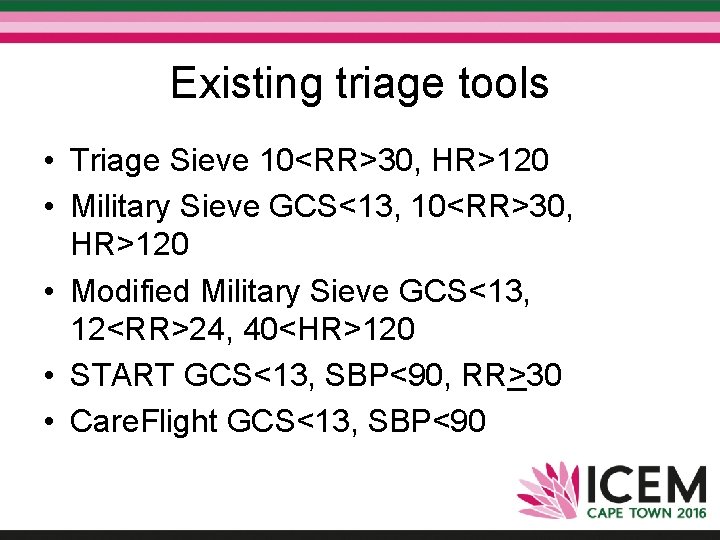
Existing triage tools • Triage Sieve 10<RR>30, HR>120 • Military Sieve GCS<13, 10<RR>30, HR>120 • Modified Military Sieve GCS<13, 12<RR>24, 40<HR>120 • START GCS<13, SBP<90, RR>30 • Care. Flight GCS<13, SBP<90
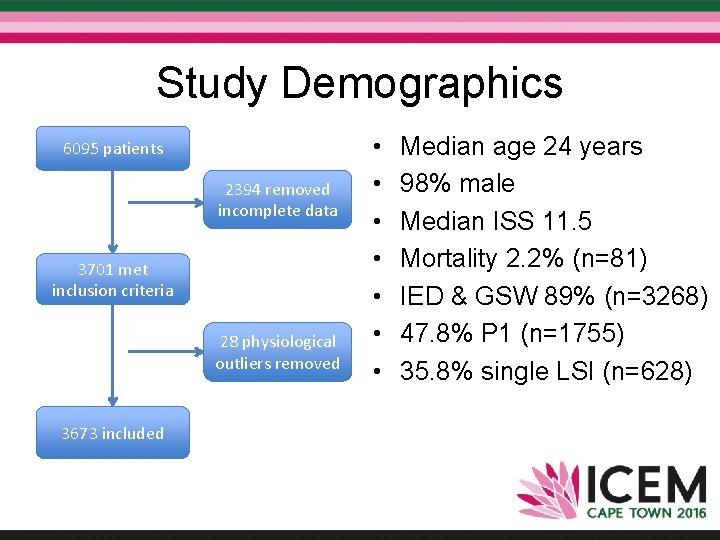
Study Demographics 6095 patients 2394 removed incomplete data 3701 met inclusion criteria 28 physiological outliers removed 3673 included • • Median age 24 years 98% male Median ISS 11. 5 Mortality 2. 2% (n=81) IED & GSW 89% (n=3268) 47. 8% P 1 (n=1755) 35. 8% single LSI (n=628)
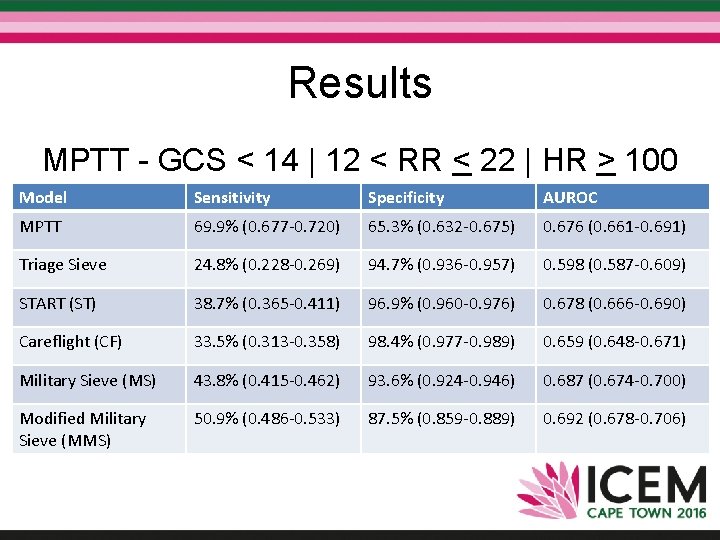
Results MPTT - GCS < 14 | 12 < RR < 22 | HR > 100 Model Sensitivity Specificity AUROC MPTT 69. 9% (0. 677 -0. 720) 65. 3% (0. 632 -0. 675) 0. 676 (0. 661 -0. 691) Triage Sieve 24. 8% (0. 228 -0. 269) 94. 7% (0. 936 -0. 957) 0. 598 (0. 587 -0. 609) START (ST) 38. 7% (0. 365 -0. 411) 96. 9% (0. 960 -0. 976) 0. 678 (0. 666 -0. 690) Careflight (CF) 33. 5% (0. 313 -0. 358) 98. 4% (0. 977 -0. 989) 0. 659 (0. 648 -0. 671) Military Sieve (MS) 43. 8% (0. 415 -0. 462) 93. 6% (0. 924 -0. 946) 0. 687 (0. 674 -0. 700) Modified Military Sieve (MMS) 50. 9% (0. 486 -0. 533) 87. 5% (0. 859 -0. 889) 0. 692 (0. 678 -0. 706)
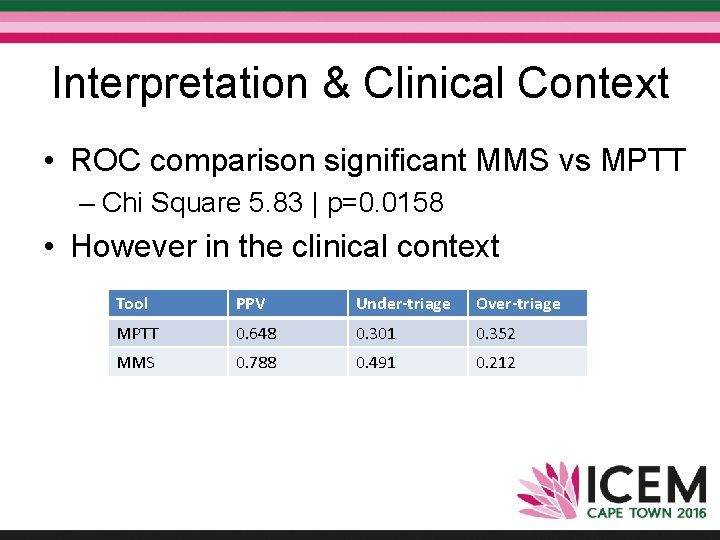
Interpretation & Clinical Context • ROC comparison significant MMS vs MPTT – Chi Square 5. 83 | p=0. 0158 • However in the clinical context Tool PPV Under-triage Over-triage MPTT 0. 648 0. 301 0. 352 MMS 0. 788 0. 491 0. 212
Conclusions & Future Work • Evidence based physiological triage algorithm • Currently support use within a military context • Reduction in under-triage • Further research ongoing in order to validate in a civilian context
Any Questions? “The Academic Department of Military Emergency Medicine (ADMEM) and Defence Analytical Services and Advice (DASA) are thanked for collecting, collating and identifying the data used in this paper”