
Major incident medical management support By Dr Ahmed
Major incident medical management & support By Dr. Ahmed Mostafa Assist. Prof. of anesthesia & I. C. U. Benha faculty of medicine
Major incident medical management & support Definition Of major incident: Any incident where the location, number, severity or type of live causalities requires extraordinary resources.
�Classification: 1. Natural: e. g. , earthquake, volcano and tsunami or manmade: e. g. , wars, terrorism, chemical weapons. 2. Simple: infrastructures remains intact e. g. , read, hospital, lines of communications or compound: infrastructure affected. 3. Compensated: load less than capacity or uncompensated: load exceeds the capacity.
Phases of major incident: 1 - Preparation: Planning: to fail to plan for major incident is to plan to fail on the day one occurs. "It will never happen to us" is not an acceptable excuse for the absence of adequate planning. Equipment: Personal protective equipment. Tools that may assist the health service providers. Ambulance service equipment. Communication equipment. Training: Education. Exercise.
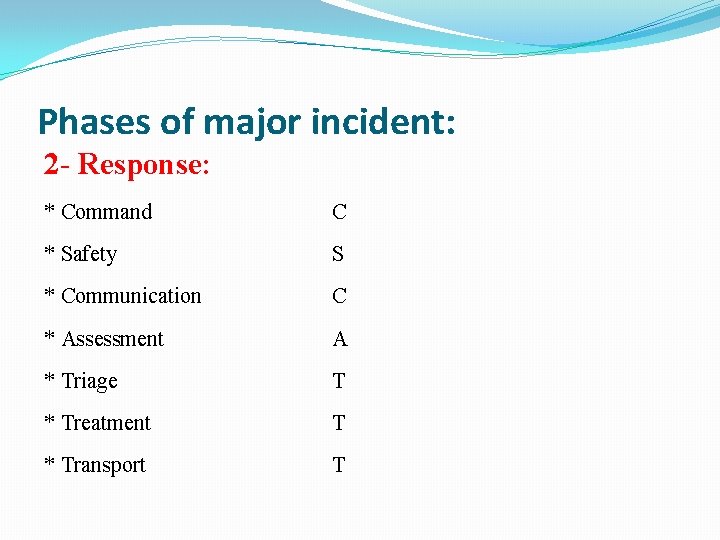
Phases of major incident: 2 - Response: * Command C * Safety S * Communication C * Assessment A * Triage T * Treatment T * Transport T

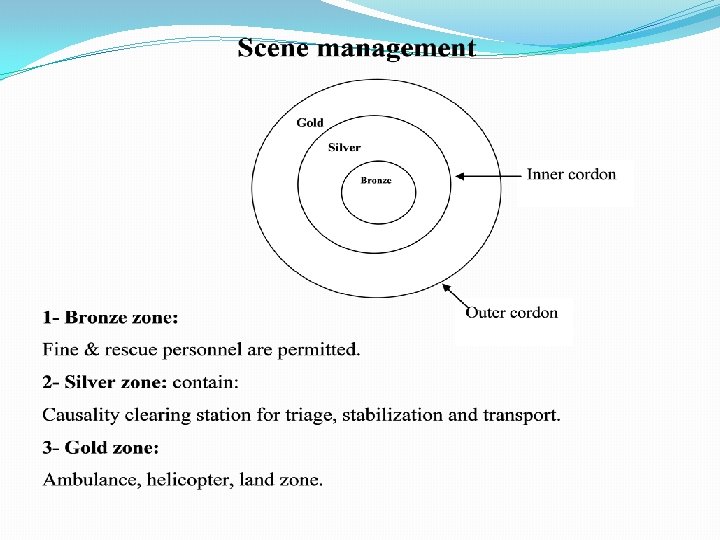
Response Command: each emergency service at the scene has a commander. Safety: 1. Self: wearing the appropriate personal protective equipment. 2. Scene: effective control of the cordons. The aim is to prevent those arriving to assist at the incident, or the media and public who will want to observe from becoming part of the incident.
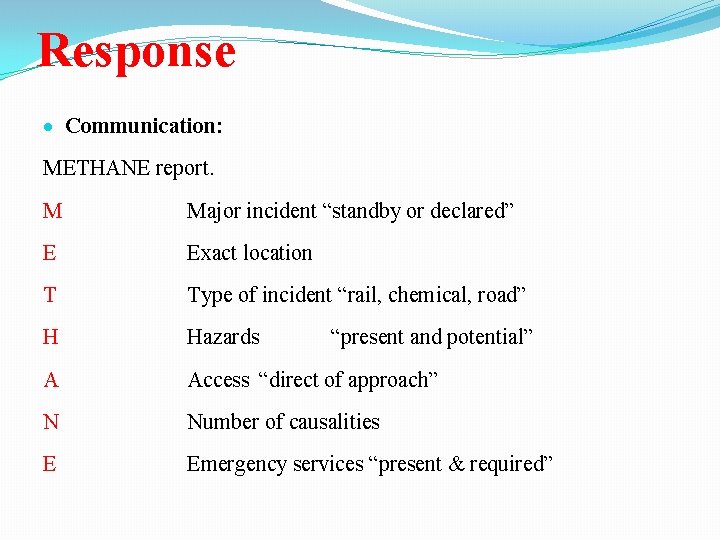
Response Communication: METHANE report. M Major incident “standby or declared” E Exact location T Type of incident “rail, chemical, road” H Hazards A Access “direct of approach” N Number of causalities E Emergency services “present & required” “present and potential”
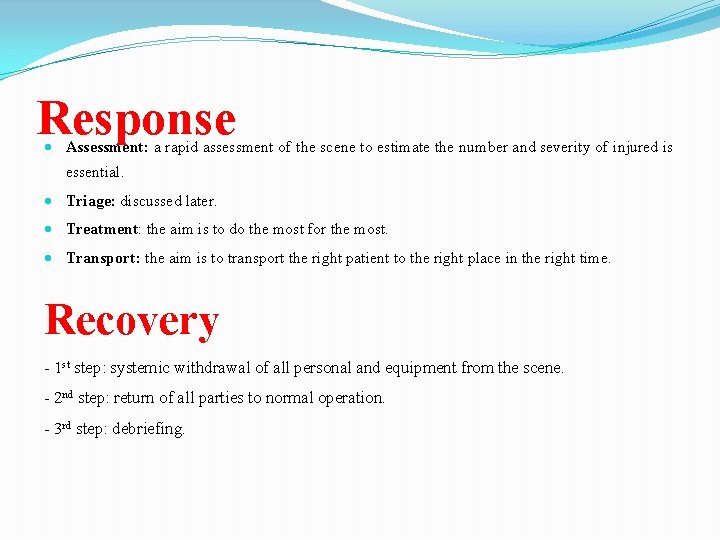
Response Assessment: a rapid assessment of the scene to estimate the number and severity of injured is essential. Triage: discussed later. Treatment: the aim is to do the most for the most. Transport: the aim is to transport the right patient to the right place in the right time. Recovery - 1 st step: systemic withdrawal of all personal and equipment from the scene. - 2 nd step: return of all parties to normal operation. - 3 rd step: debriefing.

Triage
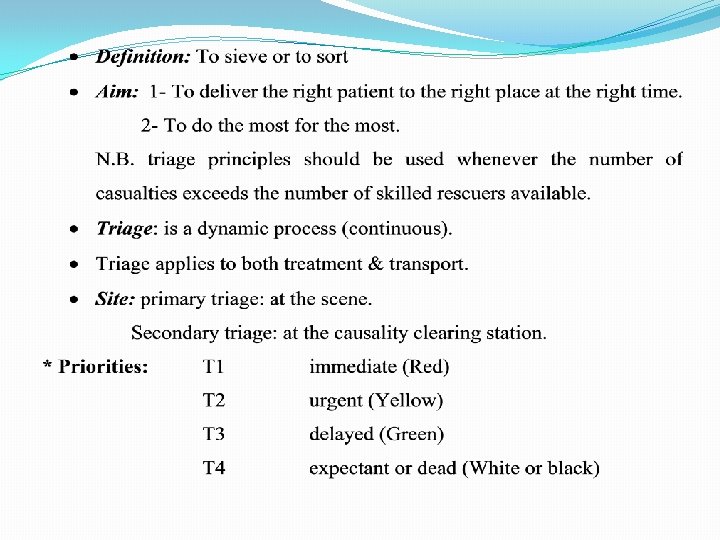
* Method: **Primary triage “triage sieve”: Mobility: walking patients are initially categorized as T 3. A. B. C. : Airway: Patients who cannot breath despite simple airway maneuvers are dead. If breathing starts when the airway is opened, these patients are T 1 (immediate). Breathing: Respiratory rates above or equal to 30 or below or equal to 9 breaths/ min are T 1 (immediate priority). If respiratory rate between 10 -29/min assess circulation. Circulation: Capillary refill time greater than 2 seconds are T 1 (immediate).
* Method: Secondary triage: “triage sort”. TRTS priority 1 - 10 T 1 11 T 2 12 T 3 0 Dead



Thank you Dr. Ahmed Mostafa
- Slides: 16