
Major globalization facts and some important issues for
Major globalization facts and some important issues for educational research in a global world Erik De Corte Center for Instructional psychology and Technology, University of Leuven, Belgium Paper presented in a panel session on: Globalism’s contributions to educational research and the development of new knowledge, organized at the Annual Meeting of the American Educational Research Association, San Diego, April 13 – 17, 2009
OVERVIEW • Some background • Major globalization facts on the road to educational research globalism • Some issues for educational research in a global world

Some background: What is globalism? Globalism is a belief system that emphasizes the current trend toward international organizations and institutions Globalization denotes a process of increased global interaction and integration among people, companies, and governments of different nations It has effects on the environment, on culture, on political systems, on economic development and prosperity, and on physical well-being in societies around the world Globalization is an element of globalism Globalism has ancient roots, but so called “thick globalism” characterized by an increasig density of interactions is a post-second World War phenomenon Already in 1971 a colleague of mine published a book The world is our village

Major globalization facts on the road to educational research globalism AERA 1979: restricted number of “aliens” AERA mid-1990 s: the number was much bigger and has continued to grow Europe: in the 1970 s not much contact between scholars. Euro-colleagues met each other in this country Since the foundation of EARLI in 1985 exchange and cooperation between researchers has been soaring and has led to many spin-off networks and projects Currently a substantial number of EARLI members and participants in the biennial conferences are non. Europeans
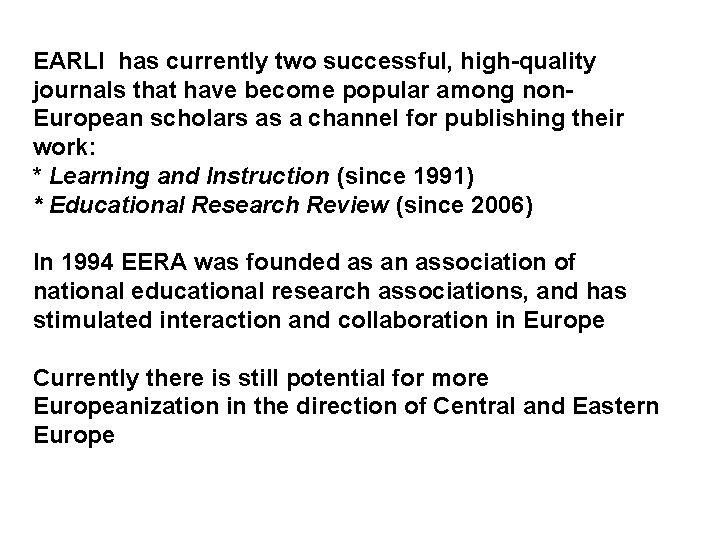
EARLI has currently two successful, high-quality journals that have become popular among non. European scholars as a channel for publishing their work: * Learning and Instruction (since 1991) * Educational Research Review (since 2006) In 1994 EERA was founded as an association of national educational research associations, and has stimulated interaction and collaboration in Europe Currently there is still potential for more Europeanization in the direction of Central and Eastern Europe
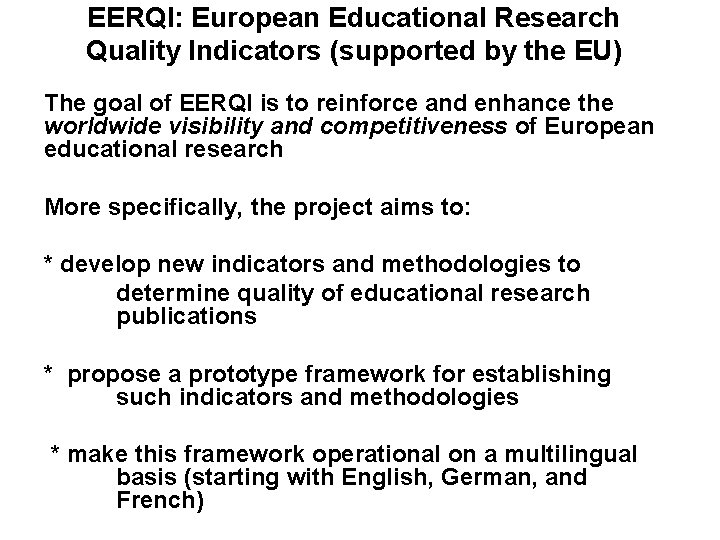
EERQI: European Educational Research Quality Indicators (supported by the EU) The goal of EERQI is to reinforce and enhance the worldwide visibility and competitiveness of European educational research More specifically, the project aims to: * develop new indicators and methodologies to determine quality of educational research publications * propose a prototype framework for establishing such indicators and methodologies * make this framework operational on a multilingual basis (starting with English, German, and French)
A last and very recent development in the globalization of educational research is the establishment (in fact in the margin of this AERA meeting) of WERA, the World Educational Research Association, an association of about 25 national, regional, and international educational research associations (see Educational Researcher, 38(1), January/February 2009)
Some issues for educational research in a global world No doubt that educ. res. has benefited from those international developments (i. e. globalization) Good example: research on math education: exchanges and interactions in meetings of PME and ICME, but also at this annual meeting have contributed to our better understanding of students’ math learning and to the development of new approaches to teaching This work has been enriched by the so-called “ethnomathematics”, the study of math practiced, expressed, and transmitted in identifiable sociocultural groups, such as non-Western indigenous cultures
International comparative studies of educational achievement TIMSS (Trends in International Mathematics and Science Study; more than 60 countries in 2007) PIRLS (Progress in International Reading Literacy Study; more than 50 countries in 2011) organized by the International Association for the Evaluation of Educational Achievement (started in 1964) PISA (Programme for International Student Assessment), started in 2000 with 43 countries; 62 countries will participate in 2009) organized by OECD
These studies are constantly the object of debate and criticism For instance, they are sometimes called horse race studies that raise a lot of critical questions relating to differences in curricula, time spent in school and student population, etc. But they certainly have also been useful in some respects, such as forcing countries to submit their curricula to a close scrutiny and to examine factors that are likely to influence educational achievement Moreover, some developments in this kind of studies are promising, especially the fact that besides quantitative also qualitative data are collected analyzed that are very informative (e. g. , about class size, functioning of teacher as a professional group, spiral curriculum, etc. )
Some other relevant topics derived partly from a small survey among IAE Fellows World-wide research addressing the issue of what are the basic competencies (fundamental knowledge and skills) that should be included in any K-12 curriculum? And in what grade levels should these competencies be introduced? The European Commission has just unveiled an initiative called New Skills for New Jobs that aims at anticipating the skills needed for the jobs of the future Fundamental research, using quantitative as well as qualitative data, is needed to provide such reliable anticipative information. Developing common tools and methodologies is a essential requirement to ensure valid comparability
How can/should education cope with the increasing diversity that accompanies globalization? How can education best deal with individual differences based on an analysis of the different ways that nations currently cope with such differences? Capacity building in universities in the so-called developing countries (Africa, Asia, Latin America)
Initiatives of the International Academy of Education contributing to the globalization of educ. res. , esp. of evidence-based outcomes of general relevance Educational Practices Series: short publications addressed to practioners which present the results of well-established bodies of research on specific topics in easy-to-read booklets (18 booklets available; published and distributed through a cooperative arrangement with the International Bureau of Education in Geneva) Educational Policy Series: A similar series aimed at policy- and decision-makers (10 booklets; published and distributed through a cooperative arrangement with the International Institute for Educational Planning in Paris)
Teaching by Brophy, J. Parents and Learning by Redding, S. Effective Educational Practices by Walberg, H. J. , & Paik, S. J. Improving Student Achievement in Mathematics by Grouws, D. A. , & Cebulla, K. J. Tutoring by Topping, K. Teaching Additional Languages by Judd, E. L. , Tan, L. , & Walberg, H. J. How Children Learn by Vosniadou, S. Preventing Behaviour Problems: What Works by Foster, S. L. , Brennan, P. , Biglan, A. , Wang, L. , & al–Ghaith, S.
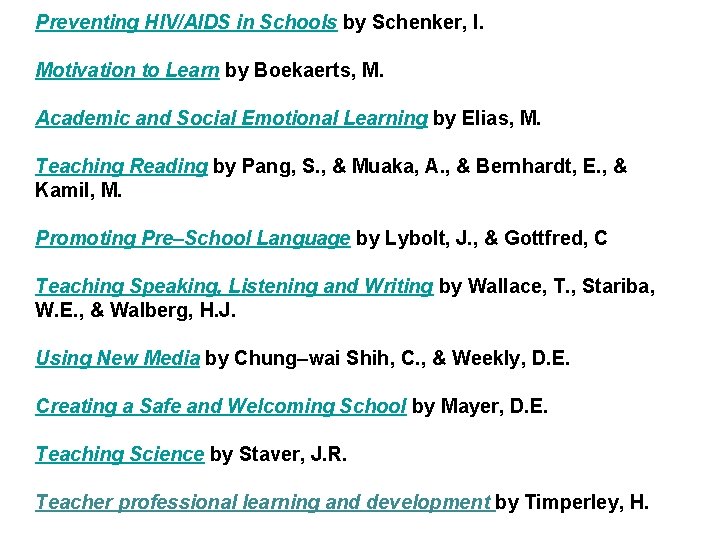
Preventing HIV/AIDS in Schools by Schenker, I. Motivation to Learn by Boekaerts, M. Academic and Social Emotional Learning by Elias, M. Teaching Reading by Pang, S. , & Muaka, A. , & Bernhardt, E. , & Kamil, M. Promoting Pre–School Language by Lybolt, J. , & Gottfred, C Teaching Speaking, Listening and Writing by Wallace, T. , Stariba, W. E. , & Walberg, H. J. Using New Media by Chung–wai Shih, C. , & Weekly, D. E. Creating a Safe and Welcoming School by Mayer, D. E. Teaching Science by Staver, J. R. Teacher professional learning and development by Timperley, H.
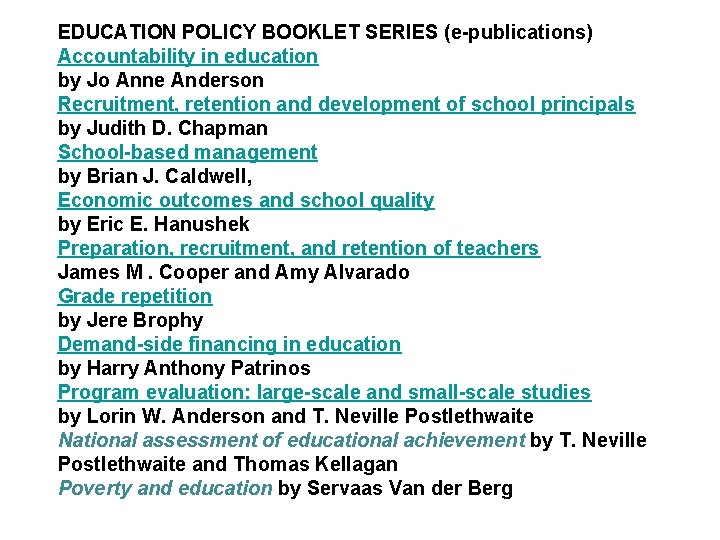
EDUCATION POLICY BOOKLET SERIES (e-publications) Accountability in education by Jo Anne Anderson Recruitment, retention and development of school principals by Judith D. Chapman School-based management by Brian J. Caldwell, Economic outcomes and school quality by Eric E. Hanushek Preparation, recruitment, and retention of teachers James M. Cooper and Amy Alvarado Grade repetition by Jere Brophy Demand-side financing in education by Harry Anthony Patrinos Program evaluation: large-scale and small-scale studies by Lorin W. Anderson and T. Neville Postlethwaite National assessment of educational achievement by T. Neville Postlethwaite and Thomas Kellagan Poverty and education by Servaas Van der Berg
- Slides: 16