
Major Events of the Cold War 1945 1991
- Slides: 45
Major Events of the Cold War 1945 – 1991
Review of Cold War Events already covered February, 1945 – Yalta Conference › Allies agree to divide up Germany after the war May, 1945 – Germany surrenders June, 1945 – United Nations chartered › Security Council 5 Permanent members = Great Britain, China, France, Soviet Union, U. S. A. July – August, 1945 – Potsdam Conference › Truman tells Stalin about the atomic bomb August 6 th & 9 th, 1945 – U. S. drops atomic bombs on Hiroshima and Nagasaki, Japan September, 1945 – Japan surrenders
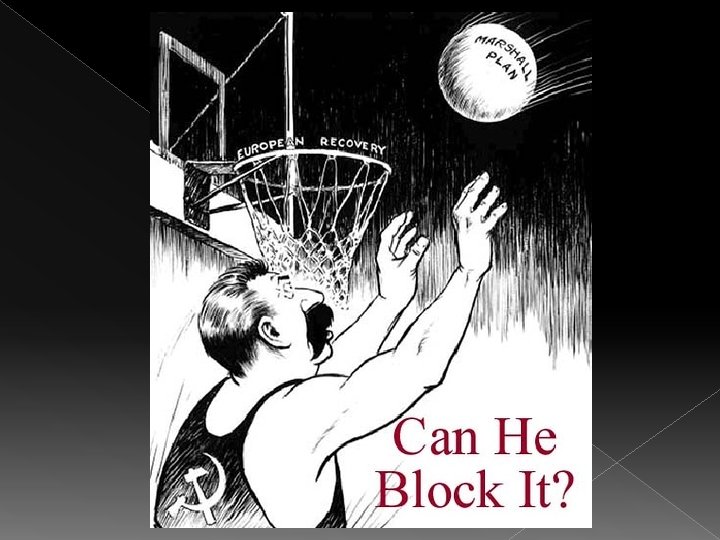
Review of Cold War Events already covered March 5, 1946 – Churchill’s “Iron Curtain” Speech March 12, 1947 – Truman Doctrine › $400 million in aid to Greece and Turkey to prevent communist revolutions 1948 – 1952 – Marshall Plan › $12. 5 billion in aid to Western Europe to rebuild June, 1948 – May, 1949 – Berlin Airlift
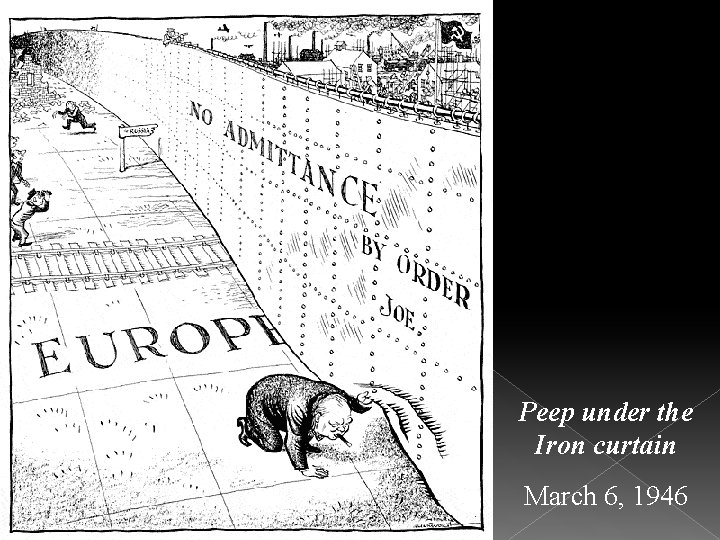
Peep under the Iron curtain March 6, 1946
Truman’s Containment Policy Containment = U. S. policy to attempt to prevent the spread of communism › Forming alliances against the Soviet Union › Helping countries resist communist influence Containment policy in action › › Truman Doctrine Marshall Plan Berlin Airlift NATO
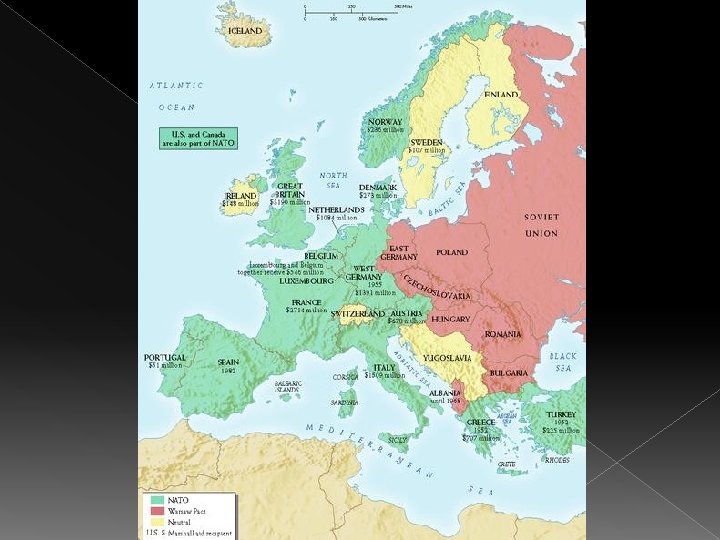
NATO vs. Warsaw Pact NATO (1949) = North Atlantic Treaty Organization › 10 western European nations, U. S. & Canada › Defensive military alliance Warsaw Pact (1955) › Soviet Union, East Germany, Czechoslovakia, Poland, Hungary, Romania, Bulgaria, and Albania › 1961 – Berlin Wall built, becomes the physical symbol of the Cold War Many countries do not join either side › India and China
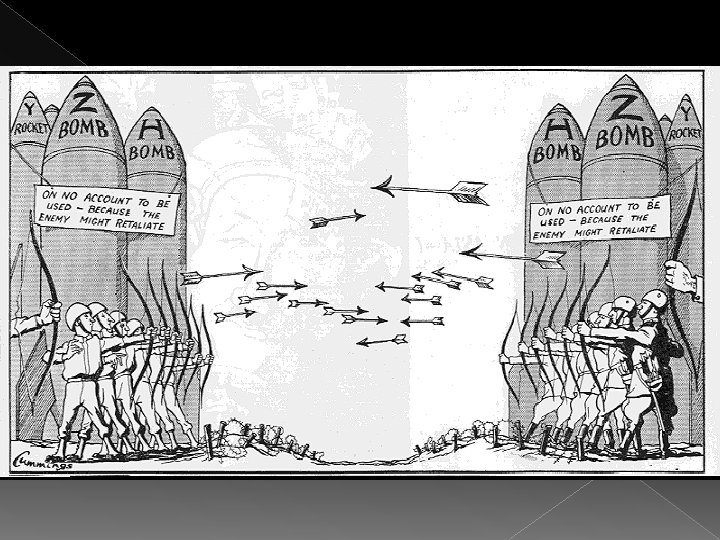
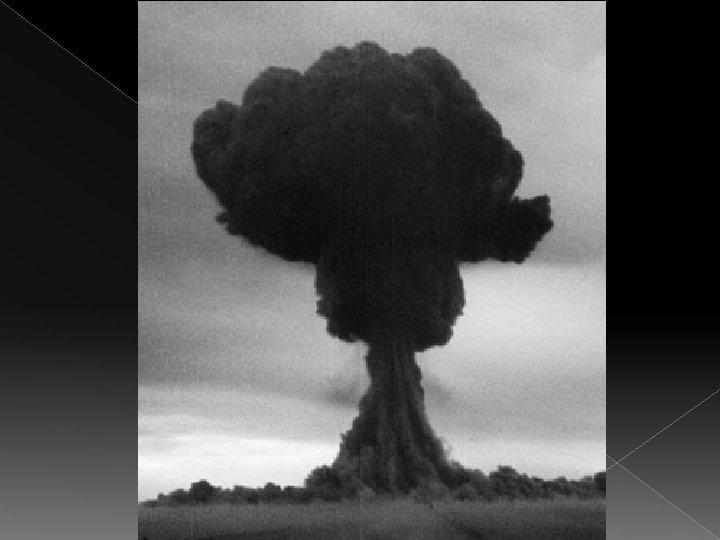
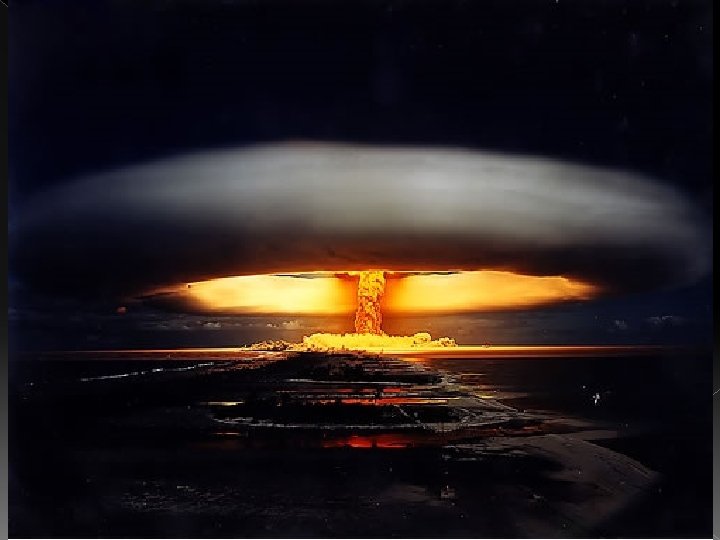
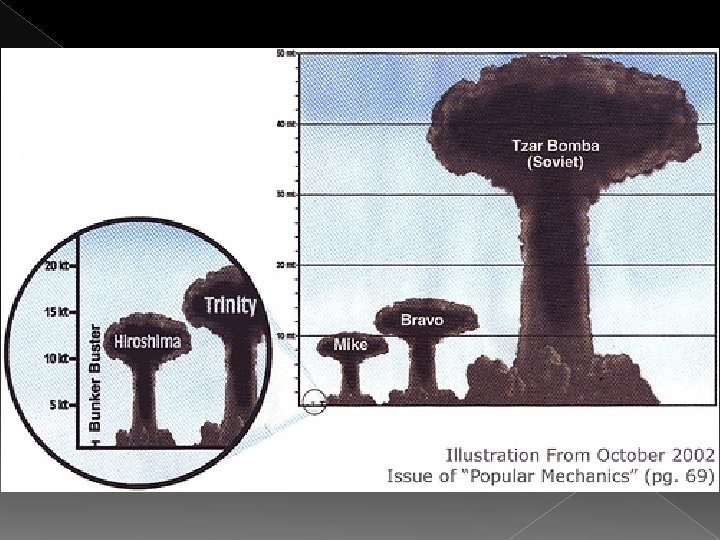
Arms Race 1945 – U. S. tests and uses the first atomic bombs 1949 – U. S. S. R. tests an atomic weapon 1952 – U. S. tests first H-bomb (hydrogen or thermonuclear bomb) 1953 – U. S. S. R. tests an H-bomb 1953 – U. S. Secretary of State John Foster Dulles begins “brinkmanship” › Threaten to go to the “brink” of war against the Soviet Union
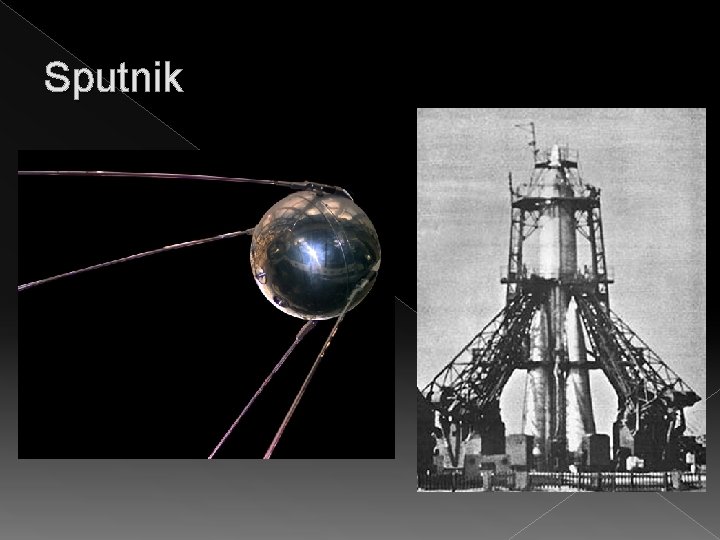
Arms Race 1957 – U. S. S. R. tests first ICBMs (Intercontinental Ballistic Missiles) › Missiles that could carry a nuclear weapon thousands of miles 1957 – U. S. S. R. launches Sputnik into orbit › First ever artificial satellite 1960 – U. S. U-2 spy plane shot down over the Soviet Union › U. S. pilot Francis Gary Powers captured
The Space Race 1957 – U. S. S. R. launches Sputnik 1958 – U. S. A. launches Explorer I 1961 – U. S. S. R. sends first man into space › Yuri Gagarin 1961 – Alan Shepard becomes first American in space 1969 – U. S. lands first men on the moon › Neil Armstrong, Buzz Aldrin, & Michael Collins 1971 – U. S. S. R. creates first manned space station 1975 – U. S. & U. S. S. R. begin working together in space
Sputnik
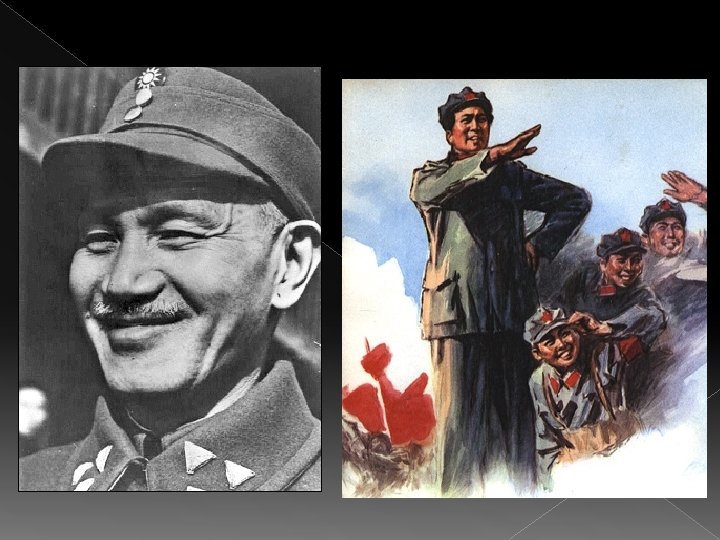
China becomes Communist 1946 – China renews its civil war › Jiang Jieshi leads the Nationalists Was given money by the U. S. to help › Mao Zedong leads the Communists Was given money and weapons by the U. S. S. R. to help Zedong’s communist forces take control in October 1949 › Creates the People’s Republic of China Jieshi and his followers retreated to Taiwan › Creates the Nationalist Republic of China
Communist China Mao leads Marxist Socialism › Created collective farming and nationalized businesses and factories The Great Leap Forward › Created giant collective farms (communes) › Failed to produce enough food and led to famine Split with the Soviet Union › Both wanted to lead the world of communism › Disagreements over the border Cultural Revolution › Red Guard – high school and college students who led a militant revolution › Beat and killed any enemy of Mao › Eventually put down by Mao’s army
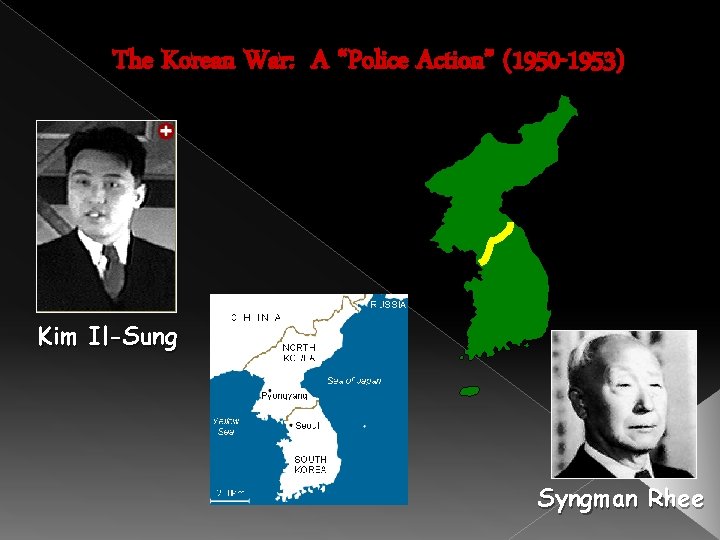
The Korean War: A “Police Action” (1950 -1953) Kim Il-Sung Syngman Rhee
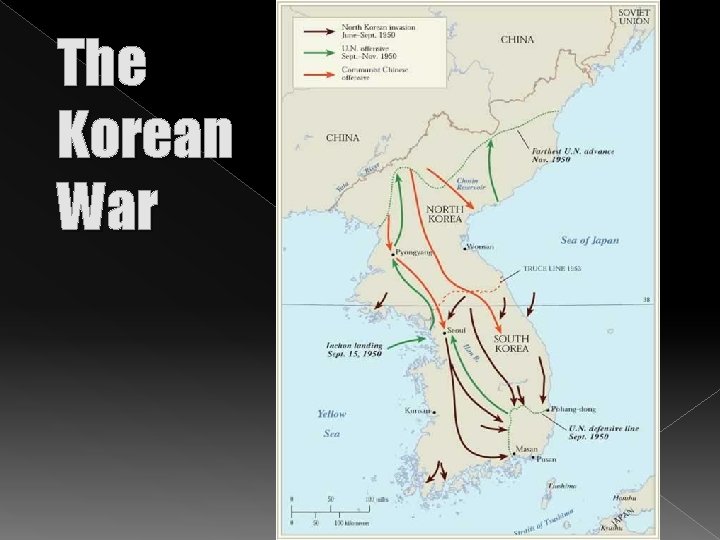
The Korean War
The Korean War June 25, 1950 – North Korea invades South Korea (38 th Parallel) The U. N. sent troops to defend South Korea › Mostly Americans led by Douglas Mac. Arthur U. N. forces come close to taking over all of North Korea, and then China joins the conflict Fighting ends with a ceasefire in July, 1953 › Still no peace treaty
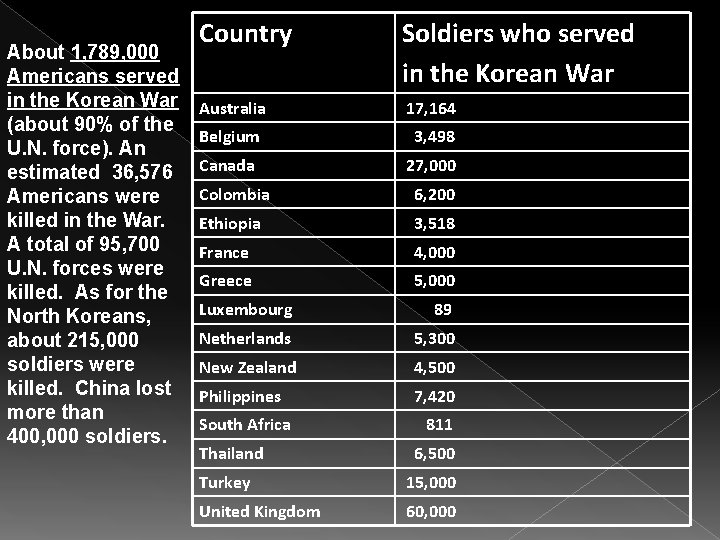
About 1, 789, 000 Americans served in the Korean War (about 90% of the U. N. force). An estimated 36, 576 Americans were killed in the War. A total of 95, 700 U. N. forces were killed. As for the North Koreans, about 215, 000 soldiers were killed. China lost more than 400, 000 soldiers. Country Soldiers who served in the Korean War Australia 17, 164 Belgium 3, 498 Canada 27, 000 Colombia 6, 200 Ethiopia 3, 518 France 4, 000 Greece 5, 000 Luxembourg 89 Netherlands 5, 300 New Zealand 4, 500 Philippines 7, 420 South Africa 811 Thailand 6, 500 Turkey 15, 000 United Kingdom 60, 000
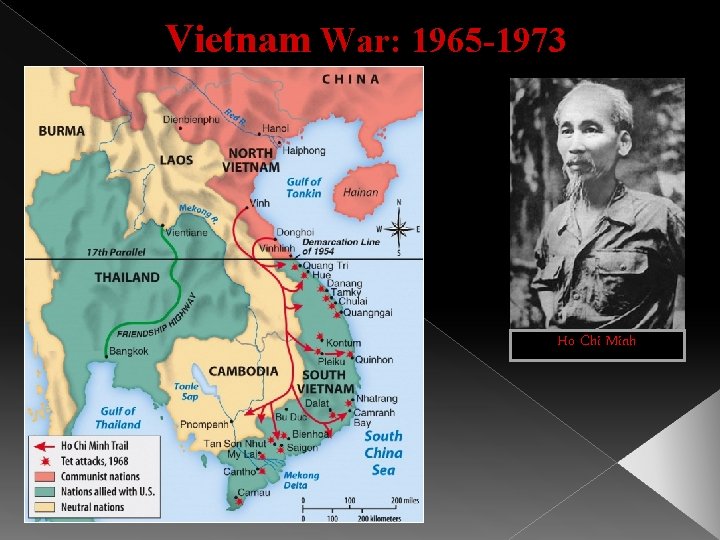
Vietnam War: 1965 -1973 Ho Chi Minh
Vietnam War French Indochina › Vietnam, Laos, and Cambodia › Independence movement begins in the early 1900 s Ho Chi Minh › Gains communist support in the 1930 s against the French › Leader of the Vietminh against Japan during World War II Fighting Begins › Fights against the French after WWII › Battle of Dien Bien Phu ends French involvement
Vietnam War Domino Theory › U. S. theory (Eisenhower) that believed communism would move from nation to nation › Justified involvement in Vietnam Divided Vietnam › North Vietnam – Ho Chi Minh leads communist government › South Vietnam – Ngo Dinh Diem leads anticommunist government Vietcong – South Vietnamese Communist fighters 1963 – Diem assassinated
Vietnam War Gulf of Tonkin › American ships attacked near North Vietnam U. S. escalation › President Lyndon Johnson increases U. S. involvement › U. S. fights ground air war › South Vietnam government and the U. S. become more and more unpopular U. S. Withdrawal › President Nixon begins Vietnamization program = South Vietnam takes over the fighting › U. S. bombs Vietnam, Laos and Cambodia › 1973 – last U. S. soldier leaves › 1975 – North Vietnam takes over
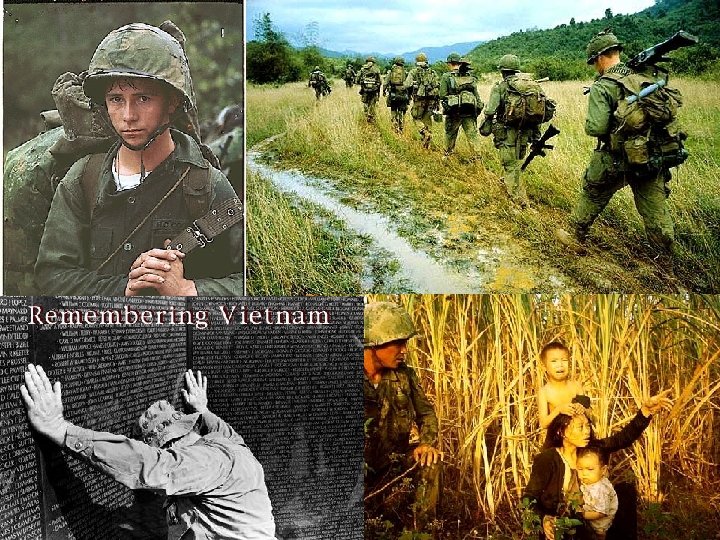
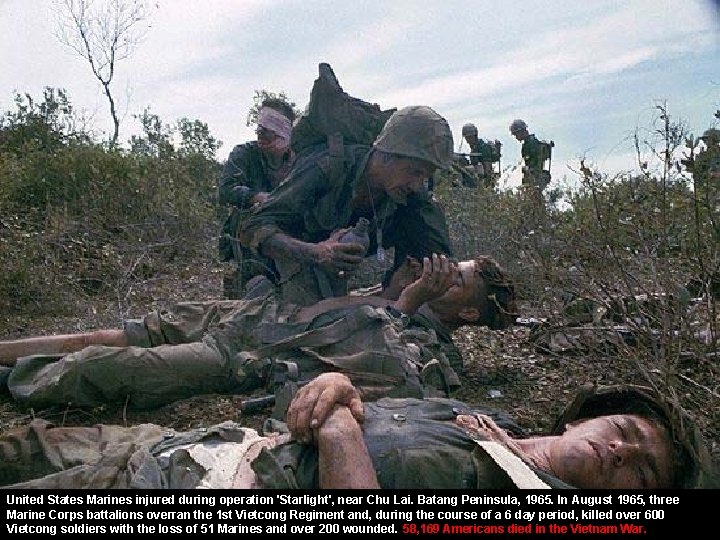
United States Marines injured during operation 'Starlight', near Chu Lai. Batang Peninsula, 1965. In August 1965, three Marine Corps battalions overran the 1 st Vietcong Regiment and, during the course of a 6 day period, killed over 600 Vietcong soldiers with the loss of 51 Marines and over 200 wounded. 58, 169 Americans died in the Vietnam War.
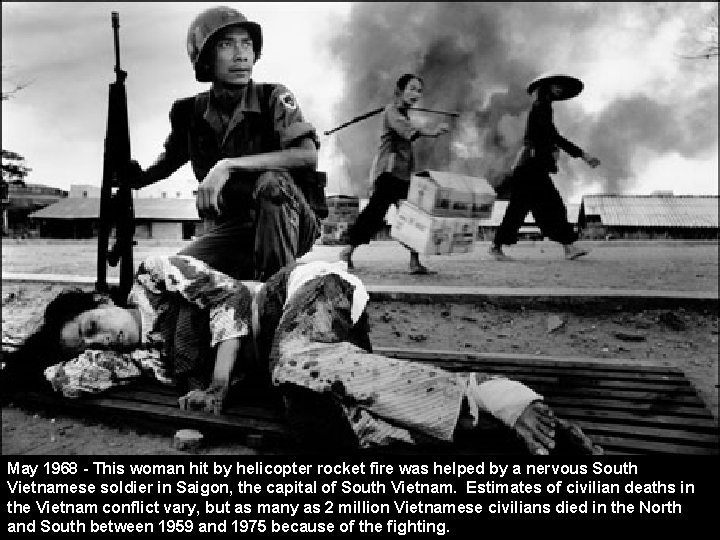
May 1968 - This woman hit by helicopter rocket fire was helped by a nervous South Vietnamese soldier in Saigon, the capital of South Vietnam. Estimates of civilian deaths in the Vietnam conflict vary, but as many as 2 million Vietnamese civilians died in the North and South between 1959 and 1975 because of the fighting.
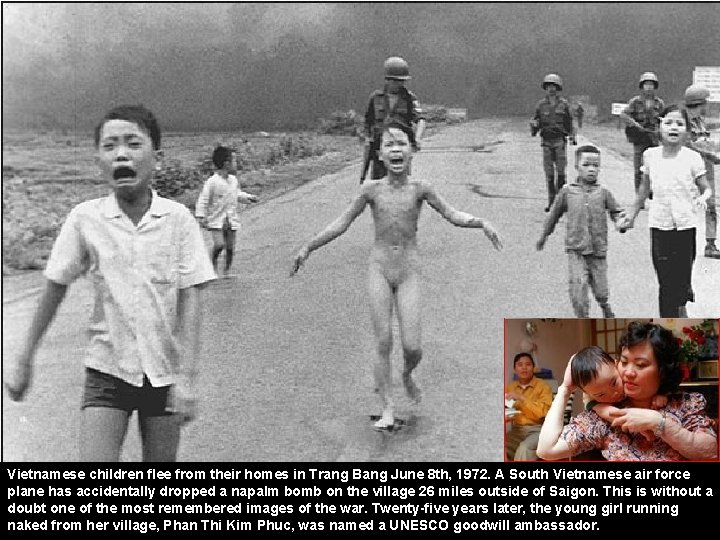
Vietnamese children flee from their homes in Trang Bang June 8 th, 1972. A South Vietnamese air force plane has accidentally dropped a napalm bomb on the village 26 miles outside of Saigon. This is without a doubt one of the most remembered images of the war. Twenty-five years later, the young girl running naked from her village, Phan Thi Kim Phuc, was named a UNESCO goodwill ambassador.
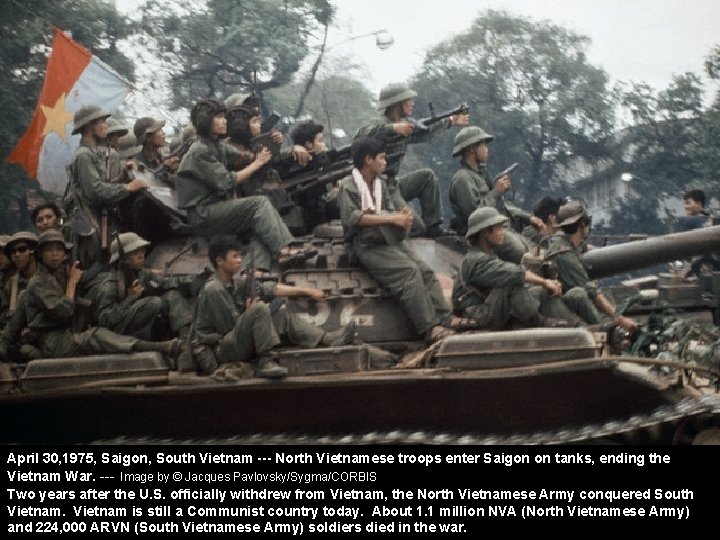
April 30, 1975, Saigon, South Vietnam --- North Vietnamese troops enter Saigon on tanks, ending the Vietnam War. --- Image by © Jacques Pavlovsky/Sygma/CORBIS Two years after the U. S. officially withdrew from Vietnam, the North Vietnamese Army conquered South Vietnam is still a Communist country today. About 1. 1 million NVA (North Vietnamese Army) and 224, 000 ARVN (South Vietnamese Army) soldiers died in the war.
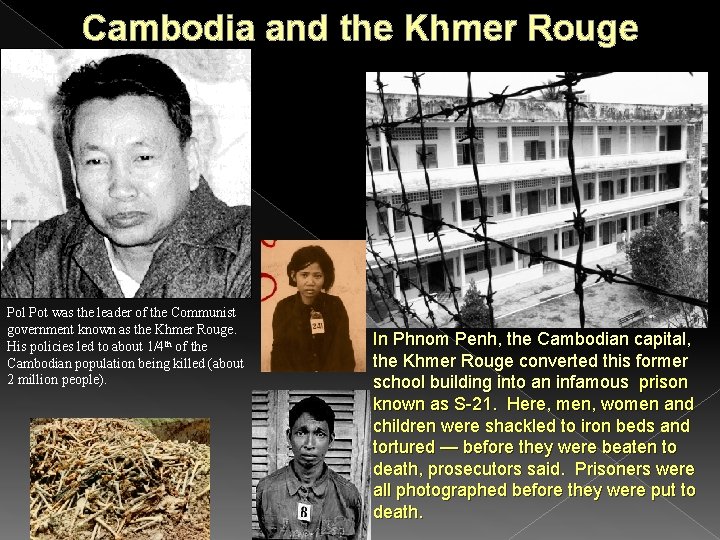
Cambodia and the Khmer Rouge Pol Pot was the leader of the Communist government known as the Khmer Rouge. His policies led to about 1/4 th of the Cambodian population being killed (about 2 million people). In Phnom Penh, the Cambodian capital, the Khmer Rouge converted this former school building into an infamous prison known as S-21. Here, men, women and children were shackled to iron beds and tortured — before they were beaten to death, prosecutors said. Prisoners were all photographed before they were put to death.
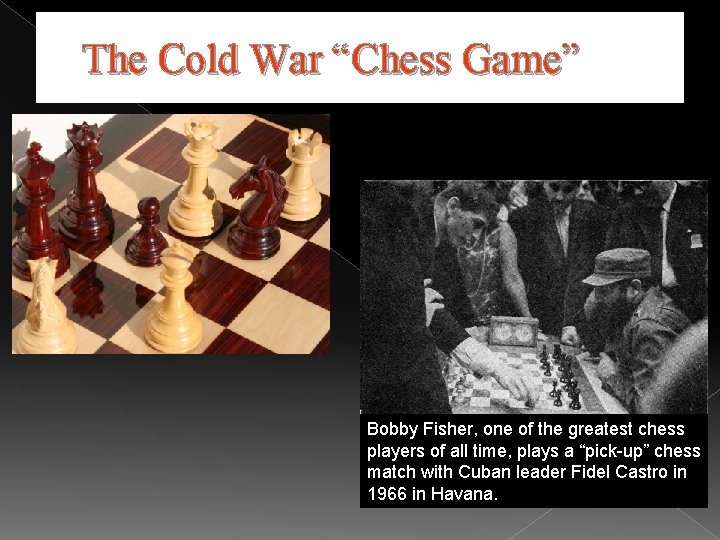
The Cold War “Chess Game” Bobby Fisher, one of the greatest chess players of all time, plays a “pick-up” chess match with Cuban leader Fidel Castro in 1966 in Havana.
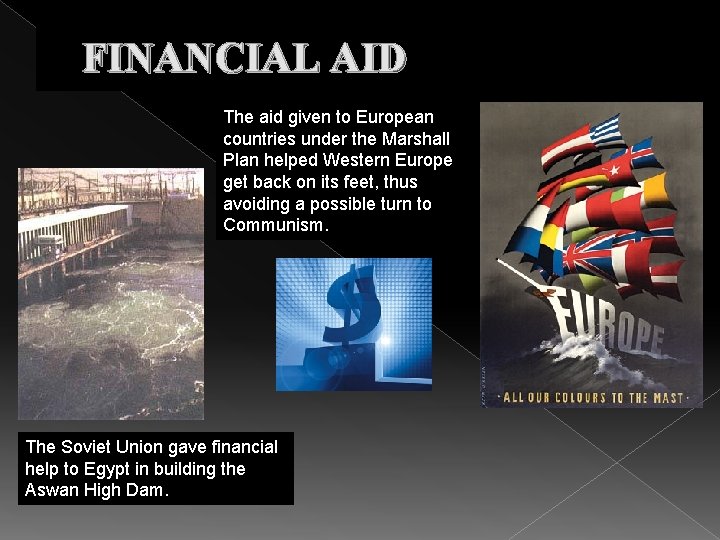
FINANCIAL AID The aid given to European countries under the Marshall Plan helped Western Europe get back on its feet, thus avoiding a possible turn to Communism. The Soviet Union gave financial help to Egypt in building the Aswan High Dam.
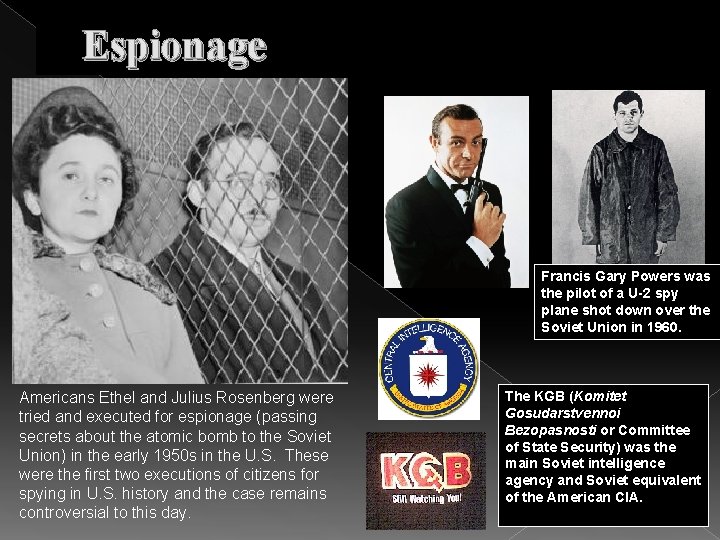
Espionage Francis Gary Powers was the pilot of a U-2 spy plane shot down over the Soviet Union in 1960. Americans Ethel and Julius Rosenberg were tried and executed for espionage (passing secrets about the atomic bomb to the Soviet Union) in the early 1950 s in the U. S. These were the first two executions of citizens for spying in U. S. history and the case remains controversial to this day. The KGB (Komitet Gosudarstvennoi Bezopasnosti or Committee of State Security) was the main Soviet intelligence agency and Soviet equivalent of the American CIA.
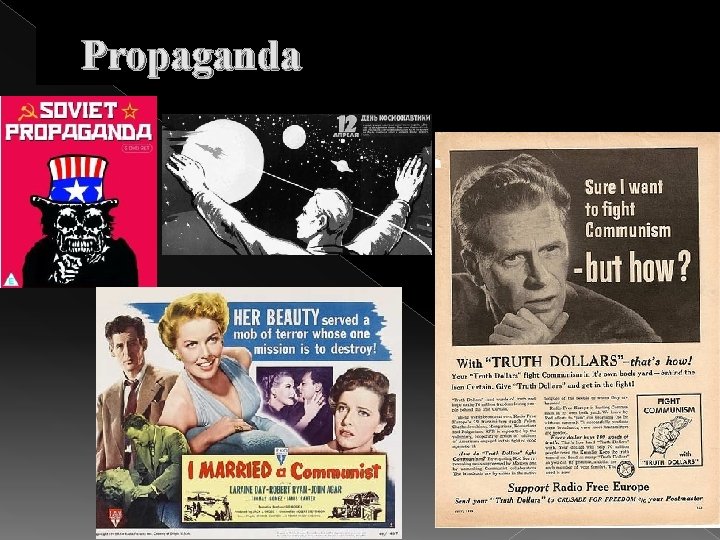
Propaganda
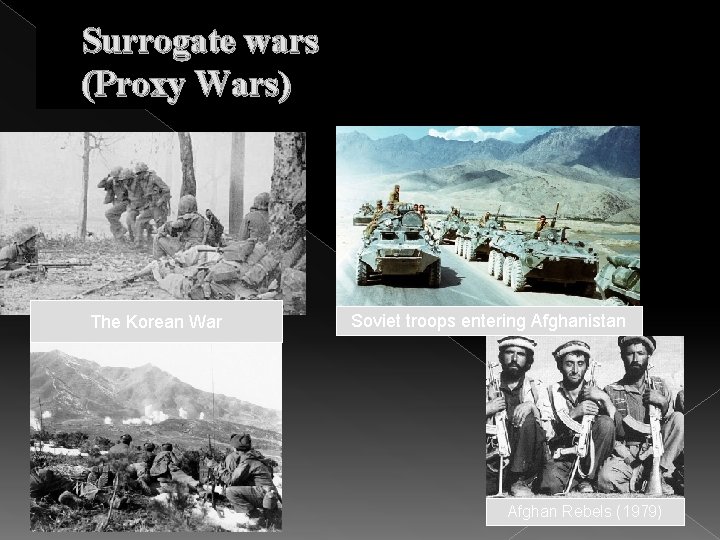
Surrogate wars (Proxy Wars) The Korean War Soviet troops entering Afghanistan Afghan Rebels (1979)
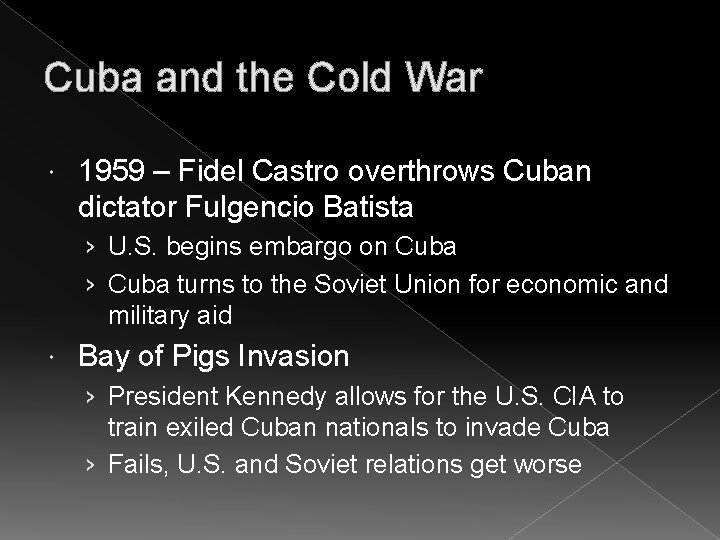
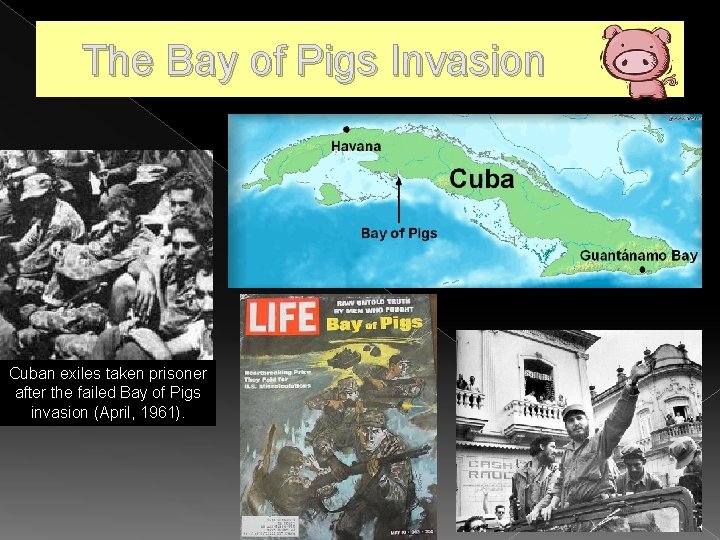
Cuba and the Cold War 1959 – Fidel Castro overthrows Cuban dictator Fulgencio Batista › U. S. begins embargo on Cuba › Cuba turns to the Soviet Union for economic and military aid Bay of Pigs Invasion › President Kennedy allows for the U. S. CIA to train exiled Cuban nationals to invade Cuba › Fails, U. S. and Soviet relations get worse
The Bay of Pigs Invasion Cuban exiles taken prisoner after the failed Bay of Pigs invasion (April, 1961).
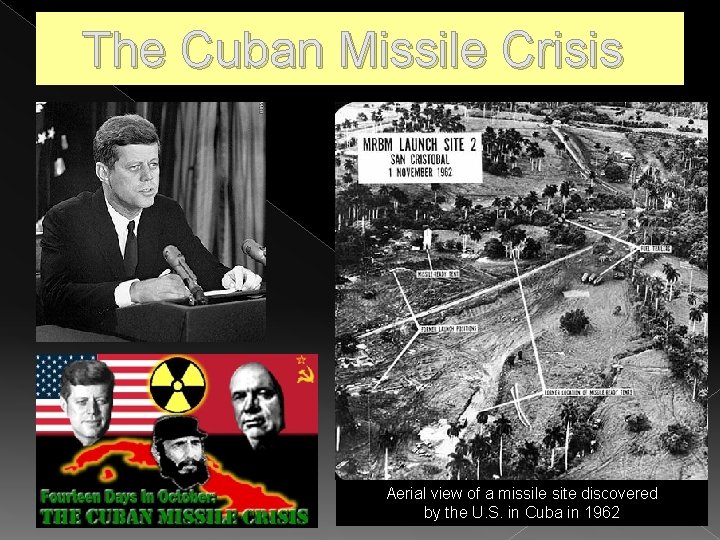
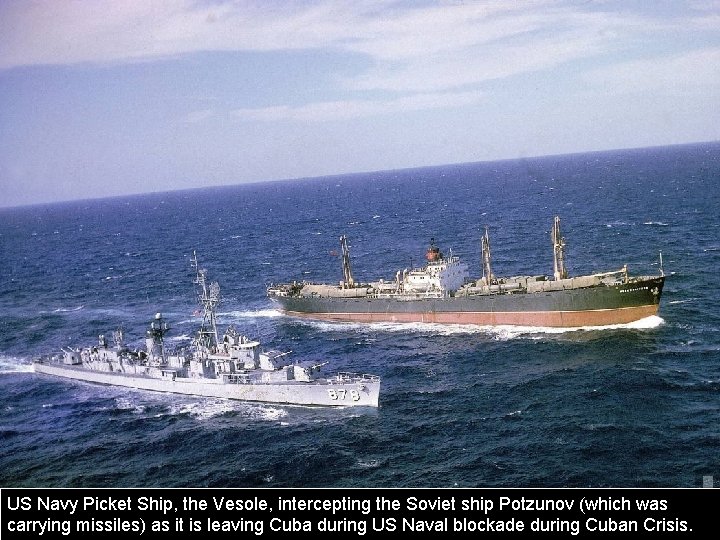
Cuban Missile Crisis Soviet Union builds missile bases in Cuba U. S. placed a naval blockade on Cuba U. S. President Kennedy and Soviet Premier Khrushchev face off for 13 days › World prepares for nuclear war between the two super powers! Soviet Union agrees to remove missiles in Cuba and U. S. removes missiles in Turkey
The Cuban Missile Crisis Aerial view of a missile site discovered by the U. S. in Cuba in 1962
US Navy Picket Ship, the Vesole, intercepting the Soviet ship Potzunov (which was carrying missiles) as it is leaving Cuba during US Naval blockade during Cuban Crisis.
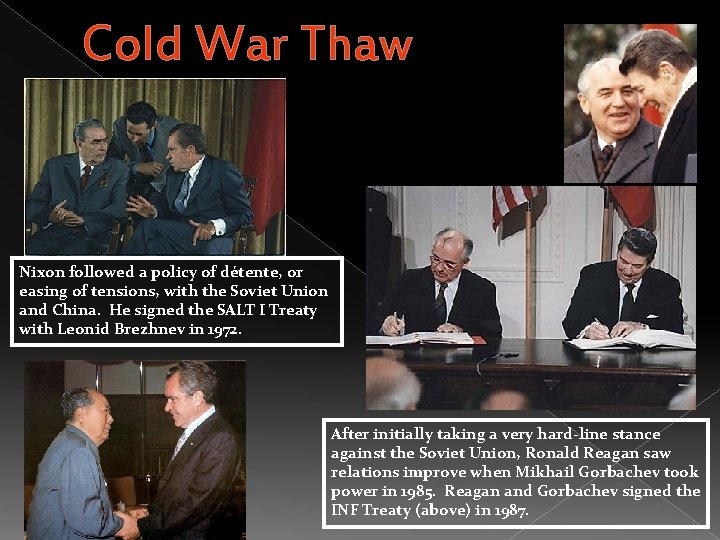
Cold War Thaw Nixon followed a policy of détente, or easing of tensions, with the Soviet Union and China. He signed the SALT I Treaty with Leonid Brezhnev in 1972. After initially taking a very hard-line stance against the Soviet Union, Ronald Reagan saw relations improve when Mikhail Gorbachev took power in 1985. Reagan and Gorbachev signed the INF Treaty (above) in 1987.
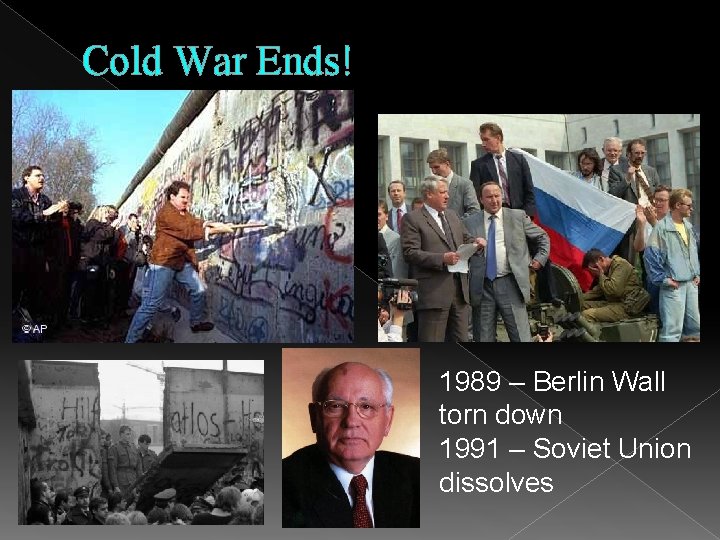
Cold War Ends! 1989 – Berlin Wall torn down 1991 – Soviet Union dissolves