
Maintenance of the AFP Detector REFURBISHMENT OF DETECTOR
Maintenance of the AFP Detector

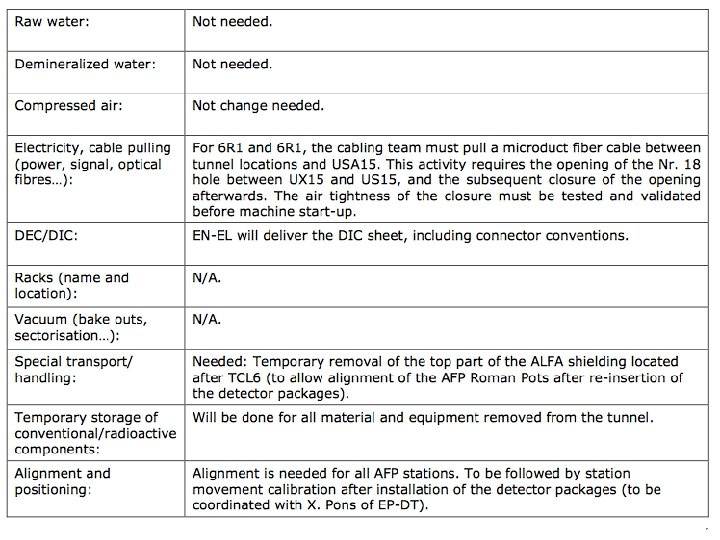
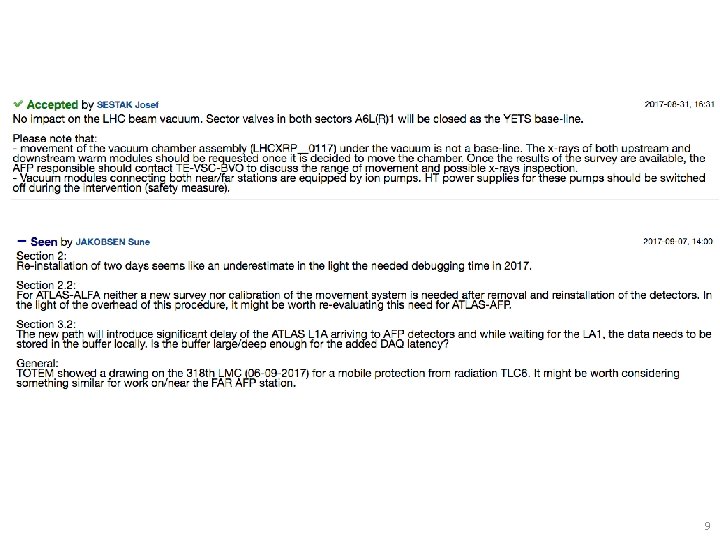
REFURBISHMENT OF DETECTOR PACKAGES IN THE AFP STATIONS • Removal of detector packages in the stations (1 day per arm by AFP personnel). It is proposed that this is done as early as possible in the YETS 2017: in Week 51 after the area is released by Radio Protection for work, and otherwise in Week 2 of 2018 • 2. Radiological survey of the detector packages and storage for cool-down if necessary. TREC registration. • 3. Re-installation of detector packages (2 days per arm). This re-installation will take 1 day per detector package because of cabling and extensive testing before and after insertion of the detector package. It is proposed that the re-installation take place late in the YETS 2017, possibly in the last week before the area is closed for Cryo operations. 2
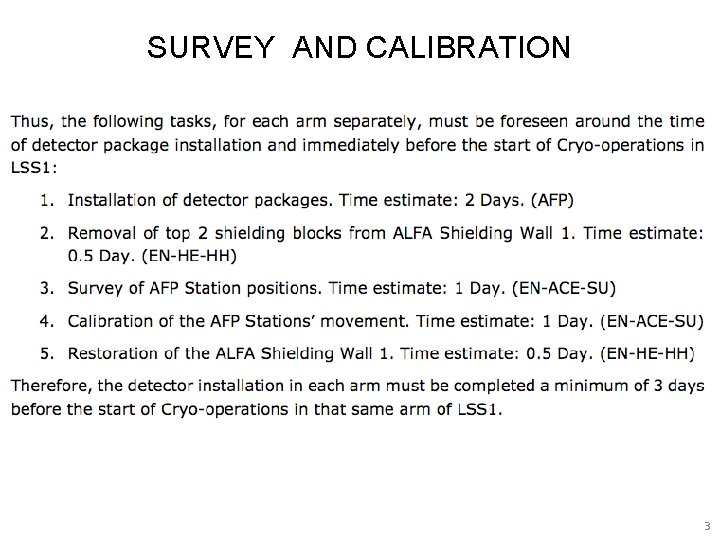
SURVEY AND CALIBRATION 3

DATA ACQUISITION FIBER BUNDLE INSTALLATION • a single optical fiber bundle of 12 SM fibers/bundle will be pneumatically blown (“jetted”) into a pre-installed 7 -microduct cable, cut, and then terminated with 12 -fiber MTP/MPO female connectors. 4
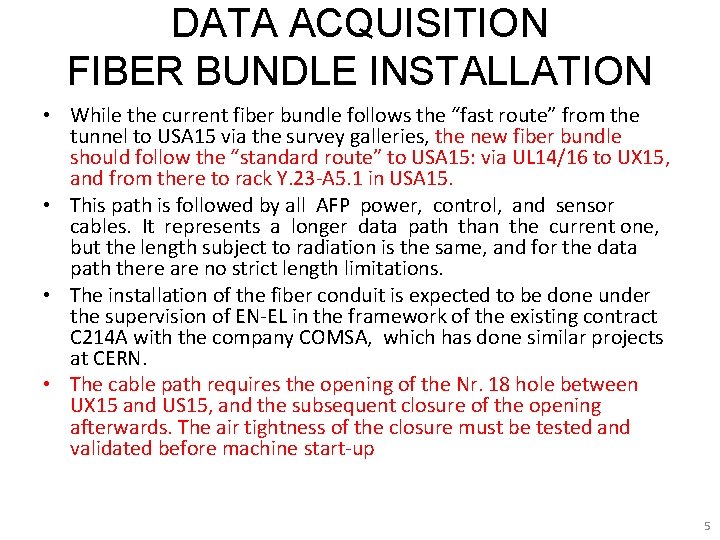
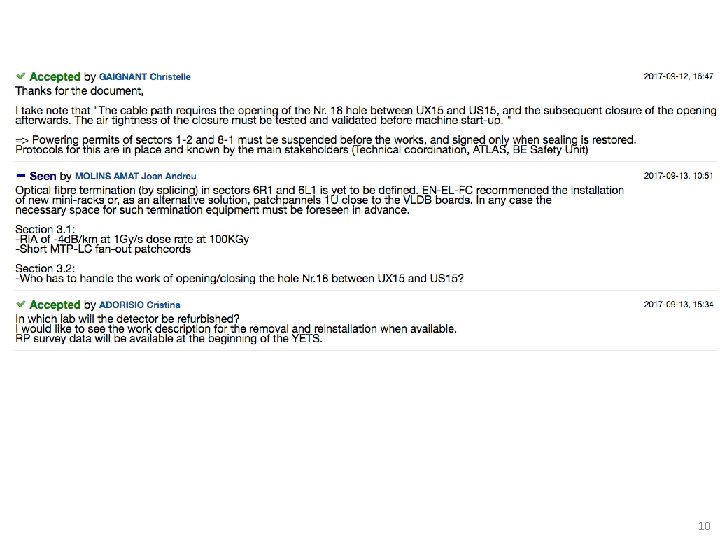
DATA ACQUISITION FIBER BUNDLE INSTALLATION • While the current fiber bundle follows the “fast route” from the tunnel to USA 15 via the survey galleries, the new fiber bundle should follow the “standard route” to USA 15: via UL 14/16 to UX 15, and from there to rack Y. 23 -A 5. 1 in USA 15. • This path is followed by all AFP power, control, and sensor cables. It represents a longer data path than the current one, but the length subject to radiation is the same, and for the data path there are no strict length limitations. • The installation of the fiber conduit is expected to be done under the supervision of EN-EL in the framework of the existing contract C 214 A with the company COMSA, which has done similar projects at CERN. • The cable path requires the opening of the Nr. 18 hole between UX 15 and US 15, and the subsequent closure of the opening afterwards. The air tightness of the closure must be tested and validated before machine start-up 5
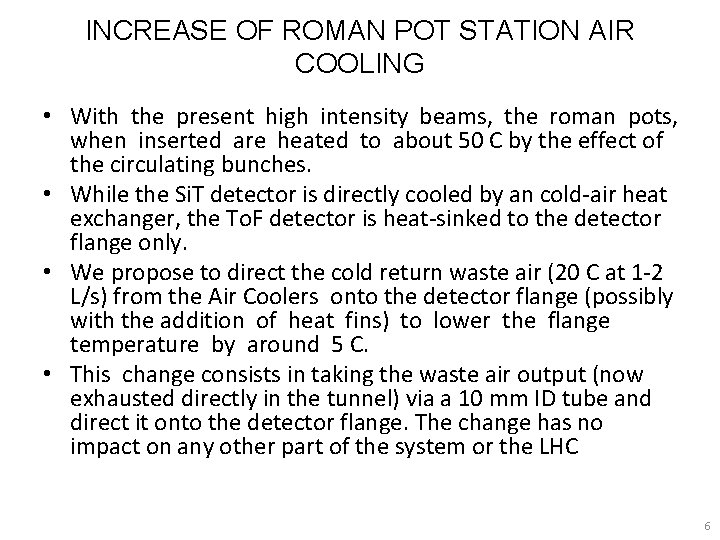
INCREASE OF ROMAN POT STATION AIR COOLING • With the present high intensity beams, the roman pots, when inserted are heated to about 50 C by the effect of the circulating bunches. • While the Si. T detector is directly cooled by an cold-air heat exchanger, the To. F detector is heat-sinked to the detector flange only. • We propose to direct the cold return waste air (20 C at 1 -2 L/s) from the Air Coolers onto the detector flange (possibly with the addition of heat fins) to lower the flange temperature by around 5 C. • This change consists in taking the waste air output (now exhausted directly in the tunnel) via a 10 mm ID tube and direct it onto the detector flange. The change has no impact on any other part of the system or the LHC 6
7

8
9
10
- Slides: 10