
Maintenance and Repairing of Electrical System Equipment Switchboard
Maintenance and Repairing of Electrical System Equipment, Switchboard ds, Electric Motors, Generators and DC Electrical System and Equipment: Part 1
Lecturing 03 Review n What is Lockout-Tagout (LOTO) Procedures n How Permit systems work? n What is earthing device and how to apply it safely? n Describe safety precaution when performing various maintenance or repair task on ship!
Pre Lecturing 04 Quiz Describe the principle of major and periodic overhaul, periodic and daily maintenance, survey after damage with the use of technical documentation! n Explain the principle of organization of maintenance, repairs, and describes how to document maintenance, repairs and trials. n Describe how to manage maintenance intervals repairs and spare part in the computer system (e. g. AMOS) n
Principle of Major and Periodic Overhaul n Traditionally, 5 types of maintenance have been distinguished, which are differentiated by the nature of the tasks that they include: – Corrective Maintenance – Preventive Maintenance – Predictive Maintenance – Zero Haul Maintenance (Overhaul) – Periodic Maintenance (Time Based Maintenance)
Corrective Maintenance n The set of tasks is destined to correct the defects to be found in the different equipment and that are communicated to the maintenance department by users of the same equipment.
Preventive Maintenance n Its mission is to maintain a level of certain service on equipment, programming the interventions of their vulnerabilities in the most opportune time. It is used to be a systematic character, that is, the equipment is inspected even if it has not given any symptoms of having a problem.
Predictive Maintenance n It pursues constantly know and report the status and operational capacity of the installations by knowing the values of certain variables, which represent such state and operational ability. To apply this maintenance, it is necessary to identify physical variables (temperature, vibration, power consumption, etc. ). Which variation is indicative of problems that may be appearing on the equipment. This maintenance it is the most technical, since it requires advanced technical resources, and at times of strong mathematical, physical and / or technical knowledge.
Zero Haul Maintenance n The set of tasks whose goal is to review the equipment at scheduled intervals before appearing any failure, either when the reliability of the equipment has decreased considerably so it is risky to make forecasts of production capacity. This review is based on leaving the equipment to zero hours of operation, that is, as if the equipment were new. These reviews will replace or repair all items subject to wear. The aim is to ensure, with high probability, a good working time fixed in advance.
Periodic maintenance n The basic maintenance of equipment made by the users of it. It consists of a series of elementary tasks (data collections, visual inspections, cleaning, lubrication, retightening screws, …) for which no extensive training is necessary, but perhaps only a brief training. This type of maintenance is the based on TPM (Total Productive Maintenance).
TPM & RCM n Total Productive Maintenance n Reliability Centered Maintenance
TPM & RCM n Both methods started their lives in America, although one of them, TPM, migrated to Japan where it took on a life if its own. In the United States, it was known as PM (no “T”) and it stood for Preventive Maintenance. PM was arguably the industry standard for production and provided a solid enough foundation, but it was purely an engineering tool intended to make equipment more reliable.
Development TPM & RCM The TPM was developed by Seiichi Nakajima based on experience of the practical application of maintenance best practice in Japan between 1950 and 1970. This experience led to the recognition that a leadership mindset engaging front line teams in small group improvement activity is an essential element of effective operation. The outcome from his work was the application of the TPM process in 1971. One of the first companies to gain from this was Nippondenso, a company that created parts for Toyota n RCM is the technique developed by the aircraft industry to generate maintenance procedures. By considering “the tool” as functions and how they might fail, then comparing the maintenance cost against the cost (and the consequences) of a failure, and using a special decision diagram. n
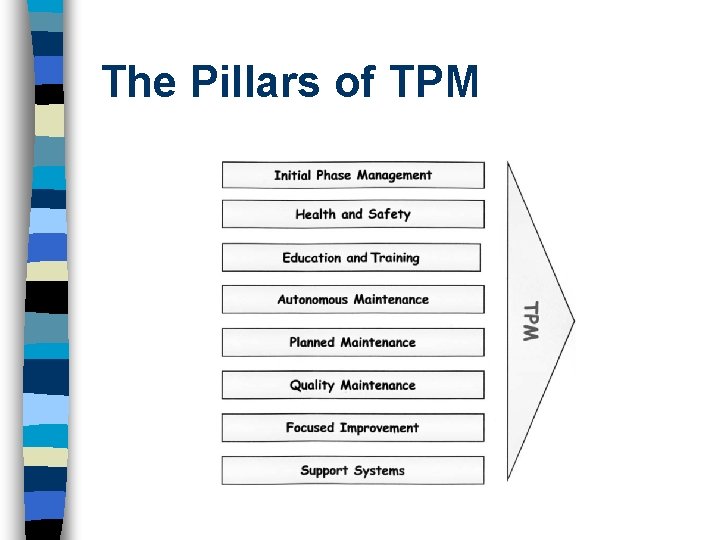
The Pillars of TPM
Implementation of TPM Initial evaluation of TPM level, Introductory Education and Propaganda (IEP) for TPM, Formation of TPM committee, Development of master plan for TPM implementation, Stage by stage training to the employees and stakeholders on all eight pillars of TPM, n Implementation preparation process, n Establishing the TPM policies and goals and development of a road map for TPM implementation. n n n
Difference from TQM n Total quality management and total productive maintenance are often used interchangeably. However, TQM and TPM share a lot of similarities, but are considered as two different approaches in the official literature. TQM attempts to increase the quality of goods, services and concomitant customer satisfaction by raising awareness of quality concerns across the organization.
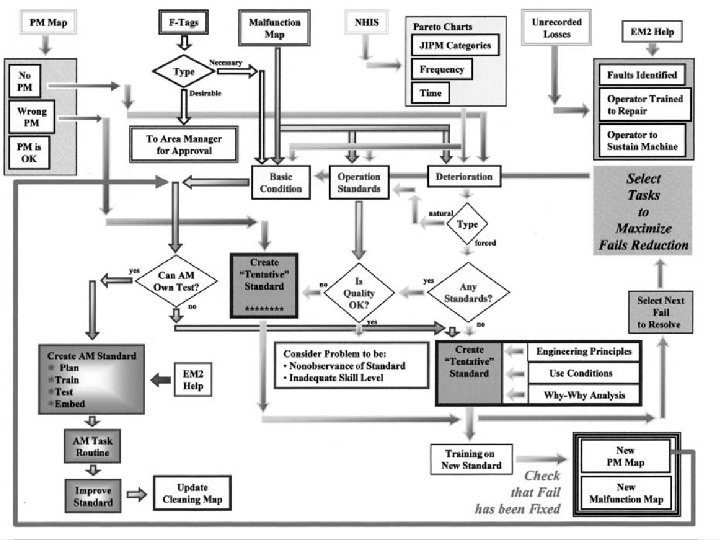
The TPM Preventive Maintenance (PM) Analysis n The Malfunction and PM Maps n Interpreting PM Maps n Scheduled Maintenance or Scheduled Restoration n Scheduled Replacement and Schedule Discard
The RCM Preventive Maintenance (PM) Analysis n The RCM Decision Diagram n Failure is Unacceptable : Redesign the System n Recording the process on the decision worksheet n Failure finding and calculating acceptable risk
Computerized Planned Maintenance System Software The computerized maintenance system will refer to a software based maintenance programmed, which is usually installed both on board the vessel and in the operator’s office. The approval for such software is given by the classification societies which are primarily focused on the maintenance management functionality n The Examples Are: n – Amos, which operates on board approximately 7000 ships – Bassnet, which is installed on board 2000 vessels approximately – Titan
Planned Maintenance System (PMS) n the machinery PMS system has to have the following essential features: – all dates of Class survey and items that were dealt with, – must cover all related ships equipment including: deck, engine, lifesaving equipment, firefighting equipment and etc. , – maintenance schedules, – monitor of the machinery running hours, details on specifications when certain work has been done (with dates, references and etc. ),
Planned Maintenance System (PMS) – condition monitoring procedures, – details if some unscheduled maintenance has been done, – preventive and corrective maintenance, – marking flagging critical equipment, – details if some work is to be done in overdue; why and when a specific work is in overdue, reasons why it cannot be done, – history of components, breakdowns / defects,
Planned Maintenance System (PMS) – manufacturer’s service instructions and work instructions, – spare part list and information, – reporting status and if records are regularly sent to the office, – list of defective equipment, – spares’ quality, quantity, inventory, – monitor of outstanding requirements,
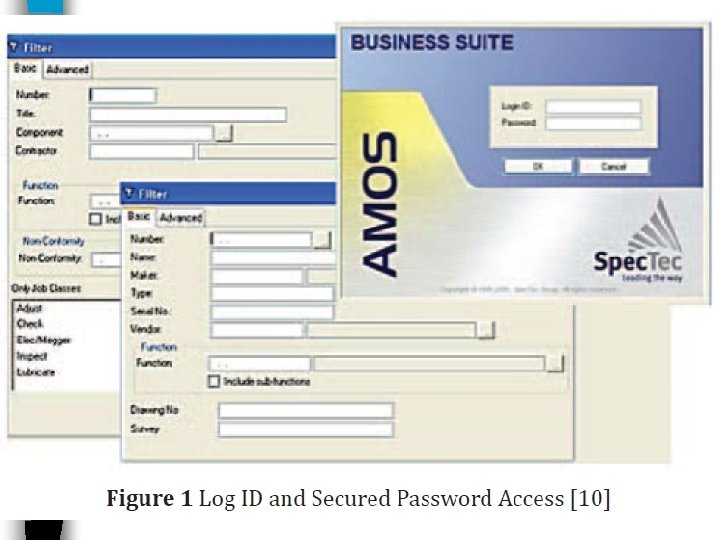
Planned Maintenance System (PMS) – log in ID and password, – access rights to be identified and restricted, – documentation of the PMS to be in the English language, – computerized system with adequate backup (backup copy on board or a regular exchange of data between – ship and office), – - time saving of work history reports, equipment breakdown and damages for at least five years.
Computerized PMS Software Amos PMS software Amos was designed by Spec. Tec Company which was founded in 1985 at Oslo, Norway, and is the world’s leading maintenance management system. n Amos PMS software is a Windows based programme capable of handling daily functions of PMS on board vessels and in the office at multiple locations. n
n Depending on the version, a full Amos package software consists of the following modules: – Maintenance and Purchase – Quality and Safety – Personnel – Mail – Voyage Management
Tugas! n Jelaskan Beberapa fitur lain yang bias digunakan dari software AMOS n Jelaskan tentang Bassnet dan Titan!
- Slides: 27