
Maintenance and Reliability 17 Power Point presentation to
Maintenance and Reliability 17 Power. Point presentation to accompany Heizer and Render Operations Management, Eleventh Edition Principles of Operations Management, Ninth Edition Power. Point slides by Jeff Heyl Additional content from Gerry Cook © 2014 Pearson Education, Inc. © 2014 Pearson Education, 17 - 1
Outline ► ► ► Global Company Profile: Orlando Utilities Commission The Strategic Importance of Maintenance and Reliability Maintenance Total Productive Maintenance © 2014 Pearson Education, Inc. 17 - 2
Learning Objectives When you complete this chapter you should be able to: 1. Describe how to improve system reliability 2. Determine system reliability 3. Determine mean time between failure (MTBF) 4. Distinguish between preventive and breakdown maintenance © 2014 Pearson Education, Inc. 17 - 3
Learning Objectives When you complete this chapter you should be able to: 5. Describe how to improve maintenance 6. Compare preventive and breakdown maintenance costs 7. Define autonomous maintenance © 2014 Pearson Education, Inc. 17 - 4
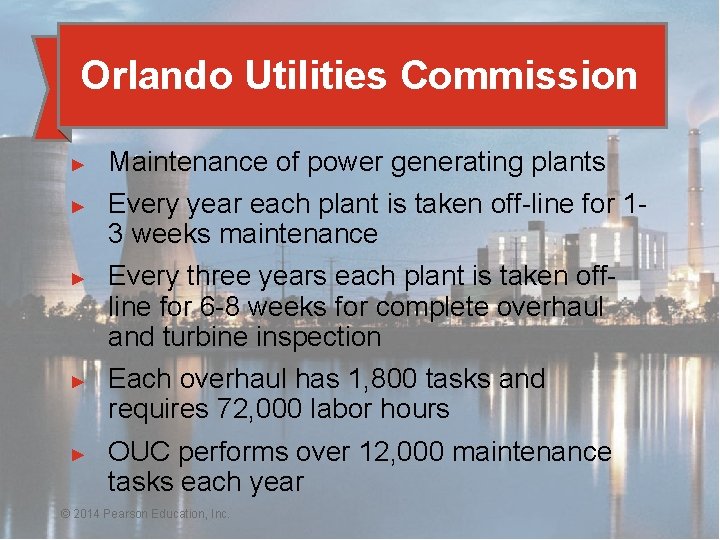
Orlando Utilities Commission ► ► ► Maintenance of power generating plants Every year each plant is taken off-line for 13 weeks maintenance Every three years each plant is taken offline for 6 -8 weeks for complete overhaul and turbine inspection Each overhaul has 1, 800 tasks and requires 72, 000 labor hours OUC performs over 12, 000 maintenance tasks each year © 2014 Pearson Education, Inc. © 2014 Pearson Education, 17 - 5
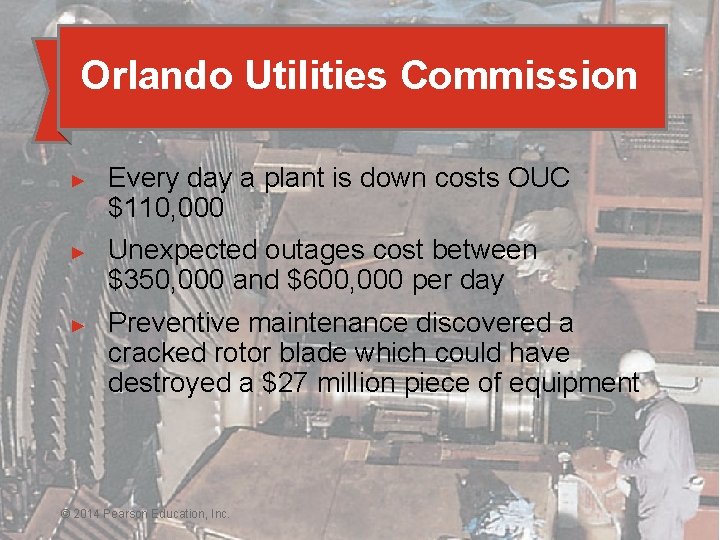
Orlando Utilities Commission ► ► ► Every day a plant is down costs OUC $110, 000 Unexpected outages cost between $350, 000 and $600, 000 per day Preventive maintenance discovered a cracked rotor blade which could have destroyed a $27 million piece of equipment © 2014 Pearson Education, Inc. © 2014 Pearson Education, 17 - 6
Strategic Importance of Maintenance and Reliability The objective of maintenance and reliability is to maintain the capability of the system © 2014 Pearson Education, Inc. 17 - 7
Strategic Importance of Maintenance and Reliability ▶ Failure has far reaching effects on a firm’s ▶ Operation ▶ Reputation ▶ Profitability ▶ Customer satisfaction ▶ Reducing idle time ▶ Protecting investment in plant and equipment © 2014 Pearson Education, Inc. 17 - 8
Maintenance and Reliability ▶ Maintenance is all activities involved in keeping a system’s equipment in working order ▶ Reliability is the probability that a machine will function properly for a specified time © 2014 Pearson Education, Inc. 17 - 9
Important Tactics ▶ Reliability 1. Improving individual components 2. Providing redundancy ▶ Maintenance 1. Implementing or improving preventive maintenance 2. Increasing repair capability or speed © 2014 Pearson Education, Inc. 17 - 10
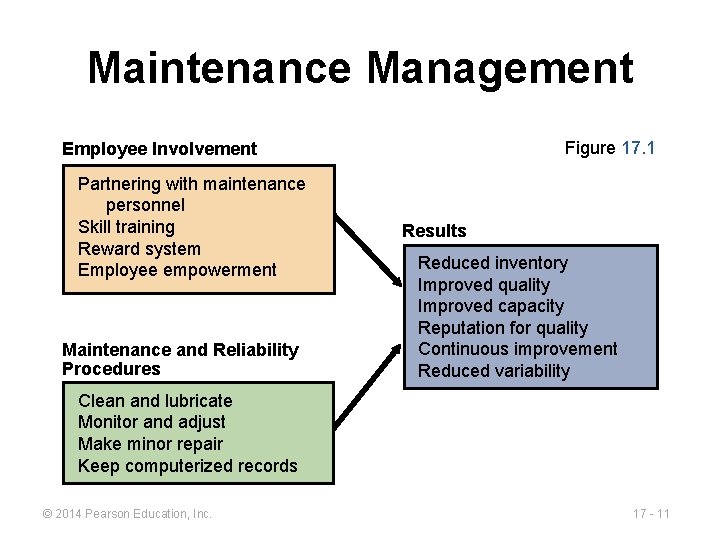
Maintenance Management Figure 17. 1 Employee Involvement Partnering with maintenance personnel Skill training Reward system Employee empowerment Maintenance and Reliability Procedures Results Reduced inventory Improved quality Improved capacity Reputation for quality Continuous improvement Reduced variability Clean and lubricate Monitor and adjust Make minor repair Keep computerized records © 2014 Pearson Education, Inc. 17 - 11
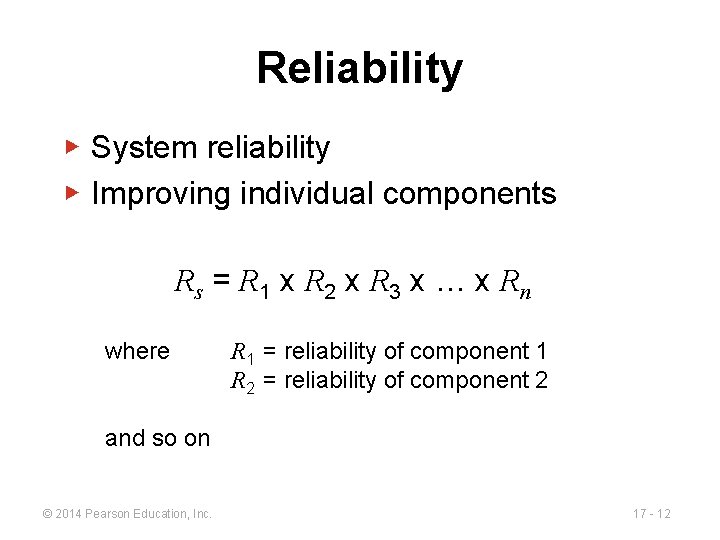
Reliability ▶ System reliability ▶ Improving individual components Rs = R 1 x R 2 x R 3 x … x Rn where R 1 = reliability of component 1 R 2 = reliability of component 2 and so on © 2014 Pearson Education, Inc. 17 - 12
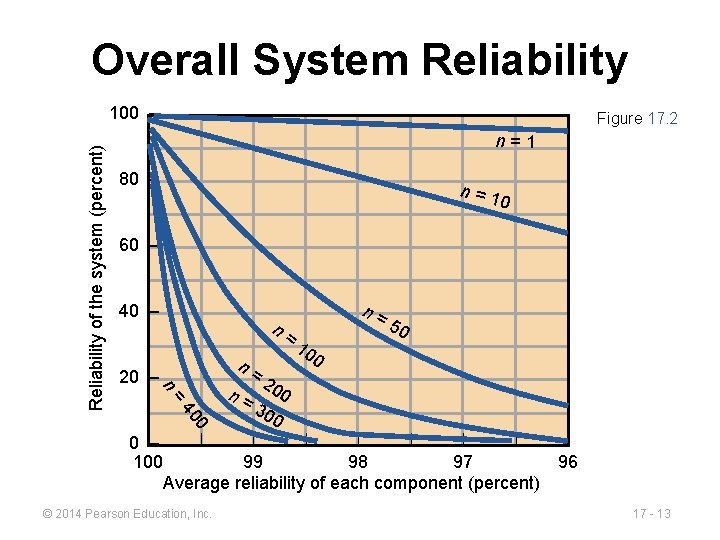
Overall System Reliability Figure 17. 2 n=1 80 – n=1 0 60 – 40 – n n= 20 – n = 0 40 Reliability of the system (percent) 100 – n= = n= 10 50 0 20 0 30 0 | | | | 0 |– 100 99 98 97 Average reliability of each component (percent) © 2014 Pearson Education, Inc. | 96 17 - 13
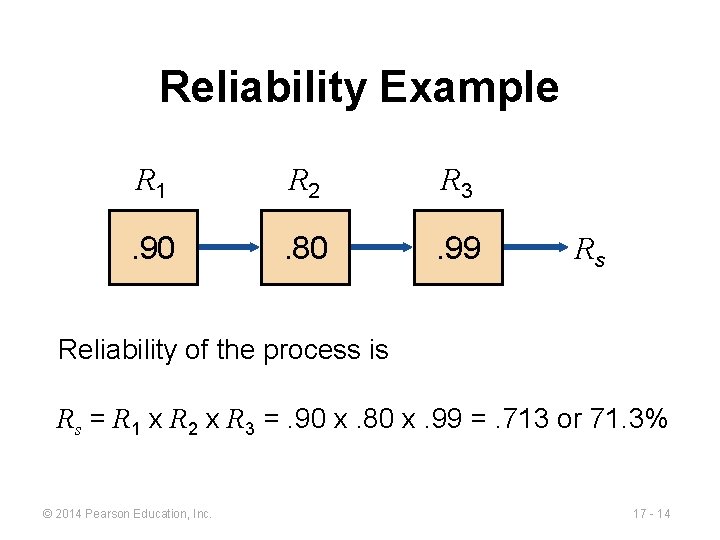
Reliability Example R 1 R 2 R 3 . 90 . 80 . 99 Rs Reliability of the process is Rs = R 1 x R 2 x R 3 =. 90 x. 80 x. 99 =. 713 or 71. 3% © 2014 Pearson Education, Inc. 17 - 14
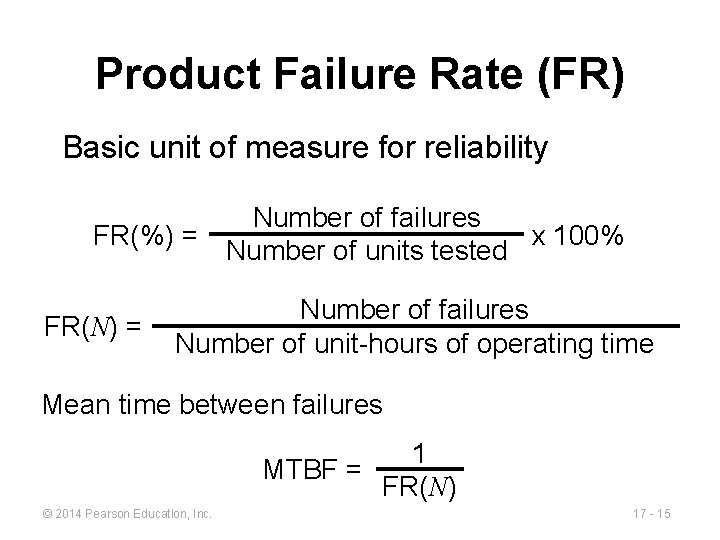
Product Failure Rate (FR) Basic unit of measure for reliability FR(%) = FR(N) = Number of failures x 100% Number of units tested Number of failures Number of unit-hours of operating time Mean time between failures 1 MTBF = FR(N) © 2014 Pearson Education, Inc. 17 - 15
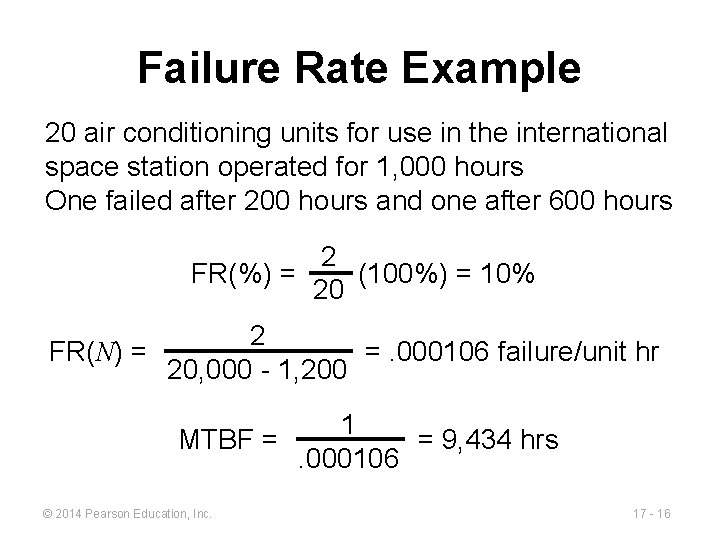
Failure Rate Example 20 air conditioning units for use in the international space station operated for 1, 000 hours One failed after 200 hours and one after 600 hours 2 FR(%) = (100%) = 10% 20 2 FR(N) = =. 000106 failure/unit hr 20, 000 - 1, 200 1 MTBF = = 9, 434 hrs. 000106 © 2014 Pearson Education, Inc. 17 - 16
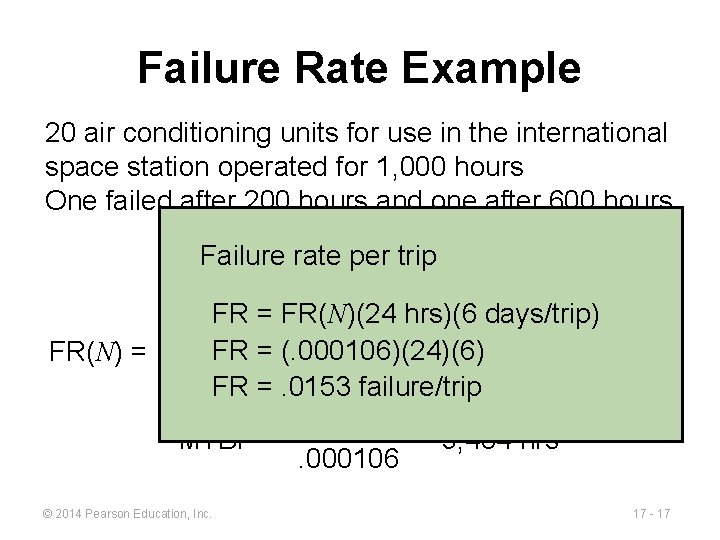
Failure Rate Example 20 air conditioning units for use in the international space station operated for 1, 000 hours One failed after 200 hours and one after 600 hours Failure rate 2 per trip FR(%) = (100%) = 10% 20 FR = FR(N)(24 hrs)(6 days/trip) 2 FR = (. 000106)(24)(6) FR(N) = =. 000106 failure/unit hr 20, 000 - 1, 200 FR =. 0153 failure/trip 1 MTBF = = 9, 434 hrs. 000106 © 2014 Pearson Education, Inc. 17 - 17
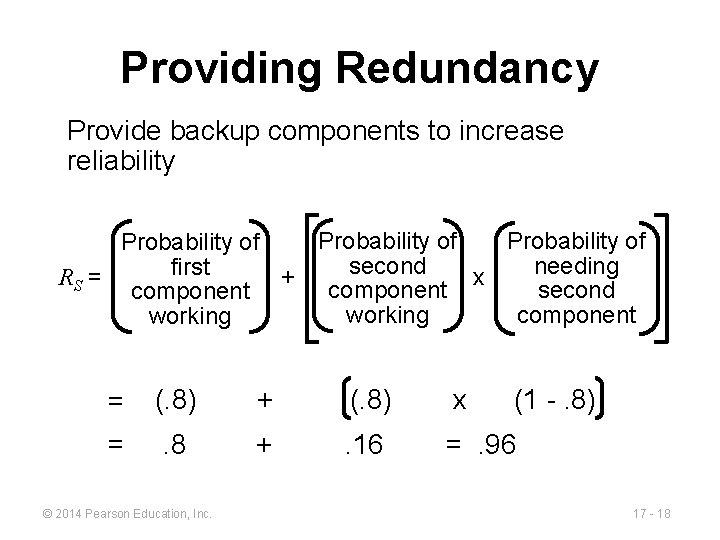
Providing Redundancy Provide backup components to increase reliability Probability of second needing first RS = + x component second component working = (. 8) + (. 8) x = . 8 + . 16 =. 96 © 2014 Pearson Education, Inc. (1 -. 8) 17 - 18
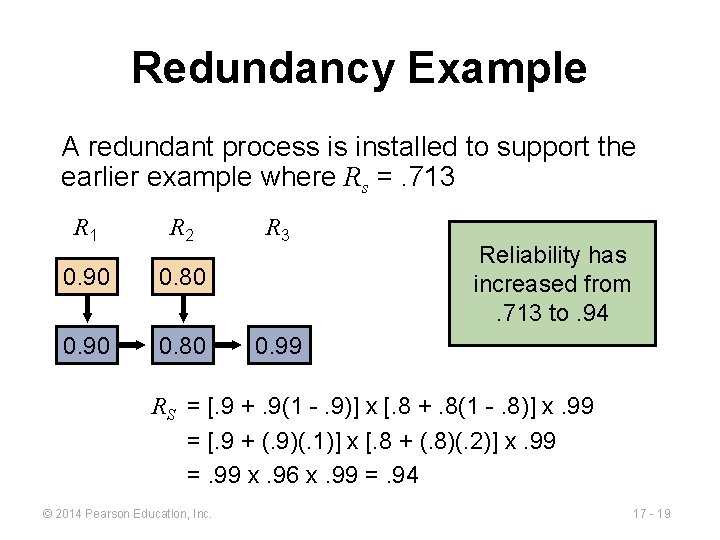
Redundancy Example A redundant process is installed to support the earlier example where Rs =. 713 R 1 R 2 0. 90 0. 80 R 3 Reliability has increased from. 713 to. 94 0. 99 RS = [. 9 +. 9(1 -. 9)] x [. 8 +. 8(1 -. 8)] x. 99 = [. 9 + (. 9)(. 1)] x [. 8 + (. 8)(. 2)] x. 99 =. 99 x. 96 x. 99 =. 94 © 2014 Pearson Education, Inc. 17 - 19
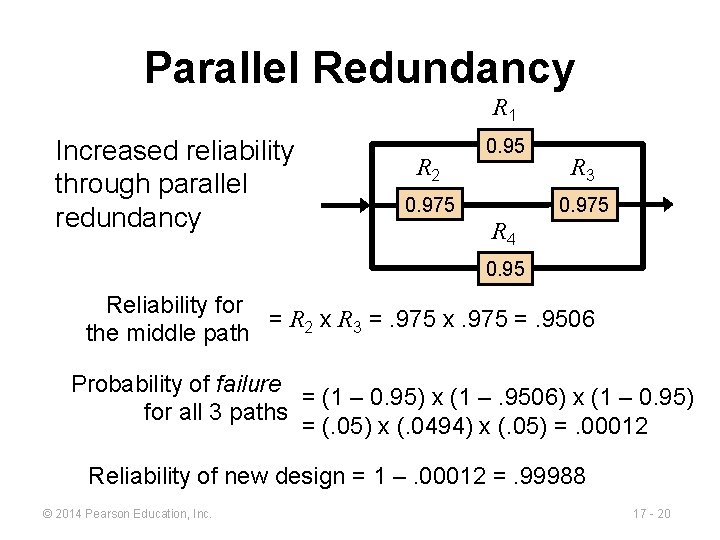
Parallel Redundancy R 1 Increased reliability through parallel redundancy R 2 0. 95 R 3 0. 975 R 4 0. 95 Reliability for = R 2 x R 3 =. 975 x. 975 =. 9506 the middle path Probability of failure = (1 – 0. 95) x (1 –. 9506) x (1 – 0. 95) for all 3 paths = (. 05) x (. 0494) x (. 05) =. 00012 Reliability of new design = 1 –. 00012 =. 99988 © 2014 Pearson Education, Inc. 17 - 20
Maintenance ▶ Two types of maintenance ▶ Preventive maintenance – routine inspection and servicing to keep facilities in good repair ▶ Breakdown maintenance – emergency or priority repairs on failed equipment © 2014 Pearson Education, Inc. 17 - 21
Implementing Preventive Maintenance ▶ Need to know when a system requires service or is likely to fail ▶ High initial failure rates are known as infant mortality ▶ Once a product settles in, MTBF generally follows a normal distribution ▶ Good reporting and record keeping can aid the decision on when preventive maintenance should be performed © 2014 Pearson Education, Inc. 17 - 22

Computerized Maintenance System Data Files Output Reports Equipment file with parts list Inventory and purchasing reports Maintenance and work order schedule Equipment parts list Repair history file Equipment history reports Inventory of spare parts Cost analysis (Actual vs. standard) Personnel data with skills, wages, etc. Work orders Figure 17. 3 © 2014 Pearson Education, Inc. 17 - 23
Maintenance Costs ▶ The traditional view attempted to balance preventive and breakdown maintenance costs ▶ Typically this approach failed to consider the full costs of a breakdown ▶ Inventory ▶ Employee morale ▶ Schedule unreliability © 2014 Pearson Education, Inc. 17 - 24
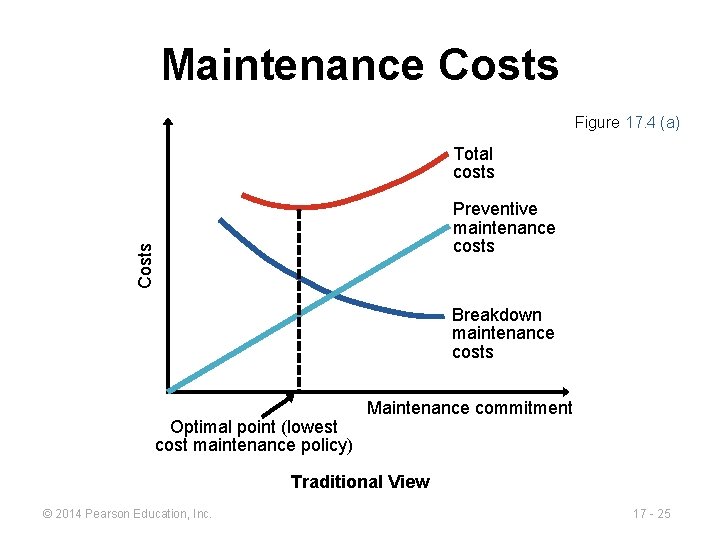
Maintenance Costs Figure 17. 4 (a) Total costs Costs Preventive maintenance costs Breakdown maintenance costs Optimal point (lowest cost maintenance policy) Maintenance commitment Traditional View © 2014 Pearson Education, Inc. 17 - 25
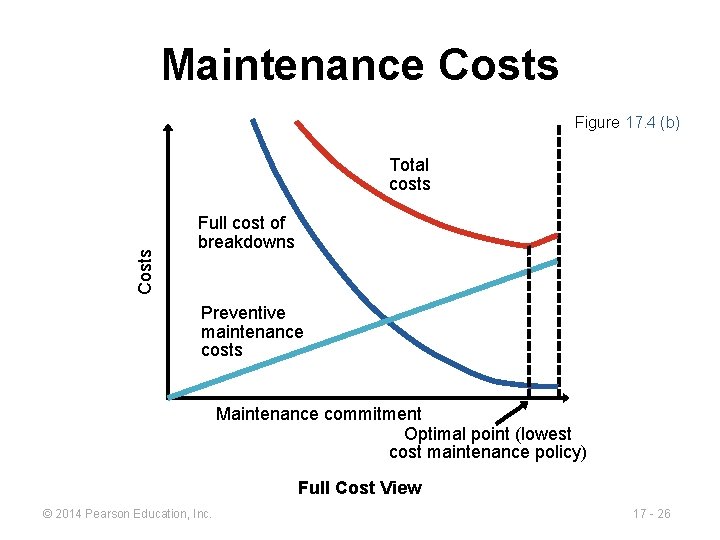
Maintenance Costs Figure 17. 4 (b) Costs Total costs Full cost of breakdowns Preventive maintenance costs Maintenance commitment Optimal point (lowest cost maintenance policy) Full Cost View © 2014 Pearson Education, Inc. 17 - 26
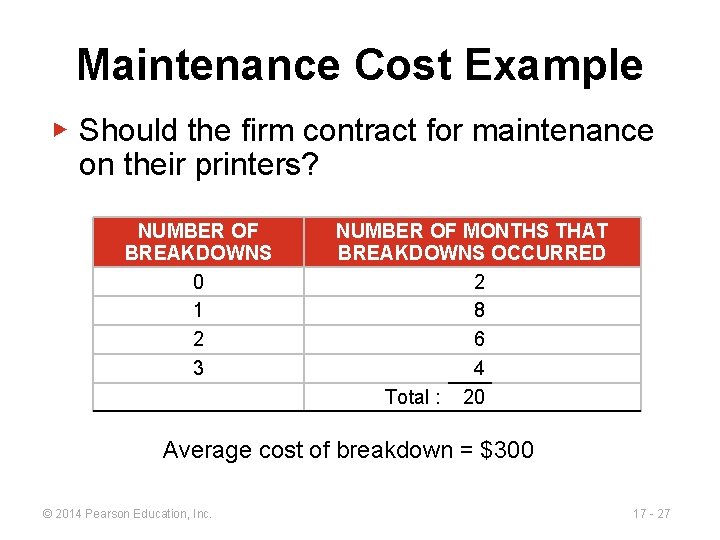
Maintenance Cost Example ▶ Should the firm contract for maintenance on their printers? NUMBER OF BREAKDOWNS 0 1 2 3 NUMBER OF MONTHS THAT BREAKDOWNS OCCURRED 2 8 6 4 Total : 20 Average cost of breakdown = $300 © 2014 Pearson Education, Inc. 17 - 27
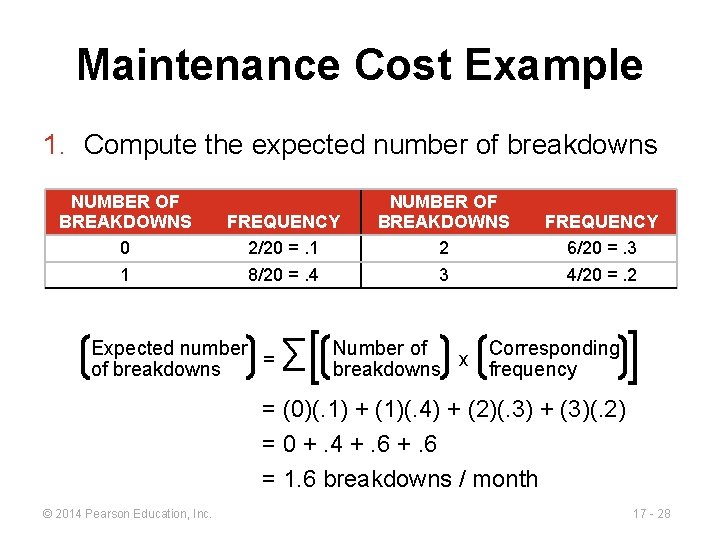
Maintenance Cost Example 1. Compute the expected number of breakdowns NUMBER OF BREAKDOWNS 0 1 FREQUENCY 2/20 =. 1 8/20 =. 4 Expected number = of breakdowns ∑ NUMBER OF BREAKDOWNS 2 3 Number of breakdowns x FREQUENCY 6/20 =. 3 4/20 =. 2 Corresponding frequency = (0)(. 1) + (1)(. 4) + (2)(. 3) + (3)(. 2) = 0 +. 4 +. 6 = 1. 6 breakdowns / month © 2014 Pearson Education, Inc. 17 - 28
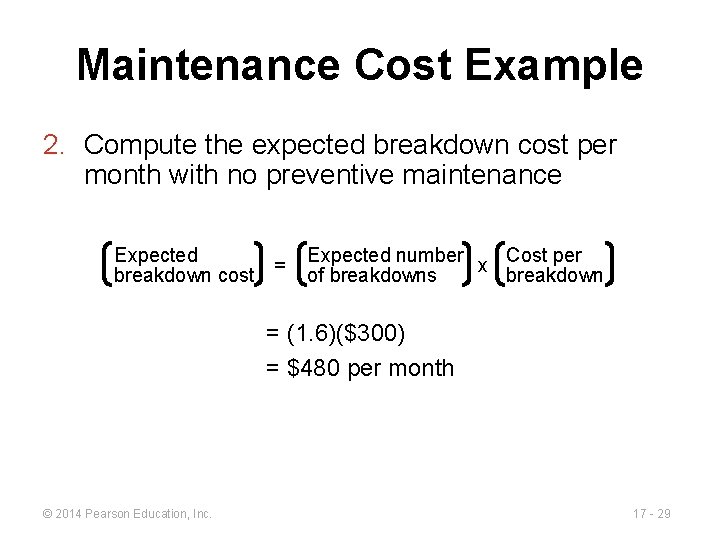
Maintenance Cost Example 2. Compute the expected breakdown cost per month with no preventive maintenance Expected breakdown cost = Expected number Cost per x of breakdowns breakdown = (1. 6)($300) = $480 per month © 2014 Pearson Education, Inc. 17 - 29
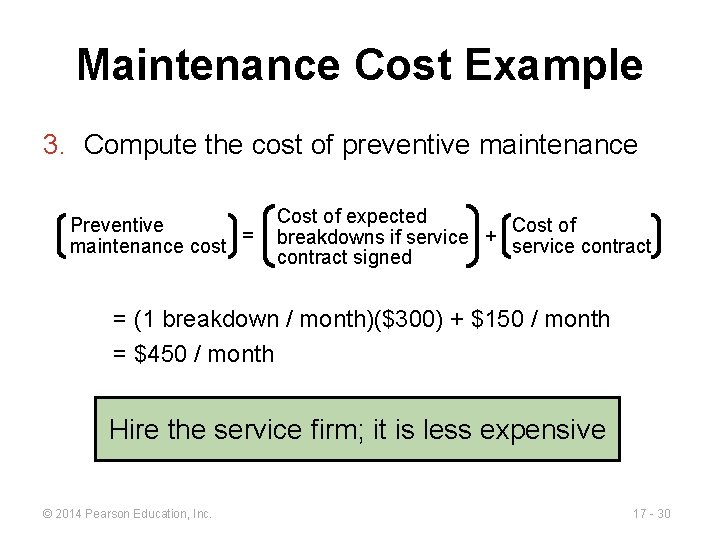
Maintenance Cost Example 3. Compute the cost of preventive maintenance = Preventive maintenance cost Cost of expected Cost of breakdowns if service + service contract signed = (1 breakdown / month)($300) + $150 / month = $450 / month Hire the service firm; it is less expensive © 2014 Pearson Education, Inc. 17 - 30
Increasing Repair Capabilities 1. Well-trained personnel 2. Adequate resources 3. Ability to establish repair plan and priorities 4. Ability and authority to do material planning 5. Ability to identify the cause of breakdowns 6. Ability to design ways to extend MTBF © 2014 Pearson Education, Inc. 17 - 31
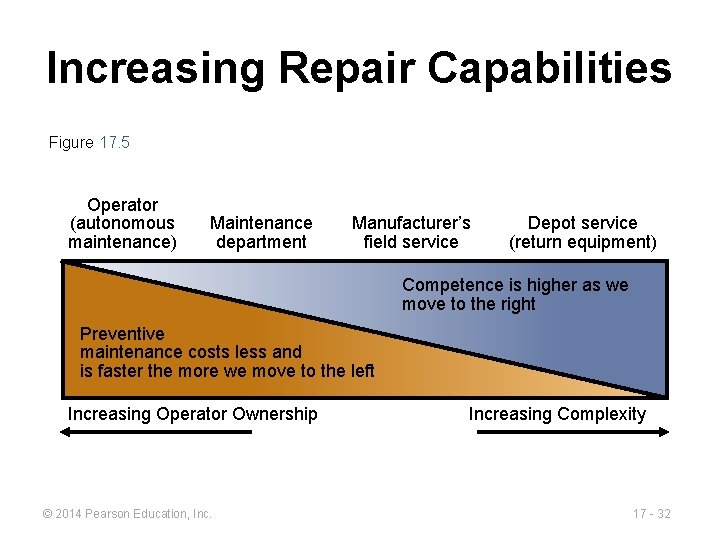
Increasing Repair Capabilities Figure 17. 5 Operator (autonomous maintenance) Maintenance department Manufacturer’s field service Depot service (return equipment) Competence is higher as we move to the right Preventive maintenance costs less and is faster the more we move to the left Increasing Operator Ownership © 2014 Pearson Education, Increasing Complexity 17 - 32
Autonomous Maintenance ▶ Employees accept responsibility for ▶ Observe ▶ Check ▶ Adjust ▶ Clean ▶ Notify ▶ Predict failures, prevent breakdowns, prolong equipment life © 2014 Pearson Education, Inc. 17 - 33
Total Productive Maintenance (TPM) ▶ Designing machines that are reliable, easy to operate, and easy to maintain ▶ Emphasizing total cost of ownership when purchasing machines, so that service and maintenance are included in the cost © 2014 Pearson Education, Inc. 17 - 34
Total Productive Maintenance (TPM) ▶ Developing preventive maintenance plans that utilize the best practices of operators, maintenance departments, and depot service ▶ Training for autonomous maintenance so operators maintain their own machines and partner with maintenance personnel © 2014 Pearson Education, Inc. 17 - 35
More on Maintenance – Supplemental Material ▶ A simple redundancy formula ▶ Problems with breakdown and preventive maintenance ▶ Predictive maintenance tools ▶ Maintenance strategy implementation ▶ Effective reliability © 2014 Pearson Education, Inc. 17 - 36
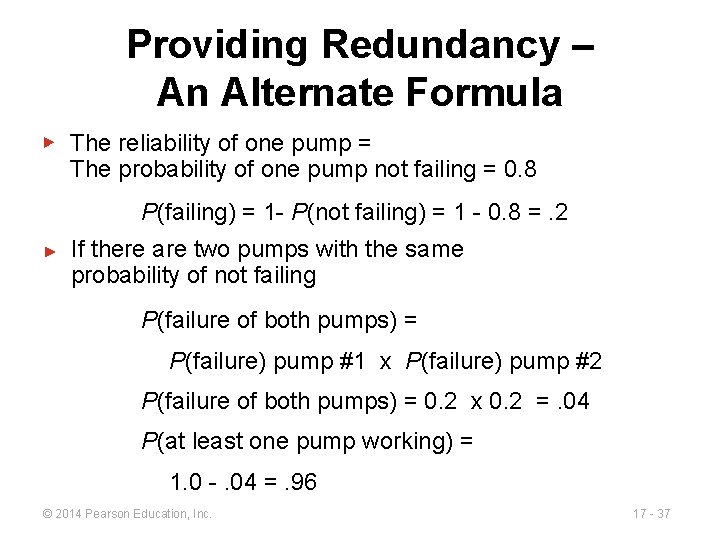
Providing Redundancy – An Alternate Formula ▶ The reliability of one pump = The probability of one pump not failing = 0. 8 P(failing) = 1 - P(not failing) = 1 - 0. 8 =. 2 ► If there are two pumps with the same probability of not failing P(failure of both pumps) = P(failure) pump #1 x P(failure) pump #2 P(failure of both pumps) = 0. 2 x 0. 2 =. 04 P(at least one pump working) = 1. 0 -. 04 =. 96 © 2014 Pearson Education, Inc. 17 - 37
Problems With Breakdown Maintenance ▶ Run it till it breaks” ▶ Might be ok for low criticality equipment or redundant systems ▶ Could be disastrous for mission-critical plant machinery or equipment ▶ Not permissible for systems that could imperil life or limb (like aircraft) © 2014 Pearson Education, Inc. 17 - 38
Problems With Preventive Maintenance ▶ Fix it “whether or not it is broken” ▶ Scheduled replacement or adjustment of parts/equipment with a well-established service life ▶ Typical example – plant relamping ▶ Sometimes misapplied ▶ Replacing old but still good bearings ▶ Over-tightening electrical lugs in switchgear © 2014 Pearson Education, Inc. 17 - 39
Another Maintenance Strategy ▶ Predictive maintenance – Using advanced technology to monitor equipment and predict failures ▶ Using technology to detect and predict imminent equipment failure ▶ Visual inspection and/or scheduled measurements of vibration, temperature, oil and water quality ▶ Measurements are compared to a “healthy” baseline ▶ Equipment that is trending towards failure can be scheduled for repair © 2014 Pearson Education, Inc. 17 - 40
Predictive Maintenance Tools ▶ ▶ Vibration analysis Infrared Thermography Oil and Water Analysis Other Tools: ▶ Ultrasonic testing ▶ Liquid Penetrant Dye testing ▶ Shock Pulse Measurement (SPM) © 2014 Pearson Education, Inc. 17 - 41
Predictive Maintenance Vibration Analysis ▶ Using sensitive transducers and instruments to detect and analyze vibration ▶ Typically used on expensive, mission-critical equipment–large turbines, motors, engines or gearboxes ▶ Sophisticated frequency (FFT) analysis can pinpoint the exact moving part that is worn or defective ▶ Can utilize a monitoring service © 2014 Pearson Education, Inc. 17 - 42
Predictive Maintenance Infrared (IR) Thermography ▶ Using IR cameras to look for temperature “hot spots” on equipment ▶ Typically used to check electrical equipment for wiring problems or poor/loose connections ▶ Can also be used to look for “cold (wet) spots” when inspecting roofs for leaks ▶ High quality IR cameras are expensive – most pay for IR thermography services © 2014 Pearson Education, Inc. 17 - 43
Predictive Maintenance Oil and Water Analysis ▶ Taking oil samples from large gearboxes, compressors or turbines for chemical and particle analysis ▶ Particle size can indicate abnormal wear ▶ Taking cooling water samples for analysis – can detect excessive rust, acidity, or microbiological fouling ▶ Services usually provided by oil vendors and water treatment companies © 2014 Pearson Education, Inc. 17 - 44
Predictive Maintenance Other Tools and Techniques ▶ Ultrasonic and dye testing – used to find stress cracks in tubes, turbine blades and load bearing structures ▶ Ultrasonic waves sent through metal ▶ Surface coated with red dye, then cleaned off, dye shows cracks ▶ Shock-pulse testing – a specialized form of vibration analysis used to detect flaws in ball or roller bearings at high frequency (32 k. Hz) © 2014 Pearson Education, Inc. 17 - 45
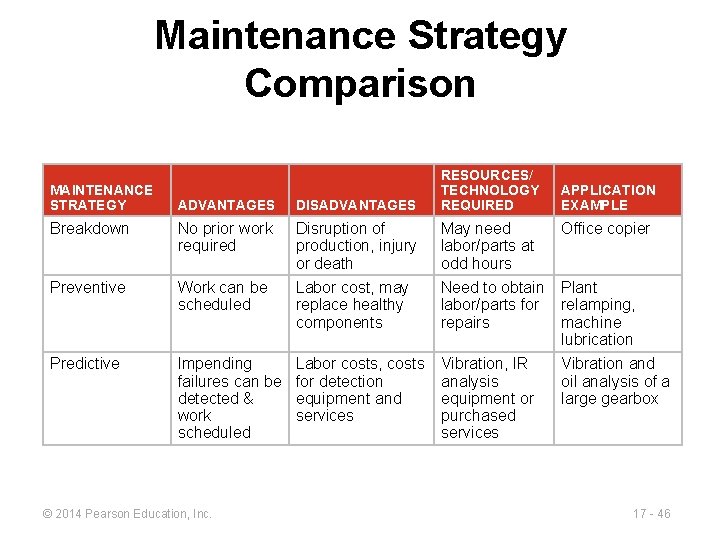
Maintenance Strategy Comparison ADVANTAGES DISADVANTAGES RESOURCES/ TECHNOLOGY REQUIRED Breakdown No prior work required Disruption of production, injury or death May need labor/parts at odd hours Office copier Preventive Work can be scheduled Labor cost, may replace healthy components Need to obtain labor/parts for repairs Plant relamping, machine lubrication Predictive Impending failures can be detected & work scheduled Labor costs, costs for detection equipment and services Vibration, IR analysis equipment or purchased services Vibration and oil analysis of a large gearbox MAINTENANCE STRATEGY © 2014 Pearson Education, Inc. APPLICATION EXAMPLE 17 - 46
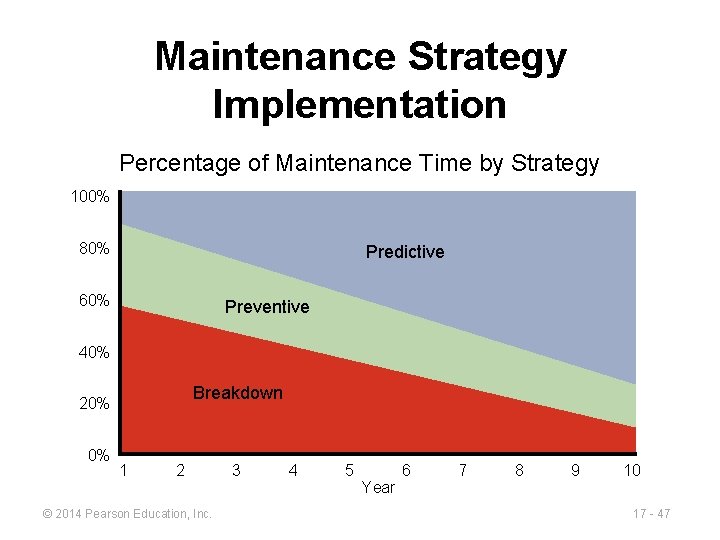
Maintenance Strategy Implementation Percentage of Maintenance Time by Strategy 100% 80% Predictive 60% Preventive 40% Breakdown 20% 0% 1 2 © 2014 Pearson Education, Inc. 3 4 5 Year 6 7 8 9 10 17 - 47
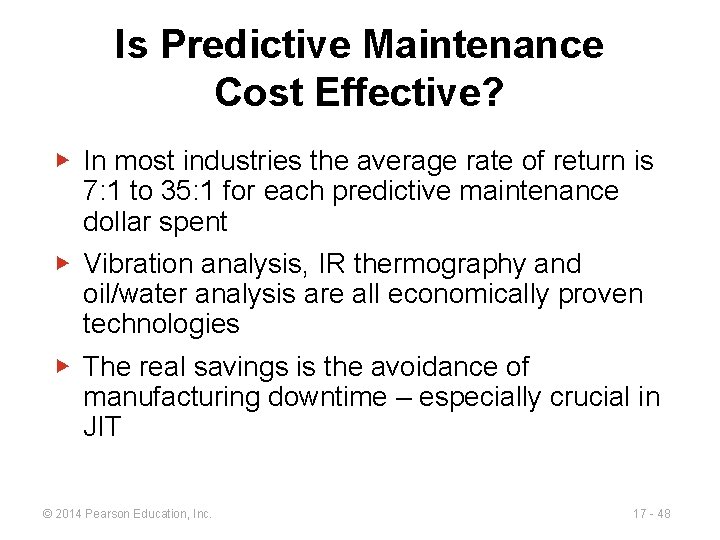
Is Predictive Maintenance Cost Effective? ▶ In most industries the average rate of return is 7: 1 to 35: 1 for each predictive maintenance dollar spent ▶ Vibration analysis, IR thermography and oil/water analysis are all economically proven technologies ▶ The real savings is the avoidance of manufacturing downtime – especially crucial in JIT © 2014 Pearson Education, Inc. 17 - 48
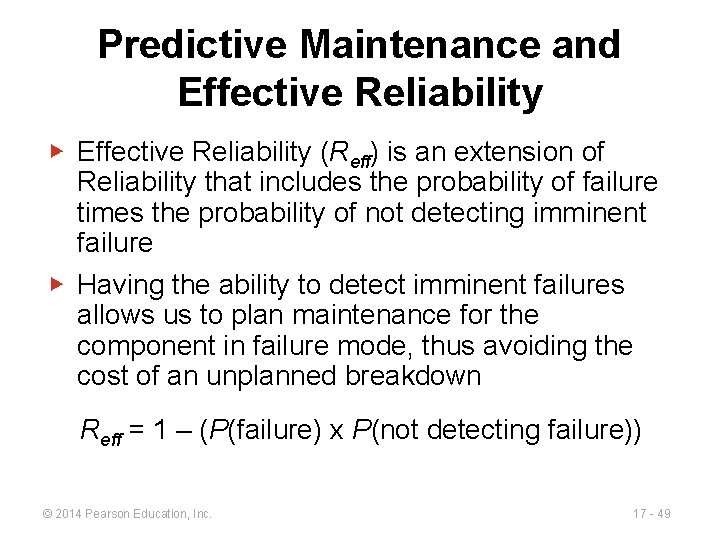
Predictive Maintenance and Effective Reliability ▶ Effective Reliability (Reff) is an extension of Reliability that includes the probability of failure times the probability of not detecting imminent failure ▶ Having the ability to detect imminent failures allows us to plan maintenance for the component in failure mode, thus avoiding the cost of an unplanned breakdown Reff = 1 – (P(failure) x P(not detecting failure)) © 2014 Pearson Education, Inc. 17 - 49
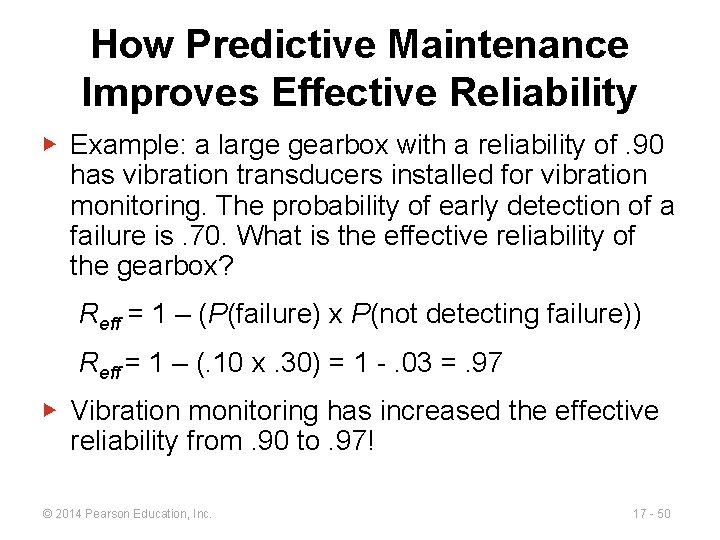
How Predictive Maintenance Improves Effective Reliability ▶ Example: a large gearbox with a reliability of. 90 has vibration transducers installed for vibration monitoring. The probability of early detection of a failure is. 70. What is the effective reliability of the gearbox? Reff = 1 – (P(failure) x P(not detecting failure)) Reff = 1 – (. 10 x. 30) = 1 -. 03 =. 97 ▶ Vibration monitoring has increased the effective reliability from. 90 to. 97! © 2014 Pearson Education, Inc. 17 - 50
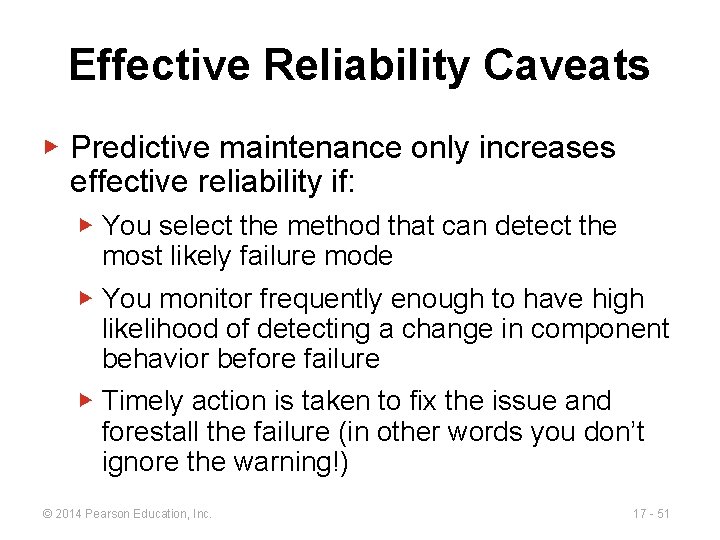
Effective Reliability Caveats ▶ Predictive maintenance only increases effective reliability if: ▶ You select the method that can detect the most likely failure mode ▶ You monitor frequently enough to have high likelihood of detecting a change in component behavior before failure ▶ Timely action is taken to fix the issue and forestall the failure (in other words you don’t ignore the warning!) © 2014 Pearson Education, Inc. 17 - 51
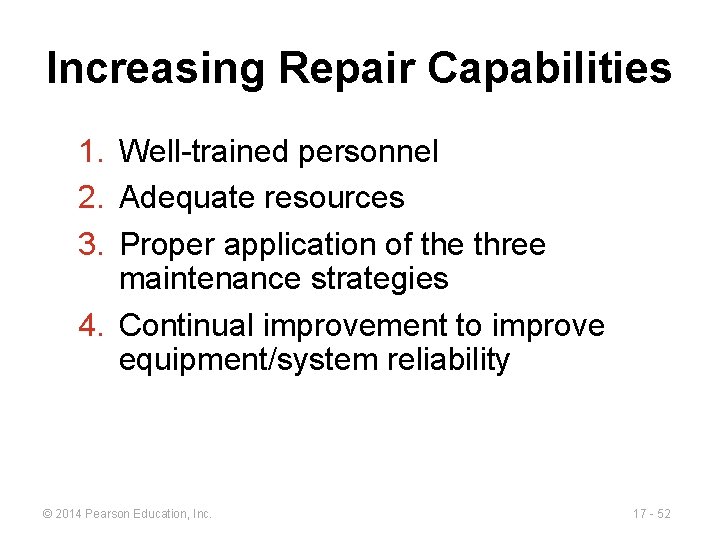
Increasing Repair Capabilities 1. Well-trained personnel 2. Adequate resources 3. Proper application of the three maintenance strategies 4. Continual improvement to improve equipment/system reliability © 2014 Pearson Education, Inc. 17 - 52

All rights reserved. No part of this publication may be reproduced, stored in a retrieval system, or transmitted, in any form or by any means, electronic, mechanical, photocopying, recording, or otherwise, without the prior written permission of the publisher. Printed in the United States of America. © 2014 Pearson Education, Inc. 17 - 53
- Slides: 53