
MAINTAINING HEALTHY ETHICAL BOUNDARIES Presented by Jim Messina
MAINTAINING HEALTHY ETHICAL BOUNDARIES Presented by: Jim Messina, Ph. D. , CCMHC, NCC, DCMHS-T Troy University Tampa Bay Site CE Broker Tracking #: 20 -615486 approved for 3 CEU’s by Florida 491 Board and Florida Board of Nursing
OBJECTIVES OF Description of Program: Boundaries must. PRESENTATION be set and maintained in the helping relationship to ensure that the Helper: 1. Does “no harm” to the helpee; 2. The rights of helpees are respected and honored; 3. The helper is always respectful of and conscious of the need to guard the privacy of the helpee; and 4. The helper does not take advantage of “power differential” in the helping relationship and recognizes extent of “vulnerability” of the helpee in the helping relationship. Case Studies will be used to help learners understand more fully the ethical process in establishing healthy boundaries in the helping relationship. Learning Objectives 1. To identify and understand the basic moral principles involved in ethical thinking: 1. Autonomy; 2. Beneficence; 3. Non-maleficence; 4. Justice; 5. Fidelity; and 6. Veracity. 2. To identify specific guidelines for best practices for avoiding breaches of ethical, legal, professional and moral behaviors in the provision of their clinical responsibilities. 3. To identify common pitfalls or mistakes which contribute to poor boundary maintenance in the provision of clinical work in busy clinical settings. 4. To identify specific steps which professional helpers can take to limit their unknowingly breaching ethical standards, boundaries, or guidelines within their work as clinicians with individuals, couples and families as well as when providing supervision or consultation services
WHY BOUNDARIES ARE IMPORTANT Boundaries must be set & maintained in the counseling relationship to insure: Ø Helper does “No Harm” to client Ø Rights of client are respected & honored Ø Helper is always respectful of & conscious of need to guard privacy of client Ø Helper does not take advantage of “power differential” in relationship & recognizes extent of “vulnerability” of client in counseling relationship.
DO THE SELFASSESSMENT ON PROFESSIONAL BOUNDARIES Take self-assessment instrument entitled: Professional Boundary Self-Assessment
DO THE SELFASSESSMENT ON PROFESSIONAL BOUNDARIES Results: If you have answered Ø 3 or more items with scores of 7 or higher or Ø 5 or more items with scores of 5 or higher Ø There is a strong possibility that you are maintaining weak boundaries with your clients and or their families based on your behaviors with them
WHAT ARE HEALTHY BOUNDARIES? ØThey are framework within which professional helper-client relationship occurs ØThey make the relationship professional & safe for client ØThey set parameters within which helping services are delivered ØThey refer to line between self of client & self of professional helper
WHAT DO HEALTHY BOUNDARIES INCLUDE? Healthy Professional Boundaries include: Ø length of a session Ø time of session Ø personal disclosure Ø limits regarding the use of touch Ø the general tone of the professional relationship Ø fee setting (if it is not a pro-bono service)

WHAT MIGHT BE BLURRING BOUNDARIES? ØAre you an addicted fixer or rescuer? Maybe this is keeping you from maintaining healthy boundaries with your clients ØTake self-assessment instrument entitled: Compulsive Fixer -Rescuer Self-Assessment

SO ARE YOU A COMPULSIVE FIXER OR RESCUER? Results: if on this survey you have answered: Ø 3 or more items with scores of 7 or higher or Ø 5 or more items with scores of 5 or higher Ø There is a strong possibility that you are maintaining weak boundaries with your clients and/or their families because of your being an “addicted fixer” or “rescuer”
BASIC MORAL PRINCIPLES OF ETHICAL DECISION MAKING Autonomy: Ø to promote self-determination Beneficence: Ø to do good for others and promote the well-being of clients Non-maleficence: Ø to avoid doing harm Justice: Ø to be fair by giving equally to others and to treat others justly Fidelity: Ø to make realistic commitments and keep these promises Veracity: Ø to be truthful and deal honestly with clients
LEVELS OF ETHICAL PRACTICE Mandatory Ethics Ø level of ethical functioning wherein helpers comply with minimal standards, acknowledging the basic “musts” and “must nots” Ø Example: providing informed consent in professional relationships Aspirational Ethics Ø refer to the highest professional standards of conduct to which helpers can aspire Ø Example: providing services pro bono for those in the community who cannot afford needed services Principle Ethics Ø focuses on moral issues with the goal of solving a particular dilemma and establishing a framework to guide future ethical thinking and behavior Ø Example: asks “Is this situation unethical? ” Virtue Ethics Ø focuses on character traits of the helper and non-obligatory ideals Ø Example: asks “Am I doing what is best for my client? ”
STEPS IN MAKING ETHICAL DECISIONS In thinking through ethical dilemmas: 1. Identify the problem or dilemma 2. Identify the potential issues involved 3. Review the relevant ethics codes 4. Know the applicable laws and regulations 5. Obtain consultation 6. Consider possible and probable courses of action 7. Enumerate the consequences of various decisions 8. Choose what appears to be the best course of action
MINIMIZING RISKS IN MULTIPLE RELATIONSHIPS Identify measures aimed at minimizing the risks: ØSet healthy boundaries from the outset ØSecure informed consent of clients ØDiscuss both potential risks and benefits of counseling ØConsult with other professionals to resolve any dilemmas ØSeek supervision when needed ØDocument in clinical case notes ØExamine your own motivations ØRefer when necessary

AVOID DUAL RELATIONSHIPS Ø One cannot be both “helper” & “friend” or “significant other” to client due to reality it is too easy to lose perspective in helping client & client loses perspective as to helper’s real role in client’s life Ø Helper has a “power or authority” role with client even if helping service in not fee-based service Ø Important not to confuse client in creating relationship where roles become blurred & where expectations & demands on helper become magnified due to demands & needs of client who has been befriended & overly attached to helper
AVOID BECOMING A FRIEND WITH CLIENTS Ø Providing “help” to another in need has visual & emotional aspect of “friendship” it is important to maintain the boundary of “no friendship with clients” Ø Danger in becoming a friend while serving a client is emotional vulnerability of client will become sensitized Ø If you should not be able to spend amount of time or provide amount of services which client expects to receive from a friend there is situation which is ripe for conflict, hurt feelings & conceivably exacerbating needs of client who already was vulnerable & in need prior to helping relationship being established
AVOID SOCIALIZING WITH CURRENT OR FORMER CLIENTS Potential Disadvantages of Socializing Ø Helpers may not be as challenging as they need to be with clients they know socially because of a need to be liked and accepted by the clients Ø Helpers’ own needs may be enmeshed with those of their clients to the point that objectivity is lost Ø Helpers are at greater risk of exploiting clients because of power differential in therapeutic relationship. Ø If Helper develops a friendship with former client, then client is not eligible to use Helper’s professional services in future.
BE CAREFUL IN USE OF SELF-DISCLOSURE WITH CLIENTS Ø When Helper reveals very personal information about self with client which sharing has no real purpose in goals of meeting the needs of client Ø Such self-disclosure take spotlight off of client’s issues & focuses rather on helper Ø Unless a specific therapeutic positive outcome is to be gained by self-disclosure Helpers ought to avoid it Ø When Helper is ready to disclose one must ask question: Does self-disclosure serve client’s therapeutic goal? Unless it can be justified, stay away from self-disclosing to maintain healthy boundary maintenance with clients
USE CAUTION IN ESTABLISHING A BARTERING RELATIONSHIP ØEvaluate whether it puts you at risk of impaired professional judgment ØDetermine value of goods or services in a collaborative fashion ØDetermine appropriate length of time for arrangement ØDocument arrangement ØConsult with experienced colleagues or supervisors ØMinimize unique financial arrangements ØIf bartering is used, it is better to exchange goods rather than services ØBoth Helper & client should have a written agreement for the compensation by bartering
MAINTAIN BUSINESS-LIKE HELPING SITUATION PROTOCOLS WHILE PROVIDING HELP TO CLIENTS This means maintaining a professional relationship which includes: Ø seeing clients only during work hours Ø seeing clients only in “appropriate professional locations” where helping relationship is to be performed Ø only taking emergency phone calls from clients on rare occasion & not make nightly or weekly phone calls between clients & Helper a normal routine

AVOID GIVING OR RECEIVING GIFTS OF SIGNIFICANT VALUE WITH CLIENTS Ø If such gift giving were to transpire, client who gave gift could expect “special” treatment from Helper & conversely Helper could feel “more obligated” to go outside norms of typical helping protocol to “pay back” client for client’s generosity in gift given Ø To avoid such confusion in future rule would be to just abide by No Gift Giving Guideline
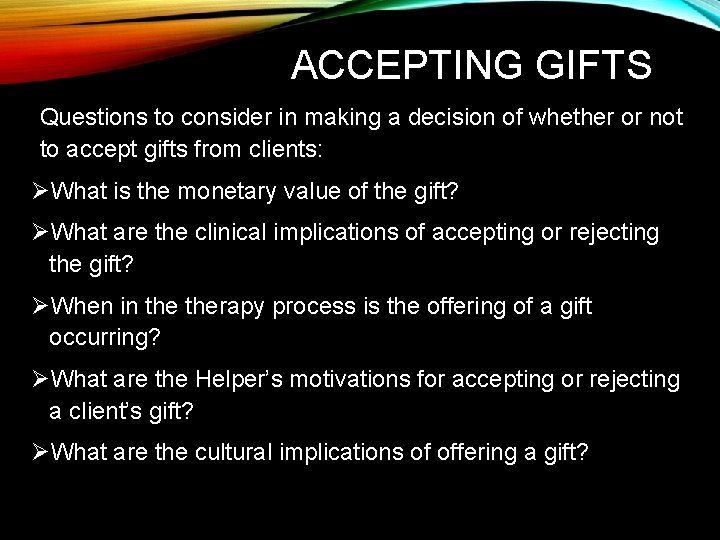
ACCEPTING GIFTS Questions to consider in making a decision of whether or not to accept gifts from clients: ØWhat is the monetary value of the gift? ØWhat are the clinical implications of accepting or rejecting the gift? ØWhen in therapy process is the offering of a gift occurring? ØWhat are the Helper’s motivations for accepting or rejecting a client’s gift? ØWhat are the cultural implications of offering a gift?
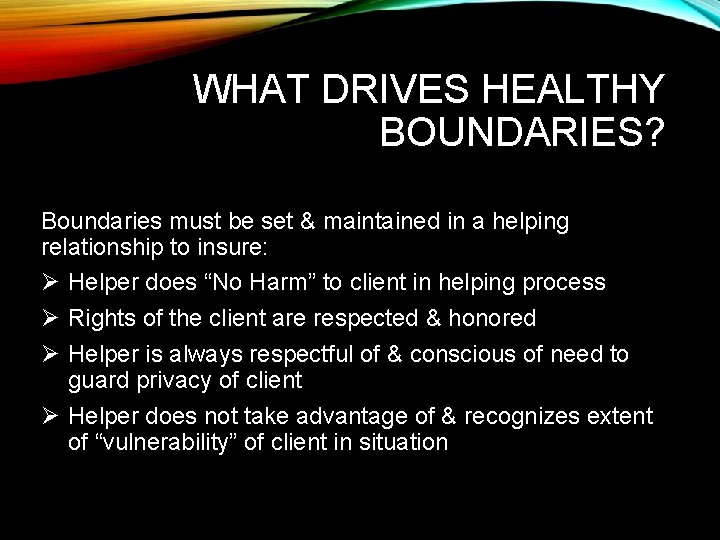
WHAT DRIVES HEALTHY BOUNDARIES? Boundaries must be set & maintained in a helping relationship to insure: Ø Helper does “No Harm” to client in helping process Ø Rights of the client are respected & honored Ø Helper is always respectful of & conscious of need to guard privacy of client Ø Helper does not take advantage of & recognizes extent of “vulnerability” of client in situation
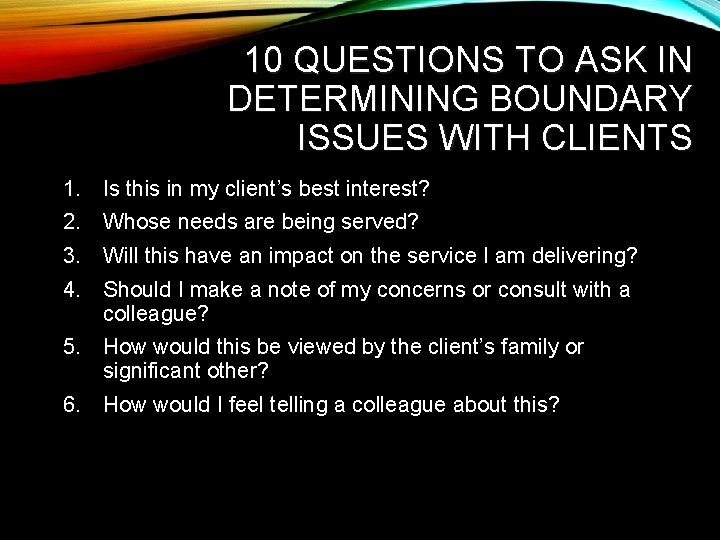
10 QUESTIONS TO ASK IN DETERMINING BOUNDARY ISSUES WITH CLIENTS 1. Is this in my client’s best interest? 2. Whose needs are being served? 3. Will this have an impact on the service I am delivering? 4. Should I make a note of my concerns or consult with a colleague? 5. How would this be viewed by the client’s family or significant other? 6. How would I feel telling a colleague about this?
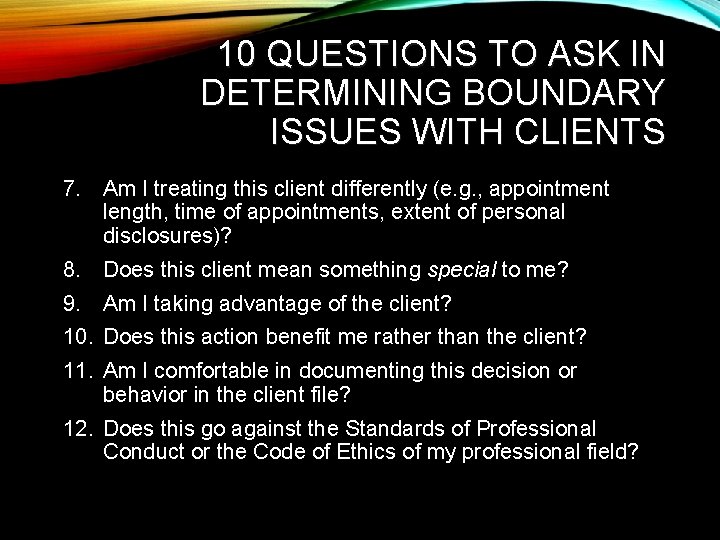
10 QUESTIONS TO ASK IN DETERMINING BOUNDARY ISSUES WITH CLIENTS 7. Am I treating this client differently (e. g. , appointment length, time of appointments, extent of personal disclosures)? 8. Does this client mean something special to me? 9. Am I taking advantage of the client? 10. Does this action benefit me rather than the client? 11. Am I comfortable in documenting this decision or behavior in the client file? 12. Does this go against the Standards of Professional Conduct or the Code of Ethics of my professional field?
CHALLENGE TO HELPER IN MAINTAINING BOUNDARIES Being aware: Ø Be self-aware of feelings & behaviors involved in working with each client & family Ø Be observant of behavior of other Helpers in the field & call them on it, if they appear to be overstepping their boundaries with clients Ø Always act in best interest of clients & families Ø Most importantly DO NO HARM to your clients
NOW LET’S GET TO WORK! In small Groups answer the following questions for each of the case studies handed out to you. 1. What moral Ethical/Moral Principle has been violated in this case? 2. What could have been done to avoid the boundary violation in this case? 3. What steps should the helper in this case taken to mitigate the damages which occurred in the violation of boundaries with the client in this case? 4. What would have been the appropriate decision which the State Board of Licensing should have taken in this case? 5. What can you learn from this case which will help you in your future work with clients to avoid a similar circumstance from occurring?
SO WHAT HAVE YOU LEARNED ØLet’s see what you have learned ØAnswer these questions as we go ØSelect the correct answer for each question ØShare with your fellow participants as we proceed through these 10 questions
QUESTION #1 When referring to the relationship between the client and Helper, boundaries are: A. B. C. D. Actions that are not appropriate in client care Whatever the client feels is appropriate Whatever the helper feels is appropriate The limits that define the Helper-Client relationship
ANSWER QUESTION #1 D. The limits that define the Helper-client relationship
QUESTION #2 Boundaries are essential to protect clients from the Helper’s A. B. C. D. Power Anger Poor services Lack of knowledge

ANSWER QUESTION #2 A. Power
QUESTION #3 Which is one of the clearest signs that a boundary violation has occurred in the Helper-Client relationship? A. B. C. D. The client is not happy with his or her care The Helper hugs the client The Helper asks for a change of assignment The needs of the Helper are being met
ANSWER QUESTION #3 D. The needs of the Helper are being met
QUESTION #4 Which of the following is the best example of a professional business-like boundary violation? The Helper: A. Shares personal information with the client B. Asks the client if she would like to buy some “Mary Kay Cosmetics” C. Is attracted to the client D. Attends a party given by the client’s family
ANSWER QUESTION #4 C. Is attracted to the Client
QUESTION #5 Gerald the Helper assigned to George, regularly talks about his personal problems with George is happy to listen to his Helper Gerald’s personal problems and never complains about it. Since this relationship seems to benefit both parties it does not appear to be a violation of boundaries. A. True B. False
ANSWER QUESTION #5 B. False
QUESTION #6 The first person to realize there is a boundary violation is: A. The client B. The Helper who is committing the boundary violation C. A co-worker or the supervisor of the helper D. None of the above
ANSWER QUESTION #6 D. None of the above since the correct answer would be any of the above
QUESTION #7 If there are things in the Helper-client relationship which the helper would not want to record in the record of the client then a boundary violation is likely. A. True B. False

ANSWER QUESTION #7 A. True
QUESTION #8 Gill is a 46 year old client who has become very attracted to his Helper Suzette who is 35. Suzette is equally attracted to Gill. Their personal relationship began when Gill shared his feelings of attraction to Suzette and she shared her similar feelings. Since Gill wants this relationship it is OK for Suzette to allow it to develop. A. True B. False
ANSWER QUESTION #8 B. False
QUESTION #9 Albert is a Helper who has been working with Charles for the past year and it is now time for Albert to leave this client setting due to Charles no longer needing the assistance which Albert has to offer. However on his last visit Albert finds out that Charles is lacking enough food supplies in his house to keep he and his family fed for the next week. Albert’s best response is to: A. Call Salvation Army to request they drop off food from their food pantry for Charles and his family B. Bring groceries to Charles home after he gets off from work that day C. Notify the agency for whom Albert works about Charles’ circumstances D. Calls Charles’ ex-wife to inform her of Charles pressing need for groceries in his house to feed himself and his family
ANSWER QUESTION #9 C. Notify the agency for whom Albert works about Charles’ circumstances
QUESTION #10 Jackie is a “Mary Kay” distributor in her community and while working with her client Maggie Jo, Maggie Jo sees the logo on Jackie’s purse and says: “Oh I love those products and I sure could use some more…” Jackie’s best action is to: A. Request a change of assignment away from Maggie Jo B. Give Maggie Jo the name of another Mary Kay distributor in the community C. Tell Maggie Jo that she cannot sell product to her but can sell it to her relatives or friends D. Sells Maggie Jo the products she needs
ANSWER QUESTION #10 B. Give Maggie Jo the name of another Mary Kay distributor in the community

SO HOW DID IT GO? ØHave you a better idea as to what Maintaining Professional Boundaries with your clients and their families is all about? ØCan you now identify if you are a compulsive fixer or rescuer which could impact your maintaining healthy boundaries with your clients and their families? ØCan you now Identify steps you can take to maintain healthy boundaries in your professional work?
RESOURCES ON COPING. US TO HELP YOU WITH PROFESSIONAL BOUNDARIES Overcoming the Need to Fix: http: //www. coping. us/toolsforhandlingcontrol/overcomeneedtofix. html Tempering Idealism: http: //www. coping. us/toolsforhandlingcontrol/temperingidealism. html Eliminating Caretaker Behaviors: http: //www. coping. us/toolsforhandlingcontrol/eliminatecaretakerbehaviors. html Letting Go of the Uncontrollables and Unchangeables http: //www. coping. us/toolsforhandlingcontrol/letgouncontrollablesunchangeables. html Accepting Powerlessness http: //www. coping. us/toolsforhandlingcontrol/acceptingpowerlessness. html Developing Detachment http: //www. coping. us/toolsforhandlingcontrol/developingdetachment. html Establishing Healthy Boundaries http: //www. coping. us/growingdown/healthyboundaries. html
- Slides: 49