
Maintaining an electrosurgical machine o Principles of operation

- Slides: 17
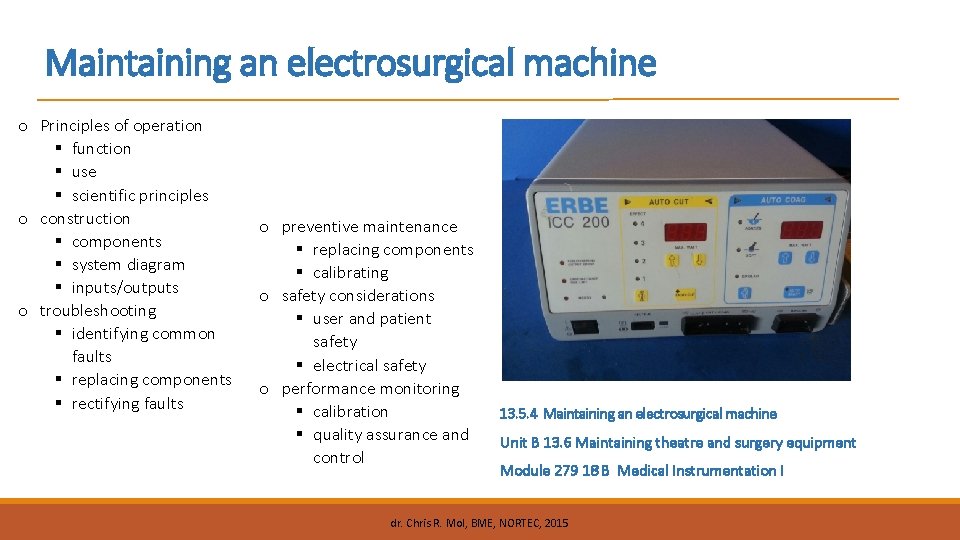
Maintaining an electrosurgical machine o Principles of operation function use scientific principles o construction components system diagram inputs/outputs o troubleshooting identifying common faults replacing components rectifying faults o preventive maintenance replacing components calibrating o safety considerations user and patient safety electrical safety o performance monitoring calibration quality assurance and control 13. 5. 4 Maintaining an electrosurgical machine Unit B 13. 6 Maintaining theatre and surgery equipment Module 279 18 B Medical Instrumentation I dr. Chris R. Mol, BME, NORTEC, 2015
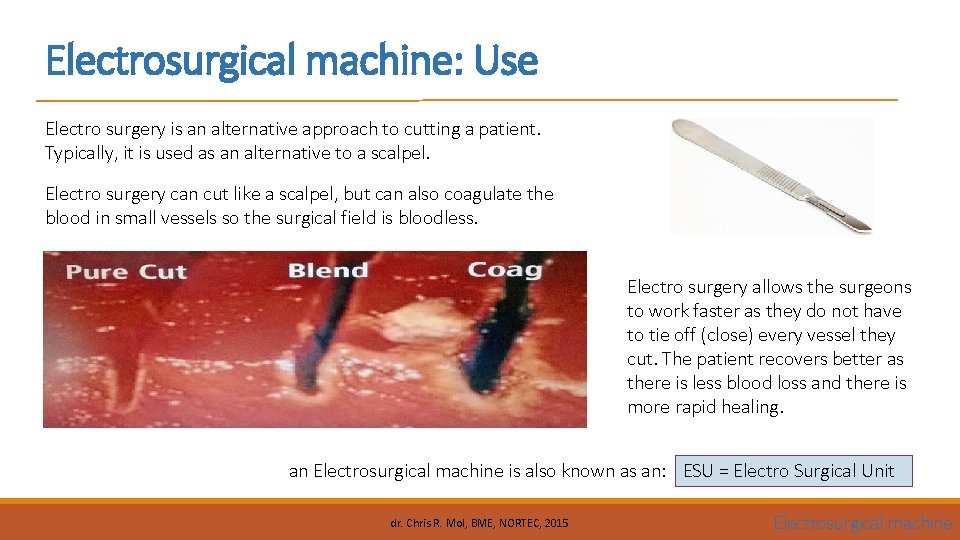
Electrosurgical machine: Use Electro surgery is an alternative approach to cutting a patient. Typically, it is used as an alternative to a scalpel. Electro surgery can cut like a scalpel, but can also coagulate the blood in small vessels so the surgical field is bloodless. Electro surgery allows the surgeons to work faster as they do not have to tie off (close) every vessel they cut. The patient recovers better as there is less blood loss and there is more rapid healing. an Electrosurgical machine is also known as an: ESU = Electro Surgical Unit dr. Chris R. Mol, BME, NORTEC, 2015 Electrosurgical machine
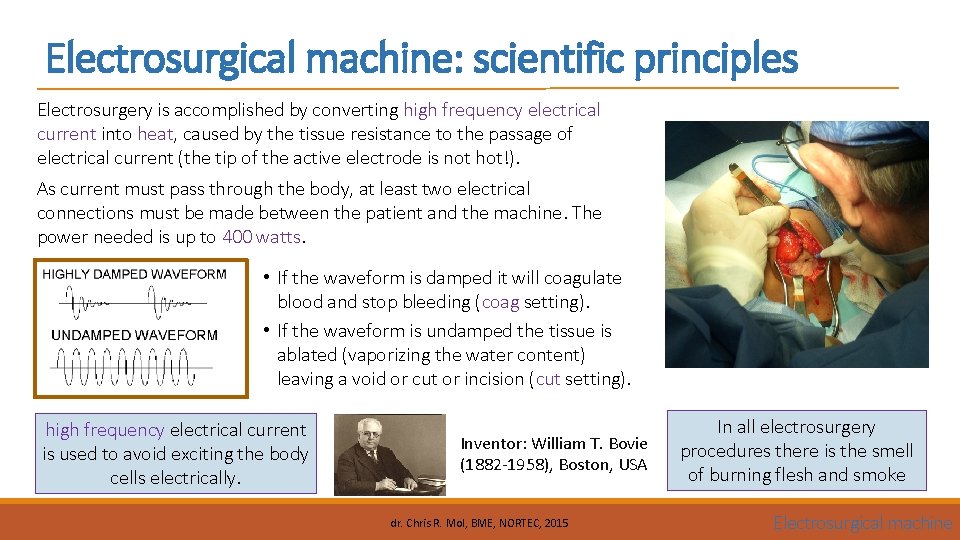
Electrosurgical machine: scientific principles Electrosurgery is accomplished by converting high frequency electrical current into heat, caused by the tissue resistance to the passage of electrical current (the tip of the active electrode is not hot!). As current must pass through the body, at least two electrical connections must be made between the patient and the machine. The power needed is up to 400 watts. • If the waveform is damped it will coagulate blood and stop bleeding (coag setting). • If the waveform is undamped the tissue is ablated (vaporizing the water content) leaving a void or cut or incision (cut setting). high frequency electrical current is used to avoid exciting the body cells electrically. Inventor: William T. Bovie (1882 -1958), Boston, USA dr. Chris R. Mol, BME, NORTEC, 2015 In all electrosurgery procedures there is the smell of burning flesh and smoke Electrosurgical machine
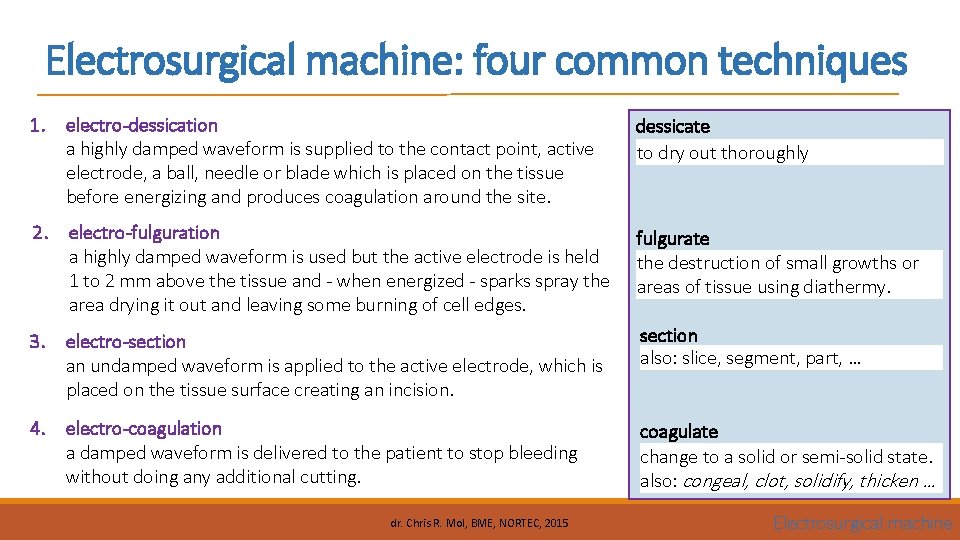
Electrosurgical machine: four common techniques 1. electro-dessication a highly damped waveform is supplied to the contact point, active electrode, a ball, needle or blade which is placed on the tissue before energizing and produces coagulation around the site. dessicate to dry out thoroughly 2. electro-fulguration a highly damped waveform is used but the active electrode is held 1 to 2 mm above the tissue and - when energized - sparks spray the area drying it out and leaving some burning of cell edges. fulgurate the destruction of small growths or areas of tissue using diathermy. 3. electro-section an undamped waveform is applied to the active electrode, which is placed on the tissue surface creating an incision. section also: slice, segment, part, … 4. electro-coagulation a damped waveform is delivered to the patient to stop bleeding without doing any additional cutting. coagulate change to a solid or semi-solid state. also: congeal, clot, solidify, thicken … dr. Chris R. Mol, BME, NORTEC, 2015 Electrosurgical machine
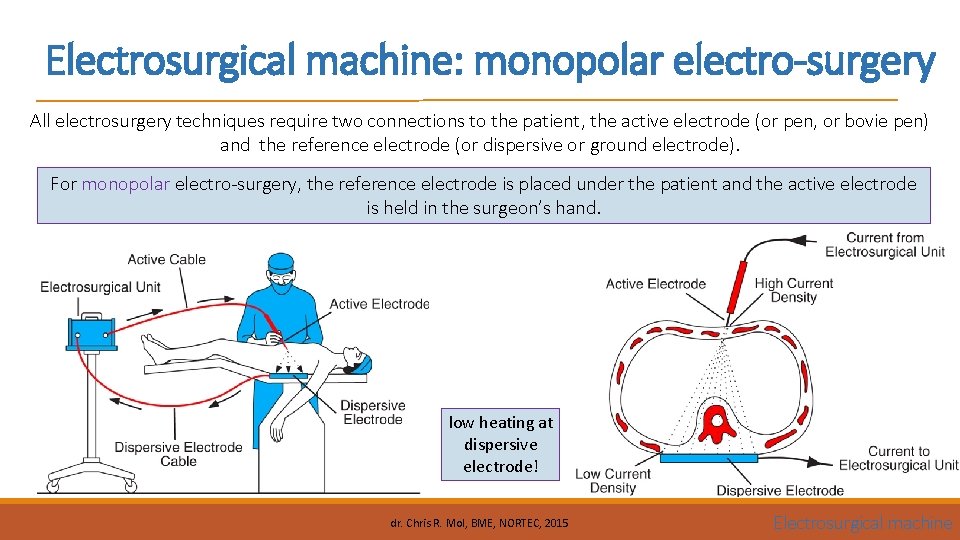
Electrosurgical machine: monopolar electro-surgery All electrosurgery techniques require two connections to the patient, the active electrode (or pen, or bovie pen) and the reference electrode (or dispersive or ground electrode). For monopolar electro-surgery, the reference electrode is placed under the patient and the active electrode is held in the surgeon’s hand. low heating at dispersive electrode! dr. Chris R. Mol, BME, NORTEC, 2015 Electrosurgical machine
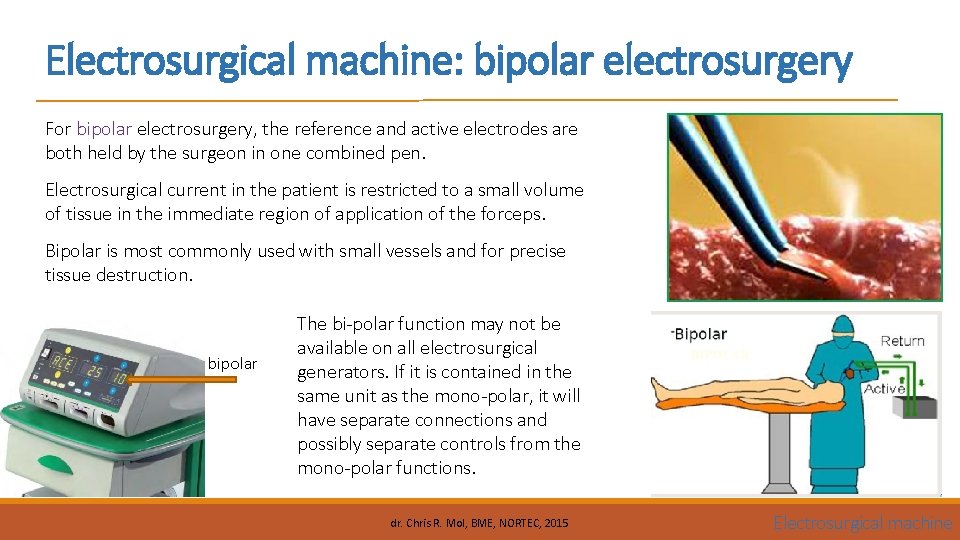
Electrosurgical machine: bipolar electrosurgery For bipolar electrosurgery, the reference and active electrodes are both held by the surgeon in one combined pen. Electrosurgical current in the patient is restricted to a small volume of tissue in the immediate region of application of the forceps. Bipolar is most commonly used with small vessels and for precise tissue destruction. bipolar The bi-polar function may not be available on all electrosurgical generators. If it is contained in the same unit as the mono-polar, it will have separate connections and possibly separate controls from the mono-polar functions. dr. Chris R. Mol, BME, NORTEC, 2015 Electrosurgical machine
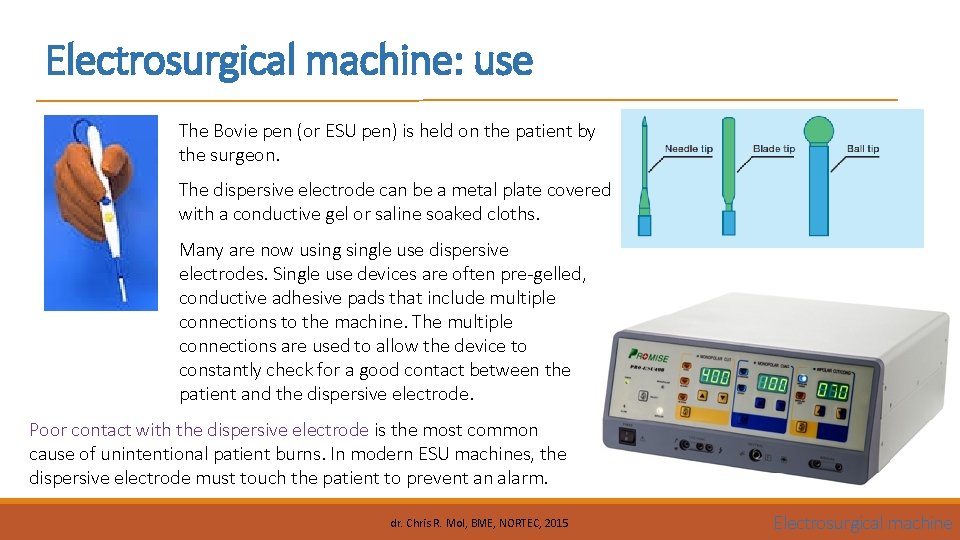
Electrosurgical machine: use The Bovie pen (or ESU pen) is held on the patient by the surgeon. The dispersive electrode can be a metal plate covered with a conductive gel or saline soaked cloths. Many are now usingle use dispersive electrodes. Single use devices are often pre-gelled, conductive adhesive pads that include multiple connections to the machine. The multiple connections are used to allow the device to constantly check for a good contact between the patient and the dispersive electrode. Poor contact with the dispersive electrode is the most common cause of unintentional patient burns. In modern ESU machines, the dispersive electrode must touch the patient to prevent an alarm. dr. Chris R. Mol, BME, NORTEC, 2015 Electrosurgical machine
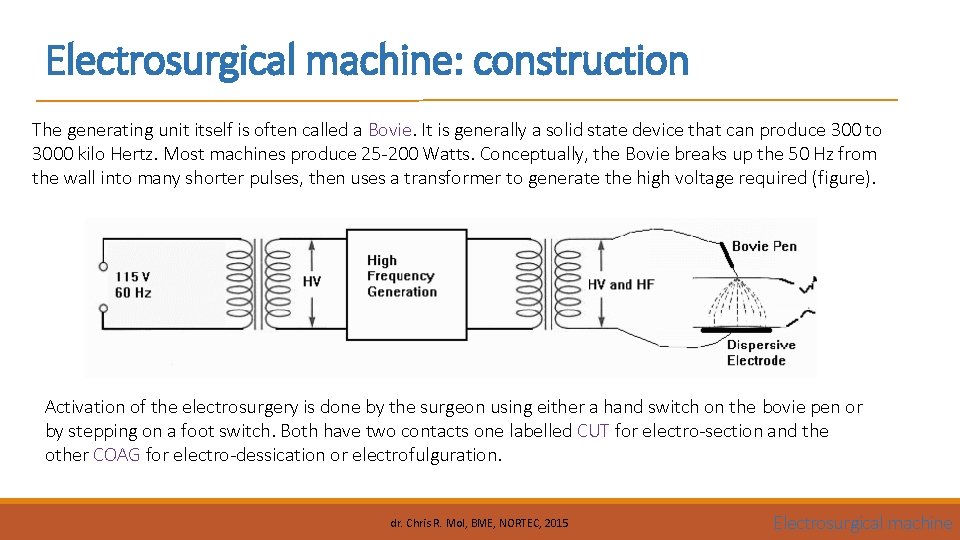
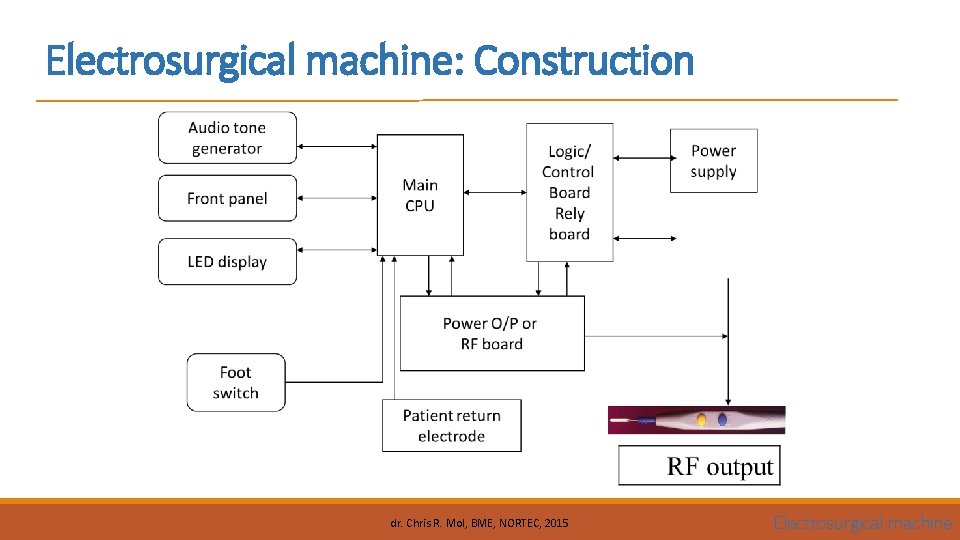
Electrosurgical machine: construction The generating unit itself is often called a Bovie. It is generally a solid state device that can produce 300 to 3000 kilo Hertz. Most machines produce 25 -200 Watts. Conceptually, the Bovie breaks up the 50 Hz from the wall into many shorter pulses, then uses a transformer to generate the high voltage required (figure). Activation of the electrosurgery is done by the surgeon using either a hand switch on the bovie pen or by stepping on a foot switch. Both have two contacts one labelled CUT for electro-section and the other COAG for electro-dessication or electrofulguration. dr. Chris R. Mol, BME, NORTEC, 2015 Electrosurgical machine
Electrosurgical machine: Construction dr. Chris R. Mol, BME, NORTEC, 2015 Electrosurgical machine
Troubleshooting The most common problems in electrosurgery are: • burns, excessive tissue damage, damage to alternate sites (areas of the patient's body other than the target surgical site) • fires • interference with other devices. Skin burns are the most frequently reported of these problems, usually occurring at the return electrode site. Partial or complete detachment of the electrode pad from the patient is the most common cause. The dispersive electrode should always be placed on an area of the body that has good blood flow and is not subject to high weight concentration. The side of the thigh is a very common location, under the buttocks is not a good location as it generally is a high weight bearing point. In older machines, the lack of contact with the electrode may not be detected by the system. The effect can be patient burns where the electrical current finds an alternative path to ground. In newer machines, the generator has two connections to the dispersive electrode. When connected to the patient, a small current is passed between the two halves of the dispersive electrodes. When not properly connected to the patient, the current cannot pass and an alarm will sound. dr. Chris R. Mol, BME, NORTEC, 2015 Electrosurgical machine
Electrosurgical machine: Trouble shooting If the tip is dirty, there can be little, or no, current passing through the patient. The bovie pens are not intended to be reused. However, they are often reused in the developing world. In addition to problems with dirty tips, the wires become broken with reuse. They are simple wires which can be resoldered for repairs. If the wire break is in the pen, the pen can be taken apart, the wires reconnected and the pen glued together dr. Chris R. Mol, BME, NORTEC, 2015 Electrosurgical machine
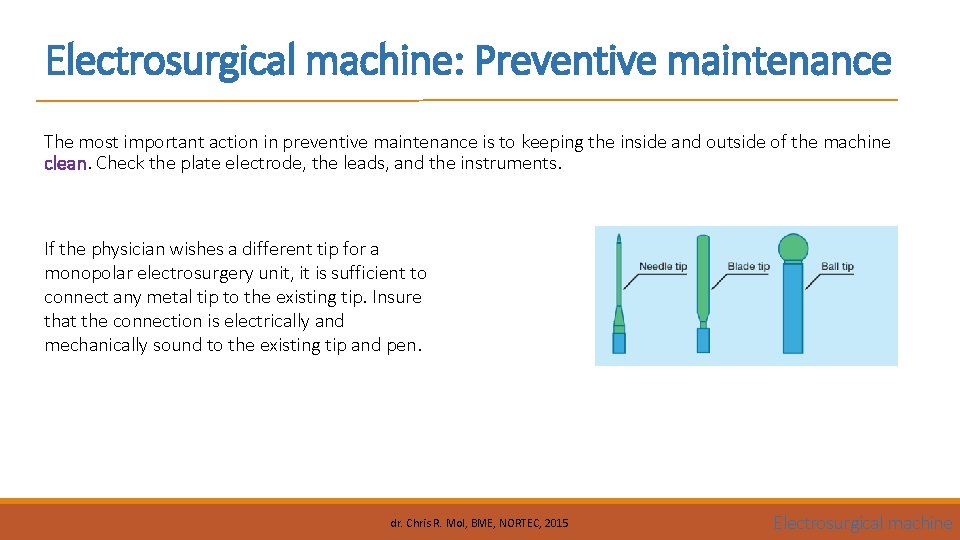
Electrosurgical machine: Preventive maintenance The most important action in preventive maintenance is to keeping the inside and outside of the machine clean. Check the plate electrode, the leads, and the instruments. If the physician wishes a different tip for a monopolar electrosurgery unit, it is sufficient to connect any metal tip to the existing tip. Insure that the connection is electrically and mechanically sound to the existing tip and pen. dr. Chris R. Mol, BME, NORTEC, 2015 Electrosurgical machine
Electrosurgical machine: Safety considerations The ESU is inherently a potentially dangerous device. All members of the surgical team using an ESU must be fully aware of the hazards, understand the principles of operation and safe handling, and be familiar with the abilities and limitations of their particular unit (training !) The main risks associated with electrical surgery Burns Electrical interference with the heart muscle Explosion/fire caused by sparks and Electrical interference with pacemaker and other medical equipment. Sparks are a common occurrence when electrosurgery is in use. When oxygen is being administered to the patient, it may leak, creating an atmosphere where fires can quickly ignite. The drapes covering the patients should be flame retardant but will burn under the right conditions. Special care is required when doing neck or mouth surgery to avoid a flash fire. dr. Chris R. Mol, BME, NORTEC, 2015 Electrosurgical machine
Electrosurgical machine: Performance monitoring An electrosurgery unit can be checked and calibrated easily and efficiently through the use of an electrosurgery tester. • You cannot test the device by performing the operation on a resistor in most cases. Although 400 Ohms would work, only a resistor with a very large power rating will survive the procedure. Such large power resistors are generally not available in the developing world. In most cases, a bar of soap or a fresh piece of citrus fruit (like an orange) can be used to do your initial testing. Be sure that both sides of the dispersive electrode are touching to prevent an alarm. In many cases, you will want a final test on meat. A reasonable final test is to cut a raw piece of chicken, pork or beef. Be sure that the indifferent electrode is touching the meat before testing. Both sides of a split dispersive electrode must touch the meat to avoid an alarm! It is best to conduct the final test with the physician present. In this way, you can not only assure that the device is minimally operating, but you can also be sure that it is operating in a manner that satisfies the physician. For more modern units, insure that the dispersive electrode alarm is working by disconnecting half of the electrode from the meat, or pulling the dispersive electrode out of the machine. dr. Chris R. Mol, BME, NORTEC, 2015 Electrosurgical machine
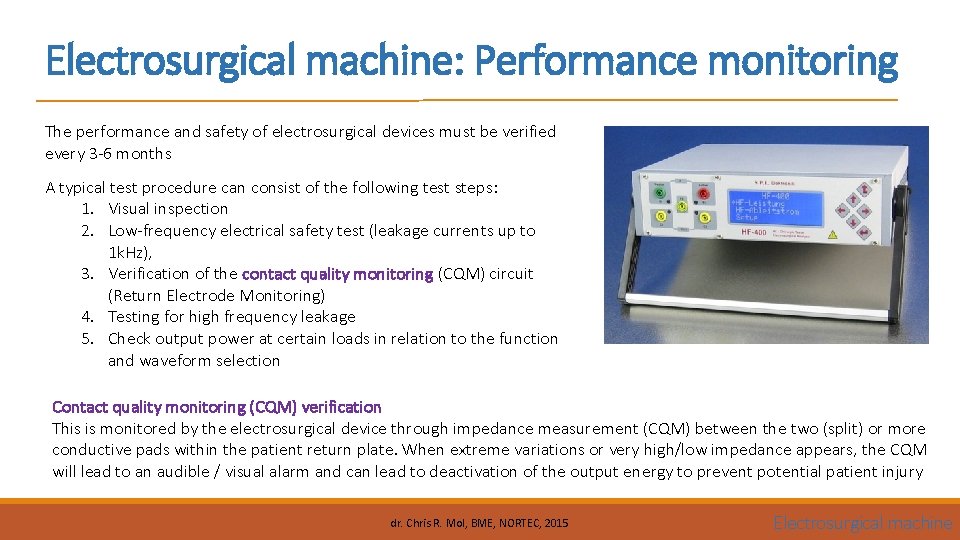
Electrosurgical machine: Performance monitoring The performance and safety of electrosurgical devices must be verified every 3 -6 months A typical test procedure can consist of the following test steps: 1. Visual inspection 2. Low-frequency electrical safety test (leakage currents up to 1 k. Hz), 3. Verification of the contact quality monitoring (CQM) circuit (Return Electrode Monitoring) 4. Testing for high frequency leakage 5. Check output power at certain loads in relation to the function and waveform selection Contact quality monitoring (CQM) verification This is monitored by the electrosurgical device through impedance measurement (CQM) between the two (split) or more conductive pads within the patient return plate. When extreme variations or very high/low impedance appears, the CQM will lead to an audible / visual alarm and can lead to deactivation of the output energy to prevent potential patient injury dr. Chris R. Mol, BME, NORTEC, 2015 Electrosurgical machine
Electrosurgery Links Electrosurgical Principles • https: //www. youtube. com/watch? v=7 LW 78 yoa. Ee 0 Principles of Electrosurgery in Laproscopy • https: //www. youtube. com/watch? v=mqmva. Kxfq 3 A Understanding Electrosurgery • http: //www. boviemed. com/products_boviemed_lit/pdfs/aaron_understanding_sc. pdf Electrosurgery Manual http: //www. klsmartin. com/fileadmin/Inhalte/Downloads_Prospekte/HF-Geraete/90 -604 -0204_09_06_Handbuch_HF. pdf Electrosurgical Checklist • http: //mdsr. ecri. org/summary/detail. aspx? doc_id=8271 Electrosurgery Self-study guide • http: //www. covidien. com/pace/clinical-education/273622 dr. Chris R. Mol, BME, NORTEC, 2015
END The creation of this presentation was supported by a grant from THET: see https: //www. thet. org/