
Maintaining a water distiller o Principles of operation


- Slides: 16
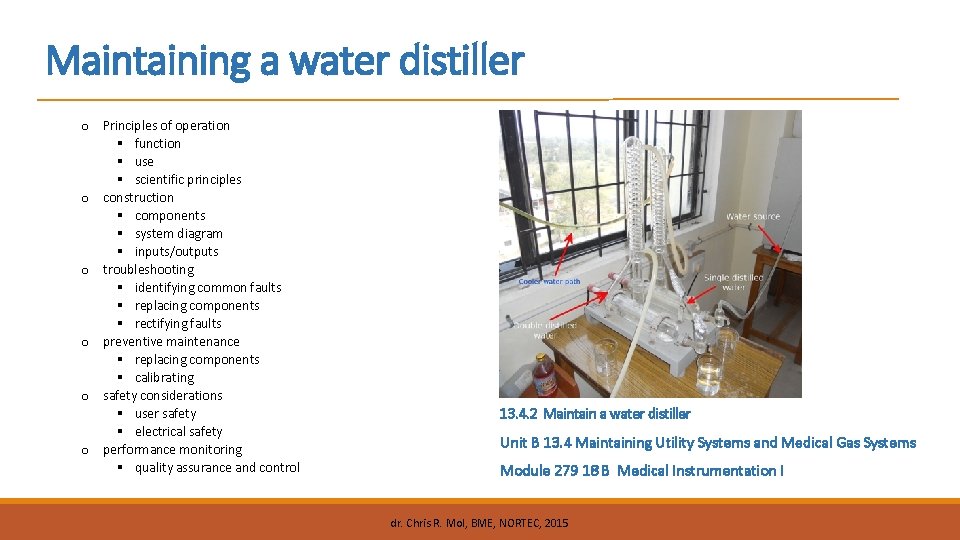
Maintaining a water distiller o Principles of operation function use scientific principles o construction components system diagram inputs/outputs o troubleshooting identifying common faults replacing components rectifying faults o preventive maintenance replacing components calibrating o safety considerations user safety electrical safety o performance monitoring quality assurance and control 13. 4. 2 Maintain a water distiller Unit B 13. 4 Maintaining Utility Systems and Medical Gas Systems Module 279 18 B Medical Instrumentation I dr. Chris R. Mol, BME, NORTEC, 2015
Water distiller: purify water What is a water distiller ? A water distiller is a system to obtain very pure water from potable water normally provided by the aqueduct services in urban centres. Distilled water is characterized by a lack of solids in suspension. What is the use of distilled water ? It is used in multiple applications health centres, especially in laboratory units, in cleaning and sterilization. Is all distilled water of the same quality ? No, to obtain very pure substances, consecutive distillation cycles are performed with the aim of progressively eliminating other substances present in the mix. The more specialized the procedures are in the laboratory, the greater will be the level of purity required. For example: the preparation of reagents or biological material requires water of the highest quality. dr. Chris R. Mol, BME, NORTEC, 2015 Maintain a water distiller
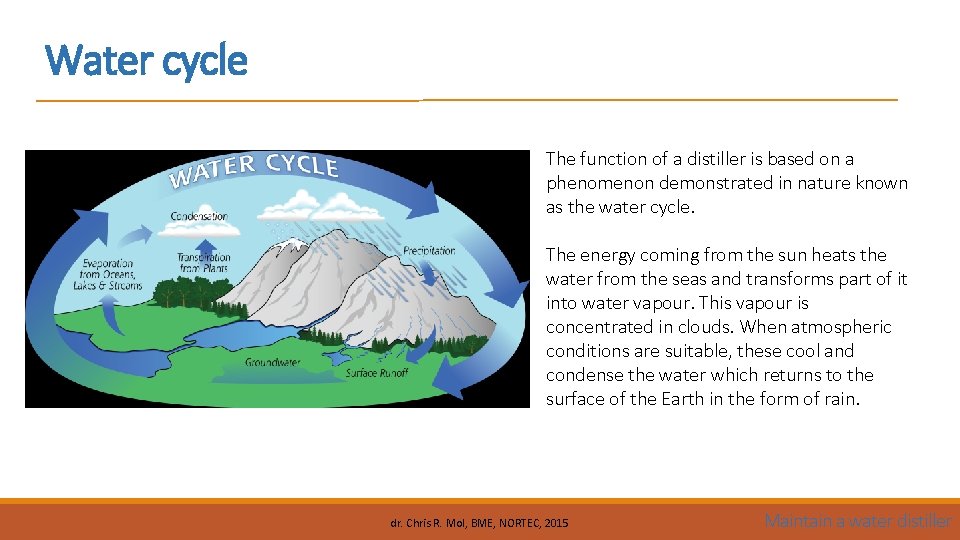
Water cycle The function of a distiller is based on a phenomenon demonstrated in nature known as the water cycle. The energy coming from the sun heats the water from the seas and transforms part of it into water vapour. This vapour is concentrated in clouds. When atmospheric conditions are suitable, these cool and condense the water which returns to the surface of the Earth in the form of rain. dr. Chris R. Mol, BME, NORTEC, 2015 Maintain a water distiller
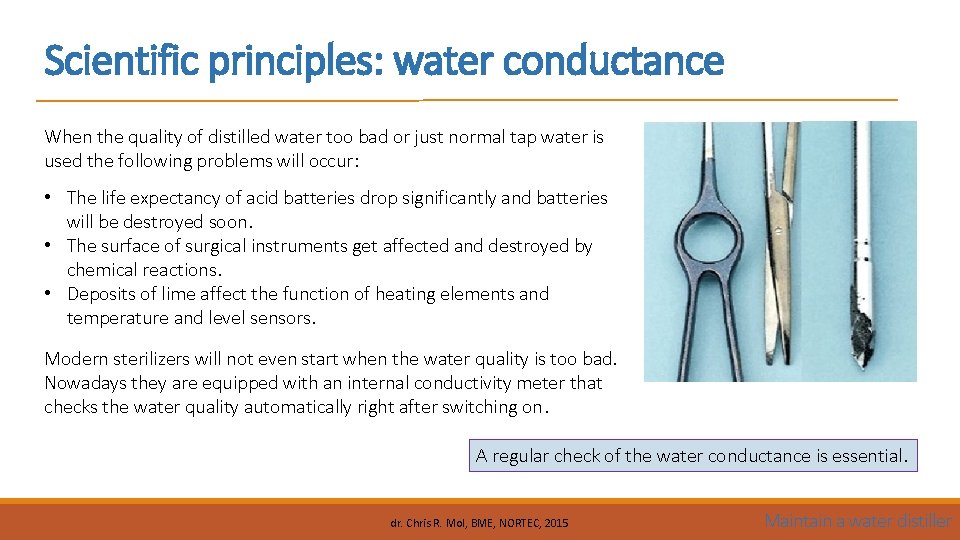
Use Distilled water is needed in hospitals for running autoclaves and in the workshop for the maintenance of lead-acid batteries for cars and electrical backup systems. Normal tap water must not be used for technical applications because it contains minerals. Minerals are important for the human body, but harmful for any technical application. Technical water has to be free of minerals and other solids. Unfortunately the quality of distilled water is very different. Specially in the hospitals of developing countries usually simple tap water is used instead of distilled water and the bottles of distilled water you can buy in the streets is far behind European or US standards. Often these 'distilled waters' are also just normal tap water. This causes a lot of problems. Car batteries will be destroyed soon after refilling and operating theatre personnel complain about the damaged surfaces of their expensive surgical instruments. To prevent these problems it is important to make sure that only distilled water of good quality is used. It is the task of the hospital technician to check the water quality frequently. dr. Chris R. Mol, BME, NORTEC, 2015 Maintain a water distiller
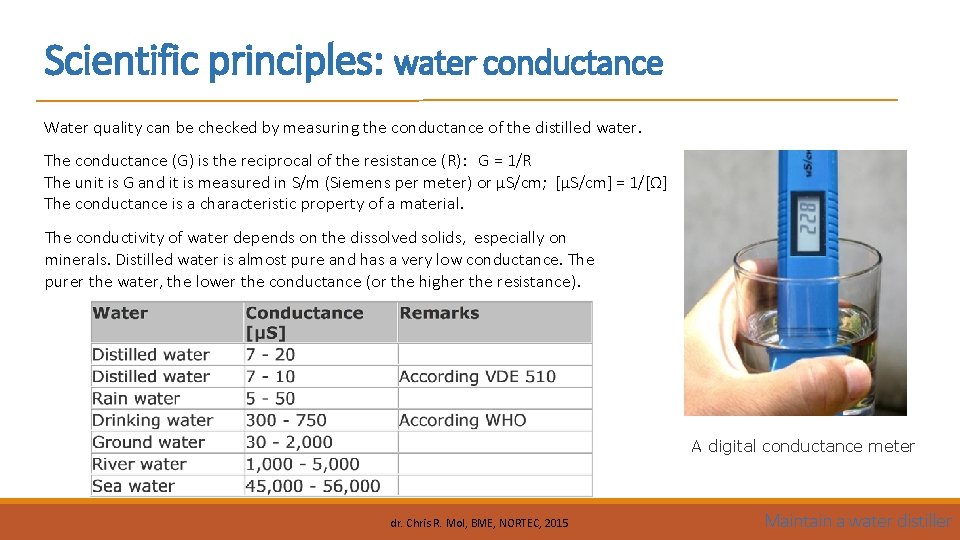
Scientific principles: water conductance Water quality can be checked by measuring the conductance of the distilled water. The conductance (G) is the reciprocal of the resistance (R): G = 1/R The unit is G and it is measured in S/m (Siemens per meter) or µS/cm; [µS/cm] = 1/[Ω] The conductance is a characteristic property of a material. The conductivity of water depends on the dissolved solids, especially on minerals. Distilled water is almost pure and has a very low conductance. The purer the water, the lower the conductance (or the higher the resistance). A digital conductance meter dr. Chris R. Mol, BME, NORTEC, 2015 Maintain a water distiller
Scientific principles: water conductance When the quality of distilled water too bad or just normal tap water is used the following problems will occur: • The life expectancy of acid batteries drop significantly and batteries will be destroyed soon. • The surface of surgical instruments get affected and destroyed by chemical reactions. • Deposits of lime affect the function of heating elements and temperature and level sensors. Modern sterilizers will not even start when the water quality is too bad. Nowadays they are equipped with an internal conductivity meter that checks the water quality automatically right after switching on. A regular check of the water conductance is essential. dr. Chris R. Mol, BME, NORTEC, 2015 Maintain a water distiller
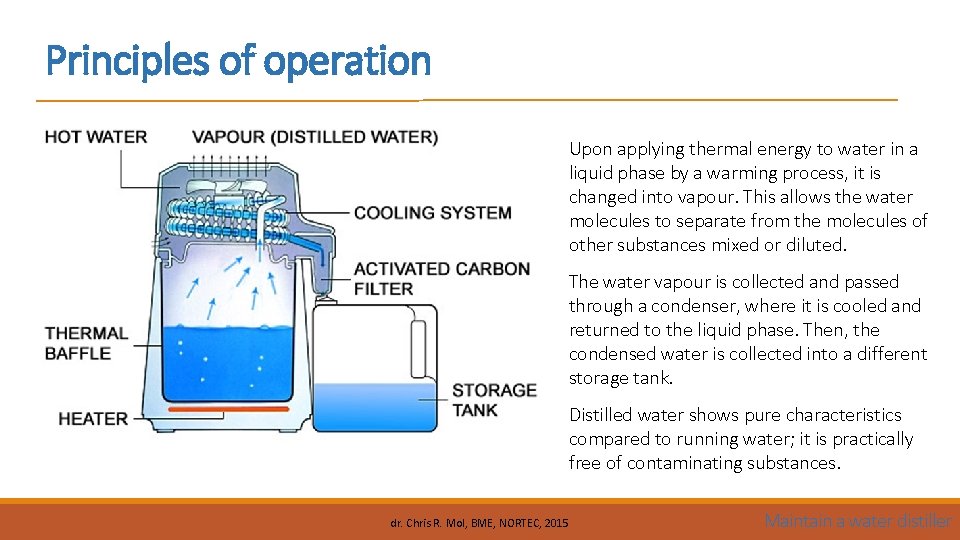
Principles of operation Upon applying thermal energy to water in a liquid phase by a warming process, it is changed into vapour. This allows the water molecules to separate from the molecules of other substances mixed or diluted. The water vapour is collected and passed through a condenser, where it is cooled and returned to the liquid phase. Then, the condensed water is collected into a different storage tank. Distilled water shows pure characteristics compared to running water; it is practically free of contaminating substances. dr. Chris R. Mol, BME, NORTEC, 2015 Maintain a water distiller
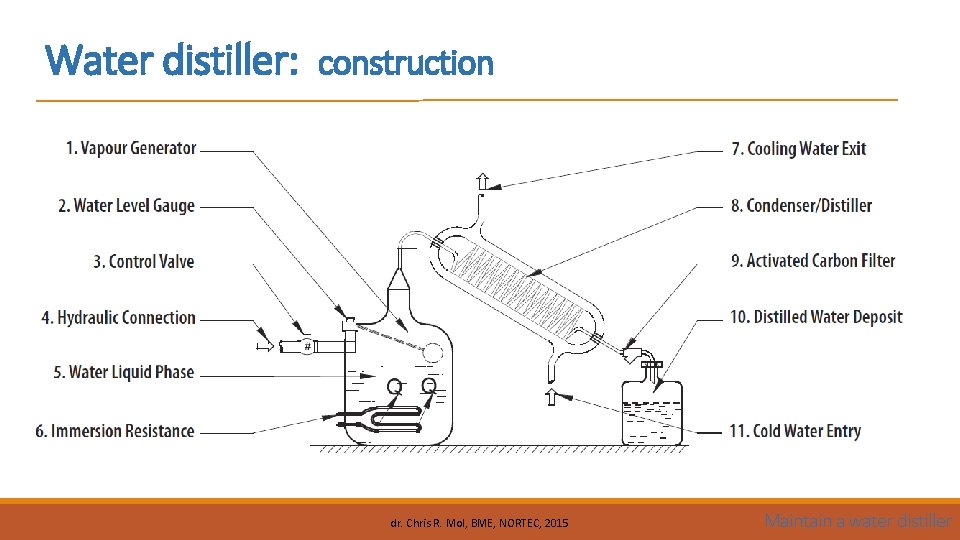
Water distiller: construction dr. Chris R. Mol, BME, NORTEC, 2015 Maintain a water distiller
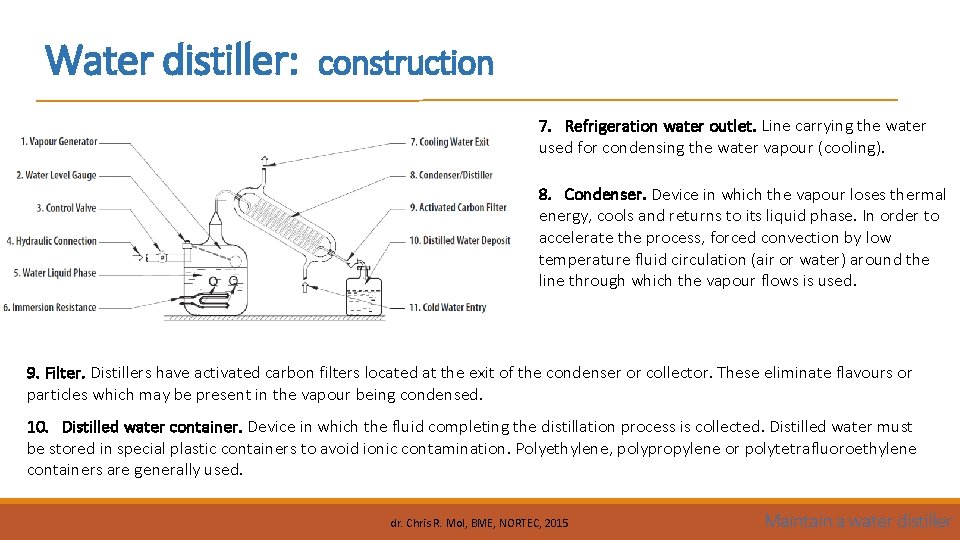
Water distiller: construction 1. Vapour generator or boiling tank is the container where the water to be distilled is stored. It is generally made of glass in small distillers or of stainless steel with copper, tin or titanium coverings in large capacity machines. 2. Water level. Device which allows the quantity of water to be regulated inside the vapour generator. When the quantity of water in liquid phase contained in the boiling tank decreases, the device allows the quantity of liquid evaporated to be recovered. 3. Control valve. Mechanical or electromechanical device which allows the flow of water towards the vapour generator tank to be regulated. 6. Immersion resistors. Devices generating heat when an electrical current circulates through them. These are isolated by a ceramic cap and protected from the external environment by a metal shield. dr. Chris R. Mol, BME, NORTEC, 2015 Maintain a water distiller
Water distiller: construction 7. Refrigeration water outlet. Line carrying the water used for condensing the water vapour (cooling). 8. Condenser. Device in which the vapour loses thermal energy, cools and returns to its liquid phase. In order to accelerate the process, forced convection by low temperature fluid circulation (air or water) around the line through which the vapour flows is used. 9. Filter. Distillers have activated carbon filters located at the exit of the condenser or collector. These eliminate flavours or particles which may be present in the vapour being condensed. 10. Distilled water container. Device in which the fluid completing the distillation process is collected. Distilled water must be stored in special plastic containers to avoid ionic contamination. Polyethylene, polypropylene or polytetrafluoroethylene containers are generally used. dr. Chris R. Mol, BME, NORTEC, 2015 Maintain a water distiller
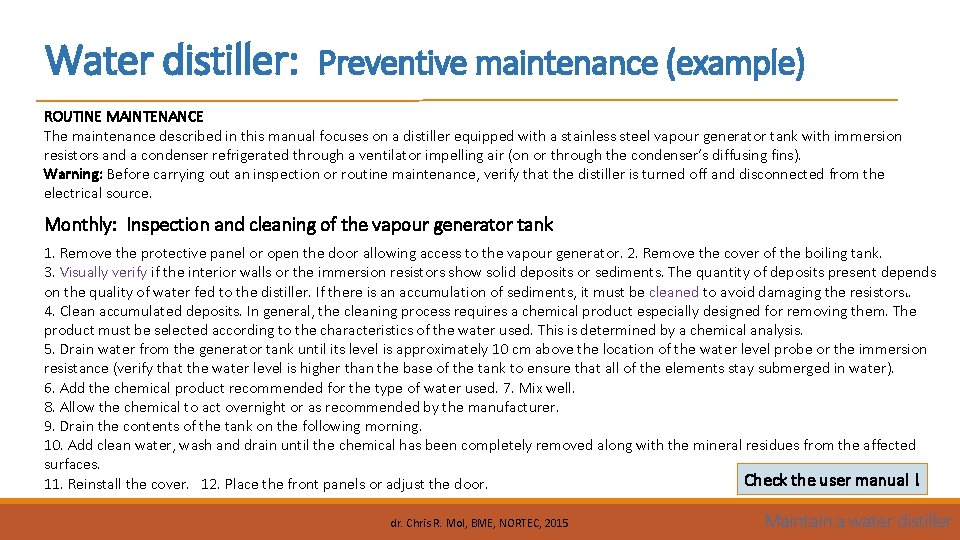
Water distiller: Preventive maintenance (example) ROUTINE MAINTENANCE The maintenance described in this manual focuses on a distiller equipped with a stainless steel vapour generator tank with immersion resistors and a condenser refrigerated through a ventilator impelling air (on or through the condenser’s diffusing fins). Warning: Before carrying out an inspection or routine maintenance, verify that the distiller is turned off and disconnected from the electrical source. Monthly: Inspection and cleaning of the vapour generator tank 1. Remove the protective panel or open the door allowing access to the vapour generator. 2. Remove the cover of the boiling tank. 3. Visually verify if the interior walls or the immersion resistors show solid deposits or sediments. The quantity of deposits present depends on the quality of water fed to the distiller. If there is an accumulation of sediments, it must be cleaned to avoid damaging the resistors 1. 4. Clean accumulated deposits. In general, the cleaning process requires a chemical product especially designed for removing them. The product must be selected according to the characteristics of the water used. This is determined by a chemical analysis. 5. Drain water from the generator tank until its level is approximately 10 cm above the location of the water level probe or the immersion resistance (verify that the water level is higher than the base of the tank to ensure that all of the elements stay submerged in water). 6. Add the chemical product recommended for the type of water used. 7. Mix well. 8. Allow the chemical to act overnight or as recommended by the manufacturer. 9. Drain the contents of the tank on the following morning. 10. Add clean water, wash and drain until the chemical has been completely removed along with the mineral residues from the affected surfaces. Check the user manual ! 11. Reinstall the cover. 12. Place the front panels or adjust the door. dr. Chris R. Mol, BME, NORTEC, 2015 Maintain a water distiller
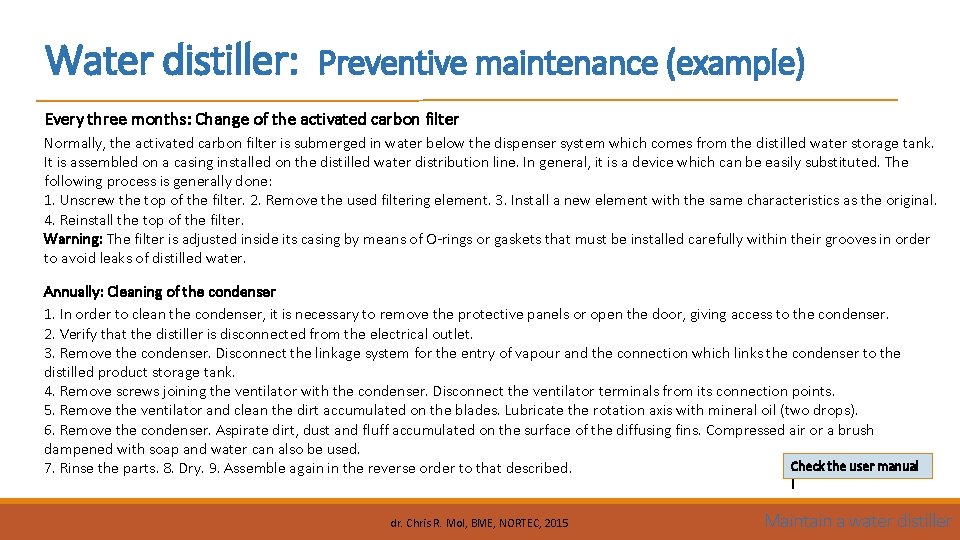
Water distiller: Preventive maintenance (example) Every three months: Change of the activated carbon filter Normally, the activated carbon filter is submerged in water below the dispenser system which comes from the distilled water storage tank. It is assembled on a casing installed on the distilled water distribution line. In general, it is a device which can be easily substituted. The following process is generally done: 1. Unscrew the top of the filter. 2. Remove the used filtering element. 3. Install a new element with the same characteristics as the original. 4. Reinstall the top of the filter. Warning: The filter is adjusted inside its casing by means of O-rings or gaskets that must be installed carefully within their grooves in order to avoid leaks of distilled water. Annually: Cleaning of the condenser 1. In order to clean the condenser, it is necessary to remove the protective panels or open the door, giving access to the condenser. 2. Verify that the distiller is disconnected from the electrical outlet. 3. Remove the condenser. Disconnect the linkage system for the entry of vapour and the connection which links the condenser to the distilled product storage tank. 4. Remove screws joining the ventilator with the condenser. Disconnect the ventilator terminals from its connection points. 5. Remove the ventilator and clean the dirt accumulated on the blades. Lubricate the rotation axis with mineral oil (two drops). 6. Remove the condenser. Aspirate dirt, dust and fluff accumulated on the surface of the diffusing fins. Compressed air or a brush dampened with soap and water can also be used. Check the user manual 7. Rinse the parts. 8. Dry. 9. Assemble again in the reverse order to that described. ! dr. Chris R. Mol, BME, NORTEC, 2015 Maintain a water distiller
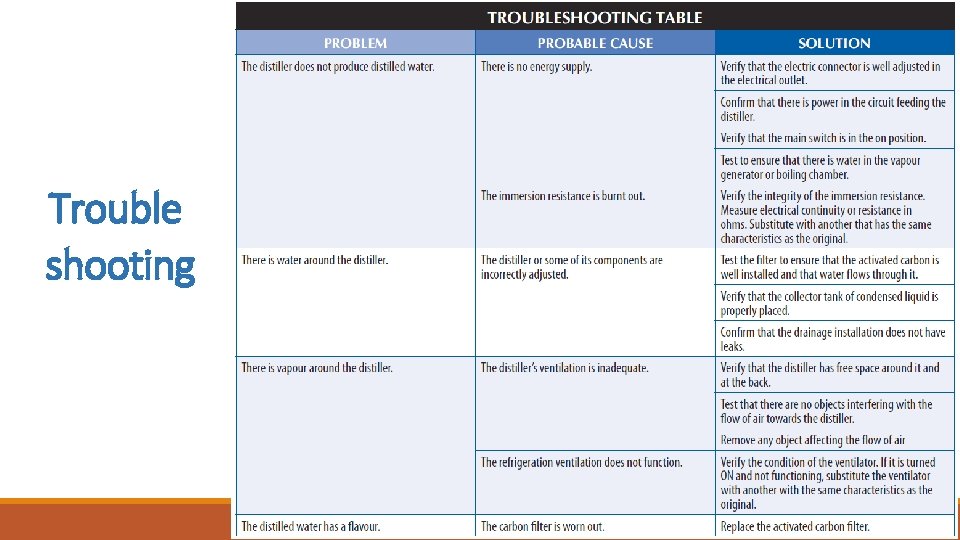
Trouble shooting
Water distiller: Safety considerations • Ensure a suitable electricity supply • Constant supervision to ensure • sufficient supply of cooling water, • the boiling flask does not run dry (sometimes an automatic protection is available) • the receiver is not overfilled • The boiling flask and element must be checked for inorganic deposits and descaled as appropriate. This must be done frequently in hard-water areas. • All glassware must be checked for cracks • The system must be checked regularly to ensure that it is leak proof dr. Chris R. Mol, BME, NORTEC, 2015 Maintain a water distiller
Water distiller: Performance Monitoring regularly check water purity via conductance measurement ! dr. Chris R. Mol, BME, NORTEC, 2015 Maintain a water distiller
END The creation of this presentation was supported by a grant from THET: see https: //www. thet. org/