
Maintain an Xray machine o principles of operation


- Slides: 31
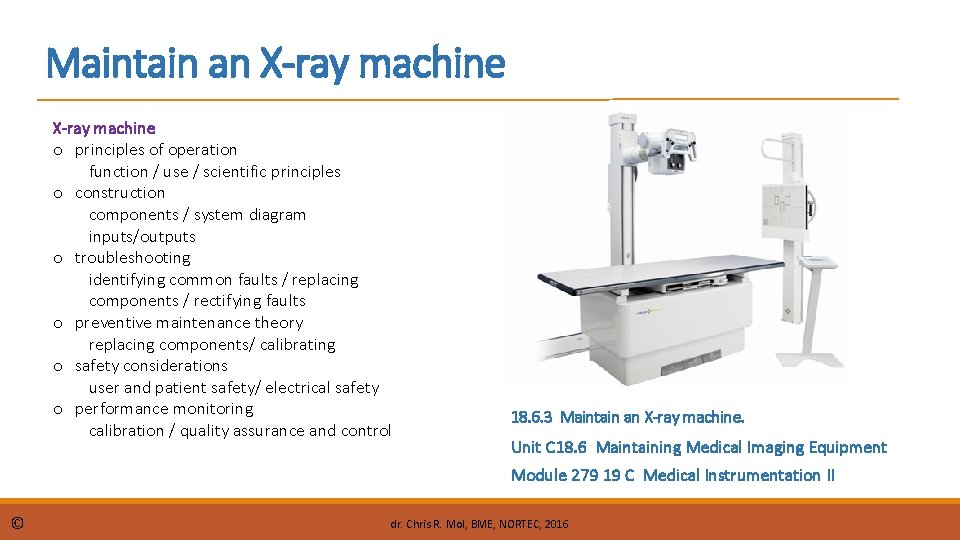
Maintain an X-ray machine o principles of operation function / use / scientific principles o construction components / system diagram inputs/outputs o troubleshooting identifying common faults / replacing components / rectifying faults o preventive maintenance theory replacing components/ calibrating o safety considerations user and patient safety/ electrical safety o performance monitoring calibration / quality assurance and control 18. 6. 3 Maintain an X-ray machine. Unit C 18. 6 Maintaining Medical Imaging Equipment Module 279 19 C Medical Instrumentation II © dr. Chris R. Mol, BME, NORTEC, 2016
Function / use / scientific principles Much of the function, use and scientific principles of X-ray systems have been explained in the two previous lectures. In this lecture, we cover construction and maintenance of Radiology systems that make static images. This lecture does not have the ambition to enable you to fully maintain and X-ray system by yourself. Instead, you will be able to act as a receiver of customer complaints, solve some of the most common and simple problems, and interact as an interface with an X-ray service specialist. This means you need to speak his/her (X–ray) language ! In a next lecture we will cover the X-ray Fluoroscopy systems that make dynamic images (video). © dr. Chris R. Mol, BME, NORTEC, 2016 X-Ray Machine
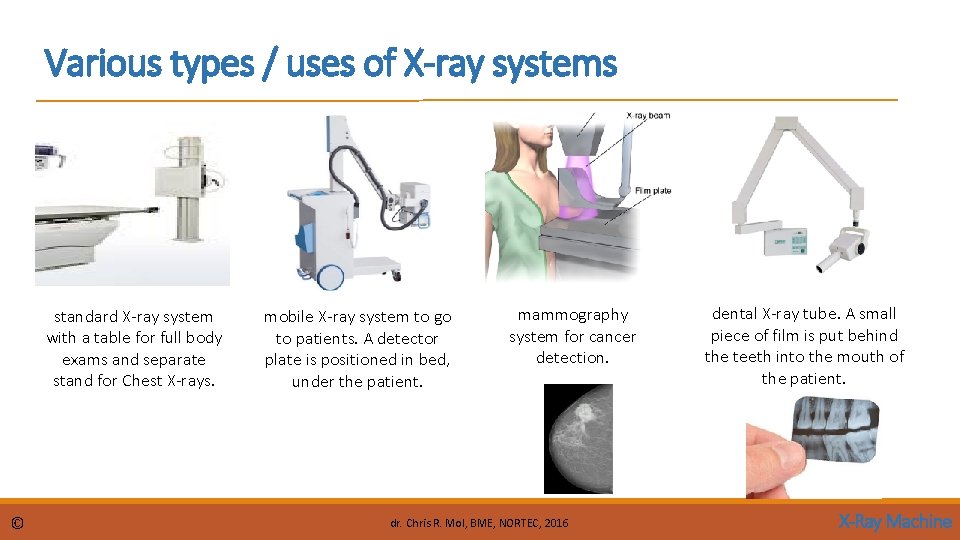
Various types / uses of X-ray systems standard X-ray system with a table for full body exams and separate stand for Chest X-rays. © mobile X-ray system to go to patients. A detector plate is positioned in bed, under the patient. mammography system for cancer detection. dr. Chris R. Mol, BME, NORTEC, 2016 dental X-ray tube. A small piece of film is put behind the teeth into the mouth of the patient. X-Ray Machine
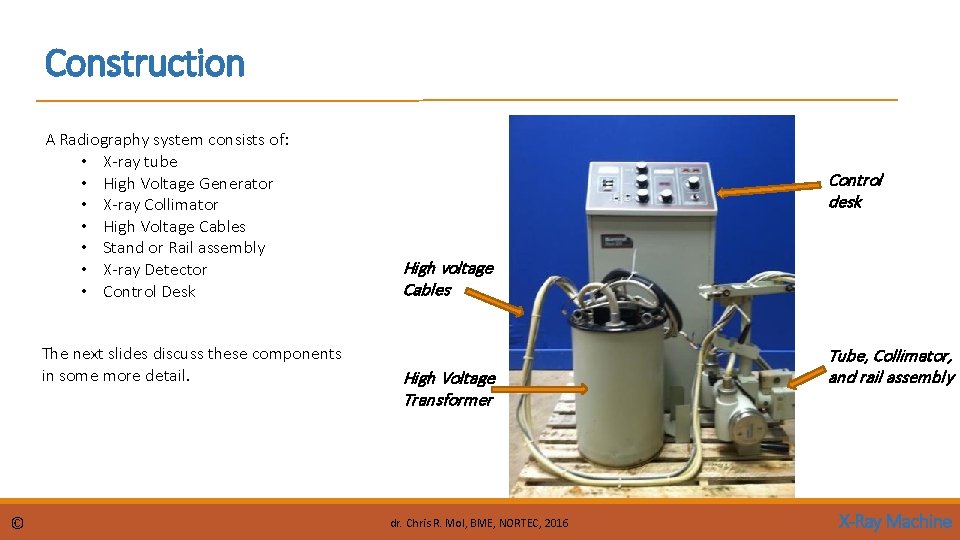
Construction A Radiography system consists of: • X-ray tube • High Voltage Generator • X-ray Collimator • High Voltage Cables • Stand or Rail assembly • X-ray Detector • Control Desk The next slides discuss these components in some more detail. © Control desk High voltage Cables High Voltage Transformer dr. Chris R. Mol, BME, NORTEC, 2016 Tube, Collimator, and rail assembly X-Ray Machine
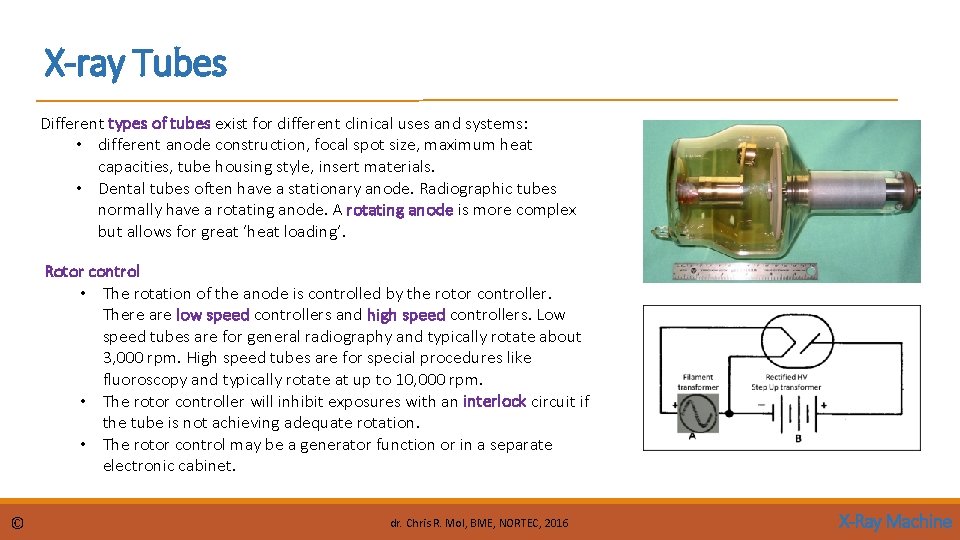
X-ray Tubes Different types of tubes exist for different clinical uses and systems: • different anode construction, focal spot size, maximum heat capacities, tube housing style, insert materials. • Dental tubes often have a stationary anode. Radiographic tubes normally have a rotating anode. A rotating anode is more complex but allows for great ‘heat loading’. Rotor control • The rotation of the anode is controlled by the rotor controller. There are low speed controllers and high speed controllers. Low speed tubes are for general radiography and typically rotate about 3, 000 rpm. High speed tubes are for special procedures like fluoroscopy and typically rotate at up to 10, 000 rpm. • The rotor controller will inhibit exposures with an interlock circuit if the tube is not achieving adequate rotation. • The rotor control may be a generator function or in a separate electronic cabinet. © dr. Chris R. Mol, BME, NORTEC, 2016 X-Ray Machine
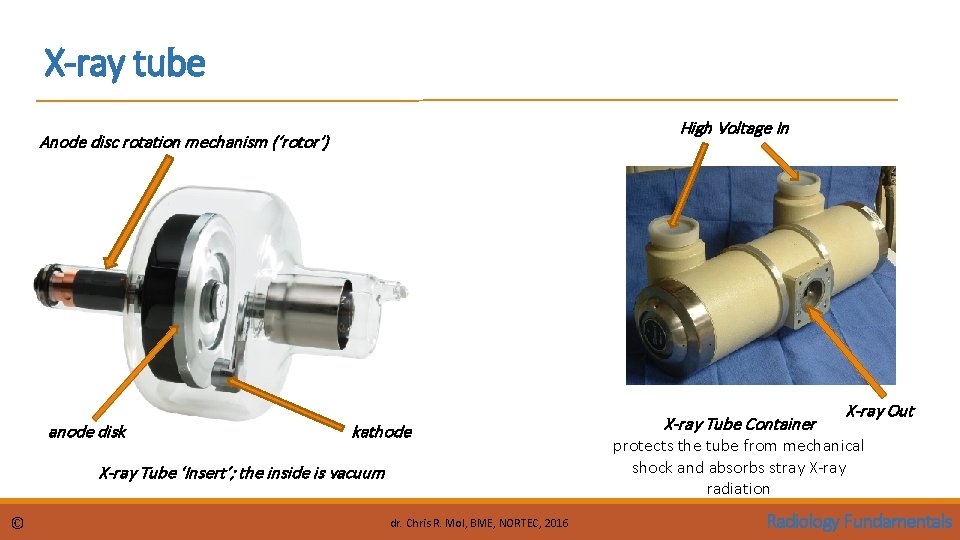
X-ray tube High Voltage In Anode disc rotation mechanism (‘rotor’) anode disk kathode X-ray Tube ‘Insert’; the inside is vacuum © dr. Chris R. Mol, BME, NORTEC, 2016 X-ray Tube Container X-ray Out protects the tube from mechanical shock and absorbs stray X-ray radiation Radiology Fundamentals
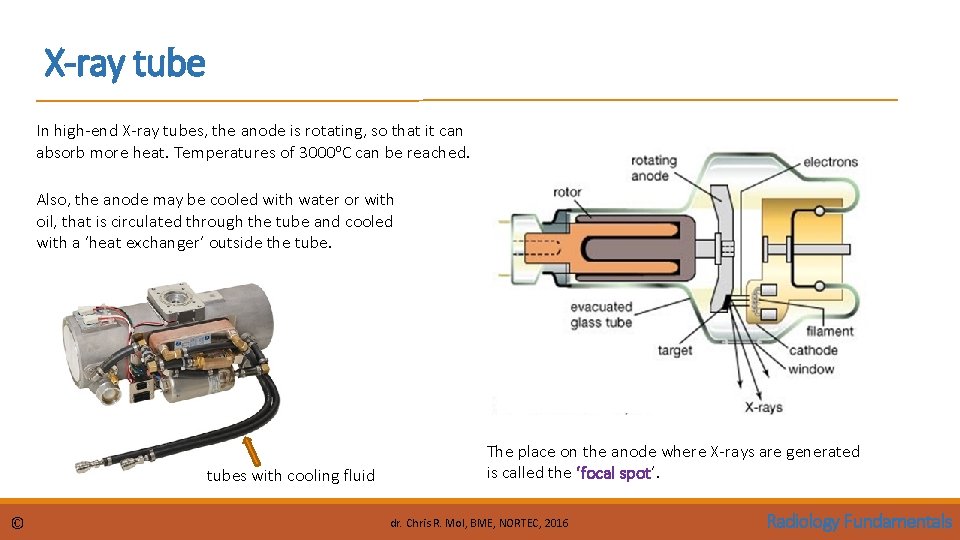
X-ray tube In high-end X-ray tubes, the anode is rotating, so that it can absorb more heat. Temperatures of 3000 o. C can be reached. Also, the anode may be cooled with water or with oil, that is circulated through the tube and cooled with a ‘heat exchanger’ outside the tubes with cooling fluid © The place on the anode where X-rays are generated is called the ‘focal spot’. dr. Chris R. Mol, BME, NORTEC, 2016 Radiology Fundamentals
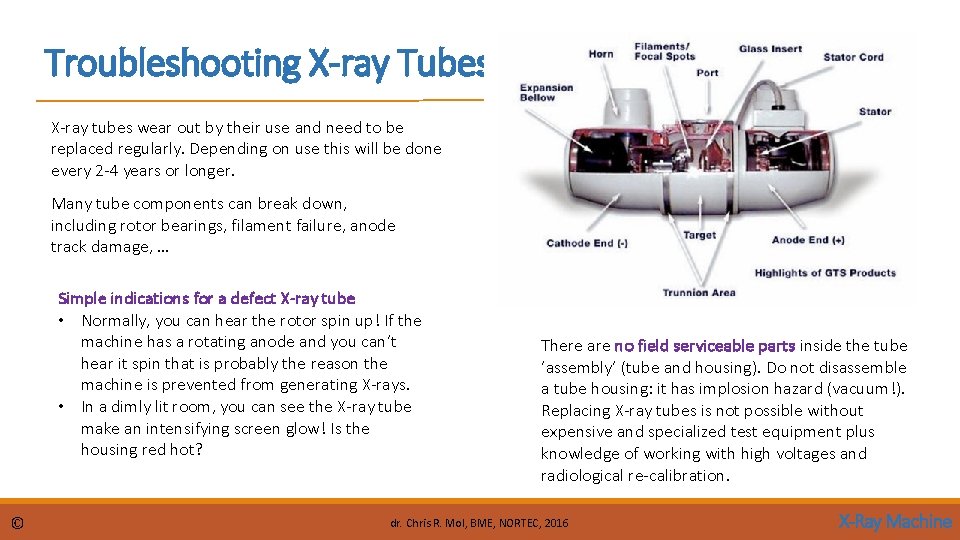
Troubleshooting X-ray Tubes X-ray tubes wear out by their use and need to be replaced regularly. Depending on use this will be done every 2 -4 years or longer. Many tube components can break down, including rotor bearings, filament failure, anode track damage, … Simple indications for a defect X-ray tube • Normally, you can hear the rotor spin up! If the machine has a rotating anode and you can’t hear it spin that is probably the reason the machine is prevented from generating X-rays. • In a dimly lit room, you can see the X-ray tube make an intensifying screen glow! Is the housing red hot? © There are no field serviceable parts inside the tube ‘assembly’ (tube and housing). Do not disassemble a tube housing: it has implosion hazard (vacuum!). Replacing X-ray tubes is not possible without expensive and specialized test equipment plus knowledge of working with high voltages and radiological re-calibration. dr. Chris R. Mol, BME, NORTEC, 2016 X-Ray Machine
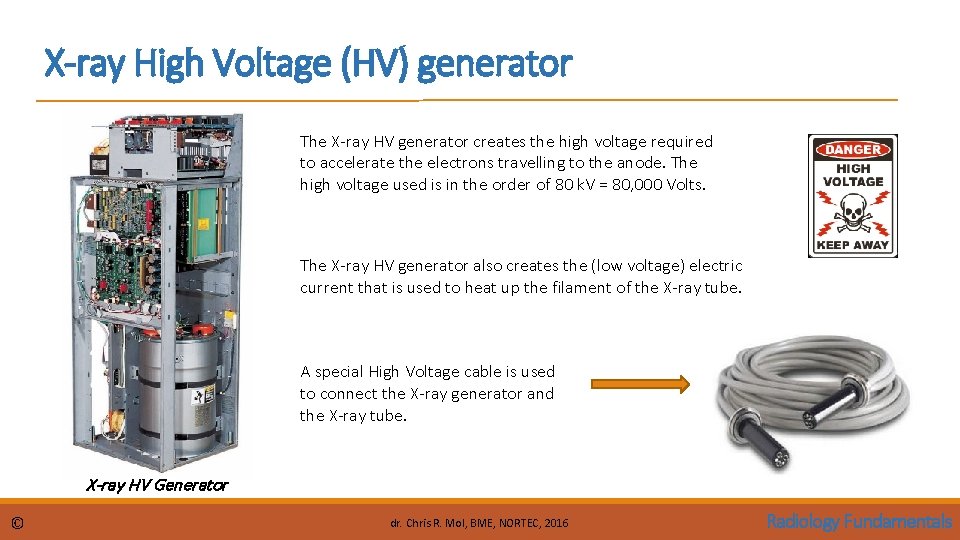
X-ray High Voltage (HV) generator The X-ray HV generator creates the high voltage required to accelerate the electrons travelling to the anode. The high voltage used is in the order of 80 k. V = 80, 000 Volts. The X-ray HV generator also creates the (low voltage) electric current that is used to heat up the filament of the X-ray tube. A special High Voltage cable is used to connect the X-ray generator and the X-ray tube. X-ray HV Generator © dr. Chris R. Mol, BME, NORTEC, 2016 Radiology Fundamentals
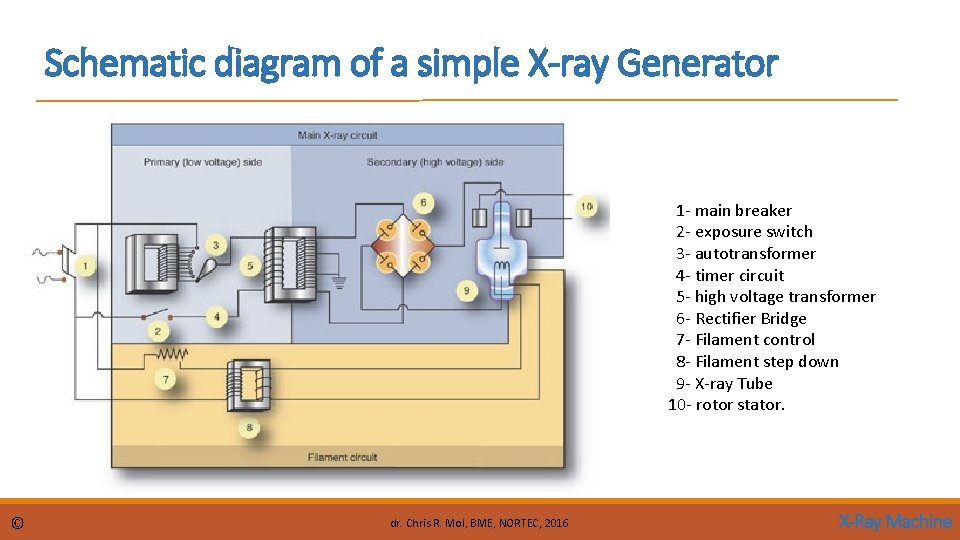
Schematic diagram of a simple X-ray Generator 1 - main breaker 2 - exposure switch 3 - autotransformer 4 - timer circuit 5 - high voltage transformer 6 - Rectifier Bridge 7 - Filament control 8 - Filament step down 9 - X-ray Tube 10 - rotor stator. © dr. Chris R. Mol, BME, NORTEC, 2016 X-Ray Machine
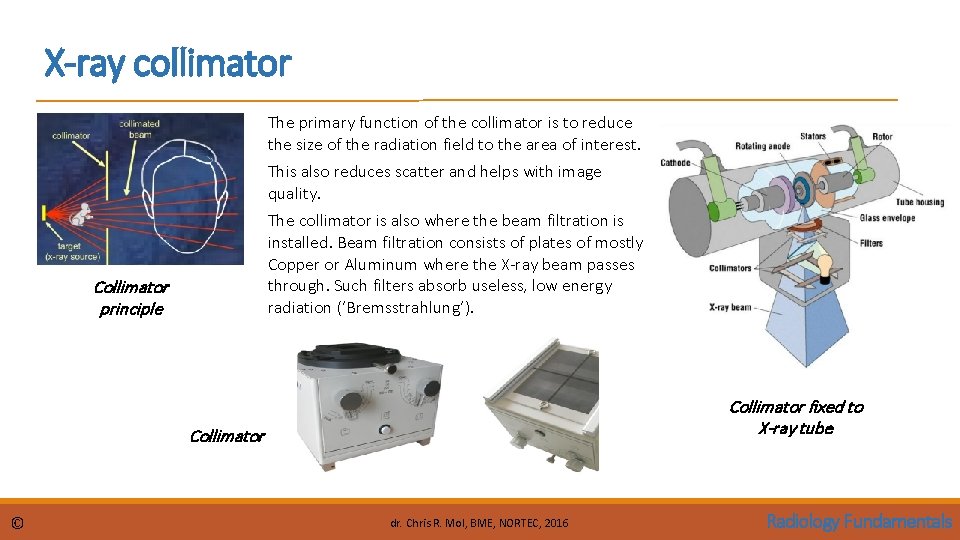
X-ray collimator The primary function of the collimator is to reduce the size of the radiation field to the area of interest. This also reduces scatter and helps with image quality. The collimator is also where the beam filtration is installed. Beam filtration consists of plates of mostly Copper or Aluminum where the X-ray beam passes through. Such filters absorb useless, low energy radiation (‘Bremsstrahlung’). Collimator principle Collimator fixed to X-ray tube Collimator © dr. Chris R. Mol, BME, NORTEC, 2016 Radiology Fundamentals
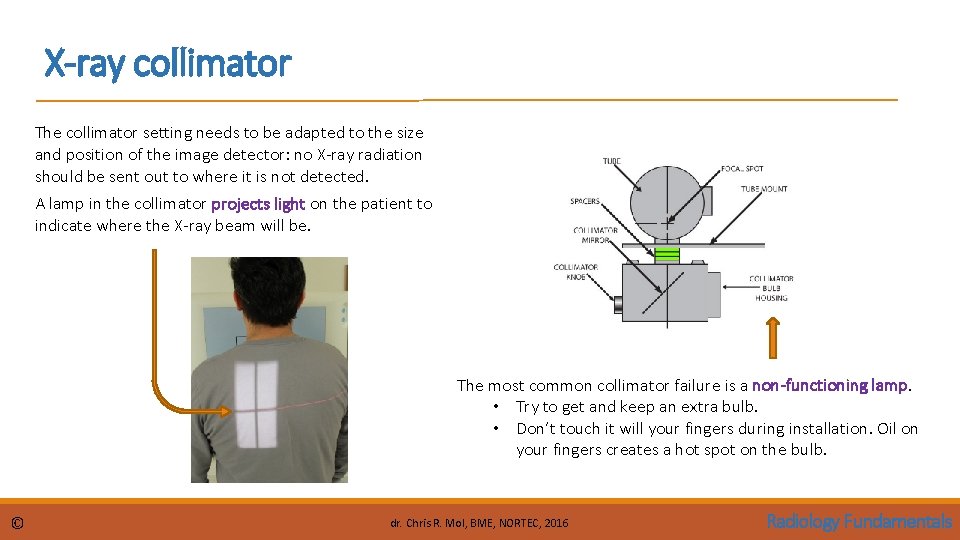
X-ray collimator The collimator setting needs to be adapted to the size and position of the image detector: no X-ray radiation should be sent out to where it is not detected. A lamp in the collimator projects light on the patient to indicate where the X-ray beam will be. The most common collimator failure is a non-functioning lamp. • Try to get and keep an extra bulb. • Don’t touch it will your fingers during installation. Oil on your fingers creates a hot spot on the bulb. © dr. Chris R. Mol, BME, NORTEC, 2016 Radiology Fundamentals
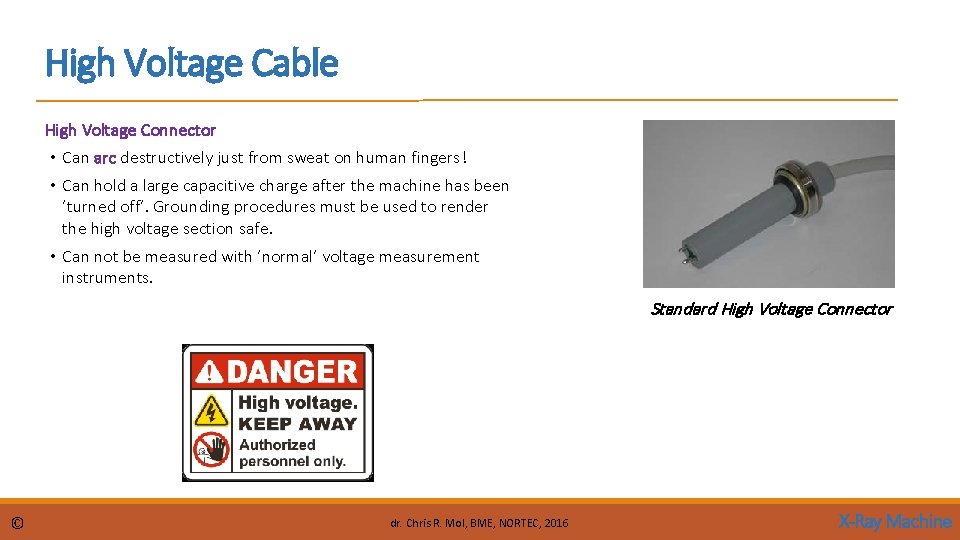
High Voltage Cable High Voltage Connector • Can arc destructively just from sweat on human fingers! • Can hold a large capacitive charge after the machine has been ‘turned off’. Grounding procedures must be used to render the high voltage section safe. • Can not be measured with ‘normal’ voltage measurement instruments. Standard High Voltage Connector © dr. Chris R. Mol, BME, NORTEC, 2016 X-Ray Machine
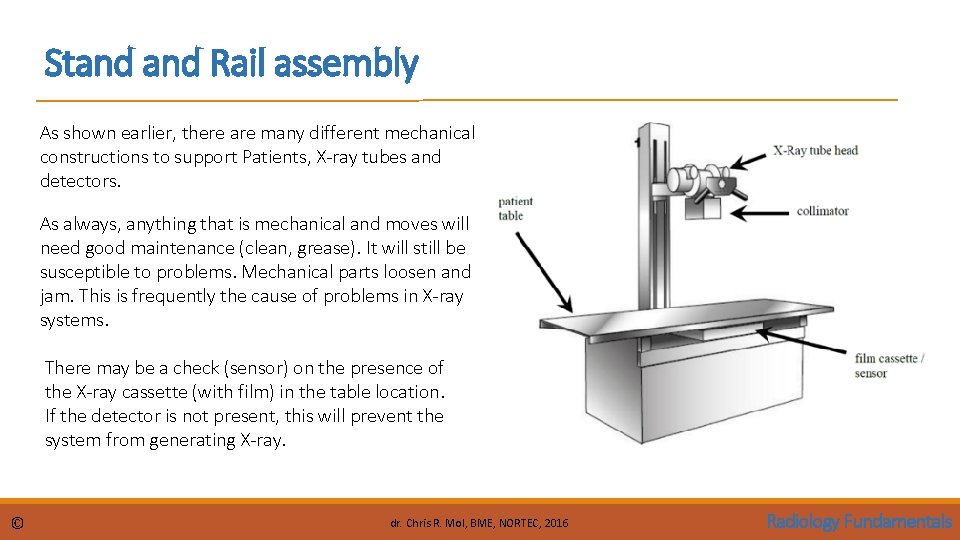
Stand Rail assembly As shown earlier, there are many different mechanical constructions to support Patients, X-ray tubes and detectors. As always, anything that is mechanical and moves will need good maintenance (clean, grease). It will still be susceptible to problems. Mechanical parts loosen and jam. This is frequently the cause of problems in X-ray systems. There may be a check (sensor) on the presence of the X-ray cassette (with film) in the table location. If the detector is not present, this will prevent the system from generating X-ray. © dr. Chris R. Mol, BME, NORTEC, 2016 Radiology Fundamentals
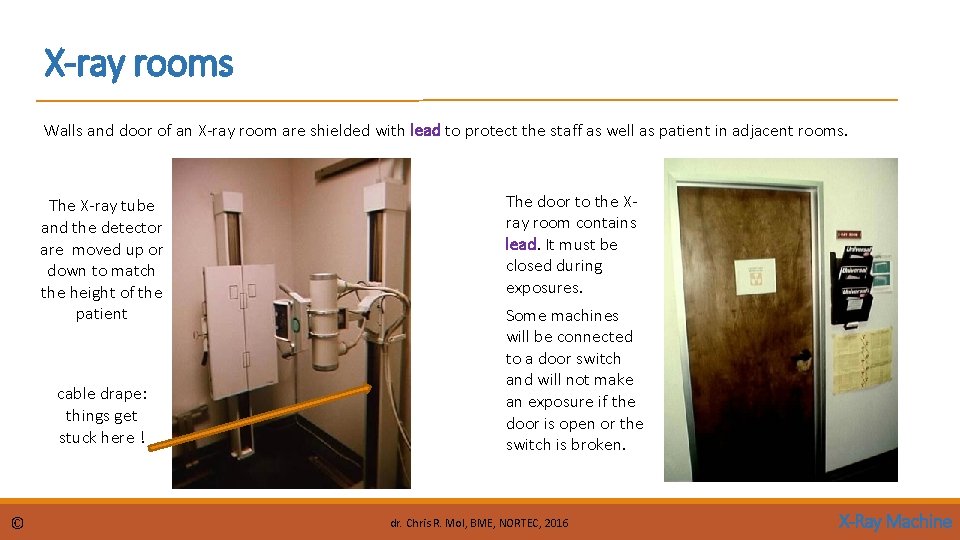
X-ray rooms Walls and door of an X-ray room are shielded with lead to protect the staff as well as patient in adjacent rooms. The X-ray tube and the detector are moved up or down to match the height of the patient cable drape: things get stuck here ! © The door to the Xray room contains lead. It must be closed during exposures. Some machines will be connected to a door switch and will not make an exposure if the door is open or the switch is broken. dr. Chris R. Mol, BME, NORTEC, 2016 X-Ray Machine
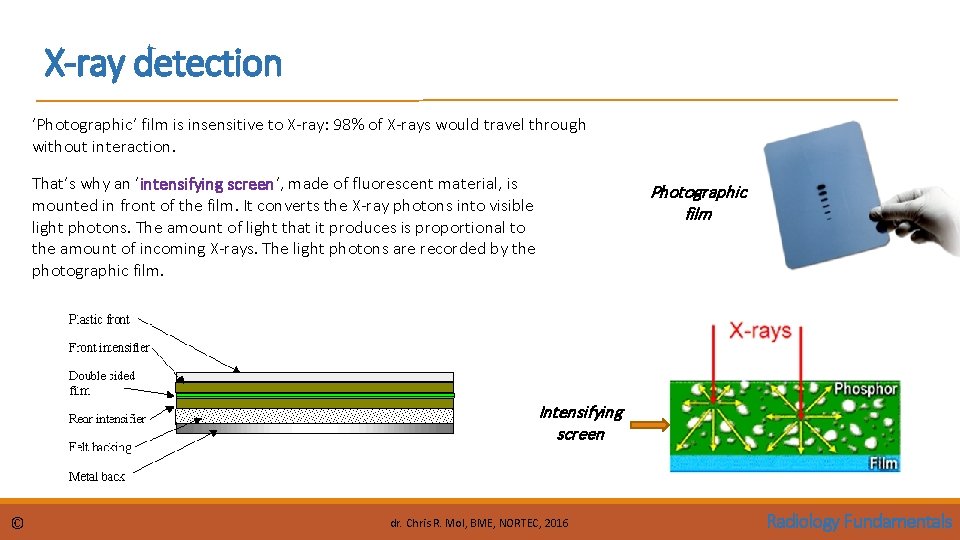
X-ray detection ‘Photographic’ film is insensitive to X-ray: 98% of X-rays would travel through without interaction. That’s why an ‘intensifying screen’, made of fluorescent material, is mounted in front of the film. It converts the X-ray photons into visible light photons. The amount of light that it produces is proportional to the amount of incoming X-rays. The light photons are recorded by the photographic film. Photographic film Intensifying screen © dr. Chris R. Mol, BME, NORTEC, 2016 Radiology Fundamentals
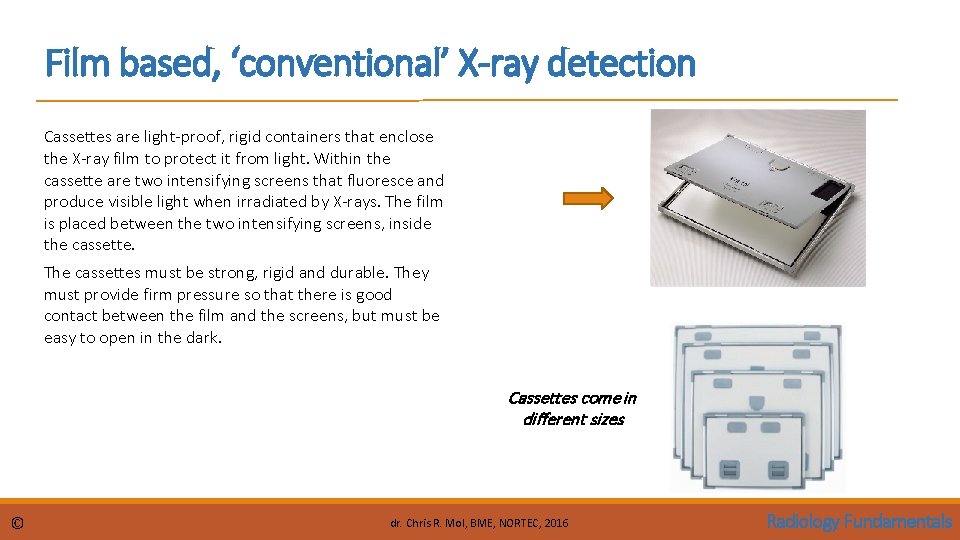
Film based, ‘conventional’ X-ray detection Cassettes are light-proof, rigid containers that enclose the X-ray film to protect it from light. Within the cassette are two intensifying screens that fluoresce and produce visible light when irradiated by X-rays. The film is placed between the two intensifying screens, inside the cassette. The cassettes must be strong, rigid and durable. They must provide firm pressure so that there is good contact between the film and the screens, but must be easy to open in the dark. Cassettes come in different sizes © dr. Chris R. Mol, BME, NORTEC, 2016 Radiology Fundamentals
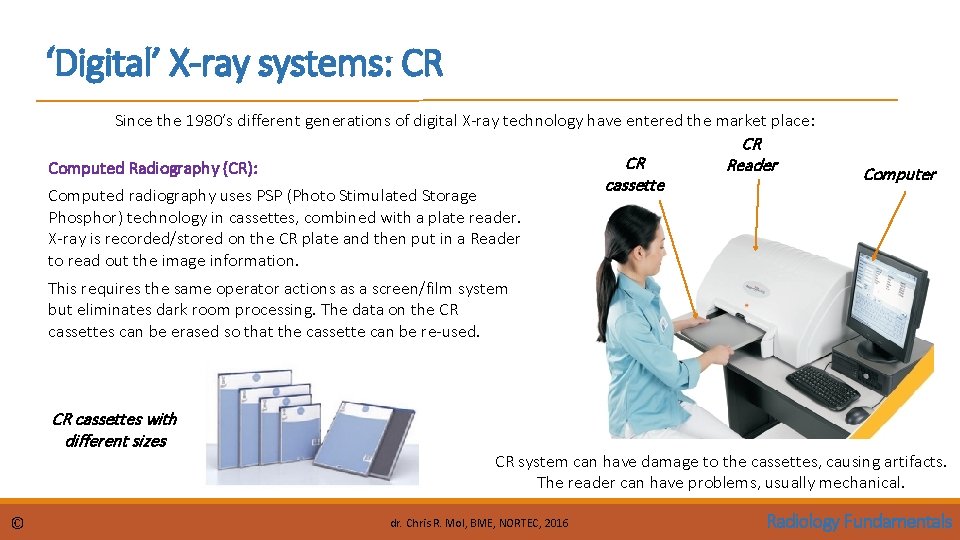
‘Digital’ X-ray systems: CR Since the 1980’s different generations of digital X-ray technology have entered the market place: Computed Radiography (CR): Computed radiography uses PSP (Photo Stimulated Storage Phosphor) technology in cassettes, combined with a plate reader. X-ray is recorded/stored on the CR plate and then put in a Reader to read out the image information. CR cassette CR Reader Computer This requires the same operator actions as a screen/film system but eliminates dark room processing. The data on the CR cassettes can be erased so that the cassette can be re-used. CR cassettes with different sizes © CR system can have damage to the cassettes, causing artifacts. The reader can have problems, usually mechanical. dr. Chris R. Mol, BME, NORTEC, 2016 Radiology Fundamentals
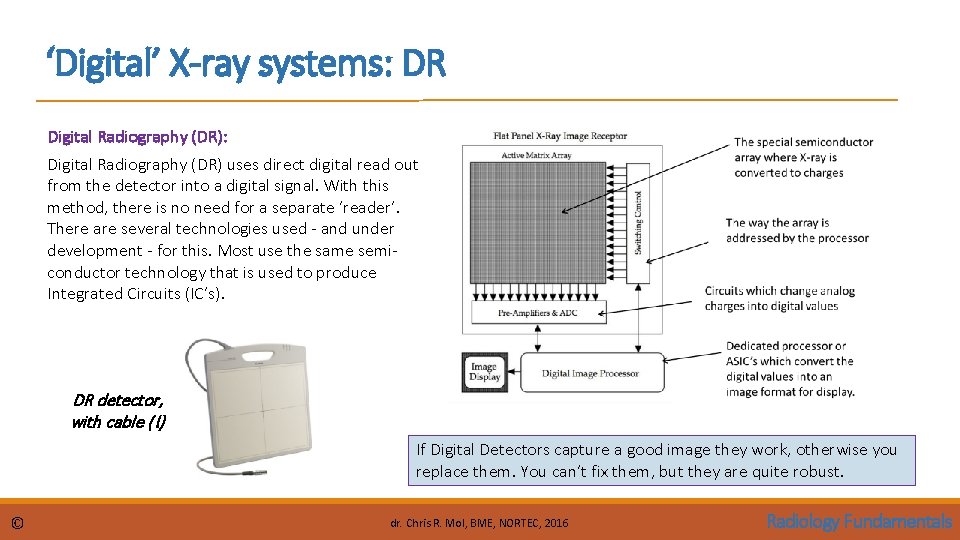
‘Digital’ X-ray systems: DR Digital Radiography (DR): Digital Radiography (DR) uses direct digital read out from the detector into a digital signal. With this method, there is no need for a separate ‘reader’. There are several technologies used - and under development - for this. Most use the same semiconductor technology that is used to produce Integrated Circuits (IC’s). DR detector, with cable (!) If Digital Detectors capture a good image they work, otherwise you replace them. You can’t fix them, but they are quite robust. © dr. Chris R. Mol, BME, NORTEC, 2016 Radiology Fundamentals
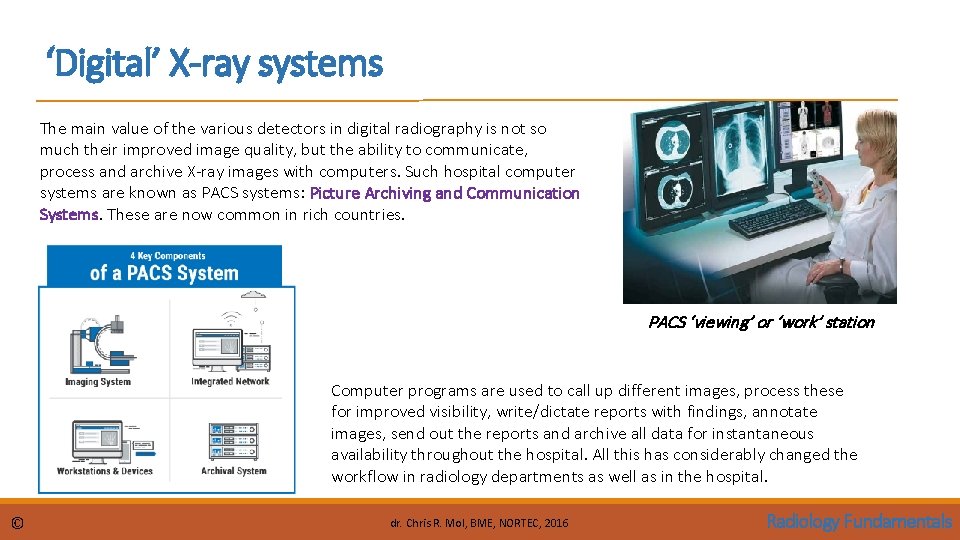
‘Digital’ X-ray systems The main value of the various detectors in digital radiography is not so much their improved image quality, but the ability to communicate, process and archive X-ray images with computers. Such hospital computer systems are known as PACS systems: Picture Archiving and Communication Systems. These are now common in rich countries. PACS ‘viewing’ or ‘work’ station Computer programs are used to call up different images, process these for improved visibility, write/dictate reports with findings, annotate images, send out the reports and archive all data for instantaneous availability throughout the hospital. All this has considerably changed the workflow in radiology departments as well as in the hospital. © dr. Chris R. Mol, BME, NORTEC, 2016 Radiology Fundamentals
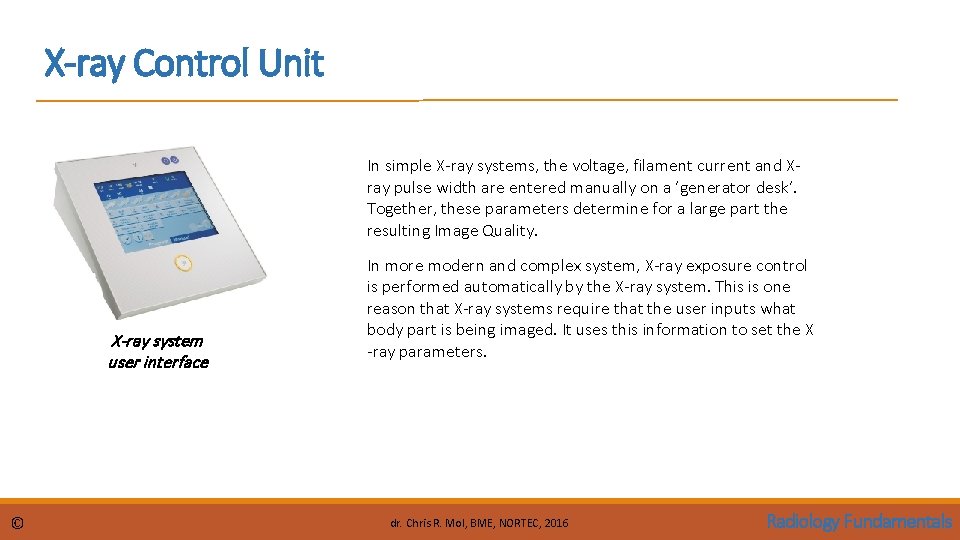
X-ray Control Unit In simple X-ray systems, the voltage, filament current and Xray pulse width are entered manually on a ‘generator desk’. Together, these parameters determine for a large part the resulting Image Quality. X-ray system user interface © In more modern and complex system, X-ray exposure control is performed automatically by the X-ray system. This is one reason that X-ray systems require that the user inputs what body part is being imaged. It uses this information to set the X -ray parameters. dr. Chris R. Mol, BME, NORTEC, 2016 Radiology Fundamentals
Troubleshooting Common complaints of X-ray systems consist of: • getting no exposure / image • getting poor quality images • mechanical failure of table/rail movement, knobs, buttons, equipment handles, motor drives, etc. Common causes are: • user error, such as wrong program (‘technique’) selection, no cassette placed, … • High Voltage transformer failure • X-ray control failure • collimator failure • Stand failure • …. . ‘No Exposure’ is often related to the Generator control. This unit contains a lot of safety circuits and interlocks that prohibit the generation of X-ray when something is deemed to be wrong. This may be caused by user error. Cable problems are common: cable drapes get caught. Power cables are stretched and broken. Cables are constantly flexed and will fail at strain reliefs. Cables running to the tube support are very susceptible due to the constant movement. © dr. Chris R. Mol, BME, NORTEC, 2016 X-Ray Machine
Troubleshooting When trouble shooting an X-ray system, it is not practically possible to start with a book of schematics. X-ray systems are too complex for that. First, you need to ‘narrow down’ the problem – based on your understanding of the system - to a specific sub-system. Then you need the service documentation to find the faulty component. Actual mechanical and electronic designs vary a a lot between different manufacturers. However, the sub-system functions are similar. © Rules for troubleshooting: • Know your machines intimately. • • Keep records! Gather all the information available about the fault. Reproduce the actual failure Isolate from system knowledge the sub-system you suspect. • Troubleshoot to the component level. Verify that the suspected component is bad. • Check the new component functions correctly. • Test the system and compare with the documentation on file. dr. Chris R. Mol, BME, NORTEC, 2016 X-Ray Machine
Troubleshooting © dr. Chris R. Mol, BME, NORTEC, 2016 X-Ray Machine
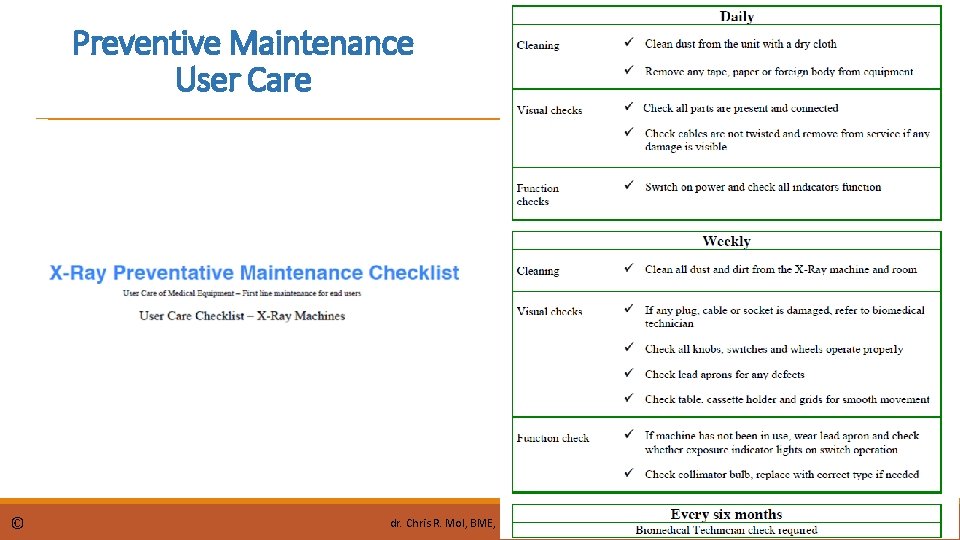
Preventive Maintenance An X-ray Room PM occurs at least once (or twice) a year. A full X-ray room PM will take several hours to two days to complete. Get the preventive maintenance instructions from the service manual. It should include activities on all the main system components as well as on Automatic Exposure Control and on Image Quality. Some Highlights: • vacuum dust and dirt out of equipment • check all wiring and connections • check all mechanical (table, tube stand) movements • check alignment of tube to receptors • check all lamps and indicators • check if various modes of operation are functional • check level of oil in transformer • • lubricate moving mechanical parts apply touch up paint to equipment scratches check Image Quality clean the floor and every equipment surface High Voltage work requires more training and special tools! © dr. Chris R. Mol, BME, NORTEC, 2016 X-Ray Machine
Preventive Maintenance User Care © dr. Chris R. Mol, BME, NORTEC, 2016 X-Ray Machine
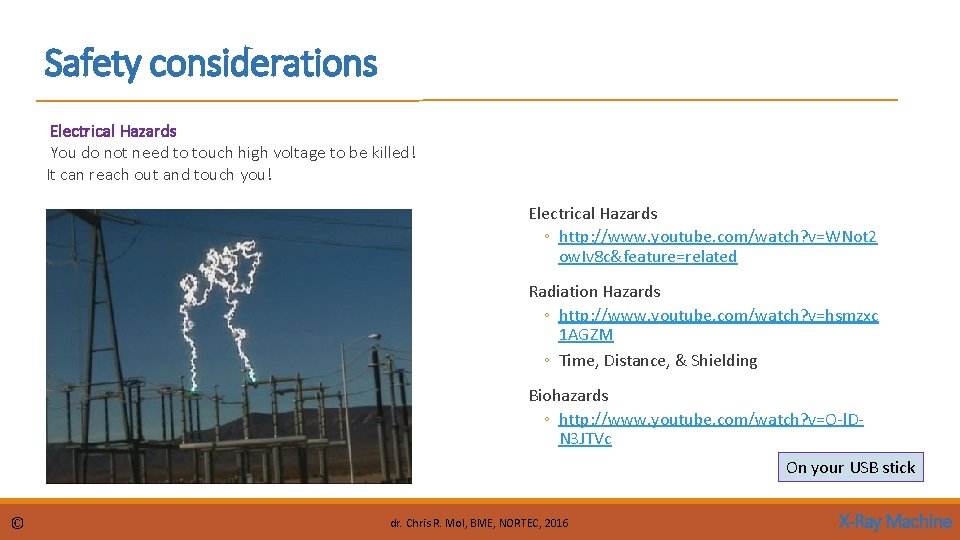
Safety considerations Electrical Hazards You do not need to touch high voltage to be killed! It can reach out and touch you! Electrical Hazards ◦ http: //www. youtube. com/watch? v=WNot 2 ow. Iv 8 c&feature=related Radiation Hazards ◦ http: //www. youtube. com/watch? v=hsmzxc 1 AGZM ◦ Time, Distance, & Shielding Biohazards ◦ http: //www. youtube. com/watch? v=O-l. DN 3 JTVc On your USB stick © dr. Chris R. Mol, BME, NORTEC, 2016 X-Ray Machine
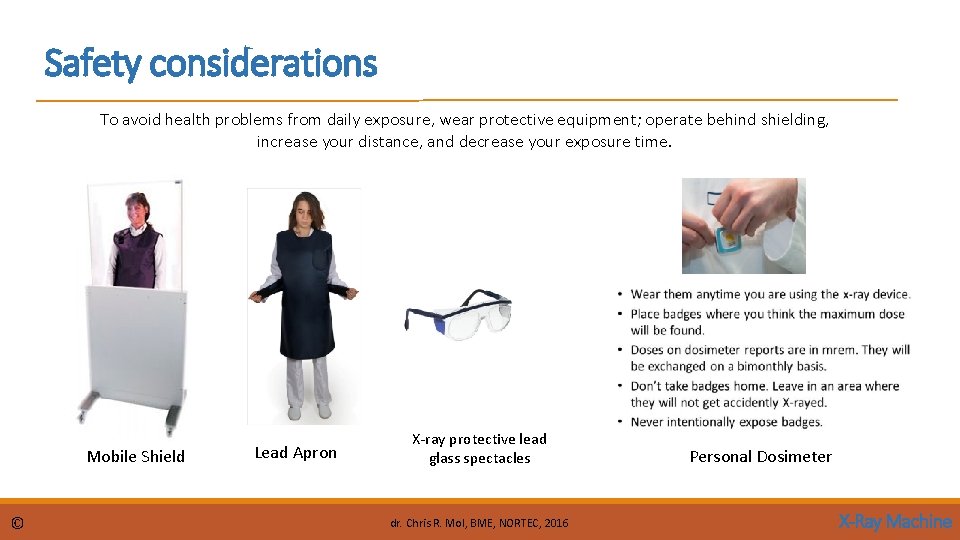
Safety considerations To avoid health problems from daily exposure, wear protective equipment; operate behind shielding, increase your distance, and decrease your exposure time. Mobile Shield © Lead Apron X-ray protective lead glass spectacles dr. Chris R. Mol, BME, NORTEC, 2016 Personal Dosimeter X-Ray Machine
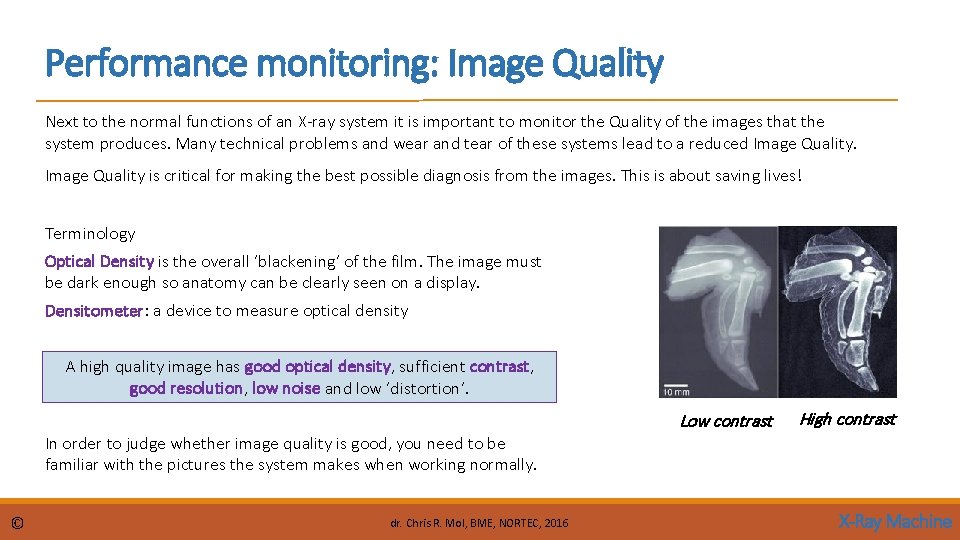
Performance monitoring: Image Quality Next to the normal functions of an X-ray system it is important to monitor the Quality of the images that the system produces. Many technical problems and wear and tear of these systems lead to a reduced Image Quality is critical for making the best possible diagnosis from the images. This is about saving lives! Terminology Optical Density is the overall ‘blackening’ of the film. The image must be dark enough so anatomy can be clearly seen on a display. Densitometer: a device to measure optical density A high quality image has good optical density, sufficient contrast, good resolution, low noise and low ‘distortion’. Low contrast High contrast In order to judge whether image quality is good, you need to be familiar with the pictures the system makes when working normally. © dr. Chris R. Mol, BME, NORTEC, 2016 X-Ray Machine
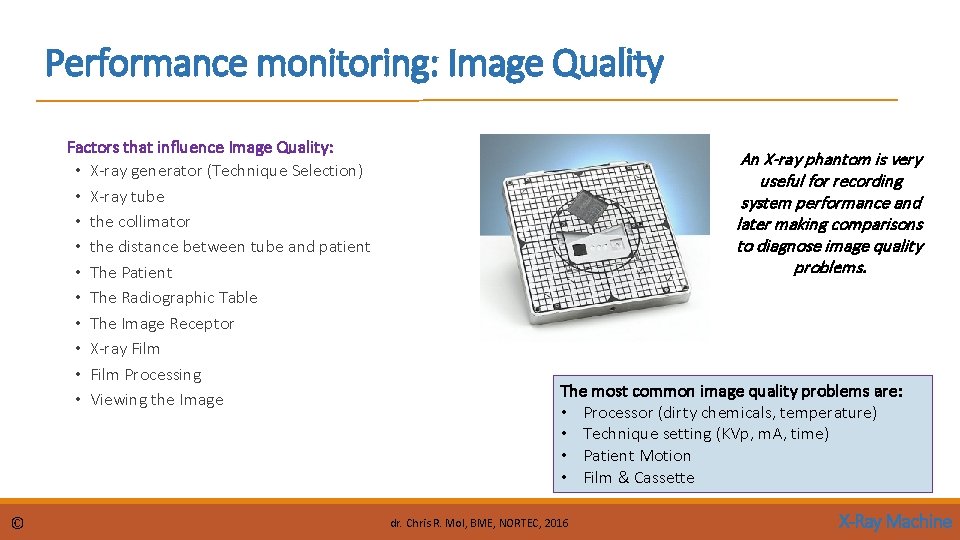
Performance monitoring: Image Quality Factors that influence Image Quality: • X-ray generator (Technique Selection) • X-ray tube • the collimator • the distance between tube and patient • The Patient • The Radiographic Table • The Image Receptor • X-ray Film • Film Processing • Viewing the Image © An X-ray phantom is very useful for recording system performance and later making comparisons to diagnose image quality problems. The most common image quality problems are: • Processor (dirty chemicals, temperature) • Technique setting (KVp, m. A, time) • Patient Motion • Film & Cassette dr. Chris R. Mol, BME, NORTEC, 2016 X-Ray Machine
END The creation of this presentation was supported by a grant from THET: see https: //www. thet. org/