
Maintain an Xray film processor manual and automatic

- Slides: 19
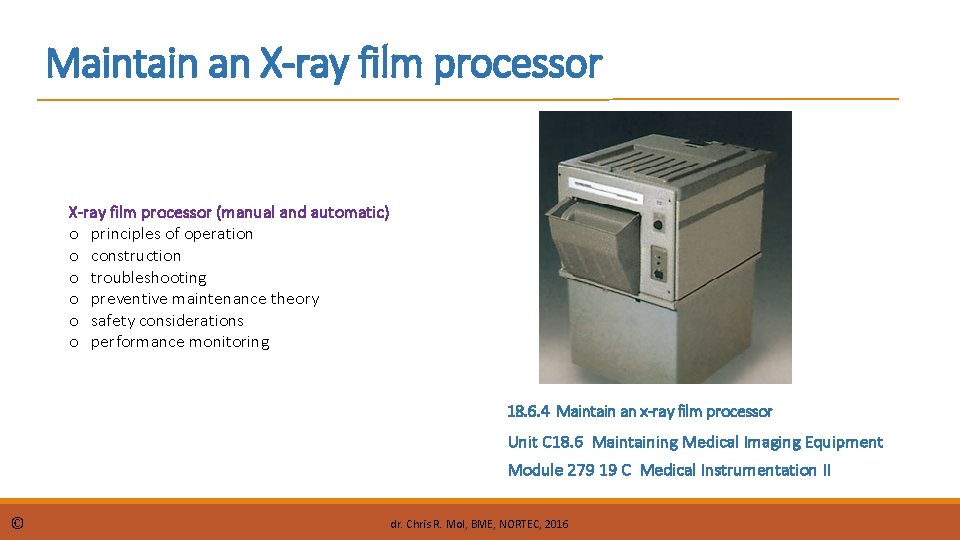
Maintain an X-ray film processor (manual and automatic) o principles of operation o construction o troubleshooting o preventive maintenance theory o safety considerations o performance monitoring 18. 6. 4 Maintain an x-ray film processor Unit C 18. 6 Maintaining Medical Imaging Equipment Module 279 19 C Medical Instrumentation II © dr. Chris R. Mol, BME, NORTEC, 2016
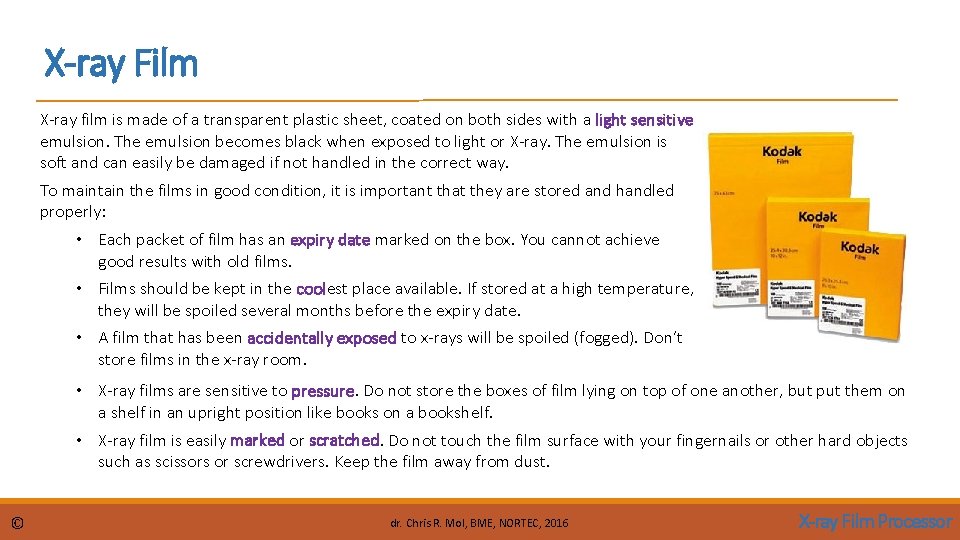
X-ray Film X-ray film is made of a transparent plastic sheet, coated on both sides with a light sensitive emulsion. The emulsion becomes black when exposed to light or X-ray. The emulsion is soft and can easily be damaged if not handled in the correct way. To maintain the films in good condition, it is important that they are stored and handled properly: • Each packet of film has an expiry date marked on the box. You cannot achieve good results with old films. • Films should be kept in the coolest place available. If stored at a high temperature, they will be spoiled several months before the expiry date. • A film that has been accidentally exposed to x-rays will be spoiled (fogged). Don’t store films in the x-ray room. • X-ray films are sensitive to pressure. Do not store the boxes of film lying on top of one another, but put them on a shelf in an upright position like books on a bookshelf. • X-ray film is easily marked or scratched. Do not touch the film surface with your fingernails or other hard objects such as scissors or screwdrivers. Keep the film away from dust. © dr. Chris R. Mol, BME, NORTEC, 2016 X-ray Film Processor
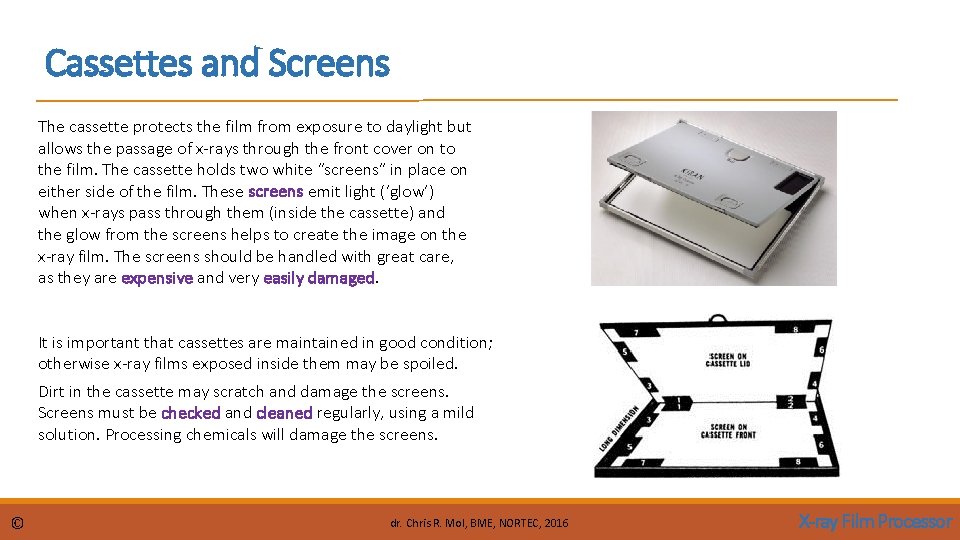
Cassettes and Screens The cassette protects the film from exposure to daylight but allows the passage of x-rays through the front cover on to the film. The cassette holds two white “screens” in place on either side of the film. These screens emit light (‘glow’) when x-rays pass through them (inside the cassette) and the glow from the screens helps to create the image on the x-ray film. The screens should be handled with great care, as they are expensive and very easily damaged. It is important that cassettes are maintained in good condition; otherwise x-ray films exposed inside them may be spoiled. Dirt in the cassette may scratch and damage the screens. Screens must be checked and cleaned regularly, using a mild solution. Processing chemicals will damage the screens. © dr. Chris R. Mol, BME, NORTEC, 2016 X-ray Film Processor
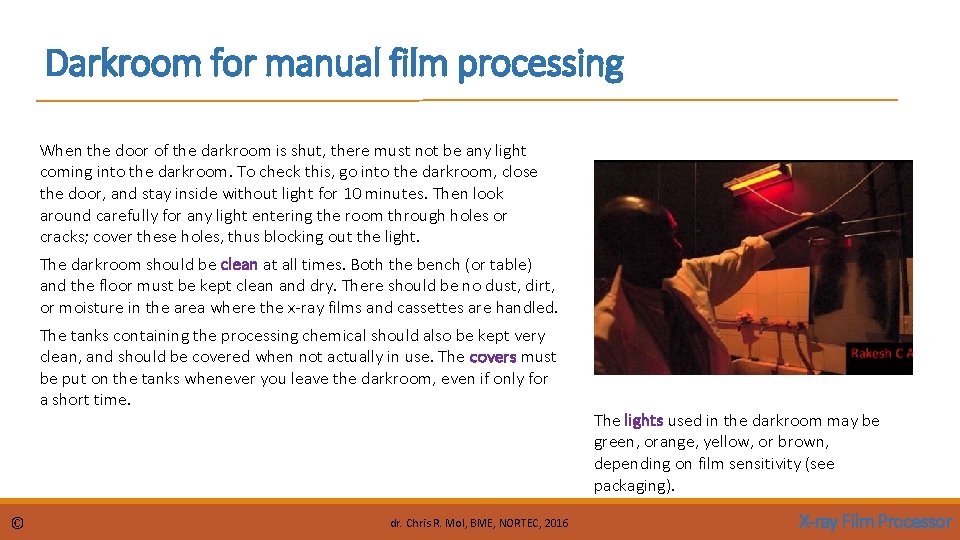
Darkroom for manual film processing When the door of the darkroom is shut, there must not be any light coming into the darkroom. To check this, go into the darkroom, close the door, and stay inside without light for 10 minutes. Then look around carefully for any light entering the room through holes or cracks; cover these holes, thus blocking out the light. The darkroom should be clean at all times. Both the bench (or table) and the floor must be kept clean and dry. There should be no dust, dirt, or moisture in the area where the x-ray films and cassettes are handled. The tanks containing the processing chemical should also be kept very clean, and should be covered when not actually in use. The covers must be put on the tanks whenever you leave the darkroom, even if only for a short time. © dr. Chris R. Mol, BME, NORTEC, 2016 The lights used in the darkroom may be green, orange, yellow, or brown, depending on film sensitivity (see packaging). X-ray Film Processor
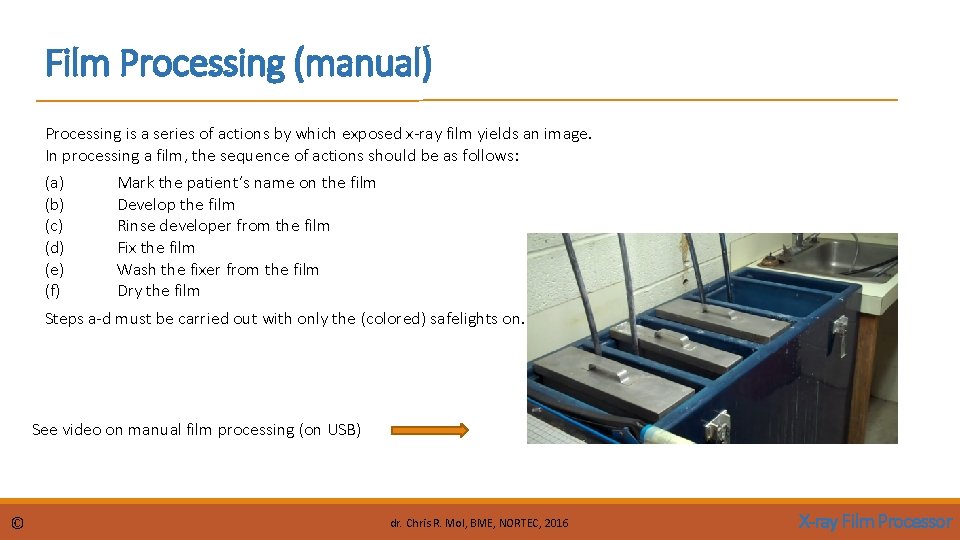
Film Processing (manual) Processing is a series of actions by which exposed x-ray film yields an image. In processing a film, the sequence of actions should be as follows: (a) (b) (c) (d) (e) (f) Mark the patient’s name on the film Develop the film Rinse developer from the film Fix the film Wash the fixer from the film Dry the film Steps a-d must be carried out with only the (colored) safelights on. See video on manual film processing (on USB) © dr. Chris R. Mol, BME, NORTEC, 2016 X-ray Film Processor
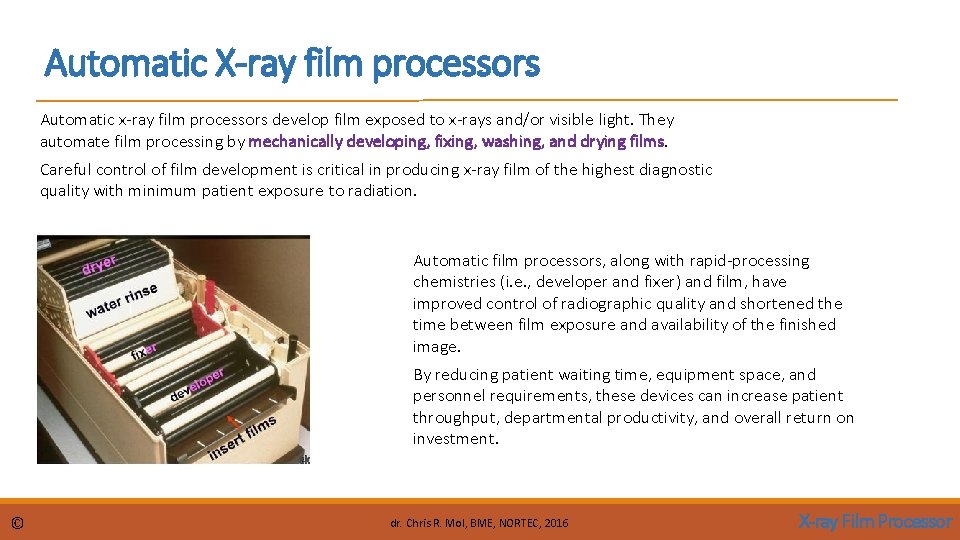
Automatic X-ray film processors Automatic x-ray film processors develop film exposed to x-rays and/or visible light. They automate film processing by mechanically developing, fixing, washing, and drying films. Careful control of film development is critical in producing x-ray film of the highest diagnostic quality with minimum patient exposure to radiation. Automatic film processors, along with rapid-processing chemistries (i. e. , developer and fixer) and film, have improved control of radiographic quality and shortened the time between film exposure and availability of the finished image. By reducing patient waiting time, equipment space, and personnel requirements, these devices can increase patient throughput, departmental productivity, and overall return on investment. © dr. Chris R. Mol, BME, NORTEC, 2016 X-ray Film Processor
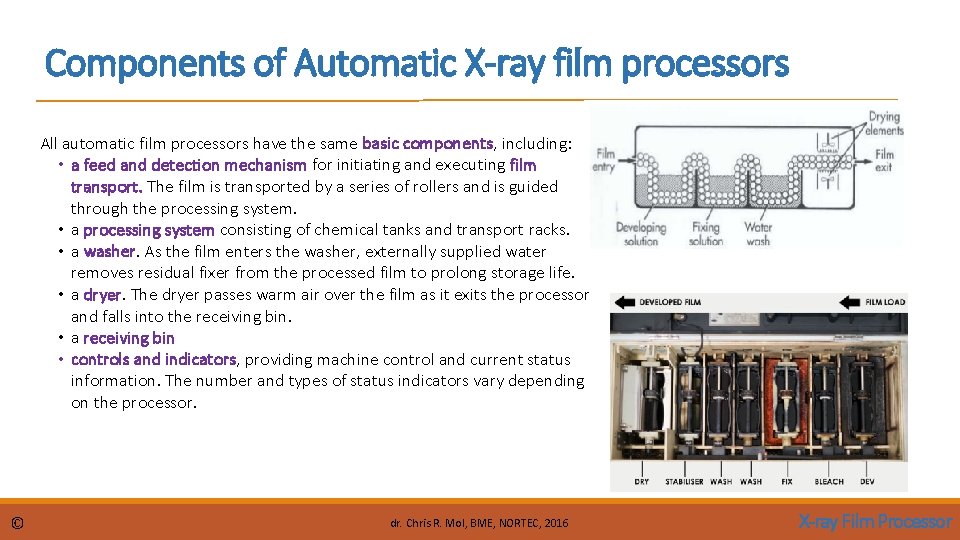
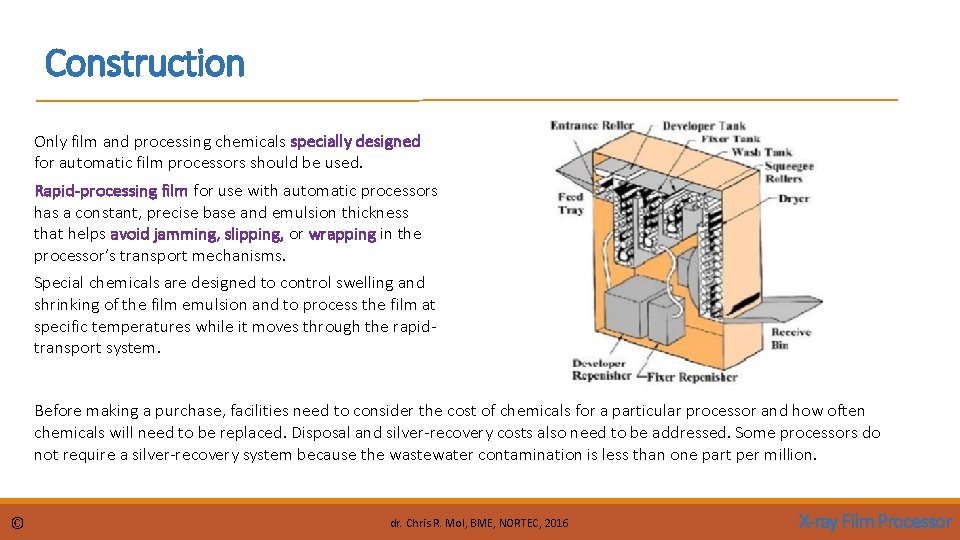
Components of Automatic X-ray film processors All automatic film processors have the same basic components, including: • a feed and detection mechanism for initiating and executing film transport. The film is transported by a series of rollers and is guided through the processing system. • a processing system consisting of chemical tanks and transport racks. • a washer. As the film enters the washer, externally supplied water removes residual fixer from the processed film to prolong storage life. • a dryer. The dryer passes warm air over the film as it exits the processor and falls into the receiving bin. • a receiving bin • controls and indicators, providing machine control and current status information. The number and types of status indicators vary depending on the processor. © dr. Chris R. Mol, BME, NORTEC, 2016 X-ray Film Processor
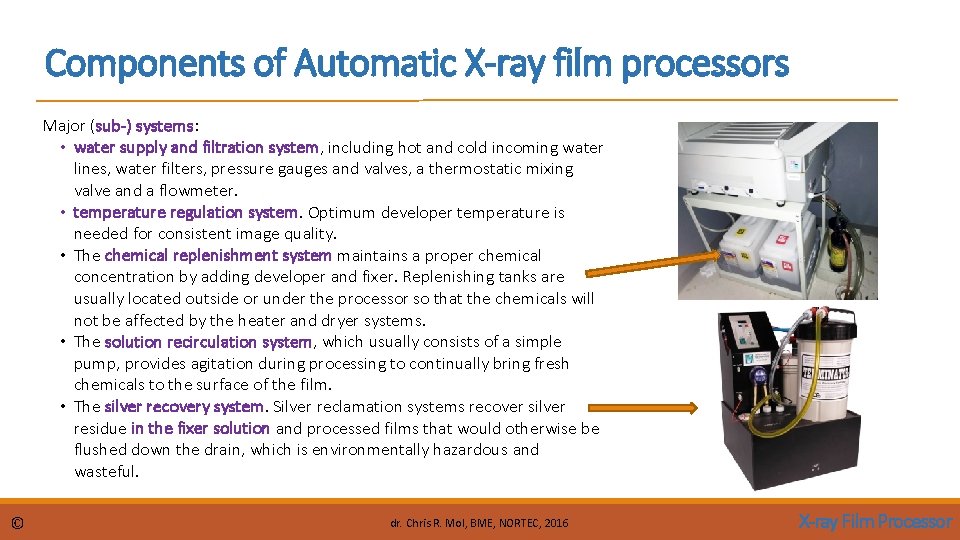
Components of Automatic X-ray film processors Major (sub-) systems: • water supply and filtration system, including hot and cold incoming water lines, water filters, pressure gauges and valves, a thermostatic mixing valve and a flowmeter. • temperature regulation system. Optimum developer temperature is needed for consistent image quality. • The chemical replenishment system maintains a proper chemical concentration by adding developer and fixer. Replenishing tanks are usually located outside or under the processor so that the chemicals will not be affected by the heater and dryer systems. • The solution recirculation system, which usually consists of a simple pump, provides agitation during processing to continually bring fresh chemicals to the surface of the film. • The silver recovery system. Silver reclamation systems recover silver residue in the fixer solution and processed films that would otherwise be flushed down the drain, which is environmentally hazardous and wasteful. © dr. Chris R. Mol, BME, NORTEC, 2016 X-ray Film Processor
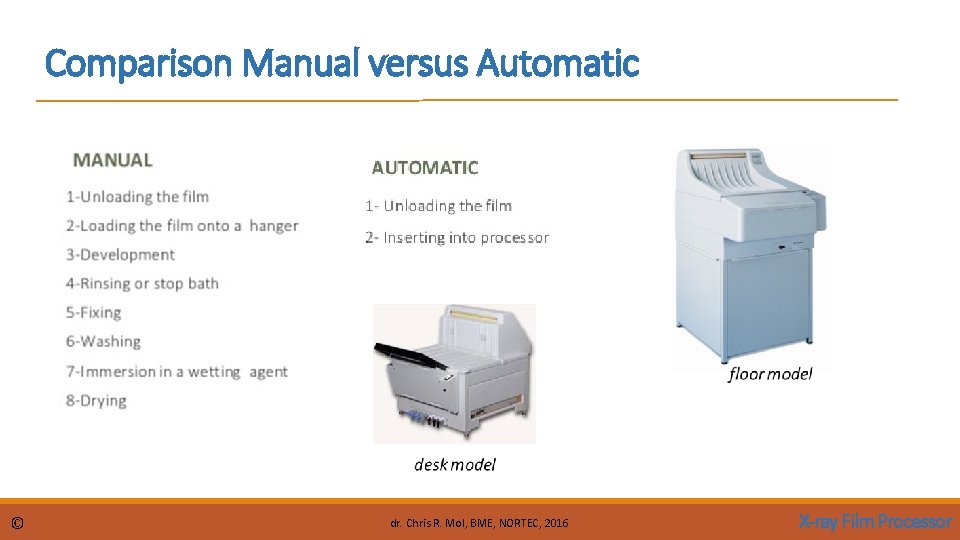
Comparison Manual versus Automatic © dr. Chris R. Mol, BME, NORTEC, 2016 X-ray Film Processor
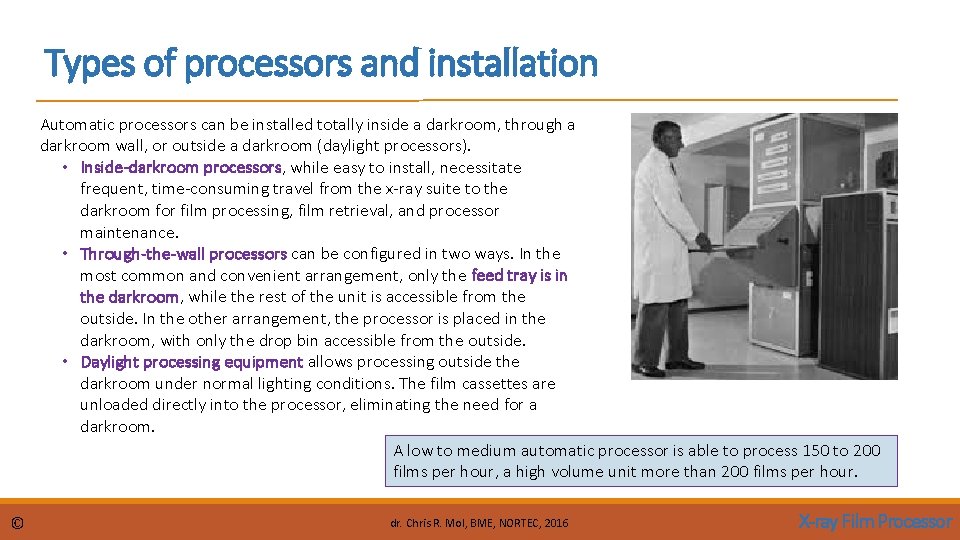
Types of processors and installation Automatic processors can be installed totally inside a darkroom, through a darkroom wall, or outside a darkroom (daylight processors). • Inside-darkroom processors, while easy to install, necessitate frequent, time-consuming travel from the x-ray suite to the darkroom for film processing, film retrieval, and processor maintenance. • Through-the-wall processors can be configured in two ways. In the most common and convenient arrangement, only the feed tray is in the darkroom, while the rest of the unit is accessible from the outside. In the other arrangement, the processor is placed in the darkroom, with only the drop bin accessible from the outside. • Daylight processing equipment allows processing outside the darkroom under normal lighting conditions. The film cassettes are unloaded directly into the processor, eliminating the need for a darkroom. A low to medium automatic processor is able to process 150 to 200 films per hour, a high volume unit more than 200 films per hour. © dr. Chris R. Mol, BME, NORTEC, 2016 X-ray Film Processor
Construction Only film and processing chemicals specially designed for automatic film processors should be used. Rapid-processing film for use with automatic processors has a constant, precise base and emulsion thickness that helps avoid jamming, slipping, or wrapping in the processor’s transport mechanisms. Special chemicals are designed to control swelling and shrinking of the film emulsion and to process the film at specific temperatures while it moves through the rapidtransport system. Before making a purchase, facilities need to consider the cost of chemicals for a particular processor and how often chemicals will need to be replaced. Disposal and silver-recovery costs also need to be addressed. Some processors do not require a silver-recovery system because the wastewater contamination is less than one part per million. © dr. Chris R. Mol, BME, NORTEC, 2016 X-ray Film Processor
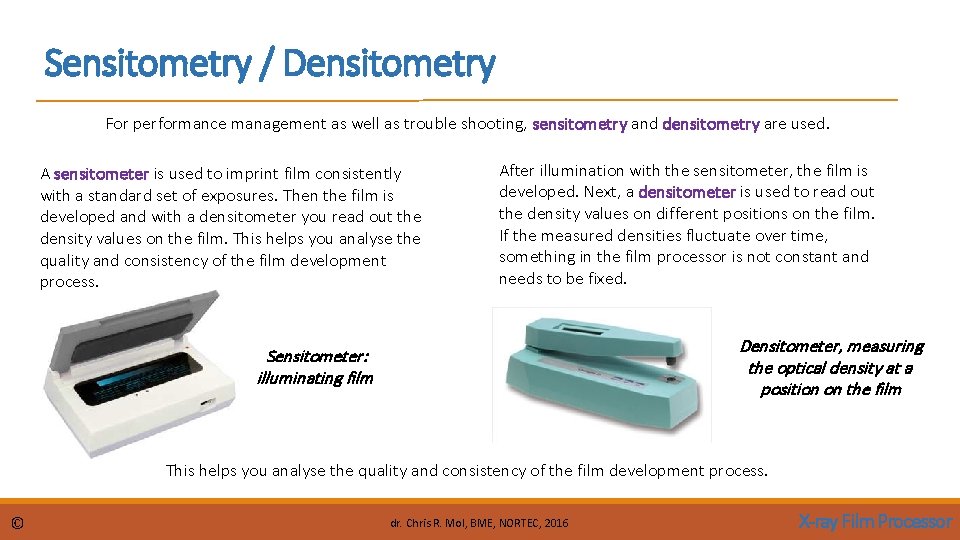
Sensitometry / Densitometry For performance management as well as trouble shooting, sensitometry and densitometry are used. A sensitometer is used to imprint film consistently with a standard set of exposures. Then the film is developed and with a densitometer you read out the density values on the film. This helps you analyse the quality and consistency of the film development process. After illumination with the sensitometer, the film is developed. Next, a densitometer is used to read out the density values on different positions on the film. If the measured densities fluctuate over time, something in the film processor is not constant and needs to be fixed. Densitometer, measuring the optical density at a position on the film Sensitometer: illuminating film This helps you analyse the quality and consistency of the film development process. © dr. Chris R. Mol, BME, NORTEC, 2016 X-ray Film Processor
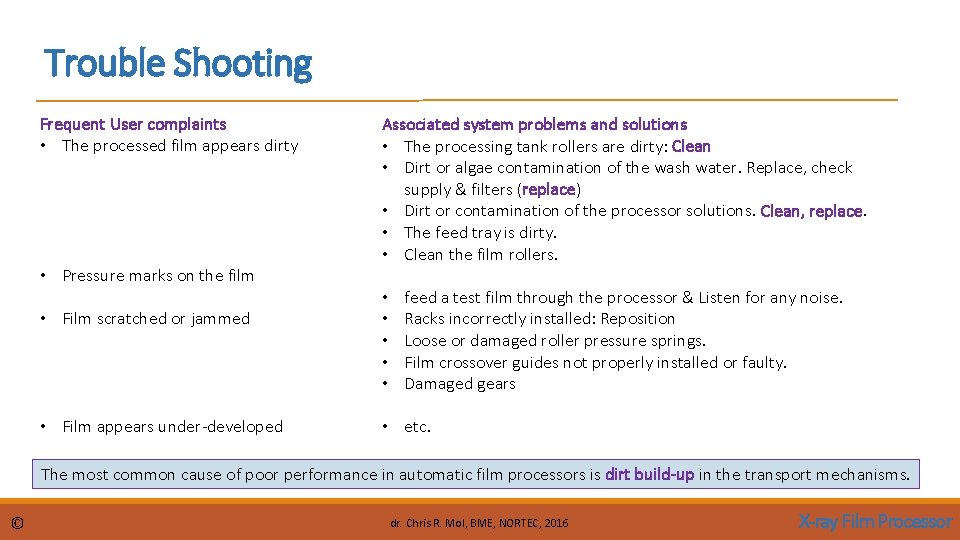
Trouble Shooting Frequent User complaints • The processed film appears dirty • Pressure marks on the film • Film scratched or jammed • Film appears under-developed Associated system problems and solutions • The processing tank rollers are dirty: Clean • Dirt or algae contamination of the wash water. Replace, check supply & filters (replace) • Dirt or contamination of the processor solutions. Clean, replace. • The feed tray is dirty. • Clean the film rollers. • • • feed a test film through the processor & Listen for any noise. Racks incorrectly installed: Reposition Loose or damaged roller pressure springs. Film crossover guides not properly installed or faulty. Damaged gears • etc. The most common cause of poor performance in automatic film processors is dirt build-up in the transport mechanisms. © dr. Chris R. Mol, BME, NORTEC, 2016 X-ray Film Processor
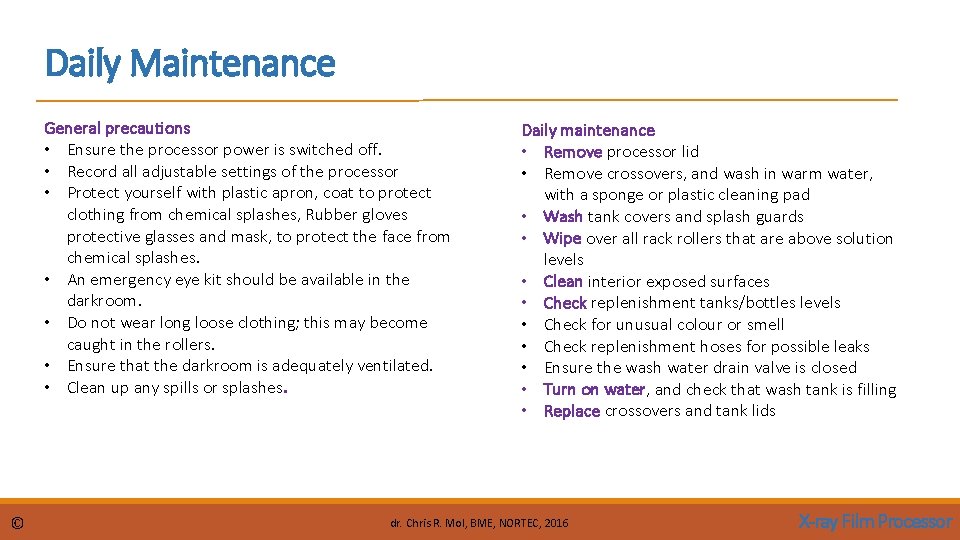
Daily Maintenance General precautions • Ensure the processor power is switched off. • Record all adjustable settings of the processor • Protect yourself with plastic apron, coat to protect clothing from chemical splashes, Rubber gloves protective glasses and mask, to protect the face from chemical splashes. • An emergency eye kit should be available in the darkroom. • Do not wear long loose clothing; this may become caught in the rollers. • Ensure that the darkroom is adequately ventilated. • Clean up any spills or splashes. © Daily maintenance • Remove processor lid • Remove crossovers, and wash in warm water, with a sponge or plastic cleaning pad • Wash tank covers and splash guards • Wipe over all rack rollers that are above solution levels • Clean interior exposed surfaces • Check replenishment tanks/bottles levels • Check for unusual colour or smell • Check replenishment hoses for possible leaks • Ensure the wash water drain valve is closed • Turn on water, and check that wash tank is filling • Replace crossovers and tank lids dr. Chris R. Mol, BME, NORTEC, 2016 X-ray Film Processor
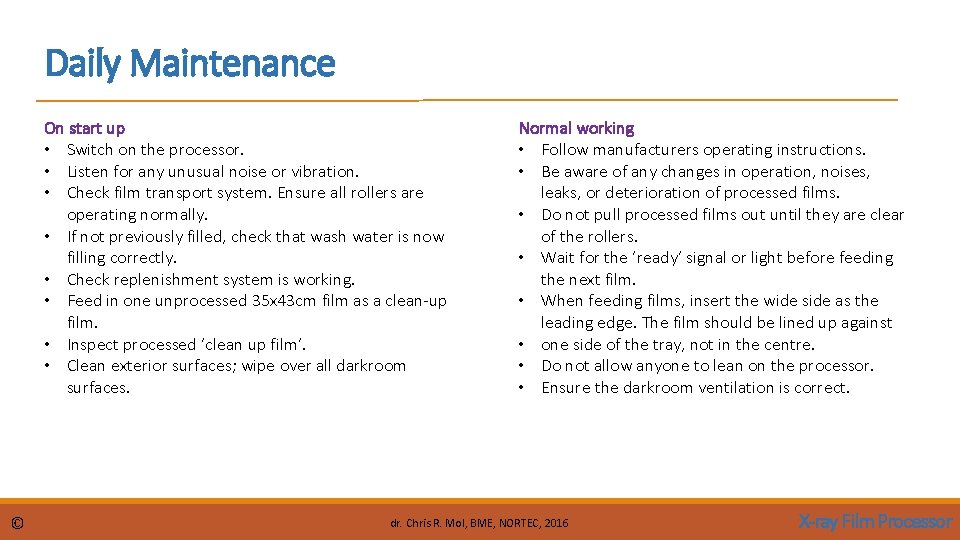
Daily Maintenance On start up • Switch on the processor. • Listen for any unusual noise or vibration. • Check film transport system. Ensure all rollers are operating normally. • If not previously filled, check that wash water is now filling correctly. • Check replenishment system is working. • Feed in one unprocessed 35 x 43 cm film as a clean-up film. • Inspect processed ‘clean up film’. • Clean exterior surfaces; wipe over all darkroom surfaces. © Normal working • Follow manufacturers operating instructions. • Be aware of any changes in operation, noises, leaks, or deterioration of processed films. • Do not pull processed films out until they are clear of the rollers. • Wait for the ‘ready’ signal or light before feeding the next film. • When feeding films, insert the wide side as the leading edge. The film should be lined up against • one side of the tray, not in the centre. • Do not allow anyone to lean on the processor. • Ensure the darkroom ventilation is correct. dr. Chris R. Mol, BME, NORTEC, 2016 X-ray Film Processor
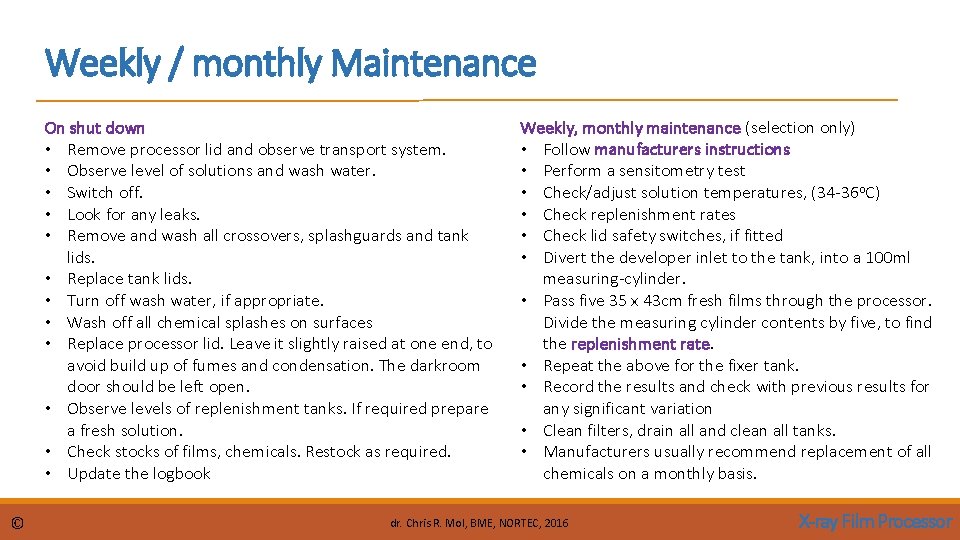
Weekly / monthly Maintenance On shut down • Remove processor lid and observe transport system. • Observe level of solutions and wash water. • Switch off. • Look for any leaks. • Remove and wash all crossovers, splashguards and tank lids. • Replace tank lids. • Turn off wash water, if appropriate. • Wash off all chemical splashes on surfaces • Replace processor lid. Leave it slightly raised at one end, to avoid build up of fumes and condensation. The darkroom door should be left open. • Observe levels of replenishment tanks. If required prepare a fresh solution. • Check stocks of films, chemicals. Restock as required. • Update the logbook © Weekly, monthly maintenance (selection only) • Follow manufacturers instructions • Perform a sensitometry test • Check/adjust solution temperatures, (34 -36 o. C) • Check replenishment rates • Check lid safety switches, if fitted • Divert the developer inlet to the tank, into a 100 ml measuring-cylinder. • Pass five 35 x 43 cm fresh films through the processor. Divide the measuring cylinder contents by five, to find the replenishment rate. • Repeat the above for the fixer tank. • Record the results and check with previous results for any significant variation • Clean filters, drain all and clean all tanks. • Manufacturers usually recommend replacement of all chemicals on a monthly basis. dr. Chris R. Mol, BME, NORTEC, 2016 X-ray Film Processor
Safety In terms of patient care, a poor-quality radiograph may be more harmful than the patient not having an X-ray examination at all. Proper venting of automatic film processors is necessary to remove excessive heat and chemical fumes that can cause both acute and chronic respiratory illness. © dr. Chris R. Mol, BME, NORTEC, 2016 X-ray Film Processor
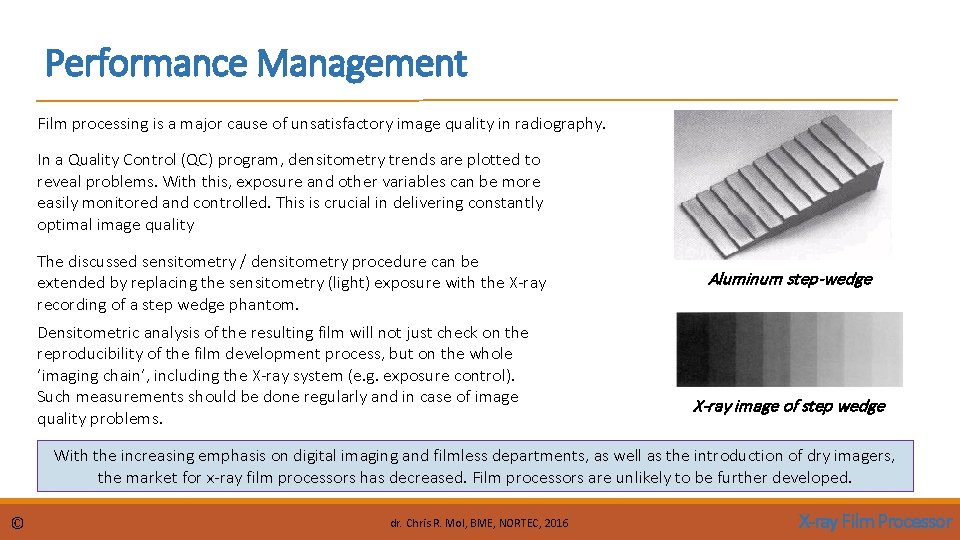
Performance Management Film processing is a major cause of unsatisfactory image quality in radiography. In a Quality Control (QC) program, densitometry trends are plotted to reveal problems. With this, exposure and other variables can be more easily monitored and controlled. This is crucial in delivering constantly optimal image quality The discussed sensitometry / densitometry procedure can be extended by replacing the sensitometry (light) exposure with the X-ray recording of a step wedge phantom. Densitometric analysis of the resulting film will not just check on the reproducibility of the film development process, but on the whole ‘imaging chain’, including the X-ray system (e. g. exposure control). Such measurements should be done regularly and in case of image quality problems. Aluminum step-wedge X-ray image of step wedge With the increasing emphasis on digital imaging and filmless departments, as well as the introduction of dry imagers, the market for x-ray film processors has decreased. Film processors are unlikely to be further developed. © dr. Chris R. Mol, BME, NORTEC, 2016 X-ray Film Processor
END The creation of this presentation was supported by a grant from THET: see https: //www. thet. org/