
MAIN TOPICS v Conservation of Mass v Newtons
- Slides: 22
MAIN TOPICS v Conservation of Mass v Newton’s Second Law – The Linear Momentum Equations v The Moment-of-Momentum Equations v First Law of Thermodynamics – The Energy Equation v Second Law of Thermodynamics – Irreversible Flow 1
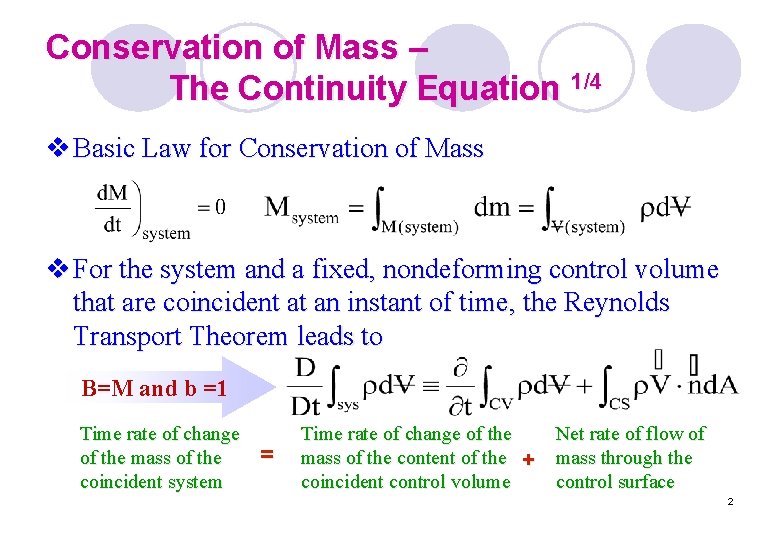
Conservation of Mass – The Continuity Equation 1/4 v Basic Law for Conservation of Mass v For the system and a fixed, nondeforming control volume that are coincident at an instant of time, the Reynolds Transport Theorem leads to B=M and b =1 Time rate of change of the mass of the coincident system = Time rate of change of the mass of the content of the coincident control volume + Net rate of flow of mass through the control surface 2
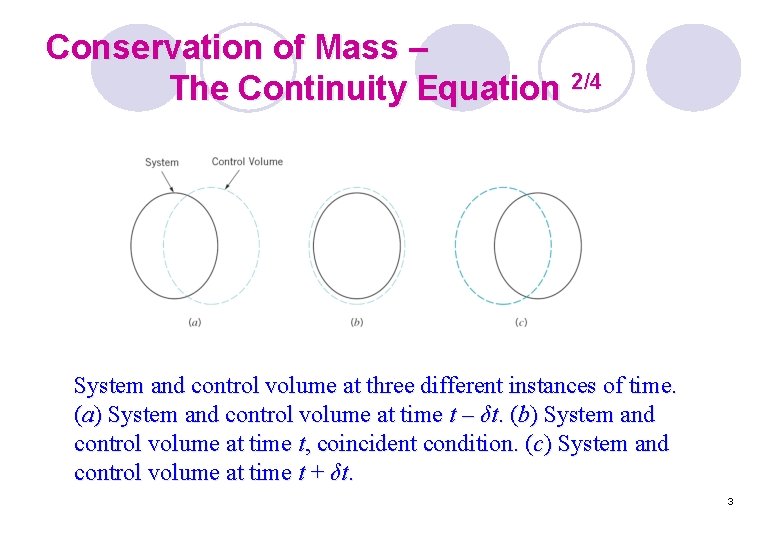
Conservation of Mass – The Continuity Equation 2/4 System and control volume at three different instances of time. (a) System and control volume at time t – δt. (b) System and control volume at time t, coincident condition. (c) System and control volume at time t + δt. 3
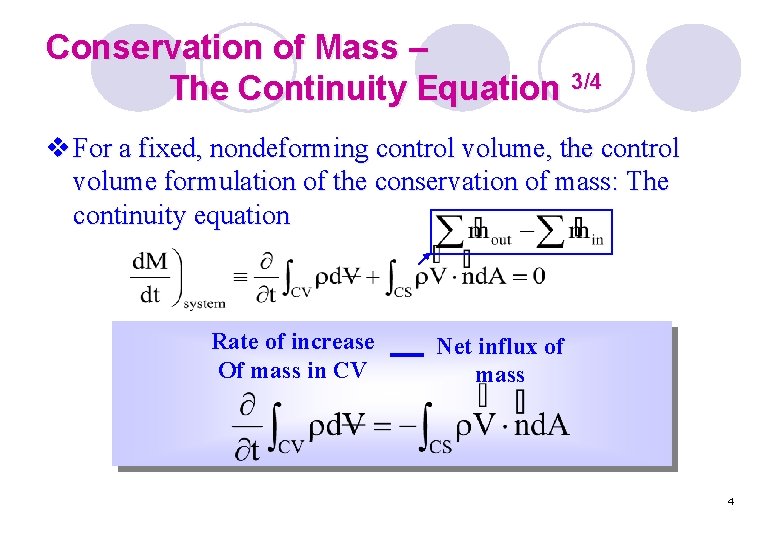
Conservation of Mass – The Continuity Equation 3/4 v For a fixed, nondeforming control volume, the control volume formulation of the conservation of mass: The continuity equation Rate of increase Of mass in CV Net influx of mass 4
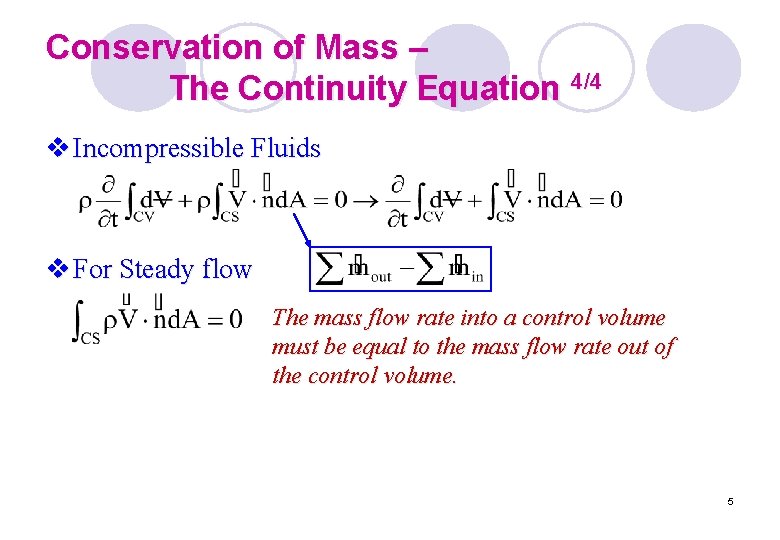
Conservation of Mass – The Continuity Equation 4/4 v Incompressible Fluids v For Steady flow The mass flow rate into a control volume must be equal to the mass flow rate out of the control volume. 5
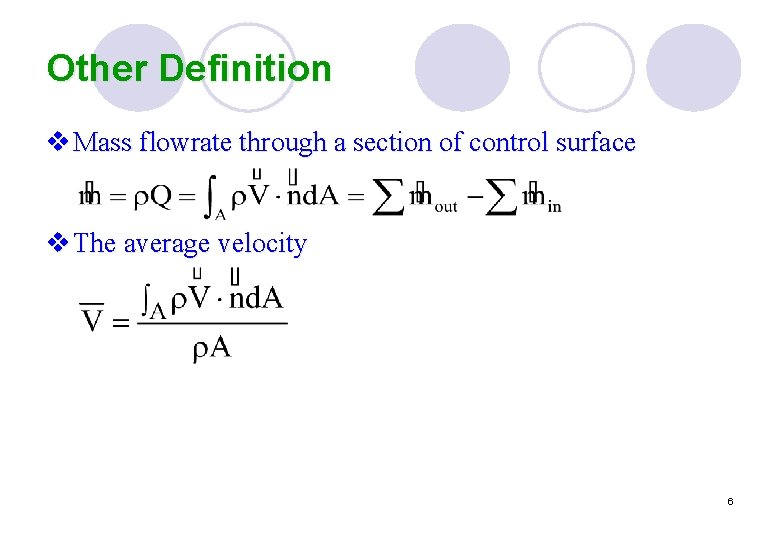
Other Definition v Mass flowrate through a section of control surface v The average velocity 6
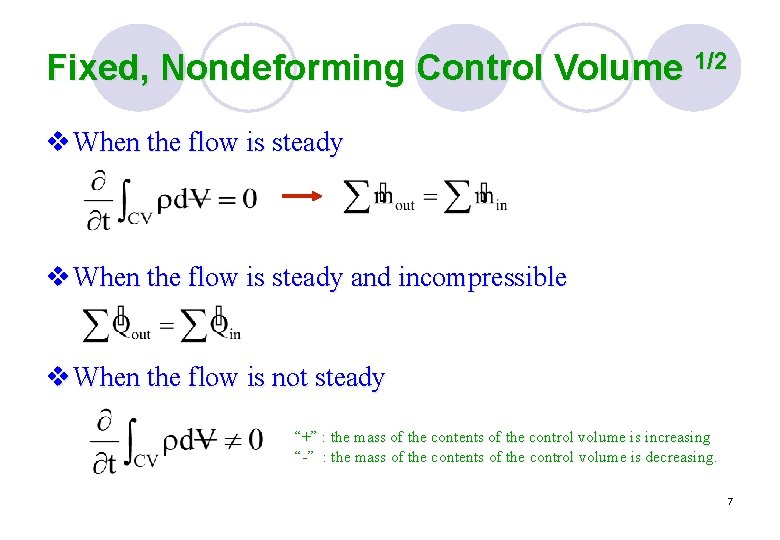
Fixed, Nondeforming Control Volume 1/2 v When the flow is steady and incompressible v When the flow is not steady “+” : the mass of the contents of the control volume is increasing “-” : the mass of the contents of the control volume is decreasing. 7
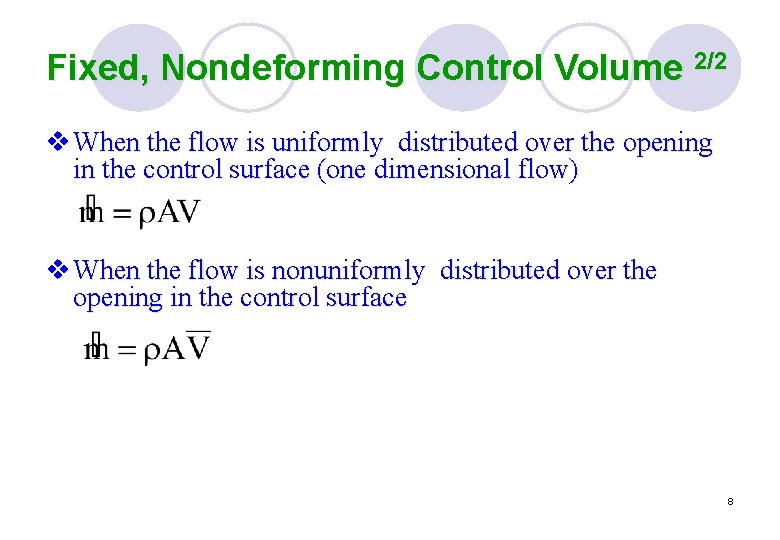
Fixed, Nondeforming Control Volume 2/2 v When the flow is uniformly distributed over the opening in the control surface (one dimensional flow) v When the flow is nonuniformly distributed over the opening in the control surface 8
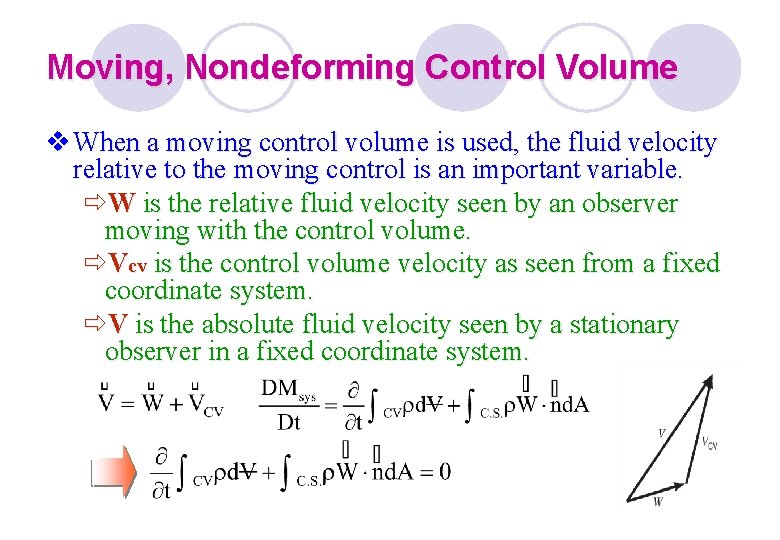
Moving, Nondeforming Control Volume v When a moving control volume is used, the fluid velocity relative to the moving control is an important variable. ðW is the relative fluid velocity seen by an observer moving with the control volume. ðVcv is the control volume velocity as seen from a fixed coordinate system. ðV is the absolute fluid velocity seen by a stationary observer in a fixed coordinate system. 9
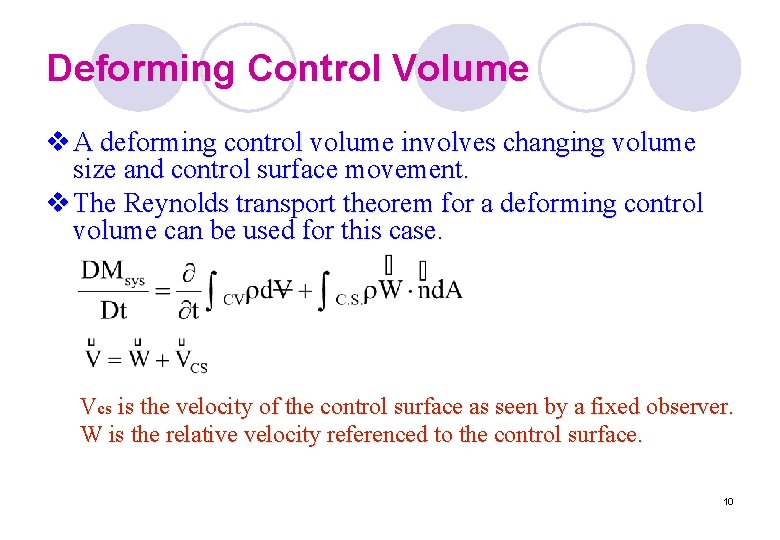
Deforming Control Volume v A deforming control volume involves changing volume size and control surface movement. v The Reynolds transport theorem for a deforming control volume can be used for this case. Vcs is the velocity of the control surface as seen by a fixed observer. W is the relative velocity referenced to the control surface. 10
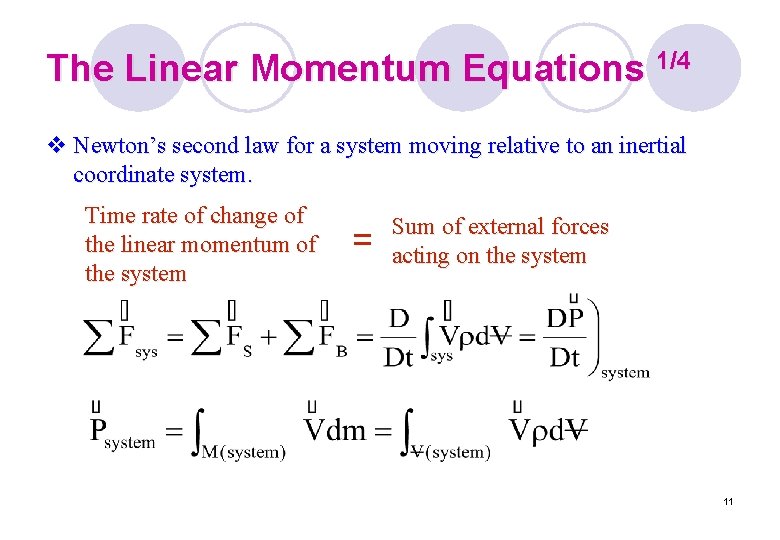
The Linear Momentum Equations 1/4 v Newton’s second law for a system moving relative to an inertial coordinate system. Time rate of change of the linear momentum of the system = Sum of external forces acting on the system 11
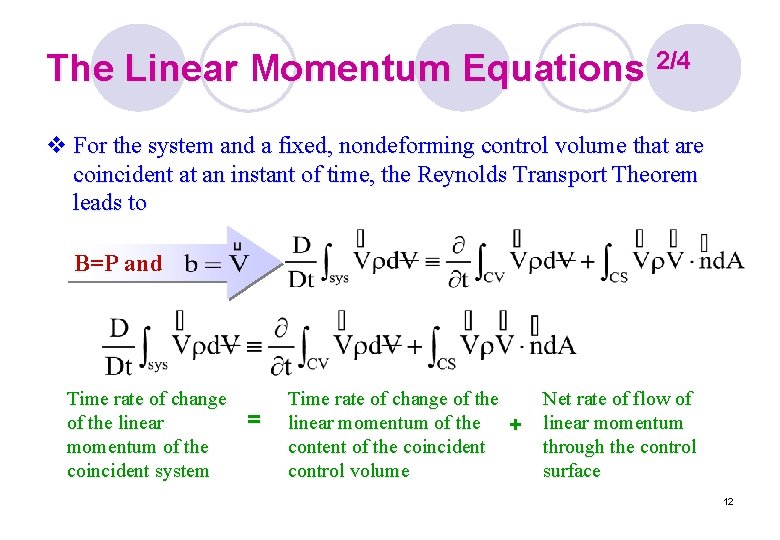
The Linear Momentum Equations 2/4 v For the system and a fixed, nondeforming control volume that are coincident at an instant of time, the Reynolds Transport Theorem leads to B=P and Time rate of change of the linear momentum of the coincident system = Time rate of change of the linear momentum of the content of the coincident control volume + Net rate of flow of linear momentum through the control surface 12
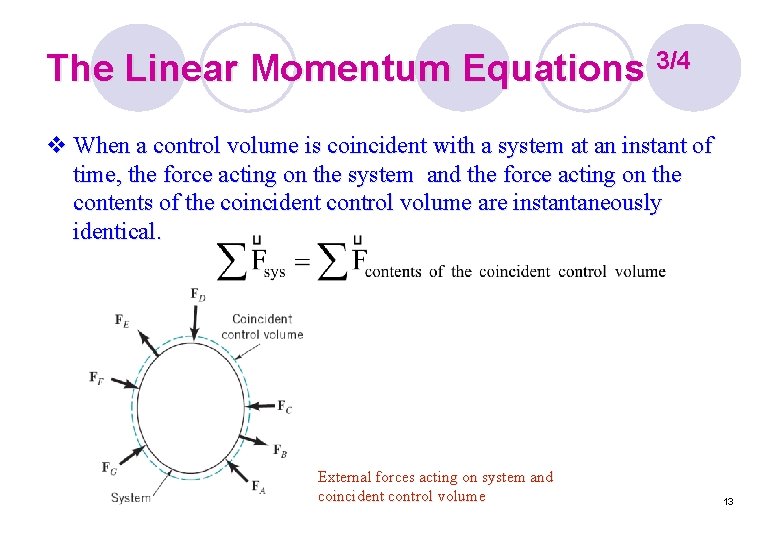
The Linear Momentum Equations 3/4 v When a control volume is coincident with a system at an instant of time, the force acting on the system and the force acting on the contents of the coincident control volume are instantaneously identical. External forces acting on system and coincident control volume 13
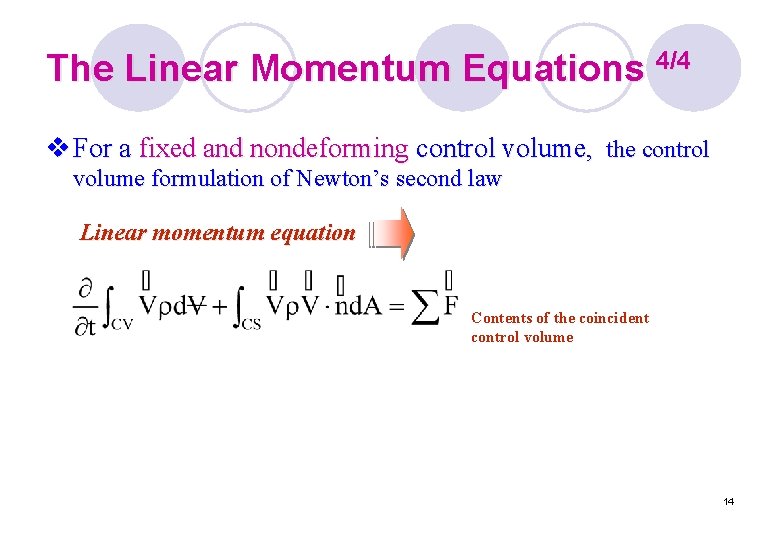
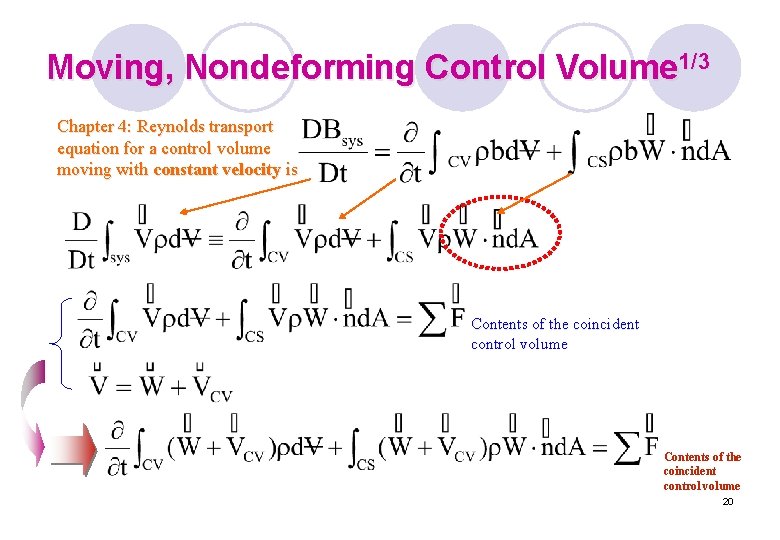
The Linear Momentum Equations 4/4 v For a fixed and nondeforming control volume, the control volume formulation of Newton’s second law Linear momentum equation Contents of the coincident control volume 14
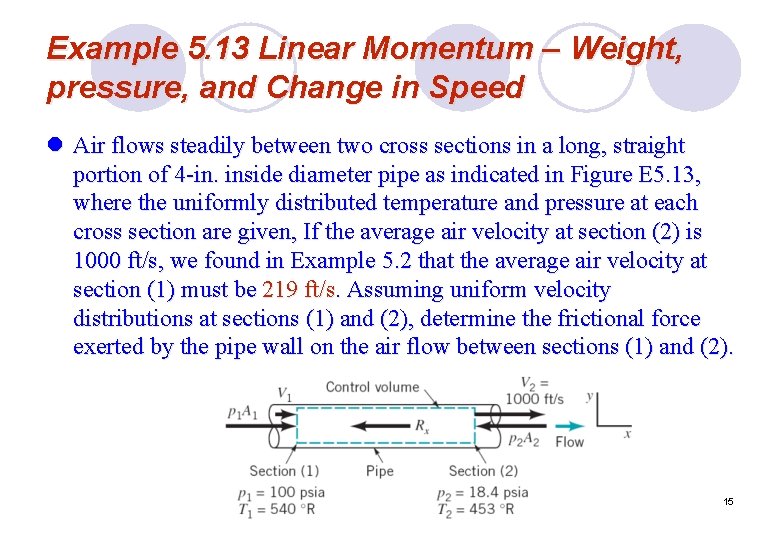
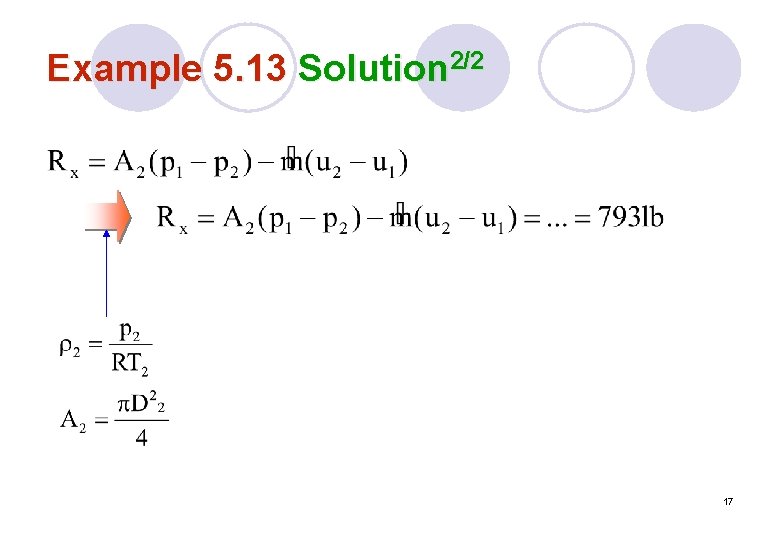
Example 5. 13 Linear Momentum – Weight, pressure, and Change in Speed l Air flows steadily between two cross sections in a long, straight portion of 4 -in. inside diameter pipe as indicated in Figure E 5. 13, where the uniformly distributed temperature and pressure at each cross section are given, If the average air velocity at section (2) is 1000 ft/s, we found in Example 5. 2 that the average air velocity at section (1) must be 219 ft/s. Assuming uniform velocity distributions at sections (1) and (2), determine the frictional force exerted by the pipe wall on the air flow between sections (1) and (2). 15
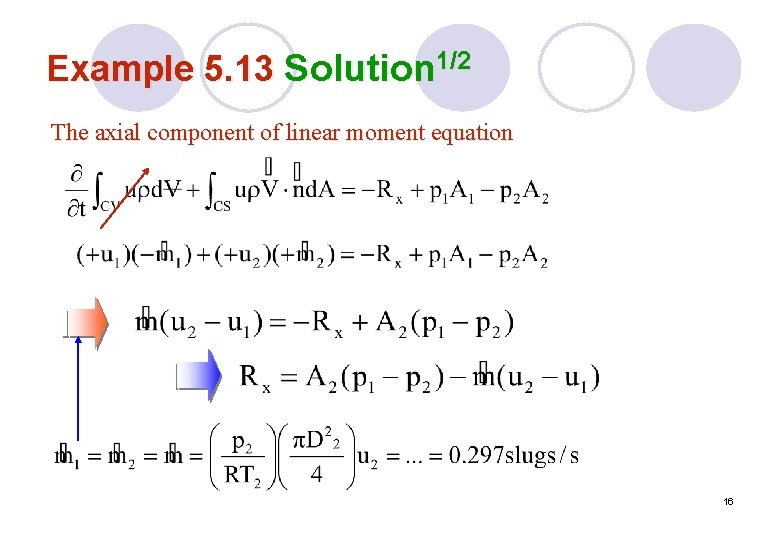
Example 5. 13 Solution 1/2 The axial component of linear moment equation 16
Example 5. 13 Solution 2/2 17
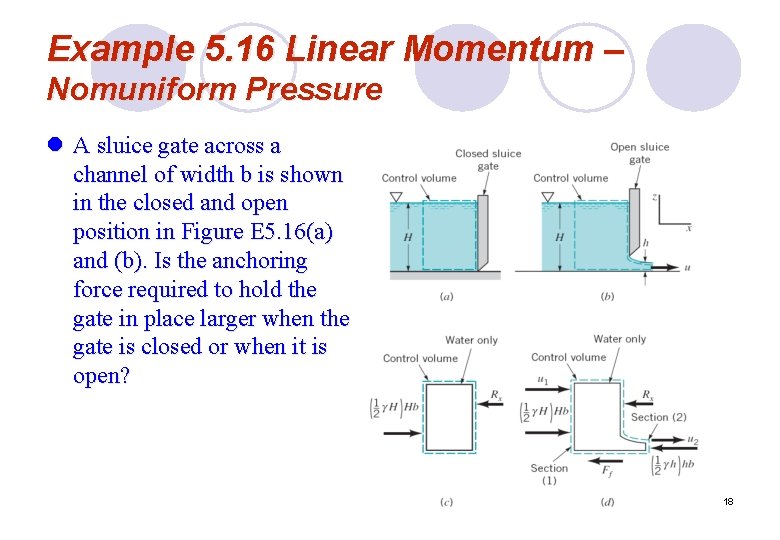
Example 5. 16 Linear Momentum – Nomuniform Pressure l A sluice gate across a channel of width b is shown in the closed and open position in Figure E 5. 16(a) and (b). Is the anchoring force required to hold the gate in place larger when the gate is closed or when it is open? 18
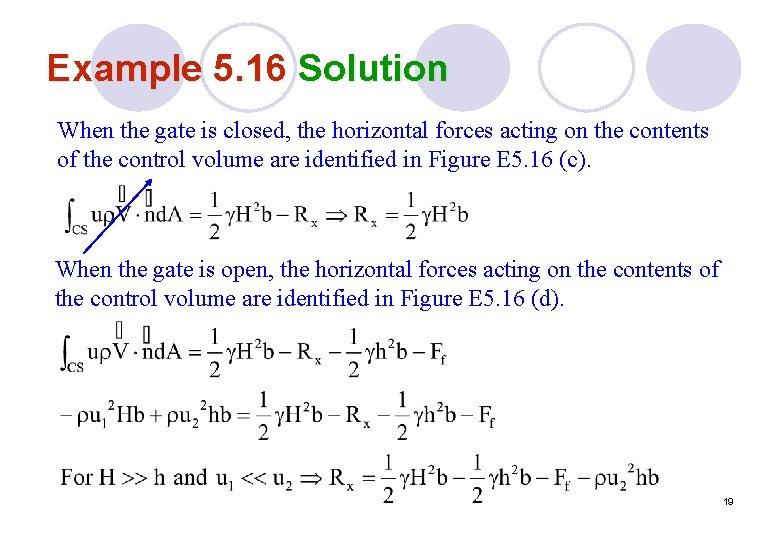
Example 5. 16 Solution When the gate is closed, the horizontal forces acting on the contents of the control volume are identified in Figure E 5. 16 (c). When the gate is open, the horizontal forces acting on the contents of the control volume are identified in Figure E 5. 16 (d). 19
Moving, Nondeforming Control Volume 1/3 Chapter 4: Reynolds transport equation for a control volume moving with constant velocity is Contents of the coincident control volume 20
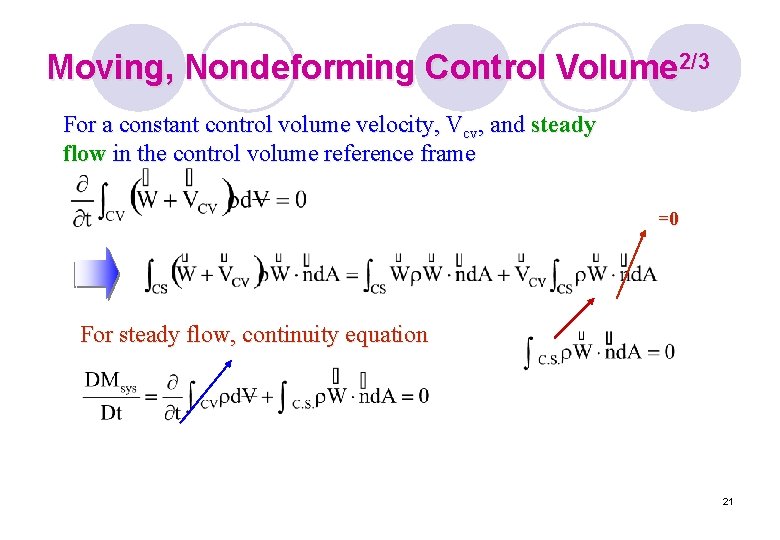
Moving, Nondeforming Control Volume 2/3 For a constant control volume velocity, Vcv, and steady flow in the control volume reference frame =0 For steady flow, continuity equation 21
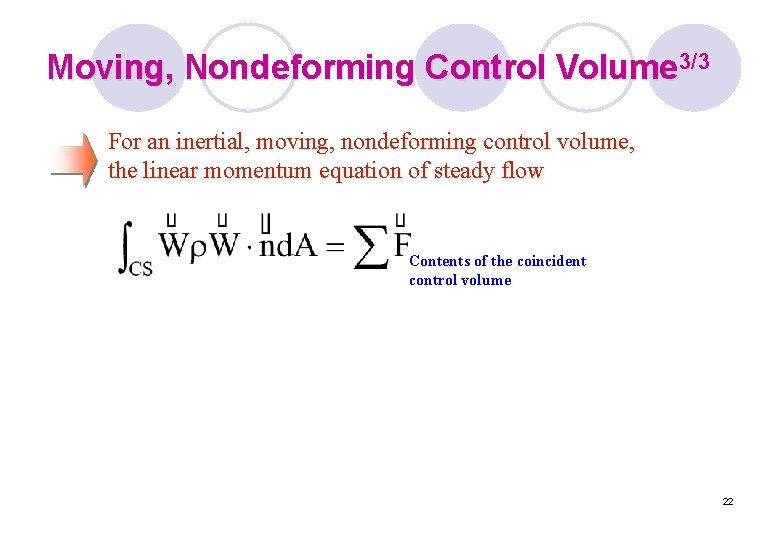
Moving, Nondeforming Control Volume 3/3 For an inertial, moving, nondeforming control volume, the linear momentum equation of steady flow Contents of the coincident control volume 22