
MAIN REPRODUCTIVE PATHOGENS IN SWINE PRACTICE Alberto Morillo
MAIN REPRODUCTIVE PATHOGENS IN SWINE PRACTICE Alberto Morillo Alujas Tests and Trials
Main reproductive pathogens in swine practice • Disease in swine reproduction and its symptomatology • PCV 2 • PPV • PRRS 2
Disease of swine reproduction system Reduction of fertility parameters: • • • Farrowing rate Empty sows: back to oestrus or empty sow at farrow Changes in productive parameters: • • • Reduction of piglets born Increase of stillbirths • Occurrence of pathological signs: • • • Increase of mummies Abortions Vaginal discharges Depends on the stage of disease occurrence along with embryo or foetal development Total failure of embryo development 3
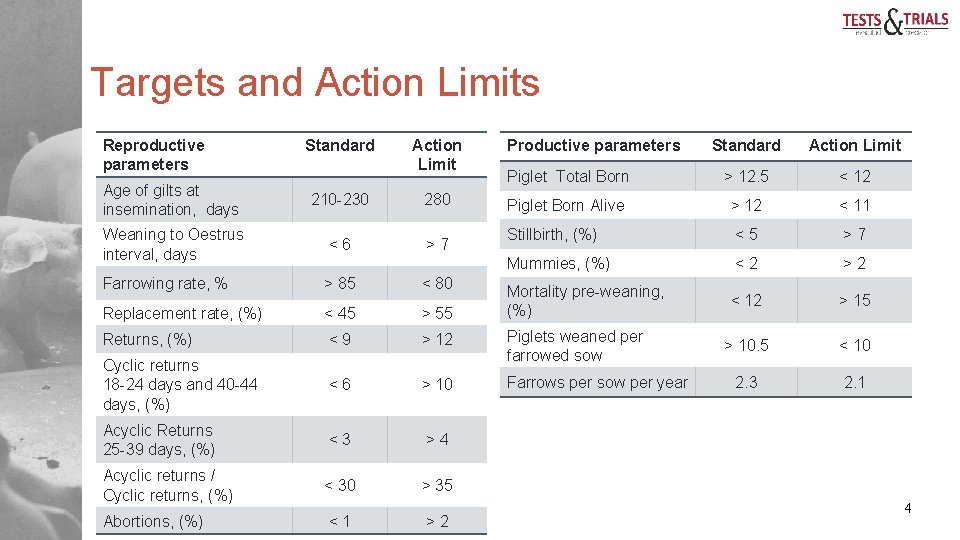
Targets and Action Limits Reproductive parameters Standard Action Limit Piglet Total Born > 12. 5 < 12 Piglet Born Alive > 12 < 11 Stillbirth, (%) < 5 > 7 Mummies, (%) < 2 > 2 Mortality pre-weaning, (%) < 12 > 15 > 10. 5 < 10 2. 3 2. 1 Age of gilts at insemination, days 210 -230 280 Weaning to Oestrus interval, days < 6 > 7 Farrowing rate, % > 85 < 80 Replacement rate, (%) < 45 > 55 Returns, (%) < 9 > 12 Cyclic returns 18 -24 days and 40 -44 days, (%) Piglets weaned per farrowed sow < 6 > 10 Farrows per sow per year Acyclic Returns 25 -39 days, (%) < 3 > 4 Acyclic returns / Cyclic returns, (%) < 30 > 35 Abortions, (%) < 1 > 2 4
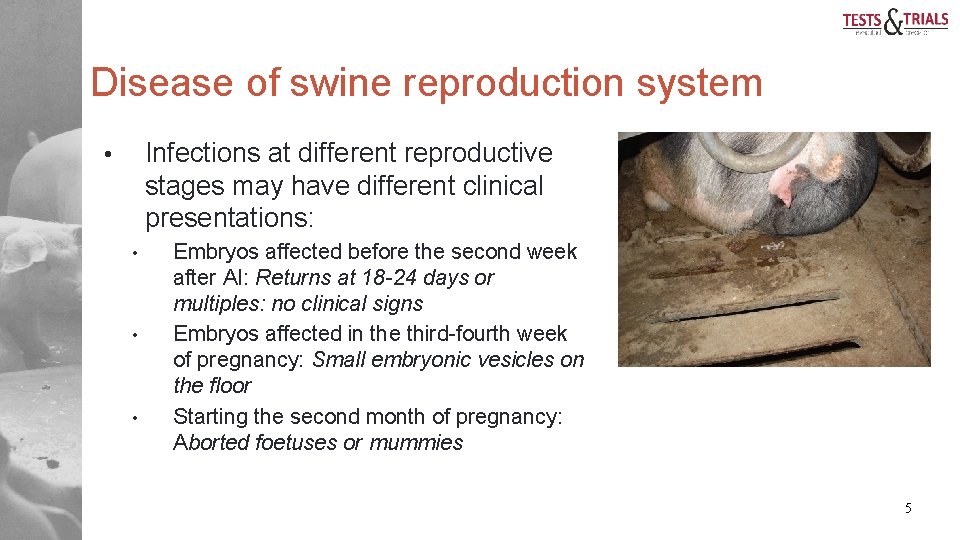
Disease of swine reproduction system Infections at different reproductive stages may have different clinical presentations: • • Embryos affected before the second week after AI: Returns at 18 -24 days or multiples: no clinical signs Embryos affected in the third-fourth week of pregnancy: Small embryonic vesicles on the floor Starting the second month of pregnancy: Aborted foetuses or mummies 5
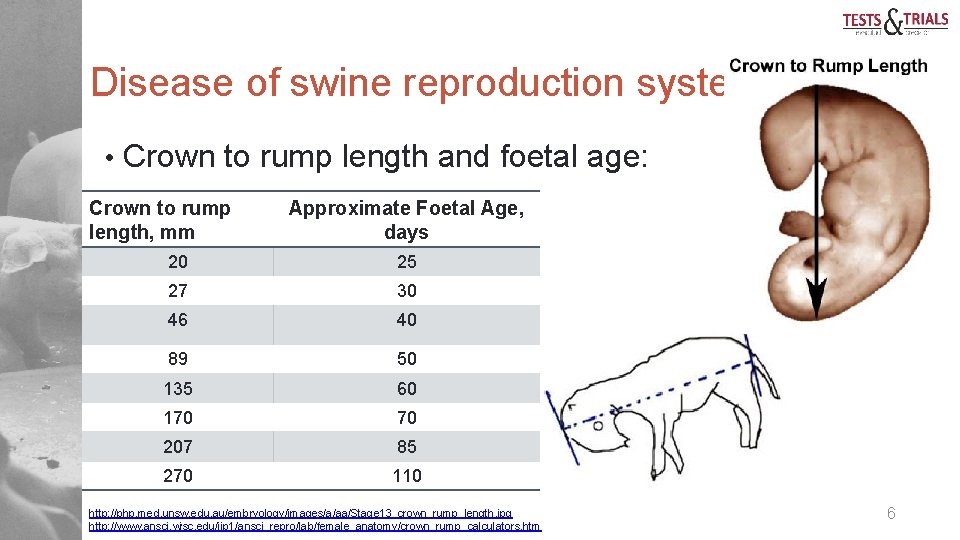
Disease of swine reproduction system • Crown to rump length and foetal age: Crown to rump length, mm Approximate Foetal Age, days 20 25 27 30 46 40 89 50 135 60 170 70 207 85 270 110 http: //php. med. unsw. edu. au/embryology/images/a/aa/Stage 13_crown_rump_length. jpg http: //www. ansci. wisc. edu/jjp 1/ansci_repro/lab/female_anatomy/crown_rump_calculators. htm 6
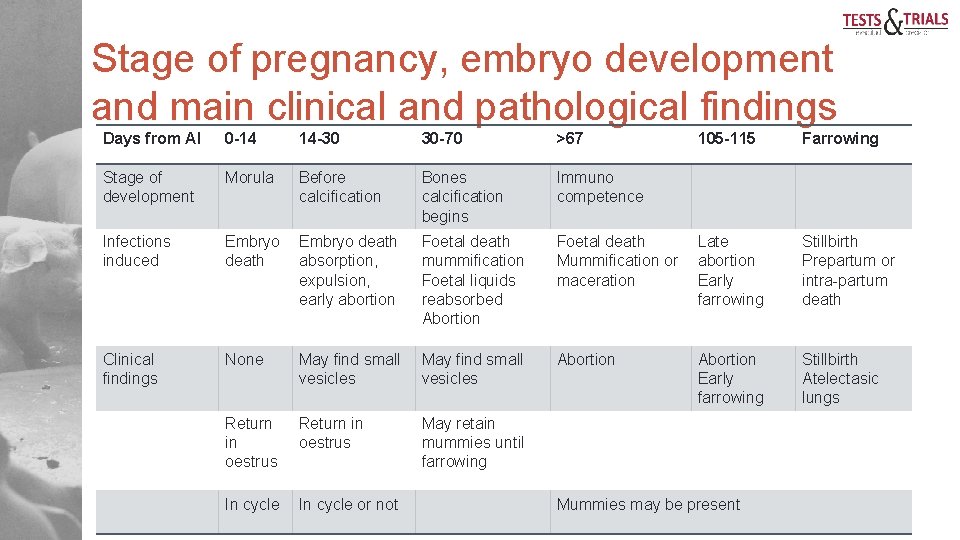
Stage of pregnancy, embryo development and main clinical and pathological findings Days from AI 0 -14 14 -30 30 -70 >67 105 -115 Stage of development Morula Before calcification Bones calcification begins Immuno competence Infections induced Embryo death absorption, expulsion, early abortion Foetal death mummification Foetal liquids reabsorbed Abortion Foetal death Late Mummification or abortion maceration Early farrowing Stillbirth Prepartum or intra-partum death Clinical findings None May find small vesicles Abortion Stillbirth Atelectasic lungs Return in oestrus May retain mummies until farrowing In cycle or not Abortion Early farrowing Mummies may be present Farrowing
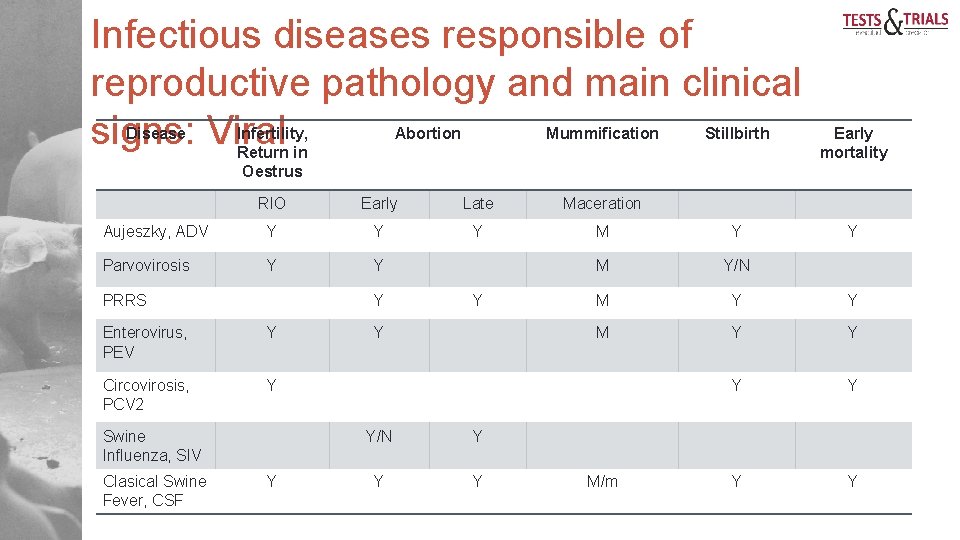
Infectious diseases responsible of reproductive pathology and main clinical signs: Viral Disease Infertility, Return in Oestrus Abortion Mummification Stillbirth Early mortality Y RIO Early Late Maceration Aujeszky, ADV Y Y Y M Y Parvovirosis Y Y M Y/N M Y Y Y Y PRRS Y Enterovirus, PEV Y Circovirosis, PCV 2 Y Swine Influenza, SIV Clasical Swine Fever, CSF Y Y/N Y Y Y M/m
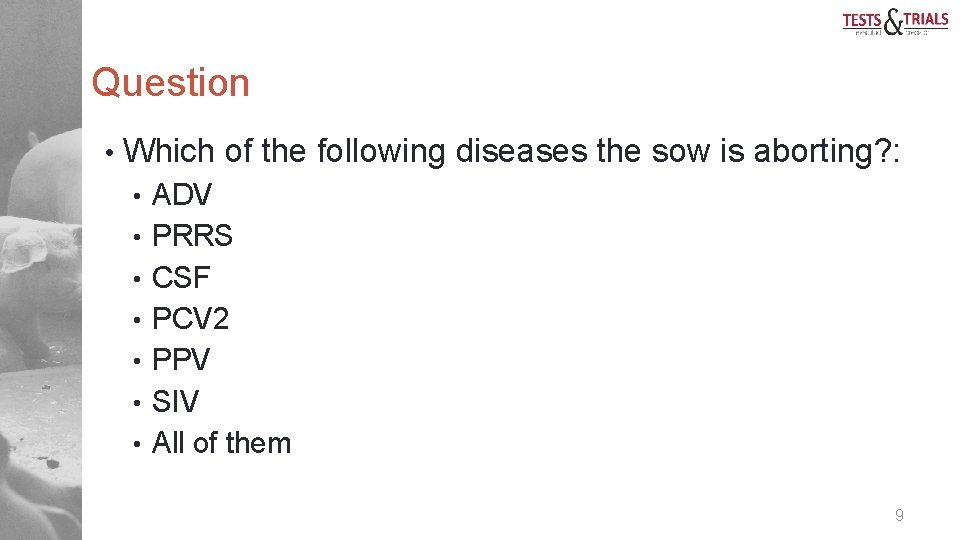
Question • Which of the following diseases the sow is aborting? : • ADV • PRRS • CSF • PCV 2 • PPV • SIV • All of them 9
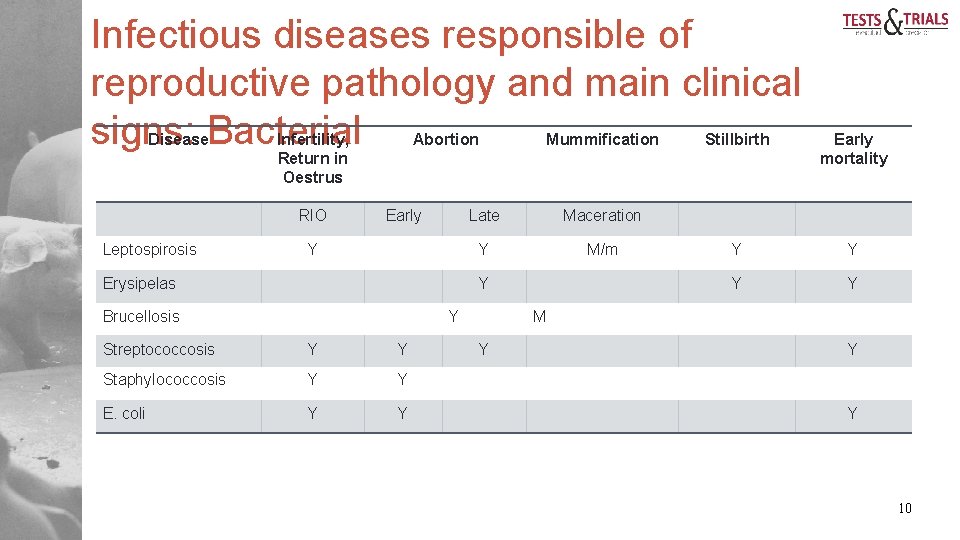
Infectious diseases responsible of reproductive pathology and main clinical signs: Bacterial Disease Infertility, Return in Oestrus RIO Leptospirosis Abortion Early Y Erysipelas Mummification Late Maceration Y M/m Y Brucellosis Y Streptococcosis Y Y Staphylococcosis Y Y E. coli Y Y Stillbirth Early mortality Y Y M Y Y Y 10
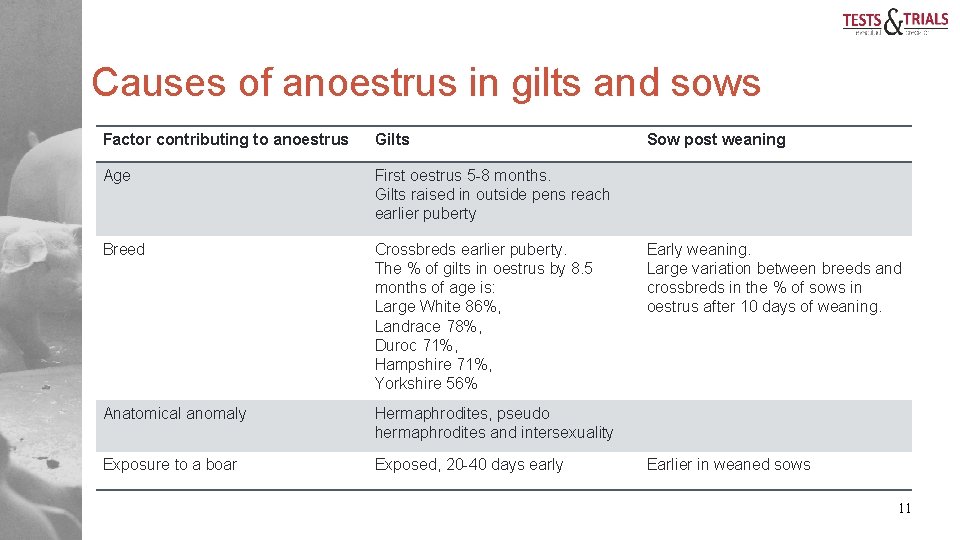
Causes of anoestrus in gilts and sows Factor contributing to anoestrus Gilts Age First oestrus 5 -8 months. Gilts raised in outside pens reach earlier puberty Breed Crossbreds earlier puberty. The % of gilts in oestrus by 8. 5 months of age is: Large White 86%, Landrace 78%, Duroc 71%, Hampshire 71%, Yorkshire 56% Anatomical anomaly Hermaphrodites, pseudo hermaphrodites and intersexuality Exposure to a boar Exposed, 20 -40 days early Sow post weaning Early weaning. Large variation between breeds and crossbreds in the % of sows in oestrus after 10 days of weaning. Earlier in weaned sows 11
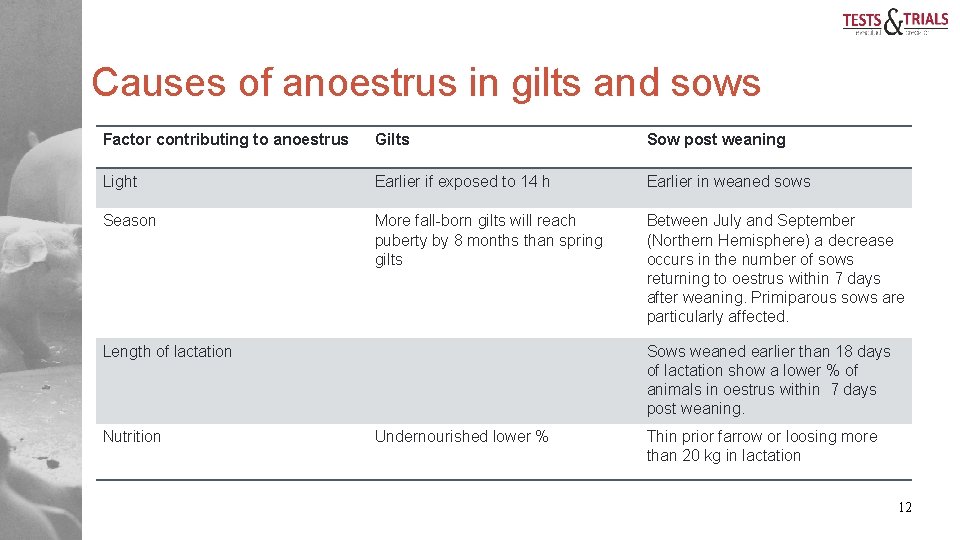
Causes of anoestrus in gilts and sows Factor contributing to anoestrus Gilts Sow post weaning Light Earlier if exposed to 14 h Earlier in weaned sows Season More fall-born gilts will reach puberty by 8 months than spring gilts Between July and September (Northern Hemisphere) a decrease occurs in the number of sows returning to oestrus within 7 days after weaning. Primiparous sows are particularly affected. Length of lactation Nutrition Sows weaned earlier than 18 days of lactation show a lower % of animals in oestrus within 7 days post weaning. Undernourished lower % Thin prior farrow or loosing more than 20 kg in lactation 12
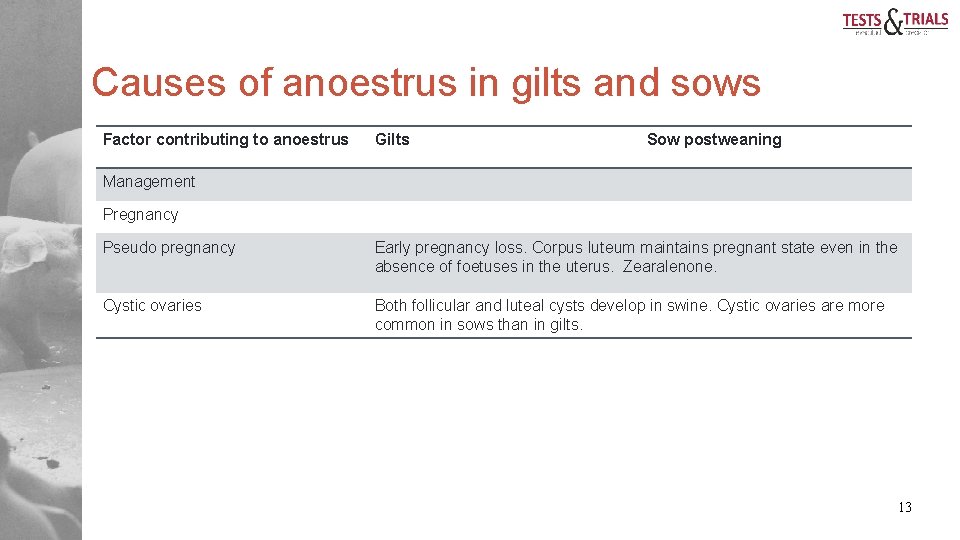
Causes of anoestrus in gilts and sows Factor contributing to anoestrus Gilts Sow postweaning Management Pregnancy Pseudo pregnancy Early pregnancy loss. Corpus luteum maintains pregnant state even in the absence of foetuses in the uterus. Zearalenone. Cystic ovaries Both follicular and luteal cysts develop in swine. Cystic ovaries are more common in sows than in gilts. 13
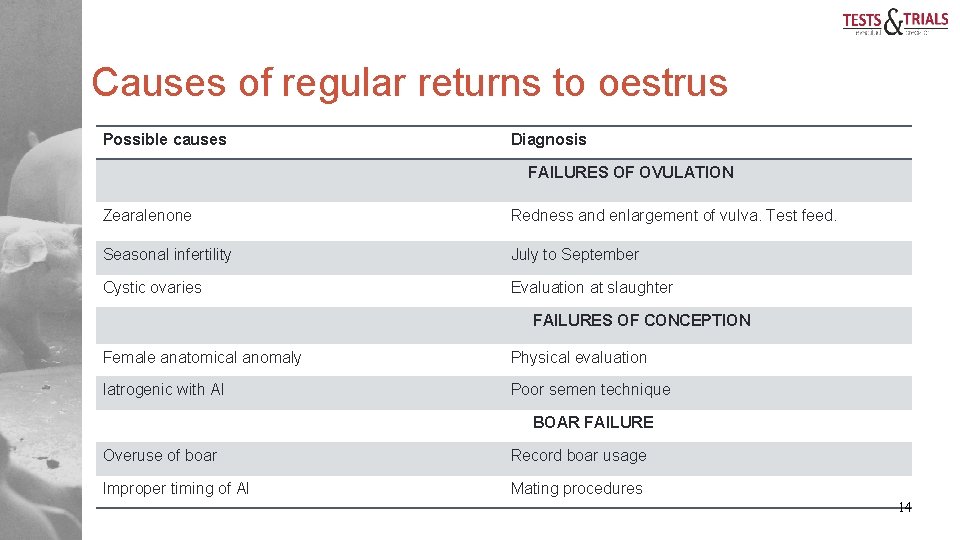
Causes of regular returns to oestrus Possible causes Diagnosis FAILURES OF OVULATION Zearalenone Redness and enlargement of vulva. Test feed. Seasonal infertility July to September Cystic ovaries Evaluation at slaughter FAILURES OF CONCEPTION Female anatomical anomaly Physical evaluation Iatrogenic with AI Poor semen technique BOAR FAILURE Overuse of boar Record boar usage Improper timing of AI Mating procedures 14
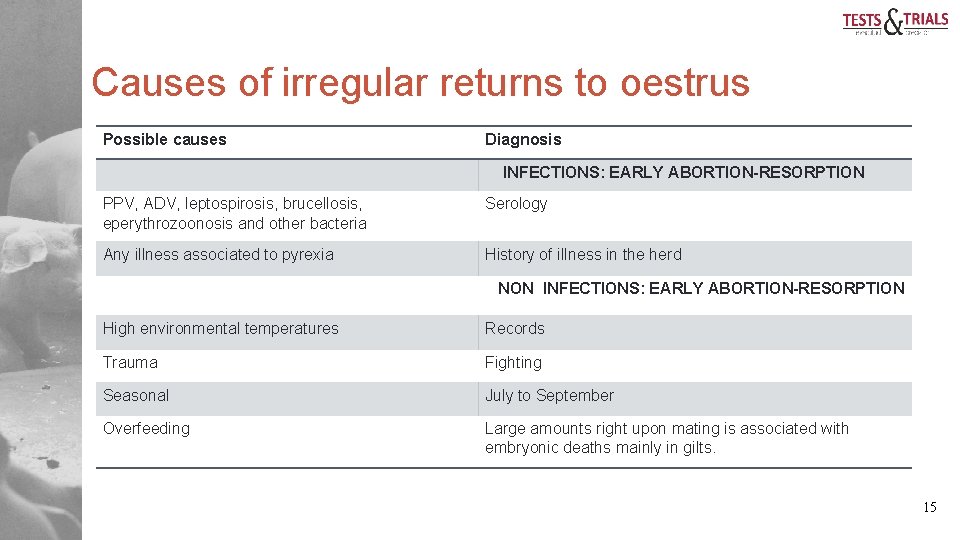
Causes of irregular returns to oestrus Possible causes Diagnosis INFECTIONS: EARLY ABORTION-RESORPTION PPV, ADV, leptospirosis, brucellosis, eperythrozoonosis and other bacteria Serology Any illness associated to pyrexia History of illness in the herd NON INFECTIONS: EARLY ABORTION-RESORPTION High environmental temperatures Records Trauma Fighting Seasonal July to September Overfeeding Large amounts right upon mating is associated with embryonic deaths mainly in gilts. 15
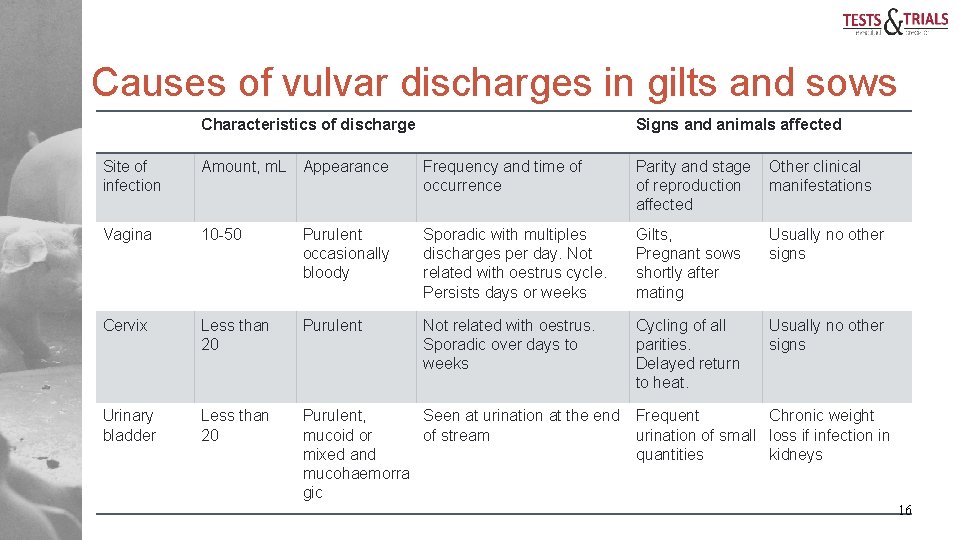
Causes of vulvar discharges in gilts and sows Characteristics of discharge Signs and animals affected Site of infection Amount, m. L Appearance Frequency and time of occurrence Parity and stage Other clinical of reproduction manifestations affected Vagina 10 -50 Purulent occasionally bloody Sporadic with multiples discharges per day. Not related with oestrus cycle. Persists days or weeks Gilts, Pregnant sows shortly after mating Usually no other signs Cervix Less than 20 Purulent Not related with oestrus. Sporadic over days to weeks Cycling of all parities. Delayed return to heat. Usually no other signs Urinary bladder Less than 20 Purulent, Seen at urination at the end Frequent Chronic weight mucoid or of stream urination of small loss if infection in mixed and quantities kidneys mucohaemorra gic 16
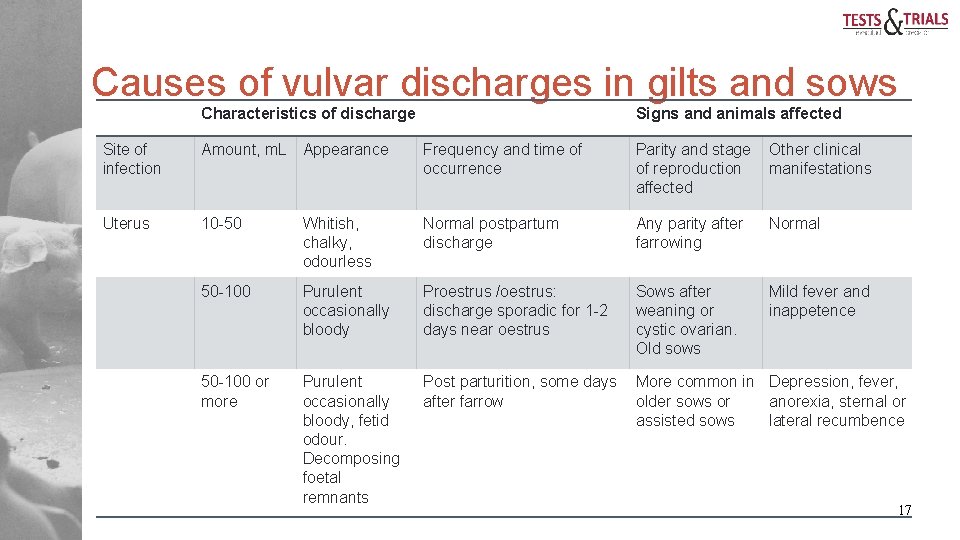
Causes of vulvar discharges in gilts and sows Characteristics of discharge Signs and animals affected Site of infection Amount, m. L Appearance Frequency and time of occurrence Parity and stage Other clinical of reproduction manifestations affected Uterus 10 -50 Whitish, chalky, odourless Normal postpartum discharge Any parity after farrowing Normal 50 -100 Purulent occasionally bloody Proestrus /oestrus: discharge sporadic for 1 -2 days near oestrus Sows after weaning or cystic ovarian. Old sows Mild fever and inappetence 50 -100 or more Purulent occasionally bloody, fetid odour. Decomposing foetal remnants Post parturition, some days More common in Depression, fever, after farrow older sows or anorexia, sternal or assisted sows lateral recumbence 17
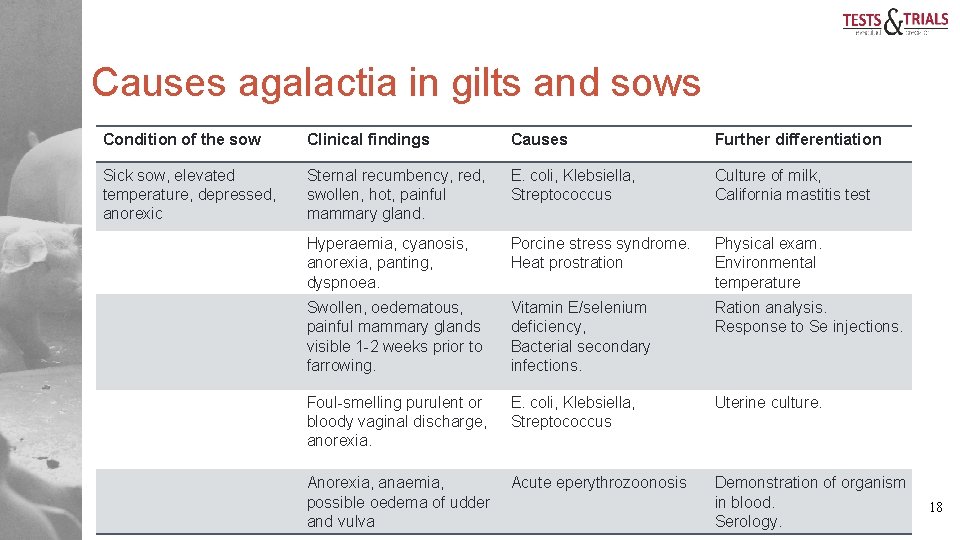
Causes agalactia in gilts and sows Condition of the sow Clinical findings Causes Further differentiation Sick sow, elevated temperature, depressed, anorexic Sternal recumbency, red, swollen, hot, painful mammary gland. E. coli, Klebsiella, Streptococcus Culture of milk, California mastitis test Hyperaemia, cyanosis, anorexia, panting, dyspnoea. Porcine stress syndrome. Heat prostration Physical exam. Environmental temperature Swollen, oedematous, painful mammary glands visible 1 -2 weeks prior to farrowing. Vitamin E/selenium deficiency, Bacterial secondary infections. Ration analysis. Response to Se injections. Foul-smelling purulent or bloody vaginal discharge, anorexia. E. coli, Klebsiella, Streptococcus Uterine culture. Anorexia, anaemia, Acute eperythrozoonosis possible oedema of udder and vulva Demonstration of organism in blood. Serology. 18
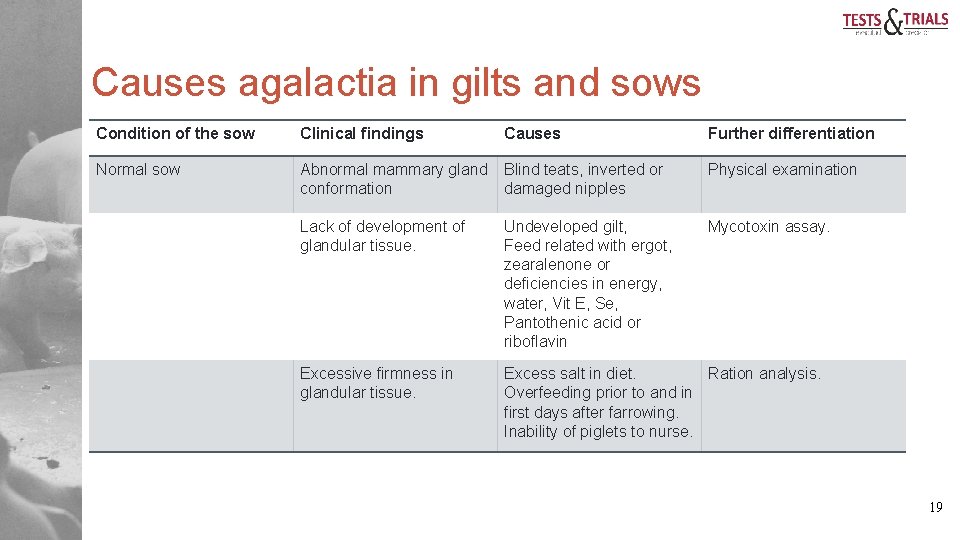
Causes agalactia in gilts and sows Condition of the sow Clinical findings Causes Further differentiation Normal sow Abnormal mammary gland Blind teats, inverted or conformation damaged nipples Physical examination Lack of development of glandular tissue. Undeveloped gilt, Feed related with ergot, zearalenone or deficiencies in energy, water, Vit E, Se, Pantothenic acid or riboflavin Mycotoxin assay. Excessive firmness in glandular tissue. Excess salt in diet. Ration analysis. Overfeeding prior to and in first days after farrowing. Inability of piglets to nurse. 19
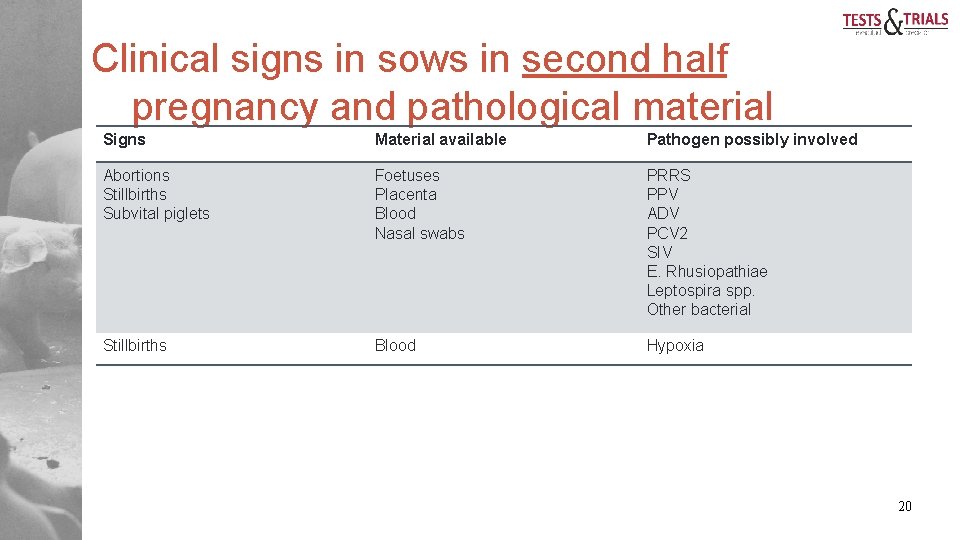
Clinical signs in sows in second half pregnancy and pathological material Signs Material available Pathogen possibly involved Abortions Stillbirths Subvital piglets Foetuses Placenta Blood Nasal swabs PRRS PPV ADV PCV 2 SIV E. Rhusiopathiae Leptospira spp. Other bacterial Stillbirths Blood Hypoxia 20
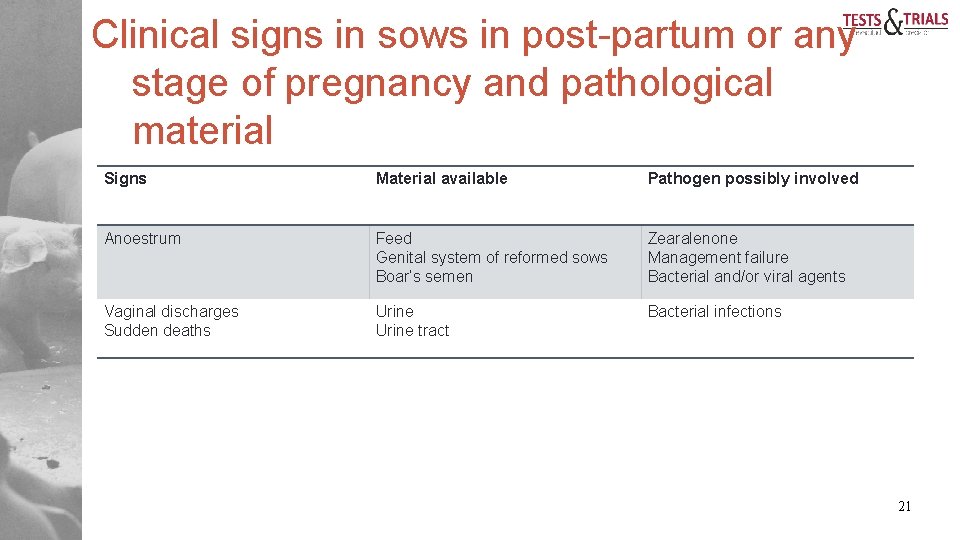
Clinical signs in sows in post-partum or any stage of pregnancy and pathological material Signs Material available Pathogen possibly involved Anoestrum Feed Genital system of reformed sows Boar’s semen Zearalenone Management failure Bacterial and/or viral agents Vaginal discharges Sudden deaths Urine tract Bacterial infections 21
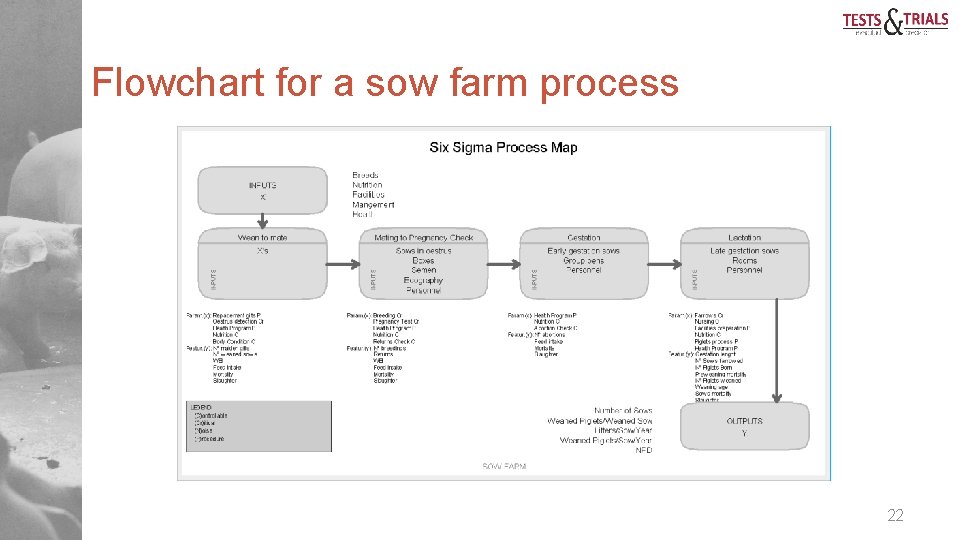
Flowchart for a sow farm process 22
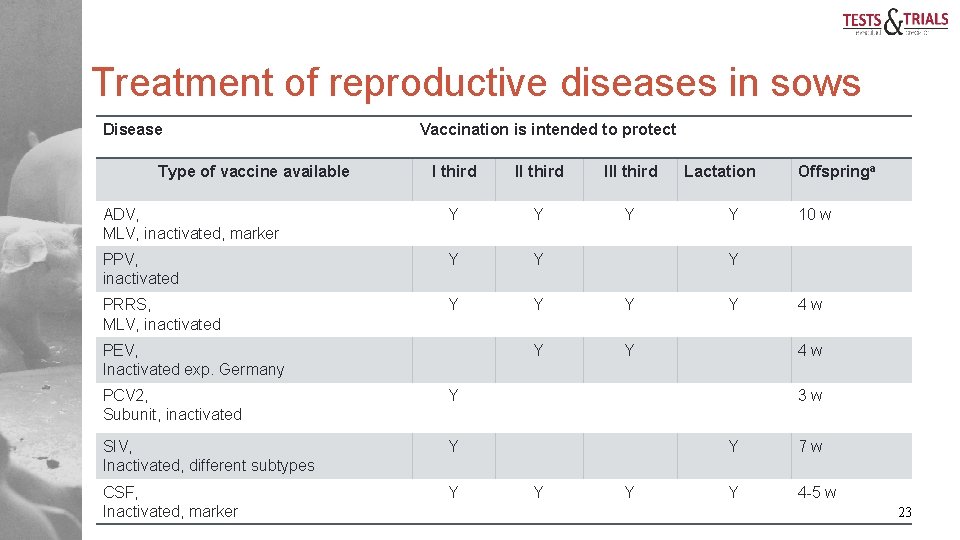
Treatment of reproductive diseases in sows Disease Type of vaccine available Vaccination is intended to protect I third III third ADV, MLV, inactivated, marker Y Y Y PPV, inactivated Y Y PRRS, MLV, inactivated Y Y Y PEV, Inactivated exp. Germany PCV 2, Subunit, inactivated Y SIV, Inactivated, different subtypes Y CSF, Inactivated, marker Y Lactation Y Offspringa 10 w Y Y 4 w 3 w Y Y Y 7 w Y 4 -5 w 23
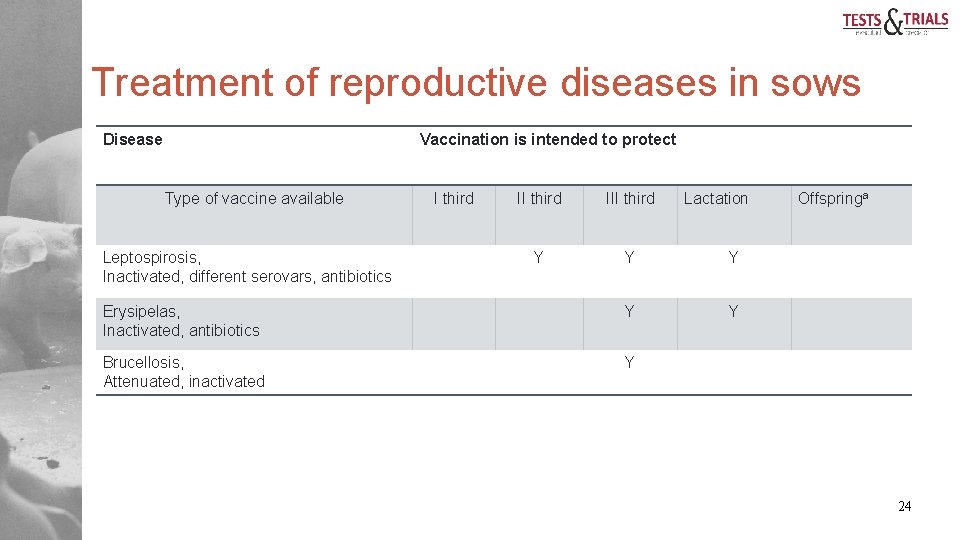
Treatment of reproductive diseases in sows Disease Vaccination is intended to protect Type of vaccine available II third III third Y Y Y Erysipelas, Inactivated, antibiotics Y Y Brucellosis, Attenuated, inactivated Y Leptospirosis, Inactivated, different serovars, antibiotics I third Lactation Offspringa 24
Main reproductive pathogens in swine practice • Disease in swine reproduction and its symptomatology • PCV 2 • PPV • PRRS 25
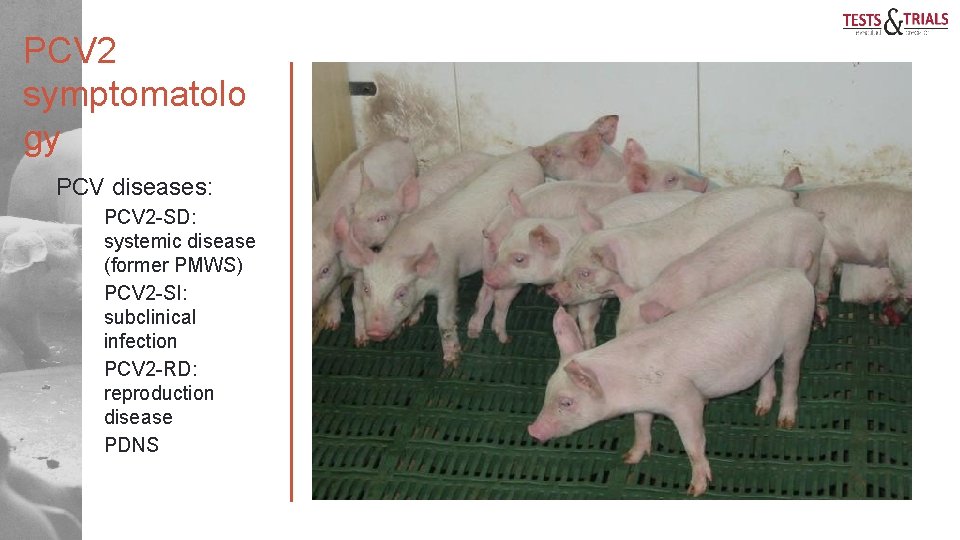
PCV 2 symptomatolo gy PCV diseases: PCV 2 -SD: systemic disease (former PMWS) PCV 2 -SI: subclinical infection PCV 2 -RD: reproduction disease PDNS
PCV 2 Immunity: Humoral • Total (TA) and Neutralizing (NA) antibodies • TA appear 10 -28 days after infection • In SD, delayed response of TA: • Immune supresion • Pigs infected with PCV 2: • Increase of helper and cytotoxic T-cells (measured by the number of IFN-γsecreting cells) • Starts at 2 -3 weeks post natural infection and • May last at least 6 -7 weeks but very variable among pigs • Impaired or limited response 27
PCV 2 Immunity and vaccination • PCV 2 can persist in tissues and blood with high TA titers • Complete neutralization does not occur • PCV 2 antibodies does not fully guarantee viral clearance: • Cell mediated (IFN-γ-SC) response, TA, and significant NA response are the responsible mechanisms for viral clearance • To protect offspring SD or SI: late gestation • Delay piglet vaccination till week 6 of age • For RD: before mating • repeated before mating also protects again SD or SI • New: before mating • And piglet vaccination at 3 weeks of age (overcome MDA interference) 28
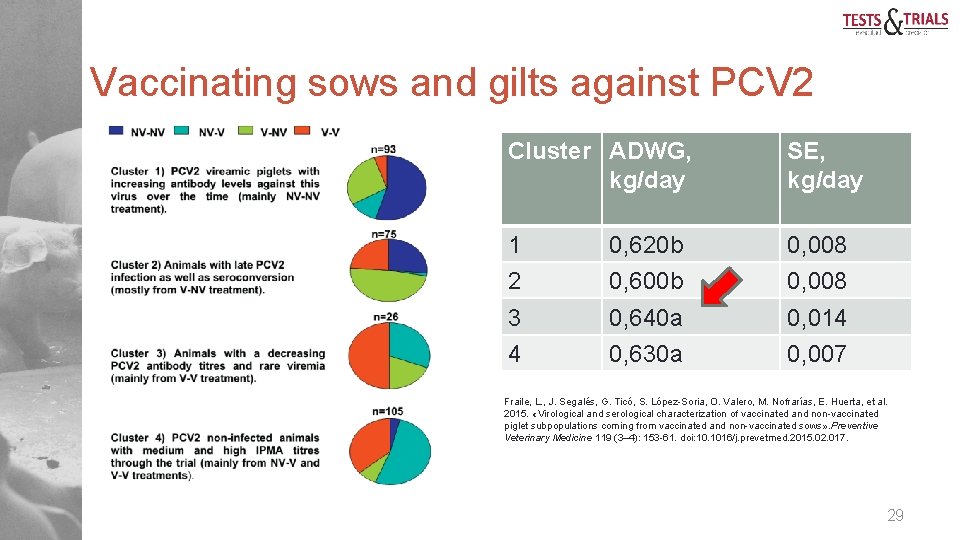
Vaccinating sows and gilts against PCV 2 Cluster ADWG, kg/day SE, kg/day 1 2 3 4 0, 008 0, 014 0, 007 0, 620 b 0, 600 b 0, 640 a 0, 630 a Fraile, L. , J. Segalés, G. Ticó, S. López-Soria, O. Valero, M. Nofrarías, E. Huerta, et al. 2015. «Virological and serological characterization of vaccinated and non-vaccinated piglet subpopulations coming from vaccinated and non-vaccinated sows» . Preventive Veterinary Medicine 119 (3– 4): 153 -61. doi: 10. 1016/j. prevetmed. 2015. 02. 017. 29
Main reproductive pathogens in swine practice • Disease in swine reproduction and its symptomatology • PCV 2 • PPV • PRRS 30
PPV Symptomatology • The most common and important cause of infectious infertility • Multiplies in the intestine NO CLINICAL SIGNS • Transmitted either by mouth or through the nose going to the intestine and to the faeces 31
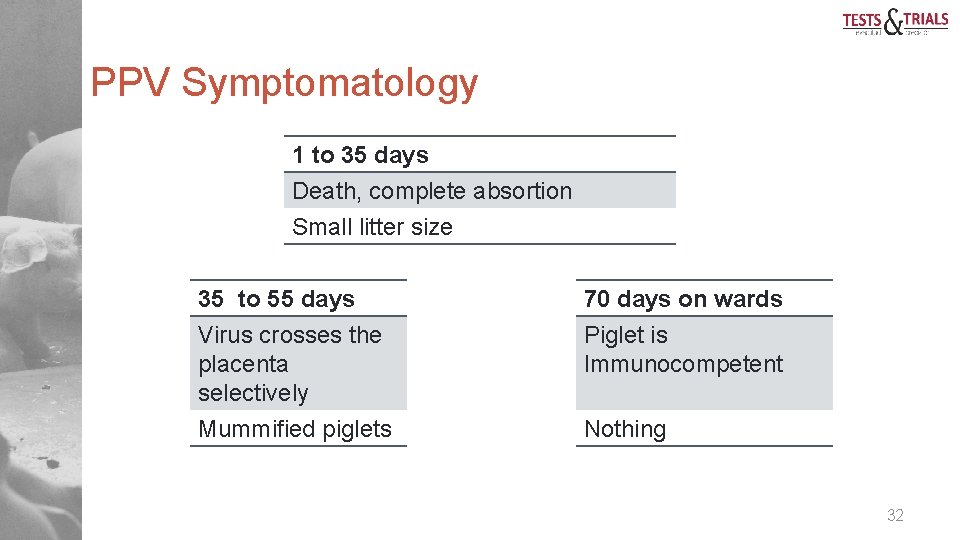
PPV Symptomatology 1 to 35 days Death, complete absortion Small litter size 35 to 55 days 70 days on wards Virus crosses the placenta selectively Mummified piglets Piglet is Immunocompetent Nothing 32
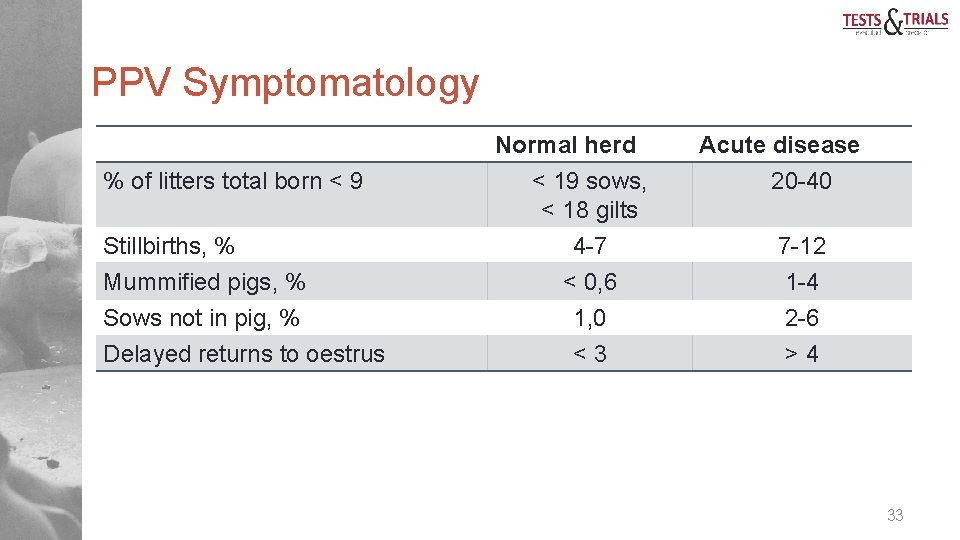
PPV Symptomatology Normal herd % of litters total born < 9 Stillbirths, % Mummified pigs, % Sows not in pig, % Delayed returns to oestrus < 19 sows, < 18 gilts 4 -7 < 0, 6 1, 0 < 3 Acute disease 20 -40 7 -12 1 -4 2 -6 > 4 33
Main reproductive pathogens in swine practice • Disease in swine reproduction and its symptomatology • PCV 2 • PPV • PRRS 34
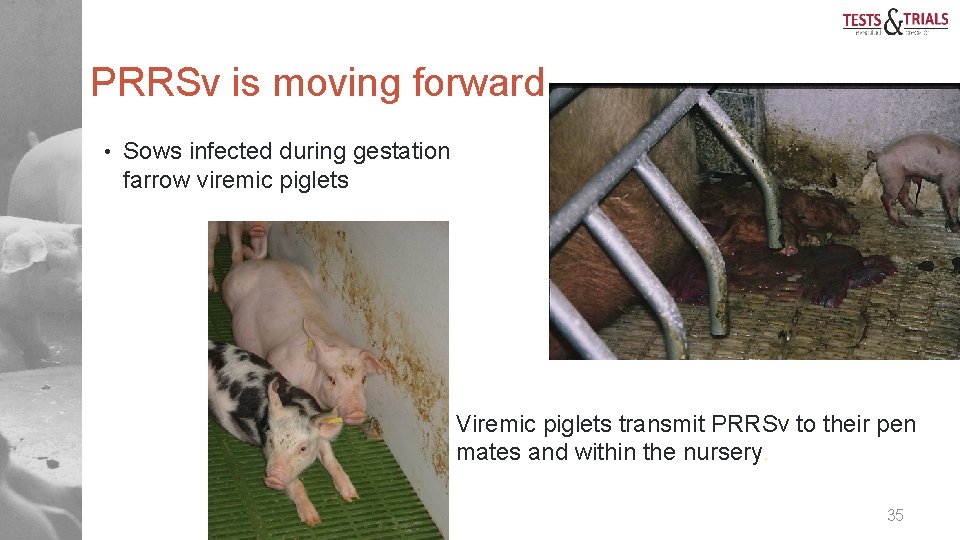
PRRSv is moving forward • Sows infected during gestation farrow viremic piglets Viremic piglets transmit PRRSv to their pen mates and within the nursery. 35
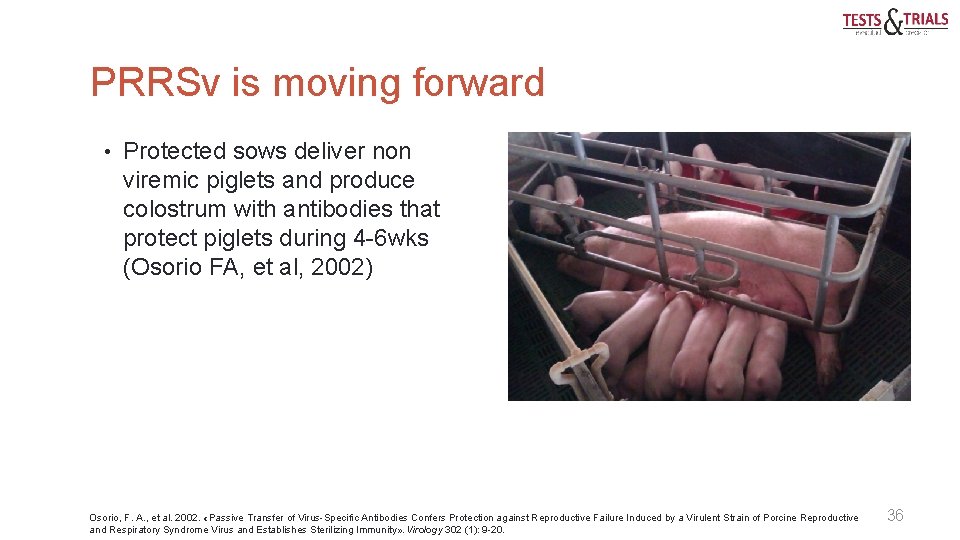
PRRSv is moving forward • Protected sows deliver non viremic piglets and produce colostrum with antibodies that protect piglets during 4 -6 wks (Osorio FA, et al, 2002) Osorio, F. A. , et al. 2002. «Passive Transfer of Virus-Specific Antibodies Confers Protection against Reproductive Failure Induced by a Virulent Strain of Porcine Reproductive and Respiratory Syndrome Virus and Establishes Sterilizing Immunity» . Virology 302 (1): 9 -20. 36
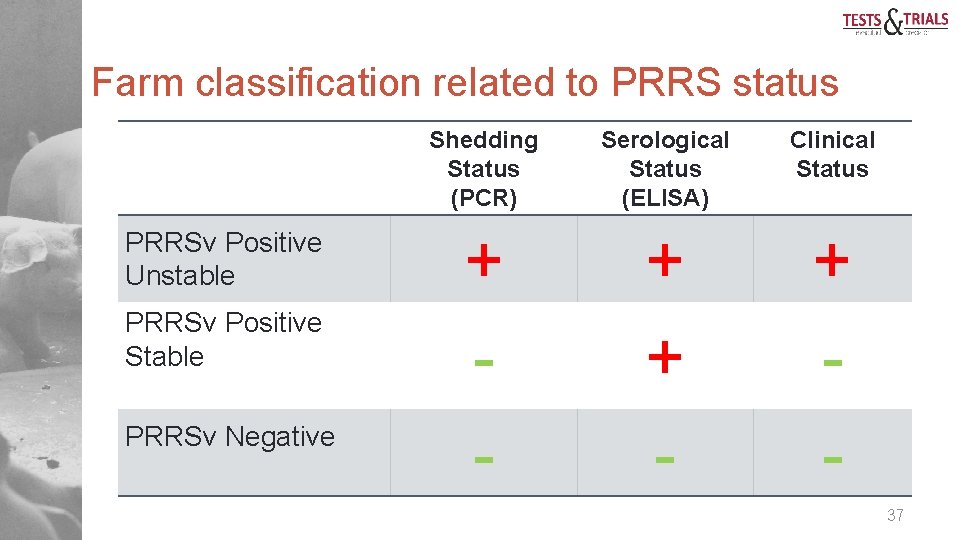
Farm classification related to PRRS status PRRSv Positive Unstable PRRSv Positive Stable PRRSv Negative Shedding Status (PCR) Serological Status (ELISA) Clinical Status + - + 37
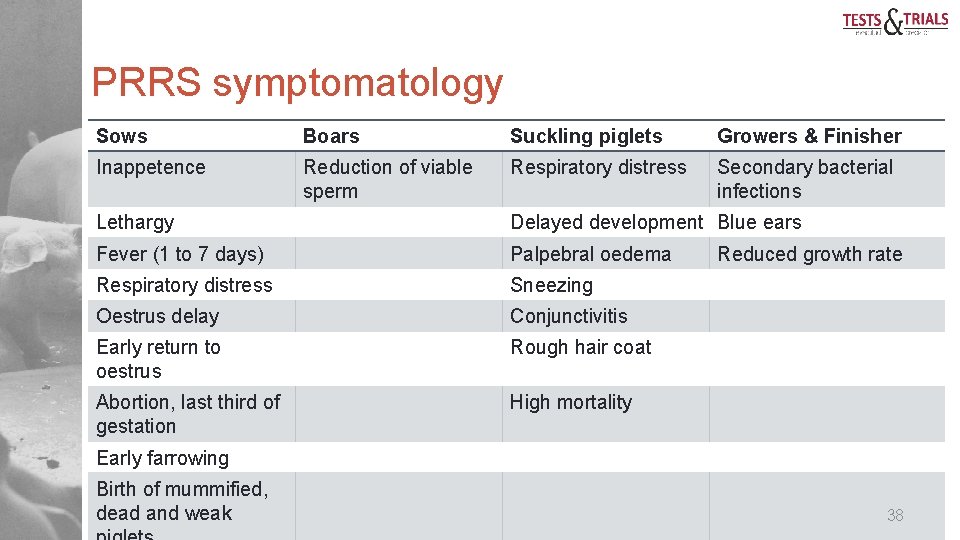
PRRS symptomatology Sows Boars Suckling piglets Growers & Finisher Inappetence Reduction of viable sperm Respiratory distress Secondary bacterial infections Lethargy Delayed development Blue ears Fever (1 to 7 days) Palpebral oedema Respiratory distress Sneezing Oestrus delay Conjunctivitis Early return to oestrus Rough hair coat Abortion, last third of gestation High mortality Reduced growth rate Early farrowing Birth of mummified, dead and weak 38
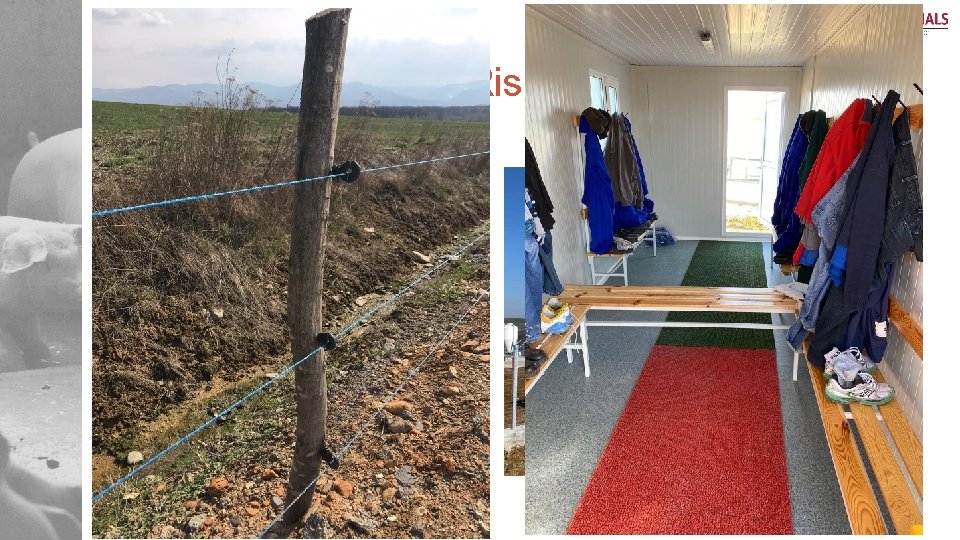
Biosecurity/ External Risks 39
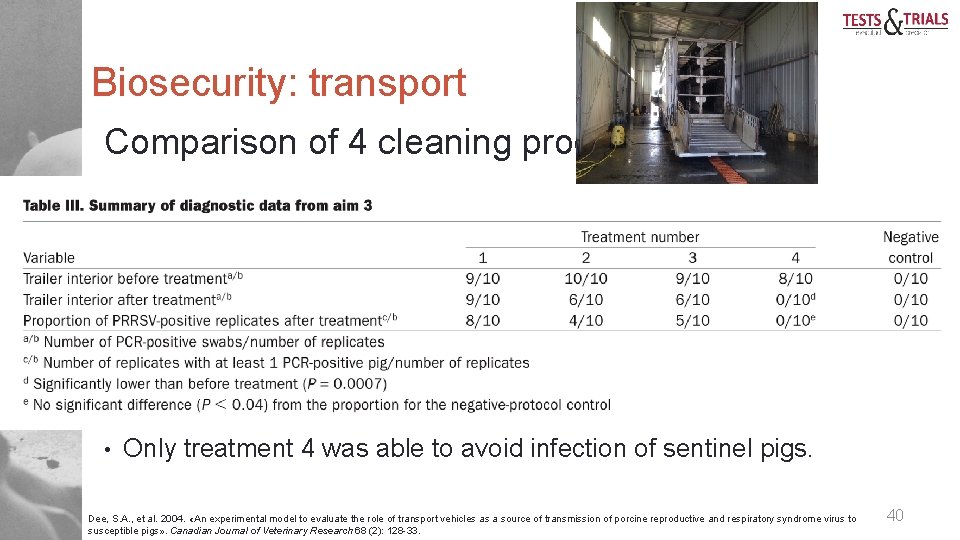
Biosecurity: transport Comparison of 4 cleaning processes: 1. 2. 3. 4. Manual scraping of the interior to remove soiled bedding (sawdust and feces) Bedding removal, washing (80°C, 20 500 k. Pa), and disinfecting (with 1: 256 phenol; 10 -min contact time) followed by freezing and thawing. Bedding removal, washing, disinfecting, and drying • Only treatment 4 was able to avoid infection of sentinel pigs. Dee, S. A. , et al. 2004. «An experimental model to evaluate the role of transport vehicles as a source of transmission of porcine reproductive and respiratory syndrome virus to susceptible pigs» . Canadian Journal of Veterinary Research 68 (2): 128 -33. 40
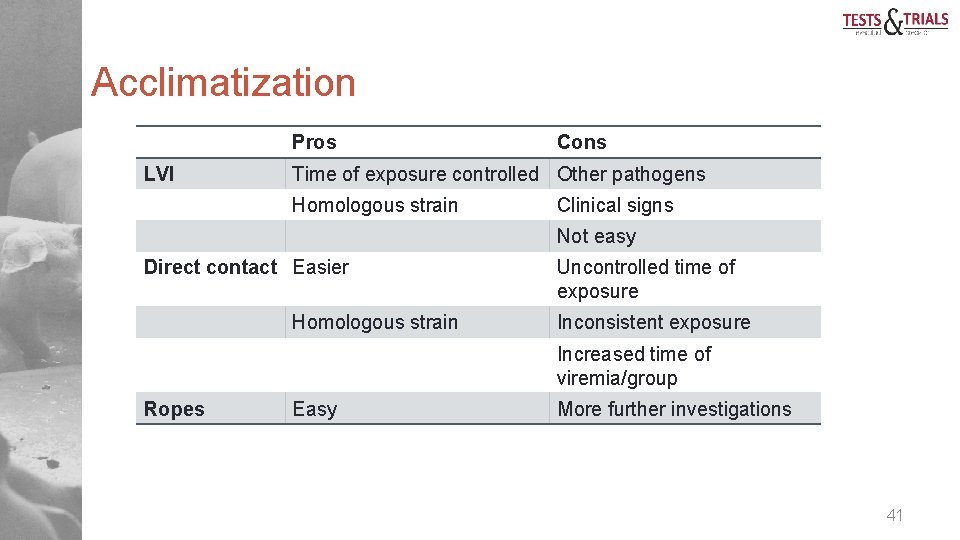
Acclimatization Pros LVI Cons Time of exposure controlled Other pathogens Homologous strain Clinical signs Not easy Direct contact Easier Homologous strain Uncontrolled time of exposure Inconsistent exposure Increased time of viremia/group Ropes Easy More further investigations 41
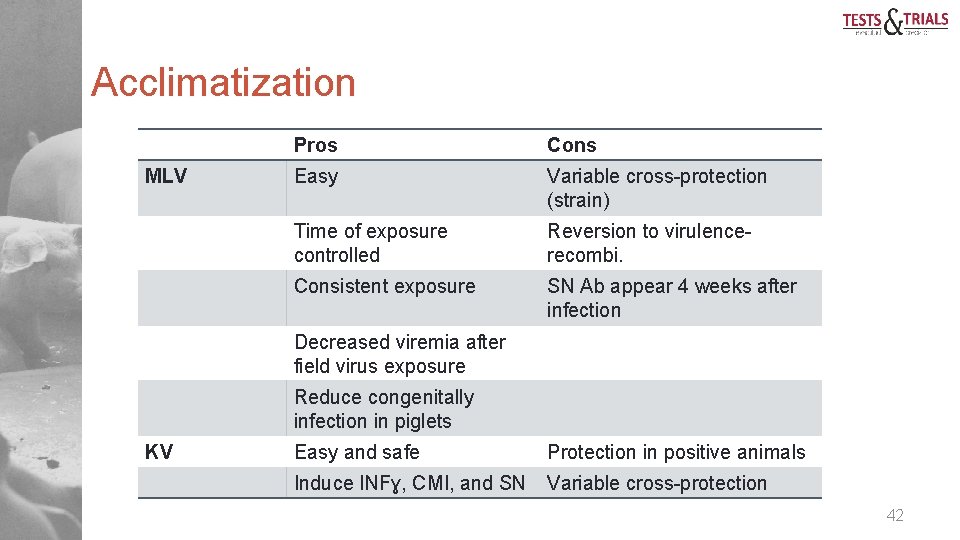
Acclimatization MLV Pros Cons Easy Variable cross-protection (strain) Time of exposure controlled Reversion to virulencerecombi. Consistent exposure SN Ab appear 4 weeks after infection Decreased viremia after field virus exposure Reduce congenitally infection in piglets KV Easy and safe Protection in positive animals Induce INFɣ, CMI, and SN Variable cross-protection 42
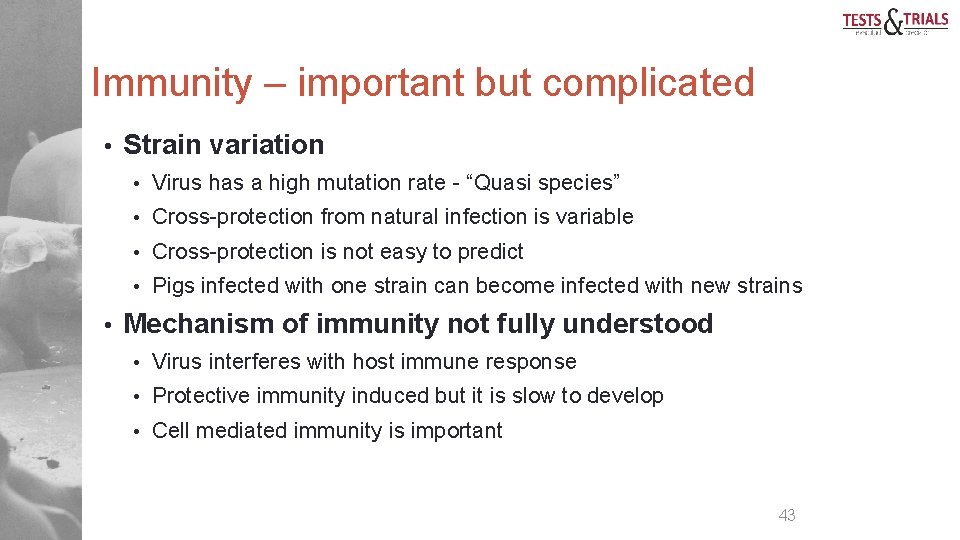
Immunity – important but complicated • Strain variation • Virus has a high mutation rate - “Quasi species” • Cross-protection from natural infection is variable • Cross-protection is not easy to predict • Pigs infected with one strain can become infected with new strains • Mechanism of immunity not fully understood • Virus interferes with host immune response • Protective immunity induced but it is slow to develop • Cell mediated immunity is important 43
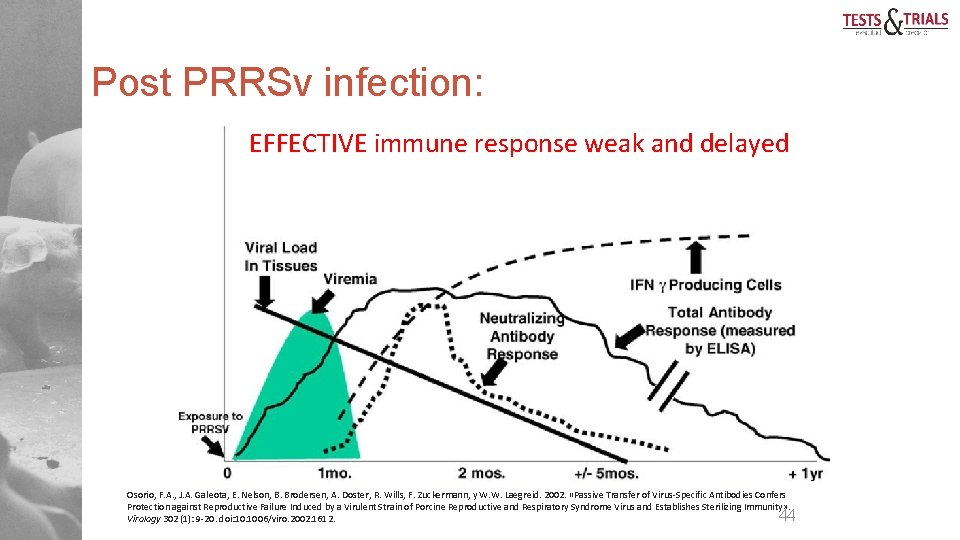
Post PRRSv infection: EFFECTIVE immune response weak and delayed Osorio, F. A. , J. A. Galeota, E. Nelson, B. Brodersen, A. Doster, R. Wills, F. Zuckermann, y W. W. Laegreid. 2002. «Passive Transfer of Virus-Specific Antibodies Confers Protection against Reproductive Failure Induced by a Virulent Strain of Porcine Reproductive and Respiratory Syndrome Virus and Establishes Sterilizing Immunity» . 44 Virology 302 (1): 9 -20. doi: 10. 1006/viro. 2002. 1612.
Question • Which of the following sentences are true: • Viremia is really long in PRRS more than 2 months • Neutralizing Antibodies appear really fast after infection • Saliva has a lot of viruses 45
Vaccines Modified Live Virus • No universal protection (Labarque, et al. 2004). • Partial protection against heterologous strains • Risk of producing viremic pigs when they are applied at the end of gestation, specially type 2 (Nielssen et al. 2002) 46
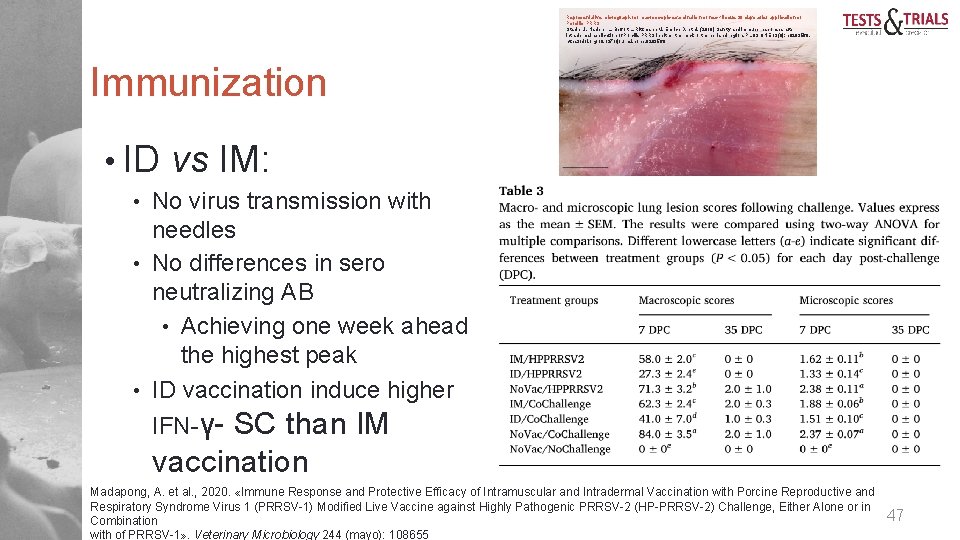
Representative micrograph for macroscopic examination of neck tissue 28 days after application of Porcilis PRRS Stadler J, Naderer L, Beffort L, Ritzmann M, Emrich D, et al. (2018) Safety and immune responses after intradermal application of Porcilis PRRS in either the neck or the perianal region. PLOS ONE 13(9): e 0203560. https: //doi. org/10. 1371/journal. pone. 0203560 Immunization • ID vs IM: • No virus transmission with needles • No differences in sero neutralizing AB • Achieving one week ahead the highest peak • ID vaccination induce higher IFN-γ- SC than IM vaccination Madapong, A. et al. , 2020. «Immune Response and Protective Efficacy of Intramuscular and Intradermal Vaccination with Porcine Reproductive and Respiratory Syndrome Virus 1 (PRRSV-1) Modified Live Vaccine against Highly Pathogenic PRRSV-2 (HP-PRRSV-2) Challenge, Either Alone or in Combination with of PRRSV-1» . Veterinary Microbiology 244 (mayo): 108655 47
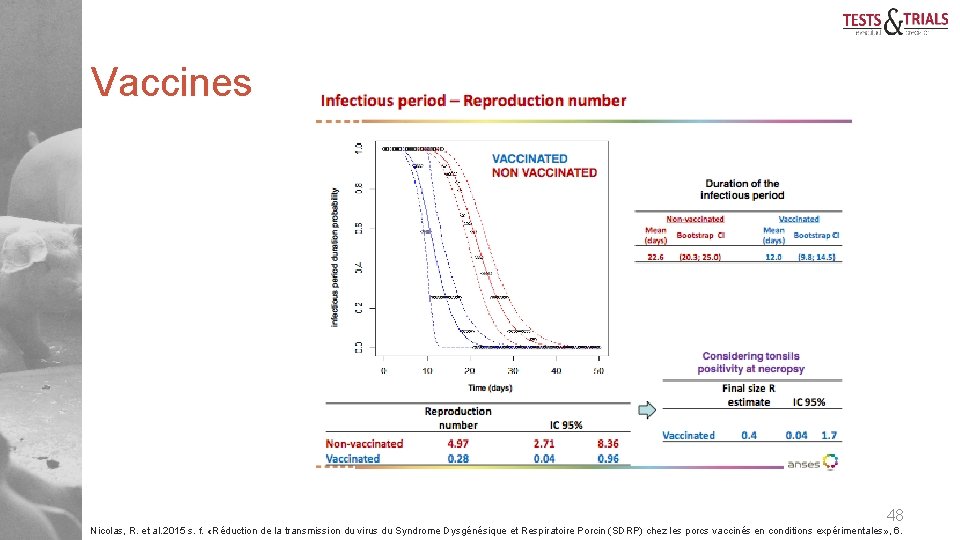
Vaccines 48 Nicolas, R. et al. 2015 s. f. «Réduction de la transmission du virus du Syndrome Dysgénésique et Respiratoire Porcin (SDRP) chez les porcs vaccinés en conditions expérimentales» , 6.
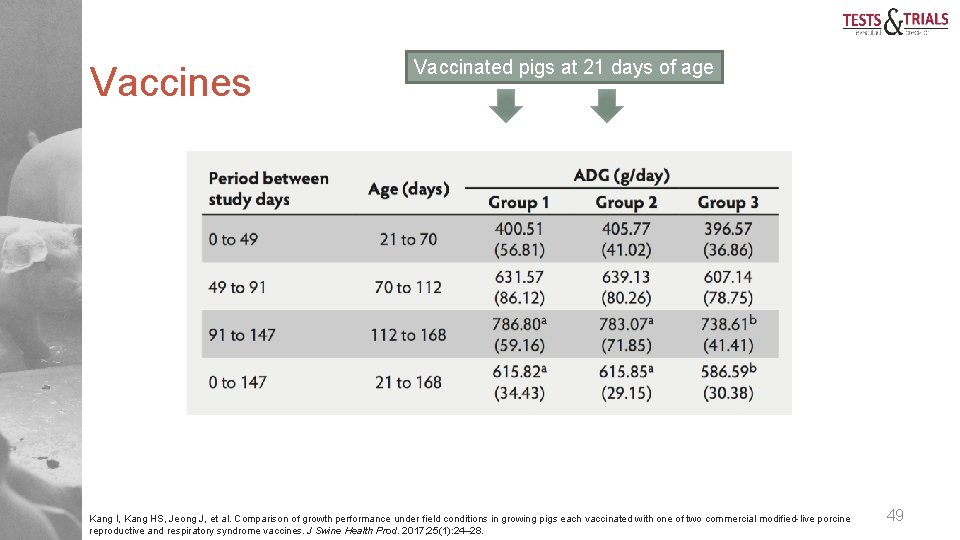
Vaccines Vaccinated pigs at 21 days of age Kang I, Kang HS, Jeong J, et al. Comparison of growth performance under field conditions in growing pigs each vaccinated with one of two commercial modified-live porcine reproductive and respiratory syndrome vaccines. J Swine Health Prod. 2017; 25(1): 24– 28. 49
Vaccines • Inactivated Virus • Safer • Two shots needed, one with a MLV vaccine and 1 or 2 with KV • They do not produce a serological reaction when applied on negative animals. 50
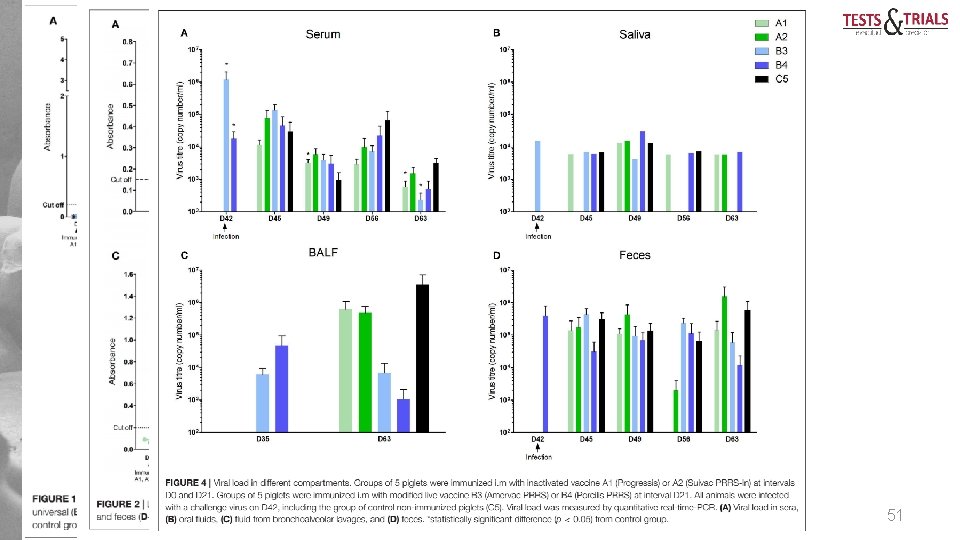
Killed vaccines Toman, M. et al. , 2019. «Dynamics and Differences in Systemic and Local Immune Responses After Vaccination With Inactivated and Live 51
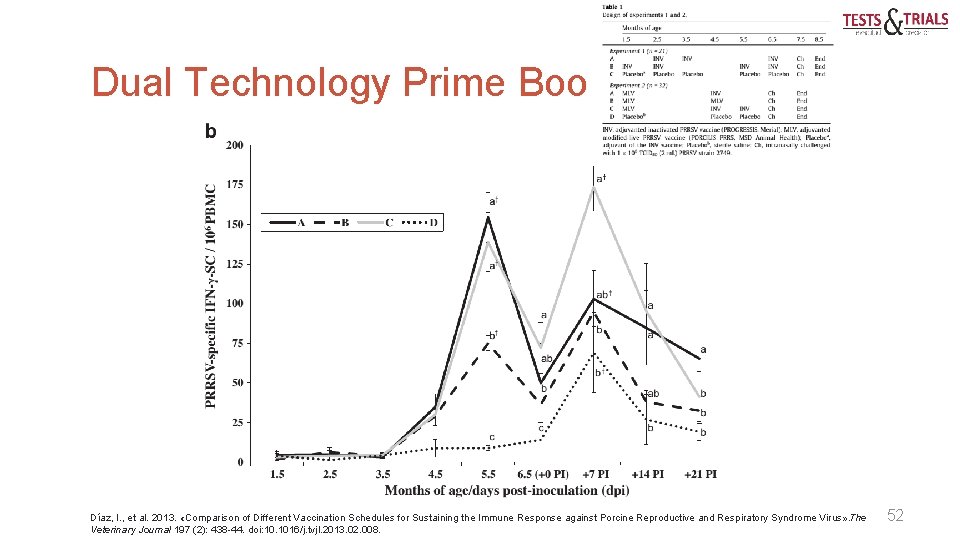
Dual Technology Prime Boost: MLV+ KV • Celullar response IFN-γ- SC: Díaz, I. , et al. 2013. «Comparison of Different Vaccination Schedules for Sustaining the Immune Response against Porcine Reproductive and Respiratory Syndrome Virus» . The Veterinary Journal 197 (2): 438 -44. doi: 10. 1016/j. tvjl. 2013. 02. 008. 52
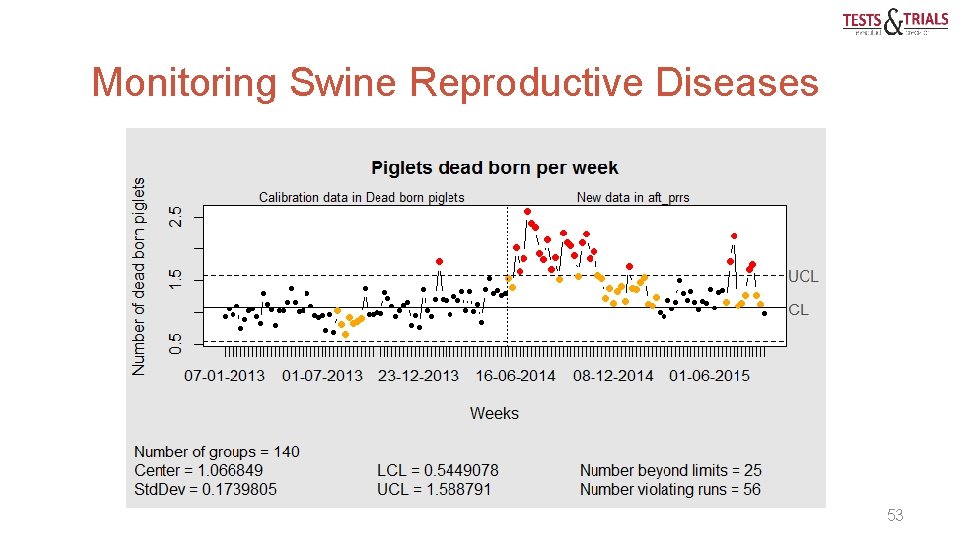
Monitoring Swine Reproductive Diseases 53
• Thanks for your attention 54
- Slides: 54