
Main Menu Start Slide Show Chapter Selection Slide

- Slides: 38
Main Menu Start Slide Show Chapter Selection Slide Selection Audio/Video Exit program
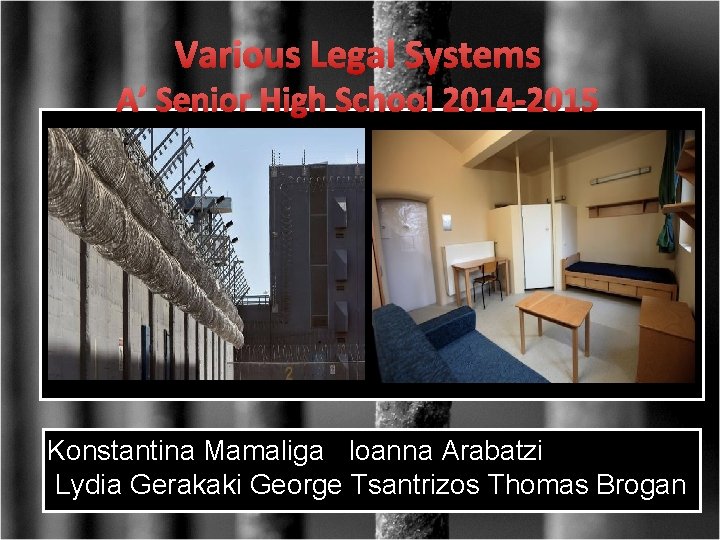
Various Legal Systems A’ Senior High School 2014 -2015 Konstantina Mamaliga Ioanna Arabatzi Lydia Gerakaki George Tsantrizos Thomas Brogan
Teacher: C. Tziva Class: A’ Senior High School Age of Students: 15 years old Duration of Project: 2 months Aims/ Objectives of project: to enhance their vocabulary in legal jargon and theme of violence and justice to broaden their cultural knowledge regarding legal systems in other countries to encourage their critical thinking regarding state punishment.
Contents Ø Places that enforce strict punishments Ø Extreme forms of punishment Ø Types of punishment in different countries Ø Prison systems in developed Vs developing countries Ø Types of prisons Ø Ways of treating juvenile delinquency
Places that enforce strict punishments
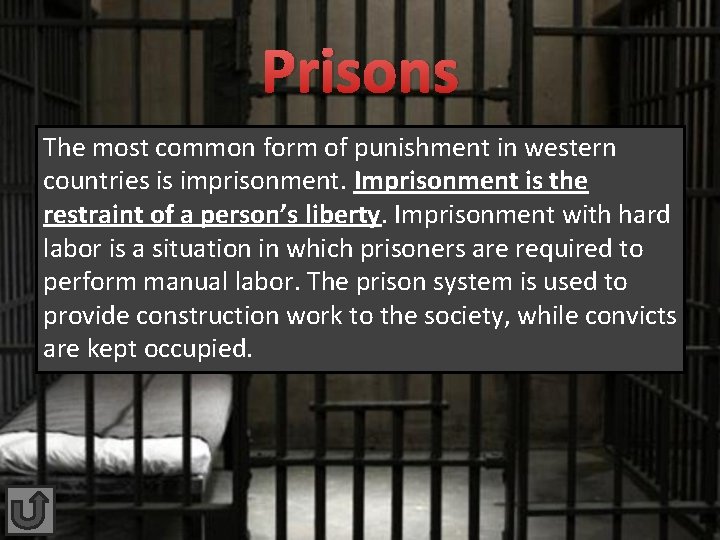
Prisons The most common form of punishment in western countries is imprisonment. Imprisonment is the restraint of a person’s liberty. Imprisonment with hard labor is a situation in which prisoners are required to perform manual labor. The prison system is used to provide construction work to the society, while convicts are kept occupied.
Juvenile Reform Schools are essentially holding places for juvenile offenders. In the last decade of the 20 th century, the military model of the reformatories became popular. In the early 21 th century, various types of institutions for juvenile offenders are in operation, including training schools, ranches, farms and boot camps.
Extreme forms of punishment Societies have developed many methods for punishing crimes over the centuries. Although many of the cruelest punishments have been eradicated, there remain examples of legally-authorized punishment in some parts of the world which can be included among them. • • •
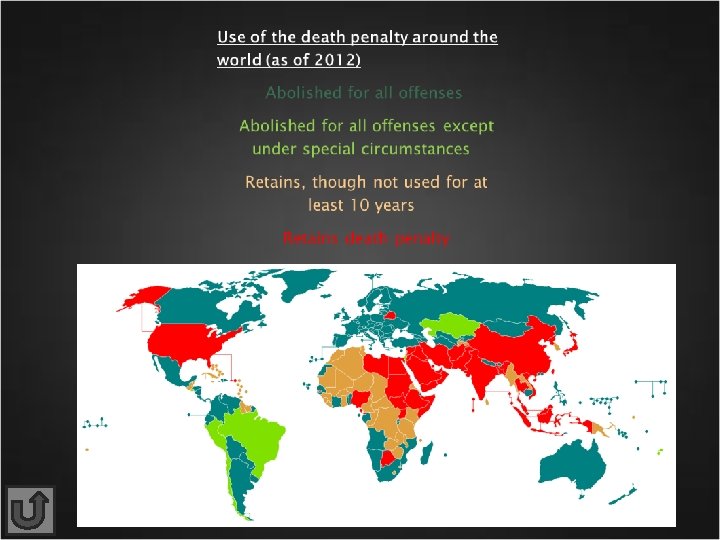
Death Sentence In modern societies the most extreme form of punishment is the Death Sentence. Capital punishment or the death penalty is a legal process whereby a person is put to death by the state as a punishment for a crime. Federal and state courts have upheld modern methods of carrying out the death penalty, such as shooting, hanging, electrocution and lethal injection, as constitutional.
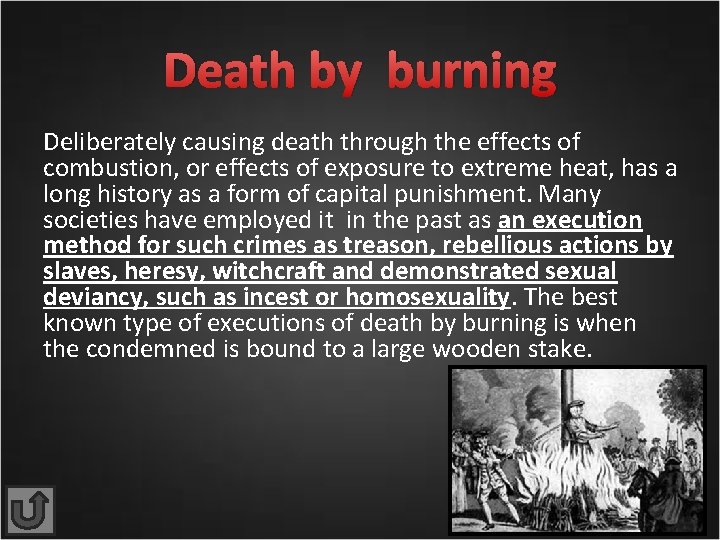
Death by burning Deliberately causing death through the effects of combustion, or effects of exposure to extreme heat, has a long history as a form of capital punishment. Many societies have employed it in the past as an execution method for such crimes as treason, rebellious actions by slaves, heresy, witchcraft and demonstrated sexual deviancy, such as incest or homosexuality. The best known type of executions of death by burning is when the condemned is bound to a large wooden stake.
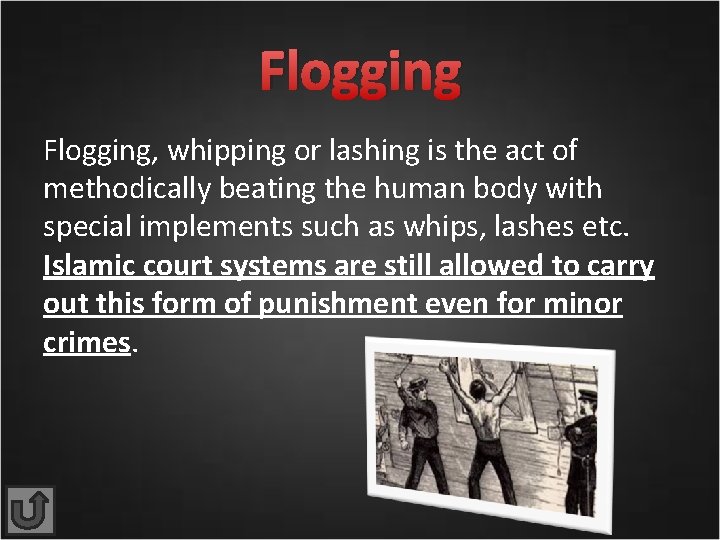
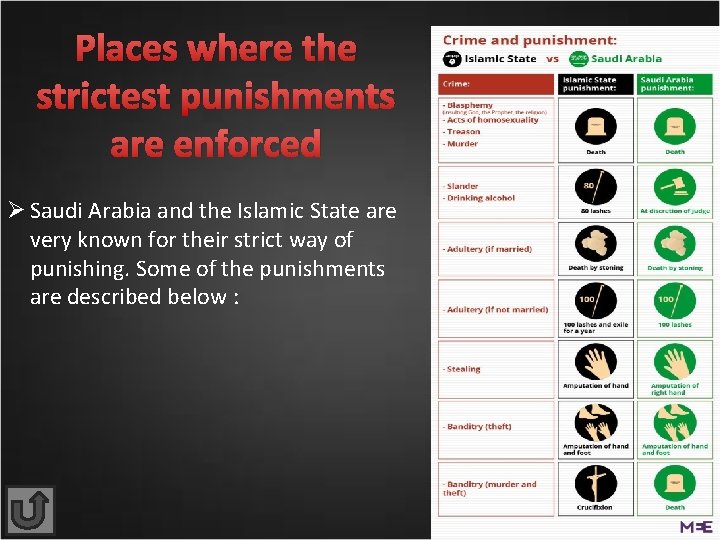
Flogging, whipping or lashing is the act of methodically beating the human body with special implements such as whips, lashes etc. Islamic court systems are still allowed to carry out this form of punishment even for minor crimes.
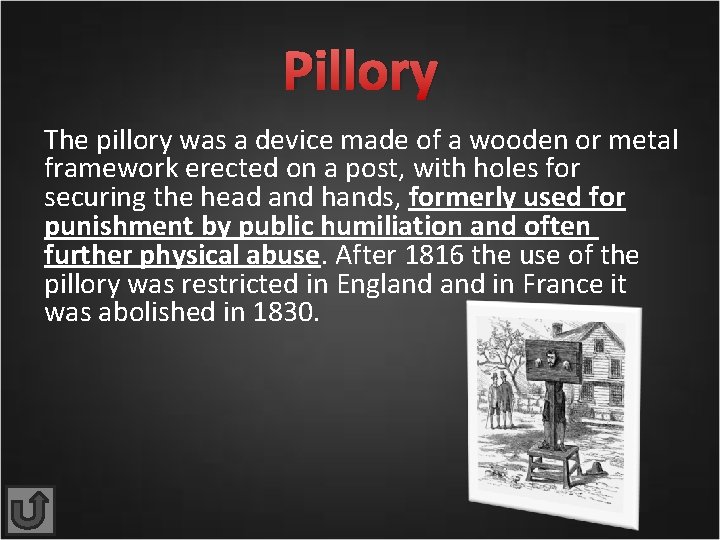
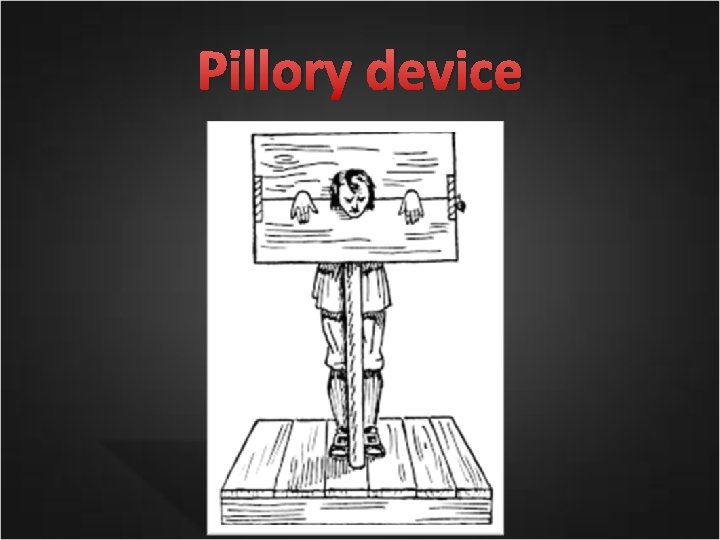
Pillory The pillory was a device made of a wooden or metal framework erected on a post, with holes for securing the head and hands, formerly used for punishment by public humiliation and often further physical abuse. After 1816 the use of the pillory was restricted in England in France it was abolished in 1830.
Pillory device
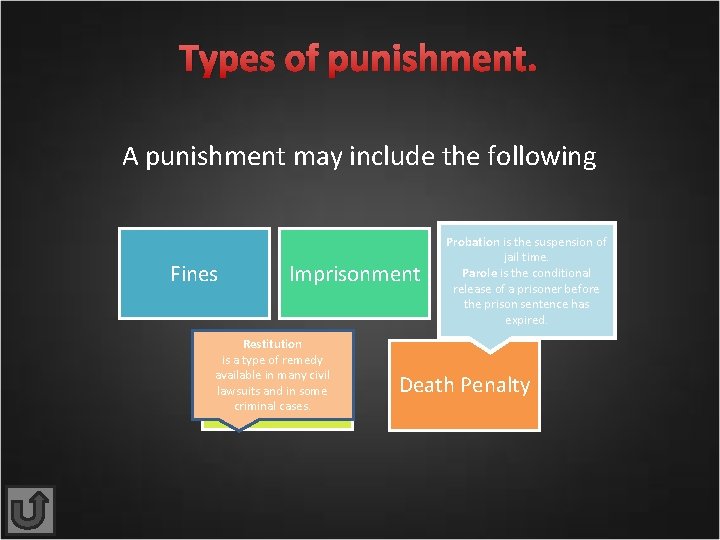
Types of punishment. A punishment may include the following Fines Imprisonment Restitution is a type of remedy available in many civil lawsuits and in some criminal cases. Restitution Probation is the suspension of jail time. Parole is the conditional release of a prisoner before the prison sentence has expired. Probation or Parole Death Penalty
Places where the strictest punishments are enforced Ø Saudi Arabia and the Islamic State are very known for their strict way of punishing. Some of the punishments are described below :
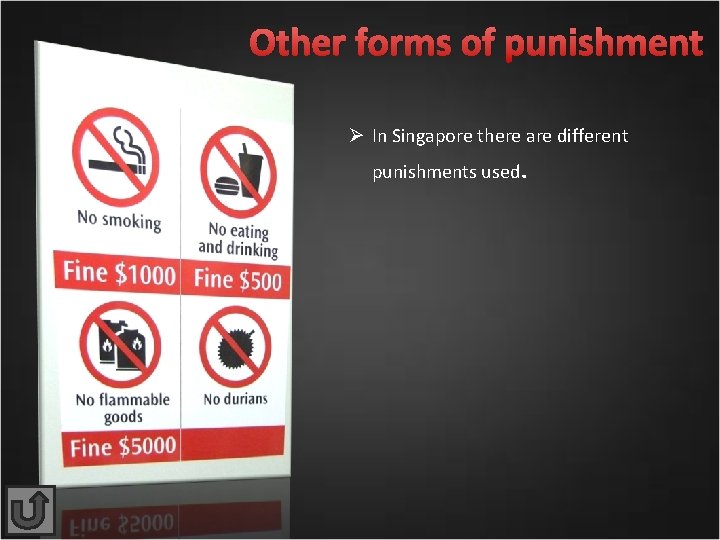
Other forms of punishment Ø In Singapore there are different punishments used .
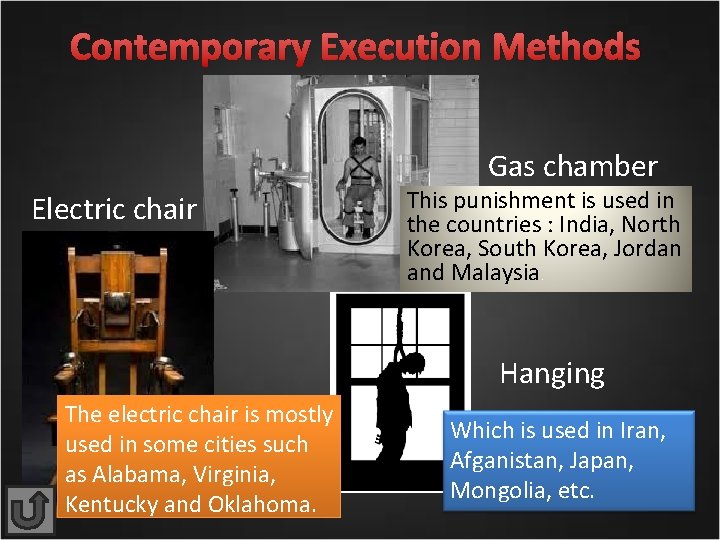
Contemporary Execution Methods Gas chamber Electric chair This punishment is used in the countries : India, North Korea, South Korea, Jordan and Malaysia. Hanging The electric chair is mostly used in some cities such as Alabama, Virginia, Kentucky and Oklahoma. Which is used in Iran, Afganistan, Japan, Mongolia, etc.
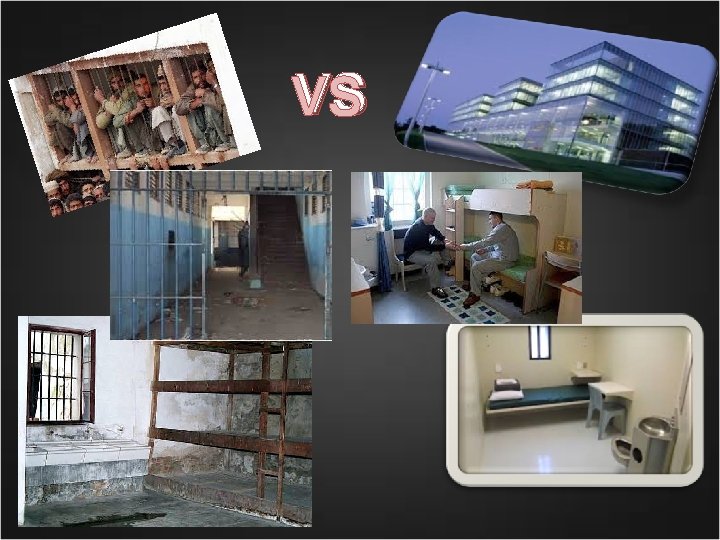
Prison System in Developing Countries In developing countries, local prisoners rely on their family to supplement their diet by bringing in food for them to the prisons. Foreign prisoners are at a disadvantage as they are dependent on money sent to them by their families back home. Many foreign prisoners' families however cannot afford to send money.
Prison System in Developed Countries In developed countries the facilities are more advanced than in developing countries, each block possesses multiple shower rooms, a large food court and a central court yard. The facilities are kept clean and food is stocked at regular intervals. Inmates do not require to have family to bring extra food since there are enough meals.
VS VS
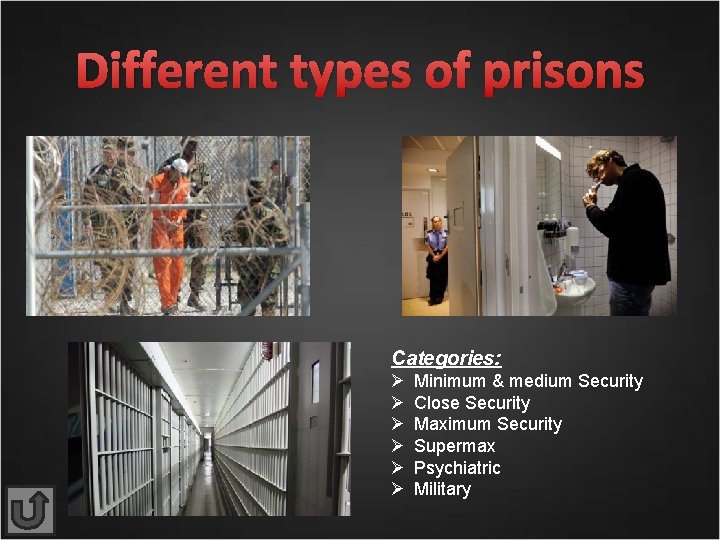
Different types of prisons Categories: Ø Ø Ø Minimum & medium Security Close Security Maximum Security Supermax Psychiatric Military
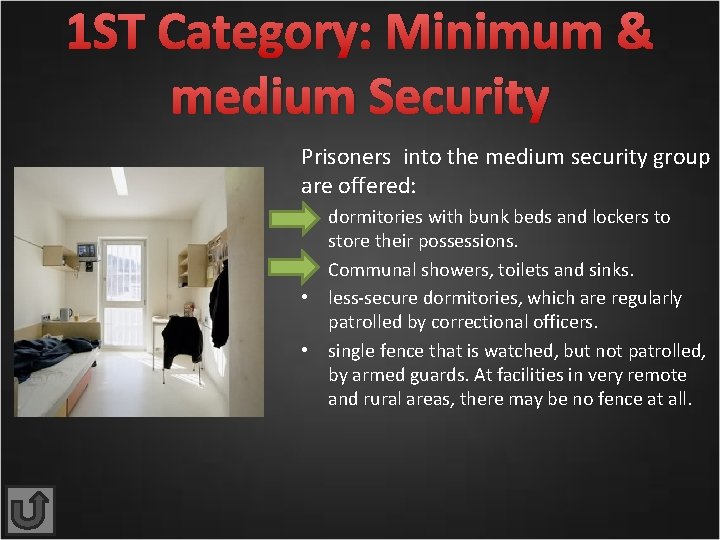
1 ST Category: Minimum & medium Security Prisoners into the medium security group are offered: • dormitories with bunk beds and lockers to store their possessions. • Communal showers, toilets and sinks. • less-secure dormitories, which are regularly patrolled by correctional officers. • single fence that is watched, but not patrolled, by armed guards. At facilities in very remote and rural areas, there may be no fence at all.
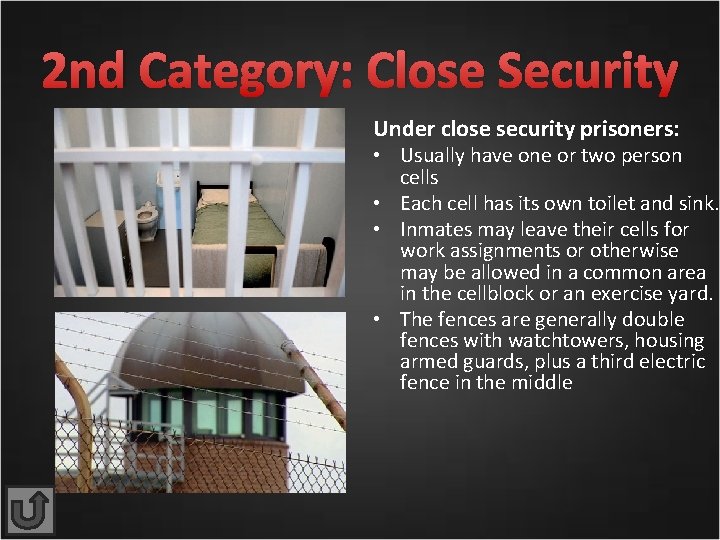
2 nd Category: Close Security Under close security prisoners: • Usually have one or two person cells • Each cell has its own toilet and sink. • Inmates may leave their cells for work assignments or otherwise may be allowed in a common area in the cellblock or an exercise yard. • The fences are generally double fences with watchtowers, housing armed guards, plus a third electric fence in the middle
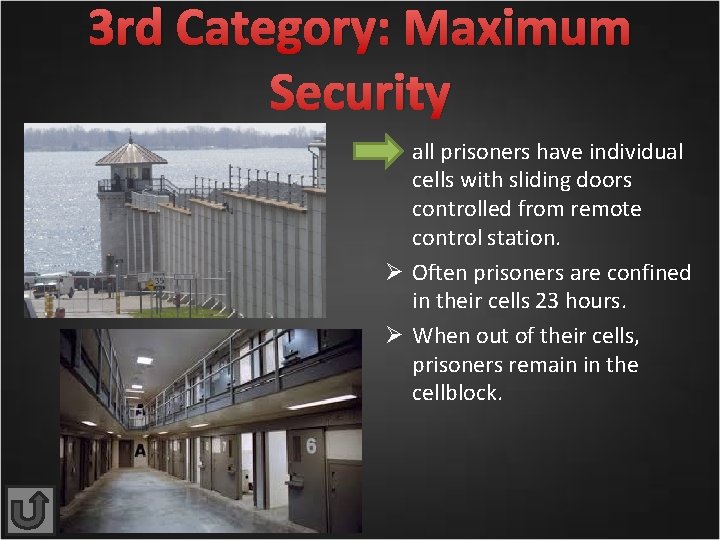
3 rd Category: Maximum Security Ø all prisoners have individual cells with sliding doors controlled from remote control station. Ø Often prisoners are confined in their cells 23 hours. Ø When out of their cells, prisoners remain in the cellblock.
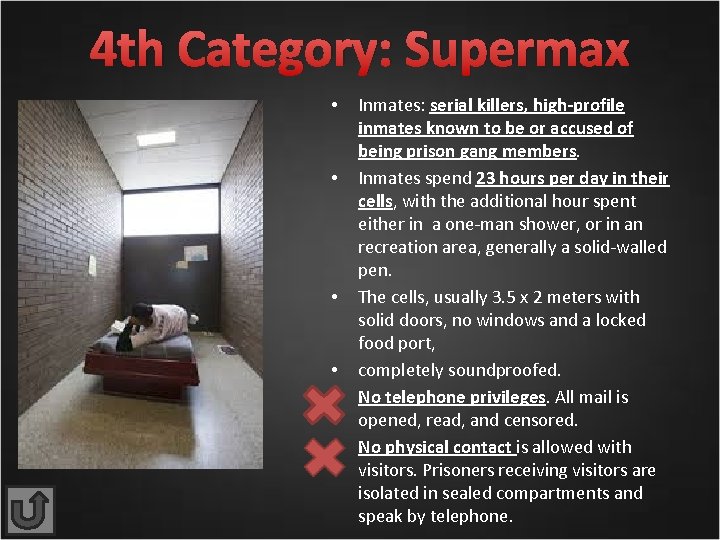
4 th Category: Supermax • • • Inmates: serial killers, high-profile inmates known to be or accused of being prison gang members. Inmates spend 23 hours per day in their cells, with the additional hour spent either in a one-man shower, or in an recreation area, generally a solid-walled pen. The cells, usually 3. 5 x 2 meters with solid doors, no windows and a locked food port, completely soundproofed. No telephone privileges. All mail is opened, read, and censored. No physical contact is allowed with visitors. Prisoners receiving visitors are isolated in sealed compartments and speak by telephone.
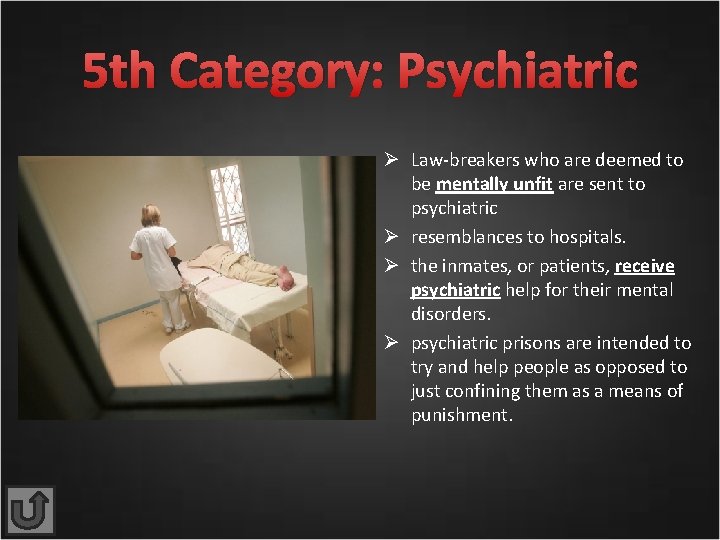
5 th Category: Psychiatric Ø Law-breakers who are deemed to be mentally unfit are sent to psychiatric Ø resemblances to hospitals. Ø the inmates, or patients, receive psychiatric help for their mental disorders. Ø psychiatric prisons are intended to try and help people as opposed to just confining them as a means of punishment.
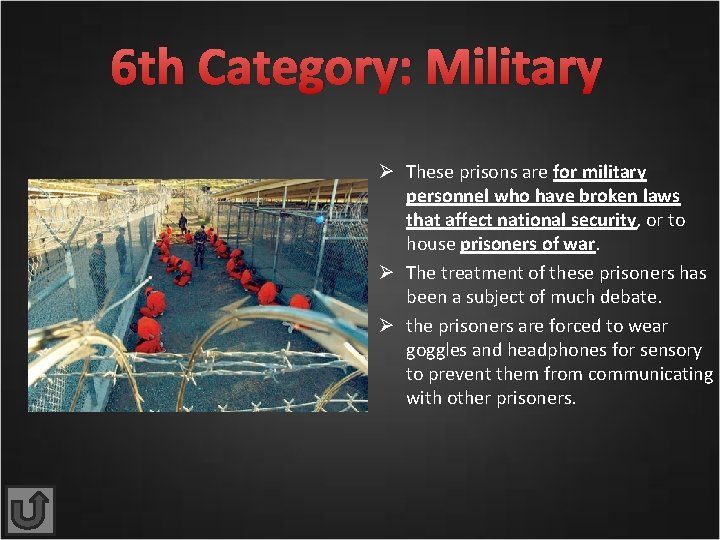
6 th Category: Military Ø These prisons are for military personnel who have broken laws that affect national security, or to house prisoners of war. Ø The treatment of these prisoners has been a subject of much debate. Ø the prisoners are forced to wear goggles and headphones for sensory to prevent them from communicating with other prisoners.
Causes of Juvenile Delinquency FAMILY: • Parents extremely bossy and mentally ill, who abuse their children, being a negative example for them. • They do not offer neither love and care, nor the appropriate intellectual and ethical education. • Lack of communication between children-parents • Indifference from the parents towards the kids, which hurts their emotional world.
Causes of Juvenile Delinquency SCHOOL: • Educational failure, interruption of the studies. • Utilitarian education instead of humanitarian education. • Lack of psychologists and absence of preventive programs against violence.
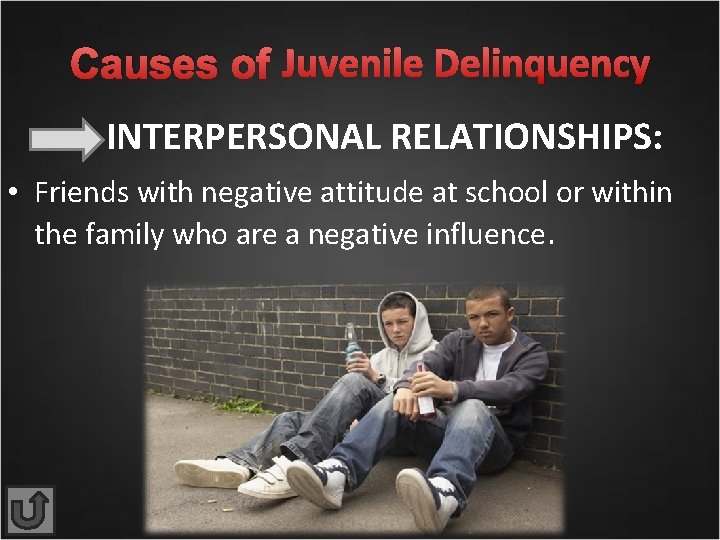
Causes of Juvenile Delinquency INTERPERSONAL RELATIONSHIPS: • Friends with negative attitude at school or within the family who are a negative influence.
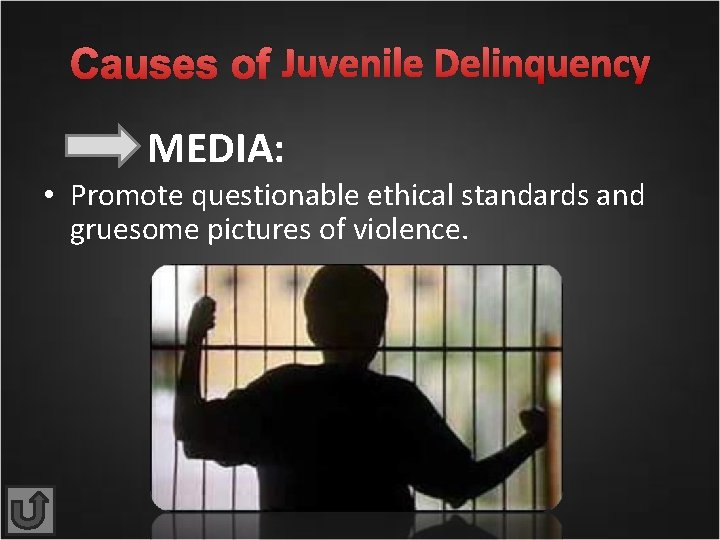
Causes of Juvenile Delinquency MEDIA: • Promote questionable ethical standards and gruesome pictures of violence.
Causes of Juvenile Delinquency SOCIAL AND POLITICAL SYSTEM (VALUES & WAYS OF LIVING): • Urbanism: lack of outside areas for sports and juvenile centers confinement in apartments-cages. • Consumeristic role models money is the superior value. • Corruption • Negative examples • Social inequality • Unemployment • Marginalization • Social exclusion • Diminished ethical principles
WAYS OF DEALING WITH JUVENILE DELINQUENCY FAMILY-SCHOOL-MEDIA: ØPromotion of healthy standards. ØFormation of people who are characterized by the feeling of responsibility. ØCreativity ØBelief in values ØSelf-control, composure ØFruitful dialogue ØCollaboration between family and school ØPromotion of vision for a society of solidarity
WAYS OF DEALING WITH JUVENILE DELINQUENCY STATE & JUSTICE: Ø Work initiative including measures of social policy (for poor and unemployed) Ø Presence of psychologists is necessary in every school Ø Concern for reintegration of juvenile offenders (not stigmatization, but protection of children from adult) Ø avoidance of confinement in institutions
K N A H T ! U O Y
Sources • http: //www. legalmatch. com/law-library/article/criminalpunishments. html • http: //www. washingtonpost. com/blogs/worldviews/wp/2015/01/21/how -saudi-arabias-harsh-legal-punishments-compare-to-the-islamic-states/ • http: //criminal. lawyers. com/criminal-law-basics/punishment-ofcrime. html • http: //en. wikipedia. org/wiki/Capital_punishment • http: //www. incarceration 101. com/types-of-prisons. php • http: //www. crimemuseum. org/crime-library/types-of-prisons • ΕΚΦΡΑΣΗ- ΕΚΘΕΣΗ, εκδώσεις Σαββάλας (κ. Ν. Τρίγκα-κ. Μαστρομανώλη)[σχολικός εκφοβισμός]
Slide Selection A/V 1 2 3 4 5 6 7 8 9 10 11 12 13 14 15 16 17 18 19 20 21 22 23 24 25 26 27 28 29 30 31 32 33 34 35 36 37 Return Color Index