
Main Legal and Normative Acts Constitution of the



- Slides: 26
Main Legal and Normative Acts Конституция Российской Федерации (Constitution of the Russian Federation) Art. 7 . . . Occupational safety and health protection. . . Art. 37. . . Everybody has right to labor in conditions meeting the requirements of safety and hygiene. . . Трудовой кодекс РФ-ТК РФ (RF Labor Code-LC RF) the aim of the labor legislation is to establish state guarantees of labor rights and freedom of the citizens; create labor favorable conditions, protect the rights and the interests of the employees and employers. Постановление Минтруда РФ от 24. 10. 02 № 73, утвердившее «Положение об особенностях расследования несчастных случаев на производстве в отдельных отраслях и организациях» (Decree of the RF Ministry of Labor dated 24. 10. 02 № 73, which approved «Regulation on specifics of work injuries investigation in separate branches and organizations» ) 1
Main State Duties on Ensuring Safe Conditions and Occupational Safety - Ensure priority of employees life and health sustaining; - Adopt and implement Federal Laws and other normative legal acts; - Occupational safety State control; - Investigate work injuries and occupational diseases; - Protect legal interests of the employees suffered from work injuries and occupational diseases, as well as members of their families based on the mandatory social insurance of the employees against work injuries and professional diseases; - Establish compensations for hard work and the work with harmful working conditions; - Distribute the advanced native and foreign work experience on improvement of the working and occupational safety conditions; - State participation in financing measures on occupational safety; - Occupational safety specialists training and advanced training; - International cooperation in the field of occupational safety; - Conduct effective taxation policy stimulating creation of safe working conditions; - Establish procedure of ensuring employees with personal and collective protective equipment. - etc. 2
Main Employer’s Duties on Ensuring Safe Conditions and Occupational Safety The employer must ensure: ü Employees safety ü Working conditions at each work place relevant to occupational safety requirements; ü Employees schedule of work and rest; ü Training with safe methods and techniques of work execution, occupational safety briefing, probation at working places of the employees and knowledge testing of occupational safety requirements; ü Arrange control for working conditions status at the work places; ü Inform employees about conditions and occupational safety at the work places; ü Take actions on emergency situations prevention; ü Investigate work injuries and professional diseases; ü Etc. 3
Main Employee’s Duties on Ensuring Safe Conditions and Occupational Safety Employee is obliged to : ü Follow occupational safety requirements; ü Undergo training of safe methods and procedures of works execution, occupational safety briefing, probation at the working place and knowledge testing of occupational safety requirements; ü Inform immediately his own direct or higher rank leader about any situation threatening life and health of the people, about every injury occurred at the plant, or about worsening his health status, as well as about manifestation of acute professional disease (poisoning); 4
Main Office-manager’s Duties on Ensuring Safe Conditions and Occupational Safety • Organize trainings and briefings; • Control following laws, rules and other local acts on occupational safety of the organization; • Organize work on preventing work injuries, professional diseases conditioned by the production factors, as well as works on working conditions improvement; • Inform and provide consultations on occupational safety issues for the employees; • Study and distribution of the advanced experience on occupational safety, propaganda of occupational safety issues. 5
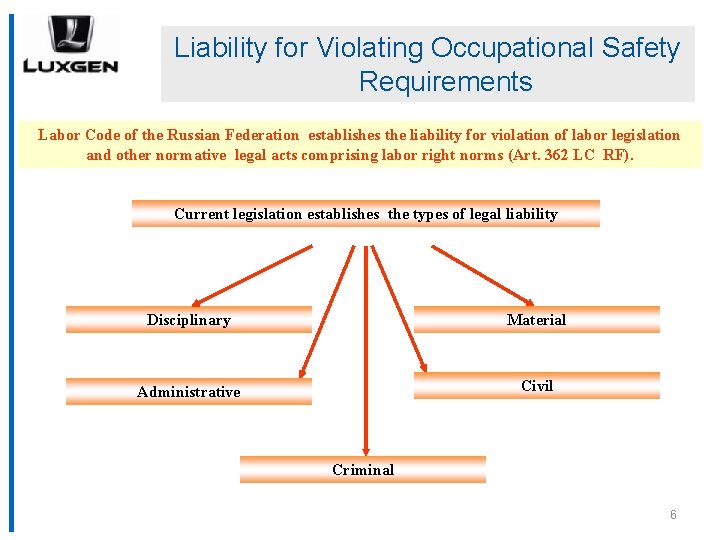
Liability for Violating Occupational Safety Requirements Labor Code of the Russian Federation establishes the liability for violation of labor legislation and other normative legal acts comprising labor right norms (Art. 362 LC RF). Current legislation establishes the types of legal liability Disciplinary Material Administrative Civil Criminal 6
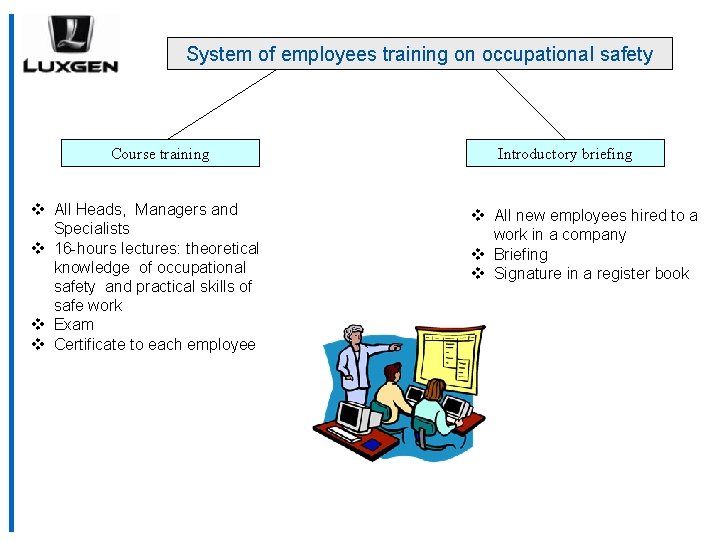
System of employees training on occupational safety Course training v All Heads, Managers and Specialists v 16 -hours lectures: theoretical knowledge of occupational safety and practical skills of safe work v Exam v Certificate to each employee Introductory briefing v All new employees hired to a work in a company v Briefing v Signature in a register book
Internal work Regulation \lrdc 01Luxgen_CommonHRPublicLLCPolitics_and_ Regulations AIM: - to promote the strengthening of the labor discipline, regulation of the employment and dismissal order, efficient use by the employees of their working and resting time, high quality of works, improvement of labor efficiency - to establish the mutual rights and obligations of the Employer and the employees, as well as the responsibility for their observance and performance. The Regulation is binding on all the employees 1. 2. 3. 4. Working time: Monday – Friday since 9 a. m. till 6 p. m. Lunch time: 1 hour within the period from 1 till 3 p. m. Annual leave Sick leave 8
Labour protection requirements BEFORE starting the work The Employees are obligated to: - inspect the workplace and put it in order; at the workplace there should not be any devices, equipment and other accessories which are not used during work; - check light at the workplace; - check correctness of the connection of equipment to the power supply network, visually inspect cords whether they have fractures, cracks or other damages; - check correctness of installation of the table, chair, position of equipment, slope angle of screen, position of keyboard. - inform immediate supervisor or office manager about all irregularities and malfunctions of the equipment 9
Labour protection requirements DURING the work The Employees are obligated to: - To perform only the work for which the Employee was trained and which is specified in his/her job description; - During any work, the Employees should be careful, not hurry and should perform the work with the use of safe methods; - Immediately stop working, switch off the PC, other electric equipment and inform the supervisor if any problems occur with the equipment; - When being at a workplace, the Employee should not perform any action which can cause an accident: Ø Not to rock on a chair; Ø Not to touch bared wires; Ø Not to use equipment with wet hands; Ø Not to swing any sharp and cutting subjects; Ø Not to take food and drinks of any nature and content. - To keep the workplace in order and clean for the whole working day. - The PC screen should be cleaned from dust at least once a day. 10
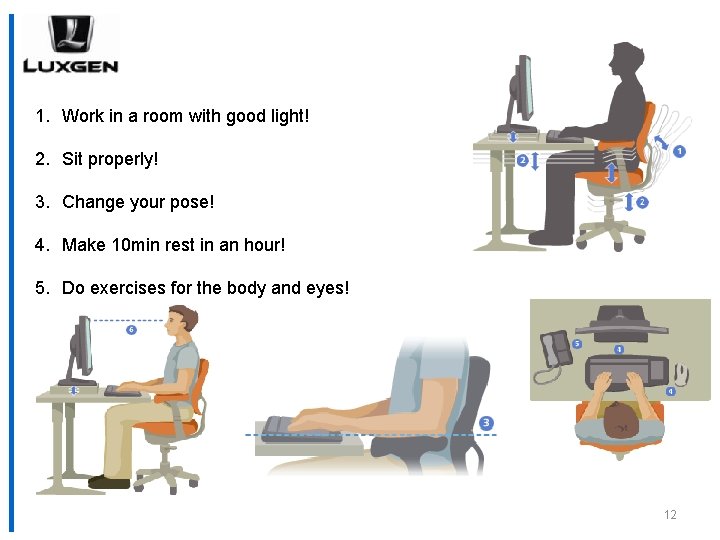
When working with a PC, it is necessary to perform the following: - To comply with the operating instructions for the PC according to the operating manuals; - The distance from the employees’ eyes to the screen should be within 60 - 80 cm; - The local light source should be placed in relation to the workplace so to exclude any hit of direct light to eyes; - If the screen should be watched from time to time: the screen should be on the right, the keyboard – opposite the right shoulder, and documents – in the centre. In case of the regular job, the screen should be in the centre of the field of view, documents – on the left on the table or on a special support. - To decrease visual and general fatigue, after each hour of work at the screen it is necessary to use 10 -minutes pauses for the rest. - When working with any text information, to select the most comfortable mode of visualisation of black characters on white background; - To comply with the regulated rest periods provided for by the work schedule and to perform recommended exercises for eyes, neck, arms, body, legs during physical training breaks 11
1. Work in a room with good light! 2. Sit properly! 3. Change your pose! 4. Make 10 min rest in an hour! 5. Do exercises for the body and eyes! 12
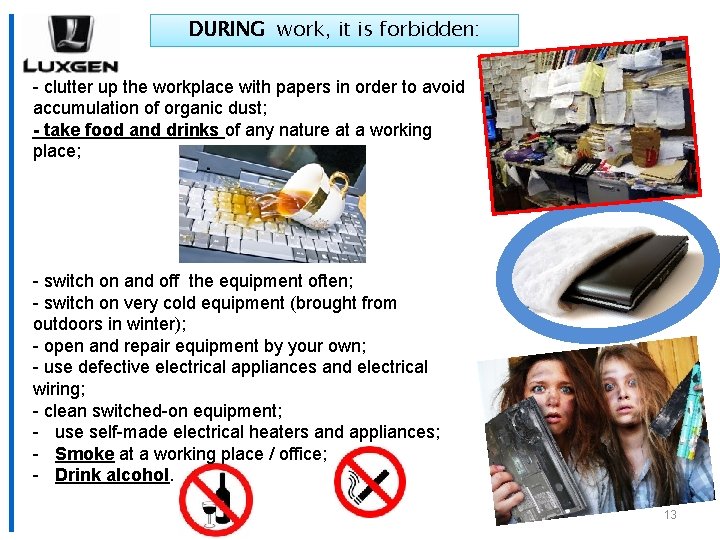
DURING work, it is forbidden: - clutter up the workplace with papers in order to avoid accumulation of organic dust; - take food and drinks of any nature at a working place; - switch on and off the equipment often; - switch on very cold equipment (brought from outdoors in winter); - open and repair equipment by your own; - use defective electrical appliances and electrical wiring; - clean switched-on equipment; - use self-made electrical heaters and appliances; - Smoke at a working place / office; - Drink alcohol. 13
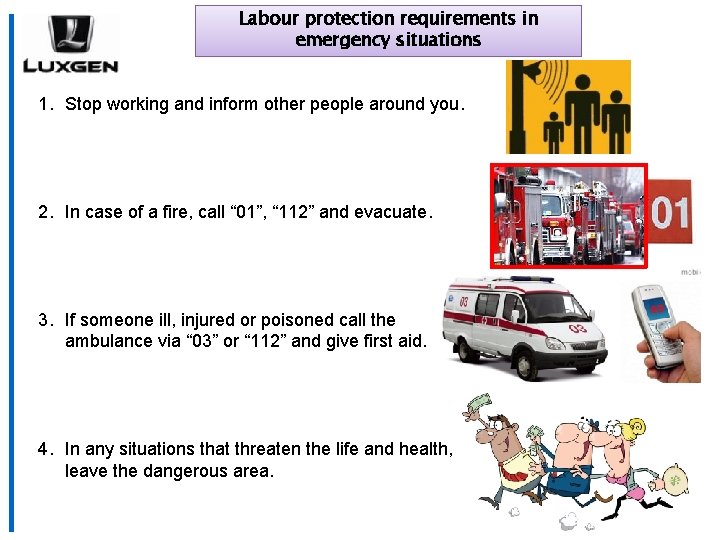
Labour protection requirements in emergency situations 1. Stop working and inform other people around you. 2. In case of a fire, call “ 01”, “ 112” and evacuate. 3. If someone ill, injured or poisoned call the ambulance via “ 03” or “ 112” and give first aid. 4. In any situations that threaten the life and health, leave the dangerous area. 14
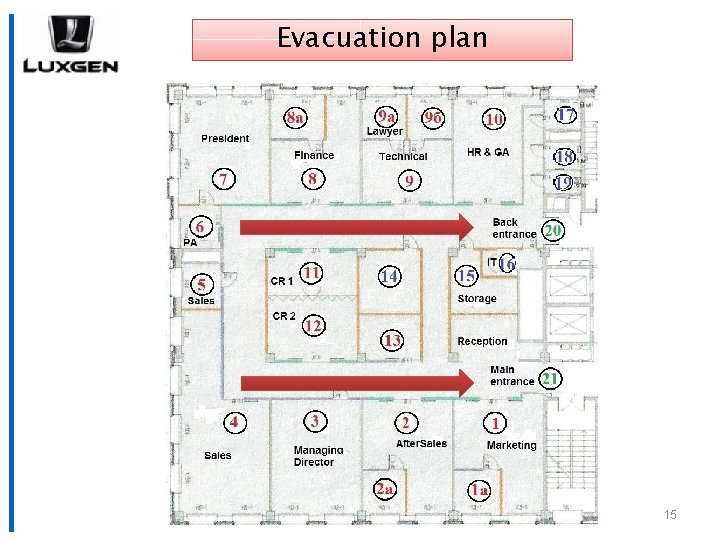
Evacuation plan 15
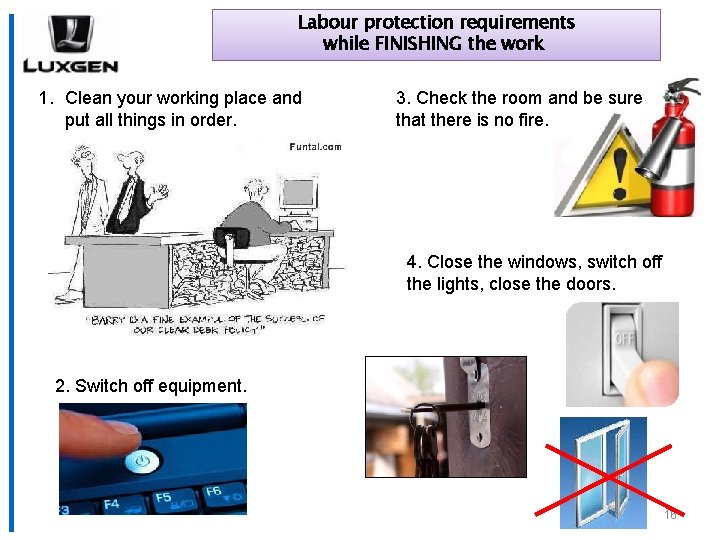
Labour protection requirements while FINISHING the work 1. Clean your working place and put all things in order. 3. Check the room and be sure that there is no fire. 4. Close the windows, switch off the lights, close the doors. 2. Switch off equipment. 16
Electrical safety
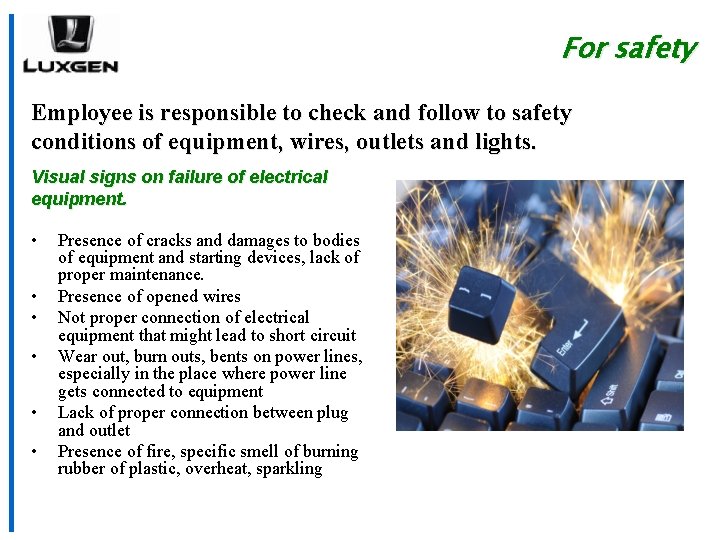
For safety Employee is responsible to check and follow to safety conditions of equipment, wires, outlets and lights. Visual signs on failure of electrical equipment. • • • Presence of cracks and damages to bodies of equipment and starting devices, lack of proper maintenance. Presence of opened wires Not proper connection of electrical equipment that might lead to short circuit Wear out, burn outs, bents on power lines, especially in the place where power line gets connected to equipment Lack of proper connection between plug and outlet Presence of fire, specific smell of burning rubber of plastic, overheat, sparkling
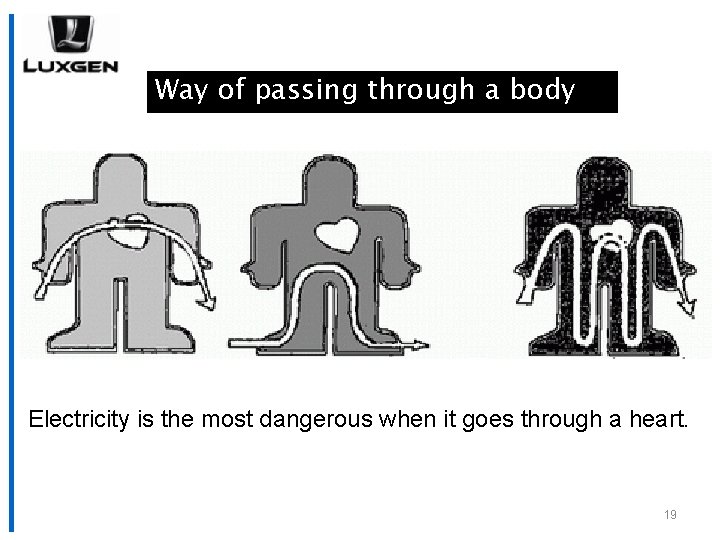
Way of passing through a body Electricity is the most dangerous when it goes through a heart. 19
It is prohibited for employees to: 1. Use of electrical equipment without preliminary study of its work conditions and manuals; 2. Use damaged electrical equipment; 3. Remove plug out of outlet by pulling the wire; 4. Switch on and off the equipment often; 5. Switch on very cold equipment (brought from outdoors in winter); 6. Open and repair equipment by your own; 7. Use defective equipment; 8. Clean switched-on equipment with wet rags; 9. Use self-made electrical heaters and appliances; 10. Move equipment without disconnection it from power lines, drop power plugs on floor; 11. Use of extension plugs; 12. Use of electrical heaters without protection covers; 13. Put electrical lines of electrical equipment on wet or hot surfaces, in places where they might have tear out, bent or expansion;
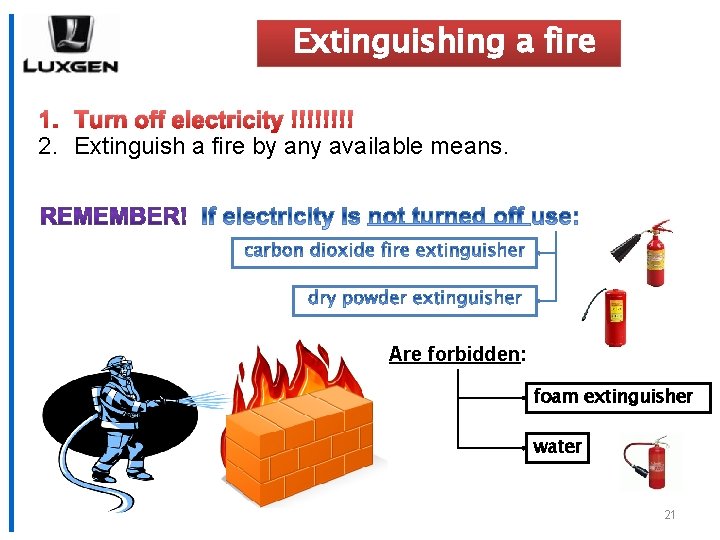
Extinguishing a fire 1. Turn off electricity !!!! 2. Extinguish a fire by any available means. Are forbidden: foam extinguisher water 21
First Aid Kit
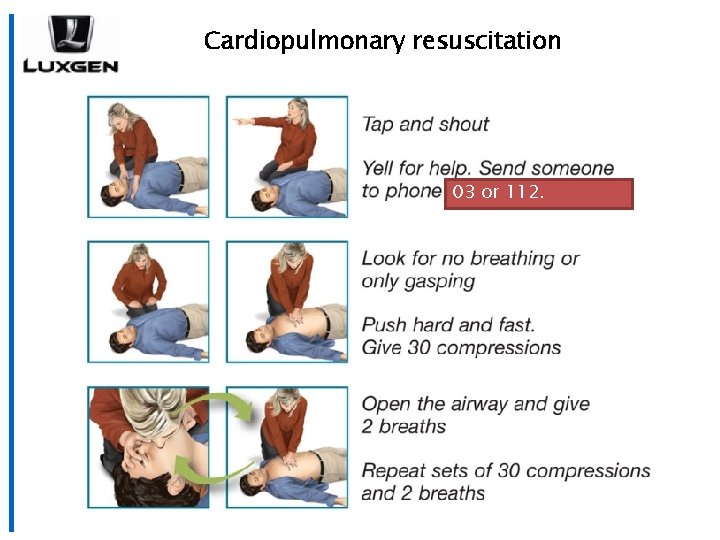
Cardiopulmonary resuscitation 03 or 112.
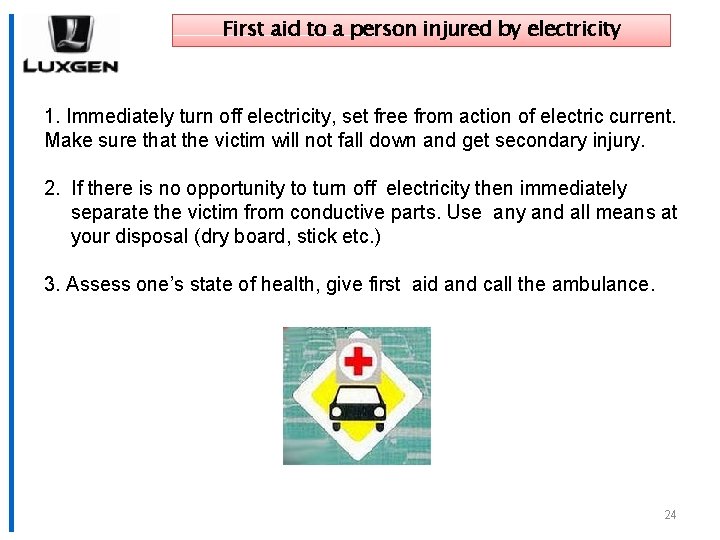
First aid to a person injured by electricity 1. Immediately turn off electricity, set free from action of electric current. Make sure that the victim will not fall down and get secondary injury. 2. If there is no opportunity to turn off electricity then immediately separate the victim from conductive parts. Use any and all means at your disposal (dry board, stick etc. ) 3. Assess one’s state of health, give first aid and call the ambulance. 24
Results: The very first aid to the victim - it is your attitude towards it. Dial 03 or 112 and call the ambulance!!