
Main ideas of a NMR quantum computer Advantages
- Slides: 33
Main ideas of a NMR quantum computer
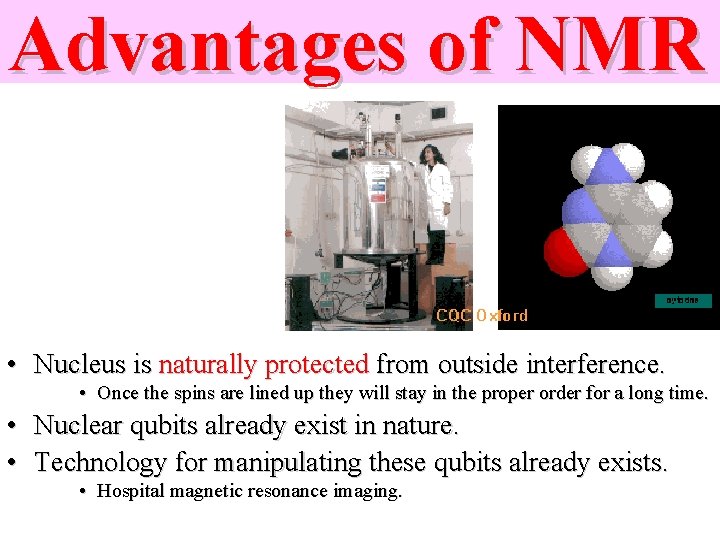
Advantages of NMR • Nucleus is naturally protected from outside interference. • Once the spins are lined up they will stay in the proper order for a long time. • Nuclear qubits already exist in nature. • Technology for manipulating these qubits already exists. • Hospital magnetic resonance imaging.
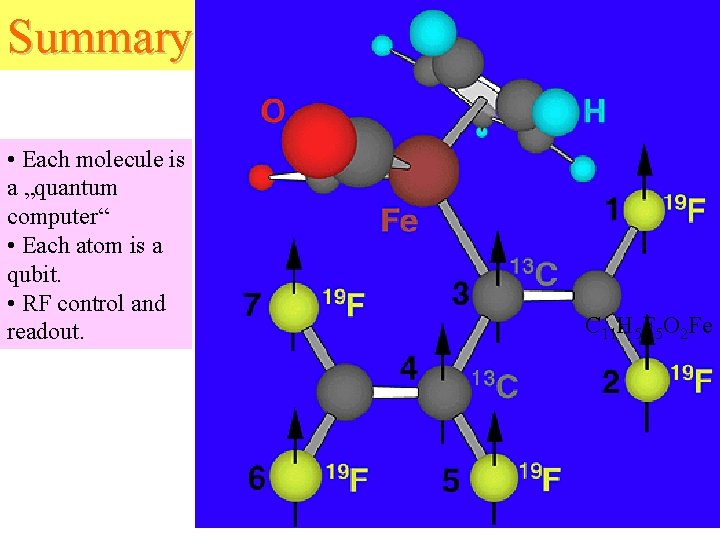
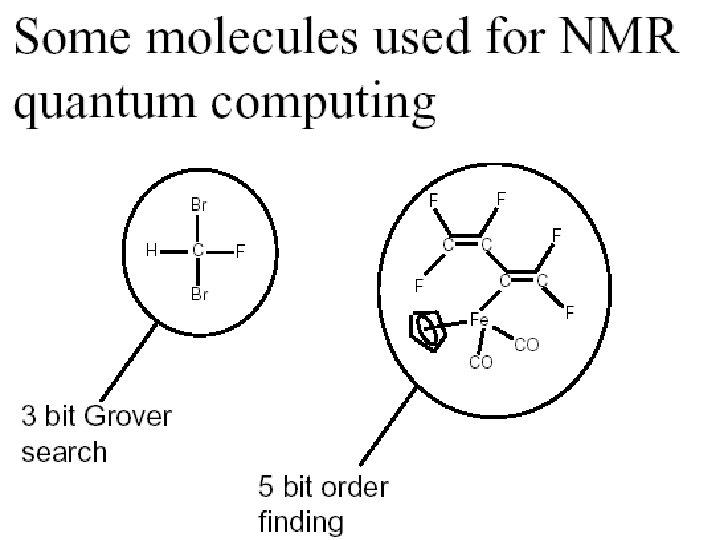
Summary • Each molecule is a „quantum computer“ • Each atom is a qubit. • RF control and readout. C 11 H 5 F 5 O 2 Fe
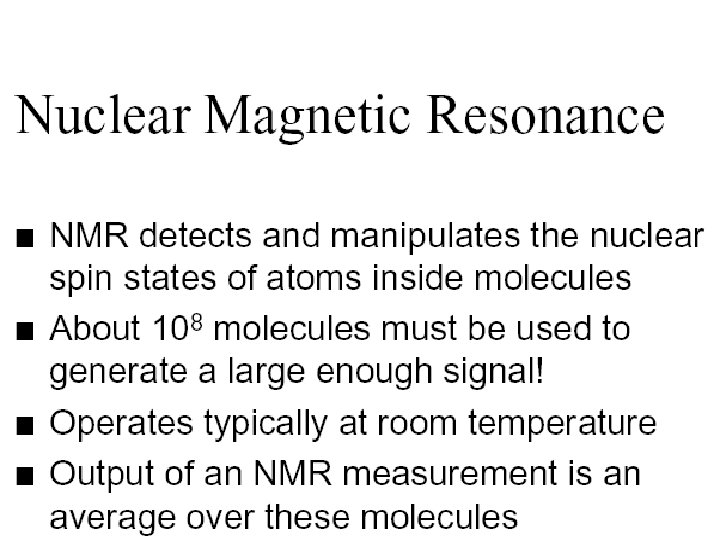
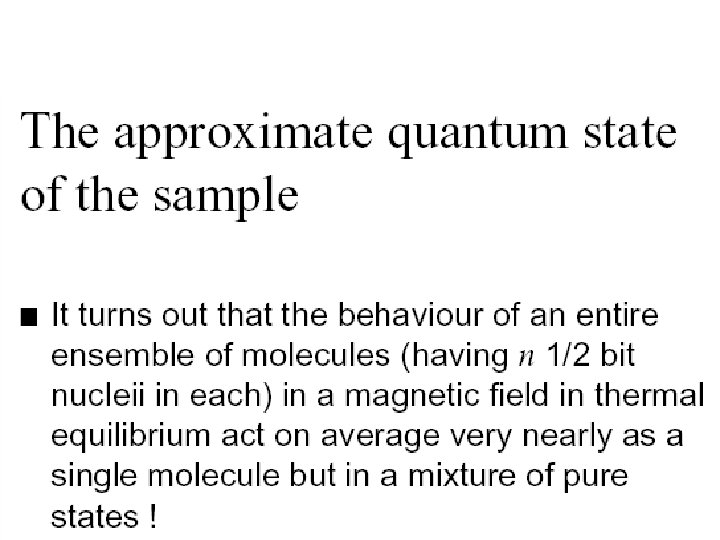
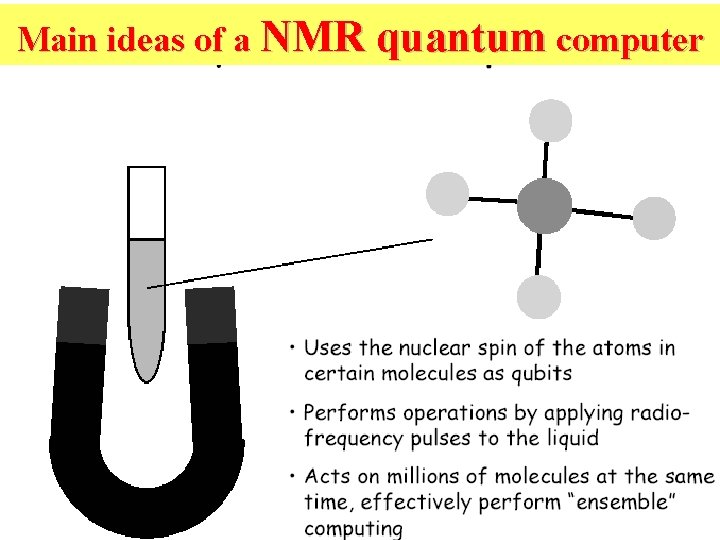
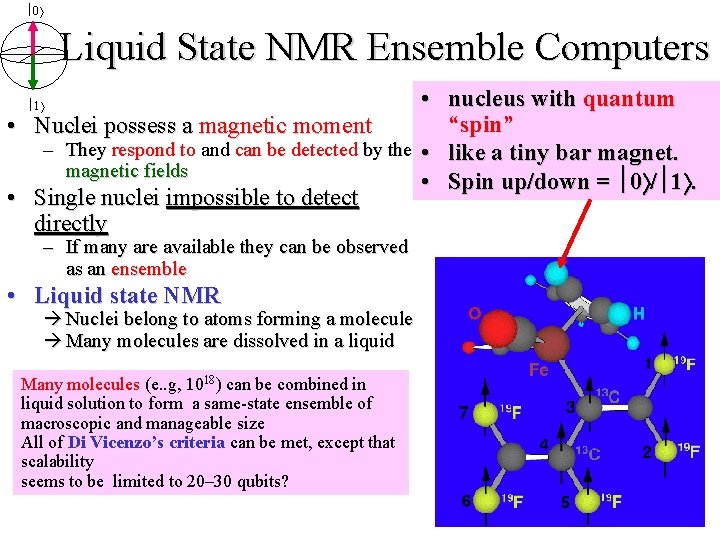
0 Liquid State NMR Ensemble Computers • nucleus with quantum “spin” • Nuclei possess a magnetic moment – They respond to and can be detected by their • like a tiny bar magnetic fields • Spin up/down = 0 / 1. • Single nuclei impossible to detect directly 1 – If many are available they can be observed as an ensemble • Liquid state NMR à Nuclei belong to atoms forming a molecule à Many molecules are dissolved in a liquid Many molecules (e. . g, 1018) can be combined in liquid solution to form a same-state ensemble of macroscopic and manageable size All of Di Vicenzo’s criteria can be met, except that scalability seems to be limited to 20– 30 qubits?
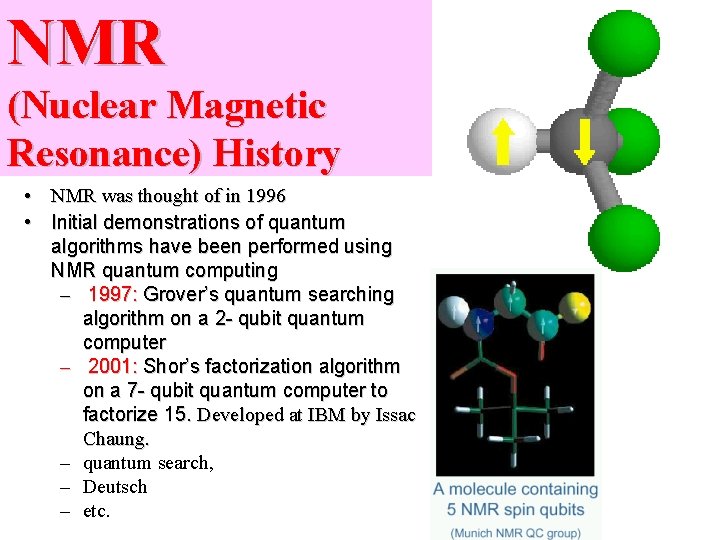
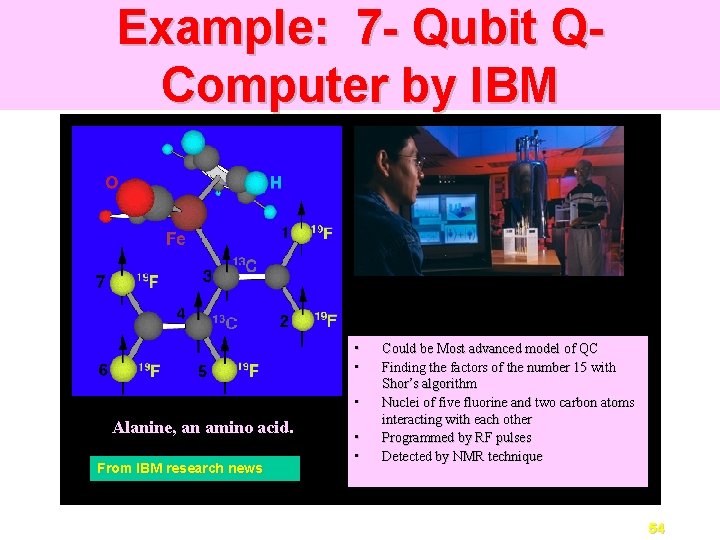
NMR (Nuclear Magnetic Resonance) History • NMR was thought of in 1996 • Initial demonstrations of quantum algorithms have been performed using NMR quantum computing – 1997: Grover’s quantum searching algorithm on a 2 - qubit quantum computer – 2001: Shor’s factorization algorithm on a 7 - qubit quantum computer to factorize 15. Developed at IBM by Issac Chaung. – quantum search, – Deutsch – etc.
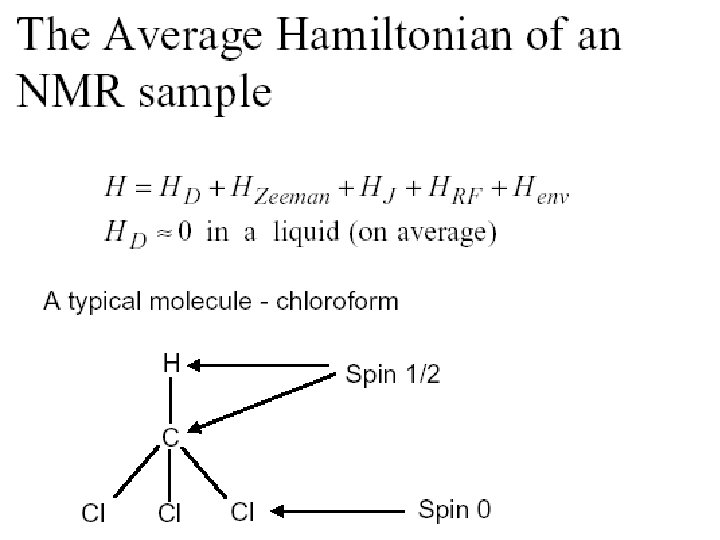
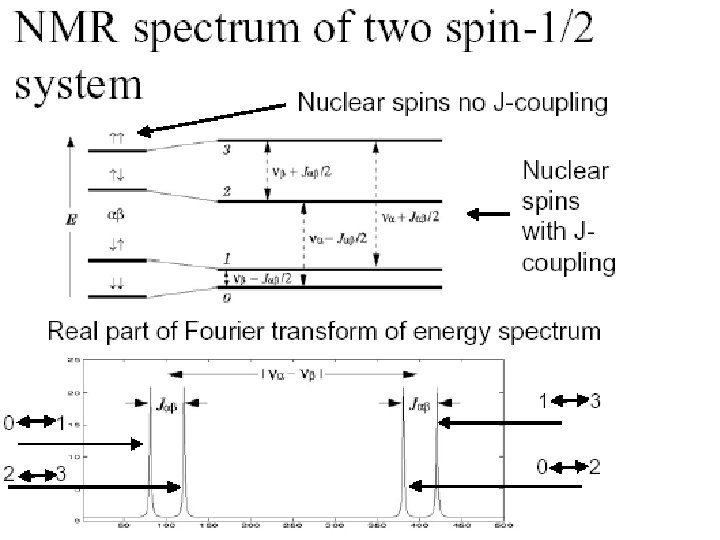
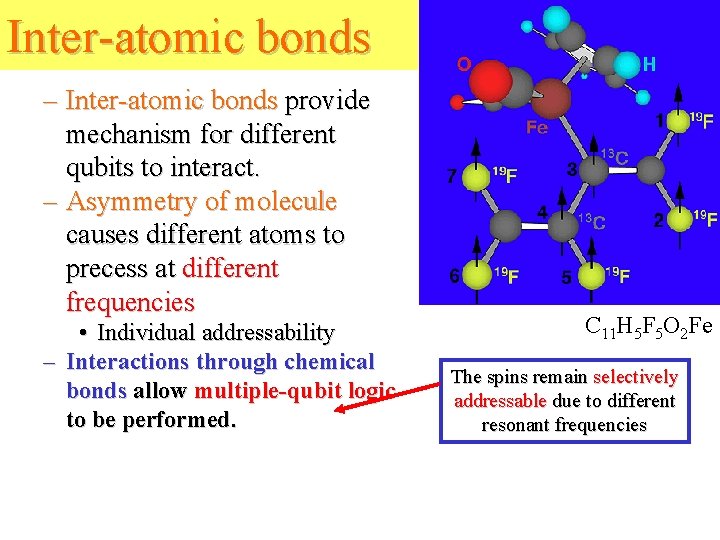
Inter-atomic bonds – Inter-atomic bonds provide mechanism for different qubits to interact. – Asymmetry of molecule causes different atoms to precess at different frequencies • Individual addressability – Interactions through chemical bonds allow multiple-qubit logic to be performed. C 11 H 5 F 5 O 2 Fe The spins remain selectively addressable due to different resonant frequencies
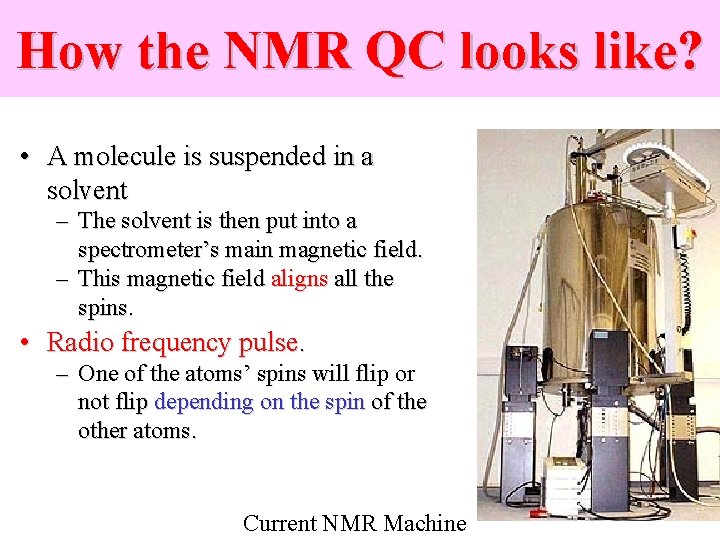
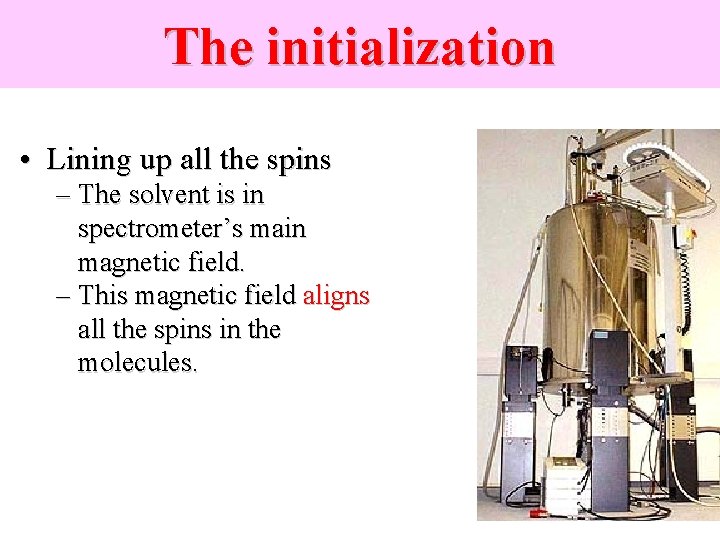
How the NMR QC looks like? • A molecule is suspended in a solvent – The solvent is then put into a spectrometer’s main magnetic field. – This magnetic field aligns all the spins. • Radio frequency pulse. – One of the atoms’ spins will flip or not flip depending on the spin of the other atoms. Current NMR Machine
The initialization • Lining up all the spins – The solvent is in spectrometer’s main magnetic field. – This magnetic field aligns all the spins in the molecules.
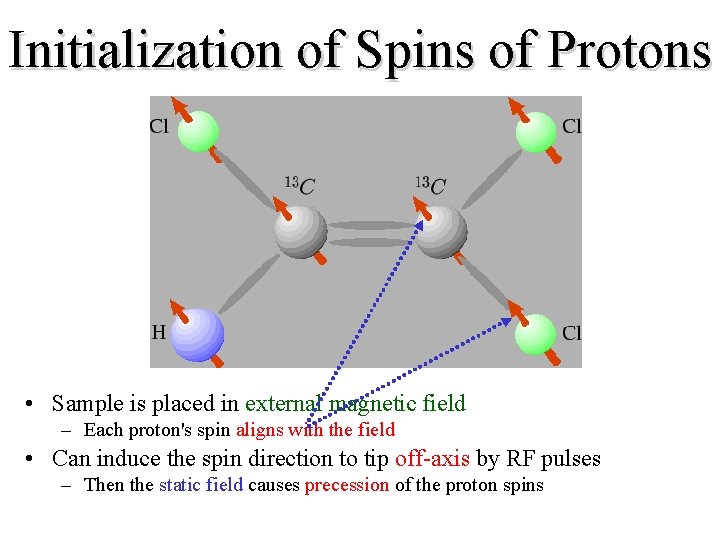
Initialization of Spins of Protons • Sample is placed in external magnetic field – Each proton's spin aligns with the field • Can induce the spin direction to tip off-axis by RF pulses – Then the static field causes precession of the proton spins
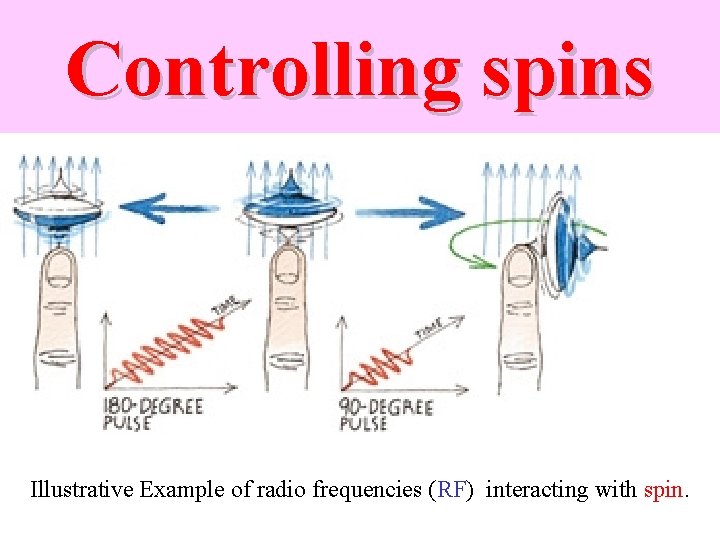
Controlling spins Illustrative Example of radio frequencies (RF) interacting with spin.
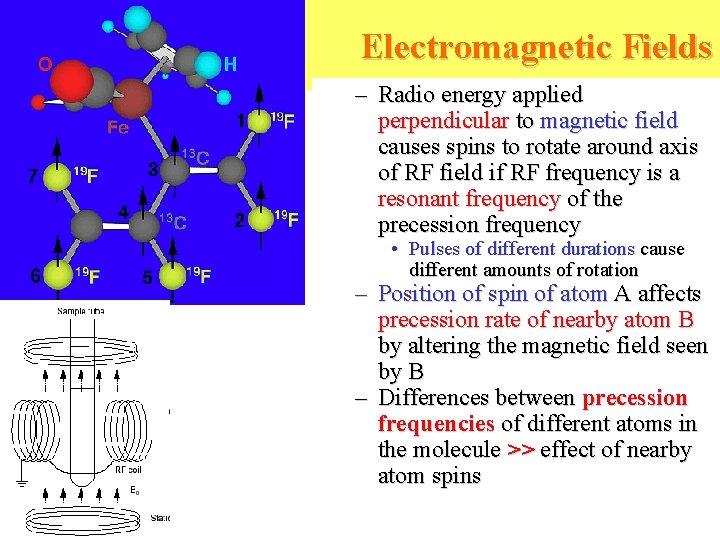
Electromagnetic Fields – Radio energy applied perpendicular to magnetic field causes spins to rotate around axis of RF field if RF frequency is a resonant frequency of the precession frequency • Pulses of different durations cause different amounts of rotation – Position of spin of atom A affects precession rate of nearby atom B by altering the magnetic field seen by B – Differences between precession frequencies of different atoms in the molecule >> effect of nearby atom spins
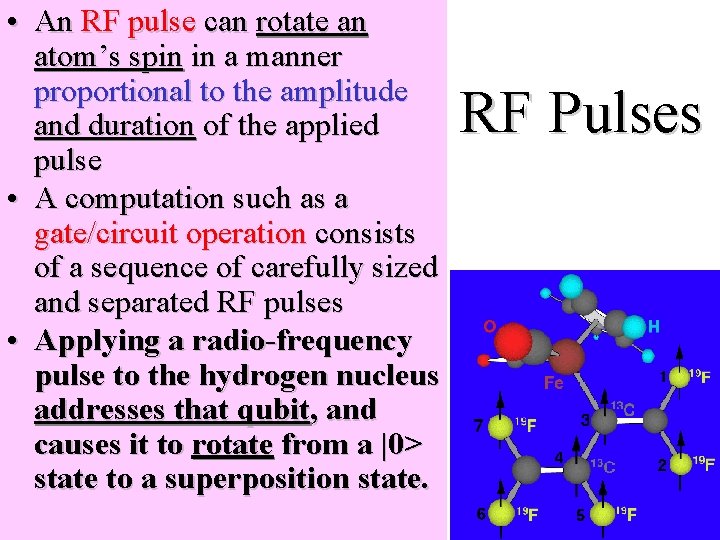
• An RF pulse can rotate an atom’s spin in a manner proportional to the amplitude and duration of the applied pulse • A computation such as a gate/circuit operation consists of a sequence of carefully sized and separated RF pulses • Applying a radio-frequency pulse to the hydrogen nucleus addresses that qubit, and causes it to rotate from a |0> state to a superposition state. RF Pulses
CNOT gate and machine language • Can flip state of bit with appropriately-timed RF pulse, or set into superposition with shorter pulse • Can create multi-input gates by sending pulses at the frequency that the atom will precess at if appropriate other bits are in a given state. – CNOT operation • CNOT operation + set of operations on individual qubits = universal set of gates • “Machine language” is now set of frequency of RF pulses, duration of pulses, and time between pulses • Read state out by rotating qubit spins into horizontal plane, sensing the time-varying magnetic field they create as they precess
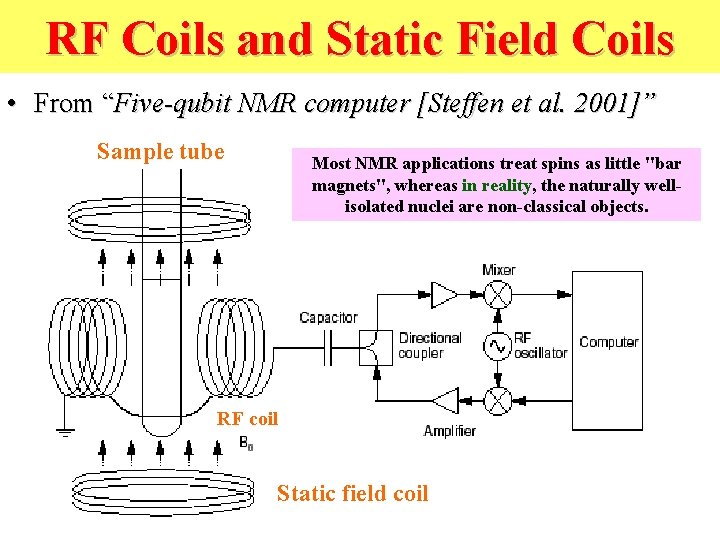
RF Coils and Static Field Coils • From “Five-qubit NMR computer [Steffen et al. 2001]” Sample tube Most NMR applications treat spins as little "bar magnets", whereas in reality, the naturally wellisolated nuclei are non-classical objects. RF coil Static field coil
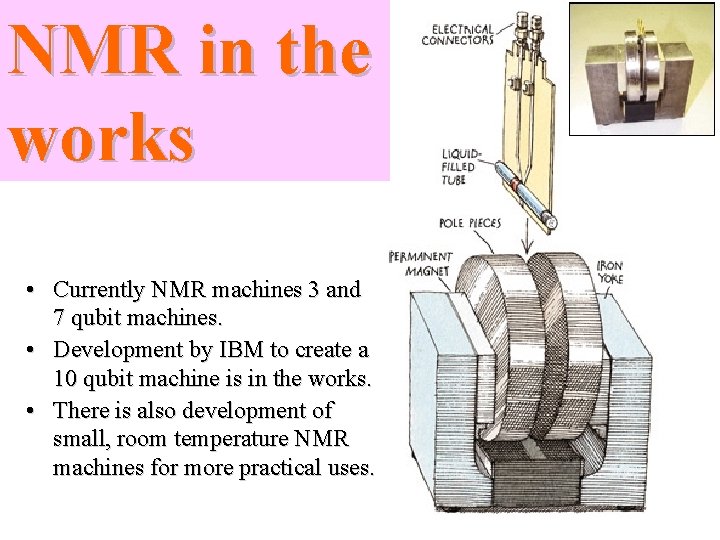
NMR in the NMR works (In The Works) • Currently NMR machines 3 and 7 qubit machines. • Development by IBM to create a 10 qubit machine is in the works. • There is also development of small, room temperature NMR machines for more practical uses.
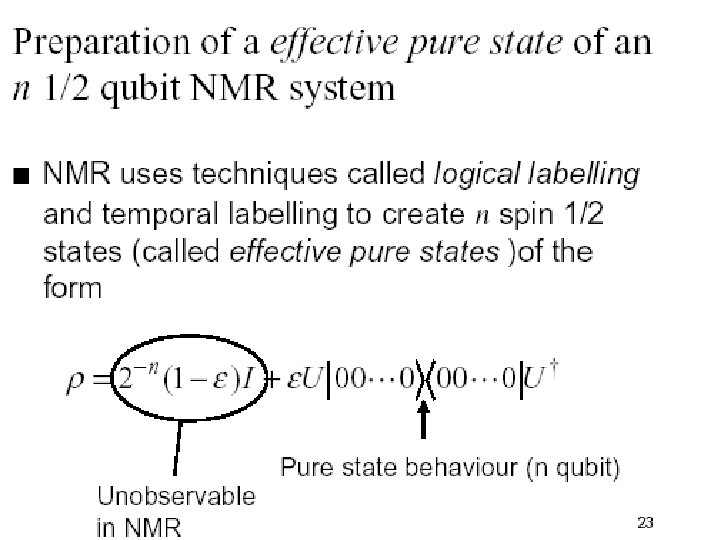
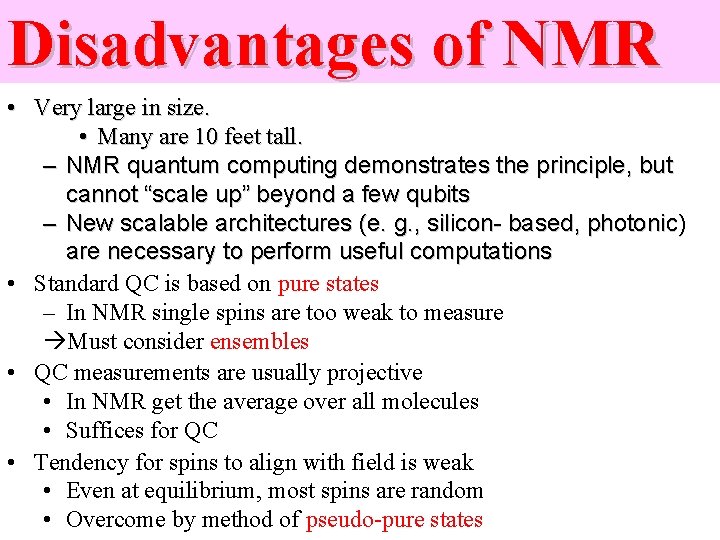
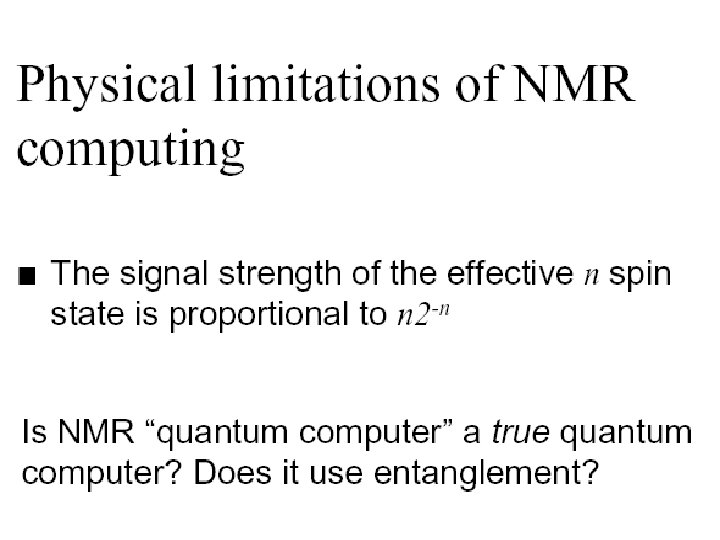
Disadvantages of NMR … and cons…. • Very large in size. • Many are 10 feet tall. – NMR quantum computing demonstrates the principle, but cannot “scale up” beyond a few qubits – New scalable architectures (e. g. , silicon- based, photonic) are necessary to perform useful computations • Standard QC is based on pure states – In NMR single spins are too weak to measure àMust consider ensembles • QC measurements are usually projective • In NMR get the average over all molecules • Suffices for QC • Tendency for spins to align with field is weak • Even at equilibrium, most spins are random • Overcome by method of pseudo-pure states
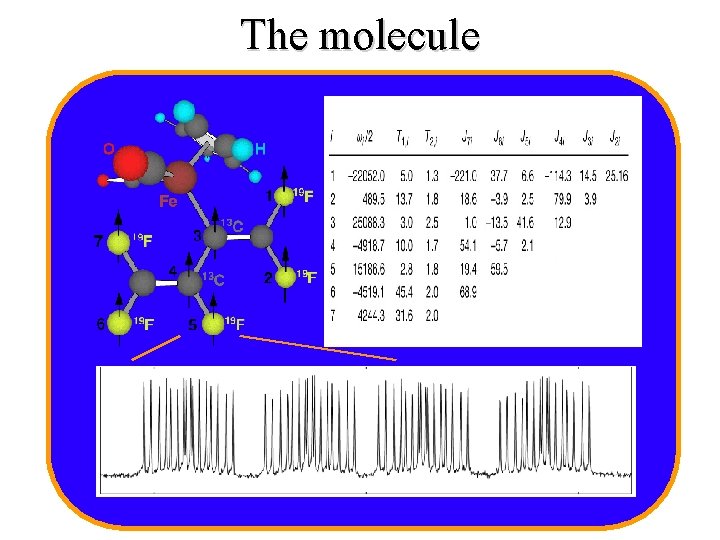
Example: 7 - Qubit QComputer by IBM Quantum computing researchers: (l-r) Isaac Chuang and Costantino Yannoni • • Diagram of the 7 -qubit molecule Alanine, an amino acid. From IBM research news • • • Could be Most advanced model of QC Finding the factors of the number 15 with Shor’s algorithm Nuclei of five fluorine and two carbon atoms interacting with each other Programmed by RF pulses Detected by NMR technique 54
Experimental Realization of Shor’s ‡ Factoring Algorithm M. Steffen 1, 2, L. M. K. Vandersypen 1, 2, G. Breyta 1, C. S. Yannoni 1, M. Sherwood 1, I. L. Chuang 1, 3 1 IBM Almaden Research Center, San Jose, CA 95120 Stanford University, Stanford, CA 94305 3 MIT Media Laboratory, Cambridge, MA 02139 2 ‡ Vandersypen L. M. K, et al, Nature, v. 414, pp. 883 – 887 (2001)
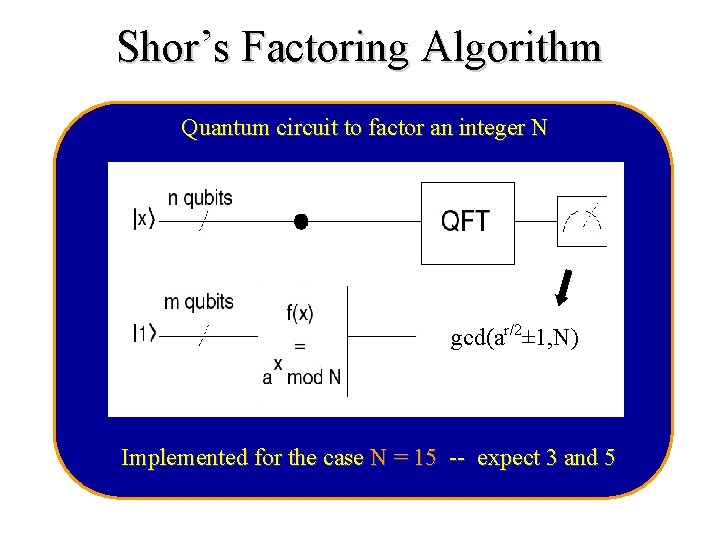
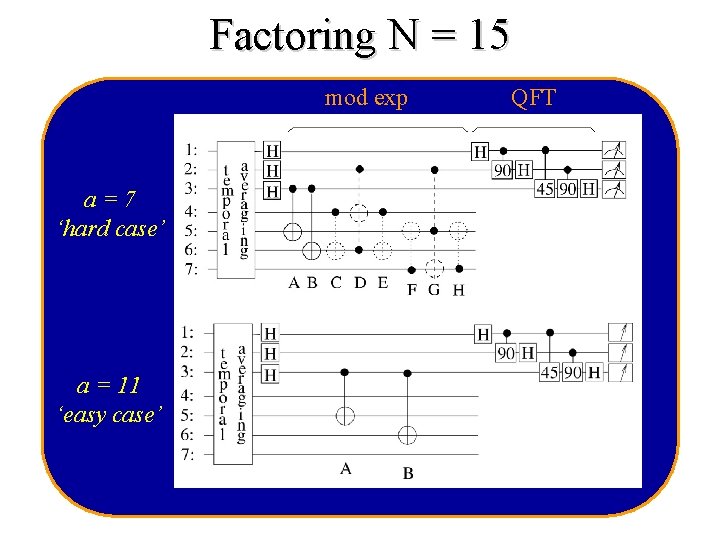
Shor’s Factoring Algorithm Quantum circuit to factor an integer N gcd(ar/2± 1, N) Implemented for the case N = 15 -- expect 3 and 5
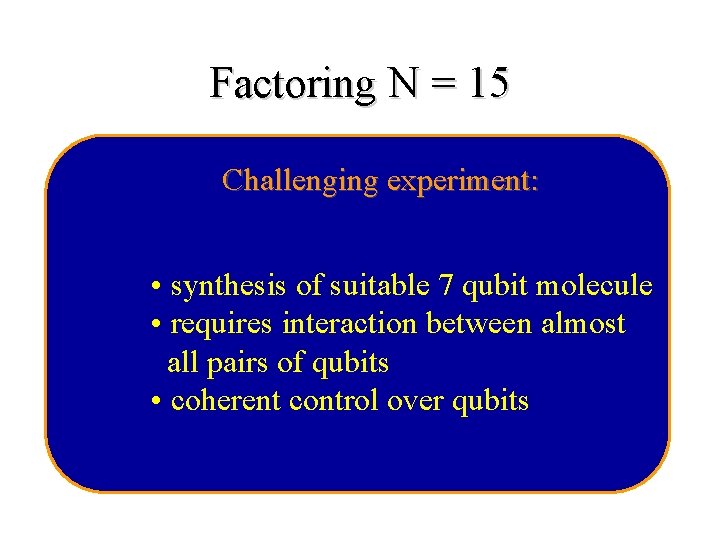
Factoring N = 15 Challenging experiment: • synthesis of suitable 7 qubit molecule • requires interaction between almost all pairs of qubits • coherent control over qubits
Factoring N = 15 mod exp a=7 ‘hard case’ a = 11 ‘easy case’ QFT
The molecule
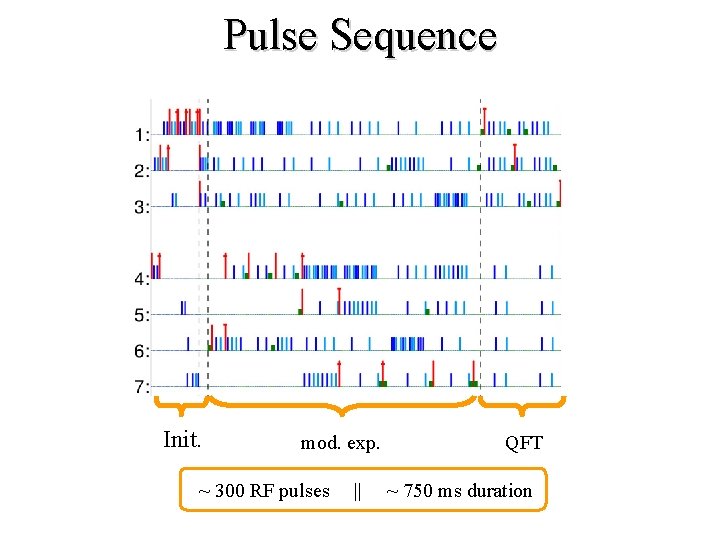
Pulse Sequence Init. mod. exp. ~ 300 RF pulses || QFT ~ 750 ms duration
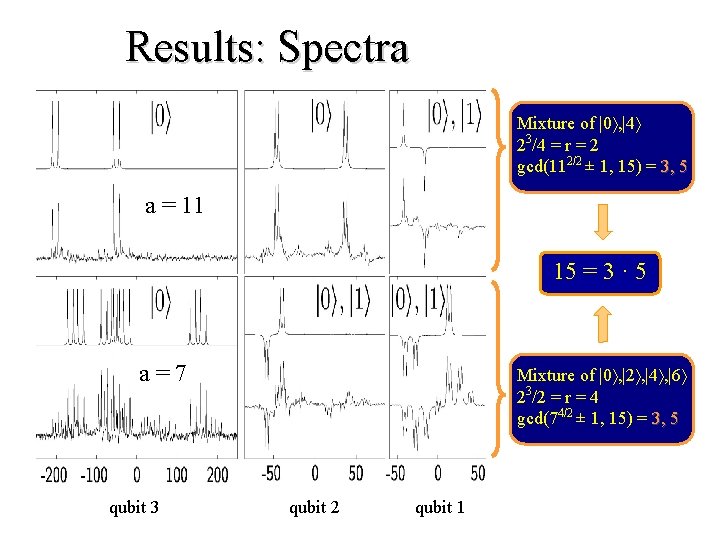
Results: Spectra Mixture of |0 , |4 23/4 = r = 2 gcd(112/2 ± 1, 15) = 3, 5 a = 11 15 = 3 · 5 a=7 qubit 3 Mixture of |0 , |2 , |4 , |6 23/2 = r = 4 gcd(74/2 ± 1, 15) = 3, 5 qubit 2 qubit 1
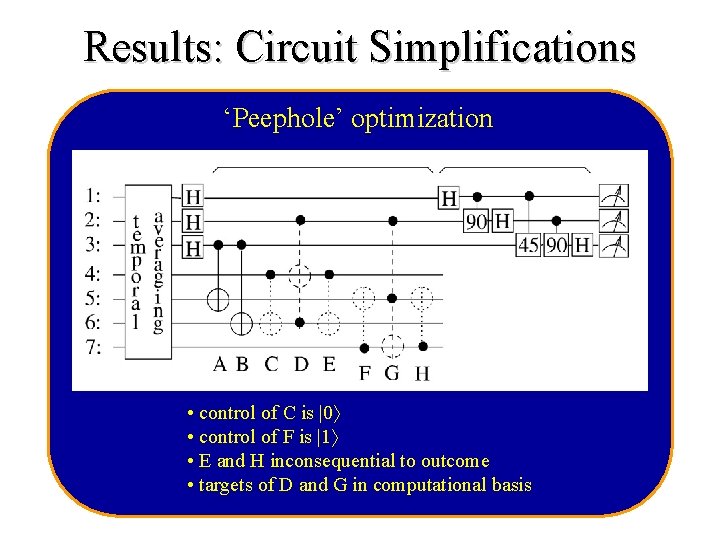
Results: Circuit Simplifications ‘Peephole’ optimization • control of C is |0 • control of F is |1 • E and H inconsequential to outcome • targets of D and G in computational basis
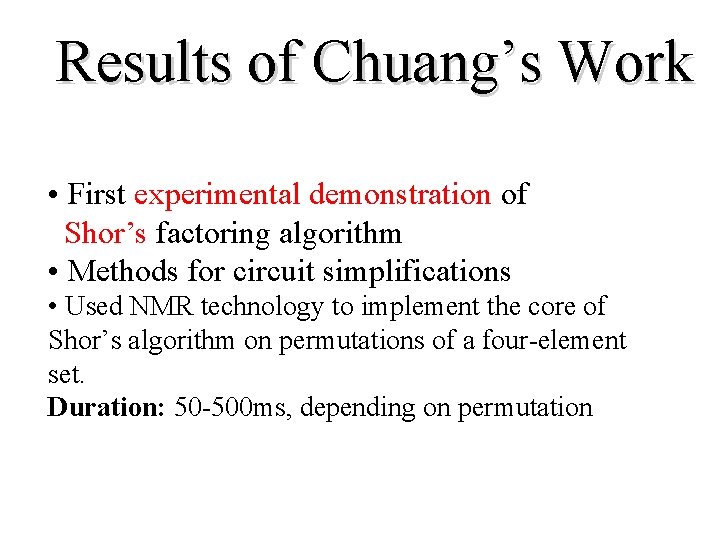
Results of Chuang’s Work • First experimental demonstration of Shor’s factoring algorithm • Methods for circuit simplifications • Used NMR technology to implement the core of Shor’s algorithm on permutations of a four-element set. Duration: 50 -500 ms, depending on permutation